HYDER: No crisis with newcomers arriving in Canada

Good commentary by Goldy Hyder of Hill+Knowlton Strategies and board member of the Century Initiative.

Perhaps more important is that this appeared in the Toronto Sun to provide a different perspective than their usual contributors (just as the Star and Globe could benefit from a broader range of views):

Over 25 years ago, I wrote my master’s thesis on how the crisis label applied to public policy is both an opportunity for governments and a problem for its citizens.

The example I used to make the point was the “refugee crisis” generated by the dramatic boat arrival of 174 Sikhs off the coast of Nova Scotia in August 1986. This was preceded in equally dramatic fashion by 155 Tamils also arriving on a boat a year earlier.

In the first case, the government of the day responded with openness, generosity and willingness to embrace those who claimed to be fleeing persecution.

The public response was less generous, particularly upon learning that the boat and its occupants were in fact arriving not from India (hardly a refugee producing country) but in fact a safe country (Germany) that could have and should have applied its own refugee laws to determine legitimacy of the claims.

An RCMP officer standing in Saint-Bernard-de-Lacolle, Que., advises migrants that they are about to illegally cross from Champlain, N.Y., and will be arrested, Monday, Aug. 7, 2017.

When fate afforded the government a do-over upon the next boat arrival, the response by the same government — clearly feeling both duped by the circuitous manner in which the first boat arrived, and with the full knowledge of public sentiments on such arrivals — was to label the issue as a “refugee crisis.”

This dominated headlines, debate in Parliament and the public’s attention. It allowed a government under pressure on other issues to leverage the advantages that a “crisis” label affords any government: Namely the public’s demand and expectation that the government will — as a matter of priority — focus on and put an end to the “crisis.”

In 2018, history is repeating itself.

It was no more a crisis in the aforementioned incidents than there is one today from a purely statistical perspective. But that didn’t matter then and it doesn’t matter now.

There are many reasons we stand to be worse off if the debate heads in the direction it currently is driven by emotion, stoked by political agendas on both sides.

Canadians, I believe, are smarter than that. But, they must be heard.

We know our history. Unless Indigenous, we are all immigrants. What we cherish as a value is fairness and rule of law. We do not like our generosity and compassion to be abused.

While much attention goes to how the so called “alt-right” or those labelled racists, the fact is that masks what is taking place much more broadly in society albeit less overtly.

In the modern era, these debates cannot be suppressed, nor do they function uncomfortably underground. Rather, they play out in the open and that, frankly, is an opportunity.

Migration in all its forms has long been used as an issue to debate because it is deeply personal and goes to who we are as a people and as a nation. We need to be reminded from time to time about the role immigrants, refugees and migrants (not all the same thing) have played in making Canada what it is today.

We know study after study has proven time and again that immigrants put more into the system than they take out of it. Yet, people here in Canada, and in many other countries, are reaching a point of saying either “no more” or “not so many.” Whether there is a crisis or not (there isn’t), this is an opportunity to hear the voices of Canadians, left and right and those in between to understand what is driving their emotions.

If there is one thing I have learned about we Canadians, it is this: Given the right information, provided an opportunity to speak and be heard, there is a collective wisdom in the Canadian public consciousness that usually gets the answer right in the end.

Source: HYDER: No crisis with newcomers arriving in Canada

Immigrants, fearing Trump crackdown, drop out of nutrition programs

Short-term reaction with longer-term health implications, just as the previous Canadian Conservative government’s cut to the interim federal health program had with respect to refugees (restored by the current government):

Immigrants are turning down government help to buy infant formula and healthy food for their young children because they’re afraid the Trump administration could bar them from getting a green card if they take federal aid.

Local health providers say they’ve received panicked phone calls from both documented and undocumented immigrant families demanding to be dropped from the rolls of WIC, a federal nutrition program aimed at pregnant women and children, after news reports that the White House is potentially planning to deny legal status to immigrants who’ve used public benefits. Agencies in at least 18 states say they’ve seen drops of up to 20 percent in enrollment, and they attribute the change largely to fears about the immigration policy.

The Trump administration hasn’t officially put the policy in place yet, but even without a formal rule, families are already being scared away from using services, health providers say.

“It’s a stealth regulation,” said Kathleen Campbell Walker, an immigration attorney at Dickinson Wright in El Paso, Texas. “It doesn’t really exist, but it’s being applied subliminally.”

Health advocates say the policy change could put more babies who are U.S.-born citizens at risk of low birth weight and other problems — undermining public health while also potentially fueling higher health care costs at taxpayer expense. WIC — formally the Special Supplemental Nutrition Program for Women, Infants, and Children — serves about half of all babies born in the U.S by providing vouchers or benefit cards so pregnant women and families with small children can buy staple foods and infant formula. The program is also designed to support women who are breastfeeding.

Because it benefits babies, the vast majority of whom are U.S.-born citizens, WIC is among the least politically controversial programs that the administration is said to be targeting in its crackdown.

“The big concern for all of us in the WIC community is that this program is really about growing healthy babies,” said Rev. Douglas Greenaway, president and CEO of the National WIC Association. “When any population that’s potential eligible for this program is either driven away by changes in regulation or legislation or simply by political rhetoric inducing fear there are huge personal consequences to those babies and their families.”

The White House did not respond to requests for comment.

The immigration proposal, which White House officials are working on ahead of the midterms as a way to energize the Republican base, would primarily affect legal immigrants already in the U.S. who are seeking a green card and people applying for legal admission to the U.S. It could also affect undocumented immigrants if they want to seek legal permanent residency in the future — a change that would represent a substantial expansion of the definition of public charge.

Under a provision known as public charge, U.S. immigration law has for more than a century allowed officials to reject admission to the country on the grounds that potential immigrants or visitors might become overly reliant on the government. But until now, officials have looked narrowly at whether someone would need cash benefits such as welfare or long-term institutional care. Immigration hawks in the Trump administration are pushing to consider would-be immigrants’ use of a much broader array of services, including non-cash assistance like food stamps, Head Start, Medicaid and WIC, according to versions of the proposed rule that were obtained by news organizations earlier this year.

Undocumented immigrants do not qualify for most government aid programs, but such an expansion of public charge could apply to the whole family. In the past, if a mom was applying for a green card her own use of public benefits might be examined. Under the proposed change, her child’s enrollment in Medicaid or Head Start would weighed as a negative factor, even if that child is a U.S. citizen.

Trump administration officials have argued that they are simply trying to clarify and enforce current immigration law.

“The goal is not to reduce immigration or in some diabolical fashion shut the door on people, family-based immigration, anything like that,” said Francis Cissna, director of U.S. Citizenship and Immigration Services, at the National Press Club earlier this month.

Cissna said the rule the administration is working on is “rational and reasonable” and will go through the full and “proper” regulatory process.

Enrollment in WIC has been going down for a variety of reasons as the economy has improved and the birth rates decline. When Trump took office there were approximately 7.4 million women and children in the program. As of May, the last month for which there is data, the number had dropped to 6.8 million.

Government officials aren’t able to track exactly how many people have dropped from WIC or declined the benefits because they’re afraid of the public charge rule, in part because the program is immigration blind. But providers say anecdotal evidence shows the proposal is contributing to the drop-off.

POLITICO interviewed more than a dozen WIC providers nationwide who serve tens of thousands of children from Washington state, Kansas and New York state. Almost all said they have seen immigrant mothers and their children drop from WIC, citing public charge concerns. They also said they’ve fielded inquiries about whether participating in WIC could put a family at risk of either deportation or at a disadvantage in immigration proceedings.

Jennifer Mejias-Martinez, who works on WIC at the Shawnee County Health Department in Topeka, Kan., recalled getting a call earlier this year from a family who’d seen a report on Univision about public benefits being a threat to immigration proceedings.

“They were very, very scared,” Mejias-Martinez said of the family. She said she tried to calm them down and assure that the policy had not changed, but they dropped from the program anyway. “It made me very sad, and quite frankly upset,” she said.

In some cases, immigration attorneys are recommending that families drop out of all government programs, including WIC, to avoid any chance that using the benefits could negatively affect their chances of getting a green card — or even prevent a family member from being able to get a visa to visit, according to caseworkers.

Public health and immigration advocates say they now find themselves debating the ethics of encouraging people to enroll in the program to improve their children’s health while there’s so much fear the benefits might one day jeopardize their ability to stay in the United States.

“Without a draft rule being released, we don’t think it’s wise to frighten people or tell them that they’re in the clear,” said Zach Hennessey, vice president of programs and services at Public Health Solutions, a large health non-profit in New York City.

The leaked version of the proposed rule suggests benefits used before the rule is final wouldn’t be used against an applicant.

Nearly two-thirds of WIC providers, from 18 different states, reported they have noticed a difference in immigrant WIC access in the wake of the news about potential changes in the public charge rules, according to a March survey by the National WIC Association. Seventeen of the agencies reported that participants had asked to dis-enroll or be deleted from WIC records.

An agency in Longview, Texas, reported it’s losing an estimated 75 to 90 participants per month to public charge fears. In Beacon, N.Y., an agency estimated it’s lost 20 percent of its caseload. In St. Louis, Mo., a provider said it’s seen a few dozen drop in the last year.

Public Health Solutions, the largest WIC provider in New York state, said WIC caseloads fell after press coverage of the proposed public charge changes. The non-profit said it saw more than six times the normal attrition rate after initial news reports about a potential executive order in the first quarter of 2017. The drop rate spiked again twice more in the wake of additional news reports about the coming proposed rule.

The group cautioned that the numbers don’t prove that public charge fears drove households from the program, but said that the unusually large declines appeared to correspond with the timing of the news reports.

The USDA, which oversees the WIC program, is conducting several studies to explore why eligible families are either not enrolling in WIC or discontinuing their participation, according to a spokesperson.

“The USDA is committed to the health and well-being of all WIC eligible mothers, infants and children and supports families seeking assistance,” a spokesperson said in a statement to POLITICO.

The department did not comment on whether officials are concerned about public charge fears driving participation down.

The drops in WIC enrollment stemming from public charge concerns come alongside broader fears about the Trump administration’s crackdown on both legal and illegal immigration.

Maria Isabel Rangel, a graduate student at the University of California, Berkeley, recently interviewed ten farmworker families in California whose households included both legal and undocumented immigrants. She said they described dealing with “constant anxiety,” even when they’ve decided to keep using programs like WIC, Medicaid and food stamps.

“They’re worried that their documentation status will be somehow be jeopardized by participating in these health programs,” Rangel said. “They say: ‘I can’t stop using these programs because my children need them, but I know I’m risking my future and the future of my children.’”

“They’re making these decisions basically based off fear,” she said.

WIC has been largely immigration-blind since it was created in 1974, most of the infants it serves are citizens born in the U.S. regardless of their parents’ immigration status. Despite that, providers say parents’ fear of deportation may also be driving declining enrollment in WIC.

False rumors that federal agents are planning to raid WIC clinics have circulated in immigrant communities, to the point that providers in places like King County, Wash. have posted signs designating their clinics as “private” areas and have statements on their websites that immigrants should access services “without fear.”

Aliya Haq, a nutrition supervisor at International Community Health Services, a large health non-profit in Washington state, recalled a terrified father calling in earlier this year asking that his wife be dropped from WIC, citing fears about getting deported.

“He was literally begging us requesting that we remove his family from the WIC program. … it was very heartbreaking,” Haq said.

The WIC program is broadly supported on both sides of the aisle because it’s been shown to lead to better health outcomes for mothers and babies, and pays dividends in savings to Medicaid. A 1988 USDA study found that for every dollar spent on WIC, there is between $1.77 and $3.13 in Medicaid savings for the infant and mother in the first 60 days after birth.

Rep. Roger Marshall, a conservative Kansas Republican who was an obstetrician before he ran for Congress in 2016, says the program is “crucial.” When he saw pregnant women during his three decades in practice, he said, “This nutrition helped prevent birth defects, led to healthier outcomes, and healthier infants.”

Marshall noted he hasn’t seen the changes the administration is considering. “I will stand beside WIC and say they’ve been a great use of federal dollars,” he said.

Even as they’re considering the proposed rule change, Trump officials have already begun enacting some new restrictions. In January, the State Department instructed embassies and consulates to look at potential use of nutrition and health benefits when deciding whom to admit to the U.S.

A spokesperson from the State Department said the changes “clarify current regulations and policy guidance.”

Immigration lawyers are watching very closely to see whether the updated guidance leads to more denials based on public charge grounds.

Immigrant advocates are expected to mount a court challenge if the expanded public charge rule is finalized, but public health advocates say the damage is already being done to women and families who are afraid to use WIC.

“One way or another society is going to pay for this,” said Hennessey of Public Health Solutions in New York City. “It’s very expensive for a baby in the NICU. It’s very expensive when a child’s developmental needs aren’t met, or there’s a severe maternal morbidity event.”

Source: Immigrants, fearing Trump crackdown, drop out of nutrition programs

Would-be Canadian terrorists are often made in Canada: Gurski

Good reminder by Phil Gurski:
What is a citizen? Well, it depends. The concept appears to date back to city states in ancient Greece, but in the modern era each state decides what the rules are. For the average person citizenship is determined by the particular country in which they were born. There are, however, exceptions. Some nations recognize anyone born on their soil—so-called jus soli—so that if a woman gives birth while in transit on a flight that child can receive that country’s citizenship. Others do not.
During the recent Conservative convention in Halifax a resolution was passed calling for the government to stop granting citizenship to anyone born on Canadian soil, and instead to require at least one parent to be a Canadian citizen or permanent resident. The motion was spurred by a belief that pregnant non-Canadian women were flying to Canada for the sole purpose of giving birth, although there are no indications that this is a significant problem in our country. The Conservative position has already led to reactions that it is not necessary.
Two cases in our country have arisen that lead to interesting dilemmas. In the first, two children born in Canada to Russians here illegally as spies were once seen as citizens. The Supreme Court is currently weighing in on a lower court decision that removed their citizenship. I imagine that most Canadians would not want to see the offspring of Russian spies receive the privileges our country has to offer, even if the fact they were born here was not their ‘fault’.
So what about terrorists? The Harper government tried to enact legislation that would strip those convicted of terrorist offences in Canada of their citizenship. The case of Zakaria Amara, one of the leaders of the 2005-6 Toronto 18 terrorist cell, was the test case. His citizenship was revoked but re-granted after the Liberals took power.
Like the case of the children of the Russian “illegals” I would wager that most Canadians would have little to no problem with taking away the benefit of being one of us from someone who sought to blow us up. If an immigrant to whom we granted citizenship goes and becomes a terrorist and plans to kill his fellow Canadians, does he deserve to be one of us? Great question.
There are of course limitations on when a state can take citizenship away. No state can—or rather, no state should—render a person stateless. Hence, an individual with status in only one country can not have that status taken away: that act can only be applied to those who can fall back on a secondary citizenship. Mr. Amara had dual Jordanian-Canadian citizenship and had temporarily lost the latter.
As I argued in Western Foreign Fighters, however, the decision to take away citizenship does not solve one significant issue: those who come to our land as children and become terrorists (note that I wrote “become” and not “were born as”) do so within our society. In other words, the process of radicalization occurs here, not elsewhere. Even if we were to remove such people who pose a threat to us through their terrorist plots by stripping them of their Canadian citizenship and deporting them, this does little to disrupt the incidence of radicalization here (aside of course from removing one radicalizing influence who can affect others).
This is an important detail. Contrary to public wisdom, radicalization to violence is a Canadian problem: it does not appear on our shores via the immigration system. We thus have to learn to deal with it and the government has started a new centre to help coordinate those efforts.
I fully understand the anger that Canadians feel towards those of us who choose to embrace terrorism (note that I wrote “choose” and not “were duped into”): I share that anger. Perhaps steps to yank citizenship will act as a deterrent for others: perhaps not (I lean towards the latter). Which ever way the government goes it does not eliminate the need to develop a better understanding of why Canadians radicalize to violence, and either travel abroad to join terrorist groups or plan acts here. One thing we cannot do is deport our way out of this problem.

MacDougall: Journalists are addicted to Twitter, and it’s poisoning their journalism

Valid points by MacDougall. Other observation, to be corrected as necessary by journalists, is the degree to which it cuts down on their time for more detailed investigation and reporting, thus resulting in less deep coverage of issues:

What’s the problem with the media?

Ping a journalist that question, and you’ll get back chapter and verse about the money problems facing newsrooms and the indifference of advertising-stealing platforms such as Facebook and Google.

Ask a random bloke on the street, however, and there’s a good chance the answer will be “bias” or “trust,” as in: “I don’t trust the press, they’re all biased.”

Ah, yes. The “fake” news. The “enemies of the people.” It’s not the best time to be repping the fourth estate.

The question now is how the press should fix their dismal approval ratings. A good start would be to stop being their own worst enemies. And a good place to start with that is ditching social media. It’s simply too easy for opinions to slip into posts that would never make it into news copy, leading to perceptions of bias.

Reporters should instead treat social media like the poison it is. For one, it’s not a representative sample of the public. Nor is the “shoot-first, think-later” mentality encouraged conducive to good journalism. Most importantly, social media reveals way too much of a reporter’s own bias to the people they cover and the people who read that coverage.

The ability of social media to reveal reporter bias has been apparent for years, but it’s shifted into overdrive now that Donald Trump has turned Twitter into grotesque political performance art, dragging an enraged global press corps with him, most of whom tweet their disgust or puzzlement at what the president does every day. And it’s affecting political journalism in every country. A day now isn’t a day without reporters broadcasting hot takes that risk tainting the coverage they ultimately provide.

And while it’s true most media organizations have guidelines or social media codes of conduct — most of which prohibit opining — they are largely self-enforced. Stretched editors simply can’t track their charges all day long on Twitter.

Forget about columnists, who are paid to give their opinion; it’s a mystery why straight news reporters would want to reveal anything about themselves or their views on public policy. Most politicians already think the press is biased — why risk confirming it for them in real-time?

Why, for example, would a freelance journalist want Conservative leader Andrew Scheer to know that his views on Scheer’s views on government are that they are a “ridiculous collection of straw men?” They might be, but good luck convincing Scheer’s people that anything you ever write will be a fair shake.

Sadly, it’s not just the smaller fish in the profession who blunder in this way; the problem reaches up much higher.

Lots of people heaped scorn on Maxime Bernier’s clumsy foray into multicuralism on Twitter before his split from the Conservative party, but did one of them really need to be the senior broadcast producer of Canada’s most-watched television news broadcast?

And then there was Rosemary Barton of the CBC, who suggested on Twitter that her network didn’t have a clue about Bernier’s motives for tweeting about diversity, even though reporter Evan Dyer inferred in his report that the one-year anniversary of the alt-right march in Charlottesville had informed Bernier’s timing, if not his thinking.

These examples are the kind of clever or knowing things journalists have always said to each other or their subjects. In private. Now they fire away for all to see. And for what? A bushel of RT’s and “likes”?

Ten years or so into the folly of social media, it should by now be clear that it’s the ranters and shouters who get the most clicks, not the neutral observer. Reporters should stop trying to play the game.

Ten years or so into the folly of social media, it should by now be clear that it’s the ranters and shouters who get the most clicks, not the neutral observer. Reporters should stop trying to play the game.

They should instead go back to being a mystery. To valuing personal scarcity over ubiquity. To ditching Twitter, and forgetting Facebook. Or, at least limiting appearances there to the posting of their work. They should also say “no” to shouty panel appearances alongside partisans.

Reporters might even find the lack of distraction focuses them on their work. And if a politician’s B.S. needs to be called out in real-time, reporters should have an editor or colleague peek over their shoulder to give them a sense check on tone. Because even super-fact checkers such as Daniel Dale of the Toronto Star can appear biased owing to the sheer volume of material they post to their channels. And most reporters aren’t dedicated super-fact checkers, they’re just smart people with opinions, ones the news-consuming public shouldn’t know.

Political journalism is at a crossroads. Reporters need to keep doing their valuable work. But do the work, full stop. Keep your opinions to yourself. More people will believe the good work you do if they have no idea who in the hell you are, or what you think about what’s going on.

Responsibly deploying AI in the immigration process

Some good practical suggestions. While AI has the potential for greater consistency in decision-making, great care needs to be taken in development, testing and implementation to avoid bias and to identify cases where decisions need to be reviewed:

In April, the federal government sent a request for information to industry to determine where artificial intelligence (AI) could be used in the immigration system for legal research, prediction and trend analysis. The type of AI to be employed here is machine learning: developing algorithms through analysis of wide swaths of data to make predictions within a particular context. The current backlog of immigration applications leaves much room for solutions that could improve the efficiency of case processing, but Canadians should be concerned about the vulnerability of the groups targeted in this pilot project and how the use of these technologies might lead to human rights violations.

An algorithmic mistake that holds up a bank loan is frustrating enough, but in immigration screening a miscalculation could have devastating consequences. The potential for error is especially concerning because of the nature of the two application categories the government has selected for the pilot project: requests for consideration on humanitarian and compassionate grounds, and applications for Pre-Removal Risk Assessment. In the former category of cases, officials consider an applicant’s connections with Canada and the best interests of any children involved. In the latter category, a decision must be made about the danger that would confront the applicant if they were returned to their home country. In some of these cases, assessing whether someone holds political opinions for which they would be persecuted could be a crucial component. Given how challenging it is for current algorithmic methods to extract meaning and intent from human statements, it is unlikely that AI could be trusted to make such a judgment reliably. An error here could lead to someone being sent back to imprisonment or torture.

Moreover, if an inadequately designed algorithm results in decisions that infringe upon rights or amplify discrimination, people in these categories could have less capacity than other applicants to respond with a legal challenge. They may face financial constraints if they’re fleeing a dangerous regime, as well as cultural and language barriers.

An algorithmic mistake that holds up a bank loan is frustrating enough, but in immigration screening a miscalculation could have devastating consequences.

Because of the complexity of these decisions and the stakes involved, the government must think carefully about which parts of the screening process can be automated. Decision-makers need to take extreme care to ensure that machine learning techniques are employed ethically and with respect for human rights. We have several recommendations for how this can be done.

First, we suggest that the federal government take some best practices from the European Union’s General Data Protection Regulation (GDPR). The GDPR has expanded individual rights with regard to the collection and processing of personal data. Article 22 guarantees the right to challenge the automated decisions of algorithms, including the right to have a human review the decision. The Canadian government should consider a similar expansion of rights for individuals whose immigration applications are decided by, or informed by, the use of automated methods. In addition, it must ensure that the vulnerable groups being targeted are able to exercise those rights.

Second, the government must think carefully about what kinds of transparency are needed, for whom, and how greater transparency might create new risks. The immigration process is already complex and opaque, and with added automation, it may become more difficult to verify that these important decisions are being made in fair and thorough ways. The government’s request for information asks for input from industry on ensuring sufficient transparency so that AI decisions can be audited. In the context of immigration screening, we argue that a spectrum of transparency is needed because there are multiple parties with different interests and rights to information.

If the government were to reveal to everyone exactly how these algorithms work, there could be adverse consequences. A fully transparent AI decision process would open doors for people who want to exploit the system, including human traffickers. They could game the algorithm, for example, by observing the keywords and phrases that the AI system flags as markers of acceptability and inserting those words into immigration applications. Job seekers already do something similar, by using keywords strategically to get a resumé in front of human eyes. One possible mechanism for oversight in the case of immigration would be a neutral regulatory body that would be given the full details of how the algorithm operates but would reveal only case-specific details to the applicants and partial details to other relevant stakeholders.

Finally, the government needs to get broader input when designing this proposed use of AI. Requesting solutions from industry alone will deliver only part of the story. The government should also draw on expertise from the country’s three leading AI research institutes in Edmonton, Montreal and Toronto, as well as two new ones focused specifically on AI ethics: the University of Toronto’s Ethics of AI Lab and the Montreal AI Ethics Institute. Another group whose input should be included is the immigration applicants themselves. Developers and policy-makers have a responsibility to understand the context for which they are developing solutions. By bringing these perspectives into their design process, they can help bridge empathy gaps. An example of how users’ first-hand knowledge of a process can yield helpful tools is the recently launched chatbot Destin, which was designed by immigrants to help guide applicants through the Canadian immigration process.

The application of AI to immigration screening is promising: applications could be processed faster, with less human bias and at lower cost. But care must be taken with implementation. Canada has been taking a considered and strategic approach to the use of AI, as evidenced by the Pan-Canadian Artificial Intelligence Strategy, a major investment by the federal government that includes a focus on developing global thought leadership on the ethical and societal implications of advances in AI. We encourage the government to continue to pursue this thoughtful approach and an emphasis on human rights to guide the use of AI in immigration.

Source: Responsibly deploying AI in the immigration process

Here’s the Conversation We Really Need to Have About Bias at Google

Ongoing issue of bias in algorithms:

Let’s get this out of the way first: There is no basis for the charge that President Trump leveled against Google this week — that the search engine, for political reasons, favored anti-Trump news outlets in its results. None.

Mr. Trump also claimed that Google advertised President Barack Obama’s State of the Union addresses on its home page but did not highlight his own. That, too, was false, as screenshots show that Google did link to Mr. Trump’s address this year.

But that concludes the “defense of Google” portion of this column. Because whether he knew it or not, Mr. Trump’s false charges crashed into a longstanding set of worries about Google, its biases and its power. When you get beyond the president’s claims, you come upon a set of uncomfortable facts — uncomfortable for Google and for society, because they highlight how in thrall we are to this single company, and how few checks we have against the many unseen ways it is influencing global discourse.

In particular, a raft of research suggests there is another kind of bias to worry about at Google. The naked partisan bias that Mr. Trump alleges is unlikely to occur, but there is a potential problem for hidden, pervasive and often unintended bias — the sort that led Google to once return links to many pornographic pages for searches for “black girls,” that offered “angry” and “loud” as autocomplete suggestions for the phrase “why are black women so,” or that returned pictures of black people for searches of “gorilla.”

I culled these examples — which Google has apologized for and fixed, but variants of which keep popping up — from “Algorithms of Oppression: How Search Engines Reinforce Racism,” a book by Safiya U. Noble, a professor at the University of Southern California’s Annenberg School of Communication.

Dr. Noble argues that many people have the wrong idea about Google. We think of the search engine as a neutral oracle, as if the company somehow marshals computers and math to objectively sift truth from trash.

But Google is made by humans who have preferences, opinions and blind spots and who work within a corporate structure that has clear financial and political goals. What’s more, because Google’s systems are increasingly created by artificial intelligence tools that learn from real-world data, there’s a growing possibility that it will amplify the many biases found in society, even unbeknown to its creators.

Google says it is aware of the potential for certain kinds of bias in its search results, and that it has instituted efforts to prevent them. “What you have from us is an absolute commitment that we want to continually improve results and continually address these problems in an effective, scalable way,” said Pandu Nayak, who heads Google’s search ranking team. “We have not sat around ignoring these problems.”

For years, Dr. Noble and others who have researched hidden biases — as well as the many corporate critics of Google’s power, like the frequent antagonist Yelp — have tried to start a public discussion about how the search company influences speech and commerce online.

There’s a worry now that Mr. Trump’s incorrect charges could undermine such work. “I think Trump’s complaint undid a lot of good and sophisticated thought that was starting to work its way into public consciousness about these issues,” said Siva Vaidhyanathan, a professor of media studies at the University of Virginia who has studied Google and Facebook’s influence on society.

Dr. Noble suggested a more constructive conversation was the one “about one monopolistic platform controlling the information landscape.”

So, let’s have it.

Google’s most important decisions are secret

In the United States, about eight out of 10 web searches are conducted through Google; across Europe, South America and India, Google’s share is even higher. Google also owns other major communications platforms, among them YouTube and Gmail, and it makes the Android operating system and its app store. It is the world’s dominant internet advertising company, and through that business, it also shapes the market for digital news.

Google’s power alone is not damning. The important question is how it manages that power, and what checks we have on it. That’s where critics say it falls down.

Google’s influence on public discourse happens primarily through algorithms, chief among them the system that determines which results you see in its search engine. These algorithms are secret, which Google says is necessary because search is its golden goose (it does not want Microsoft’s Bing to know what makes Google so great) and because explaining the precise ways the algorithms work would leave them open to being manipulated.

But this initial secrecy creates a troubling opacity. Because search engines take into account the time, place and some personalized factors when you search, the results you get today will not necessarily match the results I get tomorrow. This makes it difficult for outsiders to investigate bias across Google’s results.

A lot of people made fun this week of the paucity of evidence that Mr. Trump put forward to support his claim. But researchers point out that if Google somehow went rogue and decided to throw an election to a favored candidate, it would only have to alter a small fraction of search results to do so. If the public did spot evidence of such an event, it would look thin and inconclusive, too.

“We really have to have a much more sophisticated sense of how to investigate and identify these claims,” said Frank Pasquale, a professor at the University of Maryland’s law school who has studied the role that algorithms play in society.

In a law review article published in 2010, Mr. Pasquale outlined a way for regulatory agencies like the Federal Trade Commission and the Federal Communications Commission to gain access to search data to monitor and investigate claims of bias. No one has taken up that idea. Facebook, which also shapes global discourse through secret algorithms, recently sketched out a plan to give academic researchers access to its data to investigate bias, among other issues.

Google has no similar program, but Dr. Nayak said the company often shares data with outside researchers. He also argued that Google’s results are less “personalized” than people think, suggesting that search biases, when they come up, will be easy to spot.

“All our work is out there in the open — anyone can evaluate it, including our critics,” he said.

Search biases mirror real-world ones

The kind of blanket, intentional bias Mr. Trump is claiming would necessarily involve many workers at Google. And Google is leaky; on hot-button issues — debates over diversity or whether to work with the military — politically minded employees have provided important information to the media. If there was even a rumor that Google’s search team was skewing search for political ends, we would likely see some evidence of such a conspiracy in the media.

That’s why, in the view of researchers who study the issue of algorithmic bias, the more pressing concern is not about Google’s deliberate bias against one or another major political party, but about the potential for bias against those who do not already hold power in society. These people — women, minorities and others who lack economic, social and political clout — fall into the blind spots of companies run by wealthy men in California.

It’s in these blind spots that we find the most problematic biases with Google, like in the way it once suggested a spelling correction for the search “English major who taught herself calculus” — the correct spelling, Google offered, was “English major who taught himself calculus.”

Why did it do that? Google’s explanation was not at all comforting: The phrase “taught himself calculus” is a lot more popular online than “taught herself calculus,” so Google’s computers assumed that it was correct. In other words, a longstanding structural bias in society was replicated on the web, which was reflected in Google’s algorithm, which then hung out live online for who knows how long, unknown to anyone at Google, subtly undermining every female English major who wanted to teach herself calculus.

Eventually, this error was fixed. But how many other such errors are hidden in Google? We have no idea.

Google says it understands these worries, and often addresses them. In 2016, some people noticed that it listed a Holocaust-denial site as a top result for the search “Did the Holocaust happen?” That started a large effort at the company to address hate speech and misinformation online. The effort, Dr. Nayak said, shows that “when we see real-world biases making results worse than they should be, we try to get to the heart of the problem.”

Google has escaped recent scrutiny

Yet it is not just these unintended biases that we should be worried about. Researchers point to other issues: Google’s algorithms favor recency and activity, which is why they are so often vulnerable to being manipulated in favor of misinformation and rumor in the aftermath of major news events. (Google says it is working on addressing misinformation.)

Some of Google’s rivals charge that the company favors its own properties in its search results over those of third-party sites — for instance, how it highlights Google’s local reviews instead of Yelp’s in response to local search queries.

Regulators in Europe have already fined Google for this sort of search bias. In 2012, the F.T.C.’s antitrust investigators found credible evidence of unfair search practices at Google. The F.T.C.’s commissioners, however, voted unanimously against bringing charges. Google denies any wrongdoing.

The danger for Google is that Mr. Trump’s charges, however misinformed, create an opening to discuss these legitimate issues.

On Thursday, Senator Orrin Hatch, Republican of Utah, called for the F.T.C. to reopen its Google investigation. There is likely more to come. For the last few years, Facebook has weathered much of society’s skepticism regarding big tech. Now, it may be Google’s time in the spotlight.

Source: Here’s the Conversation We Really Need to Have About Bias at …

Special report: how Canadian immigration fraud saw 860 rich Chinese blacklisted

Ian Young of the South China Morning Post detailed report on investor immigrant fraud and the false premises of the program (fortunately cancelled by the former Conservative government although Quebec still maintains its program which is largely a backdoor entry point for Vancouver and other locations). Good long read:

On the morning of October 17, 2012, Canadian border agents began their raids simultaneously, targeting offices in downtown Vancouver and nearby Richmond, as well as a large house on a busy arterial road.

They seized 90 crates of documents and 18 computers, stacks of supposedly “lost” Chinese passports, even a handful of red rubber stamps. There was so much evidence it would take more than a year to translate and organise.

The vast haul, seized from unlicensed immigration consultant Xun “Sunny” Wang, would send shock waves through the lucrative arena of millionaire migration, and in 2015 sent Wang to prison, for scams that had earned him C$10 million (US$7.6million). Sentenced to seven years’ jail, Wang was paroled late last year, having served a third of his time.

But an investigation by the South China Morning Post – based on dozens of court and immigration hearings, as well as on interviews with lawyers, tax auditors, officials and industry veterans – shows that the scandal of the biggest immigration fraud in Canadian history is far from over.

And the story began years before officers pulled up outside Wang’s home.

Some of the hundreds of Chinese passports, along with fake Chinese passport stamps, that were seized from the home and offices of the former unlicensed immigration consultant Xun ‘Sunny’ Wang, by Canadian border officers in raids across greater Vancouver on October 17, 2012. Photo: Canada Border Services Agency

Canada’s border authority told the Post at least 860 clients of Wang’s firms, New Can Consultants and Wellong International Investments, had already either lost immigration status – resulting in expulsion and five-year bans from entering the country – or been reported for inadmissibility.

Resolved cases reveal the privileged lives of the Chinese millionaires whose presence in Canada Wang fabricated with fake addresses and jobs, allowing them to maintain permanent residency or obtain citizenship when, in fact, they lived most of the time in China.

Yet there had been warning signs for years about the endemic failures in Canada’s wealth migration system that allowed Wang’s scam to flourish.

The little-remembered case of the disgraced immigration lawyer Martin Sheldon Pilzmaker rocked Canadian legal circles in the late 1980s.

It featured a cast of foreign millionaires and a rule-breaking advocate who would fix their immigration woes, as he cruised Toronto’s Bay Street in a chauffeur-driven Rolls-Royce. His tactics and his Hong Kong clients’ motives offered a near-perfect template for the Wang case.

Instead of jail, Pilzmaker’s adventures in the world of wealth migration ended 27 years ago with his suicide in a cheap hotel.

The implications of his lurid case would go ignored by policymakers for decades, as waves of wealthy newcomers helped Canada dominate the global millionaire migration industry and reshaped parts of the country, particularly the west coast city of Vancouver.

The fraud employed in the Wang case “is old hat” said one 30-year veteran of the industry, pointing to the Pilzmaker scandal. “It’s been going on ever since we’ve had business immigration.”

He and other insiders said both cases exposed the foundational flaw in the premise of millionaire migration: the widespread unwillingness of breadwinners in such households to actually live and pay tax in Canada. Their observations are also backed by years of tax and immigration statistics.

“What’s the main reason [for the Wang case]? Well, it’s the fiction that wealthy immigrants are going to come here and do a lot of business here … Wealthy immigrants have no interest in that. They want to park their wives and kids here.”

Among Wang’s ex-clients, case after case tells that very story – salted with various eye-popping details.

There is the wealthy Beijing lawyer and his family who returned to China just 10 days after activating permanent residency in Vancouver. There is the investor with five homes in Canada, who still lived in the mainland because he claimed Chinese custom required him to mourn his dead mother in her home village for three years.

There is the millionaire who declared his entire worldwide income as C$720 in Canadian childcare benefits, but who sent his student daughter C$61,000 to buy a Mercedes-Benz in Vancouver that year.

New cases continue to emerge, as Wang’s 1,600-plus clients are checked off against a list when they arrive at Canadian airports, according to a lawyer for one.

“By their very nature, these are individuals who are not inclined to stay in Canada,” said the lawyer, who declined to be identified. “They have lives and businesses in China.”


The rise and fall of Martin Pilzmaker

An open packet of cigarettes sat on a window ledge outside the front door of Wang’s house in south Richmond – the same property where at least 20 of his clients once fraudulently claimed to reside.

The home, built in 1990 in gauche Palladian style, looks dated now with its five-metre columns and salmon paint. It is nevertheless worth C$1.5 million.

When the Post knocked on a recent Sunday, the curtains flickered and someone peeped outside. But no one came to the door. A written request for Wang to contact the Post went unanswered, although he was recently spotted leaving the home by broadcaster Radio-Canada.

For Wang, his return to the scene of the 2012 raid brings him full-circle.

There would be no such closure for Martin Pilzmaker.

David Lesperance, a former border officer at Toronto’s Pearson International Airport, had just started out in his new career as an immigration lawyer when the scandal was hitting headlines.

It was the talk of the industry – one day in the early 1990s, a wealthy Hong Kong immigrant turned up at Lesperance’s office, asking if anyone knew how to find Pilzmaker, from whom he expected delivery of a Canadian passport. It was left to Lesperance to deliver the double blow that Pilzmaker was dead, and it was unlikely the immigrant would be getting his passport any time soon.

As Lesperance digested the case: “Things that I was seeing when I was a border official all of a sudden started to make sense.”

Pilzmaker had been called to the bar in 1977, but his story really begins with the 1984 Sino-British Joint Declaration on Hong Kong, sealing the territory’s return to Chinese rule in 1997 and triggering a rush for foreign passports that would make Pilzmaker rich.

Pilzmaker was one of the first to recognise the lucrative potential of millionaire migration out of Hong Kong. His solo practise was booming when he set his sights on a partnership with a Bay Street firm in Toronto, the top tier of Canadian legaldom.

Immigration lawyer Martin Pilzmaker is freed on C$75,000 bail in Toronto on July 6, 1989. Pilzmaker, charged with more than 50 immigration-related offences, committed suicide on April 19, 1991, two weeks before his trial was due to begin. Photo: Getty Images

Rhodes scholar Philip Slayton recalled Pilzmaker applying for a job at Blake Cassels & Graydon, where Slayton worked. His demands “were hard to swallow”, Slayton wrote in his book Lawyers Gone Bad, in which he described Pilzmaker wearing a C$20,000 fur coat.

“Pilzmaker wanted an immediate partnership, a big share of the profits, and a corner office. Blakes … would also have to pay for the chauffeur of his Rolls-Royce Corniche convertible.”

Rejected by Blakes, Pilzmaker was recruited instead by Lang Michener in 1985. He was just 37, but in his first year he received full partnership and an astonishing C$400,000 starting salary – his stablemate at the firm, the future Canadian prime minister Jean Chrétien, had to settle for C$100,000.

The flashy Pilzmaker was an awkward fit at a practice described as the “government in waiting”, so packed was it with Liberal Party elites. But “they were ready to hold their noses and suffer Pilzmaker’s crude conduct for an entry into the teeming Pacific Rim,” wrote investigative reporter Victor Malarek, in an account of the scandal in his 1996 book Gut Instinct.

The new recruit was an immediate success, bringing more than C$1 million in business in his first year, the Toronto Star later reported.

It was too good to be true.

Pilzmaker clients’ initial preferred pathway was via an entrepreneur immigration scheme. Then in 1986, Canada launched its Immigrant Investor Programme (IIP), in which applicants selected by wealth benchmarks paid for permanent residency via government-approved investment, initially C$150,000.

It was the world’s “first true residence by investment programme”, according to the Global Investor Immigration Council.

The industry exploded, and Canada found itself at the forefront of an immigration gold rush.

By 1996, the federal IIP and its Quebec variant would bring more than 57,000 rich immigrants to Canada, about half from Hong Kong and a further 20,000 from Taiwan.

But Pilzmaker – like Sunny Wang decades later – recognised the flaw in the basis of wealth-determined migration.

Although applicants coveted Canadian citizenship and residency rights as a potential escape route for their families, they were unwilling to actually live, work and pay much tax in Canada.

Pilzmaker offered a solution. He bought three houses in Toronto to help fabricate backstories for his clients. The addresses were used to obtain local driving licences and utility accounts in their names. Bills and other official documents addressed to his clients provided fake proof of residency.

In Business & Professional Ethics for Directors, Executives, & Accountants, by Leonard J Brooks and Paul Dunn, Pilzmaker’s deceptions are fleshed out – becoming a literal textbook case of immigration fraud.

Citing Law Society proceedings, it recounts how Pilzmaker’s juniors confessed in 1986 to Tom Douglas, a senior colleague at Lang Michener, that Pilzmaker “was running a double-passport operation”.

“The scam involved the false reporting of lost Hong Kong passports by his clients, which, in fact, would be kept by Pilzmaker in Canada,” the book recounts, paraphrasing Douglas.

The Cromwell hotel flats on Isabella Street in downtown Toronto, where immigration lawyer Martin Pilzmaker committed suicide on April 19, 1991, two weeks before his trial was due to begin. Photo: Google Earth

“On their replacement passports, the clients could travel in and out of the country at will. When the time came to apply for citizenship … they could supply the original ‘lost’ passports to show few if any absences from Canada.”

On June 8, 1988, the Royal Canadian Mounted Police raided Lang Michener’s First Canada Place offices, seizing files on 149 of Pilzmaker’s clients.

The Law Society found five Lang Michener partners guilty of misconduct in 1990 for their handling of their rogue colleague.

As for Pilzmaker, he was charged with more than 50 immigration offences in July 1989, then disbarred on January 25, 1990, and declared “ungovernable”.

Fifteen months later, freed on C$75,000 bail, and with his criminal trial scheduled to begin in a fortnight, Pilzmaker checked into The Cromwell hotel flats on Isabella Street in downtown Toronto.

There he was found dead, next to two empty pill bottles, on April 19, 1991.


Warning bells and the ‘complete fantasy’ of millionaire migration

In legal circles the recriminations of the “Lang Michener Affair” went on for years, damaging the reputation of Chrétien and others and raising questions about the governance of lawyers.

But for immigration policymakers it was as if the scandal, with its obvious implications for the booming millionaire migration industry, never occurred.

The reluctance of rich immigrants to physically relocate and declare all worldwide income to Canada – Lesperance terms them “ghost immigrants” – seemed almost universal.

“It wasn’t a function of nationality of the immigrants … it was simply the target market,” said Lesperance, describing how the problem was as common among Hongkongers fleeing in the wake of the Tiananmen Square massacre as it was among millionaires from the Middle East after the first Gulf War.

In Vancouver, long favoured as the primary destination of millionaire migrants in Canada, these tendencies would fuel the phenomenon of astronaut families, whose primary breadwinners return to their place of origin. Peer-reviewed research has linked undeclared foreign earnings and immigrant wealth to the chronic detachment of property prices and local incomes in the city, now one of the most unaffordable in the world.

Obscuring this tendency of his clients to live in China – while claiming residency in Canada – formed the entire basis of Sunny Wang’s services.

Vancouver, seen from near City Hall, has long been the most popular destination for wealthy foreign-earning immigrants, whose role in boosting property prices has been attested to by peer-reviewed research. The Chinese millionaire clients of unlicensed immigration consultant Xun “Sunny” Wang were among those who flocked to the city, though many breadwinners returned to China, while buying real estate and leaving families behind in Vancouver. Photo: Ian Young

One client, investor migrant Xi Wen Dai, 61, repeatedly described Canada as home as he fought an exclusion order. But he had spent just 33 days in Canada in the five years prior to his appeal, which was rejected by the Immigration and Refugee Board in April 2017. “China is and always has been his home,” said IRB panellist George Pemberton.

Xi claimed his lengthy absences from Canada were due to a tradition demanding three years of mourning the death of his mother – in her Chinese home village. That “is beyond the norm of what I can reasonably take notice of as cultural practice”, Pemberton said.

In 1991, soon after Pilzmaker’s death, Lesperance testified in Ottawa to a parliamentary subcommittee on immigration, laying out the quandary posed by ghost immigrants. But the parliamentarians, he said, subscribed to the image that rich immigrants wanted to come to Canada to “rub shoulders with everyone in Canadian Tire and Tim Horton’s”. It was, he said, a “very nice, complete fantasy”.

They were also ignorant, he said, of the situation’s impending scale. “They didn’t see the tidal wave coming,” said Lesperance.

Combined, the entrepreneur and investor schemes would eventually bring about 400,000 rich newcomers to Canada, although the federal IIP and the entrepreneur scheme were shut down in 2014. The QIIP, now priced at C$1.2million in loans to the provincial government, is still scheduled to bring in 1,900 millionaire households each year.

It wasn’t just Lesperance raising concerns.

In 1995, a team of Canada Revenue Agency auditors in greater Vancouver began investigating 200 immigrant investors on a client list obtained from one of the funds that were then linked to the scheme.

“The results were worse than we thought,” said one of the auditors – now retired from the CRA but requiring anonymity because of their current employment. “Even though many of the investors had not even filed income tax returns, not one of the investors that filed tax returns reported any business income, or income from offshore sources such as salary or dividends.

“Only Canadian interest income and government family allowance income was reported. So no taxes were paid, and certainly no worldwide income from persons who supposedly had businesses located overseas.”

Those investigated were mostly in their 40s and 50s – “their prime income earning years”.

The auditors then examined the lifestyles of the 200 migrants and “immediately recognised that many of them had purchased homes in the wealthiest neighbourhoods in various parts of Vancouver”.

Spreadsheets showed the vast disparity between their supposed incomes and the values of their new homes; some of these documents were leaked to the Post in 2016.
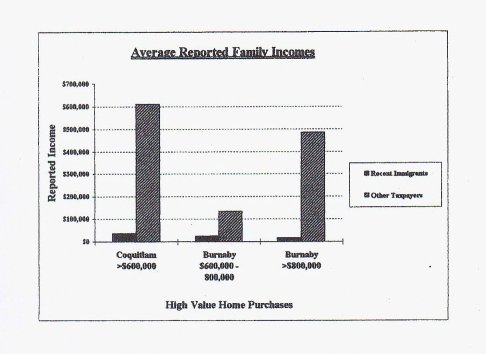
A chart that was part of leaked documents provided to the ‘South China Morning Post’ by current and former Canada Revenue Agency auditors in 2016. The 1996 chart depicts the huge disparity in declared incomes among investor immigrants and other buyers of Vancouver-area luxury homes, a part of an analysis by the auditors suggesting widespread tax cheating among the newcomers. Image: SCMP

The results were sent to CRA bosses in the hope of triggering a major investigation of investor migration. “The thought process was that this factual info could shock local senior management and management in Ottawa of the gross misrepresentation of reported income by these very wealthy people,” the retired auditor said.

But few official audits were launched – and those that were resulted in drawn-out court battles with well-financed opponents. Because of the huge manpower required to audit unidentified global income – versus, say, a local Canadian business – tax recovery was minimal compared to the effort.

Auditors were keen to pursue immigrant investors as a matter of law enforcement and principle, but as a revenue raiser, bosses saw the project as a bust.

There was “not enough leadership or recognition of the magnitude of the non-compliance from top management … the screened files got swept under the carpet”.

In hollow vindication, the auditors’ suspicions would eventually be reflected in long-term tax data showing immigrant investors declaring, on average, refugee-level incomes in Canada.

Ten years after admission, a 2014 federal government evaluation showed, average annual income tax being paid by IIP breadwinners was C$1,400 (one-fifth that of the average taxpayer, and one-eighth that of skilled-worker immigrants). Their annual taxable income from all sources peaked at just C$19,500 three years after arrival, then defied the trend of all other immigrant classes by falling sharply, to C$15,800 after 10 years.

The failure for more than 30 years to systematically investigate the suspiciously low incomes endemic to wealth migration remains a source of regret among CRA staff: three current and former auditors helped the Post with its 2016 investigation.

Forged alterations on stamps in the Chinese passport of a client of former unlicensed immigration consultant Xun “Sunny” Wang. The altered dates helped Wang’s clients retain Canadian permanent residency and receive citizenship by making it appear they had been living in Canada when in fact they were in China. Photo: Canada Border Services Agency

“I spoke recently to a retired CRA real estate appraiser, who said ‘we missed the first wave in the ’90s, then the wave in the 2000s, now we have gone through another wave, and we still have no handle on it’,” said one of them. “You’d think we, or the politicians, would have it figured it by now.”

An associated phenomenon is the chronically low retention rate of IIP and QIIP, another tendency exploited by Wang and Pilzmaker.

Census and immigration data show more than 40 per cent of IIP principal applicants do not live in Canada; the true figure is likely higher, since it excludes people who deceptively claim physical residency. It is, nevertheless, the worst in-Canada retention rate among all immigrant classes.

Even lower are the in-province retention rates for the Quebec IIP. Only 10 per cent of the 58,000 QIIP immigrants still in Canada for the 2016 census were living in Quebec. Most of the rest lived in Vancouver.

A 30-year veteran of the Canadian immigration industry, now retired, said that low retention of millionaire migrants suggested illicit services like those provided by Wang would be commonplace.

“It’s the same pattern that’s been going on for 30 years now,” he said, drawing a direct line between Pilzmaker and Wang, both of whom were “fabricating indicia of presence in Canada when in fact [their clients] were not here”.

“It goes way, way, way back and it’s part of the same phenomenon that we see with Hong Kong and Taiwan and now mainland Chinese – mostly business immigrant – families, where the head of the family has no interest in immigrating to Canada at all. He wants to continue running his business in China, or wherever.”

The Chinese passport of a client of former unlicensed immigration consultant Xun ‘Sunny’ Wang. Photo: Canada Border Services Agency

This was not a specifically Chinese behaviour but was instead typical for the rich, with profitable businesses and high-paying jobs in their country of origin. “They are the ones with the incentive not to actually live in Canada,” the immigration expert said.

One such client of Wang, millionaire businessman Pi Long Sun, had only visited Canada twice since 2012. However, he continued to file his taxes in Canada, listing his entire worldwide income in 2015 as C$720 from Canada’s Universal Child Care Benefit.

“In that year [Wang and wife Ying Wang] paid for their children’s living expenses in Canada, university tuition at the University of British Columbia for [their eldest daughter], private school tuition for their youngest daughter, and C$61,000 cash for a Mercedes-Benz [for their eldest daughter],” said IRB panellist Pemberton, as he denied the couple’s appeal against exclusion last year.

The downside of this general phenomenon was not just the loss of tax revenue, and the compromised integrity of Canadian residency and citizenship, added the retired CRA auditor. “They do not report their income while taking full advantage of our social programmes and boosting the value of real estate,” he said.

Among Wang’s clients, 146 fraudulently claimed Canadian benefits meant for the working poor, investigators say.

These included Xiao Qing Li, who lost an appeal against exclusion in June 2017. She and her husband, a partner in a Beijing law firm, had returned to China to live just 10 days after activating Canadian permanent residency in 2006.

In 2014, Li and the couple’s two sons did indeed move to Canada, where Li claimed benefits based on her status as a low-income worker, in a fake job arranged by Wang.

Her West Vancouver home was valued at more than C$8 million. Other Canadian properties boosted the family’s net equity position to “well over C$10 million”, according the IRB ruling against her.


The legal wreckage left in Wang’s wake

Vancouver immigration lawyer Peter Larlee is busy these days, as he cleans up after Sunny Wang.

He has represented about 50 ex-clients of Wang, about 35 of whom have already lost residency status and been issued five-year exclusion orders. Other cases are pending, while three have been successfully appealed.

“I really feel for my clients because a lot of them were so poorly served by Wang. They were led into a type of behaviour that is not condoned in our society, signing blank forms, leaving it all up to someone else to do,” Larlee said. “But we all tend to fall into that. I mean, if you go into a lawyer’s office you put your trust in someone, and they put their trust in the wrong people.”


The bid to expand millionaire migration and ‘placate concerns’

Sources such as the Middle East and Taiwan represent large but finite pools of would-be millionaire immigrants. But mainland China’s pool is limitless, practically speaking.

Even as Wang’s clients wend through the legal system, some in Canada’s immigration industry eye that pool hungrily, as they pursue the revival of the federal millionaire migration scheme.

In December 2016, scores of immigration professionals, lawyers, academics and other stakeholders gathered at the Hilton Toronto Airport Hotel. They were there for the Conference Board of Canada’s “Entrepreneur & Investor Immigration Summit”, an event pitched as helping shape the future of business immigration in Canada.

“Launching a new federal immigrant investor programme could draw more foreign capital to Canada to support such key areas as infrastructure, affordable housing, and venture capital,” wrote the board’s Kareem El-Assal, the summit organiser, in a report summarising the event.

Vancouver immigration lawyer Jeffrey Lowe suggested to attendees that a new IIP could require applicants to fund affordable housing with investments of C$1.5 million.

Retention of IIP immigrants had been a pervasive problem, Assal’s report acknowledged, while the board noted in a news release that “a public awareness campaign would also be required to placate concerns regarding the impact of immigrant investors on real estate prices in major cities such as Vancouver”.

Another investor immigration summit is planned by the board in Ottawa this November, by “popular demand”. Guests are slated to include government ministers….

Source: Special report: how Canadian immigration fraud saw 860 rich Chinese blacklisted

‘Determining our growth:’ Morden, Man., finds hope for future in provincial immigration program

It all began 20 years ago with Manitoba’s provincial nominee program, one of the very first experiments in Canada matching foreign workers with specific job openings.

It’s a fast-track option, allowing provinces and territories to nominate people who want to immigrate to Canada, are interested in settling in a particular province or territory and have the skills, education and work experience to contribute to the economy.

Each province and territory has its own criteria and “streams” — programs targeted to specific groups such as students, business people, skilled workers or semi-skilled workers.

The more points they have, based on their work qualifications, experience and language ability, the faster they move up the queue in the immigration process. A definitive job offer by an employer is a significant benefit.

After being nominated, applicants still have to apply to Immigration, Refugees and Citizenship Canada for permanent residence status.

Manitoba’s program remains one of the most successful. It boasts high recruitment and retention rates and accounts for a significant percentage of the province’s population growth.

“We see a program that has specific objectives. It’s met them and it’s one that we can measure as a successful government program,” Winnipeg immigration lawyer Ken Zaifman said last month during a celebration of its 20th anniversary.

Province Program started Total landed nominees Estimated 2017 annual provincial growth* 2017 landed nominees Percentage of 2017 growth from nominee program
Man. 1998 130,000 21,786 9,425 43
B.C. 2001 63,230 59,502** 7,650 13
Alta. 2002 89,979 54,189 6,996 13
N.S. 2003 17,365 6,536 2,735 42
Ont. 2007 27,890 216,727 6,980 3

*Population growth estimates from Statistics Canada

**Source: Province of British Columbia

According to provincial statistics, of the 130,000 immigrants who have settled in Manitoba through the nominee program since 1998, 85 per cent were working within three months and 76 per cent were homeowners within three to five years of their arrival.

In 2012, Morden began a community-driven immigration initiative under the provincial program to attract even more people. Since then, it’s brought 50 families a year to the rural community.

“It’s a win-win situation for us because we get to choose people that our employers want. I believe it’s a win for [the program] because our retention is really good because of the support we give,” Voth said.

With an unemployment rate of just three per cent and a small local labour pool to draw from, Voth said some businesses might be hesitant to invest in the community “but because of our steady flow of people coming in and the fact that we can target skill sets to what they’re looking for, it is a really great incentive for setting up in Morden.”

The city program has been so successful that other communities across the country come to get advice on how to set up their own strategic initiatives inside their provincial nominee programs, Voth said.

It’s more than just the skill set. It’s the work ethic…. That’s a hard thing to find.– Jim Duff, vice-president of manufacturing for ON2 Solutions

The national and international rhetoric around foreign workers taking jobs from Canadians crops up now and then in Morden. Voth and others say they sometimes get asked why they’re recruiting immigrants when there are local people without jobs.

Their answer? Some of these are jobs Canadians don’t want to do while others require skills and experience that can’t be found — or recruited — in the area.

And, Voth said, very few of those who apply are chosen.

“It’s not just an open the doors and anybody comes in. We go through a tough application. We’re picking about five per cent of our applications,” she said.

“We’re picking really good people and I think the success stories of the people that have been coming in speaks a lot for the program and also helps the community to be more comfortable with the program.”

‘It’s the work ethic’

Jim Duff, vice-president of manufacturing for ON2 Solutions, is working with Voth to find up to 200 workers in the next three years. He needs electricians and plumbers to help grow his business of manufacturing oxygen concentrators for hospitals and emergency shelters for mining companies.

Duff has tried to hire local people, but says he can’t find what he needs.

“It’s more than just the skill set. It’s the work ethic. It’s the contribution to the team, the desire to be part of the team. That’s a hard thing to find,” he says.

“Our last interview process, we interviewed a couple of born and raised Canadians and the attitude was shocking, really, when it came down to it. I don’t know how to put that in words but it was a significant difference.”

Duff has talked to the school division and local educational programs to try to train workers, but said he has run into the same problem.

Jim Duff, left, is working with Morden’s immigration program to find up to 200 new employees in the next three years and says foreign workers like Victor Kovtan, right, are helping ON2 Solutions grow and thrive.(Warren Kay/CBC News)

Meanwhile, he’s thrilled with the workers he’s hired through the provincial nominee program and Morden’s strategic initiative.

“I would very honestly say that if we didn’t have these five people, we wouldn’t be where we are now. I don’t even know that we would necessarily be in business. I would say [the foreign workers are] that crucial,” he says.

Source: ‘Determining our growth:’ Morden, Man., finds hope for future in provincial immigration program

Citizenship case processing centre in Vegreville officially closed

Of note. Originally located in Vegreville under the Mulroney government under which, if memory serves me correctly, former deputy prime minister Don Mazankowski pressed for its location in his riding (Liberal governments also located processing centres in rural areas):

The federal government’s Immigration, Refugee and Citizenship Case Processing Centre (CPC) in Vegreville, Alta. officially closed its doors on Friday.

The centre has been the subject of a contentious debate since the closure was announced by the federal Liberals in 2016.

“It was an array of mixed emotions,” said Michelle Henderson, union vice-president of Customs Employment and Immigration.

“We’ve had people that have been there for 24 years and worked there their whole career. It’s not just about closing an office and relocating it; it’s about almost losing parts of your family because you’re all so close.”

Employees marked their final week with an appreciation BBQ hosted by the town on Wednesday.

About 200 people worked at the document-processing centre at the time it was closed.

When the government announced the closure, it said the centre would be moved to Edmonton to improve access.

“Basically, anybody who was employed at the office in Vegreville was offered their job in Edmonton,” Henderson said, adding some staff retired, took other jobs or moved out of the province.

“(The government) still went forward with the relocation,” Henderson said. “I would love to see the department realize they could have a smaller satellite office in Vegreville, which is what we’ve been pushing for right from the beginning. We’ve pushed for telework and we’ve pushed for a satellite office.

“The type of work that we do, we don’t see anybody. We were set up there as a mail and processing centre only… Where we’re physically located was, as far as I’m concerned, a moot point.”

The community of Vegreville has a population of about 5,000 and is located about 100 kilometres east of Edmonton. In May 2017, the mayor said the move to Edmonton could cost the town more than seven per cent of its population.

John McCallum, the federal immigration minister at the time said his department had a made a strong business case for the relocation.

“The government inherited a completely broken immigration system, so our priority has to be to improve service, to reduce processing time, and to spend taxpayers’ money wisely,” McCallum told the House of Commons November 2016.

McCallum also sent a letter to Shannon Stubbs, the Conservative MP who represents voters in Vegreville, in which he wrote, “The relocation will also save money as the new office space will be located within the Government of Canada’s existing property inventory.”

According to the most recent data held by Statistics Canada, about 75 per cent of the federal government’s 315,500 employees work in large urban centres like Toronto or Montreal.  About one-third of those or 135,900 work in the Ottawa—Gatineau region.

Henderson said the union heard Thursday it had won a grievance against the employer.

“Union filed a policy grievance basically saying the employer didn’t respect our collective agreement.”

Henderson said the union representative in Ottawa will work with the employer over the next 60 days or so to decide what steps should be taken now.

Source: Citizenship case processing centre in Vegreville officially closed