Italian Catholic priests go to war with Salvini over immigration

Noteworthy:

Gianfranco Formenton, a priest in Italy’s central Umbria region who has long preached against racism and in support of migrants, knows what it is like to clash with Matteo Salvini, the recently installed interior minister and leader of the far-right League party.

In response to the party’s xenophobic rhetoric in 2015 – the year more than a million migrants arrived in Europe and 150,000 landed on Italy’s southern shores – he put a sign up on the door of his church in San Martino di Trignano, a hamlet of the town of Spoleto, saying: “Racists are forbidden from entering. Go home!”

He immediately bore the wrath of Salvini, who wrote on Twitter: “Perhaps the priest prefers smugglers, slaveholders and terrorists? Pity Spoleto and this church if this man [calls himself] a priest.”

Fr Formenton is also believed to have been the target of intimidation by far-right sympathisers when his rectory and home were ransacked a few days after Luca Traini, a failed League candidate in a local ballot, injured six Africans in a shooting in the town of Macerata in early February.

As the Democratic party, the biggest left-wing force in Italy, appears cowed in the face of Salvini’s vitriolic immigration stance, fearing it will lose support, the interior minister’s strongest opponents are priests such as Formenton.

But they are struggling to convince parishioners to welcome migrants, amid mounting adulation of Salvini, a Catholic who reportedly attends mass.

“We have a population that wants blessings from the church, processions and religious rites, but every time Pope Francis recalls migrants or the poor, they no longer listen,” Formenton told the Guardian.

“There is an evil force of racism, and Salvini has contributed to this. He’s been a magician in cultivating hate and manipulating anger. People of all ages have become racist because of the climate we’re living in.”

Knowing that many of his backers are devout Catholics, Salvini has exploited religion to galvanise support. The 45-year-old once again brandished a rosary and swore on the gospel to be “loyal to his people” while addressing thousands of ecstatic voters at the League’s annual rally in Pontida, a town in the northern Lombardy region, last Sunday. His speech, during which he pledged to create a European-wide alliance against “mass immigration”, came a few days after Mario Delpini, the Archbishop of Milan, pleaded for more humanity among Christians.

“Can they go to mass each Sunday and ignore the drama that is happening in front of their eyes?” said Delpini.

In the few days since Salvini’s speech, more than 200 migrants have drowned in the Mediterranean.

Pope Francis also spoke out after Salvini, who is also deputy prime minister, blocked the Aquarius, a rescue ship with more than 600 people on board, from docking in Italy in June. “I encourage those who bring them aid and hope that the international community will act in a united and efficient fashion to prevent the causes of forced migration,” the pontiff said.

At the same time, Salvini has been nurturing a relationship with US Cardinal Richard Burke, a fierce critic of Pope Francis and supporter of Donald Trump, as he strives to build consensus from within the church.

Cosimo Scordato, a priest at Saint Francesco church in Ballarò, a neighbourhood of Palermo and home to many migrants recently arrived in Sicily, compared Salvini’s use of religious imagery to that deployed by Mafia bosses.

“Holding a rosary in front of thousands of supporters reminds me of Mafia bosses holding the Bible,” Fr Scordato, who has been subjected to intimidation by the Mafia, told the Guardian.

“Mobsters believe themselves to be sort-of spokesmen of Christian values, they feel protected by the church and want to show people they have God on their side.”

Scordato said he recently wrote a letter to Salvini encouraging him to see migrants as an opportunity in a country with a low birth rate and ageing population. He got no reply.

Fr Enzo Volpe, a Salesian priest in Palermo, said Christians have “forgotten about the Good Samaritan, who healed and took care of the poor”.

“Young Italians are moving to the US and England in search of work and opportunities,” he added. “What if these countries had stopped Italians at the border like Italy is doing with Africans? What’s the difference? Is it because Africans are black?”

Fr Luigi Ciotti, one of the most popular priests in Italy, organised a protest this weekend, which invites people to wear a red T-shirt – the same colour worn by three-year-old Syrian Aylan Kurdi when his drowned body washed up on a beach in Turkey in 2015.

“Red also means to stop,” he said. “And we need to stop now, stop and reflect and look inside ourselves. We need to question our hearts and conscience: what are we becoming?”

Earlier this week Fr Alex Zanotelli, a member of the Comboni missionaries in Verona, urged journalists to report on the tragedies in Africa and raise more awareness among Italians about the plight of migrants, who are now perceived by many as “parasites” and “invaders”.

“If Italians don’t know what’s going on in Africa, they cannot understand why so many people are fleeing their lands and risking their lives,” he said.

But with the Democratic party failing to voice a strong opposition, the onus rests on the priests to wrestle against Salvini.

“The party is divided and doesn’t know how to counteract Salvini, and on which issues,” said Mattia Diletti, a politics professor at Sapienza University in Rome. “Due to people being so connected to him and the immigration issue, there is a fear that [opposing him] could be damaging.”

Source: Italian Catholic priests go to war with Salvini over immigration

Germany’s Jewish community issues appeal for anti-Semitism funding oath

Echoes of the Canada Summer Jobs attestation:

  • “Both the job* and my organization’s core mandate* respect individual human rights in Canada, including the values underlying the Canadian Charter of Rights and Freedoms as well as other rights. These include reproductive rights and the right to be free from discrimination on the basis of sex, religion, race, national or ethnic origin, colour, mental or physical disability or sexual orientation, or gender identity or expression;”

Curious to see if the ewish Forum for Democracy and Against Anti-Semitism (JFDA) proposal generates similar opposition within Germany:

Just last week, a man wearing the Star of David was beaten down and kicked right in the center of Berlin. Some weeks earlier, a similar incident in Germany’s capital caused public outrage and sparked a nationwide debate on anti-Semitism when a 19-year-old Syrian attacked and Arab Israeli and his companion with a belt in broad daylight. Both victims wore kippahs (traditional Jewish head coverings) in what was an allegedly anti-Semitic attack.

Call for an oath

Enough is enough, according to more than 30 Jewish organizations and communities, who have now issued an appeal to the German government. In a declaration published on Monday, Germany’s Jewish Forum for Democracy and Against Anti-Semitism (JFDA) called on the authorities to crack down harder against anti-Semitic agitation and attacks. The organization is demanding that in the future, public funding for civil and religious groups should be granted only if those groups have publicly distanced themselves from all forms of anti-Semitism — a kind of pro-democracy oath.

The authors of the declaration stressed that this applies to Muslim organizations as well. Lala Süsskind, chairperson of the JFDA, warned against playing down anti-Semitism among Muslims out of misconceived concern. “Of course, anti-Semitism also exists on the Muslim side,” she told DW. Denying that does not prevent the exploitation of Muslim anti-Semitism by the enemies of Islam, but it is detrimental to combating anti-Semitism effectively and makes a mockery of the victims, Süsskind said. The German government should, therefore, examine very carefully which organizations benefited from public funding, she explained, and whether said organizations were, in effect, adhering to Germany’s Basic Law, or constitution.

As an example, the JDFA cited the controversial debate surrounding the Berlin Institute for Islamic Theology, which is scheduled to open its doors in 2022 as an affiliate of the city’s Humboldt University. It remains a controversial issue to this day how much control should be given to the three representatives of traditional conservative Islamic associations on the institute’s advisory board. They include the Central Council of Muslims in Germany, the Islamic Federation and the Islamic Community of Shiite Parishes. These associations are among those which, according to the Jewish organizations’ representatives, should make some kind of public commitment to democracy.

Even Jewish students in Berlin have been subjected to anti-Semitic harassment

‘Committed to this fight’

The president of the Central Council of Muslims in Germany, Aiman Mazyek, does not think of himself as a direct addressee of the Jewish organizations’ initiative. “I take note of the appeal, and I believe it’s correct and important to highlight painful issues, to make every necessary effort to fight anti-Semitism, and that we remain committed to this fight with all the social power that’s available to us,” he told DW, adding that was all he could say about the matter.

Mazyek says his organization is committed to fighting anti-Semitism

After the interview, Mazyek sent DW a newspaper article detailing how he — as president of the Central Council of Muslims — visited the former Buchenwald concentration camp with a group of Syrian refugees in April. Mazyek’s message, which he wants to be understood by DW and by the public, is that his organization is actively campaigning for reconciliation between Muslims and Jews in Germany. He, therefore, said he doesn’t care to comment on appeals, pro-democracy oaths or any other such demands.

Süsskind said she found that response regrettable, and that it reminds her of previous dialogue between Jewish and Islamic organizations on the thorny issue of anti-Semitism. “There are few Muslim associations to which you can speak openly,” she claimed. What’s more, Süsskind added, the appeal was to be explicitly understood as an invitation to all religious groups, political parties and social associations — after all, not only Jewish life in Germany was at stake. “If people are not ready to stand up for their democracy, it goes down the drain,” she said.

An anti-Semitic attack in April prompted a show of solidarity from Berlin’s Jewish community

More financial support

The German government has not yet responded to the appeal issued by the country’s Jewish community. Interior Minister Horst Seehofer had already announced on July 6 that the government plans to extend financial support for the Central Council of Jews in Germany. The annual subsidy will rise from €10 million ($11.75 million) to €13 million, both sides confirmed. The reason behind this was, according to Seehofer, the growing threat to Jewish life in Germany. “Those who threaten our Jewish citizens threaten us all,” he said.

Read more: Anti-Semitism in German schools to be tackled with anti-bullying commissioners

Süsskind stressed that the social climate has changed considerably with respect to Jews. She said she frequently receives hate mail, including one message that read: “In goes the knife, out goes the knife, the Jew’s dead.” When she tried to report the authors of those hate messages to the authorities, she was repeatedly informed that they were protected under freedom of speech legislation. In response, Süsskind asked: “Is that really possible?”

Source: Germany’s Jewish community issues appeal for anti-Semitism funding oath

ICYMI: Anne Frank’s Family Was Thwarted by United States Immigration Rules, New Research Shows

Not that surprising (Canada was no more welcoming):

Attempts by Anne Frank’s father to escape the Nazis in Europe and travel to the United States were complicated by tight American restrictions on immigration at the time, one of a series of roadblocks that narrowed the Frank family’s options and thrust them into hiding, according to a new report released on Friday.

The research, conducted jointly by the Anne Frank House in Amsterdamand the United States Holocaust Memorial Museum in Washington, details the challenges faced by the Frank family and thousands of others looking to escape Europe as Nazi Germany gained strength and anti-refugee sentiment swept the United States.

Otto Frank, Anne’s father, was never outright denied an immigration visa, the report concludes, but “bureaucracy, war and time” thwarted his efforts.

In order to obtain a visa, Mr. Frank would have had to gather copies of family birth certificates, military records and proof of a paid ticket to America, among other documents, and be interviewed at the consulate.

In one instance, an application that Mr. Frank said he submitted in 1938 languished in an American consulate in Rotterdam, the Netherlands, amid a swell of similar applications and was lost in a bombing raid in 1940. Mr. Frank wrote to a friend that the extensive papers he had gathered as part of a visa application “have been destroyed there.”

In 1941, as Mr. Frank was again attempting to navigate the matrix of paperwork and sponsors necessary to immigrate, the United States government imposed a stricter review of applications for visas, grew suspicious of possible spies and saboteurs among Jewish refugees, and banned applicants with relatives in German-occupied countries.

President Franklin Delano Roosevelt warned at the time that Jewish refugees could be “spying under compulsion,” and the report states that “national security took precedence over humanitarian concerns.”

Mr. Frank had sought help from an influential friend, Nathan Straus Jr., who was the head of the United States Housing Authority, a friend of Eleanor Roosevelt’s and the son of a Macy’s co-owner. Despite Mr. Straus’s connections, Mr. Frank wrote to him that “all their efforts would be useless” given the immigration climate, the report states.

“We wanted to learn more about the process in itself and what documentation an applicant (e.g. Otto Frank) had to produce,” said Gertjan Broek, a researcher with the Anne Frank House who worked on the latest findings. “In the report, we point out how complex and tedious the process was and how the bombing of the Rotterdam consulate disrupted things.”

The report was released 76 years after the Frank family went into hiding on July 6, 1942. Researchers drew on dozens of pages of correspondence between Mr. Frank and friends, much of which was first made public in 2007, as well as records involving United States immigration policy.

Anne Frank’s diaries describing her time in hiding gave a voice to millions who died at the hands of the Nazis. She was eventually discovered and she died in a concentration camp in 1945, when she was 15.

Mr. Frank was the only member of the immediate family to survive the concentration camps.

News about the Frank family continues to captivate the public, despite challenges in educating younger generations about the Holocaust.

“She has allowed millions of people, maybe hundreds of millions of people, to identify with persecution at the worst level,” said Richard Breitman, a professor emeritus at American University who has written about the family’s attempts to immigrate to the United States. “Any time there is a glimmer of new information, it’s a big story.”

The new research comes at a time when President Trump’s attempts to curb immigration have been likened to those in the World War II era. Mr. Trump has repeatedly sought to justify letting fewer people into the country by arguing that criminals and terrorists could be among the immigrants and refugees seeking to enter.

Mr. Breitman underscored those similarities, pointing to debates over immigration policy today and after Sept. 11. Mr. Breitman said that as Mr. Frank was trying to get to the United States, the country was instituting an “extreme cutback” on immigration.

“It wasn’t just extremists and wackos who believed that there was a serious threat to the security of the United States in 1940 that justified an immigration cutback,” Mr. Breitman said. “You can fill in the rest of it after 9/11 and today.”

Mr. Broek said the researchers did not intend to highlight parallels.

“The Anne Frank House researches into the life of Anne Frank and her family, to tell her story as accurate as possible,” Mr. Broek said. “The attempted immigration is a part of that story too.”

ICYMI – Shree Paradkar: Whataboutism is just a trolling tactic — and it deserves to be shut down

While parallels and comparisons can be useful in providing perspective, excessive use is more to divert rather than engage in conversation:

This much is for sure: there’s no dearth of injustices around the world. But just when you tackle the proverbial elephant, up pops this logical fallacy: “What about that other bit here, what about that bit there?”

When I, as a Canadian from India, write about racism and white supremacy, the predictable question is, “But what about the caste system?”

Well, what about it? And what is the commenter doing to dismantle it, or any set of unjust hierarchies?

The caste system has astounding parallels to white supremacy, except it’s even older. It’s the same violent and heritable hierarchy that enforces the creation of an impoverished class, builds societies and prosperity for some on the backs of those it stamps down and then blames them for their own marginalization.

I am a beneficiary of this system. These are the complex contradictions that some of us hold as we navigate and nudge a system towards genuine egalitarianism.

A new survey, the first of its kind, shows caste discrimination playing out among South Asians in the U.S. I have no reason to believe it wouldn’t in Canada.

But its existence has little bearing on the truth of white supremacy. People who throw up the caste apartheid in response to racial apartheid don’t really care about the oppressed Dalits and Adivasis; they’re using them to score points in a verbal argument.

In the bargain they show a few things: That they are unable to look past the fact that a non-white Canadian (“the other”) is critiquing Canadian systems, that they are defensive, conflating white supremacy with white people, which is telling, that they are indulging in a whataboutism, a tactic that has seen a recent upswing in usage.

According to Merriam-Webster, “whataboutism” is a rhetorical device that “is not merely the changing of a subject (‘What about the economy?’) to deflect away from an earlier subject as a political strategy; it’s essentially a reversal of accusation, arguing that an opponent is guilty of an offence just as egregious or worse than what the original party was accused of doing, however unconnected the offences may be.”

Another predictable whataboutism is, “What about Black crime?”

Well, what about it? And what are the commenters doing beyond looking at crime stories, Black skin and going one plus one equals the same old tired tropes?

It’s an ahistorical view that discounts the root causes of the violence and is usually raised to suggest Black people are inherently criminal, or that they are architects of their own oppression.

Like as if, since the end of slavery, Black people in the U.S. and Canada have been given job opportunities, quality education, access to housing, equitable health services, and fair treatment by law makers and lawkeepers.

Given that background, what we should marvel at is the ongoing resilience of Black people who excel despite these conditions.

There are many more convenient whataboutisms.

Some create false equivalences: “What about the Indigenous people who were killing each other?” As if internecine warfare is the same as the violence of colonization.

Others are irrelevant. “What about how women are treated in the Middle East?” As if that should impact how Canada treats its women from different backgrounds. “What about FGM?”

“What about slavery in Africa’s past?”

“What about Irish history here?”

All these topics can be addressed in detail — many have been on these pages and elsewhere — but it’s never enough to satisfy the next person who doesn’t care to educate themself but feels entitled to answers to the same questions, again and again.

Sometimes, however, legitimate questions on context, holding the powerful to account and challenging falsehoods can be falsely labelled as whataboutism.

Waging international war on the pretext of rescuing local populations from human rights violations, for instance: “What about the human rights violations you will enact there? What is your accountability?”

A political party claiming to be a friend of Indigenous people: “What about your record on pipelines or policies on access to drinking water? What about your leader asking Indigenous people to leave their reserves?”

A person who uses “race is a social construct” as a tool to dismiss the existence of racism: “What about” — and there is literally an embarrassing richness of data to pick from to show the real life, detrimental, even fatal effects of racism.

True whataboutism, however, is just a trolling tactic, a means to deflect from the original point and dictate the terms of discussion.

To stay on point, the best answer to such a “what about” is: “Don’t change the subject.”

Source: Shree Paradkar: Whataboutism is just a trolling tactic — and it deserves to be shut down

Access denied: Canada’s refusal rate for visitor visas soars – The Globe and Mail

Good in-depth reporting. Data indicates that Liberal government is not as soft on immigration and refugees as opposition would lead us to believe. Article would have benefitted, however, for a more balanced discussion regarding the risks of those over staying their visas or claiming asylum which largely drives visa policy (i.e., the benefits, not just the costs).

The different rates for countries suggest this is risk-based.

And like any system that has to make numerous decisions, it sometimes gets them wrong, either refusing people who should be let in, or letting in others that should not:

For a country that prides itself on its openness to the world, Canada makes its borders surprisingly impenetrable for millions of people who want to visit from abroad.

Last year alone, Canada refused entry to nearly 600,000 people who wanted to come for a short stay for tourism, school, business, academic conferences or simply to see their families. And the refusals have skyrocketed: The number has more than doubled since 2012, according to data obtained by The Globe and Mail.

The trend has huge implications for Canada’s relationship with the world, yet the issue is rarely debated. Entry decisions are left to mid-level bureaucrats, and little information is provided to applicants, even though the rising number of refusals and opaque application process can damage Canada’s reputation on the global stage.

Part of the trend is simply due to globalization. People are more mobile, formerly poor countries have more wealth and the number of entry-visa applications has soared in recent years, leading to a larger number of visitors.

But the data also suggest it is becoming tougher to get into Canada, and the odds against applicants are rising.
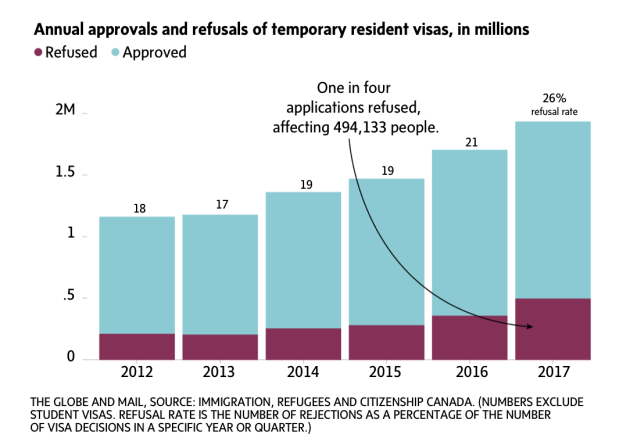
In 2012, the number of rejections was about 18 per cent of the total number of applications for Canadian visitor visas (excluding student visas). By last year, the refusal rate had increased to 26 per cent. And in the first three months of this year, the refusal rate had risen again to about 30 per cent. Similarly, the refusal rate for student visas has also increased, from 26 per cent in 2012 to a new rate of 33 per cent last year.

Statistics obtained by The Globe from the federal immigration department show that the highest refusal rates are clustered in Africa and the Middle East. Over the past two years, Canada rejected more than 75 per cent of visitor applications from countries such as Somalia, Yemen, Syria and Afghanistan.

Other countries are affected, too. About 200 delegates, including dozens of Chinese government officials, were denied visas to attend a recent conference of the World Guangdong Community Federation in Vancouver.

When scholars gathered at Queen’s University in early May for their annual African studies conference, the program had a dozen gaps. Twelve invited scholars from Africa were denied an entry visa or could not obtain one in time.

Organizers had to scramble to find replacements or combine sessions to make up for missing panelists. “It’s frustrating and disruptive, and it discourages people from coming next time,” said Belinda Dodson, a geographer and Africa migration expert based in Ottawa.

The intangible costs for Canada

The World Economic Forum, which conducts an annual study of travel and tourism competitiveness around the world, puts Canada’s visa requirements among the most complex and opaque in the world. In a 2017 survey that ranks 136 countries from best to worst when it comes to the difficulty of their visa rules, Canada placed a dismal 120th – a drop of 14 places from an earlier survey in 2013.

The process is about to become even more difficult. Beginning on July 31, visa applicants from Africa, Europe and the Middle East will be required to give their fingerprints at a foreign-based application centre. The rule will be imposed for Asians and Latin Americans at the end of December.

In most cases of denied visas, Canadian officials say they are not satisfied that the applicants would leave at the end of their visit. Officials can reject an application if they believe the applicant has not shown evidence of sufficient funds to pay for their stay, or has close family or financial connections to Canada and looser ties to their home country.

Denying visas to tourists or business investors costs the country millions of dollars in potential revenue. Canadian tourism promoters say the visa system is one of their biggest headaches.

The Tourism Industry Association of Canada, which estimates that tourism employs 1.7 million people in Canada, says the visa application process is “an area of significant concern.” It can be an “unnecessarily complex” barrier to visitors, it says.

“Canada continues to lag behind its competitors in terms of requirements, processing times and reciprocity programs,” the association said in a recent report. “Canada must find ways to ease or eliminate such access barriers for legitimate travellers.”

And there is a more intangible cost. When officials reject an application from a respected scholar or activist, it often leads to a flurry of negative publicity, undercutting Canada’s image as progressive on freedom and human rights, especially when the poorest countries seem to suffer the highest refusal rates.

“It casts Canada in a poor light, belying the government’s encouragement of transnational exchange of academic research,” Audrey Macklin, a law professor at the University of Toronto, said after many African and Asian scholars were denied visas to attend a recent conference she helped organize in Toronto.

“Participants denied visas lose – and we lose, too. It certainly damages Canada’s reputation abroad.”

Angola’s most famous anti-corruption campaigner, Rafael Marques de Morais, and a prominent Bahraini human-rights activist, Maryam al-Khawaja, are among those who were recently denied visas to visit Canada, although the decisions were reversed. Both had been penalized in the visa process for criminal charges against them – even though they were charged by authoritarian regimes as a result of their human-rights work.

Scientists from around the world protested in 2013 when Canada denied a visa to Russian scholar Vladimir Kolossov, then president of the International Geographical Union (IGU), to attend an assembly of the International Social Science Council in Montreal. Visa officials said he had failed to give proof of his employment and financial resources, but the IGU said he had provided documentation of both. The geographical union called it an “arbitrary and unreasonable denial of free scientific exchange.

Applications on the rise

Requests for Canadian visas have surged to record numbers in recent years. Applications increased from about 1.3 million in 2012 to about 2.3 million last year. Many of the new applicants are tourists or business visitors from booming countries such as China and India who have more money to travel. But the surge has been accompanied by an even faster growing number of rejections.

The government insists it can handle the dramatic rise. “Updated technology allows the department to take advantage of capacity anywhere in our global network so that applications can be processed quickly,” Shannon Ker, a spokeswoman for Immigration, Refugees and Citizenship Canada, said in response to questions from The Globe.

But errors can happen. Shuvai Mandigo, a 38-year-old Zimbabwean with eight years of experience in community development work, won a scholarship to study at the Coady International Institute in Nova Scotia – but was denied a Canadian student visa. Officials mistakenly told her she had applied in a different category.

She applied a second time, and was again denied. Officials decreed that she might try to stay illegally, even though she visited Canada twice before and returned home both times.

The decision “breaks my heart,” she said. “I was really hurt. Opportunities come once in a lifetime, and to think that the only opportunity I had to study in Canada – after so much effort by my Canadian friends and well-wishers – could not come to pass because someone just thought I will not come back to Zimbabwe after my stay is really unfair.”

The House of Commons standing committee on citizenship and immigration, in a report last year, recommended that Canada provide more detailed information to applicants to explain its visa denials. “It is possible to provide failed applicants with a more fulsome explanation, while maintaining fast processing,” the committee said.

The soaring number of visa applications could be leading to mistakes and arbitrary rejections in an overly hasty processing system. Rejections typically come in a terse and generic letter that provides no explanation of the specific reasons for the denial.

In many cases, Canadian civil servants have not made the decisions, because Canada has outsourced the job to private foreign firms in the countries where the applicants originate.

The Canadian branch of Amnesty International often invites foreign human-rights activists and civil society leaders to Canada for meetings and conferences. “Every time we are faced with this, we steel ourselves for what we know is going to be an arduous, fraught and highly unpredictable process,” said Alex Neve, secretary-general of Amnesty’s office in Canada.

Foreign human-rights activists have suffered “blatantly discriminatory” visa delays and denials from the Canadian government for years, Mr. Neve said. They are forced to “jump through an immense number of hoops” to get the paperwork Canada demands.

When not all applicants are equal

The government denies any discrimination. “All applications from around the world are assessed equally against the same criteria,” Ms. Ker said.

But not every applicant is equal. One of the factors visa officers consider is the “economic and political stability of the home country,” according to Mathieu Genest, press secretary to Immigration Minister Ahmed Hussen.

Mr. Neve expressed particular concern about the high refusal rates for visa applications from countries with serious records of human-rights violations, such as African and Middle Eastern countries. He said those applications require even more special attention to ensure people are not penalized because they’re from a certain country.

“If there’s a possibility here that people’s visa applications are being refused simply because they come from a country experiencing war or human-rights violations, that there’s an irreversible presumption that they’re not going to go home and their … application gets treated differently, that certainly is a concern.”

Annie Bunting, a social sciences professor and Africa expert at York University, said two of her Nigerian colleagues were recently denied visitor visas to travel to Toronto, where they were scheduled to present their research at a law and society conference. Their participation had been funded by the Social Sciences and Humanities Research Council of Canada (SSHRC), a federal research funding agency.

One of the scholars, Lawan Balami, a medical doctor and researcher, was planning to present research on women and girls kidnapped by Islamist radical group Boko Haram.

Umar Ahmad Umar was planning to present his research on access to justice for Nigerian victims of gender-based violence and child marriage. “He has a family in Nigeria, has full-time employment,” Ms. Bunting said. “He has travelled before. He’s fully funded. It’s an international conference with a letter of invitation from the conference, from me, and mention of the SSHRC grant – and that is not enough to get a visitor’s visa to come for a week.”
via Access denied: Canada’s refusal rate for visitor visas soars – The Globe and Mail

Lawmaker In ‘Canvassing While Black’ Incident: ‘You Can’t Legislate Humanity’

Incident handled with grace by the legislator and the police:

People have asked Janelle Bynum whether legislation would help solve the problem of police being called on black people for just going about their daily lives. Bynum, an Oregon state representative who herself had authorities called on her while canvassing for votes earlier this month, simply tells them, “You can’t legislate humanity.”

Bynum, who is the only black representative in the Oregon state House, was canvassing in her district ahead of Independence Day, as NPR’s Tanya Ballard Brown reported. The lawmaker said she was typing notes in a driveway when a deputy from the Clackamas County Sheriff’s Office approached her.

Bynum said her mind went from disbelief to “what did I do?”

The deputy approached her and guessed that she was selling something, according to Bynum. She introduced herself as a state representative, and to her surprise, Bynum said, he did not demand proof of identification.

“It was so incredible for me because he believed me,” she said of the officer.

“He was well within his rights to go as far down as he could to humiliate me in that circumstance as he wanted to, and he didn’t,” Bynum said.

While the situation did not escalate — she said on Facebook that the deputy “responded professionally” — Bynum points to a history of interactions between police and African-Americans that have not ended as peacefully.

“I think if you have the luxury of never having to live in fear it doesn’t mean that much to you to call the authorities on someone,” Bynum said. “And so there’s no consequence. There’s no feedback. You’re not forced to see my humanity.”

The incident came amid a spate of recent incidents in which police were called on to investigate African-Americans in the middle of everyday activities. In April, for example, two men were arrested while waiting for an associate at a Starbucks in Philadelphia. In May, a graduate student at Yale who was napping in her dormitory’s common room had a police encounter after a white graduate student called authorities. And on Independence Day, there were at least two separate incidents at pools. In North Carolina, police were called after a man demanded that a black woman show her identification to use a private community pool. In Tennessee, an apartment manager called police because a black man was wearing socks in the pool.

Bynum said she thinks incidents like these can be “bravado on some people’s part to call the police.”

“I don’t know if it’s out of fear or power.”

But the course to changing that won’t necessarily lie with changing the law, Bynum said.

“I think it’s more of a policy, it’s more of a mind shift than any law could ever mandate.”

Bynum pointed to training police “to make sure that the person who’s been accused and hasn’t done anything feels whole after the incident.”

“You’ve created a victim,” she said of such police encounters, “but then there’s no justice for that victim.”

The deputy in Bynum’s case used his cellphone to call the constituent after the lawmaker said she would like to speak with the person.

According to Bynum, the caller, a woman, apologized but was not interested in meeting with her.

Lost for words: One in every 20 Torontonians can’t speak English or French, study finds

Interesting data, although it appears that in percentage terms, no significant change. As one would expect, lack of official language more prevalent among seniors, women, and low-income.

Will be including this data in my upcoming riding-based analysis:

One in 20 Torontonians can’t speak English or French and the language barrier has greatly impeded their ability to find a job, be active in the community and enjoy a decent life, says a new study.

More than 132,700 Toronto residents are unable to have a conversation in either official language and they account for 20.5 per cent of the 648,970 non-English and non-French-speaking population across Canada, according to the Social Planning Toronto report which is believed to be the first ever to profile this cohort.

Census data collected between 1996 and 2016 found the number of people without knowledge of either official language has increased by more than 175,000 in Canada over the two decades, though it fluctuated only slightly as a percentage of the total population. In Toronto, the number of people who don’t speak English or French shrank by 10,000 in the same period.

In the GTA, Toronto’s percentage of non-English and non-French speakers ranks second to York Region (5.6 per cent) and is followed by Peel (4 per cent), Hamilton (1.8 per cent) and Durham (0.8 per cent).

Within the city, this population mostly resides in the west end of North York, throughout the former city of York, in the old city of Toronto and in northwestern Scarborough, which alone is home to more than 30,000 residents with no English or French.

The report found a total of 43.5 per cent of Toronto residents who do not speak an official language reported a Chinese language as their mother tongue, followed by Portuguese, Italian, Spanish, Tamil, Vietnamese, Korean, Persian, Russian and Arabic. These residents also tend to live in areas where their mother tongue is common, it said.

“There is a range of diversity within the group, but we have an overrepresentation of seniors and women who don’t speak English or French,” said Peter Clutterbuck, interim executive director of Social Planning Toronto, a non-profit group that works to improve equity, social justice and quality of life. “You can’t get employment without some capacity of an official language or access services if you are unable to communicate with others. It limits your ability to be active in the community and to feel connected.”

The report, titled Talking Access & Equity, said women and girls make up almost 60 per cent of Toronto residents who speak neither official language, though they only account for 51.9 per cent of the city’s population.

While only 15.6 per cent of Toronto residents are 65 and above, 44.6 per cent of the city’s non-English, non-French-speaking population belong to this age group.

The report said both women and seniors are more likely to come to Canada as dependants and hence may lack the same official-language skills required of the principal applicants or sponsors.

Fahmeeda Qureshi was sponsored by her husband to Canada from Pakistan in 1972 when she was 18, and never attended English classes because she was busy caring for her three children, parents and in-laws.

“I was too busy to learn English because I had to look after everyone else,” said the now 66-year-old, who spoke little English when she arrived and later picked up the language informally from her husband and children. “It is very important to learn English so you can communicate and do anything you want and be independent.”

Robert Koil, who came to Canada in 1992 and later founded a Tamil seniors group in Rexdale, said older immigrants without English proficiency are forced to rely on their children in their day-to-day lives as they’re often isolated from the world outside of their family.

“They don’t know other people and need help for mobility issues and health issues,” said Koil, 88, whose group organizes monthly seminars and meetings at Rexdale Women’s Centre for non-English-speaking Tamil seniors about health, diet and well-being.

“They speak in their mother tongue at home, stay with their children and are afraid to speak English because they are embarrassed by their English,” added Koil, who unlike many of the people he helps, spoke flawless English when he arrived in Canada.

Jenny Huang moved to Canada from China in 2009 with her daughter and husband.

“I only started learning English in junior high (in China) and knew just a few English words when I came,” Huang said in Cantonese. “I go to English classes but it’s hard to learn a new language as an adult. I can understand better than I speak.”

With limited English, Huang said she also has limited job opportunities and gets by working in restaurants and garment factories.

The report found 35.7 per cent of Torontonians with no English or French had a household income below the poverty line compared to 20.2 per cent of residents overall. The unemployment rate for residents without official-language ability was three percentage points higher than the Toronto average.

Source: Lost for words: One in every 20 Torontonians can’t speak English or French, study finds

Immigrants in Canada are turning to faith for settlement, support and sociability

Interesting research and findings on the generational shifts, with appropriate nuance on trends:

Upon arrival in Canada, newcomers often look to spiritual communities for support, whether for help learning a new language, locking down a job or simply to find a social circle as they make their way in a new country.

And, while some new immigrants find spiritual fulfilment in addition to material help from these communities, firmly held religious views — such as the role religion ought to play in public life — tend to sag over subsequent generations, says new research by the Angus Reid Institute, a non-profit opinion research organization, and Cardus, a non-partisan, faith-based think tank.

“I’m not sure Canadians appreciate the story of what faith communities do,” says Ray Pennings, Cardus’s executive vice-president. “They actually play a pretty significant role in our day-to-day life.”

The report says nearly one-half of those born outside of Canada received material support from a faith-based group, while 63 per cent relied on them to form a social network.

“They don’t know anyone, so they go to their church, synagogue, temple or whatever, and that’s where they find people,” says Angus Reid, chairman of the Angus Reid Institute. The survey, Reid says, didn’t differentiate between services from religiously based organizations and those provided directly from congregations.

“You’re going back to the history of settlement in Canada. Churches always, always played a big role,” says Fariborz Birjandian, who heads the Calgary Catholic Immigration Society, which provides services ranging from child care and transitional shelter to employment services. He says many agencies, including his, started as specifically faith-based organizations and are now more religiously diverse, serving a wide array of religious and cultural backgrounds.

Ray Pennings is vice president of research for the Work Research Foundation, a think tank dedicated to the study of Canada’s social architecture.

“If you look at it deeply, the faith groups, part of the mandate is to help those (who are) vulnerable,” he says.

Birjandian, a Baha’i refugee from Iran, says he was helped by the Baha’i community when he arrived in Canada. “That’s was actually an amazing place for us to go, because we were accepted when we went to our faith group with no questions,” he says. “You want to be accepted … and definitely a faith group plays a big, big role.”

And, yes, 65 per cent of respondents — the sample included 1,509 adults who are members of the Angus Reid Forum, a community of opinion-givers, and 494 members of Ethnic Corner, a research group focusing on ethnic groups and new Canadians — said they found a spiritual home among Canada’s religious communities. The polling includes both refugees and those who immigrated for different reasons.

But the data suggest there is a change in religiosity between generations of immigrants: 20 per cent of those newly arrived, for example, say religion should have a major influence on public life. But among second-generation immigrants, it drops to 14 per cent and, among those the survey calls “third generation+” (those who trace their roots to their grandparents at least – so, most of the rest of us) that percentage drops to just 10 per cent.

Reid says that while “the political implications of all this remain something you can only speculate on,” the belief in the importance of religion in the public sphere could pose a challenge on issues such as abortion or public funding of religious schools.

On other metrics, too, some views fade, such as the importance of a formal welcoming into religious life, such as baptism. 60 per cent of those born outside of Canada say this is very or somewhat important, dropping to 50 per cent for second-generation Canadians and 47 per cent for everyone else.

As for believing in God or a higher power, 65 per cent of immigrants believe this is very or somewhat important for their children, while 57 per cent of the second generation and 51 per cent of the third generation say that’s the case.

Among those surveyed born outside of Canada, 57 per cent said religion has more positive than negative effects on Canada; by the second generation, 54 per cent say it’s a mix of good and bad and just 33 per cent agree with their parents on its positive effects.

Peter Beyer, a University of Ottawa professor who’s researched religion and migration, says these trends aren’t surprising, although he says some research suggests, among certain demographics, trends of declining religiosity among each generation doesn’t always hold true.

Still, he says, “in the history of migration studies … this has been noted again and again: Immigrants do not stay the same.”

Source: Immigrants in Canada are turning to faith for settlement, support and sociability

Canada’s Secret to Escaping the ‘Liberal Doom Loop’

This take in The Atlantic may be a bit too pollyannish, and would have benefitted from some critical voices being included, but nevertheless has the big picture largely right in terms of the reasons for Canada being comparably exceptional:

…In 1971, Prime Minister Pierre Trudeau, the father of the current PM Justin Trudeau, offered an ingenious compromise to assuage all parties. Rather than say that Canada was unicultural or bicultural, he created a policy of multiculturalism. He announced that no one group defined Canada and that the government accepted “the contention of other cultural communities that they, too, are essential elements in Canada.” This had a three-part effect, according to Andrew Stark, a political science professor at the University of Toronto. It appealed to new immigrants by honoring their heritage; it accommodated Quebec by retaining French as an official language; and it placated the west by diluting French-Canadian influence.

One might have expected Canada’s equivalent of the Tea Party to have brewed in its western provinces. But the most successful Canadian populists today aren’t really anti-migrant or anti-globalism. Quite the opposite, Canadian conservatives have seen free trade and multiculturalism as a weapons to take on the political dominion and cultural elitism of the eastern provinces.

“When the right is leading the cause for immigration and saying to the left, you’re not doing enough to welcome immigrants into the country, it creates a competition to see who can do more,” Russell said. “This, of course, increases the size of the immigrant community and the immigrant vote, which becomes an unignorable political force.” In Canada, multiculturalism isn’t a kumbaya song. It’s hard-nosed politics.

Breaking the Doom Loop

Last year, as I saw right-wing populism sweeping the developing world, I offered a “liberal doom loop” theory to unite several trends in fertility, immigration, racism, and liberalism. In this theory, low fertility and the threat of stagnating populations would encourage some governments to accept more immigrants; this diverse influx of people would make certain groups (particularly white, older, and less educated) afraid of economic and cultural threats posed by other ethnicities; the anxious electorate would back illiberal populist movements to preserve whites’ economic and cultural authority; and these votes would ultimately threaten the liberal welfare state.

What lessons can the Canada example offer other countries? Some of its features defy imitation. The U.S. cannot instantly recreate 200 years of inter-state relations. Its legacy of slavery permanently poisons its relationship with race. White Americans still hold fast to old-fashioned, Westphalian notions that a nation-state ought to signify a sovereign monocultural identity—an idea Canada’s government rejected more than 40 years ago.

But there is a clear lesson worth importing from Canada: When a city or province passes a certain threshold of diversity, pro-immigration politics can become a self-sustaining virtuous cycle. International research on xenophobia has found that whites who don’t know many foreign-born people are more likely to fear their presence, while those who actually know immigrants are much more likely to have positive attitudes toward them. This is true even in the U.S., where, despite Trump’s election, immigration is more popular than any period in the last 30 years. A majority of babies born in the U.S. for the last four years have been non-white. Historic ethnic diversity is not a future the U.S. can choose to accept or reject; it’s the only future on its way. And it’s a world where Republicans might finally choose to imitate Canadian conservatives by looking to steal immigrants’ votes, rather than their children.

The physicist Max Planck once said that a new scientific truth doesn’t triumph through persuasion, but rather through attrition, as “its opponents eventually die, and a new generation grows up that is familiar with it.” This generation of Canadians has grown up familiar with the idea that immigrants can be liberal or conservative, and now both liberals and conservatives are fighting for immigrants. If American conservatives recognize the political potential of appealing to the foreign-born, the United States will join Canada in the future that may be spreading, albeit fitfully, around the world. “Multinational, multicultural Canada might offer more useful guidance for what lies ahead for the peoples of this planet than the tidy model of the single-nation sovereign state,” Peter Russell writes. “Canada could replace empire and nation-state as the most attractive model in the 21st century.”

Source: Canada’s Secret to Escaping the ‘Liberal Doom Loop’

Can we avoid bias in hiring practices?


Good analysis of some of the weaknesses in the Treasury Board and selected departments piloting of masking applicant names to remove hiring bias.

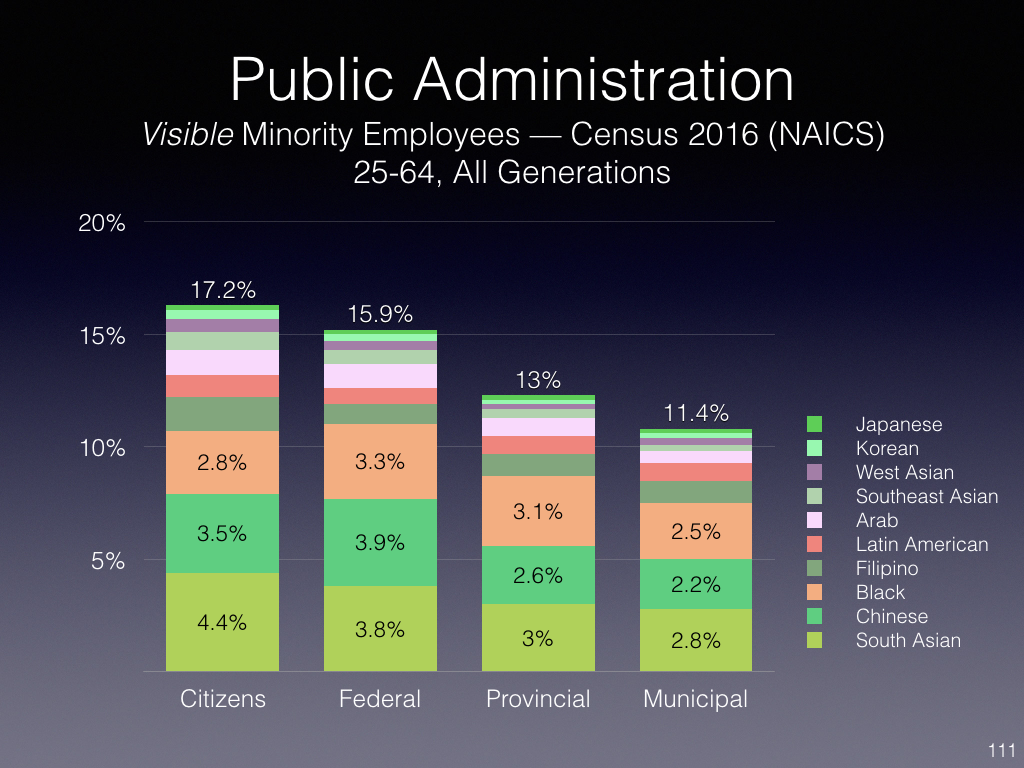
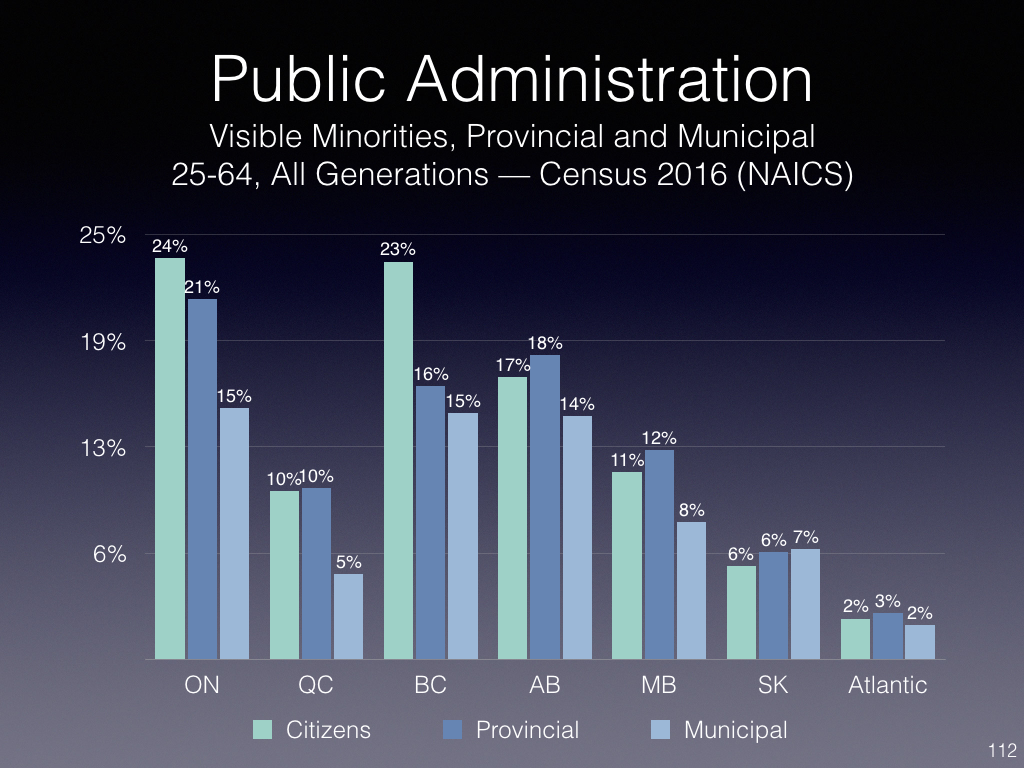
That being said, federal government representation of visible minorities, at 15.9 percent (2016 Census public administration less Canadian Forces, a number slightly higher than the most recent federal employment equity data), is relatively close to the percentage who are also Canadian citizens (17.2 percent, 2016 Census):

Ottawa’s Name-Blind Recruitment Pilot Project was launched in April 2017 to explore whether masking applicants’ names would remove bias in the hiring process for the federal public service. There was a lot to praise in this initiative of the Public Service Commission (PSC). Previous research, including some of our own, has shown that recruiters often react to the name on a resumé, independently of other factors such as education and experience. Our most recent publication (in the March issue of Canadian Public Policy) suggests that much of this discrimination is unconscious and unintentional, so employers actually could benefit from better hires by taking relatively straightforward steps to remove names during the initial stages of the selection process.

One similar and important example is the case of musicians auditioning for positions in popular orchestras in the United States. Traditionally orchestras have been male dominated, and criticized for discriminating against women. Researchers showed convincingly that orchestras that held auditions with the applicants performing behind a screen began to hire more women. Given that auditions are an effective means to observe productivity (music quality), the fact that more women were hired under this method suggests that orchestras previously were missing out on better musicians when gender was known. Most orchestras now audition using screens, showing a desire to avoid discrimination and make better hires. It’s a classic case of win-win-win: a win for women musicians getting more equal opportunity, a win for orchestras tapping a larger talent pool and a win for audiences enjoying better music.

However, the PSC’s hiring bias experiment has yet to yield such positive results. When the project report was released in January 2018, it appeared to show there was in fact “no bias” in federal public service hiring in the first place. This led Treasury Board President Scott Brison to write, “The project did not uncover bias.” National media disseminated this story. The CBC, for example, ran with the headline “No Sign of Bias against Government Job-Seekers with Ethnic-Sounding Names, Pilot Project Finds.” The article states that hiding ethnic-sounding names on resumés was found to have “no real bearing on who’s picked from the pile of applications.”

Unfortunately, this version of the results significantly misrepresents the actual findings of the pilot project. A careful reading of the report indicates that the pilot project was not really designed as a test of discrimination, and the report clearly acknowledged this fact.

The design of the pilot project included two features that would undermine its relevance in assessing the broader use of name-blind hiring. First, the project relied on departments within PSC that volunteered to take part, and within those, job openings were considered for inclusion as they arose; both features introduce a non-random element that undermines the value of the results. Second, and more important, all hiring managers in the project made their decisions knowing that they would be subject to review. For the managers using the traditional method, the awareness that their decisions would be scrutinized and compared with results from name-blind hiring made them more likely to be conscious of bias, and therefore more likely to alter their hiring decisions accordingly.

The procedure in the PSC pilot removed more than the applicant’s name; it also took out all other potentially identifying information — information that might have been useful in assessing the resumé. This was likely why anonymized applications in the pilot were less likely to lead to call-backs.

The report points out that a different study approach used to measure bias, called audit methodology, would have lessened the effect of managers’ awareness of being in a comparative study. Our own study used the audit methodology, in which employers are selected at random and are sent computer-generated resumés for assessment without advance notification. Such a procedure has been employed many times, in a number of countries.

Of course, it’s possible that discrimination against applicants with ethnic-sounding names doesn’t exist in the federal public service. For name-blinding to influence hiring decisions, there must be a problem to begin with. As the report mentions, the PSC is already taking steps to help ensure that the federal government is practising unbiased hiring, and it outlines several important initiatives.

Our research found that bias varies considerably among organizations. We’ve shown in data from Toronto and Montreal that large organizations with over 500 employees practise discrimination against applicants with Asian names about half as often as smaller organizations. This difference may well arise from a tendency for large organizations to have more policies in place to help avoid discriminatory behaviour. The potential benefits from name-blinding may be minimal for the federal government if it is already doing a good job minimizing bias.

However, to conclude that there is no bias in hiring within the federal public service on the basis of the January report — which clearly indicates that the pilot project was not designed to test bias effectively — may move efforts to promote fairness backward rather than forward. There is still a need to follow through on the good intentions that seemed to motivate the name-blind hiring pilot when it was first announced. Ideally, a study on the impact of name-blinding would first identify an organization where clear discrimination occurs, as shown through an audit, and then explore how name-blinding affects the chances of applicants getting an interview, and ultimately getting hired. Tellingly, the report suggested an audit study as a good next step “to improve the understanding of any potential bias during selection of candidates.” In fact, any organization, including the federal public service, that wishes to consider name-blind recruitment as a way to broaden its talent pool would be well-advised to consider an audit as a first step to test for bias.

It can be quite challenging to design an effective name-blind hiring procedure. The procedure in the PSC pilot removed more than just the applicant’s name; it also took out all other potentially identifying information — information that might have been useful in assessing the resumé. This was most likely the reason that anonymized applications in the pilot were less likely to lead to call-backs than traditional applications. One option would be to remove only the name, or only a very limited amount of other information in the resumés that might give away the visible minority status of the applicant. An automated tool for reviewing submitted resumés might be developed to facilitate this approach.

It’s critical that the desire of an organization to burnish its public image not stand in the way of ensuring a fair and equitable process of finding the best candidates for available jobs. It may feel great to say, “We didn’t uncover any bias.” But if bias does exist, it’s better to be able to say, “We found bias and we’ve taken meaningful steps to eliminate it.”

Source: Can we avoid bias in hiring practices?