Australia: Citizenship discount for migrant pensioners, widows scrapped

Migrant pensioners, veterans and widows who receive Centrelink payments will soon have to pay full price when applying for Australian citizenship after Home Affairs minister Peter Dutton removed a regulation that offered them a discounted price.

Most people pay a $285 fee when they apply for citizenship, but disadvantaged pensioners and widows have long been granted a concession rate of $20 or $40.

Mr Dutton lodged a legislative instrument on Thursday last week that removes the concession, effective from July 1. The Greens have already promised to attempt to overturn the regulation when parliament sits next week.

The change mostly affects those who hold a pensioner concession card and receive certain welfare payments, including Newstart, the aged pension, the disability support pension or parenting payments.

The Federation of Ethnic Communities, which represents migrant groups in Australia, is calling for the change to be reversed.

“This is a needless imposition,” chair Mary Patetsos told SBS News.

“It puzzles me why you would want to create a hurdle that makes a resident who is entitled to claim for citizenship choose between paying their bills and applying for citizenship,” she said.

Veterans with pensioner cards who receive income support payments – including payments for aged service, invalidity service or partner service – will also lose their discount, as will some widows who hold health care cards.

The changes will also capture those applying for citizenship a second time, who will now have to pay the full fare with each application.

SBS News asked Mr Dutton to comment on the matter but was referred to the Department of Home Affairs.

A spokesperson for the department said only three per cent of people who applied for citizenship via the entrance test – as opposed to those who became citizens by descent or adoption – paid a concession fee in the past 12 months.

“Australia’s citizenship application fees remain internationally competitive and among the lowest in OECD nations,” the spokesperson wrote.

“The Department is committed to ensuring that application fees remain compliant with the Australian Government Cost Recovery Guidelines.”

Greens move to overturn changes

The changes were introduced via a legislative instrument that amends the Australian Citizenship Regulation, meaning they did not require legislation to pass the parliament.

But the Senate can still move to disallow the motion and overturn it. Last month, the government backflipped on controversial changes to parent visa sponsorship rules after it became clear a disallowance motion was about to pass.

Greens senator Nick McKim said he would move a disallowance motion when parliament sits again next week and called on Labor and the crossbench to support him.

“It’s an incredibly small-minded and vindictive move by this government,” Senator McKim told SBS News on the phone from Hobart.

The senator questioned why the government would close the concessions when only a small number of applicants applied for a discount.

“If it’s correct that this only applies to about three per cent of applicants in the recent past, it begs the obvious question as to why in fact the government is moving forward.”

Ms Patetsos said the change was inconsistent with Australia’s approach to encourage migrants to join the broader community and would impact the most vulnerable applicants.

“We’ve always encouraged new arrivals and migrants to apply for citizenship as soon as they’re eligible and that encouragement shouldn’t be dependent on a capacity to pay,” she said.

Source: Citizenship discount for migrant pensioners, widows scrapped

‘Anything would be better:’ Critics warn Ottawa’s family-reunification lottery is flawed, open to manipulation – The Globe and Mail

Almost comical if it were not for the impact on people. And it should not be surprising, given our immigration system’s emphasis on high skilled economic immigrants, that some of them should have the mathematical and technical smarts to point out the lack of randomness:

Canada’s family-reunification program is using a common spreadsheet application to select candidates as part of a process critics say is flawed and open to manipulation.

As the first step in the program, the federal government uses Microsoft Excel to randomly pick applications in its lottery, The Globe and Mail has learned. Experts have warned that using Excel to conduct such a sensitive lottery could be problematic, and that the lottery process itself may make the system less fair over all.

The Parents and Grandparents Program allows Canadians to sponsor family members for permanent-resident status. The Liberals introduced a lottery in 2017 in an effort to make the system fairer – previously, applications were accepted on a first-come, first-served basis. The program receives roughly 100,000 applications each year and selects 10,000.

Details on the lottery, obtained through an Access to Information request shared with The Globe, show a procedure carried out in just a few steps: Immigration, Refugees and Citizenship Canada (IRCC) uses Excel to assign each application a random number, then takes the first 10,000 numbers.

Excel’s method for generating random numbers is “very bad,” according to Université de Montréal computer-science professor Pierre L’Ecuyer, an expert in random-number generation. “It’s a very old generator, and it’s really not state-of-the-art.” Prof. L’Ecuyer’s research has shown that Excel’s random-number generator doesn’t pass certain statistical tests, meaning it’s less random than it appears. Under the current system, “it may be that not everybody has exactly the same chance,” Prof. L’Ecuyer said.

Excel uses pseudo-random number generators, a class of algorithms that rely on formulas to generate numbers. These generators have a key flaw – they rely on a “seed” number to kick off the mathematical process. In the case of Excel, this seed is generated automatically by the application. “If you know one number at one step,” Prof. L’Ecuyer explained, “you can compute all the numbers that will follow.”

This means the process could be exploited by someone with the right skills. It’s happened before: In 1994, IT consultant Daniel Corriveau discovered a pattern in a keno game – which uses a random numbering system – at the Casino de Montréal and won $620,000 in a single evening. An investigation later determined the game was using the same seed number at the start of each day.

Using more robust generators, such as the ones used for cryptography, may not cost the government much, either. “Cryptographic generators are free. They are on the internet,” Prof. L’Ecuyer said. “Just pick one, you need to know about it and that’s all. It’s not complicated.

“Anything would be better.”

For its part, IRCC is satisfied with its use of Excel, spokeswoman Shannon Ker said in an e-mailed statement. “We stand by this randomized selection process as a sufficient means of equal opportunity for all who look to express an interest in sponsoring their parents and grandparents.”

Others would rather see the lottery scrapped altogether. For the past two years, Igor Wolford, a data-analytics manager at Loblaws, has applied to sponsor his parents in Russia. He hasn’t made it past the lottery stage, and recently started a website to petition the federal government to abandon the system.

Mr. Wolford has corresponded with members of Parliament about his concerns. “I actually prepared an Excel sheet showing how random processes work,” Mr. Wolford said. “After 10 years of selection, only half of people who were eligible 10 years ago would be selected.”

Number of people from an original pool of 95,000 applicants who haven‘t made it past the lottery stage
Assuming 20,000 new applicants each year and 10,000 applicants selected each year

https://s3.amazonaws.com/chartprod/cZByyEpAhKuPixSBk/thumbnail.png 

Although the lottery selects roughly one in 10 applications, the number of people who pass additional vetting and ultimately make it into the program is far lower.

“Last year, they selected the original 10,000 people [during the lottery], but only 6,000 people actually [made it into the program],” Mr. Wolford said. This is partly be cause the lottery is the first step in the process, meaning anyone can fill out the form.

IRCC responded to these complaints in 2018 by including a self-assessment screening for applicants. However, the questions are still optional, as one Twitter user noted.

When told the lottery was conducted in Excel, Mr. Wolford wasn’t surprised. “That’s a very sad process. It’s easily manipulatable,” he warned. According to IRCC, the process is double-blind, and to date there is no indication the system has been manipulated.

“The process has become unpredictable,” Mr. Wolford said. “Before, you knew that it would take seven years from start to finish, and you could plan your life. Right now, you don’t know if it will happen this year, in five years, in 15 years.”

“Because it’s a lottery, you might never be selected.”

via ‘Anything would be better:’ Critics warn Ottawa’s family-reunification lottery is flawed, open to manipulation – The Globe and Mail

American Muslims on Trump’s iftar: Thanks, but no thanks

Appropriate non-attendance:

A scene from the horror movie “Get Out.” A moment of bloody betrayal — the dreaded Red Wedding — from HBO’s “Game of Thrones.” A medieval painting depicting a huge mouth devouring people as they eat.

On Wednesday, President Donald Trump’s White House will host its first iftar, the sundown meal that breaks fasts during the holy month of Ramadan. For some American Muslims, it’s also time to break out the horror-movie memes.
White House press secretary Sarah Huckabee Sanders said “30 to 40” people had been invited to the iftar, though Trump administration officials haven’t yet released a guest list or divulged many details about the event.
On Wednesday, a White House spokesperson said Trump will host the iftar dinner in the State Dining Room at 8 p.m. ET “for the Washington diplomatic community.”
In years past, White House iftars have invited not only diplomats but dozens of American Muslims from civil society, including corporate executives, scholars, activists and athletes.
But many American Muslims say they are reluctant to break bread with Trump, citing the President’s rhetoric and actions toward Muslims and other religious and racial minorities.
“We do not need an iftar dinner,” said Imam Yahya Hendi, the Muslim chaplain at Georgetown University. “Rather, we need to get the respect we highly deserve. Do not feed us and stab us.”
Hendi attended a White House iftar in 2009, when President Barack Obama was in office. He said he was not invited this year. Like many prominent Muslims who have attended previous White House iftars, Hendi said he would not attend if invited this year.
Many American Muslims said they suspect Trump’s iftar is aimed at placating the country’s allies overseas, rather than making genuine connections with their community, with whom the president has had a troubled relationship.
“I was not invited to the White House iftar, but I would not attend if I were,” said Dalia Mogahed, director of research at the Institute for Social Policy and Understanding.
“Attending this event, especially during the holy month, a time of introspection and spiritual growth, would be inappropriate in my view as it would appear to normalize this administration’s behavior.” …

Source: American Muslims on Trump’s iftar: Thanks, but no thanks

Québec solidaire dévoile sa politique en matière d’inclusion

Quebec does not require Canadian citizenship as a pre-condition (Permanent Residents acceptable), nor make it a preference as does the federal government. Hence the overall number of visible minorities is a valid benchmark although I would still argue a more realistic one would the visible minority citizenship benchmark (9.9 percent):

Le Québec a un tel retard à corriger en matière d’inclusion qu’il faudrait que le secteur public se fixe un taux d’embauche de 25 % au sein des minorités visibles et ethniques jusqu’à ce que celles-ci représentent 18 % de la main-d’œuvre, affirme Québec solidaire (QS).

Convaincu d’un « coup de barre » à donner, le parti a dévoilé dimanche une politique qui, s’il était porté au pouvoir, prévoirait aussi la création de « Carrefours d’accueil en immigration ». Ceux-ci joueraient un rôle de « guichet unique » permettant d’orienter les nouveaux arrivants vers des services comme l’aide à l’emploi ou des cours de francisation.

« C’est là que le Parti libéral, qui est là depuis 15 ans, a le plus échoué : face aux nouveaux arrivants et arrivantes, face aux gens de la diversité culturelle, des minorités visibles », a dit la députée de Sainte-Marie–Saint-Jacques, Manon Massé, lors de la présentation de la politique dimanche en compagnie du député Amir Khadir, d’Andres Fontecilla, qui se présentera dans Laurier-Dorion, et de plusieurs autres candidats.

« Dans la fonction publique, il y a des règles. Elles sont à peine respectées. D’ailleurs, il manque énormément d’employés issus de la diversité culturelle au sein du secteur public », a ajouté Mme Massé. « Il faut un coup de barre. » Québec solidaire souhaite que le taux de représentation des communautés culturelles soit le même que dans la société, soit d’environ 18 %. D’ici 2024, la fonction publique devrait embaucher un « minimum » de 3750 personnes, a-t-elle dit. Le parti politique souhaite aussi travailler à la reconnaissance des compétences de l’étranger.

En mars 2017, les communautés culturelles comptaient pour 9,4 % des employés du secteur public, selon le Secrétariat du Conseil du trésor. Le gouvernement Couillard a déjà affirmé que le taux d’emploi des immigrants qui sont au Québec depuis plus de dix ans (81,9 %) est inférieur à celui des gens nés au Canada (86,2 %).

À quelques mois des élections, les annonces se succèdent. Le gouvernement Couillard a récemment annoncé une stratégie de la main-d’œuvre 2018-2023 qui promet une somme de 1,3 milliard sur cinq ans. Le plan insiste sur la francisation, mais aussi sur la réduction des délais dans la remise des certificats de sélection.

Le Parti québécois a proposé il y a deux semaines de travailler sur la sélection des immigrants en fonction notamment de leur connaissance du français. Il souhaite aussi qu’ils choisissent de s’installer pas seulement à Montréal, mais en région.

Du côté de la CAQ, des documents révélés récemment par L’actualité montrent que le parti veut mettre un accent particulier sur la francisation et souhaite réformer « en profondeur » le ministère de l’Immigration.

Outre les investissements supplémentaires en francisation, QS souhaite impliquer les entreprises. Par exemple, l’application de la loi 101, qui vise actuellement les entreprises de 50 employés et plus, couvrirait désormais les sociétés de 20 employés et plus.

Source: Québec solidaire dévoile sa politique en matière d’inclusion

Fixing a broken culture: public service in the wake of Phoenix

Good representative set of comments. Minister Brison has a valid point: service delivery is a very poor cousin compared to policy and communications, with most senior execs having moved up the ladder largely on their ability to deliver on policy:

In no uncertain terms, auditor general Michael Ferguson laid bare last month his belief that a “broken government culture” enabled the Phoenix pay system fiasco to play out, despite bureaucratic safeguards that should have been enough to prevent the failure.

However, after explaining the “why” of Phoenix — “an obedient public service that fears mistakes and risk,” unwilling or unable to hear and convey “hard truths” — in a message accompanying the audit of its building and implementation, Ferguson left it up to the federal government to puzzle out a remedy.

That solution depends on who you ask.

THE FORMER PBO: New leadership needed Kevin Page, president and chief executive of the Institute of Fiscal Studies and Democracy at the University of Ottawa, proposed a stark fork in the bureaucracy’s road forward. “You either get rid of the top echelon of the public service — all the deputy ministers in the central agencies go, and replace them with a new group that we feel confident have the competency and the values and make sure that this stuff won’t repeat over and over again, or we just wait for the next generation.” Page, who served as Canada’s first parliamentary budget officer, and at various central agencies during a 27-year federal public service career, called Phoenix a “failure of values.” While they might not always be emphasized, he said, qualities such as integrity, stewardship and excellence comprise a public service “code.”

In his eyes, the negligence of executives charged with the Phoenix project — cancelling a pilot run, pressing forward without an adequate contingency plan — speaks to a deeper disregard for the values that should underscore public service. “It’s not just a few project managers. It cuts right through all the work that’s done by senior managers and central agencies who are responsible to support decision-making and oversight for the executive,” Page said. “There’s going to have to be new leadership in the public service.” While the current cadre of senior executives could ostensibly have a “come-to-Jesus moment” in which a post-Phoenix reckoning leads to commitment to examine these underlying values, Page said he’s not hopeful. Despite the AG’s self-professed “bleak” assessment of its workplace culture, Page said he works with many students who continue to aspire to public service. In fact, he said, it’s possible that this recent bit of bad press could actually spur on those who believe they can be part of a culture and values shift in the bureaucracy. “The time to buy is when the market is low,” Page quipped.

THE EXECUTIVES: It’s time to move forward The head of the association that represents the more than 6,000 executives — typically directors and above — in the federal public service, sees things very differently. “The executive community is as frustrated as any other group with this, and we’re being tarred with a brush with respect to Phoenix,” said Michel Vermette, CEO of the Association of Professional Executives of the Public Service of Canada.

The auditor general made some important recommendations, Vermette said, including the need for project oversight and independent review mechanisms for government-wide IT projects — to which Public Services and Procurement Canada and the Treasury Board of Canada Secretariat have agreed for all such projects, moving forward. Ferguson’s comments about public service culture have also provided a “good reminder” to executives about the nature of their job — to provide advice to ministers, and implement the decisions those ministers ultimately make, according to Vermette. But after two AG reports and an independent study by the Goss Gilroy Inc. consulting firm, Vermette said, it’s time to move forward, implement the audits’ recommendations, and work on fixing the pay problems Phoenix has given rise to. He rejected calls from the Public Service Alliance of Canada for a public inquiry into the project’s failure, and a freeze on executive performance bonuses until employee pay issues are resolved. “That’s damning an entire community of people who are working hard to make sure their staff get paid, but have little control over the system.”

THE PUBLIC SERVANTS: A public inquiry Meanwhile, PSAC national president Chris Aylward says a national public inquiry into Phoenix is the public service’s only hope for changing the culture of “incomprehensible failures” that Ferguson cited. PSAC, the largest union representing federal public-sector workers, will submit a formal request for an inquiry in the coming weeks.

“We need people to be compelled to come and testify under oath to say exactly what had happened,“ Aylward said, describing a culture that often discourages public servants from speaking out about perceived or possible flaws. “I think the broader issue is that workers don’t want to come forward and say, ‘Hey there might be an issue here,’ because they’re afraid of reprisal. “Then, a lot of times, the senior bureaucrats at the deputy level or the assistant deputy level, they don’t want to hear it because they’ve got the political pressure coming down from their ministers and from parliamentarians saying, ‘This has to get done,'” Aylward said.

THE EXPERT: Change the reward structure The subjugation of the bureaucracy by political priorities was among Ferguson’s grim observations about what ails today’s public service. It’s something Christopher Stoney, an associate professor at Carleton University’s School of Public Policy and Administration, has observed. “When it comes to culture, it seems to be very top-down as a hierarchy,” he said. “It cascades down from the political priorities and timing to the managerial, then it goes down to the public service themselves, who are then under pressure to try and meet these deadlines, which may be unrealistic.” With Phoenix, Ferguson pointed out that executives were “more focused on meeting the project budget and timeline than on what the system needed to do,” as evidenced by decisions such as removing pay processing functions from Phoenix, compressing the project schedule and reducing the number of employees assigned to it, rather than asking for more time or money. Stoney said this kind of perversion of priorities is enabled in part by the reward system in the public service. “I would do away with performance bonuses, I think it gets too much tied into what we call goal displacement, so the people start trying to achieve things for the wrong reasons and the public interest gets lost because of self-interest and short-term thinking.” In 2015-16 — the most recent period for which figures are posted by the Treasury Board of Canada Secretariat — more than $75 million was spent on performance pay for nearly 5,500 executives. The value of the Phoenix experience, Stoney said, lies in the insight it has offered into the public service culture. “There are some projects that are so important, so big, and so time-sensitive vis-à-vis elections,” that the cracks start to show, and what lies beneath is laid bare and talked about. “Otherwise how the heck do we know what it is?”

TREASURY BOARD PRESIDENT: Tend to the plumbingThis underlying “plumbing of government,” said Scott Brison, president of the Treasury Board, is what his government has been working to improve since taking office in 2015. “The two shiny objects to which people are attracted in government are usually policy and communications,” the longtime parliamentarian said. The Liberals, according to Brison, are delving deeper.

“We have taken and continue to take concrete actions to strengthen the culture of the public service, and to encourage a culture of experimentation and innovation,” evidenced, he said, by such policies as the “unmuzzling” of government scientists and new standards for government digital projects. According to Brison, the public service needs to look less hierarchical, more agile and innovative in its approach to problem-solving and citizen engagement, and more enticing to millennials. As for why the Phoenix failure was not averted under his government’s tenure — the auditor general held accountable both the previous Harper Conservative government under which Phoenix was first approved, and the current Liberal government for the decision to green light the pay system’s launch — Brison said culture change doesn’t happen overnight. “We have made significant changes in the last couple of years, but we have a lot of work to do.” “We feel actually the auditor general’s report helps reaffirm that we are heading in the right direction.”

Source: Fixing a broken culture: public service in the wake of Phoenix

Indigenous rights are not conditional on public opinion: Pam Palmater

As is the case with all rights:

In 2017, Abacus Data, in partnership with Equal Voice, released the findings of their nationwide survey about Canadians’ views on women in politics. The majority of those surveyed—58 per cent—believed that there are just the right number or too many women in politics—this, despite the fact that women hold only 25 per cent of the seats in the House of Commons, and in provinces like New Brunswick, women make up as little as 16 per cent of the seats.

It’s a galling dissonance, but the premise of the question also feels frankly immaterial to how change is made. How relevant is it that Canadians think this dismal representation of women in government is either enough or too much female representation, when laws and policies in Canada specifically advocate for gender equality and protect against gender discrimination? How much should public opinion matter about whether Canadians agree with gender equality, when it is in fact the law? After all, if women had to wait for all men in Canada to agree with or like women’s equality, we might still be waiting. Women had to agitate for change. It’s never convenient to the comfortable, and discomfort polls poorly—but it’s the only way it happens.

The same thing might also be said about public opinion on Indigenous rights in Canada. The most recent Angus Reid public opinion survey, which polled 2,500 Canadians about their views on Indigenous peoples generally, and Indigenous public policy specifically, exposes a deep divide in opinion. A slight majority (53 per cent) feels that Canada spends too much time apologizing for residential schools and another 53 per cent think Indigenous peoples should integrate into Canadian society and have no special status—even if that means losing Indigenous cultures and traditions. Yet these are the very same attitudes held by former prime ministers and administrators of Indian Affairs that led to assimilatory policies like residential schools.

Therein lies the stark contradiction: Canadians feel we apologize for residential schools too much, and yet exhibit the same racist attitudes for which the apology was made.

Former Prime Minister Stephen Harper made a formal apology in the House of Commons on behalf of all Canadians on June 11, 2008 for the harms done in residential schools. It said, in part: “Two primary objectives of the residential schools system were to remove and isolate children from the influence of their homes, families, traditions and cultures, and to assimilate them into the dominant culture.  These objectives were based on the assumption Aboriginal cultures and spiritual beliefs were inferior and unequal. Indeed, some sought, as it was infamously said, ‘to kill the Indian in the child.’  Today, we recognize that this policy of assimilation was wrong, has caused great harm, and has no place in our country.”

In other words, the idea that Indigenous peoples should abandon their own cultures and assimilate into Canadian culture is an idea that “has no place in our country.” Yet, a decade after the apology, half of the Canadians polled still hold these racist views. This is not surprising when many political leaders and media commentators have espoused similar racist views or denied racism exists altogether. Even Angus Reid himself seems to have difficulty accepting the racist undertones of his poll’s findings; he says he does not consider the Canadians who hold these ideas to be “racist,” but instead “hardliners” who don’t think more money is the answer to growing poverty in First Nations. It’s a surprising conclusion given the over-abundance of research and data that shows just the opposite.

In addition to the crippling economic legacy left behind by the colonization of Indigenous lands and resources, broken treaties, and rigid federal control over reserves, Canada’s gross underfunding of First Nation social programs is in fact the major contributor to First Nation poverty today. One need only read any of the auditor general’s reports to show that Canada has been underfunding essential social services like education and housing for decades. Dr. Cindy Blackstock, the head of the First Nation Child and Family Caring Society, won her discrimination case against Canada at the Canadian Human Rights Tribunal, which found that Canada’s purposeful and chronic underfunding of child and family services in First Nations was racial discrimination and a direct cause of the over-representation of First Nations children in foster care. This underfunding across all social programs is so comprehensive and so severe, that even if the racially discriminatory funding stopped this year, it would take decades to close the socio-economic gap. This isn’t a matter of public opinion—it’s a fact.

While many Canadians may feel that they are reminded too often about what happened in residential schools, it seems that in fact, they are not reminded enough. The Truth and Reconciliation Commission’s final report concluded that Canada was guilty of genocide—not just cultural genocide, but physical and biological genocide as well. Canadians should never forget what their country did to Indigenous peoples. Scalping bounties, smallpox blankets, forced sterilizations, and starvation policies were all part of Canada’s genocidal policies towards Indigenous peoples that, in addition to residential schools, have a lasting legacy in First Nations.

Real reconciliation is also about truth and justice. The truth requires never forgetting the rapes, tortures and deaths of thousands of children in residential school, and justice requires putting an end to the racist attitudes that allow these human rights abuses—in the form of foster care—to continue today. The same is true about historic and contemporary violence against Indigenous women and girls.

Reconciliation also requires the end of the idea that the future existence of Indigenous peoples and their identities, languages and cultures are up for debate. We have a right to exist as Mi’kmaw, Mohawk and Cree. We have a right to govern ourselves. We have a right to our lands and resources. We have a right to enjoy our Aboriginal and treaty rights. Our ancestors paid dearly for these rights. All of these rights are protected in Indigenous, Canadian and international laws. These rights form part of Canada’s founding document—the Constitution Act, 1982. Canadians do not get celebrate their own constitutionally protected rights and freedoms without recognizing ours. Our rights are not conditional on public opinion.

It’s long past time that pollsters stop asking Canadians if they like Indigenous peoples or agree with our rights—and start asking them whether they feel like they’ve put Canada’s apology into action.

Source: Indigenous rights are not conditional on public opinion

The Trump Administration Is Driving Away Immigrant Entrepreneurs: The Atlantic

Good long read on the impact of short-sighted US immigration policy changes:
In late May, the Department of Homeland Security announced its plans to rescind the International Entrepreneur Rule, an Obama-era provision that allowed foreign-born entrepreneurs to stay in the United States for up to five years to expand their businesses, granted they could prove their companies’ potential for rapid business growth and job creation. The announcement came as no surprise, given the Trump administration’s rollback of other executive orders issued during Obama’s presidency, and earlier hints the administration would cancel the rule. But it dealt a particular punch to those who saw the rule as a gateway toward a long-held goal: a start-up visa, which would create a pathway to legal immigration for foreign-born entrepreneurs, thus drawing the best founders to the United States and improving its competitiveness at a time when other countries are launching more and more lucrative start-ups.Immigrants are nearly twice as likely as American-born citizens to start businesses in the United States, according to the Kauffman Foundation, a nonprofit that promotes entrepreneurship. Fifty-one percent of all U.S. start-up companies valued at $1 billion—the so-called unicorns—have at least one immigrant founder, according to the National Foundation for American Policy, a nonpartisan public-policy research organization. But historically, there hasn’t been an immigrant-visa category tailored for entrepreneurs. Mike Krieger, the Brazilian-born co-founder of Instagram, came to Stanford University on a student visa before transitioning to a skilled-worker visa. The Google co-founder, Sergey Brin, was a child when his family immigrated to the United States from the Soviet Union as refugees. Elon Musk, the founder of SpaceX and co-founder of Tesla, first immigrated from South Africa to Canada in order to eventually immigrate to the United States.

During the Obama administration, lawmakers began pushing for a start-up visa and seemed to be gaining some traction. In August 2016, the Obama White House announced the Department of Homeland Security would propose the International Entrepreneur Rule. Hillary Clinton advocated for a start-up visa as part of her platform. Now, the death of the International Entrepreneur Rule—and, relatedly, the stalling of the start-up visa—have foreign-born entrepreneurs in the United States grappling with whether to stick it out or just leave. Silicon Valley, too, is coming to terms with losing the competitive advantage it took for granted for so long. For some, it’s the latest evidence that Donald Trump, who became president on a promise to revive the American dream, is, in fact, chipping away at it.

In the early 2000s, a person I’ll call Gyan (who requested that his real name not be used in order to protect his immigration status in the United States) considered his options. He could stay in his home country, in Asia, and pay to attend a top university, as most people do. Or he could go to the United States, where, he thought, he could create a path toward a better future. The decision was clear, and he came to the United States. Gyan applied to Stanford University, which offered him an excellent financial-aid package. He accepted immediately.

During Gyan’s senior year, an entrepreneurship class motivated him and two other students to start a company. Their product, a productivity tool, never took off, but the experience gave him the entrepreneurship bug. Gyan’s student visa allowed him to stay for a year after graduating to pursue practical training. So, he started working for various start-ups, practiced writing code in his downtime, and met fellow ambitious techies at cafes around Silicon Valley: Red Rock Coffee in Mountain View, Starbucks on Stanford Avenue.

Not being a U.S. citizen, Gyan stayed in the country by securing an employee-sponsored H-1B visa through a job as a software engineer. “Ultimately I think I was just really aching to make things happen, to build things,” he told me. He started to tinker with new product ideas after work.

Around that time, Silicon Valley investors and entrepreneurs started lobbyingfor a start-up visa. In 2010, Senators John Kerry and Richard Lugar introduced the bipartisan Startup Visa Act, the first legislation of its kind to propose a visa category for international entrepreneurs. Recognizing the catch-22 of company founders being unable to sponsor themselves for visas, the act would allow a foreign-born entrepreneur to receive a two-year visa, and then be eligible for a green card, after proving job creation and acquiring $1 million in investment capital or revenue. The proposal was beloved within the tech community. But the bill, and subsequent iterations of it—including the popular Startup Act, which includes a start-up visa as part of other provisions aimed at helping the start-up industry—didn’t gain enough traction in Washington, D.C. “Nobody was committed to championing it,” said Craig Montuori, a partner at Venture Politics, a public-affairs consulting firm based in Silicon Valley, who lobbied for the start-up visa. Most people didn’t consider it a crisis; other foreign-born start-up founders had made it work, hadn’t they?

Back in the Bay Area, that’s what Gyan kept telling himself. In 2015, he built a prototype for another start-up, this time related to hospitality management. Gyan and his co-founder soon landed a meeting with a well-known incubator. The investors didn’t ask about his immigration status, but, to Gyan, it was the elephant in the room. When they ultimately didn’t invest, Gyan couldn’t stop thinking about how his immigration status might impact his success as an entrepreneur. He can’t remember the exact questions asked during the meeting, but they were along the lines of: Why haven’t you quit your job to work on this? Are you willing to quit your job? “They want to invest in someone who can work on this full-time,” Gyan said. But if Gyan quit his job, he’d lose his H-1B visa—his gateway to staying in the United States. He couldn’t.

Around October 2016, Gyan was reading the news when he came across an article about the International Entrepreneur Rule. The rule, inspired by the Startup Act, created a special immigration status for foreign-born start-up founders. When the rule was finalized, in January 2017, Gyan inspected the requirements: Have a young company, and own a substantial interest in it. Have either $250,000 or more from qualified U.S. investors with a history of successful investments, or $100,000 or more from government entities, or other compelling evidence of the start-up’s potential for growth and job creation.*The IER would go into effect in July 2017. The DHS estimated about 2,940 entrepreneurs would be eligible for it each year, although one immigration attorney in Silicon Valley, Sophie Alcorn, told me she believes that’s a vast understatement, and that applications could have reached 10,000 or more given the excitement around it. The prospect of one day applying for the IER energized Gyan, and he was out the door again, networking with people and trying out new ideas. Every foreign kid with an entrepreneurial streak was eyeing the IER, he said.

But in July 2017, less than a week before the rule was set to start, the Trump administration delayed it and announced its intention to eventually rescind the rule. In December 2017, after some legal wrangling over the delay, U.S. Citizenship and Immigration Services (USCIS) announced in a press release it would begin accepting applications under the IER, and gave directions for how to apply—but added that it still planned to remove the rule. Finally, late last month, the DHS proposed to formally eliminate the IER, arguing it was too broad and didn’t protect U.S. workers and investors enough, and that other visa categories were available to foreign-born entrepreneurs.

Doug Rand, a former White House official who helped implement the IER during the Obama Administration and has since co-founded Boundless Immigration, which helps families navigate the U.S. immigration system, argues these other visa categories would be extraordinarily difficult to obtain for people from certain countries, or would require proof of current accomplishments rather than future promise. “For an administration that can’t stop talking about those that come in based on merit,” he said, “why would you torpedo a program that can benefit the super qualified?”

The rule had yet to make much of an impact. A spokesperson for USCIS said it has received about 12 applications for IER but hasn’t issued any final decisions. Brad Feld, an investor and an entrepreneur who advocates for a start-up visa, blamed the low numbers of applicants on the administration’s chilling actions. “Not surprisingly, the Trump White House stated relatively early on that they wanted to kill it. The second they did this, they made it unattractive to anyone, as the risk of it vanishing one day unexpectedly made it an extremely high-risk option,” he said. “It’s a self-fulfilling prophecy—if the current administration won’t support it, it’s not an attractive option.”

Meanwhile, since lawmakers in the U.S. first introduced the start-up visa eight years ago, other countries have followed their lead: Australia, Canada, Chile, France, Germany, Ireland, Israel, Italy, Japan, New Zealand, Portugal, Singapore, Spain, and the United Kingdom now all have versions of a start-up visa or other initiatives to bring in foreign workers.*

Silicon Valley may have written the script for how to build a start-up, but those practices are now global, said Natalie Novick, a sociologist and an ethnographer at the University of California at San Diego who studies start-up ecosystems around the world. Ten years ago, nearly 75 percent of the world’s venture-backed funding flowed into the United States; in 2017, the United States received 45 percent. Meanwhile, investment has grown enormously in Asia—especially in China, which now rivals the United States in VC funding and has three of the world’s five most valuable unicorns. India trails other countries in venture-capital flow, but when the United States denied Kunal Bahl, an Indian-born co-founder of the online retailer Snapdeal, an H-1B visa after he graduated from the University of Pennsylvania’s Wharton School, he returned to his home country and helped create more than 5,000 jobs with his new company.

As immigration reform remains at a standstill, and the Trump administration eyes even more restrictionist immigration policies, many in Silicon Valley are worried the United States is losing its competitive advantage—just what they were hoping to guard against with a start-up visa. In May, the Stanford Graduate School of Business’s career center hosted a “Working in Canada” event—organized largely because of student panic about jobs and visas, said Maria Pasos-Nuñez, the business school’s associate director for international-student career development. In addition to canceling the IER, the Trump administration has unveiled a new draft policy that may make it easier to force international students to leave if they’ve violated the terms of their visa. It also recently declared it wants to reform the popular practical-training programthat gives foreign students a year or more to stay in the United States and work after college. Participation in the program grew by 400 percent among graduates with STEM degrees from 2008 to 2016, according to the Pew Research Center; it’s widely considered a pipeline that helps international students to eventually become U.S.-based entrepreneurs. While some people speculate the administration may eliminate the program altogether, Carissa Cutrell, a public-affairs officer for ICE, said the exact reforms to the program are still under discussion.

Veronica Zhou, a 35-year-old Chinese native who immigrated to Canada and became a citizen there before enrolling at Stanford, helped organize the Working in Canada event. Zhou has it a little easier than some of her peers if she wants to stay in the United States, thanks to a visa available to Canadian citizens through a provision of the North American Free Trade Agreement. But she’s already networked in China, France, Israel, and Peru; while she once idealized life in Silicon Valley, she’s now not sure she wants to stay. Zhou has found that hiring people for new ventures in the United States is becoming more difficult—especially when it comes to international talent, she said, because many foreign-born workers in the United States prefer the stability of securing a visa through an established corporation to joining a start-up. And fewer international students are coming to study in the United States in the first place. “Everyone on campus will have to face the decision of whether we stay here or leave,” Zhou told me. “That’s what we think about and worry about every day.”

When Gyan heard the news that the IER collapsed, he felt disappointed—though not entirely surprised. He tried to put things in perspective. Families are being separated and sent back across the border. I have nothing to complain about, he told himself. He repeats the upbeat mantras the industry is famous for: As an aspiring entrepreneur, if you get let down and upset, maybe you shouldn’t be in the field. You have to be resilient.

Now 31, Gyan has studied and worked in the United States for 13 years. He is still committed to starting a business, though he’s currently too preoccupied with interviewing for a new job to try to execute any of his ideas. He doesn’t want to waste away as a forever employee in the United States. But his H-1B visa is expiring soon, and he’s reached the maximum number of years he can be on the visa. So along with finding a new job that, he hopes, will sponsor a green card that will allow him to stay in the country as a legal permanent resident, he’s consulting his friends in the business community about the next best visa option.

Private U.S. initiatives focused on international entrepreneurs have emerged, including residency programs at universities and a venture-capital firm aimed at immigrant-founded start-ups. Gyan could also move to another country to be an entrepreneur if need be. He lists the other options off the top of his head: Canada, Germany, Chile. “There are so many people in this country who invested in my future,” Gyan said. “Universities teach these kids from abroad, they inspire them, they invest in them. But then, at this point, there is another group of people who want to shut them down.”

Source: The Trump Administration Is Driving Away Immigrant Entrepreneurs

Denmark swings right on immigration – and Muslims feel besieged

Disturbing trend:

“It’s a lovely place,” says Jens Kramer, as he gazes across the harbour from his seat outside the wooden shed that serves as Holbæk’s boat club. “But I think people here are becoming more and more hostile to foreigners and I’m not proud of it. It’s not the Holbæk I love.”

Kramer is not alone in thinking that the tone of Denmark’s immigration debate has changed. In recent years, the rise of the rightwing anti-migrant Danish People’s party has led to previously radical positions becoming mainstream. And the country’s Muslim population in particular feels under siege. Earlier this month Danish MPs passed a law that, in effect, bans the burqa. It imposes a penalty of 10,000 kroner (£1,200) for repeat offenders.

In another move greeted with dismay by Denmark’s Muslims, a citizen’s proposal to ban the circumcision of children got the 50,000 signatures it needed to go to a parliamentary vote.

In Holbæk, an attractive small town in Zealand, the latest legislation has had a mixed reception. Kramer says: “On the burqa ban there were people who said, ‘if they make it law, then I’m going to leave’, and I said ‘OK, then leave.’” His companion Hanne Madsen chips in: “Jens and me, we are those who say: ‘If you have a problem come to me, but if you don’t want to take off your burqa or try to learn Danish…’” She throws up her hands in exasperation.

The ban was backed not only by both the ruling centre-right Liberal party but also by the centre-left Social Democrats, whose rhetoric on Islam has started to rival that of the populist right in the last two years.

The Social Democrats’ leader, Mette Frederiksen, has called Islam a barrier to integration, said some Muslims “do not respect the Danish judicial system”, that some Muslim women refuse to work for religious reasons, and that Muslim girls are subject to “massive social control”. She has also called for all Muslim schools in the country to be closed.

Emrah Tuncer, a local politician for the pro-immigration Social Liberal party, worries about where the two main parties’ rhetorical race to the bottom will lead. “They are almost fighting about who has the most extreme ideas,” he said. “With the burqa ban we’re talking about 40 people who are wearing it. Our government is making laws for just 40 people! And these 40 women will now be trapped in their homes from morning to evening. Does it help them? It does not.”

The day before we met, Tuncer’s party formally ended its 25-year electoral partnership with the Social Democrats over the party’s rightward turn on Islam and immigration. “I think it’s very ugly that the Social Democrats have become so extreme,” he says. “They’re worse than the [far-right] Danish People’s party.”

But he concedes that the party’s shift over the past two years has come in response to a change in public opinion. “They’ve smelt votes on this one,” he says. “It’s moved in Holbæk, like in the whole of Denmark, from: ‘Let’s help people even if they’re Muslims or immigrants’, to: ‘We have to take care of Danish people first.’”

Tuncer attributes the shift in mood to the rise of the Islamic State terror group and the refugee crisis. “It’s because of terror: 150 Danish citizens went to Syria to fight with Isis,” he said. “And of course the refugees cost a lot of money at the same time as, in Holbæk, they didn’t didn’t have money to buy paper for schools, or markers to write on the whiteboards.”

Stig Hjarvard, a professor of media at the University of Copenhagen who last year co-wrote a paper on Scandinavian attitudes to Islam, believes the antagonism goes further back. According to Hjarvard, it began with Danish troops’ involvement in the Nato-led invasion of Afghanistan in 2001, grew with the US-led invasion of Iraq in 2003 and was further fuelled by the reaction to publication of cartoons of the prophet Muhammad in the Jyllands-Posten newspaper in 2005.

He also thinks that the kingmaker position that the populist Danish People’s party has enjoyed in politics recently is important. “That has of course meant that their policies in terms of immigration have spilled into the agenda of the other parties: not only the Liberal party, but also the Social Democrats. That has consistently put immigration on the agenda. It’s immigration in general and it’s Muslim immigration in particular.”

Outside Tuncer’s cafe, a couple of women in Islamic headscarves are browsing in the shops, but Holbæk is more ethnically homogenous than Denmark’s major cities. Tuncer’s brother Hikmet, who is chairman of the local mosque, says he’s not aware of anyone who wears the burqa or niqab. “I think here, it’s a bit more white and Danish,” says Dennis Petersen, who is in the harbour working on his traditional galeas schooner. “In Holbæk, it seems like we have this ghetto. They’re locked in. You don’t see them.”

Madsen refers disparagingly to Agervang, a housing estate just outside the centre. “We have this ghetto where people are talking: ‘Bap, bap bap,’” she says, miming people babbling in a foreign language with her hands.

Mina, 30, has lived in Agervang all her life after her parents came to Denmark from Turkey as children. “I think it’s so sad they call it a ghetto,” she says.

“Do you know how many lawyers, doctors and engineers have come out of these blocks? I see so many people studying, trying to become part of this country, but suddenly we’re not good enough just because we don’t eat pork.”

When she went to school, she says, teachers and other pupils were sensitive to the fact that she was a Muslim without it being a big deal. “But I went to a kindergarten for my son, and the first thing they said is: ‘Are you a Muslim?’ The very first thing! I’m a human being.”

She is particularly incensed by the recent call from Inger Støjberg, Denmark’s hardline immigration minister, for all Muslims to take holidays during this month’s Ramadan fast “to avoid negative consequences for the rest of Danish society”.

“I don’t know what this lady is doing,” Mina says. “I can’t take a vacation just because I’m fasting. It’s so ridiculous.”

Istahil Hussein, 36, says the change in Danish opinion so disturbing that she is thinking of returning to Somalia, the country she left 18 years ago. “You listen every day [about] Muslims doing this, Muslims doing that. It’s not good,” she says.

“I think about what’s coming in the future, because Denmark 10 years ago, was not talking about Muslims. If Somalia is good I will go home. I will go back like this,” she laughs, and snaps her fingers.

Each month, Holbæk council holds a meeting of its advisory committee on integration. Tuncer is a member, as is Derya Tamer, a Social Democrat councillor with a Turkish background. Tuncer thinks both the Social Democrat and Liberal groups on the town council are split on immigration. And he does not think that Christina Krzyrosiak Hansen, the town’s Social Democrat mayor (and at 25, Denmark’s youngest) backs her party’s hardline stance.

“I believe she doesn’t think this position is the right one, but she can’t do much about it,” he says.

He says he has challenged Tamer on Facebook to respond to her party’s hardline position on Islam, but without any success. “I don’t understand Muslim Social Democrats. Everybody is silent. We don’t hear them,” he says. “When they joined the party, [it] didn’t say this about Muslims, so how can they just sit there and applaud?”

He wonders when or if a breaking point will come. “Now the Danish People’s party are saying that all schools and kindergartens should have to serve pork once a week,” he says. “That’s not only not liberal, it’s crazy.”

Source: Denmark swings right on immigration – and Muslims feel besieged

USA: Documents Show Political Lobbying in Census Question About Citizenship

Not surprising. Echoes of the Conservative government’s approach to the 2011 Census/National Household Survey:

Documents released in a lawsuit attempting to block the inclusion of a question about citizenship in the 2020 census show lobbying by anti-immigration hard-liners for the question’s inclusion, and resistance on the part of some census officials to asking it.

The Kansas secretary of state, Kris W. Kobach, who has taken a strong position against illegal immigration and was appointed by President Trump to a now-defunct panel on voter fraud, had advocated the question directly with the secretary of commerce, Wilbur Ross, according to the documents. In a July 2017 email to an aide to Mr. Ross, Mr. Kobach said that he had reached out to the secretary a few months earlier “on the direction of Steve Bannon,” then the White House chief strategist.

In an email to Mr. Ross, Mr. Kobach urged the addition of the question, saying that including undocumented immigrants in the decennial count of the United States population would, among other things, lead to the problem “that aliens who do not actually ‘reside’ in the United States are still counted for congressional apportionment purposes.”

The documents were released by the Justice Department late Friday night in response to a federal lawsuit from the attorneys general of 18 states aimed at blocking the inclusion of the question, which was added to the census questionnaire in March.

The 1,332 pages released by the Commerce Department show a chorus of warnings from scientists, immigrant groups and lawmakers. They also includes letters of support from others who endorse the question, including Representative Bob Goodlatte, Republican of Virginia.

Mr. Ross defended the addition of the question, pointing to the documents released. “I am confident that after months of review and consideration, this administrative record proves that the return of the citizenship question to the Decennial Census is the right move that will allow our country to have the most complete and accurate census information available,” he said.

The Commerce Department added in a statement that “the notion that Secretary Ross decided to reinstate the citizenship question in response to a single email” is disproved by the fact that Mr. Kobach’s note is but one of the more than 500 pages of records produced.

Many of the letters in the documents released support the legal justification for the inclusion of the question. Mr. Goodlatte, the chairman of the House Judiciary Committee, said it was necessary to uphold Section 2 of the Voting Rights Act, which prohibits United States citizens from being denied the right to vote because of race.

“In order to best enforce this prohibition, an accurate enumeration of the number of citizens in America should be conducted, and the most accurate such enumeration would be one in which a question regarding citizenship were reinstated starting with the 2020 census,” Mr. Goodlatte wrote.

Arthur Gary, the general counsel in the Justice Department’s justice management division, also invoked the enforcement of that Act as reason to include the question, according to the documents.

But there were also detailed scientific arguments opposing it, according to an analysis conducted by John M. Abowd, the chief scientist and associate director for research and methodology at the United States Census Bureau, that was included in the documents. The impact of asking about citizenship would be “major potential quality and cost disruptions,” it asserted.

The research also showed that the cost of adding this question, Mr. Abowd said, would be at least an additional $27.5 million, which would cover Census Bureau personnel having to track down households that did not respond.

“We believe that $27.5 million is a conservative estimate because the other evidence cited in this report suggests that the differences between citizen and noncitizen response rates and data quality will be amplified during the 2020 census compared to historical levels,” Mr. Abowd wrote in a Jan. 19 memo.

The Census Scientific Advisory Committee, a group of academics and scientists mandated to review the census by the Congress, also strongly disagreed with the inclusion of the question. “We hold the strong opinion that including citizenship in the 2020 census would be a serious mistake which would result in a substantial lowering of the response rate,” the committee said.

“These documents make clear what we already knew — career staff at the Census Bureau warned the political leadership at the Commerce Department that the inclusion of a citizenship question would depress census response rates, increase costs and diminish the quality of census data,” said Vanita Gupta, chief executive of the Leadership Conference on Civil and Human Rights.

Ms. Gupta said that the release showed political meddling by Mr. Kobach and Mr. Bannon in the census process.

The office of Mr. Kobach did not immediately respond to a request for comment. Nor did Mr. Bannon immediately respond.

In response to the release of the documents, Representative Elijah Cummings, the ranking member of the House Oversight Committee, asked Trey Gowdy, the committee chairman, to subpoena the Commerce and Justice Departments. He said the Justice Department omitted “entire categories of requested documents.”

This spring Mr. Cummings and other committee members asked both departments for any and all conversations, analyses and documentation related to the citizenship question, including the impact it could have on census response rates and costs. They wanted to know who worked on the issue and whether anyone expressed concerns, inside or outside of government. They specifically asked the Justice Department for all communications related to how the question would help enforce the Voting Rights Act.

The Justice Department is reviewing the document requests it received this spring from the House, but the information it produced Friday night was for the lawsuit and unrelated to the Oversight Committee’s efforts to obtain information.

A Justice Department spokesman declined to comment on Mr. Cummings’s statement.

Republican committee members have said they support production of the documents and would vote to subpoena for more information if necessary.

The citizenship question has not been on a decennial census since 1950. It has been on the annual American Community Survey, however, since 2005, but that goes to fewer households, rather than the entire country.

The lawsuit filed in April by 18 attorneys general, six cities and the United States Conference of Mayors — led by New York — argued that the question would result in an undercount, which would not only “fatally undermine the accuracy of the 2020 census, but will jeopardize critical federal funding needed by states and localities to provide services and support for millions of residents.”

“Further,” the suit continued, “it will deprive historically marginalized immigrant communities of critical public and private resources over the next 10 years.”

A subsequent lawsuit was filed last week by the American Civil Liberties Union and other immigrant rights groups, charging that asking the citizenship question thwarts the constitutional mandate to accurately count the United States population.

Quebec: 3% de minorité visible dans la haute fonction publique

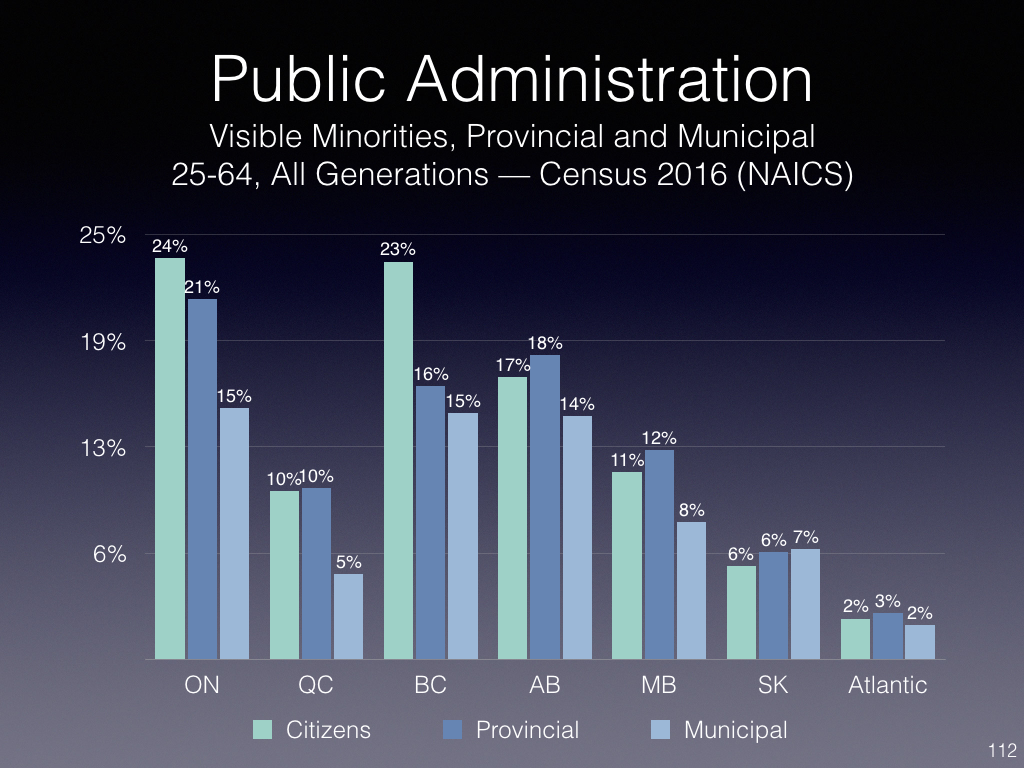
While I do not have breakdowns for senior management in all provinces (not all provide a breakdown like Quebec), this comparative chart on provincial and municipal diversity captures the overall picture (Census 2016 NAICS, visible minority numbers adjusted for citizenship):

Quelque 3% de personnes issues des minorités visibles ont été nommées à des postes de la haute fonction publique depuis 2014. Selon les données compilées par Québec solidaire (QS), parmi les 2330 personnes nommées à ces postes, seulement 72 proviennent des minorités visibles alors que celles-ci représentent 13 % de la population québécoise.

À Montréal, ce taux grimpe toutefois à 22,6 %. Bon an mal an, ce pourcentage est resté le même. De 2014 jusqu’à février 2017, le taux était de 3,7 % . En y ajoutant l’année 2018, en cours, ce taux s’établit à 3 %, selon les calculs de QS, chiffres qu’avait reconnus le Conseil exécutif.

Pour le député de QS Amir Khadir, c’est là un « constat d’échec lamentable » du gouvernement libéral au pouvoir. « Quand on parle de racisme systémique, c’est ça. La machine est structurée de telle sorte qu’elle discrimine, de manière systématique, tout ce qui n’est pas conforme. Ça vient par les accointances et les copinages au sommet », a-t-il déploré. « Si [Philippe Couillard] est sincère, il doit commencer à changer, au lieu de continuer avec des nominations partisanes et intéressées. »

En ce qui concerne plus largement la fonction publique, 9 % des effectifs sont des membres de communautés culturelles, ce qui comprend les minorités visibles et les minorités ethniques (dont la langue maternelle n’est ni le français ni l’anglais). Le gouvernement s’est engagé la semaine dernière à doubler ce pourcentage pour atteindre une cible de représentativité de 18 % des minorités.

via 3% de minorité visible dans la haute fonction publique | Le Devoir