82% of Dreamers Won’t Benefit from House Bill’s Citizenship Path

Solid analysis:

House Republicans will vote on their “compromise” immigration bill this week. Moderate Republican supporters of the bill may argue that its many restrictionist features—including draconian asylum provisions, cancelling the applications of 3 million people waiting to immigrate legally, and permanent reductions in legal immigration—are a small price to pay to help the entire Dreamer population gain a “pathway to citizenship.” However, an analysis of the Border Security and Immigration Reform Act (BSIF) shows that even under the most generous assumptions, the bill would likely initially legalize only 821,906 people, provide permanent residence (i.e. a pathway to citizenship) to 628,758, and result in citizenship for 421,268.

As provided in Table 1, only a third of the Dreamer population would likely receive status under the House plan (H.R. 6136), and just 18 percent would likely make it onto the pathway to citizenship. Only 12 percent would likely apply for and receive citizenship. Moreover, even the pathway to citizenship is tenuous, since—for all Dreamers in DACA or without legal status today—it is contingent on a future Congress appropriating money for a quite expensive (at least $25 billion) wall and security system along the Southwest border of the United States.

Table 1: Dreamer Populations and Eligibility Under Border Security and Immigration Reform Act

Sources: Authors’ calculations (see below) based on population estimates from Migration Policy Institute (DACA eligible and total Dreamer Population based on American Hope Act); Border Security and Immigration Reform Act (H.R. 6136)
*As of December 31, 2016

If Congress wants to help a larger number of Dreamers, then it would need to establish clear legalization criteria with lower costs and fewer risks, while providing greater legal certainty for the parents of Dreamers to mitigate fears of coming forward. Members of Congress should not exaggerate the extent of the legalization of Dreamers as a way to justify politically questionable policy choices, including reducing the annual level of legal immigration and eliminating several current immigration categories.

Restrictive Criteria in the House Bill

Back in January, President Trump promised a pathway to citizenship for Dreamers—up to 1.8 million of them. That’s still just half of the 3.6 million Dreamers—unauthorized immigrants who entered the country as minors—estimated by the Migration Policy Institute (MPI) to be in the United States as of January 1, 2017, but it’s still far more than the estimated number of Dreamers who will likely receive permanent residence under the House compromise legislation that will receive a vote this week.

The BSIF Act creates a four-part framework for potentially receiving permanent residence—a “path to citizenship”—and later citizenship (see Table 2 at the end). First, Dreamers would need to meet a set of basic criteria to receive conditional nonimmigrant status, a temporary renewable legal status. Second, after six years, most would need to apply for a renewal of this status. Third, they could apply for permanent residence over a 15-year period if they met a final set of requirements. Fourth, they could apply for citizenship five years after receiving permanent residence. Each stage will reduce the population that ultimately will become U.S. citizens.

The House immigration bill would use the same restrictive basic criteria as the Deferred Action for Childhood Arrivals (DACA) program. Its authors argue that if the requirements were good enough for President Obama who created DACA in 2012, they should be good enough for Democrats today. But as an act of prosecutorial discretion, DACA was never meant to be permanent immigration law, and in any case, President Obama tried to update its eligibility requirements in 2015, only to be stopped by the courts. The bill wouldn’t stop there. The House plan imposes additional eligibility requirements that would exclude even more Dreamers from receiving permanent protection.

The House bill will exclude Dreamers who entered after June 15, 2007, who entered at any age over 15, or who were over the age of 31 on June 15, 2017 (or 37 today). By the time the bill is implemented, people who had been residing in the United States for 10 or 11 years would be excluded from receiving status under the bill. The bill also requires a high school degree or equivalent or high school enrollment if the applicant is younger than 18. These restrictions were also in DACA, but the new bill would go even further to restrict eligibility. An applicant would be disqualified for having more than a single non-traffic-related misdemeanor, including immigration-related offenses; ever having missed an immigration court appearance; or having ignored an order to leave the country.

The biggest new restriction would be the requirement that Dreamers who are not students, disabled, or primary caregivers demonstrate that they can maintain an income of at least 125 percent of the poverty line. Not only do many Dreamers have incomes beneath this threshold, but also, if they have already lost DACA or never applied, it will be impossible for them to receive a legal job offer or demonstrate legal employment for the purposes of their application. This creates a catch-22 for applicants: prove you can support yourself in order to get work authorization in order to support yourself. (This provision should also concern employers which could see their records become the focus of government attention.)

In addition, receiving status under this bill will be far more expensive than receiving status under DACA. The bill would impose a fine—what the bill refers to as a border security fee—of $1,000. In addition, applicants would need to pay a fee to cover the cost of their application. DACA also had an application fee of $495, but the fee under this new bill would likely be more than double that because it requires an in-person interview and a medical examination. This will make the legalization more like applying for permanent residence, which costs $1,225. All told, applicants would need to pay about $2,225—4.5 times as much as DACA. This comes on top of any attorney fees. Many DACA applicants cite the cost as a primary challenge. MPI’s analysis also points to income as “strongly affecting” Dreamers’ ability to apply.

Finally, the bill would impose a 1-year filing deadline. This means that applicants would have just one year to gather their information, find an attorney, and save $2,225 to apply. For comparison, only 64 percent of DACA applicants submitted applications in the first 13 months of the program. This time limit will needlessly suppress applications.

Why Relatively Few Dreamers Would Even Receive Temporary Relief

In January 2018, the Migration Policy Institute used the Census Bureau’s American Community Survey to estimate that there were 1.3 million Dreamers eligible for DACA. Another 120,000 were too young to apply for DACA, but would be eligible under this legislation so long as they were enrolled in school. However, this eligible population must be reduced based on the new requirements. We estimate conservatively that the income threshold would exclude about 15 percent of the DACA eligible population. This figure is based on the share of Central American immigrants who entered between 1982 and 2007 who are below 125 percent of the poverty line, are not in school, and are not unable to work due to disability or being the primary caregiver, as recorded in the 2017 Current Population Survey.

The misdemeanor requirement is more difficult to place a precise number to, but the government says that 17,079 DACA recipients have at least two arrests, assuming that 75 percent of those arrests ended in conviction. That would reduce 12,809, or 2 percent of the DACA recipient population. Assuming that this rate would apply to the DACA eligible population as a whole (even though it is more likely that that population has more convictions that the DACA population itself), this would reduce the eligible population by another 26,000. Thus, the maximum number of Dreamers initially eligible for status under the House bill is 1.17 million. Even this is likely an overestimate because we cannot estimate how much the noncriminal restrictions (e.g. prior removal orders, false claims of U.S. citizenship, etc.) could further reduce the eligible population.

Even fewer will actually apply. Even after six years of DACA, only 61.4 percent of the eligible population applied for and received DACA. While the promise of a pathway to citizenship could result in a higher participation rate, other elements in this bill will suppress application rates, neutralizing the greater incentives to apply. Furthermore, the initial status is temporary, and the pathway to citizenship is not guaranteed. In fact, unless Congress funds the border wall repeatedly in future years, the path to citizenship would never materialize at all. Moreover, the fact that the cost will be about 450 percent higher will prevent many Dreamers from applying (as noted above).

Many Dreamers failed to apply for DACA because they didn’t realize that they were eligible, believing that they had to have finished high school or that those who had been ordered to leave the country could not sign up. This bill’s new and more complex eligibility requirements will only introduce more confusion. The risk of a denial may keep some from taking the risk to apply. Nearly 8 percent of applicants for DACA were rejected.

The uncertainty and distrust associated with the Trump administration’s enforcement actions would only add to the concern about handing over information. As we’ve noted before, many Dreamers expressed concern that their application could be used to target their families. The House bill attempts to address this fear by limiting how their application information can be used, but it amplifies the fear in other areas by providing enforcement resources and new legal authorities to the administration to speed up deportations. A future Congress could change this privacy protection at any time, and at this point, few immigrants may trust the administration to follow this type of technical “firewall.”

According to the Congressional Budget Office (CBO), the last major legalization—the 1986 amnesty—had only a two-thirds participation rate, despite the less strict criteria than the ones contained in BSIF. Ultimately, we conservatively chose to use the CBO’s higher rate of 67 percent, rounding it up to 70 percent—10 percentage points higher than DACA’s initial enrollment rate. Based on this analysis, we can conclude that at most 820,000 Dreamers would receive initial legal status under the House GOP proposal.

Why Relatively Few Dreamers Would Receive Permanent Residence & Citizenship

Under DACA, which had no additional requirements at all to extend status other than maintaining residence in the United States for another two years, just 85 percent of initial enrollees maintained status through the end of the program. Some of this drop-off can be explained by people failing to graduate high school for a variety of reasons, but the additional cost is important as well. Under the House bill, applicants for extension of their temporary status would be required to pay a fee of another $1,225 fee (2.5 times more than DACA) and have stayed in the United States for another 6 years. Assuming this rate remains roughly the same, only 698,620 would likely end up receiving an extension under the House bill.

After receiving the extension, Dreamers—as well as some legal immigrant Dreamers*—would be able to apply for a pathway to permanent residence. The bill creates a complex points system that will prioritize applications from those with more education, longer work histories, or better language skills. But the minimum threshold for points is low enough that anyone who qualified for the initial status would be eligible to apply. Of course, there is not a strong incentive even to apply for this status, and the cost of applying for permanent residence is another $1,225. They would have to apply over the course of a 15-year period, starting five years after the initially received status. We assume that about 90 percent would apply for permanent residence. Thus, only 628,758 Dreamers would likely receive permanent residence—a path to citizenship—under the House proposal.

Finally, only about two thirds of those who receive permanent residence are likely to apply for citizenship. While Dreamers are probably more likely to apply for citizenship than other immigrants, immigrants from Mexico and Central America are much less likely to apply for citizenship than immigrants from other countries—all have naturalization rates below 50 percent—and 89 percent of DACA recipients are from Central America or Mexico. These two facts work in opposite directions, leading us to assume that Dreamers will naturalize at the average rate for all immigrants—67 percent. Based on this assumption, just 421,268 immigrants are likely to become U.S. citizens under the House compromise bill.

Conclusion

In the best case scenario, the House GOP plan would likely provide a pathway to citizenship to fewer than 630,000 Dreamers—barely a third of the president’s promise in January and just 18 percent of the entire Dreamer population. Moreover, only an estimated 421,000 immigrants are likely to become citizens.

If Congress wants to fulfill the president’s promise of a pathway to citizenship for 1.8 million Dreamers, it would need to institute a broader legalization program for Dreamers with as few risks and costs, and as little confusion, as possible. Congress would also need to provide legal certainty in some form for their parents to mitigate fear of coming forward. Members of Congress should also not exaggerate the extent of the legalization of Dreamers as part of a strategy to justify questionable policy choices, including reducing legal immigration and eliminating several immigration categories.

Table 2 compares the eligibility criteria and requirements under the BSIF Act to those under DACA and the Securing America’s Future (SAF) Act, which is the other bill under consideration this week.

Table 2: Comparison of Pathways to Status & Citizenship Under House Bills and DACA

*The legal immigrant Dreamers would slightly increase the eligible population, but there are so few who would meet the requirements (10 years of continuous residency before the bill passes plus 5 or 6 more after it is implemented) that it would not substantially alter these numbers. In any case, the estimates of the Dreamer population from MPI could include people in temporary statuses that have characteristics similar to those without status (inability to access welfare or receive certifications for legal employment).

Source: 82% of Dreamers Won’t Benefit from House Bill’s Citizenship Path
Canada tracking Trump’s border crackdown to see if U.S. remains safe for asylum seekers

As I would expect. Not an easy policy and political discussion given the implications:

Canada is monitoring the impact of U.S. President Donald Trump’s “zero-tolerance” migrant policy — which has led to the forcible detention of thousands of children — to determine if the U.S. remains a safe country for asylum seekers.

Global outrage is growing over Trump’s hardline approach to people crossing illegally into the U.S. from Mexico — a policy that puts adults through the criminal justice system while sending their children to detention camps. The Trump administration also has eliminated the option of citing a risk of domestic or gang violence as grounds to seek protection.

Critics are calling on Canada to urgently respond by suspending the Safe Third Country Agreement (STCA) with the United States, but Immigration Minister Ahmed Hussen said the government will analyze the situation to determine the impact of the Trump administration’s policy on due process, appeals rights and migrants’ ability to make asylum claims.

“We have to see the impact of these changes on the domestic asylum system in the U.S. to see whether the U.S. continues to meet its obligations, not just to the international community, but also to the Safe Third Country Agreement,” he said.

Hussen said that ongoing analysis is being carried out by both countries, as well as the UN’s refugee agency. He said he could not provide any time frame for the review.

In past, the minister has said the 14-year-old agreement — which requires that migrants crossing the Canada/U.S. border make their refugee claims in the first “safe” country they come to, whether it’s Canada or the U.S. — is working in Canada’s interests but should be modernized.

According to data provided to CBC News by Immigration, Refugees and Citizenship Canada, 1,949 asylum seekers were turned back at official border points in 2017 — refused entry to Canada under the STCA.

That’s up dramatically from previous years. In 2016, 731 were refused; in 2015, 418 were turned away and in 2014 just 456 were denied entry.

Fearful fleeing Trump

“The jump in numbers means that individuals are genuinely, legitimately and justifiably afraid about how they will be treated and about whether they will be given due process under the Trump administration’s regime,” said Aris Daghighian, a refugee lawyer and executive member of the Canadian Refugee Lawyers Association.

The Department of Homeland Security (DHS) confirmed on the weekend that nearly 2,000 migrant children were separated from their families between April 19 and May 31, when the Trump administration was cracking down on illegal immigration along the U.S.-Mexico border.

The UN has said separating families amounts to an “arbitrary and unlawful” interference in family life and calls it a “serious violation” of the rights of children.

Despite international outrage and condemnation, Trump defended the practice today.

‘The United States will not be a migrant camp,’ says U.S. president 1:27

“The United States will not be a migrant camp and it will not be a refugee-holding facility,” he said.

Daghighian said it’s clear the U.S. is not meeting its international obligations on refugees, human rights and rights of the child, and that Canada should not be its immigration partner under the STCA.

“The problem here now is that both the conditions of detention — subjecting individuals to cruel and unusual separation from their children — but also the grounds for which the U.S. is willing to offer protection are being severely limited,” he said. “So in that way, Canada can’t be confident that the U.S. will abide by its international obligations that it will provide protection to these individuals under a fair process.”

Failing to denounce the U.S. and shred the agreement would amount to a departure from Canada’s record of leading on humanitarian issues and would send the wrong message to the world, Daghighian said.

Moral, legal obligations

“It would say that, for political reasons, or for reasons to do with the current trade negotiations, we’re willing to give up some of our most fundamental values, our moral obligations and our legal obligations.”

While Canada deals in much smaller numbers, this country does hold children in immigration detention centres. Statistics from the Canada Border Services Agency show that 150 minors (aged under 18) were detained with a parent or guardian over a nine-month period that ended Dec. 31, 2017, and another five were held unaccompanied.

In November 2017, Public Safety Minister Ralph Goodale issued a directive on the treatment of minors in Canada’s immigration detention system. It said that, “as much as humanly possible,” children must be kept out of detention and with their families.

Citing the best interests of the child as its primary consideration, the directive said alternatives to detention must be considered, such as cash or performance bonds and community supervision.

NDP immigration critic Jenny Kwan said the developments south of the border underscore the fact that the U.S. is no longer a ‘safe third country’.

She called it “astounding” that the Liberal government would consider keeping Canada in an agreement with a country that is flagrantly flouting international law on the rights of refugees and children.

“If we continue on with the status quo in the face of this inhumane development, then Canada is complicit to the situation,” she said.

Asked today if Canada can still consider the U.S. a safe country in light of the crackdown, Transport Minister Marc Garneau, chair of the cabinet committee on U.S. relations,  said: “Of course we can.”

Source: Canada tracking Trump’s border crackdown to see if U.S. remains safe for asylum seekers

Canada’s Immigration Minister credits outreach efforts for drop in border crossers – The Globe and Mail

Encouraging, but too early to claim a trend and the relative impact of outreach versus other factors:

The Immigration Minister says a recent drop in the number of border crossers is a credit to the government’s efforts to discourage would-be asylum seekers from crossing into Canada between official border posts.

Ahmed Hussen said there was a 27-per-cent decrease in border crossers from 2,560 in April to 1,869 in May. He said unofficial figures show the decrease has continued into June.

However, Mr. Hussen said the federal government will continue its outreach efforts in the United States to discourage “irregular migration,” given the unpredictable nature of migrant flows at the border. It’s unclear what the Trump administration’s new immigration policy, which forcibly separates migrant children from their parents, will mean for Canada, which experienced a massive surge in asylum seekers along the border following an immigration crackdown in the United States last year.

“I sincerely believe that our outreach and other efforts … are having an impact in terms of the drop in numbers, but we remain vigilant. We are not letting up on our efforts and we’ll continue to do what we’ve been doing,” Mr. Hussen said in an exclusive interview with The Globe and Mail on Monday.

Last year, more than 20,000 asylum claimants – many of whom were Haitian – flooded the Canada-U.S. land border over fears they would be deported back to their home country under President Donald Trump’s plans to end their temporary protected status in the United States. In an attempt to control the surge in border crossers, Prime Minister Justin Trudeau’s government launched an outreach campaign in the United States to discourage potential asylum seekers from irregularly crossing into Canada.

However, a new group of asylum seekers started to cross the Canada-U.S. border this year: Nigerians, carrying valid U.S. visas. Mr. Hussen and his officials traveled to Nigeria in May to dispel “myths” about Canada’s asylum system and raise the visa problem with the U.S. embassy in the West African country.

While Mr. Hussen attributed the decline in border crossers to the government’s outreach program, Conservative immigration critic Michelle Rempel warned against becoming complacent about the statistics. The number of border crossers has more than doubled since May, 2017, when 742 asylum seekers entered Canada between official ports of entry.

“That’s still a significant amount of people that are coming into the country by illegally crossing the border from the United States. That number should be closer to zero,” Ms. Rempel said.

Meanwhile, questions continue to swirl over how new U.S. immigration measures could affect Canada. Mr. Trump’s “zero-tolerance policy” has forcibly separated nearly 2,000 migrant children from their detained parents, according to Homeland Security statistics obtained by the Associated Press. Outrage over the policy is mounting around the globe, and on Monday, the United Nations High Commissioner for Human Rights urged the Trump administration to stop its “unconscionable” measures.

Ms. Rempel said the troubling reports out of the United States further underscore the need for a Canadian government plan to address the global migrant crisis. She questioned the Liberal government’s position on a major asylum-seeker agreement with the United States and, if it determines that the United States is no longer a safe country for refugees, to explain what the plan is to budget for the “enormous demand” that would be placed on Canada’s asylum system by another flood of border crossers.

The Safe Third Country Agreement requires both countries to refuse entry to asylum seekers who arrive at official border crossings, as both countries are considered safe for refugees. However, since the agreement applies only to people who arrive at official ports of entry, asylum seekers can avoid being turned away by crossing between border posts.

The Immigration and Refugee Protection Act requires the government to continually review all countries designated as safe third countries, including the United States, to ensure that the conditions that led to the designation are met.

In light of the new U.S. crackdown on migrants, NDP immigration critic Jenny Kwan said the need to suspend the Safe Third Country Agreement is more evident than ever.

“I don’t think anybody with some understanding of the international laws and with a level of humanity will accept that the United States is a safe country for refugees,” she said.

via Canada’s Immigration Minister credits outreach efforts for drop in border crossers – The Globe and Mail

Australian citizenship approvals record dramatic slowdown

In its last report, the department only met its service standard 45 percent of the time:

The processing of citizenship applications has been painfully slow this year with the Department of Home Affairs approving 54,419 applications during the first eight months of 2017-18, compared to 139,285 last year, according to information released to the Federal Parliament on Monday.

During this financial year, a total of 141,236 citizenship applications were received as of February 28, the Minister for Citizenship and Multicultural Affairs revealed.

The Department of Home Affairs last month told the Federal Parliament that over 200,000 people were awaiting the outcome of their citizenship applicants as of April 30 this year with the average waiting period for processing applications ballooning up to 16 months.

The relatively low number of citizenship grants is attributed to the period of April- October 2017 when the Department held on to new applications after announcing the citizenship reforms that sought to increase the general residence requirement and introduce a standalone English language test. The Government is planning to bring back a reworked version of the Bill after its proposed law was defeated in the Senate.

Home Affairs officer Luke Mansfield told a Senate Estimates hearing last month that an increased number of applications coupled with tightened national security requirements had led to an increase in the processing time of citizenship applications.

Citizenship applicants facing uncertainty

Atul Vidhata who runs an online forum – Fair Go for Australian Citizenship, says many migrants have been waiting much longer than sixteen months.

“When these people contact the department, they are told it’s not a service standard to process the applications within this timeframe,” he tells SBS Punjabi.

“There’s a lot of uncertainty due to a lack of clear communication. In our experience, some applications that were made in 2018 are being processed faster whereas applications made in 2017 are still held up.”

MP Julian Hill had questioned the Citizenship Minister Alan Tudge about the criteria applied for applications requiring ‘thorough analysis’ or ‘further assessment’.

“All applications for Australian citizenship are assessed on a case-by-case basis against the legislative criteria,” Mr Tudge responded.

data

India overtakes the UK as top source of Australian citizenship

Responding to questions by Victorian Labor MP Julian Hill, Mr Tudge revealed the country-wise break up of citizenship statistics.

Data

India has been the top source of citizenship in Australia for the last five years overtaking the United Kingdom.

Since 2012-13, over 118,000 people born in India have pledged their allegiance to Australia by becoming Australian citizens. Indian migrants also top the list of country-wise visa recipients in Australia’s annual immigration program.

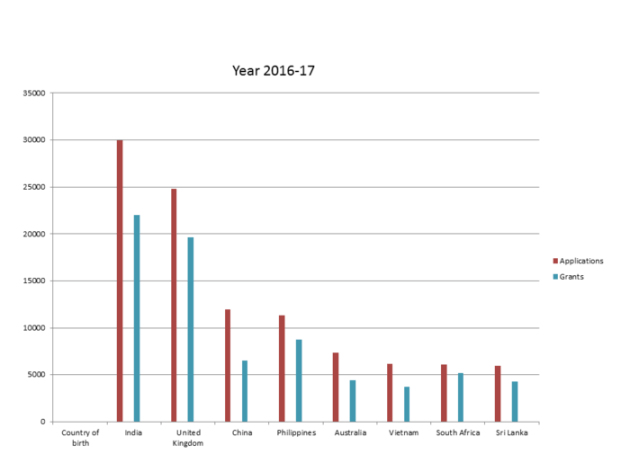
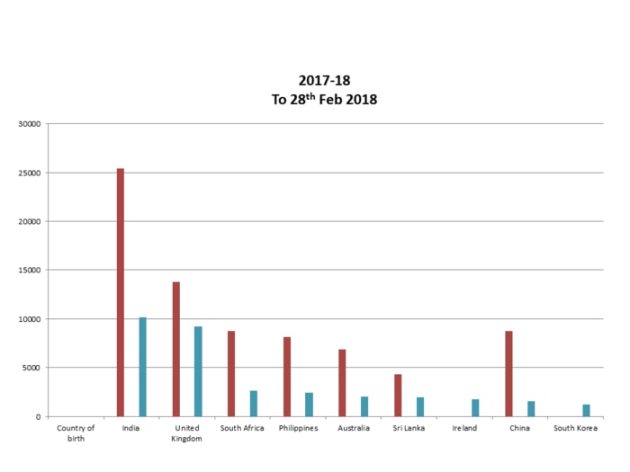
As of February 28 this year, 10,168 Indian-born migrants were granted Australian citizenship with 25,408 Indian-born people applying during the same time. The 2016-17 figure stood at 22,006 citizenship grants to Indian migrants with 29,955 Indians applying for it.

Source: Australian citizenship approvals record dramatic slowdown

USA – Miller Time: Family Separation Policy is Just the Beginning

Unclear whether the current pushback will make a difference :

No matter how the Trump administration’s “zero tolerance” border enforcement initiative plays out – and at the moment the optics are looking mighty bad – it’s just the beginning. According to Politico, domestic policy advisor and speechwriter Stephen Miller, the principal keeper of the nativist flame for Trump, has been heading up an effort to plan a whole series of steps to keep “the base” assured that the 45th president is going to restrict legal and illegal immigration alike by hook or by crook:

“Senior policy adviser Stephen Miller and a team of officials from the Justice Department, Department of Labor, Department of Homeland Security, and the Office of Management and Budget have been quietly meeting for months to find ways to use executive authority and under-the-radar rule changes to strengthen hard-line U.S. immigration policies, according to interviews with half a dozen current and former administration officials and Republicans close to the White House.”

The big idea is to ensure that Trump doesn’t have to depend on any immigration legislation, or any big policy goal like the border wall, to claim he’s kept his promises to the base. The offensive Miller is planning involves things the administration can do on its own.

“Among the fresh ideas being circulated: tightening rules on student visas and exchange programs; limiting visas for temporary agricultural workers; making it harder for legal immigrants who have applied for any welfare programs to obtain residency; and collecting biometric data from visitors from certain countries.”

And yes, the midterm base-stimulus plan included “zero tolerance,” and a pending DHS rule that would lead to the rescinding of the 1997 court settlement placing a limit on how migrant children can be locked up, which the administration thinks is the real source of its current troubles. So if Team Trump moves ahead on this front, they do have some additional plans beyond defending the indefensible.

The main thing to understand is that the White House did not blunder into the current furor over “zero tolerance” and family separation; the president’s people really, really want to send signals that Trump has turned immigration policy on its head even without congressional cooperation.

“Miller, who was instrumental to Trump’s early travel ban — which, like the border separations, triggered widespread public outrage and was put into effect without sufficient logistical planning — is among those who see the border crisis as a winning campaign issue.

“That is the fundamental political contrast and political debate that is unfolding right now,” he said in an interview with Breitbart News published on May 24. “The Democratic Party is at grave risk of completely marginalizing itself from the American voters by continuing to lean into its absolutist anti-enforcement positions.””

So don’t be surprised to learn that no matter what Trump decides to do on “zero tolerance,” he’s by no means going to shy away from the impression that he believes undocumented immigrants are enemies of America who must be repelled.”

Source: Miller Time: Family Separation Policy is Just the Beginning

Ottawa pay mess shows how hard it is to fire anyone in this town: McKenna

Valid critique over the lack of accountability. Surprised that no one has been leaking the names:

It is one of the lamest whodunits in Canadian history.

We know that three senior bureaucrats badly botched the creation and roll-out of a new pay system for nearly 300,000 federal workers. The trio left behind a trail of misery, including a relentless stream of pay errors, disrupted lives and hundreds of millions of dollars in cost overruns.

But Ottawa won’t say who the three are or how they were disciplined. We do know that no one was fired. And two of the three officials still work for the department that runs the pay system, Public Services and Procurement Canada; the other retired.

The identity of the trio − including an assistant deputy minister and an associate assistant deputy minister − must be the worst-kept secret inside the bureaucracy. Auditor-General Michael Ferguson laid out exactly what happened in a scathing report, calling the new Phoenix payroll system an “incomprehensible failure of project management and oversight.” Anxious to stick to a schedule and stay on budget, the three officials launched the system in early 2016 even though they knew it was not working properly and had dangerous security holes, the report found.

The department of Public Services isn’t naming names, citing “internal matters.”

Nor is Privy Council Clerk Michael Wernick, the government’s top civil servant and the de facto chief operating officer of the bureaucracy. Appearing last week before a parliamentary committee that is investigating the failed system, Mr. Wernick was more interested in taking swipes at Mr. Ferguson for smearing the integrity of the public service than laying blame.

Surely, the buck-passing has to stop somewhere. How can Canadians have faith in their government if no one is ever held accountable for the biggest mess ups?

Absent that, Mr. Ferguson is right. The culture inside the federal government is broken.

The mysterious Phoenix trio ignored dire warnings from outside consultants and officials in other departments that they were hurtling toward disaster. They failed to do a pilot test and had no back-up plan in place if anything went wrong. And they stripped the system of 100 key functions, such as paying employees who switch jobs or who file for back pay. They knew the system would not work properly and then apparently kept their own bosses in the dark about these problems as the system went live. All of this was done in the name of expediency and saving money, according to the Auditor-General.

Paying its employees is one of the most basic functions of any organization, and the federal government failed miserably. A system that was to have cost $310-million has soared to more than $1-billion, and the price is still rising as the government struggles to make the system do what it’s supposed to do – pay people what they are owed. Virtually every government worker has been touched in some way by the resulting mess, including tens of thousands of workers not paid for months and others paid too much (and then were overtaxed).

Given all that, you might expect heads to roll. Not in Ottawa. Public Services and Procurement Canada says only that the performance of senior officials was “assessed and appropriate measures taken.” The department did confirm that the officials involved did not get their bonuses in the year Phoenix was launched.

But what about the years before, when they made a series of fatal errors that condemned the launch to failure?

In the private sector, these would almost certainly be firing offences. Federal government leaders want to be paid on par with executives in the private sector, and many are. But they also enjoy a lot more job and pension security.

Mr. Wernick, the Clerk of the Privy Council, acknowledged that it’s extremely hard to fire anyone below the deputy minister rank for poor performance, citing protections provided by Public Service Employment Act. And he suggested that the government’s bonus and incentive system for senior managers may cause some to focus too much on cost over function.

That’s hardly confidence-inspiring for most of us who work in the private sector, where bonuses are rare and people frequently get fired when they mess up.

via Ottawa pay mess shows how hard it is to fire anyone in this town – The Globe and Mail

Trump Administration Has No Idea Whether It Backs Family Separation at the Border

Deliberate or accidental chaos. Hard to know but the impact is real:

The United States has no policy of separating migrant families at the border. There is such a policy, but it’s all the Democrats’ fault. The policy was a “simple decision,” but one “nobody likes.” The policy is good, legal, and Jesus would approve.

The Trump administration, confronted with increasing public criticism over its immensely unpopular policy of separating migrant children from their families when they cross the U.S. border, has responded to the crisis by taking taking wildly different positions on both the policy itself and the motivation behind it.

Ranging from full-throated endorsement of the decision to separate minor children from their asylum-seeking parents to flat insistence that the decision doesn’t exist, “period,” the public-relations pileup is just a facet of the botched rollout of a policy that separated nearly 2,000 children from their families in its first six weeks.

For nearly a week, President Donald Trump has pointed to congressional Democrats as the root behind his administration’s policy. “I hate the children being taken away,” Trump told reporters on the White House lawn on Friday. “The Democrats have to change their law—that’s their law.”

The president reiterated that (incorrect) statement with a Saturday morning tweet: “Democrats can fix their forced family breakup at the Border by working with Republicans on new legislation, for a change!”

But the president’s public insistence that his hands are tied on the matter of family separation at the border isn’t just undermined by the fact that no law requiring family separation exists—it has also been undermined by the head of the government department in charge of its execution.

“We do not have a policy of separating families at the border. Period,” Secretary of Homeland Security Kirstjen Nielsen tweeted as part of a defensive thread on the matter on Sunday evening. “For those seeking asylum at ports of entry, we have continued the policy from previous Administrations and will only separate if the child is in danger, there is no custodial relationship between ‘family’ members, or if the adult has broken a law.”

The Department of Homeland Security has been treating people seeking asylum as illegal border crossers, regardless of whether they are entering a port of entry or not.

Nielsen—who reportedly has been deeply conflicted about the policy in private—clearly missed a fiery press conference held by Attorney Jeff Sessions on Monday, in which the longtime immigration hawk said that people who didn’t want to fall victim to the policy shouldn’t try to enter the country.

“If you are smuggling a child then we will prosecute you, and that child will be separated from you as required by law,” Sessions said at a law enforcement conference. “If you don’t like that, then don’t smuggle children over our border.”

Later, Sessions would point to a Bible passage once popular with the Nazis as evidence that the policy was not only good for national security, but in keeping with Christian teachings.

“I would cite you to the Apostle Paul and his clear and wise command in Romans 13, to obey the laws of the government because God has ordained them for the purpose of order,” Sessions said in a speech on Thursday. “Orderly and lawful processes are good in themselves and protect the weak and lawful.”

Sessions’ endorsement of family separation as both biblically sound and legally necessary stands in contrast to the position taken by White House counselor Kellyanne Conway on Sunday, when she told NBC’s Meet the Press that “nobody likes seeing babies ripped from their mothers’ arms” and that she found flaws with the policy as a Catholic.

“As a mother, as a Catholic, as somebody who has got a conscience,” Conway said, “I will tell you that nobody likes this policy.”

Except, of course, for its likely architect. Stephen Miller, the White House speechwriter and adviser infamous for crafting the hastily written and legally disastrous ban on travel to the United States from citizens of seven (later six) primarily Muslim nations, was reportedly the driving force behind the family separation policy and has defended it like it was his own, non-migrant child.

“No nation can have the policy that whole classes of people are immune from immigration law or enforcement,” Miller told The New York Times. “It was a simple decision by the administration to have a zero tolerance policy for illegal entry, period. The message is that no one is exempt from immigration law.”

Whatever the Trump administration’s views of the policy, the American people are in agreement on the matter. According to a new Ipsos poll conducted exclusively for The Daily Beast, only 27 percent of respondents agree that it is “appropriate to separate undocumented immigrant parents from their children when they cross the border in order to discourage others from crossing the border illegally.”

Among the 56 percent of those who disagree with the policy? First lady Melania Trump.

According to Stephanie Grisham, the first lady’s spokesperson, Trump “hates to see children separated from their families.”

via Trump Administration Has No Idea Whether It Backs Family Separation at the Border

Child poverty linked to discrimination and systemic inequality, study suggests

Good use of Census data:

Federal ridings with the most child and family poverty in Canada are also home to the highest proportions of Indigenous, visible minority, immigrant and single-parent families, according to a new study.

These ridings are also more likely to have high unemployment, low rates of labour force participation, more renters and people paying more than 30 per cent of their income on housing, says the report released Monday by Campaign 2000, a national coalition of more than 120 organizations dedicated to ending child poverty.

The findings, based on the latest 2016 census and 2015 income tax data, suggest poverty is linked to persistent discrimination and systemic inequality, rather than luck, or poor individual choice, adds the report.

Area single mother Jane Syvret, 27, who is of Indigenous and Black heritage, says her family is the face of the Campaign 2000 report. She and her three young children live in Regent Park, part of Toronto Centre, the riding with the fourth highest child poverty rate in the country.

The analysis comes in advance of Ottawa’s long-awaited national poverty-reduction strategy, expected later this month, and urges the federal government to act decisively.

“After decades of waiting for federal action, the first poverty-reduction strategy must ensure Canada stops only tallying the number of children in poverty and starts to number poverty’s days instead,” said Anita Khanna, Campaign 2000’s national co-ordinator.

“Given Canada’s wealth, no child should go to bed hungry. No parent should be forced to choose between paying rent and buying medication or miss out on work or training for lack of quality affordable childcare,” she added.

The coalition, which has been documenting “the failure of good intentions” to end child poverty in Canada for almost 30 years, wants Ottawa to set aggressive poverty-busting goals and timelines and is calling for federal anti-poverty legislation before the 2019 election to hold future governments to account.

Twenty-six ridings with the highest child poverty rates are in Ontario and half are in the city of Toronto, according to the report.

Syvret’s riding of Toronto Centre includes a large social housing community as well as pricey Bay St. condos, is home to many visible minorities and recent immigrants. A troubling 40 per cent of children in the riding are growing up poor.

Although she grew up in poverty as one of nine siblings in a family with working parents, Syvret says she never “felt poor.”

“We were a big loving family and we never wanted for anything at home,” she said in an interview. “There were always programs available to local kids, with mentors and people who cared about us.”

But as the area redeveloped, community programs closed in favour of new facilities that draw kids from across the city, leaving many local families shut out, said Syvret, who pays market rent and is struggling to survive on welfare with a newborn and two other daughters ages 2 and 9.

Although she has worked since she was 15 in recreation and food preparation, she knows minimum-wage jobs won’t pull her young family out of poverty. But adult education and skills upgrading programs are difficult to access, she said.

“Why is everything always full?” she said. “These are supports that are put in place to help. But if they are always full, that means there is not a lot of help.”

As Campaign 2000 noted in its annual report card last fall, more than 1.2 million children — 17.4 per cent — were living in poverty in 2015, including a staggering 38 per cent of Indigenous children.

Children are considered to be poor if their families are living below the Low Income Measure, after taxes, or 50 per cent of the median Canadian income. In 2015, that was about $24,500 for a single parent with one child and about $36,400 for a couple with two kids.

The coalition’s latest analysis shows 162 of Canada’s 338 federal ridings have child poverty rates at or above the national average and include both rural and urban communities represented by MPs from all political parties.

In the 66 ridings with the highest rates of child poverty, an average of 30 per cent of children — or more than 400,000 — are growing up poor.

Ridings with the least child poverty are still home to more than 90,000 low-income families and nearly 150,000 low-income children, the report notes.

Churchill—Keewatinook Aski in northern Manitoba has the highest rate of child poverty at more than 64 per cent, while the Quebec ridings of Montarville, in the southwest end of the province and Levis-Lotbinière, near Quebec City, have the lowest, at just 4 per cent.

In ridings with the most child poverty, an average of 16 per cent of residents are recent immigrants and about 37 per cent are visible minorities. An average of 45 per cent are renters.

In ridings with the least child poverty, an average of 6 per cent are recent immigrants, 14 per cent are visible minorities and just 21 per cent are renters.

Khanna says fighting child poverty requires a combination of financial and social supports to help families like Syvret’s.

“Universal child care, drug and dental coverage, affordable housing, improved employment insurance and support for workers are all needed,” Khanna said. “With every riding affected by poverty, every riding will benefit from a strong federal strategy.”

Source: Child poverty linked to discrimination and systemic inequality, study suggests

Reevely: Carleton loses fight to keep survey of Jewish students secret

Amazing. No matter what the findings, the bigger story becomes Carleton’s efforts to hide them:

Carleton University has to stop hiding a survey of Jewish students meant to find out how they feel about life on campus, a panel of senior judges says. Well, how they felt about life on campus at the beginning of this decade. Carleton’s been fighting for five years to keep the survey from public view.

When the case finally made it to court this week, three judges of Ontario Divisional Court took one day to laugh the university’s arguments off. They heard the case last Tuesday and told Carleton to stop screwing around on Wednesday, in a ruling that observes that Carleton’s lawyer could point to no precedents for its secrecy and had no evidence supporting its more outlandish claims about what might happen if it lost. (Full disclosure: I have a degree from Carleton. Fuller disclosure: About once a year, Carleton as an institution does something so at odds with the values it teaches that I cringe.) This survey was done for an internal commission set up by then-president Roseann Runte in 2010 to look at how various minority groups were treated at Carleton. The point of striking a commission — this one included several dozen people, from students to senior administrators to outside volunteers — is usually to get to the bottom of a serious problem in the most open way possible. Air all the dirty laundry. Get everything out there so we can start fixing problems.

The commission’s work was a bit of a mishmash, since the “inter-cultural, inter-religious and inter-racial relations on campus” it was supposed to look at are incredibly diverse and complicated. But its report in 2012 highlighted some standout problems on campus: legitimate debates about Israel too often spilled over into anti-Semitism, or into discussions where they didn’t belong both in classrooms and faculty meetings; and Indigenous students felt stereotyped and sometimes didn’t have help they needed adapting to university life.

The commission’s most important data-gathering came in surveys — one campus-wide one and narrower followups to dig into the first big survey’s findings. The final report includes a detailed summary of the big survey, including what questions it asked, what the response rates were (barely 10 per cent among students, and 30 per cent among Carleton staff), how members of particular groups found their Carleton experiences more satisfactory or less.

The report didn’t do the same for a follow-up survey of Jewish students and staff. “Respondents to the survey (of Jews at Carleton) participated on the condition of anonymity and therefore the results have not been distributed,” the commission report said. That’s it. This is a non-standard definition of “anonymity.” You can release results of a survey without revealing who said what. A university, of all places, should have this capability.

In 2013, someone (the person’s name isn’t in the court decision) filed an access-to-information request for the commission’s materials, including the raw results of the surveys and details of how they were conducted, and minutes from the commission’s two years’ worth of meetings.

“The university submits that the requester seeks the information to challenge the findings of the commission,” this week’s court ruling says. Which is neither here nor there — if documents are public, they’re public. A government institution doesn’t get to keep public information back just because it doesn’t like what a member of the public might do with it.

The survey is research, Carleton argued. The minutes of the commission’s meetings are related to research. We don’t have to give out research. Among other things, it wouldn’t release “the survey (of Jewish students) and its results, and an explanation of the survey methodology, who designed the survey, who approved the survey, how it was conducted, who analyzed the survey results.”

Ontario post-secondary institutions are covered by provincial public-information law but they can hold back material “respecting or associated with research conducted or proposed by an employee of an educational institution or by a person associated with an educational institution.” The idea is that if every lab note from every PhD student were open to public release, competitors would spend half their time nosing around each other’s work and answering requests instead of researching.

The law covers academic research, not stuff a university does that’s like any other corporation, the judges decided: “(T)he survey results and associated information are akin to market research which is not particular to universities and is not subject to the specific concerns of academic freedom articulated by the legislators.”

The university’s lawyer “was unable to provide a single decision where information gathered internally by a university for its own purposes and unrelated to academic research was covered by (the) research exemption,” the judges pointed out.

The university argued that releasing this information will make all university research harder and harm Carleton’s competitiveness. “No evidence was adduced to substantiate this claim,” the judges observed, using legalese for “Lawyer, please.”

Carleton’s conduct here is embarrassing for a public institution that set out to address problems on campus by talking about them openly. The fact it took five years for Carleton to get slapped down is embarrassing for Ontario’s access-to-information system. Both need to work better than they have.

Source: Reevely: Carleton loses fight to keep survey of Jewish students secret

Government looking into using frozen assets to help refugees

Creative idea but the modalities and implementation may prove challenging:

The federal government is being asked to consider confiscating frozen assets in Canada to help refugees.

The proposal, which is still in its infancy, comes from the World Refugee Council, an initiative set up by the Waterloo-based Centre for International Governance Innovation.

While final and more formal recommendations will come in a report later this year, the council, chaired by Chrétien-era cabinet minister Lloyd Axworthy, already has floated the idea past government officials, according to documents obtained under the access to information law.

A letter to Justice Minister Jody Wilson-Raybould from the council’s special adviser suggests introducing legislation to establish a judicial process for requests to seize and “re-purpose” funds to benefit refugees.

“Such assets are frequently brought to Canada (or elsewhere) by corrupt leaders or their associates,” the letter says.

“Since those very leaders are often responsible for forcible displacement as a result of their bad governance, using money stolen by them to assist refugees from their country would provide a certain symmetry.”

The council is proposing that Canadian courts be empowered to take those assets and authorize payments to the country of origin (if the government is “responsible and honest”), the United Nations High Commissioner for Refugees or a non-governmental organization.

“The order could also include an accountability mechanism, with regular reporting to the court as to the disposition of the funds,” reads the letter.

‘No shortage of bad leaders’

The government already has the power to freeze assets through the Justice for Victims of Corrupt Foreign Officials Act — a version of the U.S. law popularly known as the Magnitsky Act. It targets the assets of corrupt officials “who have committed gross violations of internationally recognized human rights.”

Fen Hampson, director of the World Refugee Council, said the council’s proposal would be a next step.

“We’ve been trying to think of ways to hold bad regimes to better account,” he told CBC News. “There’s no shortage of bad leaders who are doing terrible things to their populations and creating a major problem for their neighbours, and also globally.”

The council has met with officials from the federal departments of Immigration, Refugees and Citizenship and Foreign Affairs; the latter department helps to fund the council’s work.

“Hopefully, good ideas will sell themselves, but it’s up to the government to decide whether it sees an opportunity here to play a global leadership role,” said Hampson.

Adam Austen, spokesperson for Foreign Affairs Minister Chrystia Freeland, said in an email the department is “following (the council’s) work closely, and look(s) forward to receiving their recommendations as part of their final report.

“Canada is proud to be providing financial support to the work of the World Refugee Council. We share their goal of finding new and creative solutions to better support migrants and refugees worldwide.”

The World Refugee Council was created to find creative solutions to help mitigate the global migration crisis.

“We fund the refugee system as if it’s a charity ball,” Hampson said. “Donors will make pledges, but they’re not always fulfilled.”

Source: Government looking into using frozen assets to help refugees