What the Bible Really Says About Trump’s Zero-Tolerance Immigration Policy

On scapegoating:

Attorney General Jeff Sessions invokes the Bible to justify the heinous zero-tolerance immigration policy, which incarcerates children. Sarah Huckabee Sanders calls the policy “very Biblical.” Pushback from religious figures comes quickly: from Catholic bishops and the Pope, “immoral”; from rabbis and Jewish groups, “unconscionable”; from nuns, “travesty”; and, from Jesuits, “close to obscene.” A Protestant leader cites Jesus: “Let the little children come to me” (Matthew 19:14). Then Stephen Colbert, as usual, nails it: “Hey, don’t bring God into this.”

Yet, by bringing the Bible’s God into it, Sessions has actually done the country a service. It seems obvious that separating thousands of children, including babies, from their parents, secretly scattering them across the nation, and caging them in camps and pens offends against the compassion and the love that are hallmarks of Biblical exhortation. As of yesterday, President Trump has apparently retreated on the policy, with a new executive order that ends the separating of families but doesn’t release from limbo the thousands of children already taken. This traumatizing of legions of the very young stands as an epiphany—a climactic American moment of truth.

When Sessions invited the world to measure the government’s approach to immigration against the Bible, he exposed the deeper meaning of the “illegal-aliens” trashing that has defined Donald Trump’s politics from the start. The President’s endless demagoguery about the border with Mexico, and those who flee there, is a classic instance of scapegoating, a deeply human malevolence that is rarely recognized for what it is. Groups at the mercy of free-floating negative energy—resentment, greed, fear, or, say, racial anxiety—find relief by projecting their hateful passions onto powerless figures who are blamed for discord they had nothing to do with. The marginalized victims are made to suffer, which perversely frees members of the dominant, victimizing group from its negative energy, sparking a “collective effervescence,” which in turn convinces them that the victims were deserving of the punishment they got. This is the “scapegoat mechanism” identified by the anthropologist René Girard.

Sessions accidentally invoked this analysis when he brought up the Bible, because the word “scapegoat” originates there. The scapegoat is the animal that is driven out into the wilderness (“escaped”), carrying the people’s sins, in Leviticus 16. Sessions’s mistake was less in his blatant misuse of a verse from St. Paul than in his failure to understand that the whole point of the Bible is to reverse the usual way of telling the story of abusive power.

The foundational myth of Rome relates the murder of Remus by his brother Romulus, whom the gods then valorize as the namesake of the city. The foundational myth of the Bible, by contrast, tells, in Genesis, of the murder of Abel by his brother Cain, who is forever marked with shame, and rebuked by God. (“The voice of your brother’s blood cries to me from the ground.”) From the get-go, the Bible’s God, as I have written before, stands with the victims, not the victimizers.

Instead of seeing events from the point of view of those who do the scapegoating, the Bible insists on seeing everything from the point of view of the ones driven out. This is literally what happens in Exodus, which tells the story of a people expelled into the wilderness, but does so from the side of the beleaguered Hebrews rather than from that of the all-powerful Pharaoh. It is not incidental to the American moment that the originating mythology of scapegoating is all about borders. As demarcations of contempt, the Bible is against them. This radical shift in point of view means that the Biblical critique of Trump’s policy, and his minions’ defense of it, is far more consequential than a failure of warm feelings like empathy and compassion. God does not just “feel” for victims; God sides with them, period. This is the whole point of Biblical faith.

The fact that self-affirming Christians such as Sessions and Sanders are apparently unaware of this meaning suggests how deeply into the human psyche the scapegoating impulse goes. After all, Christianity was born in a cauldron of scapegoating, when the wickedness of the impulse was fully exposed in the story of Jesus, the paradigmatic innocent victim. But what should have been the ultimate takedown of scapegoating was itself reversed when some of his traumatized supporters again, very humanly, told his anti-scapegoating story in a way that immediately scapegoated “the Jews,” who were falsely blamed for his death, and became labelled as “Christ-killers.” This scapegoating mistake sanctified the positive-negative bipolarity of the Western imagination, a holy hatred that inflamed anti-Semitism, and has shown up lately in white supremacy.

Donald Trump’s description of undocumented immigrants as people, he tweeted, who would “pour into and infest our Country,” and his rally-energizing claims that “They’re not sending their finest. We’re sending them the hell back,” are a classic display of the power of the “collective effervescence” of the victimizer, seemingly providing the most fervent of his supporters with relief from their own anguish, whatever its source. That Trump’s organizing symbol is the Wall, however impossibly impractical, perfectly expresses the depth of this malign impulse. A fantasy enemy requires an imagined boundary behind which to hide. The way to resist Trump’s exploitation of the marginal and the powerless—including, now, children—is to call it by its proper name. Immigrants, undocumented or not, are not America’s problem. They are America’s scapegoat.

Source: What the Bible Really Says About Trump’s Zero-Tolerance Immigration Policy

Pressure builds to close ‘birth tourism’ loophole for getting citizenship

Interesting coming from a Liberal MP:

Liberal MP Joe Peschisolido is optimistic that he can persuade federal ministers to curb so-called birth tourism, as pressure for action mounts in B.C.

“We are reaching a tipping point,” he said. “Nurses have told me that this is displacing folks from giving birth in Richmond.”

The number of babies born to foreign nationals at Richmond Hospital rose to 384 last year from just 18 in 2010 and now accounts for about 20 per cent of all deliveries, according to Vancouver Coastal Health. Under Canadian law, babies born here get Canadian citizenship regardless of their parents’ citizenship.

An entire industry of citizenship brokers and maternity tourism businesses are profiting from this “illegitimate business model,” said Peschisolido, who represents Steveston-Richmond East. “A whole slew of folks are complicit in this.”

Peschisolido plans to present a parliamentary e-petition — which calls for an end to this “abusive and exploitative practice” and “concrete measures” to eliminate the birth tourism —  to federal Immigration Minister Ahmed Hussen and Public Safety Minister Ralph Goodale.

In response to birth tourism, Australia and New Zealand changed their laws, granting citizenship to babies only when at least one parent is a citizen or a legal resident.

“Birth tourism is wrong and it undermines our immigration system and our health care system,” said Peschisolido. “The reason there are more than 8,000 signatures is that it violates people’s sense of fairness.”

Non-resident births account for two per cent of the 44,000 babies born in B.C. each year.

Non-residents are required to pay the costs associated with their care and the vast majority of these patients pay these fees without issue, said Laura Heinze, who speaks for the B.C. Health Ministry.

“The ministry in no way endorses or supports the marketing of maternity tourism,” she said. “Matters relating to immigration are the responsibility of the federal government.”

Pregnant women who come to Canada specifically to have a child with Canadian citizenship are not breaking the law, but they could be misleading immigration officials about their reasons for visiting Canada.

“If a person, including an expectant mother travelling to Canada, provides false information or documents, IRCC will refuse their application and that person could also be inadmissible to Canada for five years,” according to the federal Immigration, Refugees and Citizenship department.

This is the second time that the petition’s author, Kerry Starchuk, has tried to get the attention of the federal authorities. Her first petition launched in 2016 also gathered more than 8,000 signatures.

A report by Canadian immigration officials recommended changes to citizenship law to then-immigration minister Jason Kenney in 2014.

No action was taken by that Conservative government, but the number of foreign citizens coming to B.C. to give birth in order to secure Canadian citizenship for their child has risen dramatically since then.

People have until July 17 to sign the current petition.

Starchuk became concerned about growth of birth tourism after trying to greet new neighbours with cookies and came to realize the house was being used as accommodation for women from abroad who were about to give birth.

“I’ve done my part being a good neighbour, but this is exploiting the system,” she said. “They are not here to be my neighbours and I’m not OK with that.”

A Vancouver Sun investigation in 2016 found more than two dozen so-called baby houses were providing services and accommodation to birth tourists in B.C.

“These people are jumping the queue when people are waiting to immigrate,” she said. “I don’t see how being born here like this justifies citizenship.”

Petition supporter Gary Liu said the practice of birth tourism is generally “despised” in the immigrant community.

“People who have worked hard to learn the language and raise their families — and everyone has their own struggles and stories — they feel like this is a quick pass for some people,” said Liu, who has lived in Canada for more than 20 years.

Liu believes more rigorous application of existing rules by Canada Border Services Agency and enforcement of zoning bylaws against baby houses would minimize the practice.

Canada and the United States are the only G-7 nations that grant automatic citizenship for babies born in-country to foreign nationals. Critics complain that so-called “anchor babies” become a legal foothold in Canada to gain immigration access for the rest of their families.

Source: Pressure builds to close ‘birth tourism’ loophole for getting citizenship

Andrew Coyne: Without the Safe Third Country Agreement, we’d soon see how liberal on refugees we really are

Good assessment of some of the implications of the Trump administration and possible suspension of the Safe Third Country Agreement:

You must understand, there is never going to be a turning point. People keep expecting, even predicting one: the dramatic “have you no decency, sir” moment when Donald Trump at long last goes too far, even for his supporters, and begins his inevitable decline and fall. But life is not a movie, and resists our attempts to impose a narrative on it.

So yes, Trump has been forced to backtrack, a little, on the most indecent of his many indecencies, the forcible separation from their mothers and fathers of migrant children — some still babies, some kept in cages, some never to see their parents again. Henceforth, by the terms of Trump’s executive order, children and parents will be detained together, indefinitely, while their cases are heard: the “zero tolerance” policy that gave rise to the crisis, mandating that all asylum-seekers who arrive by other than the usual ports of entry be imprisoned, remains in place.

But there will be no agonized reappraisal among his supporters, just because a couple of thousand kids were traumatized, any more than there was after each previous episode when people said “this time he’s gone too far.” We have seen, instead, how it works. They simply lower their standards to meet him, invent more outlandish reasons to believe what they believe — the bawling infants, Ann Coulter suggested, were “child actors,” while the cages in which they were kept, according to Laura Ingraham, were like “boarding schools” — and move on.

If he is not going to change for all the outrage he has stirred up in his own country, he is certainly not going to change because of anything we in this country might say or do. It is probably to the good that the prime minister was shamed, belatedly, into publicly criticizing the Trump administration’s approach — it was “wrong,” he said — after days of dodging, but only for our own sense of self-respect. His failure to do so until now does not make him, or us, “complicit” in Trump’s policy, since whatever he said would have had no impact on it.

Where we are potentially complicit, rather, is in the matter of those thousands of asylum seekers arriving at the Canada-U.S. border every year whom, notwithstanding our obligations under the 1951 UN Refugee Convention, we turn back without a hearing. We are permitted to do so, or have permitted ourselves to do so, by the terms of the 2002 Safe Third Country Agreement, on the premise that, as each country regards the other as a safe haven for refugee claimants, so they should be required to have their case heard in whichever of the two they first arrive in. If the United States under Trump can no longer be regarded as “safe,” many argue, we are obliged, morally and perhaps legally, to suspend the agreement, at least until circumstances change.

The criticism is not new: it has been said since before the deal was even signed. Indeed, the agreement is rooted, not in the similarity of the two countries’ systems, but their differences: Canada’s more liberal, America’s markedly less so. It was we who asked for it, not they, and it was because we feared being unable to handle the tide of asylum seekers flowing north, in the unwelcoming aftermath of the Sept. 11 attacks, from the United States.

Still, it is one thing to return claimants to the United States of Barack Obama or even George Bush, quite another to submit them to the mercies of the Trump administration. So there may well be a case for suspending the agreement. The courts may force the government to do so in any event, whatever it might prefer.

We should understand, however, what this means. There is one reason why Canada’s treatment of those who arrive at our border unannounced tends to be more liberal than America’s: because we get relatively fewer of them. They have Mexico on their southern border; we have the United States.

But another reason we have so few is because of the Safe Third Country Agreement. In other words, our more liberal system depends in part on being able to offload so many claimants on the less liberal American system. Were we unable to do so — because we suspended the agreement, or because the Americans pulled out of it altogether — we should soon see how liberal we really were.

Even with the agreement in place, we have been dealing with an unprecedented inflow of asylum seekers, driven in part by fear of what Trump had in store for them. Indeed, until now the debate has been over whether to expand the agreement, from a handful of official ports of entry to the whole border, in a (probably futile) bid to prevent asylum seekers from crossing at irregular points.

Suspending the agreement would relieve them of that obligation — but at the cost, most probably, of greatly increasing the number of applicants arriving at the official points. For we would not only have signalled they would not be turned back. We would have publicly declared they were not safe in the United States.

The longer the resulting backlog of cases, the greater the incentive for more to apply: guaranteed a hearing, they would also be permitted to stay in Canada while they waited. Of course, they’d need to first get past the lengthening lineups at the official border crossings — meaning a good many would end up crossing illegally again.

We may still wish to suspend the agreement. But if so, we had better be prepared to spend the money needed to process the increased numbers, or we might soon find our own record for detaining claimants rivalled that of the Americans.

Source: Andrew Coyne: Without the Safe Third Country Agreement, we’d soon see how liberal on refugees we really are

Ottawa appointing more female judges, but bench still short of gender parity – The Globe and Mail

Good overview with the latest numbers. My tracking of women, visible minorities and Indigenous judicial appointments since 2016 is above:

The federal Liberal government has been naming women to the bench at an unprecedented rate this year, with nearly three women chosen for each man, government figures show. Of 37 judges named to federally appointed courts in 2018, 27 are women.

The boost in the appointment rate of women has been helped along by historic levels of female applicants, who make up 45 per cent of the 1,169 applicants since the Liberals established a new appointment process in October, 2016, according to the Office of the Commissioner for Federal Judicial Affairs, which collects data on the process. That’s up from 30 per cent during the 10 years the Conservatives were in power. (Federally appointed courts include the superior courts of provinces, the Federal Court, Tax Court and the Supreme Court of Canada.)

The rapid rate of female appointments still leaves the bench well short of gender parity. The 866 full-time positions are now 39.6 per cent women, up from 36.6 per cent when the Liberals took office in November, 2015, according to figures supplied at the request of The Globe and Mail.

The government has put into effect its stated policy of having a 50-50 gender split in Cabinet. But it has never publicly stated a target for the appointment of women to the judiciary.

If it has set numerical targets for achieving a 50-50 split, it is not saying.

“All judicial appointments are made on the basis of merit, taking into account the needs of the court,” Dave Taylor, a spokesman for Justice Minister Jody Wilson-Raybould, said in an e-mail. “As we move forward, we are confident that our Government’s goal of a balanced, meritorious and diverse bench will be realized.”

Members of the legal community interviewed for this story said they believe the Liberals are stepping up efforts to bring about gender parity on the bench. Several lawyers said they welcome that effort. “As a middle-aged white guy, I’m not concerned about what might be interpreted as a disproportionate number of women who are appointed to the bench,” Halifax privacy lawyer David Fraser said in an interview. “If it takes a little bit of corrective action to get us close to a properly representative judiciary, I think it’s fine.”

During the Conservatives’ period in office, from 2006 to 2015, women made up 30 per cent of judicial appointments. The Liberals made several changes to the appointment process in 2016, including asking applicants to fill out questionnaires describing what equity and diversity mean to them. And for the first time, they asked applicants their race, ethnicity, sexual orientation and disability status, promising to make the data public. (The judicial affairs office says it will make these more detailed figures for the second year of Liberal appointments under this process public in October. Several of the 2018 appointees are members of racial minority groups.)

The appointment process has two main stages. Applicants are screened by one of 17 judicial advisory committees made up of federal and other representatives. Then the government chooses from the list of candidates recommended or highly recommended by the committees.

Some lawyers stressed the importance of merit in judicial appointments. “I certainly support gender equity but the overriding factor has to be choosing the best candidates, as far as I’m concerned,” Andrew Rouse, a litigator in Fredericton, said in an interview.

Heather Treacy, a lawyer in Calgary, said she applauds the trend “provided it is balanced with ensuring top-quality candidates are appointed. This is less of a current concern given the increased numbers of very able females engaged in the legal profession.”

Others offered unqualified praise. “I think it’s terrific movement in the right direction,” said Brian Facey, who practices competition law in Toronto.

Rosemary Cairns Way, who teaches law at the University of Ottawa and monitors diversity in judicial appointments, said the jump in the overall proportion of women on the bench is noteworthy. It “demonstrates that achieving gender parity requires action (as opposed to faith in a ‘trickle-up’ process),” she said in an e-mail.

As for the greater proportion of women applying for the federal bench, she said, “I suspect it is because potential women applicants are more confident that the skills, experience, and expertise they present are more likely to be valued.”

via Ottawa appointing more female judges, but bench still short of gender parity – The Globe and Mail

Egypt fights Islamic extremism by allowing women leaders at mosques

Interesting approach but in a context of no separation between faith and state and an authoritarian government (in contrast to the similarly authoritarian Muslim Brotherhood):

Four years ago, Egyptian President Abdel-Fattah el-Sissi called on state-supported Muslim clerics “to improve the image of Islam in front of the world.”

In response, Islamic religious authorities are allowing Muslim women to be heard. Over the past three months, the clerics have announced that women can now serve as preachers in mosques and schools, serve on governing boards and sing in choirs dedicated to liturgical music.

“These measures show that Islam can grow in an open encounter with other faiths,” said Wafaa Abdelsalam, a 38-year-old female physician appointed by the government’s Ministry of Religious Endowments to give two sermons a week at a pair of influential mosques in the Cairo suburbs. “The audience for my Ramadan talks has been mostly upper-middle-class women who until recently have felt they have had nobody to talk to about how Islam fits into their lives.”

About 70 percent of mosques in Egypt have separate prayer areas for women, according to the Endowments Ministry. But the move to introduce women preachers – wa’ezzat in Arabic – marks the first time females have formally addressed worshippers in these spaces as officially sanctioned clergy.

“Religious education here is a chance for women to ask me questions about personal matters, including marriage problems, and to debate the merits and drawbacks of the choice to wear or not wear the (hijab) headscarf,” said Abdelsalam.

The wa’ezzat are following sermon guidelines set by the Endowments Ministry, she added.

The push to promote women in Egypt’s religious sphere is backed by scholars at Al-Azhar University, the traditional seminary of mainline Sunni theology, and arises from Egypt’s fight against extremism: El-Sissi has challenged Islamic theologians to examine texts that have been used to justify terrorism.

The Endowments Ministry, which gives out religious financial grants and appoints clergy in more than 110,000 mosques in this country of 90 million Muslims, is at the forefront of the crackdown on extremism. Last month, it moved to ban unlicensed male preachers from delivering homilies in more than 20,000 storefront mosques known locally as zawyas.

Zawya preachers have been suspected of propagating fundamentalist views among women as well as men to advance extremist beliefs.

“We can’t leave the field of Islamic women’s education to nonspecialists,” said Youmna Nasser, a female preacher newly appointed by the government.

The Endowments Ministry has trained about 300 female preachers in public speaking as well as in interpreting the Quran and other Muslim texts. It also plans to name two women to the governing boards of each mosque next month, with the aim of boosting attention to issues related to women, children and the family.

“The steps we are taking now to affirm women’s rights are based on principles recognized by Islam in the past but were neglected over time,” said Abdul Ghani Hindi, a member of the Supreme Council for Islamic Affairs. Officials are in the process of training 2,000 more female preachers, Hindi said.

“True Islam strengthens women’s status, which is why we started training courses for female preachers and are trying to find out more about women’s views about how mosques are run,” said Hindi.

Another important shift toward expanding women’s voices is happening at Al-Azhar University, which has grown beyond its original role as an Islamic seminary to provide general education in fields including medicine and engineering to more than 45,000 students in Cairo and at seven satellite campuses.

Bucking conservative fatwas that prohibit men from even listening to the sound of women singing, Al-Azhar leaders have formed a coeducational choir that performs Muslim hymns on and off campus.

“My dad was afraid that people’s views of me as religiously observant would change, and that neighbors would see me as deviating from the traditions of Islam,” said Umniah Kamal, a 21-year-old business major and choir member at Al-Azhar. “But my mom encouraged me to join the chorale and even suggested some of the religious songs we are performing.”

University officials insist that including young women in the choir will make Islam more relevant to a new generation.

“Those who say the chorale reduces Al-Azhar’s image of piety are wrong,” said Ibtisam Zaidan, the university’s artistic director. “We are using the performing arts to bolster Al-Azhar as a beacon of Islamic life and learning.”

“There is no text in the Quran that prohibits singing these songs. The young ladies dress conservatively, wear headscarves and stand separately from the young men during the performances.”

While Al-Azhar’s choir captured second place in an April competition hosted by Egypt’s Youth and Sports Ministry, the mixed-gender performances and government appointments of women to leadership roles in mosques have stirred up opposition among traditionalists.

“Drafting women as public representatives on mosque directors boards, encouraging them to issue fatwas and the outrageous formation of that mixed-gender musical team at Al-Azhar are all ideas imported from the West,” said Sameh Abdul Hamid, a Cairo preacher from the Salafi movement, a strictly traditionalist branch within Sunni Islam.

“It’s all part of an effort by Arab governments to erase our Islamic identity and is disrespectful of our belief that the way to strengthen the status of women is to safeguard their position in their homes,” said Hamid.

Government officials insist enhanced visibility and targeted programs for women in Egypt’s mosques are not about gender equality but rather education and outreach to reinforce tradition.

“Women on boards will act as a link between the female faithful and the mosque administration and greater attention will be given to family issues that were not strongly represented before,” said Shaikh Jaber Taya, the Endowments Ministry spokesman.

Source: Egypt fights Islamic extremism by allowing women leaders at mosques

If Moderate Muslims Are Asked to Condemn Extremists, Where Are Moderate Christians on Jeff Sessions?

Valid points – and has happened but mainly in the context of child separations:

“Dear moderate Christian Republicans, as a Muslim always asked to defend my alleged moderation for the past 16 years, here’s a sincere opportunity for you to step up and reclaim the Bible, Jesus and your religion from men and women using it to separate kids from their parents.”

I tweeted this invitation and request upon hearing Attorney General Jeff Sessions cite the Bible, Romans 13, to defend the administration’s zero tolerance, deterrence policy that detains and separates undocumented minors from their parents at the U.S. border. White House Press Secretary Sarah Huckabee Sanders supported his biblical justification by saying: “I can say that it is very biblical to enforce the law…It’s a moral policy to follow and enforce the law.”

On an ordinary day in America, it would be a great scandal when the nation’s top lawyer and the president’s liaison to the press both seem to be blissfully unaware that the United States is a pluralistic democracy that advocates separation of church and state and is bound by the Constitution which features the Establishment Clause of the First Amendment that prohibits the establishment of religion by the government. But in the ever decaying, deepening, moral abyss that is the Trump administration, this is just another forgettable warm up act before the new horror show of the week.

In defense of Jeff Sessions, Romans 13 has been used in the past, but often to justify slaveryand apartheid. That it was used to defend a policy of detaining 2,500 children, some of them living in cages and detention centers, shouldn’t surprise anyone. People of self-professed faith often find their way to molding religion around their political objectives.

Fox News host Laura Ingraham, who is moved by the Christian Holy Spirit, insisted that these children were merely experiencing a “summer camp.” Ann Coulter, another conservative Christian, said we should give these kids Oscars because they’re “child actors.” Not to be outdone, Corey Lewandowski, Trump’s former campaign manager, asked America to hold his beer while he mocked an undocumented minor with Down Syndrome who was separated from her mother. This is the same man who once said that Christian “faith played a big part in the [Trump] campaign.”

Trump himself never directly cited the bible to justify his policy. Instead, he blamed Democrats for wanting illegal immigrants to “infest” the United States and claimed his hands were tied to do anything else. On Wednesday afternoon, he finally reversed course and said he would sign an Executive Order ending family separation at the border.

But his new order only shifts the cruelty of his previous policy by seeking to detain undocumented minors and their parents indefinitely in “facilities” which are essentially modern day internment camps.  He seeks to undo the Flores settlement, which prohibits minors from being detained more than 20 days. He’s deliberately manufacturing a crisis and conflict with the courts —just to detain and punish migrants and their children.

In Isaiah 61:1, Jesus says God sent him “to bring good to the oppressed, to bind up the broken-hearted, to proclaim liberty to the captives, and release to the prisoners.”

I ask: Will the moderate Christian Republicans please stand up?

I ask because, as a Muslim, I don’t recognize Trump’s Jesus or Christianity. I first encountered the Christian version of Jesus while reading the Bible at my all boys, Catholic high school. To the anguish of Father Allender, my religious studies teacher, I had the highest grade every semester, followed by Kalyan, a Hindu, and Naveed, a non practicing Muslim. I was attracted to the stories and the Jesuit motto of service: “men for others.” To me, the heart of the New Testament is Agape, which refers to God’s unconditional love. This is the love that fueled Jesus’s entire mission and is clearly articulated in Matthew 25:40, where he preached, “Truly I tell you, whatever you did for one of the least of these brothers of mine, you did for me.”

I empathize with the frustration of millions of Christians horrified that their religious values and Holy Book have been hijacked by an extremist minority in power to rationalize bigotry and hateful policies. Ever since the 9-11 terror attacks, I’ve been asked to be a walking Wikipedia entry on all things Islam and Muslim-y and engage in an endless “condemnathon,”apologizing for criminal acts done by radicalized men and women I’ve never met in countries I’ve never visited. All robust condemnations, eloquent refutations, and sincere attempts at education fall on deaf ears to those who keep asking me to prove my alleged moderation. For many Republican politicians, conservative pundits, Christian leaders and their “Values Voters,” the fear persists that somehow Muslims, one percent of America’s population, will take over America, replace the Constitution and put a burqa on the Statue of Liberty.

But what if it’s the Trump administration and its supporters that represent extremism that moderate Christians and Republicans should be pressed to condemn? Perhaps it’s their absolutism that will subvert democratic norms, freedoms and institutions, which to them are merely tools for their divisive and hateful agendas?

We know that the religious minded have flocked to Trump.  Nearly 81% of white evangelical christians voted for him in 2016 , along with 60% of white Catholics. This also is the group most likely to be dogmatic about immigration policy. In a January Washington Post-ABC poll, 75% of white evangelical Christians rated the “federal crackdown on undocumented immigrants” as a positive.

What’s the appeal of Donald Trump, a racist, lying adulterer who said he should be awarded the Congressional Medal of Honor for avoiding STDs and never attends church? Well, he promised these “values voters” that under his administration “our Christian heritage will be cherished, protected, defended, like you’ve never seen before.”

But religion under the Trump administration has not been protected and defended. Instead, it has been invoked and unsheathed as a malicious sword against innocent, undocumented children, who have been used as pawns to enact a cruel immigration policy and a border wall. A sword is a fitting weapon for Trump considering he said his favorite Bible verse is “eye for an eye,” featured in Exodus 21. The irony is that Jesus singled out and rejected that old Mosaic law in his Sermon on the Mount. Jesus never said the Kingdom of Heaven would include a border wall paid for by the Romans and enforced by beefed up Praetorian Guardsmen who would keep out refugees, immigrants fleeing persecution, children and foreigners.

And yet, everything Trump corrupts is forgiven, because he is a “modern-day Cyrus” according to Evangelical pastors. Cyrus was the ancient, pagan, Persian King who welcomed exiled Jews back to Israel. Like Cyrus, Trump is apparently a flawed instrument with divine legitimacy chosen by God to “navigate in chaos” and fulfill a greater plan. But unlike Cyrus, Trump can’t welcome foreigners — undocumented immigrants and refugees — to America. Alas, nobody’s perfect, especially a flawed king.

Other prominent Christian personalities, such as Growing Pains star Kirk Cameron, absolve Trump by comparing his sexual discretions to King David, who impregnated another man’s wife and then sent him to die in battle. Although King David atoned for his sins and asked forgiveness, Trump has publicly said he doesn’t need to ask God forgiveness.

To his credit, Evangelical pastor Franklin Graham, who according to Trump was “instrumental” in helping him win over evangelical Christians, condemned Trump’s border separation policy as “disgraceful.” But, Graham still believes that God put Trump in the White House. Listening to these religious leaders, I’m reminded of a verse from the Bible, 2 Corinthians 11:13: “For such men are false apostles, deceitful workmen, disguising themselves as apostles of Christ.”

Will the moderate Christian Republicans please stand up?

Thankfully, several Christian leaders did stand up, and spoke out loudly against Trump’s “zero tolerance policy.” Earlier this week in Washington D.C., ahead of the President’s meeting with House Republicans on immigration, many evangelical leaders asked Congress and the administration to immediately end his policy of family separation. Citing the Bible, Kent Annan, Senior Fellow at the Humanitarian Disaster Institute at Wheaton College, said, “As evangelical Christians, we’re committed to the Bible as our top authority, and the Scriptures speak clearly and repeatedly about God’s concern for vulnerable foreigners, including refugees…as Christians who believe that all people bear God’s image, as well as people committed to religious liberty for all, this is very troubling.”

I pray leaders in Trump’s administration listen to their fellow Christians who are invoking Jesus, the Bible and Christian morality to denounce their hateful immigration policy. I pray Attorney General Jeff Sessions listens to over 640 members of his own United Methodist church, who condemned his defense of the border policy and are seeking church law charges against him for alleged “child abuse.”

I pray that Vice President Mike Pence, perhaps the most devout member of Trump’s administration, is listening as well. Allegedly, Pence believes Jesus talks to him. I pray Jesus does. I pray he asks him to read Matthew 18: 4-5, where Jesus tells his disciples: “Therefore, whoever takes the lowly position of this child is the greatest in the kingdom of heaven. And whoever welcomes one such child in my name welcomes me.” I pray Mike Pence understands the words and the spirit behind them and then counsels President Trump to act accordingly, like a proper Christian.

Mostly, I hope and pray for the moderate Christian Republicans to please stand up and finally denounce this administration and its cruelty.

Source: If Moderate Muslims Are Asked to Condemn Extremists, Where Are Moderate Christians on Jeff Sessions?

As birth tourism climbs in B.C., health authority files $312,595 lawsuit over one unpaid childbirth bill

Although the overall number of birth tourists is low compared to the total number of births in Canada (see What happened to Kenney’s cracking down on birth tourism? Feds couldn’t do it alone | hilltimes.com), appropriate to ensure that any unpaid bills are collected. “Birth houses” at a minimum need to be regulated if not banned given this is clearly an abuse, even if relatively small, of our immigration and health systems:

Record numbers of  so-called birth tourists, mainly from China, are expected at Richmond Hospital this year. Yet the Vancouver Coastal Health Authority has no plans to deter women from having their babies at the hospital to give them Canadian citizenship, despite suing a woman for nonpayment of $313,000 for her delivery.

The lawsuit filed in April relates to a birth in 2012 that involved complications and kept the lawsuit defendant, Yan Xia, and her infant, in the hospital for an extended time. Xia has not yet filed a statement of defence.

Although the hospital reserves the right to add interest charges of two per cent a month to unpaid bills, a spokeswoman said that is not the plan at this point. If such interest were to be added, the bill would exceed $1 million.

There has been a steady increase in the number of babies born to non-resident mothers at Richmond Hospital, to 384 in 2016-17 from 18 in 2010. Halfway through the 2017-18 fiscal year, there were 189 non-resident births, according to VCH spokeswoman Carrie Stefanson.

While all pregnant women are asked to register well in advance of giving birth so that hospital resources can be planned, there have been no measures taken by the hospital to deter birth tourism, which now accounts for 20 per cent of its deliveries. That is believed to be the highest proportion in the province, if not Canada. B.C. Women’s Hospital discourages birth tourism through various policies and practices. At times, Richmond Hospital has to send local women in labour to other hospitals when it is too busy.

The birth tourism phenomenon is tied to several factors, including Richmond’s demographics, a preponderance of “birth houses” for pregnant Chinese women in the city, the large number of doctors and nurses who speak Cantonese or Mandarin, and an industry fuelled by brokers who charge high fees to make the arrangements for women wanting to have so-called “anchor” babies in Canada.

Stefanson said she believes the Xia case is the only maternity lawsuit over $100,000 so far. Typically, the health authority uses other means to collect unpaid bills.

“VCH has invoiced non-residents for approximately $43 million in (all kinds of medical) services in the past year, and has collected about 80 per cent of that amount,” she said.

In the Xia case, such efforts have been unsuccessful, and with a six-year deadline for legal action approaching, the health authority decided it was time to take that action. Xia’s whereabouts are unknown.

Stefanson said the hospital exists to provide health care and will never deny urgent hospital care to anyone based on their ability to pay or where they are from.

She said the health authority expects foreigners will have travel insurance or some other means of paying. Non-resident pregnant women who go to any hospital in B.C. are expected to pay a deposit of $8,200 for a vaginal birth and $13,300 for a caesarean delivery. If they stay in the hospital for at least a night, there may be additional charges. In the past year, VCH has invoiced non-resident maternity clients $6.2 million, and 82 per cent of that amount has been recovered.

An article posted on the “Hongcouver” blog in the South China Morning Post says Richmond is at the centre of the birth tourism phenomenon. It highlighted one “birth house” called the Baoma Inn and its Instagram account showing photos of smiling expectant or post-delivery Chinese mothers enjoying touristy outings around Vancouver. Also pictured are newborns asleep, next to their new Canadian passports. In addition to pre- and post-partum accommodation, the inn is said to be able to arrange birth certificate and passport services plus getting newborns enrolled in the B.C. Medical Services Plan so they can receive publicly funded health care after they’ve resided in the province for three months.

The Baoma Inn is one of the dozens of so-called birth houses in Richmond. It is not known what birth house the defendant in the VCH case used, or even if she stayed in one.

The South China Morning Post article pointed out that Canada is one of a few countries (including the U.S.) that offers citizenship to babies born in the country, regardless of the nationality of parents. By contrast, in China, nationality is acquired upon birth only if one parent is a Chinese national, similar to policies in Australia and Britain.

David Georgetti, the Mandarin-speaking lawyer retained by VCH to litigate the case, could not be reached for comment.

Source: As birth tourism climbs in B.C., health authority files $312,595 lawsuit over one unpaid childbirth bill

It’s Easier To Call A Fact A Fact When It’s One You Like, Study Finds

Interesting nuanced study:

Study after study has found that partisan beliefs and bias shape what we believe is factually true.

Now the Pew Research Center has released a new study that takes a step back. They wondered: How good are Americans at telling a factual statement from an opinion statement — if they don’t have to acknowledge the factual statement is true?

By factual, Pew meant an assertion that could be proven or disproven by evidence. All the factual statements used in the study were true, to keep the results more consistent, but respondents didn’t know that.

An opinion statement, in contrast, is based on values and beliefs of the speaker, and can’t be either proven or disproven.

Pew didn’t provide people with definitions of those terms — “we didn’t want to fully hold their hands,” Michael Barthel, one of the authors of the study, told NPR. “We did, at the end of the day, want respondents to make their own judgment calls.”

The study asked people to identify a statement as factual, “whether you think it’s accurate or not,” or opinion, “whether you agree with it or not.”

They found that most Americans could identify more than three out of five in each category — slightly better than you’d expect from random luck.

(You can see how your evaluations stack up in Pew’s quiz.)

In general they found people were better at correctly identifying a factual statement if it aligned with or supported their political beliefs.

Republicans and Democrats more likely to correctly identify factual news statements when they favor their side

For instance, 89 percent of Democrats identified “President Barack Obama was born in the United States” as a factual statement, while only 63 percent of Republicans did the same.

Republicans, however, were more likely than Democrats to recognize that “Spending on Social Security, Medicare, and Medicaid make up the largest portion of the U.S. budget” is a factual statement — regardless of whether they thought it was accurate.

And opinions? Well, the opposite was true. Respondents who shared an opinion were more likely to call it a factual statement; people who disagreed with the opinion, more likely to accurately call it an opinion.

Pew was able to test that trend more precisely with a followup question: If someone called a statement an opinion, they asked if the respondent agreed or disagreed with that opinion.

If the opinion was actually an opinion, responses varied.

“If it wasn’t an opinion statement — it was a factual statement that they misclassified — they generally disagreed with it,” Barthel says.

Some groups of people were also more successful, in general, than others.

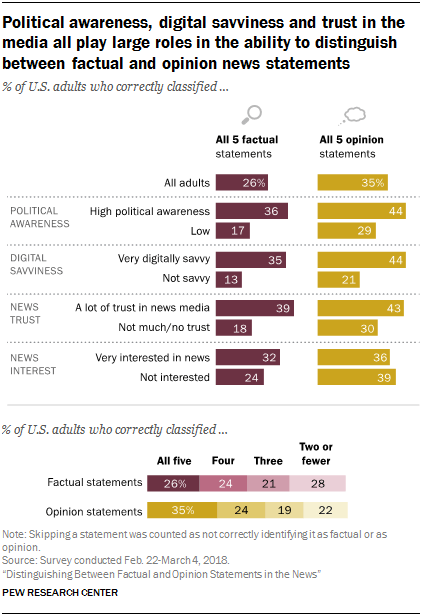
The “digitally savvy” and the politically aware were more likely to correctly identify each statement as opinion or factual. People with a lot of trust in the news media were also significantly more likely to get a perfect score: While just over a quarter of all adults got all five facts right, 39 percent of people who trust news swept that category.

But, interestingly, there was much less of an effect for people who said they were very interested in news. That population was slightly more likely to identify facts as facts — but less savvy than non-news-junkies at calling an opinion an opinion.

Political awareness, digital savviness and trust in the media all play large roles in the ability to distinguish between factual and opinion news statements

The results suggest that confirmation bias is not just a question of people rejecting facts as false — it can involve people rejecting facts as something that could be proven or disproven at all.

But Barthel saw a silver lining: In almost all cases, he said, a majority of people did classify a statement correctly — even with the trends revealing the influence of their beliefs.

“It does make a little bit of difference,” he said. “But normally, it doesn’t cross the line of making a majority of people get this wrong.”

Source: It’s Easier To Call A Fact A Fact When It’s One You Like, Study Finds

They Think They’re Winning

Good analysis. With the announcement of a Trump Executive Order no longer separating out children, appears all the pressure had an impact but we will need to see how the EO is implemented to know for sure (count me as sceptical):

In the last 48 hours, the portrait of a White House in crisis has been unmistakably clear.

Whether or not the Trump administration has a policy of separating the children of illegal border crossers from their parents to deter prospective migrants in the future depends on whom you ask. Over the last 18 months, administration officials have flitted back and forth from contemplating a policy of separation to openly pursuing it, to denying they’ve pursued it, to blaming Democrats for pursuing it, to claiming that the Bible demands they pursue it, to saying Congress can make them stoppursuing it, and finally to opposing Congressional efforts to make them stop pursuing it. Today, the White House’s immigration hardliners proudly tout their uncompromising new policy while its more conventional Republicans feign great effrontery over the mere suggestion that it exists.

The embarrassment in the West Wing is palpable, but the insecurity displayed by people like Homeland Security Sec. Kristjen Nielsen is prudent. They’re right to be concerned that their position is crumbling. The dam broke on Monday as Congressional Republicans parted en masse from the White House and condemned the new means of deterrence while offering short-term fixes for the problem. As of this writing, the White House’s new and surely untenable position is to oppose a narrow solution to the issue of family separation authored by Senator Ted Cruz—no immigration squish. Another reversal is forthcoming.

The West Wing’s simultaneously tone-deaf and flat-footed attempt to mitigate the damage from the crisis it created is not without basis in some kind of political logic: Trump’s immigration hardliners think they’re winning.

The Trump whisperers in the president’s orbit seem to have fully internalized the origin myth of this administration: that it is the manifestation of the populist backlash against a permissive, liberal immigration regime, and there is no policy they can adopt that will be too aggressive for their voters. “[I]f we’re having an argument on immigration,” an unnamed administration official boasted to the Washington Post, “we always win because that’s our ground, no matter what the nuances of the argument are.” Donald Trump’s former campaign manager, Corey Lewandowski, was only slightly more explicitly cynical. “If you want to get people motivated, you’ve got to give them a reason to vote,” he told the New York Times. “Saying ‘build the wall and stop illegals from coming in and killing American citizens’ gives them an important issue.” Another Trump aide added that mobilizing Republicans by agitating on immigration issues “upsets some people in the donor class, but it’s the reality of where the party is.” This is a flawed assumption and, if it is the course on which the Trump administration is determined to embark, the journey will be perilously fraught.

That this “is where the party is” is debatable. Three polls on the administration’s efforts to deter migrants with a policy of family separation were released yesterday, and all showed that the vast majority of voters disapprove. But since the White House only seems to care about voters who identify as Republicans, let’s focus on them. Quinnipiac found that 55 percent of Republicans favor separation for “families seeking asylum” while a CNN survey found 58 percent approve of the Trump administration’s policy. But a CBS News poll showed that a slight plurality of Republicans, 39 percent, said a policy of “separating parents from children at the border” was “unacceptable.”

The number of Republicans who support this policy varies, but whether it is 36 or 58 percent doesn’t really matter. The headline from these polls is that the Republican president is losing anywhere between 4 and 6 in 10 of his own party’s voters. Those are disastrous numbers no matter how you slice it, and that explains the cascade of Republicans racing to distance themselves from the president on this issue in the last few hours.

The more revealing thread that deserves tugging here is the animosity toward the GOP that the Trump administration’s hardliners are stoking. The fact that the president has not secured his signature campaign-trail promise despite having multiple opportunities to take “yes” for an answer suggests the immigration fanatics in Trump’s orbit still believe they win by running against their own party. But it’s not the 2016 primaries anymore; it’s the president’s first midterm. With the GOP’s majorities on the ballot and Democrats more energized to vote than Republicans, Trump needs to unify his party, not tear it apart. Stoking a sense of betrayal over immigration rather than a desire to preserve achievements like the GOP’s tax code reform law is a recipe for disaster in November.

That is the conventional view, at least. After all, staving off a GOP wipeout in November would preserve the ideologically and geographically diverse coalition of Republicans in Congress. A sweeping defeat would purge the House of its immigration dovesfirst, leaving an ideologically purer minority in its wake. And with the House gone, so, too, would the legislative phase of the Trump presidency end and take with it the responsibilities associated with governance. Thus, the party’s border hawks get the best of both worlds. They can stoke a galvanizing grievance and a persecution complex among their base supporters, and they can occupy the White House at the same time. The martyring of the wall, the outcry over family separation, and a blue wave in November can seem like a rare species of victory.

That’s a cynical way to look at things, but the alternative—the idea that the GOP base is united rather than torn asunder by the administration’s policies—is simply deluded. So which is it?

Source: They Think They’re Winning

Contrasting opinions on whether Trudeau should condemn Trump separation of children policy (in end, he did)

David Moscrop arguing he should:

…In his 1961 inaugural address, John F. Kennedy warned, in a different context, that “those who foolishly sought power by riding the back of the tiger, ended up inside.” More than 50 years later, here is Canada—beacon of hope, moral exemplar to the world, shiny liberal Valhalla—mounted squarely on the raging cat, trying to manage a relationship with an addled and unpredictable authoritarian south of the border while human rights abuses occur right in front of our faces.

There are countless grim moments throughout human history that we subject our after-the-fact moral certainty and judgment upon today, adding for good measure that “We would never have let that happen.” We’re better than our barbarous forebears, naturally. We’ve learned our lessons. We’re cosmopolitan. Forward-thinking. Smarter. Kinder. Better.

And yet today, we are silently staring down a morally outrageous and unacceptable policy, hedging toward protecting our “interests” on the backs of helpless children and their terrified families while the American president echoes poet W.H. Auden’s Epitaph on a Tyrant: “When he laughed, respected senators burst with laughter/And when he cried the little children died in the streets.”

Like it or not, we’re living history right now. We’re in the midst of a moment that future generations will look back and judge us on, scrutinizing what we did or didn’t do at the pivotal moment when our moral mettle was put to the test. If we fail to do the right thing—to call out abuses, to demand better, to require decency as a basic term of doing business—then we will rightly be condemned just as we condemn our own antecedents for their failures.

There’s still time for Canada to do the right thing. There’s still time for us to criticize human rights abuses abroad and then to turn our gaze back on ourselves and our shortcomings at home. Today, standing up for human rights is not only the right thing to do, but the necessary thing to do if we wish for a future in which a stable, just, and inclusive democracy is possible.

Source: Trudeau won’t condemn Trump’s migrant policy. That’s duplicitous and irresponsible.

L. Ian MacDonald argues the reverse (more persuasive in my view):

…From a Canadian perspective, the U.S. illegal migrant crisis offers an opportunity to assess where we have come since Trudeau posted his famous #“WelcomeToCanada” tweet in January 2017, on the heels of Trump’s order banning travel from seven majority-Islamic countries, including Syria, from which Canada had recently welcomed 25,000 refugees.

It can take over a year for asylum claims to be ruled upon by Ottawa. And admission is by no means a given. Of the 20,000 people who entered Canada illegally last year, 8,200 has since been deported, more than half of them involuntarily, with the government footing the bill for their flights home.

Another 30,000 asylum claimants crossed the border at regular points of entry, though under the Safe Third Country Agreement with the U.S., most of them were apparently sent back.

The question some are asking is whether the U.S., under Trump, is still a safe third country. But don’t expect Trudeau to make such a case. He’s got quite enough to do with the NAFTA renegotiation, without trying to score political points on the U.S. border migrant crisis.

Source: Trudeau wisely chooses high road in Trump’s immigration debacle