Second son of Russian spies wins legal battle over Canadian citizenship | The Star

Government right to appeal given that their parents were clearly employees of a foreign government, just not on the official diplomatic list. Splitting hairs, IMO: the child of a Russian, American or other spy under diplomatic cover would not be granted citizenship at birth, the child of a spy not under diplomatic cover would:

Timothy Vavilov, a Toronto-born son of Russian spies, has won a court victory that effectively affirms his Canadian citizenship, four years after the government rebuffed an attempt to renew his passport.

The Federal Court of Canada ruling follows a similar decision in the case of his younger brother, Alexander.

However, the Supreme Court of Canada will have the final say on whether the young men are Canadian citizens. The high court is expected to rule soon on whether it will examine the legal issues at the heart of the unusual espionage saga.

The brothers — Timothy, 27, and Alexander, 23 — were born in Canada in the 1990s to parents using the aliases Donald Heathfield and Tracey Ann Foley.

The parents were arrested eight years ago in the United States and indicted on charges of conspiring to act as secret agents on behalf of Moscow.

In all, 11 people — four of whom claimed to be Canadian — were indicted on charges of conspiring to act as agents in the U.S. on behalf of the SVR, successor to the notorious Soviet KGB.

Heathfield and Foley admitted to being Andrey Bezrukov and Elena Vavilova.

Timothy tried to renew his Canadian passport in 2011, but was told to first apply for a Canadian citizenship certificate. He did so in 2013, and in November the following year the application was denied by a federal citizenship official.

The analyst concluded that Timothy’s parents were employees of a foreign government when he was born and therefore, under the provisions of the Citizenship Act, he was not a Canadian.

Just months earlier, the government had used the same rationale to strip Alexander of his citizenship.

Alexander successfully challenged the decision, with the Federal Court of Appeal ruling in his favour last year. The appeal court said the provisions shouldn’t apply because the parents did not have diplomatic privileges or immunities while in Canada.

Alexander has since been able to renew his Canadian passport, and he hopes to live and work in Canada — calling his relationship with the country a cornerstone of his identity.

Although it involves the same central issue, Timothy’s case has proceeded through the courts separately.

In his April 25 decision, Federal Court Justice Patrick Gleeson said the ruling in the younger brother’s case equally applies to Timothy, making him “a citizen.”

But the brothers face what is likely a final legal hurdle.

The federal government wants to contest the Federal Court of Appeal decision in Alexander’s case in the Supreme Court.

In its application to the high court, the government says the citizenship registrar’s conclusion — that Alexander is not Canadian — was “rational and defensible.”

Hadayt Nazami, lawyer for the brothers, says in a filing with the court that acceptance of the federal position “would result in uncertainty about an individual’s fundamental right to citizenship.”

The Supreme Court could decide as early as next month whether it will hear the case.

via Second son of Russian spies wins legal battle over Canadian citizenship | The Star
Mohawk community’s law against mixed couples on reserve ruled unconstitutional | National Post

Interesting case that privileges (correctly IMO) individual rights:

A controversial membership law that requires residents of the Mohawk reserve of Kahnawake to move out if they marry a non-native violates the Canadian Charter of Rights and Freedoms, a court ruled Monday.

The ruling by Quebec Superior Court Justice Thomas Davis declares that a 37-year-old rule invoked to preserve Mohawk culture discriminates against Kahnawake members on the basis of family status and civil status.

The judge acknowledged that Kahnawake, just south of Montreal, has been disadvantaged by the actions of the federal government. “An important part of their land was expropriated for the (St. Lawrence) Seaway. The reserved lands have shrunk in size. For many years, the Mohawks were actively discouraged from practicing their culture,” Davis wrote.

But that does not justify an internal law that has sown division and sparked vandalism and online abuse as residents turned against each other.

The judge said the “Marry Out, Get Out” provision of the Kahnawake Membership Law is “largely (if not solely) grounded in a stereotypical belief that non-native spouses will use the resources and land of the Band in a way that is detrimental to it and that will have a negative impact on the ability of the Band to protect its culture and its land.”

The Mohawk Council of Kahnawake, the defendant, said it needs time to study the decision.

“Obviously, we maintain the position that matters that are so integral to our identity have no business in outside courts,” Grand Chief Joseph Norton said in a statement. “However, a decision on the case has been rendered. We are now taking the time to analyze the decision and will inform the community further in the coming days.”

Julius Grey, who represented the 16 plaintiffs, said he is optimistic the ruling can lead to reconciliation. The judge concluded there was “a clear violation” of Charter rights, but he left room for discussion, Grey said.

The lead plaintiff was Waneek Horn Miller, who represented Canada in the 2000 Summer Olympics, where she met her future husband, Keith Morgan. They have been a couple since 2002 and have three children.

When they were building a new home in Kahnawake in 2010, a petition began circulating demanding that the construction stop. In 2014, she learned her name was on an eviction list, and when she went to a band meeting to defend herself, she was verbally attacked and later received online abuse.

“Despite all of this, Ms. Miller would like to return to Kahnawake and would like her children to have access to the culture,” the ruling said. “She believes that she can contribute to the Kahnawake community. However, she is fearful of the consequences of moving back to Kahnawake for her family.”

The decision documents the verbal abuse suffered by the children of mixed marriages, who have been called “half-breeds” or “white bastard.” Tensions got particularly high in 2014 when a “grassroots” campaign began to persuade mixed couples to leave.

Marie Stacey, who lives on the reserve with her non-native partner, testified she received a notice telling her to leave. She attended a public meeting where one participant suggested a return to the 1970s, when “we burned their (non-natives’) houses,” she told the court.

“Ms. Stacey is scared of what is happening on the Reserve, scared that people might come to her home,” the decision reads. “Being a plaintiff in the present lawsuit has given her little comfort, as at least one Facebook post referred to the plaintiffs as having targets on the back of their heads.”

The plaintiffs had been seeking $50,000 damages each, but the judge said the sum was excessive. He awarded a total of $35,000 to be divided among seven plaintiffs who he said were harmed.

The judge disputed the Mohawk Council of Kahnawake’s contention that “Marry Out, Get Out” is theoretical because the council has not forcibly evicted anyone. “People’s lives have been affected,” he wrote.

via Mohawk community’s law against mixed couples on reserve ruled unconstitutional | National Post

Heterodoxy Academy: Encouraging diversity of thought

Rubin Friedman flagged this initiative to me that aims to increase diversity of thought within the academic community (primarily social sciences). Although I sense a slight balance to the right (might reflect my bias!), the principles and approach of the Heterodoxy Academy are broadly applicable.

During one of my executive development programs, considerable emphasis was placed on being able to ask open-ended questions as a learning and engagement technique, rather than leading questions to advance one’s position.

I particularly like the OpenMind exercises to increase awareness of one’s biases and develop techniques to broaden one’s perspective and engage and understand the perspectives of others. These are particularly useful when engaging in polarized political discussions such as immigration.

The five steps are below but I would encourage readers check it out (for the useful “life hacks” you need to do the exercises, each step takes between 10-20 minutes in my experience):

First step: See what you’ll gain from viewpoint diversity

  • Viewpoint diversity helps you get closer to the truth. In order to fully understand an issue, you need to challenge your assumptions and consider it from multiple angles.
  • Viewpoint diversity will help you be more persuasive. By engaging with people with whom you disagree, you can understand where they’re coming from, and craft arguments that will more likely appeal to them.
  • Viewpoint diversity will open up opportunities for growth and learning. Realizing that your views and opinions have evolved over time is a sure sign of intellectual development.
  • Therefore, it’s ideal to talk to both people with whom you agree and disagree, and try to learn from them why they believe what they believe.

Second step: Cultivate intellectual humility

  • In order to prevent our certainty from blinding us to other ideas, we must develop intellectual humility: the value espoused by Voltaire, Alexander Pope, Buddha, and many others. We can become wiser by recognizing the limits of our knowledge.
  • But doing so isn’t always easy. Those with a fixed mindset believe that intelligence is set in stone. This often causes them to prioritize looking smart at all costs, which makes it harder to learn and grow. Those with a growth mindset believe that intelligence can develop. As a result, they often relish accepting new challenges, which makes it easier for them to learn and grow.
  • In order to inject more growth into your mindset, you can: acknowledge that your abilities are fluid; view each mistake as a learning opportunity; and challenge yourself to do things you haven’t already mastered.

Third step: Explore the irrational mind

  • Our minds are divided into two parts that sometimes conflict: the elephant represents our quick, automatic intuitive thinking; the riderrepresents our slow, effortful reasoning. (You saw these two processes in action when you read the colors out loud effortlessly and then struggled a bit when naming the colors after.)
  • We often fall prey to post hoc reasoning, the process in which our elephant makes a snap moral judgment, and our rider works to justify it. (You might have used post hoc reasoning to justify your response that it’s acceptable to hit the switch on the trolley, and it’s acceptable to push the worker off the bridge.)
  • A common form of post hoc reasoning is when we seek or interpret information in a way that confirms our preexisting beliefs, which is called confirmation bias.
  • Our reasoning becomes even less reliable when we are motivated to reach a particular conclusion, especially when a moral issue is at stake. (We explored this in the different cases about the unintended economic and environmental side-effects of the president’s new program.)
  • As a result, it can be difficult to convince other people to change their minds, especially on moral issues—because their brains, just like ours, are wired in these ways.

Fourth step: Break free from your moral matrix

  • We all live within a moral matrix: a consensual hallucination that we believe represents objective reality. Many different moral communities exist, each with its own set of shared values, and each convinced that its group alone sees truth as it really is. (You saw a metaphor for this with the optical illusion of the young woman and old woman.)
  • The moral mind is like a tongue with six different taste receptors. We all share these same foundations, but we build upon them in different ways to create our own moral matrices. The six moral foundations are: Care, Fairness, Loyalty, Authority, Sanctity, and Liberty.
  • Many disagreements can be attributed to the application of different moral foundations. There are also cases when different people apply the same moral foundation in different ways. When someone disagrees with you, it’s probably not because they’re evil. It might be because they have constructed a different moral matrix and they rely on the moral foundations differently than you do.

Fifth step: Prepare for constructive disagreements

  • We can engage in constructive disagreement by seeking to learn, rather than to be right. The key to constructive disagreements is mastering the language of the elephant (automatic, intuitive thinking).

  • Sometimes, our automatic thoughts (generated by our elephants) aren’t accurate, and these cognitive distortions can cause negative feelings. Our riders can rein in our elephants by examining our initial thoughts, and—over time—training them to be more accurate

  • We can also hone our ability to communicate effectively with other people by focusing on their elephants. We can: respect their elephants (don’t criticize people or make them feel stupid); understand their elephants (learn about what other people care about and why); and appeal to their elephants (convey your thoughts in a language that will resonate with them).

ICYMI: Fringe internet culture can’t stay in the fringes

Useful and insightful commentary as usual Amarnath Amarasingam on “incel” radicalization:

Combine powerful online echo chambers, the perceived decline of the white male, a surge in online troll culture and groups of angry and alienated men, and you have a powerful cocktail for dangerous radicalization.

As of yet, we don’t have proof that these conditions led to the horrific van attack in Toronto that left 10 dead and 14 injured. But we do have a clue: a Facebook post on the page of Alek Minassian, charged in Monday’s attacks, talking about the “Incel Rebellion.”

Incels or “involuntary celibates” are those who are essentially forced into celibacy because they cannot find a sexual partner. Many of the young men who join this movement feel ignored, and the groups of which they are a part have likewise been ignored by mainstream society. That’s why many of us hadn’t heard the term “incel” until this week.

As we learn more about Minassian’s history, it might very well turn out that the incel movement was not the primary factor in his decision to get behind the wheel. But it’s worth discussing regardless, because as many of us are beginning to realize, fringe internet culture can cause real social harm.

Incels operate across the same platforms as a range of extreme right activists — platforms such as Reddit, 4chan and 8chan, and use communications channels such as Discord, the gaming chat application noted for its use by activists seeking to influence European elections in favour of far right groups.

In fact, the movement plays off of similar tropes and language as the extreme right, using terms like “cuck” and “feminazi.”

The ideological nexus that ties these groups together is the perception of (white) masculinity being under threat from external forces such as women, people of colour, refugees and the political left, combined with a hatred of social progressive values that empower previously marginalized communities.

Normies, Chads and Stacys

These incel individuals, who often suffer from a range of vulnerabilities including anxiety and autistic spectrum disorders, flourish in digital fora that provide them with the opportunity to embrace their identity as outsiders, relishing in their role as “beta male.”

In the confines of these incel echo chambers, they blame their social misfortune on their peers who have fewer issues engaging in social activities — people they label as “normies,” “Chads” and “Stacys.”

Normies, a term originating on 4Chan and referring to anything and anyone who is mainstream, includes Chads, a nickname used to describe good looking men who have no difficulty finding women who will sleep with them, and Staceys who are women who always reject incels in favour of Chads. The behaviours that the “betas” feel incapable of achieving offline — such as social confidence and intimate relationships — are projected onto these imagined boogeymen.

Many of these youth needed support, though some of them may have turned to established social institutions already for help in the past. Today, they’re increasingly finding it in these closed-off online collectives, talking with like-minded and equally alienated individuals, which ends up amplifying and reinforcing — rather than addressing and counteracting — their angst and anger.

As with all cases of radicalization, under the right set of psychological and personal conditions, individuals can be pushed to violence. Thousands of youth may feel these grievances, but only a few may ever decide that violence is a necessary way to express themselves. Even after decades of research in terrorist radicalization, the question of who might ultimately turn to violence is still beyond our grasp.

Elliot Rodger is the primary example of an incel radicalized to the point of violence. In 2014, the 22-year-old killed six people in Isla Vista, California, after posting a manifesto about his hatred of women and desire to punish them for rejecting him. His violence was later lauded on the fringes of the internet, fostering a range of distasteful memes and helping to reinforce the mythos of the group.

Academic discourse around “fragile masculinity” has long pointed out that we need to start taking these grievances more seriously, particularly among youth. Many of these online discussions are overflowing with worrisome levels of toxic masculinity and anger. In the mindset of those who occupy these spaces, they are trapped between the strong men they cannot become, and the weak men who reinforce the feminism that they see as ostracising and oppressing them.

Ultimately, these communities are providing a home to those who feel unable to find a place in mainstream society. The attitudes espoused therein must be challenged, but more importantly, these individuals must be offered an opportunity to engage with those outside of their echo chambers, through meaningful interventions and support.


Source: Fringe internet culture can’t stay in the fringes

British interior minister Rudd resigns after immigration scandal | Reuters

Taking one for the team. This happened when PM May was Home Secretary:

Britain’s interior minister resigned on Sunday after Prime Minister Theresa May’s government faced an outpouring of indignation over its treatment of some long-term Caribbean residents who were wrongly labeled illegal immigrants.

The loss of one of May’s closest allies is a blow as she navigates the final year of negotiations ahead of Britain’s exit from the European Union in March 2019. It also deprives the cabinet of one of its most outspoken pro-European members.

In a resignation letter to May, Amber Rudd said she had inadvertently misled a parliamentary committee last Wednesday by denying the government had targets for the deportation of illegal migrants. May accepted her resignation.

For two weeks, British ministers have been struggling to explain why some descendants of the so-called “Windrush generation”, invited to Britain to plug labor shortfalls between 1948 and 1971, had been denied basic rights.

The Windrush scandal overshadowed the Commonwealth summit in London and has raised questions about May’s six-year stint as interior minister before she became prime minister in the wake of the 2016 Brexit referendum.

“The Windrush scandal has rightly shone a light on an important issue for our country,” Rudd said in a resignation letter to May.

Rudd, who was appointed Home Secretary in 2016, said voters wanted those who had the right to reside in Britain to be treated fairly and humanely but also that illegal immigrants be removed.

May to blame?

The opposition Labour Party, which had repeatedly called on Rudd to resign, said May was responsible and should explain her own role in the government’s immigration policies.

“The architect of this crisis, Theresa May, must now step forward to give an immediate, full and honest account of how this inexcusable situation happened on her watch,” said Diane Abbott, Labour’s spokeswoman on interior affairs.

Abbott called on May to give a statement to the House of Commons explaining whether she knew that Rudd was misleading parliament about the deportation targets.

Facing questions over the Windrush scandal, Rudd, 54, told lawmakers on Wednesday that Britain did not have targets for the removal of immigrants, but was forced to clarify her words after leaked documents showed some targets did exist.

The Guardian newspaper on Sunday reported a letter from Rudd to May last year in which she stated an “ambitious but deliverable” aim for an increase in the enforced deportation of immigrants.

After repeated challenges to her testimony on the deportation of immigrants, Rudd telephoned May on Sunday and offered her resignation.

“I feel it is necessary to do so because I inadvertently misled the Home Affairs Select Committee over targets for removal of illegal immigrants,” Rudd told May.

With her Conservative Party split over Brexit, May will have to be careful to preserve the uneasy balance in the cabinet after the loss of such a senior pro-EU minister.

Possible contenders who could replace Rudd include Environment Secretary Michael Gove, Health Secretary Jeremy Hunt, Communities Secretary Sajid Javid, Northern Irish Secretary Karen Bradley and former Northern Irish Secretary James Brokenshire.

Windrush crisis

The government has apologized for the fiasco, promised citizenship and compensation to those affected, including to people who have lost their jobs, been threatened with deportation and denied benefits because of the errors.

But the controversy over policies which May is closely associated with has raised awkward questions about how the pursuit of lower immigration after Brexit sits alongside the desire to be an outward-looking global economy.

The immigrants are named after the Empire Windrush, one of the first ships to bring Caribbean migrants to Britain in 1948, when Commonwealth citizens were invited to fill labor shortages and help rebuild the economy after World War Two.

Almost half a million people left their homes in the West Indies to live in Britain between 1948 and 1970, according to Britain’s National Archives.

A week before local elections, May apologized to the black community on Thursday in a letter to The Voice, Britain’s national Afro-Caribbean newspaper.

“We have let you down and I am deeply sorry,” she said. “But apologies alone are not good enough. We must urgently right this historic wrong.”

The crisis has focused attention on May, who as interior minister set out to create a “really hostile environment” for illegal immigrants, imposing tough new requirements in 2012 for people to prove their legal status.

Rudd’s resignation comes four months after another close ally and her then most senior minister, Damian Green, was forced out of his job for lying about whether he knew pornography had been found on computers in his parliamentary office.

Anna Soubry, a Conservative lawmaker, predicted Rudd may one day return to a senior job in government.

“She is a woman of great courage and immense ability,” Soubry said. “If there is any justice she will soon return to the highest of office.”

via British interior minister Rudd resigns after immigration scandal | Reuters

Newcomers find jobs, prosperity in Atlantic Canada — if they stay

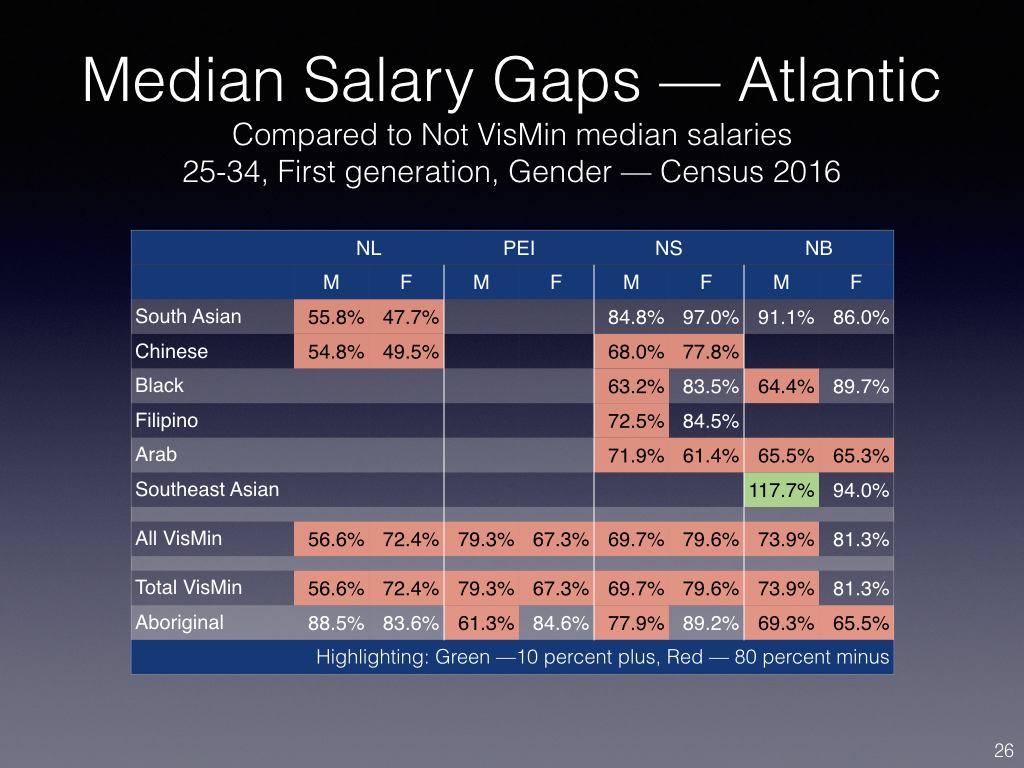
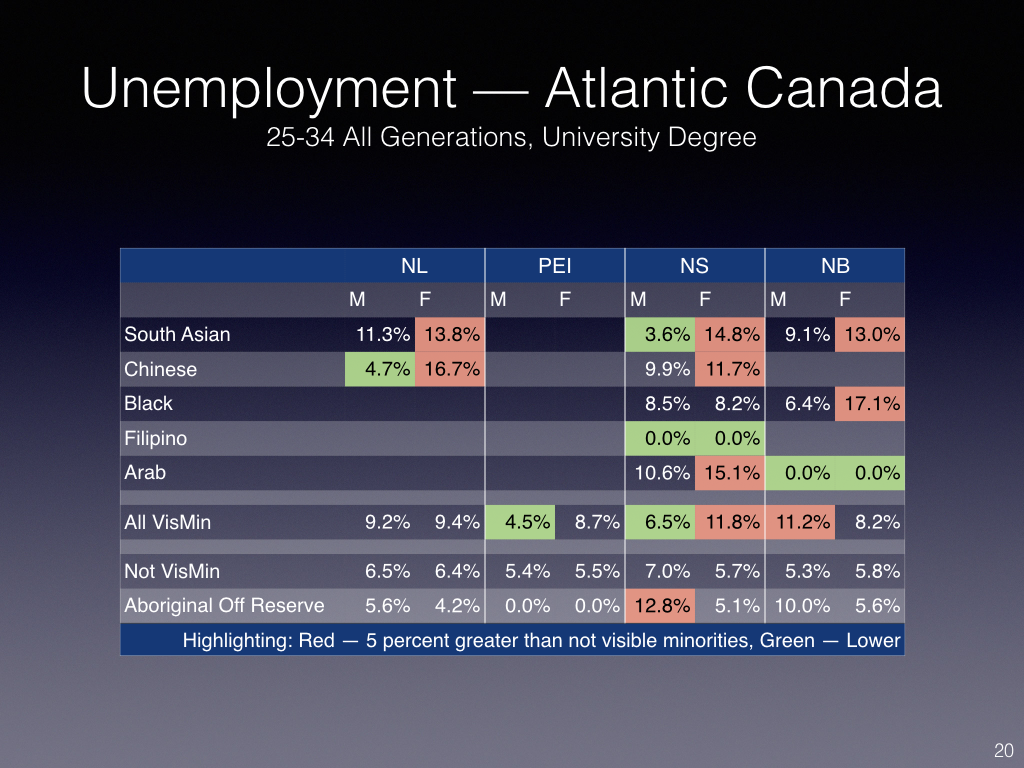
Some good data and analysis in this article, which conform with the unemployment data I have looked at but not median income(slides below):

Immigrants who stay in Atlantic Canada have higher employment levels, higher wages and face less discrimination than immigrants to other parts of Canada, yet the region struggles to attract newcomers and has the lowest retention rates in Canada.

Atlantic Canada is engaged in a radical experiment in population management that has profound implications not just for this region, but for the country as a whole. The demographic bomb that threatens Canada is set to go off here first:

— Atlantic Canada has Canada’s lowest birth rate, highest median age and often sends more residents to other parts of Canada than it takes in.

— Francis McGuire, president of the Atlantic Canada Opportunities Agency, points out that there are more than 20,000 jobs unfilled in the region.

— Across Atlantic Canada, one in every five residents is already over the age of 65. That compares to a rate of one in six across Canada.

— Newfoundland and Labrador schools have lost a third of their students since 1996; more people have died than were born in the province for each of the last three years and the average age is almost three years older than the Canadian average of 41. The Harris Centre of Regional Policy and Development at Memorial University predicts the provincial population will drop 10 per cent by 2036 and that some towns could see drops of 30 per cent or more.

— New Brunswick had an actual population decline in 2016 and has lost one fifth of its school-age children in the last two decades.

— In Nova Scotia, the resilient economy of Halifax is the only factor propping up the province’s population. Every region outside the provincial capital declined in the last census.

Immigration the solution

Many agree that a massive increase in immigration is an inescapable part of the solution. All four provincial governments have made boosting immigration a key priority and Ottawa has stepped in with Canada’s first regional immigration program: The Atlantic Immigration Pilot.

But deciding to transform your society with new blood is easier than actually doing it.

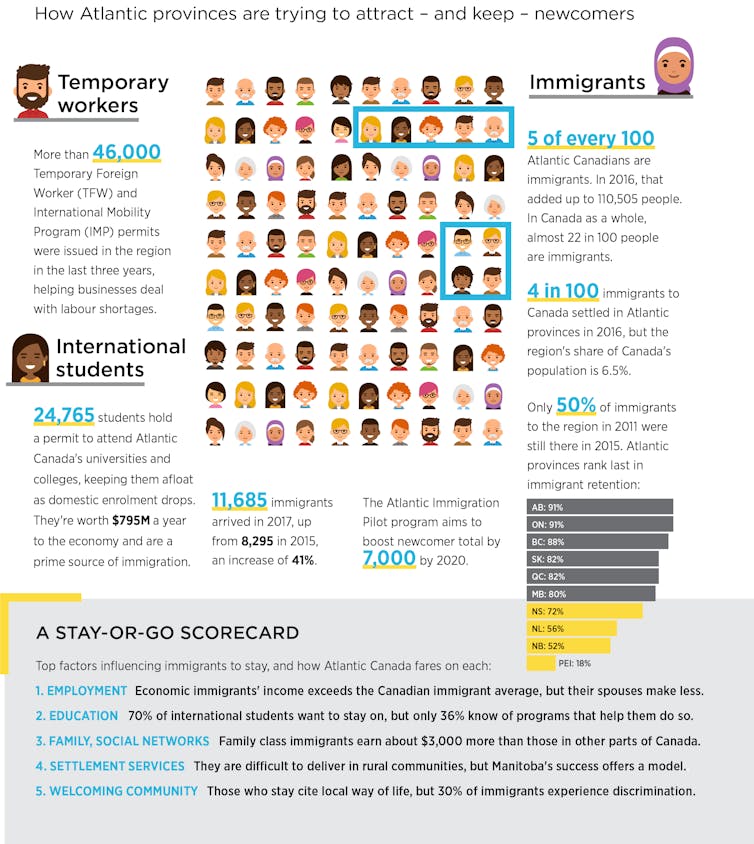
Only 18 per cent of the immigrants who landed in Prince Edward Island in 2011 were still there five years later. The rates are better in New Brunswick (52 per cent), Newfoundland and Labrador (56 per cent) and Nova Scotia (72 per cent), but they still fall far behind Ontario and Alberta, which kept 91 per cent of the immigrants who arrived in 2011, and British Columbia, which had a retention rate of 88 per cent over the same period.

Ottawa began shifting immigration responsibility to the provinces about 20 years ago.

The learning curve was steep. Initial programs in several provinces fell apart.

Now provincial recruiters target specific countries, make sure that potential newcomers know that Atlantic Canada is cold, rural and not particularly diverse, and they design immigration programs that encourage newcomers to settle.

How Canada’s Atlantic provinces are trying to attract – and keep – newcomers. Public Policy Forum, Author provided

The decision to come to Atlantic Canada and the decision to stay are two very different things.

Surveys show that immigrants leave the region in search of better jobs, but research suggests that’s not what they will find. In fact, immigrants in Atlantic Canada fare better economically than the average immigrant across Canada, and in some cases better than native-born Canadians.

Higher wages in Atlantic Canada

A profile of immigrant tax filers in Atlantic Canada published by Dalhousie University professors Yoko Yoshida and Howard Ramos found that immigrants to Nova Scotia, New Brunswick and Newfoundland were more likely to be employed and earned higher wages than the average immigrant in Canada who landed at the same time. Immigrants to P.E.I. were below the Canadian average, as were spouses of primary applicants and refugees.

Professor Ather Akbari at Saint Mary’s University found that immigrants in Atlantic Canada actually earn more than Canadian-born workers with similar skills who live in Atlantic Canada, though that wage advantage has narrowed over the last decade.

Research also disputes the familiar assumption that urban areas are more welcoming than small towns.

Dalhousie University’s Ramos recently looked at actual experiences of discrimination based on ethnicity, race and language. Overall, the incidence of discrimination was far lower in rural areas than in big cities. Atlantic Canada came out particularly well, with very low rates of discrimination compared to Ontario, the Prairies and British Columbia.

To be sure, newcomers do encounter hate and discrimination in Atlantic Canada, as in any other place.

via Newcomers find jobs, prosperity in Atlantic Canada — if they stay

Employment Equity in the Public Service of Canada for Fiscal Year 2016 to 2017: 2016-17 data delayed

Highly unusual for the EE data not to be included in the annual report (can’t recall this happening in recent years). The report’s explanation suggests that this is collateral damage of the Phoenix pay system.

That being said, better to take the necessary time for data verification than publish inaccurate data:

The 2016 to 2017 annual report features a 10-year trend analysis of the representation of the 4 designated groups and reports on results of initiatives that advance employment equity, diversity and inclusion. (Data for 2016 to 2017 will be provided at a later date and included with the report as an annex.) Over the past 4 years, the representation of each employment equity group in the core public administration has exceeded workforce availability. However, gaps persist in some departments and in certain occupational groups. We will continue our efforts to close these gaps.

…. Statistical tables for the 2016 to 2017 fiscal year in 7 areas will be published following:

  • retrieval of data from the Phoenix pay system
  • reconciliation of data with sources from the Public Service Commission of Canada and from departments and agencies
  • validation of the accuracy of the data to be published

via Employment Equity in the Public Service of Canada for Fiscal Year 2016 to 2017 – Canada.ca