Conclusion to the article that Michael Adams and I wrote for Policy Options:
What might the United States learn from Canada? First, accept immigrants with skills and education that will benefit the American economy, but recognize that they need support to thrive and contribute. Allow immigrants to sponsor close relatives. Fund programs to help newcomers learn English and find employment. Encourage immigrants to become citizens, allow dual citizenship, and encourage new citizens to vote and become legislators who articulate the needs of their communities. One day, one of their children may become president of the great republic.
…Although I focus mainly on the example of black girls to talk about search bias and stereotyping, black girls are not the only girls and women marginalized in search. The results retrieved two years into this study, in 2013, representing Asian girls, Asian Indian girls, Latina girls, white girls, and so forth reveal the ways in which girls’ identities are commercialized, sexualized or made curiosities within the gaze of the search engine. Women and girls do not fare well in Google Search — that is evident.
Of course, these problems extend to non-gendered racism, as well. On June 6, 2016, Kabir Ali, an African American teenager from Clover High School in Midlothian, Va., tweeting under the handle @iBeKabir, posted a video to Twitter of his Google Images search on the keywords “three black teenagers.” The results that Google offered were of African American teenagers’ mug shots, insinuating that the image of Black teens is that of criminality. Next, he changed one word — “black” to “white” — with very different results. “Three white teenagers” were represented as wholesome and all-American. The video went viral within 48 hours, and Jessica Guynn, from USA Today, contacted me about the story. In typical fashion, Google reported these search results as an anomaly, beyond its control, to which I responded, “If Google isn’t responsible for its algorithm, then who is?” One of Ali’s Twitter followers later posted a tweak to the algorithm made by Google on a search for “three white teens” that now included a newly introduced “criminal” image of a white teen and more “wholesome” images of black teens.
What we know about Google’s responses to racial stereotyping in its products is that it typically denies responsibility or intent to harm, but then it is able to “tweak” or “fix” these aberrations or “glitches” in its systems.
What we need to ask is why and how we get these stereotypes in the first place and what the attendant consequences of racial and gender stereotyping do in terms of public harm for people who are the targets of such misrepresentation. Images of white Americans are persistently held up in Google’s images and in its results to reinforce the superiority and mainstream acceptability of whiteness as the default “good” to which all others are made invisible. There are many examples of this, where users of Google Search have reported online their shock or dismay at the kinds of representations that consistently occur. Meanwhile, when users search beyond racial identities and occupations to engage concepts such as “professional hairstyles,” they have been met with the kinds of images seen below. The “unprofessional hairstyles for work” image search, like the one for “three black teenagers,” went viral in 2016, with multiple media outlets covering the story, again raising the question, can algorithms be racist?
Where are black girls now?
Since I began the pilot study in 2010 and collected data through 2016, some things have changed. In 2012, I wrote an article for Bitch Magazine, which covers popular culture from a feminist perspective, after some convincing from my students that this topic is important to all people — not just black women and girls. I argued that we all want access to credible information that does not foster racist or sexist views of one another. I cannot say that the article had any influence on Google in any definitive way, but I have continued to search for black girls on a regular basis, at least once a month, and I can report that Google had changed its algorithm to some degree about five months after that article was published. After years of featuring pornography as the primary representation of black girls, Google made modifications to its algorithm, and the results as of the conclusion of this research can be seen here:
No doubt, as I speak around the world on this subject, audiences are often furiously doing searches from their smart phones, trying to reconcile these issues with the momentary results. Some days they are horrified, and other times, they are less concerned, because some popular and positive issue or organization has broken through the clutter and moved to a top position on the first page. Indeed, as my book was going into production, news exploded of biased information about the U.S. presidential election flourishing through Google and Facebook, which had significant consequences in the political arena.
I encourage us all to take notice and to reconsider the affordances and the consequences of our hyper-reliance on these technologies as they shift and take on more import over time. What we need now, more than ever, is public policy that advocates protections from the effects of unregulated and unethical artificial
Will be interesting to see how the judge rules. His initial reaction suggests he will be appropriately cautious, given his reference to general guidelines:
Lawyers for a black man caught carrying a loaded gun are asking a judge to declare for the first time in Canada that African-Canadians should receive special consideration in sentencing, much as Indigenous peoples do.
The federal Criminal Code says expressly that sentencing judges must pay particular attention to the circumstances of Indigenous people. Parliament drafted that provision in 1996 in part to respond to a disproportionate rate of incarceration. Indigenous people make up 27 per cent of federal prisoners, and just 5 per cent of the country’s overall population.
But black Canadians, too, are disproportionately incarcerated. They make up 8.6 per cent of federal prisoners (those serving sentences of two years or more) and just 3 per cent of the population.
Lawyers Faisal Mirza and Emily Lam, representing Jamaal Jackson, 33, say African-Canadians, like Indigenous people, have faced dislocation, segregation, disproportionate rates of incarceration and discrimination in employment and education, plus over-policing of neighbourhoods and mistreatment in federal custody.
“In 2018 … the experience of African-Canadians is sufficiently unique that it is in and of itself deserving of special recognition,” Mr. Mirza told Ontario Superior Court Justice Shaun Nakatsuru in Toronto. Disadvantage in the black community, he said, may diminish the “moral culpability” of offenders. Just as it is mandatory for judges to consider an Indigenous offender’s history of disadvantage, they should also be obliged to perform a similar analysis for black people. “I’m asking that it become presumptively the approach for African-Canadians.”
But Justice Nakatsuru, whose Japanese-Canadian father was interned during the Second World War, told Mr. Mirza he is “struggling” with the idea. He said the Criminal Code already provides that all offenders are entitled to consideration of their individual circumstances, including discrimination and disadvantage, when they are being sentenced. To go further than that and create a presumption of special treatment for African-Canadian offenders raises difficult questions, he said. “Where does it end, to take judicial notice of a collective experience?”
Justice Nakatsuru mentioned the experiences of Asian-Canadians and other visible minorities. He said the experiences of African-Canadians are diverse, and in that sense do not fit well within a presumption of shared disadvantage. He also asked what cases, laws or constitutional principles would give him the authority to make such a declaration.
Mr. Jackson has a nearly continuous criminal record dating from his youth, prosecutor Sue Adams told the court. His most serious crime was an armed robbery of a Petro-Canada station with a sawed-off shotgun, for which he was sentenced to 81 months in prison. Released on parole, he violated his conditions and was returned to prison to serve out the full term. Seven months later, police attempting to fight the spread of guns caught him on a wiretap attempting over a two-day period to obtain a firearm. Judges had made five orders in previous cases prohibiting him from carrying weapons or ammunition. Police caught him with the handgun in Mississauga, west of Toronto, with a single bullet in its chambers.
The prosecutor is asking for a sentence of 7.5 to nine years, plus an additional year for violating his weapons prohibitions. She said she does not oppose detailed histories of an offender being put before the court, but said that given the seriousness and repeated nature of his crimes, he does not deserve special consideration in sentencing.
The defence has not yet recommended a sentence, but is expected to ask for four years.
It submitted a “race and culture assessment” by a Nova Scotia social worker, Robert Wright. Mr. Jackson spent part of his childhood and teen years in Cole Harbour, N.S., and part in London, Ont. As a light-skinned black person, Ms. Lam told the court, he was not accepted by whites or blacks. His extended family was large and had good jobs. But a lack of parental support left him seeking support from his peers. (He also identifies as Indigenous, but an Aboriginal legal group declined to take on his case, Ms. Lam said.)
If Justice Nakatsuru accepts the idea of special consideration, Mr. Mirza asked him to affirm that judges should order detailed reports on African-Canadian offenders, setting out how “intergenerational disadvantage” affected them. Such reports are done regularly for Indigenous offenders.
Mr. Mirza said that, while sentencing judges traditionally take into account the need to deter other criminals and protect communities, they should also consider that “overincarceration” perpetuates disadvantage in the African-Canadian community.
As far back as 2004, the Ontario Court of Appeal said that if racial or gender bias help explain why a crime was committed, it can be considered in sentencing.
The sentencing hearing continues Tuesday. Justice Nakatsuru is not expected to rule immediately.
Certain blindness to have let this issue fester for so long:
Jeremy Corbyn has issued his strongest condemnation of antisemitism so far as he came under intense pressure from his own backbenchers and the wider Jewish community over his failure to tackle antisemitism in the Labour party.
He was forced to step up his response during the day after an extraordinary open letter was published on Sunday night by the Board of Deputies of British Jews and the Jewish Leadership Council (JLC), accusing him of “siding with antisemites” and calling for supporters to stage a show of solidarity outside parliament as the parliamentary Labour party held its weekly meeting on Monday evening.
At the PLP meeting, backbenchers denied there was any kind of coup attempt. Wes Streeting MP, often a critic of Corbyn’s, said: “No one’s calling for a leadership election. We just want leadership.”
The pressure from backbench MPs began building on Friday when Luciana Berger challenged Corbyn over supportive comments he posted to the artist behind an antisemitic mural. It came to a head on Monday morning when John Mann, chair of the all-party antisemitism group, tweeted that the Labour party “ceases to have a reason for existence if it cannot stand up against discrimination and racism”. He said the party was “rotten to the core”.
His criticism was backed by the veteran former minister Dame Margaret Hodge, who said Corbyn had allowed himself to become “the poster boy of antisemites everywhere”.
As hundreds gathered at Westminster, including dozens of Labour MPs and peers, and a small group of rival demonstrators from Jewish Votes for Labour, Corbyn issued a “sincere apology” that acknowledged that his previous responses had been inadequate.
“I recognise that antisemitism has surfaced within the Labour party, and has too often been dismissed as simply a matter of a few bad apples,” he said on Twitter.
“This has caused pain and hurt to Jewish members of our party and to the wider Jewish community in Britain. I am sincerely sorry for the pain which has been caused, and pledge to redouble my efforts to bring this anxiety to an end.”
Corbyn’s previous apology merely recognised that there were “pockets” of antisemitism in the party. That was rejected as inadequate by Jonathan Goldstein of the JLC, who said the Labour leader had become a figurehead for antisemitism.
Speaking at the solidarity protest outside parliament, the former Labour MP Gillian Merron, who is now chief executive of the Board of Deputies, said Corbyn had only made concessions because he had been forced into it by their actions.
“People here are angry and sad,” she said. “Nobody dreamt they would be in this position. The Jewish community has had enough and we are joined in that feeling by many many people inside and out of the Labour party.”
Later, Louise Ellman, who is a former chair of the Jewish Labour Movement, told BBC Newsnight it was “unprecedented” that the mainstream Jewish community had to take to the streets to protest at antisemitism in a mainstream political party.
In the second letter, Corbyn expressly apologised for failing to study the content of the antisemitic mural in the East End of London before posting supportive comments to its artist.
Jewish leaders claimed in their letter, released on Sunday night, that the controversy proved the Labour leader “cannot seriously contemplate antisemitism, because he is so ideologically fixed within a far-left worldview that is instinctively hostile to mainstream Jewish communities”.
Countering the charge, Corbyn says in his letter: “While the forms of antisemitism expressed on the far right of politics are easily detectable, such as Holocaust denial, there needs to be a deeper understanding of what constitutes antisemitism in the labour movement. Sometimes this evil takes familiar forms – the east London mural which has caused such understandable controversy is an example.
“The idea of Jewish bankers and capitalists exploiting the workers of the world is an old antisemitic conspiracy theory … I am sorry for not having studied the content of the mural more closely before wrongly questioning its removal in 2012.”
In a much more nuanced recognition of the forms that antisemitism can take, the letter also accepts that anti-Zionism and antisemitism have become conflated.
“Criticism of Israel, particularly in relation to the continuing dispossession of the Palestinian people, cannot be avoided. Nevertheless, comparing Israel or the actions of Israeli governments to the Nazis… and using abusive phraseology about supporters of Israel such as ‘Zio’ all constitute aspects of contemporary antisemitism.”
He also promises that the party will implement in full the “overdue” recommendations of the Chakrabarti report,which was published nearly two years ago.
Andy McDonald, the shadow transport minister, insisted that action would be taken. He pledged to speed up the “far too slow” complaints process. He was unable to say how many complaints had been successfully dealt with.
A related article on the extent of antisemitism in the UK (CST report):
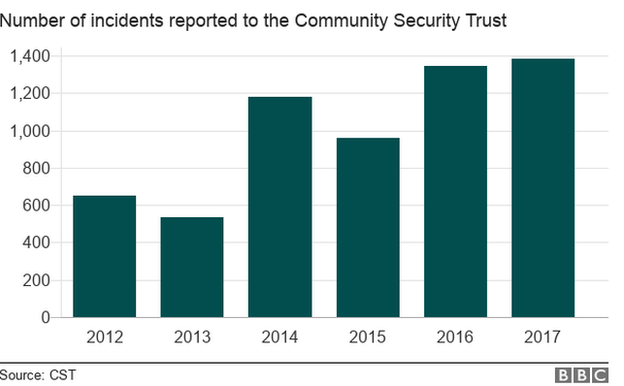
The Community Security Trust (CST), a charity that works with Jewish community organisations and police forces, recorded 1,382 anti-Semitic incidents in 2017 – the highest total ever.
Of these, 145 incidents were classed as “assaults” – up from 108 the year before. But the most common type of incident was “verbal abuse directed at random Jewish people in public” – being shouted at in the street.
Meanwhile, almost one in five incidents involved the use of social media.
One tweet sent to a Jewish charity appeared to show a rollercoaster above a concentration camp. Another social media user posted messages saying “Hitler was right”.
The CST said there had been three incidents involving damage to, or desecration of, a Jewish cemetery; eight involving stones or bricks being thrown; and eight involving eggs being thrown at property.
The charity also cited improvements in the reporting of anti-Semitic incidents – but said it believed there was still “significant under-reporting”.
Earlier this month, the former Chief Rabbi Lord Sacks told the Jewish News newspaper: “Any political party has to adopt a zero-tolerance to anti-Semitism. If they fail to do so, they are a danger not only to themselves but to the country and all inhabitants.”
Lord Sacks has previously said that anti-Semitism is an ancient hatred and a contemporary warning sign that community relations within a culture are endangered.
It is why the Jewish community is inviting members of other faiths, and of none, to join in the chorus: “Enough is Enough.”
Interesting intervention in the context of the recent India trip (even though this intervention happened before):
Foreign Affairs Minister Chrystia Freeland’s office says it was “inappropriate” for Indian diplomats to interfere in a cultural festival outside of Toronto.
The allegations stem from a controversy last summer in which Indian consular officials reportedly tried to dissuade the annual Carabram festival in Brampton, Ont. – a city west of Toronto with a large Indian population – from having separate Punjab and India pavilions. Punjab is the only state in India with a Sikh majority.
“Interference in domestic affairs by foreign representatives in Canada is inappropriate,” Ms. Freeland’s spokesman, Adam Austen, wrote in an e-mail to The Globe and Mail.
“The federal government has no role in planning Carabram, but supports the right of its organizers to do so however they see fit.”
Brampton Mayor Linda Jeffrey first raised concerns about “unwarranted and unwelcome interference” by the Consulate General of India in a letter to Ms. Freeland on Aug. 18, 2017.
In the letter, which has never been made public but was obtained by The Globe and Mail, Ms. Jeffrey said her office learned in July, 2017, that officials with the Consulate General in Toronto approached organizers of Carabram to cancel the Punjab pavilion, or merge it with the India pavilion. She also alleges that consular officials tried to pressure organizers to change the name to the Punjabi cultural pavilion. In the end, the Punjab pavilion went ahead.
“This type of unwarranted interference by Indian officials in a local cultural festival in Brampton was shocking,” Ms. Jeffrey wrote in the letter, which asks Ms. Freeland to look into the matter.
Ms. Jeffrey said it is her understanding that consular officials threatened to “go to the highest office in the country and cancel this festival.”
The allegations of improper interference come at a time of heightened tensions between Canada and the Indian government.
Prime Minister Justin Trudeau continues to face pressure from Opposition MPs to allow his national security adviser, Daniel Jean, to testify in public at committee about the Prime inister’s recent trip to India.
Mr. Trudeau caused a diplomatic stir last month after Jaspal Atwal, who was convicted of attempting to murder a visiting Indian politician on Vancouver Island in 1986, was invited to official events. Mr. Jean suggested to reporters during a background briefing that Mr. Atwal’s presence may have been engineered by factions in India that want to prevent Prime Minister Narenda Modi from getting too close to a foreign government they believe is not committed to a united India. The Indian government has denied the claim.
NDP leader Jagmeet Singh also found himself on the defensive over recent revelations that he spoke at a Sikh separatist rally in 2015 and participated in a panel discussion in 2016 where speakers endorsed political violence as part of an effort to create a Sikh homeland separate from India. Mr. Singh says he has always opposed acts of terrorism or violence.
Officials at the Consulate General in Toronto and the High Commission of India in Ottawa did not respond to requests for comment.
Ms. Jeffrey’s spokesman, Jaskaran Singh Sandhu, said the mayor stood by her letter but wouldn’t comment further. Mr. Sandhu said Ms. Freeland’s office never replied to the letter.
Carabram is an annual festival in Brampton, first started in 1982, where non-profit groups representing different cultures set up pavilions that offer food and entertainment.
Prithpal Chagger, president of the Punjab pavilion, said he believes his pavilion was singled out because of concerns that it would be used to advocate for an independent Sikh state, known as Khalistan. Mr. Chagger’s brother is the grandfather of Liberal House Leader Bardish Chagger, who told The Globe she was unaware of the situation and had not spoken with Mr. Chagger about it.
“The only objection from the Indian government is they don’t want anybody who is talking about Khalistan,” Mr. Chagger said. “But they label everybody and say they are Khalistani if they wear a turban.”
Angela Johnson, president of Carabram, said she was surprised that the Indian consulate would try to pressure them to shut down the Punjab pavilion.
She said that it’s up to the non-profit groups in charge of pavilions to determine how they would celebrate. “It was their choice and we saw no reason to object to it,” she said. Ms. Johnson confirmed the Punjab pavilion will be part of this year’s Carabram.
Dr. Maher Hussain, one of the organizers of the India pavilion, said it “would be ideal” if Punjab was part of the India pavilion. “If we have a Punjab pavilion, that means the Carabram people are supporting separate Punjab, separatism,” he said, adding he was willing to participate in the festival either way.
Sanjeev Malik, president of Uttar Pradeshies in Canada, which represents a state in northern India, said his group approached the Consulate General’s office to try to merge the Punjab pavilion with the Indian pavilion.
“There are some separatists here in Canada. They want Punjab to be separate from India. And that’s the reason they want their separate pavilion,” Mr. Malik said. “If somebody said that they want a separate Quebec, being a Canadian citizen, I’m going to oppose that.”
Overall, Metropolis remains a great venue to connect and reconnect with people active in immigration and integration. I thought I would share my overall impressions and reflections (these have also been shared with the organizers).
The plenaries were a mixed bag. One of them was excellent: a session with Calgary Mayor Nenshi, Brooks Mayor Morishita and Calgary Catholic Immigration Society’s Fariborz Birjandian on the role of the province and municipal governments, that provided lots of insights of integration at the local level. The contrast between a large city like Calgary and a small city like Brooks (population of 15,000) and how they approach similar issues was of particular interest.
The other plenary of note was on immigration futures, although it largely did not live up to its billing as most of the speakers were more in the here and now than in the future.
Irving Studin (Institute for 21st Century Questions) reiterated his 18th century geopolitical perspective on the need for a larger Canadian population, Martha Hall Finlay (CEO Canada West Foundation) talked about the need for better immigrant preparation prior to landing, Senator Yuen Pau Woo provided a good overview of the politics of immigration, noted that anti-immigrant positions were sometimes cloaked in discussions on national security and housing prices and that immigration policy had to grapple with the fact that increasingly people have transnational lives, and Rubin Nelson (Foresight Canada) delivered a rambling almost end-of-days perspective on the need for a paradigm shift. Nelson was however the only dissident voice on the need for increased immigration levels, arguing for a return to 250,000 given that reflected current absorptive capacity.
I raised a question that has preoccupied me for some time: how do we factor into immigration policy the ongoing and increasing impact of automation and AI on labour force needs? Why do virtually none of those advocating increased immigration even acknowledge this aspect? Why do they assume that previous patterns of “creative destruction” will repeat themselves? Both the audience and most panelists acknowledged the validity of these questions and I followed-up with some of the panelists.
The weakest plenary was the opener: a real yawn fest with most researchers talking about their projects and plans with no real results or lessons to share (Lori Wilkinson of U of Manitoba a rare exception as her remarks were more practical and Umit Kizilton, DG Research and Evaluation at IRCC brought home the relevance of this research far better than the researchers and SSHRC). This was more suited to a workshop for academics than the service provider organizations that form most of the attendees.
The other weak plenary was on the similarities and differences among NAFTA countries with respect to immigration. The session largely avoided the elephant in the room: the impact of Trump administration policies. The moderator ensured no questions from the floor by posing innocuous safe questions, possibly given risks that awkward questions or comments from the floor would occur. I also had the impression that the plenary was more of an infomercial for the second NAFTA country immigration conference.
One other comment: the diversity of plenary speakers (21 including moderators): 15 men, 6 women (in a conference where the majority of participants are women). Visible minorities representation was strong however: 6 out of 21.
The three workshops I organized — citizenship (data, narratives, and Focus Canada 2018 results), multiculturalism economic, social and political data, and how to debate immigration — had strong attendance and interest, particularly the immigration debate one with between 80-90 attendees (standing room only).
Citizenship: Nice contrast between my data rich presentation on Census citizenship data and the Canadian Race Relations Foundation’s Lilian Ma’s similarly data rich presentation of the Environics Institute Focus Canada 2018 public opinion tracking, and that of Yasmeen Abu-Laban, who discussed how citizenship narratives are changing as part of reconciliation with Indigenous peoples.
Needless to say, IRCC officials present challenged my interpretation of census naturalization data showing a decline which allowed me to explain the logic and data behind the analysis.
Lilian Ma was challenged on whether Canadians are honest in their replies to such surveys in which she replied, effectively, that not sharing xenophobic attitudes reveals something positive in terms of social norms; in the past, people were very willing to express openly racist views.
Multiculturalism: Considerable interest in the data I presented even though it was a lot to digest. Dan Hiebert nicely complemented my analysis by sharing some of his detailed neighbourhood mapping, again reinforcing his earlier hyper-diversity analysis of how mixed many neighbourhoods are. Annick Germain reviewed how Montréal-Nord has evolved over time as a lower-income area that has attracted many immigrants, including the recent wave of Haitians coming from the US, the impact of a younger immigrant population compared to an older non-immigrant population and the ongoing story of two Quebec’s, one diverse centred around Montreal and the more monolithic population elsewhere. Questions she raised included whether the relatively high unemployment rates for visible minority 25-34 year olds I highlighted reflected that many were still students, and what would be the impact of increased immigration and full employment on public opinion (and in which direction).
Immigration debate: I was really pleased how this worked out as I had some worries in terms of how more conservative views on immigration of Mark Milke and to a lessor extent, Raj Sharma, might land on the pro-immigration crowd at Metropolis, with Annick Germain being the moderate voice. However, both Mark and Raj effectively used humour in making their points, without sugar coating, and exposed participants to their perspectives.
The audience challenged some of their assertions and positions but did so in a focused and respectful manner. Again, this was incredibly well attended, with lots of positive feedback from those I talked to.
A lesson that it is possible to get outside bubbles/echo chambers. I believe we need to do more of these kind of conversations to improve our understanding of different perspectives.
Good nuanced exploration of the issues and discussions:
There’s hardly a more explosive issue in Germany than the question of anti-Semitism among Muslim immigrant communities and in particularly the more than 1 million migrants and refugees who have arrived in the country since 2015. On Friday the director of the Simon Wiesenthal Center in Los Angeles, Meyer H. May, told a German newspaper that such anti-Semitism was spreading like a “tumor” in Germany.
May is by no means the first Jewish leader to make this claim, but is the situation really that bad? To better understand the issue, I went to a day of discussions, hosted by an initiative to inform journalists about migration issues, with experts, social workers, refugees and a member of a Jewish sports club in Berlin.
Empirical figures on the phenomenon are hard to come by. Definitions of what qualifies as anti-Semitism vary wildly, and it’s often difficult to tell whether anti-Semitic acts that are criminal in Germany — for example, painting a swastika on a synagogue wall — are committed by Muslims, right-wing extremists, or individuals or groups motivated by some other form of anti-Jewish aggression.
What struck me most was the skittishness of people charged with combating Muslim anti-Semitism, particularly in Berlin’s schools, with regard to their description of it as a Muslim problem. The experts were at pains to counter the idea that Germany had “imported” a “new” anti-Semitism. Hostility to Jews was a wider social phenomenon, they argued, and by no means were all Muslims anti-Semitic.
Fighting anti-Semitism in times of right-wing populism
Sina Arnold, the co-author of one of the few academic studies on the phenomenon, characterized the anti-Semitism she found among refugees she interviewed as “fragmentary.” Anti-Jewish stereotypes were common, she says, but it was extremely rare for refugees to view the entire world through the lens of anti-Semitism.
“What we’ve seen is that with the migrants of the past few years, people have entered the country who have anti-Semitic attitudes — as do some people who are already here,” Arnold told DW. “Not all of the migrants, but many of them. Many of them come from countries like Syria, in which an anti-Zionism that bordered on anti-Semitism was part of state ideology.”
Arnold was quick to add that attempts to combat such attitudes should not “tar-brush” Muslims with racist stereotypes and that the sort of anti-Semitism found among migrants and refugees is not new to Germany. Equating Islam with anti-Semitism is a tactic used by the far-right populist Alternative for Germany (AfD) party.
But surely the situation Germany currently faces is new, I thought, if only because this is the first time Germany has taken in over a million largely Muslim new arrivals in such a brief span of time. That fact alone means that measures to prevent anti-Semitism need to be tailored to this specific new audience.
“Prevention efforts always have to be targeted at groups,” said historian and rabbi Andreas Nachama. “For instance it makes a big difference if you’re talking to 20- or 60-year-olds. It makes no sense to put everyone in the same boat. We’ve had a different input in the past few years.”
Prevention or political correctness?
Don’t point fingers. Try to teach people to embrace multicultural values instead of teaching them not to embrace anti-Semitism. Those are two of the guiding principles of the Kreuzberg Initiative against Anti-Semitism, or KIGA, named after the heavily Muslim Berlin district where it is located. The group trains teachers, conducts workshops in schools and contributes to the political-education “welcome classes” refugees receive after arriving in Germany.
KIGA co-founder Aycan Demirel defines one of its main purposes as trying to prevent the radicalization of Muslim youths. At the same time, he warns against overreacting, telling the story of a school that was so alarmed at a very young Muslim boy using the word “Jew” as an insult that a series of authorities that led all the way up to public prosecutors were called in to consult on the case.
When it comes to understanding prevention and education methods, it’s very difficult for journalists to form their own opinions. Schools confronted with anti-Semitism incidents are understandably publicity-shy, and it would require a raft of parental consent forms for KIGA to take a reporter along with them to witness their work with schoolkids, who are still minors. Much of the fight against anti-Jewish hatred takes place away from the eyes of the fourth estate.
Hostility and hope
The conflict between Israelis and Palestinians complicates relations between Muslims and Jews in Berlin
It is impossible to quantify the level of anti-Jewish sentiment among Berlin Muslims, but it’s clear that there is hostility. At the same time, hatred is by no means the only response in what is a very heterogeneous community. Those two conclusions were born out by the other participants at the open day.
Evgeni Abramovych, from the Jewish sporting club TuS Makkabi Berlin, described football matches with heavily Muslim teams as being far more aggressive than with other opponents. Racist insults and spitting, he said, were not infrequent occurrences. On the other hand, Abramovych also told of Muslim clubs that had approached TuS Makkabi to play friendlies in a gesture of solidarity.
Sandy — a 25-year-old refugee from Syria who came to Germany in 2014 and who teaches in welcome classes for more recent arrivals — acknowledged that some of her compatriots did hold anti-Semitic views. But she also said that she had never encountered such attitudes in her interactions with new Muslim arrivals as part of the KIGA Discover Diversity program.
Sandy and her fellow Syrian refugee Samer both speak German and use their participation in KIGA projects to learn more about their new country and pursue their interest in politics, which began back in their homeland.
More on citizenship barriers, some understandable, some less so. While the study is based on US citizenship acquisition, these points are broadly applicable:
…Recently, researchers at Stanford University’s Immigration Policy Lab, in collaboration with researchers at George Mason University and the Rockefeller College of Public Affairs & Policy at SUNY Albany, conducted a study that aimed to answer the question: How can barriers to naturalization be lifted?
Their findings provided a glimpse into the daily challenges that many Americans citizens haven’t considered. But a better understanding comes from hearing stories like Alex’s and addressing the four barriers to citizenship most often faced by immigrants.
1. Eligibility
Legally migrating to the United States is a multi-step process that begins with getting a visa. A visa isn’t something just anyone can get, though there are occasional exceptions. Spouses, children, siblings, or parents of United States citizens can file I-130 paperwork (Petition for Alien Relative with U.S. Citizenship and Immigration Services). Lawful permanent residents, or green-card holders, can only sponsor spouses and children for visas. Specialized careers like nursing, which brought Alex’s mother here, can be sponsored by their future employer.
According to Alex, one of the most stressful parts of attaining a green card is how dependent you become on those around you. “Everything I needed to do [with paperwork] was an extension of someone else,” she recalled. Since she married and became a mother as a teenager, she was trapped between two worlds: Privately, she had responsibilities as a mother and a student that she could fulfill independently, but when any of her immigration documents were due, she needed the aid of her husband, and later his parents, in the filing process.
Similarly, as a young wife and mother, who at the time was only sponsored on her mother’s visa, she couldn’t get a job. Her husband was a U.S.-born citizen who worked, but at that time, he made minimum wage. When Alex was finally given a working visa, it came with stipulations. “There is a clause on my visa saying I must be able to financially support myself,” says Alex. That financial support included paying for college out of pocket because most visa-holders don’t qualify for federal assistance. Following the rules of eligibility for her working visa left Alex wondering how she could afford college.
It’s also important to note that there are only a certain number of visas allowed per country every year. So if you’re the 300th person to apply and the United States has only 299 visas available for your country, you’re out of luck.
2. Cost
The path to citizenship can be extremely expensive. That alone makes it unattainable for many. According to the Immigration Policy Lab study’s findings, “the cost of naturalization has soared by more than 500 percent over the past three decades.”
This creates an obvious challenge for poor immigrants who are looking to become legal citizens. Since many immigrants end up doing low-skilled manual work, paying a $725-per-person application fee can wipe out one or even two weeks of wages.
Federally, U.S. Citizenship and Immigration Services recently lowered the fee for applicants between 150 and 200 percent of the poverty level. However, that does nothing to relieve the financial struggles related to citizenship for those who are at the poverty level or slightly above.
Also, naturalization isn’t a stand-alone fee. It exists in addition to the money spent on visa renewals, green cards and traveling to and from appointments—which could require time off work. The amount required to file visa paperwork varies greatly depending on the type of visa you are applying for as well as how and when you entered the United States. Additionally, the amount you spend on the process changes based on the distance you live from the consulars (in terms of time off work) and how many times you have to file or refile for your visa. The process varies so much depending on one’s individual situation and country of origin that it is impossible to get a single figure, but it’s generally far from free and easy.
3. Comprehension
Comprehension is one of the most impactful barriers to citizenship. The paperwork, research and understanding needed to submit a complete packet can be both mentally and emotionally taxing.
“I can vividly remember sitting in front of the computer and telling myself to take a deep breath as I prepared to read the forms,” says Alex (who was an honors student). The learning curve for the immigration paperwork process is so complex that most people who are able to, simply hire an immigration lawyer. But that gets costly. There was a $4,000 lawyer fee for Alex’s application alone, plus the total it would cost to file the paperwork. Having a professional file the paperwork isn’t a requirement, but it definitely helps.
In an attempt to save money, Alex tried to file on her own the first time, but the comprehension levels necessary were so high that she ended up missing something and had her application denied. There is no refund for denied packets, so you repay the fee each time you apply.
4. Timelines
Last but not least are the timelines involved in the citizenship process. To even be eligible for citizenship, assuming you have no special circumstances, U.S. Citizenship and Immigration Services says you must have “3-5 years as a Permanent Resident without leaving the United States for trips of 6 months or longer.”
From the moment you make the life-changing decision to immigrate to the U.S., you are constantly at the whim of a deadline. You must wait for a decision on your visa before you can come to the U.S. If you are approved, once you are on American soil, you have to keep up to date on all the normal responsibilities (work, family and friends) in addition to legal deadlines. If there’s something you don’t understand, you can contact the immigration office, but the wait times, both in-person and via phone, are so lengthy that they can put life on hold.
Legal residency, for as much time as it takes, also comes with a certain amount of stigma.
“There was a note on my license that I was a legal resident until a certain date,” says Alex. Knowing that date was listed on her license felt like a reminder that she didn’t belong. But the stigma of immigrating to the United States was most visible when her history and government curriculums discussed citizenship in middle school through high school.
“The teachers would ask the students who weren’t born here to raise their hands. Of course, I was one of the only black children to do so. At first, no one believed I was from Canada, but afterwards, I was teased and called an ‘illegal’ and ‘alien,’” she explained. Although they meant no harm, the teachers forgot the lesson’s relevant words “illegal alien” could easily be weaponized (the right wing does it all the time). Since Trump’s election, bullying based on citizenship status has become even more common; so much that some schools have had to offer counseling to help students cope.
Alex described how applying for jobs, college and even considering if she wanted to buy a house were always more extensive because her legal status had to be reviewed. But the fear of looming deadlines can also affect the mental health of immigrants.
“We aren’t advised to carry our green cards with us, but without it I began feeling unsafe,” she said. Applications for green cards are processed on a first come, first served basis, and waiting lines to have your application confirmed or denied average one to two years (many factors can influence that timeline, including if you entered the U.S. legally or illegally). That level of uncertainty affects many applicants’ major life decisions.
There are tens if not hundreds of obstacles that can limit law-abiding immigrants from achieving citizenship within a reasonable amount of time. The process is financially, mentally and emotionally taxing. U.S. citizens—especially those in power—should use their privileges to help alleviate these barriers. None of us can control where we were born or if our parents decided to migrate somewhere else, but we can all ensure that we treat others as humans deserving of grace.
It is where he went to university. Where he met his wife. Where he set up his successful business.
He has stayed when so many others have fled the country’s years of unrest- determined to see the country he loves and calls home succeed.
But Mr Hage, it could be argued, is a second-class citizen in Liberia. In fact, he is not a citizen at all – prohibited from becoming a full member of Liberian society because of the colour of his skin and his family’s roots in Lebanon.
‘They will enslave us’
Liberia, on Africa’s west coast, was established as a home for freed slaves returning to the continent, escaping from unthinkable misery in the United States.
Perhaps, then, it is unsurprising that when the constitution was created, a clause was put in restricting citizenship to just those of African descent, creating “a refuge and a haven for freed men of colour”.
Hundreds of years later, Liberia’s new president, the former footballer George Weah, described the rule as “unnecessary, racist and inappropriate”.
What’s more, Mr Weah said, discriminating against races “contradicts the very definition of Liberia”, which is derived from the Latin word “liber,” meaning “free”.
The pronouncement has sent shockwaves through some parts of Liberia.
“White people will definitely enslave black Liberians,” businessman Rufus Oulagbo tells the BBC, bluntly.
He fears any move to widen citizenship away from just black people would damage Liberians’ chances to develop their own country.
In particular, he says, allowing people from other countries to own property would be dangerous.
Mr Oulagbo is not the only one to voice these fears: a new advocacy group, Citizen’s Action Against Non-Negro Citizenship and Land Ownership, has been set up to fight the president’s plans.
“Every nation has a foundation on which it was built – if you undermine that foundation, the nation will definitely crumble,” the group’s leader Fubbi Henries told the BBC.
Mr Weah, he said, “needs to focus on the right policies for Liberians”.
“Right now the prime focus is how to get our businesses on track, our agricultural and educational sectors on track, not citizenship or land ownership to non-Negroes,” he said.
It is true Mr Weah has his work cut out without changing the constitution.
Despite its wealth of natural resources, Liberia is ranked 225 out of 228 countries when it comes to average income per person, at just $900 per year for 2017.
In comparison, the US figure was $59,500, while the UK’s was $43,600.
In fact, a third of Liberia’s GDP comes from those living overseas – with some families entirely dependent on remittances from the US.
Mr Weah has been blunt in his assessment of the situation: Liberia is broke, and he is going to fix it.
After years of civil war – not to mention the devastating effect of the Ebola epidemic in 2014 – the promises are music to most Liberian ears.
But changing the law now, Mr Henries says, would be like putting a two-year-old boy – Liberians – and a 45-year-old man – outsiders – in a boxing ring and seeing if they could have a fair fight.
“He will take undue advantage over that little child,” he said. “Liberian businesses don’t have that same leverage.”
Harmony
The fear of outsiders is nothing new. The Lebanese community is used to it.
“Probably some people might take this as a threat – that foreigners are coming to take over,” Mr Hage tells the BBC from his home in Monrovia. “That’s not the case.”
At its height in the 1970s, Liberia’s Lebanese community was 17,000-strong. Now, after Liberia’s long civil war, it numbers around 3,000 – barely a drop in the ocean in a population of four million.
At one point, Lebanese families had businesses across the country. Even now, the community owns some of the country’s top hotels and businesses.
But, says Mr Hage, that should never worry their Liberian-born neighbours.
“Lebanese were all over in this country and it wasn’t any threat; and we have enjoyed living with Liberian people,” he said.
“Liberian people are fine people; and we have lived together for all these years, we have had inter-marriages. The records speak for Lebanese in this country.”
In fact, he believes that should Mr Weah’s proposal go forward, it would open the way for even more cooperation.
But on a personal note, it would mean a huge amount to him.
“I have always hoped that one day the clause would be changed.
“I celebrated my 15th birthday in Liberia, I have never regretted living in Liberia.
“I am happy not because I am not a Liberian, I am happy because President Weah is looking at the future of this country,”
Good overview of the data and some of the issues and debates:
How many and whom? Australia is – again – seized by a debate about migration to this country, its size, shape and character.
“Immigration is a defining feature of Australia’s economic and social life,” the productivity commission argued in a 2016 report that found, on current projections, the country’s population would reach 40 million by the middle of the century.
From the post-war creation of an immigration department and the public catch-cry of “populate or perish”, successive waves of migrants, from different parts of the world, have shaped the country’s character, and influenced its development.
But Australia’s broader migration program has been revolutionised over a generation, and with little consultative public debate.
Australia does not have an explicit population policy or minister – it did briefly between 2010 and 2013 but the annual migration intake is set by government as part of the budget.
“Australia’s immigration policy is its de facto population policy,” the productivity commission says.
Since the prime ministership of John Howard, immigration experts argue, successive governments of both stripes have altered, almost beyond recognition from its post-war origins, the size, emphases, and nature of Australia’s migration program.
In Guardian analysis of migration data from the beginning of Howard’s premiership in 1996, several key trends emerge:
A massive increase in Australia’s annual permanent migration intake – from 85,000 in 1996 to 208,000 last year.
The emergence of India and China as the largest sources – by far – of migrants.
The movement away from family migration to skilled migration targeting national workforce needs. In 1996, family migration was about two-thirds of the program, and skilled one-third. Those ratios are now reversed.
A huge increase in temporary migration to Australia – through short-term work visas (the soon-to-be-replaced 457) and international students.
The rise of “two-step migration”, where those on short-term visas (usually 457 or student visas) gain permanent residency.
The emergence of migration, rather than natural increase (i.e. births) as the primary driver of population increase.
Publicly, the debate about migration rarely remains within the narrow confines of the number or origin of new people seeking to come to Australia to live.
Rather it spills, with increasing vituperativeness, into all areas of public debate: to arguments about road congestion and house prices, to the availability of resources such as land and water, to social debates about integration, religion, and English as Australia’s primary spoken language.
Migration is not just about those who arrive, but runs to national character: who is an Australian and who will become one.
The migration of the past 20 years has shaped the nature of today’s Australia. And today’s migration will create the Australia of the next generation.
The number of humanitarian migrants (mainly refugees being resettled) has remained fairly static since 1996, with a jump in 2012 and a trend upwards since 2015.
Over two decades, India and China have emerged as, by far, the largest countries of origin for permanent migrants. The number from India has grown from 3000 migrants in 1996 to more than 40,000 by 2013. Three countries, India, China, and the United Kingdom, provide the majority of migrants to Australia.
Since 1996, the balance of permanent migration has moved from family towards skilled. This has come as successive Australian governments sought to tie migration more closely to the needs of the labour market.
Temporary migration to Australia has risen sharply over the past two decades, largely through two channels – international students and temporary work visas (457). The number of international students has more than trebled since 1996, from about 113,000 a year, to more than 340,000.
Natural increase – babies being born – is no longer the primary driver for Australia’s population increase. Twenty years ago, the split was broadly 60% babies, 40% arriving migrants in increasing Australia’s population. Today, the inverse is true. The number of babies being born has increased, roughly in line with the rise in population, but against a hugely higher level of migration, its proportion has shrunk.
The University of Technology Sydney professor Jock Collins has studied Australia’s migration trends for four decades. He told the Guardian that while Australia was indisputably a country of migration – 28% of Australia’s population was born overseas; of OECD nations only Luxembourg and Switzerland have higher proportions – migration has always been a matter of fierce public debate.
“There has always been an immigration debate, it’s been a major feature of our nation – it’s always been controversial.”
The profound changes to the size and shape of Australia’s migration program, began under the Howard government as he ramped up migration – permanent and temporary – in part as a response to the mining boom and a thriving economy. The trend has continued, both a result of and a factor in, Australia’s continuing economic prosperity.
Previously, Collins argues, debates about migration have been closely linked to economic downturns. Recessions in the early 80s, and then again in the start of the 90s, sparked widespread questioning of the size and nature of Australia’s immigration program.
“Now, economically, we are in this long-running boom, the argument is more about the social and environmental impact, instead of ‘they’re taking our jobs’, it’s about congestion and overcrowding, infrastructure and housing prices,” he says.
Temporary migration has changed the nature of Australia’s migration program, with an increasing number of migrants now coming to Australia on a temporary visa and, via “two-steps” or more, moving towards permanent residency.
“That is the big story of the last two decades of Australian immigration, the massive increase in temporary migration,” Collins says.
“From 1947, the emphasis was settler-migration, bringing in new people to build the nation. But now, temporary migration far outweighs permanent: 700,000 or so temporary visas compared to 200,000 on permanent visas. And this has occurred without much debate or concern, it’s only been with the Fair Work commission investigation into the exploitation of international students and working holiday visa holders, or the problems with 457 visas, that we are having this debate around temporary migrants.”
Debate, not demonisation
Collins believes a debate about Australia’s migration program – how large it is, which migrants are prioritised and why – is a legitimate public policy discussion.
“But I think the thing about the current debate, it becomes disturbing when you attack a particular ethnic group – ‘Chinese immigrants are destroying the housing market’, or talk about so-called ‘African gangs’.
“I think you can have a reasoned debate about population size and accompanying issues, if you don’t attach that to a particular group. If it’s about ‘the Chinese’ or ‘African gangs’, then it becomes emotive and not evidence-based and develops a momentum of itself.”
He says the debate Australia hasn’t yet had is around where immigrants move to. Australia is one of the most urbanised countries on earth, and the vast majority of immigrants settle in cities, overwhelming Melbourne and Sydney.
“But one thing I’ve found that’s interesting: there is a massive appetite in the bush for refugees and also for migration more broadly.
“I studied attitudes towards new immigrants to rural and regional, expecting to see some evidence of, to put it crudely, ‘redneck Australia’. But I found the opposite, the warmth of the welcome was overwhelming, towards both permanent migrants and humanitarian entrants.
“I think this can be a ‘win-win’ situation if it is well managed. Australia can maintain its large migration levels, even increase its humanitarian program, but you can diffuse the urban congestion and address the house price issue, as well as addressing population decline and economic stagnation in rural and regional areas.”

 Multicultural Meanderings