Douglas Todd: Immigrants’ children, Canadians of colour most educated

A further nuance to the data presented in the two studies mentioned can be seen in the above chart showing unemployment rates for 25-34 year olds for visible minority groups compared to non-visible minorities by level of education showing generally higher unemployment rates for college and university educated visible minorities (I don’t yet have the data table by generation).

The gender gap between non visible minority men and women with university education (12.8 percent for 25-34 year olds) is also characteristic, to varying levels, among visible minority groups:

….Contrary to widespread claims that white males are “privileged” in Canada, an earlier study by Picot and Feng Hou, of the University of Victoria, found that Canada’s 3.2 million women of colour are the most educated group in the country.

“The children of immigrants from many Asian countries, such as China and India, register remarkably high educational outcomes, with 50 of Chinese and 60 per cent of those from India holding university degrees,” Picot says.

When Jedwab zeroed in on the education levels of middle-aged adults in Metro Vancouver, he found 46 per cent of immigrant men and 48 per cent of immigrant women in the city had university degrees. That ratio was 41 per cent for Canadian-born females (between the ages of 35 and 44), and only 31 per cent for Canadian-born males.

As well as being accomplished at universities, a high portion of children of immigrants tend to find success once they venture out to work in Canada.

“On average, the children of immigrants are doing as well or better (as adults) in the labour market than the children of the Canadian-born,” said Picot. “Furthermore, because of their higher educational attainment, the children of immigrants are more likely to be in professional occupations and less likely to be in blue collar jobs than children with Canadian-born parents.”

The results do not offer good news for all immigrants and their children, though. The studies by Picot and Jedwab show that immigrants to Canada are tending to divide into two polarized groups: Some are unusually strong at the high end of the economic spectrum, others are over-represented at the low end.

Jedwab found immigrants and visible-minority Canadians are far more likely than the Canadian-born and whites to report low incomes. In Metro Vancouver, for instance, Jedwab found almost 15 per cent of immigrants had low incomes, compared to just 9.4 of non-immigrants. In addition, 24 per cent of Metro’s ethnic Chinese reported low incomes, compared to 10 per cent of non-visible minorities.

In an era where some North American academics, activists and media commentators are emphasizing “white male privilege,” the census data raises questions about the usefulness of such a broad concept. It highlights contradictions and disagreements over which groups are privileged and which are disadvantaged.

Jedwab, for instance, does not think much of the arguments of those who worry that males who are “non-visible-minority Canadians” (a Statistics Canada category that is largely made up of whites, but also includes aboriginals) are disadvantaged, or under performing. He says many are simply going into blue-collar work.

“In the case of the non-visible-minority male population,” Jedwab said, “there is a growing trend we see towards getting trade certificates, where there is a sense that job opportunities are better.”

Picot’s emphasis is on maintaining the success of immigrants’ children. “Taking steps to maintain the positive attitude of Canadians towards immigration can help, since a population backlash can negatively affect second generation outcomes,” he writes. “Canada is one of the few western where researchers, policy developers and the public are little concerned about immigrants ‘stealing the jobs of Canadians.’ This is a prominent issue in most western nations.”

While economists like Collier and educators such as Bennett also appreciate the many positive achievements of immigrants and people of colour, they don’t necessarily want Western societies to abandon the domestic-born population.

Bennett, a university instructor who maintains the website Educhatter, is concerned about the “lack of motivation” among average students of Canadian background, including whites and Aboriginals. His research has found many are languishing.

Collier says high-immigrant Western countries such as Britain, the U.S. and Canada have never figured out how to address the problems of the under-achieving domestically born. Such countries, he said, have developed either universal programs for everyone, or affirmative-action plans for immigrant, ethnic or other minority groups perceived as vulnerable.

No Western country, he suggests, has ever designed a way to respond to the more nebulous needs of those in the mainstream domestic population — whom many consider to be privileged, but who are under-achieving.

Is there any chance policy-makers in Canada will be the first to take up the challenge they offer?

via Douglas Todd: Immigrants’ children, Canadians of colour most educated | Vancouver Sun

Public Record: Canada’s Immigration Policy in an Era of Political Polarization | CPAC

The link to the CPAC video of this immigration conversation:

Canada’s Immigration Policy in an Era of Political Polarization
A group of leading experts speak at a panel discussion in Ottawa on the future of immigration in Canada in an era of political polarization.

Jennifer Ditchburn, editor-in-chief of Policy Options magazine, moderates the panel, which features Rachel Curran, senior associate at Harper & Associates, Nicholas Keung, immigration reporter at the Toronto Star, Jamil Jivani, visiting professor at Osgoode Hall Law School, and Andrew Griffith, fellow at the Canadian Global Affairs Institute and the Environics Institute.

This event is sponsored by the Clayton H. Riddell Graduate Program in Political Management at Carleton University. (January 23, 2018)

via Public Record: Canada’s Immigration Policy in an Era of Political Polarization | CPAC

So What Exactly Is ‘Blood Quantum’? NPR

As Lawrence Hill recounts in his Massey Lectures Blood, there was similar classification among African Americans, including terms such as “octoroon” for those with one-eighth African American blood and thus not considered white. Bloodline is a narrow way of defining one’s identity:

If you’re Native American, there’s a good chance that you’ve thought a lot about blood quantum — a highly controversial measurement of the amount of “Indian blood” you have. It can affect your identity, your relationships and whether or not you — or your children — may become a citizen of your tribe.

Blood quantum was initially a system that the federal government placed onto tribes in an effort to limit their citizenship. Many Native nations, including the Navajo Nation and the Turtle Mountain Band of Chippewa Indians, still use it as part of their citizenship requirements.

And how tribes use blood quantum varies from tribe to tribe. The Navajo Nation requires a minimum of 25 percent “Navajo blood,” and Turtle Mountain requires a minimum of 25 percent of any Indian blood, as long as its in combination with some Turtle Mountain.

Blood quantum minimums really restrict who can be a citizen of a tribe. If you’ve got 25 percent of Navajo blood — according to that tribe’s blood quantum standards — and you have children with someone who has a lower blood quantum, those kids won’t be able to enroll.

So why keep a system that’s decreasing your tribe’s rolls and could lead to its demise?

“I use the term ‘Colonial Catch 22’ to say that there is no clear answer, and that one way or another, people are hurt,” says Elizabeth Rule. She’s a doctoral candidate at Brown University who specializes in Native American studies, and also a citizen of the Chickasaw Nation.

“The systems are so complicated,” she explains, “but it’s all part of tribes deciding on their own terms, in their own ways, utilizing their own sovereignty [to decide] what approach is best for them.”

As we explored blood quantum in this week’s episode, we thought a primer of what, exactly, this system is and how it works — or doesn’t — might be useful. Here’s my interview with Elizabeth Rule, edited and condensed for clarity.

First of all, what’s blood quantum?

Blood quantum simply is the amount of “Indian blood” that an individual possesses. The federal government, and specifically the Department of the Interior, issues what is called a “Certified Degree of Indian Blood,” and that is a card similar to an ID card. So the way that blood quantum is calculated is by using tribal documents, and usually it’s a tribal official or a government official that calculates it.

But really it’s a mathematical equation. So the quantum is a fraction of blood that is derived going back to the original enrollees of a tribe who were counted on Census rolls, and then their blood quantum was documented, and usually those original enrollees had a full blood quantum. Typically.

How did people know that those original enrollees had “full blood quantum”?

Well, they didn’t. And that’s that’s one of the major problems with blood quantum today is that a lot of times, the people taking the rolls were federal government officials who were unfamiliar with Native ways of establishing and defining their own communities.

And so, for example, these officials would mark someone potentially as “full blood” when potentially that person was not. And that assumption was based on their appearance, on their level of cultural involvement with their community.

But a great example for how to understand this problem in real life is that there is a history of freedmen who are black individuals who were living as fully incorporated members of Indian tribes. And when these original roles were taken, oftentimes these freedmen were not included, even though those individuals may be of mixed heritage: black and Indian. Because of their black appearance, they were listed on a separate roll. And today, the ramification is that they do not have that original enrollee [in their past]. They do not have enough blood quantum, and therefore oftentimes cannot be extended tribal membership.

Can you talk to me about how the concept of blood quantum came to be used for Native tribes?

Certainly, American Indians have been racialized. But our primary identity continues to be a political one. Blood quantum really emerges as a way to trace race between generations of Native people starting at the turn of the 20th century. And again, I think it’s helpful to understand the way that blood quantum works through another example that people may be more familiar with — and that’s the “one drop rule.”

The one drop rule measured the amount of “black blood” that black people had in society. And that ensured that every person who had at least one drop would be considered black and would be covered under these discriminatory laws and, even in the earlier days, enslaved.

Blood quantum emerged as a way to measure “Indian-ness” through a construct of race. So that over time, Indians would literally breed themselves out and rid the federal government of their legal duties to uphold treaty obligations.

One of the questions that kept coming up is: OK, so why don’t tribes just ditch these blood quantum requirements and switch to an enrollment requirement that uses lineal descent? (Lineal descent basically means that, if your ancestors were enrolled in a tribe, you can be, too.)

That is the question of the century. And first, I want to be clear that I don’t intend to speak on behalf of any specific tribes or even on behalf of my own, but I’m happy to walk you through some of those arguments that exist in support of maintaining blood quantum requirements for tribal membership. …

The thing that I’ve found to be most interesting about both arguments — in support and against blood quantum requirements — is the language of survival. So, lineal descendant supporters think about high memberships through the lens of existence as a resistance right. And so there’s a desire to build up tribes’ numbers and capacity in order to survive and perpetuate the tribe.

On the other side, those who defend blood quantum requirements also evoke this language of survival, and they look upon those blood quantum minimums as a way to preserve an already existing closed community that’s very close and … usually very culturally connected.

Even though they’re using what a lot of people say is a “Colonialist construct”?

Yes. And I don’t think that anyone would argue that it isn’t that. That history is very clear. But, tribes today of course have to adapt, and blood quantum for some tribes in their view has been a way to preserve their community.

I also want to emphasize that it is the tribe’s sovereign right to determine their own membership and whether that involves a blood quantum minimum or lineal descent system.

Ultimately their decision has to be respected in order to uphold tribal sovereignty.

You’ve used the phrase “personal gains” before to refer to some people who might’ve claimed Indian heritage. Can you walk me through what specifically those personal gains look like?

You hear every time a tribe changes over to lineal descent, or that there is a newly recognized tribe, for example, that usually there’s a mass group that’s interested in joining. And potentially, some of those incentives would be financial gain if the tribe, for example, has gaming revenue or other industries. Of course, there is a desire on some individuals’ part to claim an identity for affirmative-action purposes. But again, I would say that is certainly the minority of this side of the cases. But it does happen and I just want to point it out again to show that there are difficulties on both sides and that there’s not a clear-cut answer yet.

If each tribe is able to determine their own their own enrollment requirements, are there any tribes out there that you’ve heard of that are deciding to forego lineal descent and blood quantum — and deciding to use another completely different method?

I have heard of one example in Canada, where a First Nation has decided to open enrollment to people who have no Indian ancestry at all. Meaning that those individuals don’t meet the federal Canadian requirements of being a “status Indian,” and they also don’t have that blood quantum or descendancy from an original enrollee. It’s an extremely progressive and interesting move, and they’re really changing the game.

via So What Exactly Is ‘Blood Quantum’? : Code Switch : NPR

How Cheddar Man shatters accepted views of immigration | Shree Paradkar

The complexities of migration, history and identity:

You’ve got to confess it’s worthy of chuckles and cackles.

A made-for-Internet scientific discovery that at the same time strikes at the core of modern racial strife. An announcement Wednesday that DNA tests on the oldest complete skeleton in Britain, that heart and ancestral home of many white people around the world, suggest that the first modern Briton was blue-eyed, yes, but very dark-skinned and curly-haired.

The Cheddar Man, named thus for the English village of Cheddar where his skeleton was discovered in 1903, is about 10,000 years old.

To add salt to a supremacist’s wound, scientists said that the genes for lighter skin likely came from, you got it, immigrants from the Middle East.

Oh snap.

Dark-skinned native Britons and light-skinned immigrants.

It’s like reaching into the eye of a storm and fitting it with sunglasses.

Disorienting.

Those brave lads and fair maidens on glorious historical British dramas on TV — descendents of immigrants.

The image of God himself, majestic, kindly old white guy in white robes with flowing white beard — fashioned on immigrants.

Imagine being Nigel Farage, the former leader of the U.K. Independence Party, who proudly stood in front of a Nazi-era-like poster with the slogan, “Breaking point: the EU has failed us all,” and a photo of a winding lineup of migrants of colour.

Now he would have to change that slogan to “Breaking point: I come from them. I am them.”

Such horror.

No wonder there were hopeful comments online about Cheddar Man such as, “Who’s to say the person’s not a foreign visitor” or a call to index this as “fake news,” or the insistence that this was a finding driven by a social justice agenda to force poor victimized British people into accepting mass migration.

The Cheddar Man, 10,000 years old though he may be, absolutely has bearing on contemporary debates on race and migration.

This discovery of a dark-skinned original Briton doesn’t put the race genie back into the bottle in an equalizing “we’re all immigrants” kind of way.

On the contrary, in exposing the racial fluidity of Britons, Cheddar Man delivers a sucker punch to toxic ideas that drive the white power mobs who in turn fuel xenophobic policies. It reveals the basis of their quick codes equating skin colour to valour or danger as nothing but fear-based fiction.

Scientists have long argued that race is not a biological concept. People of one race — or at least people who can be grouped together with similar physical traits — are not genetically homogenous.

The concept of races evolved as a way of justifying slavery and to maintain an economy founded on slave labour; it was easier to rationalize the brutalization of the “savage” than to face the unconscionable alternative.

From then on, it continues to be a favoured tool to demonize “the other.”

Around the world, oppressor groups have always found identity a useful tool with which to assert themselves as inherently superior, as “natural” holders of power, be it on the basis of race, gender, sexual identity, religious identity, tribal identity or caste.

That race isn’t real does not mean racism isn’t real.

Anti-Black racism is so widespread and global in scope, that I wish scientists would hurry up and create a bust out of the fossils of the 750,000-year old Peking Man, for instance, and in keeping with the Out of Africa theory, definitively establish Blackness as the root ancestry of Chinese people.

Such knowledge might have given the Hubei Provincial Museum in Wuhan pause before it displayed a photography exhibit that juxtaposed wild African animals with Black African people.

I wish they were able create a bust that would depict an original “Indian Man,” one who existed before the Aryans and Dravidians did 5,000 years ago, as black-skinned — darker the better. Such knowledge might inject a modicum of humility before privileged Indians wreak racist violence on African students and caste-related violence on Dalits.

When nations look to figure out where they’re going next, it makes sense sometimes to turn back and look at the past for clues.

Being reminded of a shared heritage with people they consider coming from “s—hole” countries, might give Western leaders, including a certain U.S. president, a few pointers as they ponder immigration policies.

These leaders might read data helpfully put forward by Arvind Magesan, associate professor of economics, University of Calgary, in The Conversation. That might help them discover that although their own policies play a part in making those countries “s—holes,” those immigrants continue to be better educated, better employed (although lower-paid) than those of, shall we say, “Norway-like” countries.

This is one way the discovery of Cheddar Man’s skin colour could have the power to force aside the ahistorical lens with which we view our fellow humans.

At least for a few days.

via How Cheddar Man shatters accepted views of immigration | Toronto Star

‘Weaponization’ of free speech prompts talk of a new hate law

One to watch:

The climate for hate speech regulation in Canada appears to be shifting.

Traditional free speech advocates are reconsidering the status quo they helped create, in which hate speech is only a Criminal Code charge that requires political approval, and so is rarely prosecuted. There is even talk of resurrecting the defunct and much maligned ban on internet hate speech, Section 13 of the Canadian Human Rights Act.

The latest example was a lecture this week by Omar Mouallem, an Edmonton journalist and board member of free expression group PEN Canada, in which he argued online racists have “weaponized” free speech against Muslims, and Canada should consider a new anti-hate law to stop them.

Mouallem told a University of Alberta audience that public discourse is “fatally flawed,” and overrun with hate propagandists who traffic in lies and provocations in order to pose as censorship victims.

The far right has “co-opted” the issue of free speech, and their activism is not a principled defence of a Charter value, but “a sly political strategy to divide opponents on the left, humiliate them and cast them as hypocrites and unconstitutional, to clear a way for unconstitutional ideas,” Mouallem said in an advance email interview.

The traditional liberal response of public censure and rebuttal is no longer effective because it just “devolves into a pissing match that goes nowhere and only makes people double down on their opinions,” he said. “Given that Facebook groups and social media are the meeting point for hate groups to organize, and that online hate speech has a great ability to spread wider and faster, I think special regulation is worth considering.”

It is striking to hear that from a board member of PEN Canada, which is devoted to fighting censorship and defending freedom of expression, and was instrumental in the legislative repeal of Section 13, a law in the Canadian Human Rights Act that banned repeated messages, by phone or internet, that were “likely to expose” protected groups to hatred or contempt.

The lecture follows news that the federal Liberal government is openly mulling bringing back Section 13, which was repealed by Parliament in 2014, but later found by courts to be constitutionally valid. It allowed for legal orders banning offenders from engaging in further hate speech, on pain of criminal contempt charges, and provided for fines of $10,000.

It also follows the backtracking of another press freedom group, Canadian Journalists for Free Expression, which launched a petition for Prime Minister Justin Trudeau to “disinvite” U.S. President Donald Trump from a G7 Summit on the grounds that his administration’s attacks on press freedom have harmed American democracy. That petition was deleted soon after it was announced, amid criticism that it hypocritically also violated the principles of free expression.

Even libraries have illustrated the shift. A memorial held in a Toronto library last year for Barbara Kulaszka, a prominent lawyer for Canadian hate propagandists, led the Toronto Public Library to change its room-booking policy, allowing officials to refuse bookings that are “likely to promote, or would have the effect of promoting, discrimination, contempt or hatred of any group.”

Tasleem Thawar, executive director of PEN Canada, said she encourages diverse perspectives on the board. There has been no change to the group’s official position “that an educated, thoughtful, and vibrantly expressive citizenry is the best defence against the spread of hateful ideologies,” she said.

“If the federal government were to propose a new law (against hate speech), we would certainly comment on the specifics and its possible effects,” she said. “However, PEN is also committed to dispelling hatreds, as stated in the PEN International Charter, including on the basis of identity markers like class, race, gender, and nationality. And it is true that hateful, marginalizing and even demonizing speech can chill the freedom of expression of the groups who are being subjected to such public bigotry.”

All this might be evidence that the culture war over Canada’s uniquely balanced approach to hate speech is set to flare up again. Old arguments are being repurposed to fit modern media. Laws that were written in the age of telephone hotlines and printed newspapers are being reconsidered in the context of Twitter, Facebook and Google.

As ever, religion — especially Islam — is at the core of the debate, according to Richard Moon, the University of Windsor law professor who authored an influential 2008 report for the Canadian Human Rights Commission that urged it to stop regulating online hate via Section 13.

In his forthcoming book Putting Faith in Hate: When Religion is the Source or Target of Hate Speech, Moon describes the traditional distinction between speech that attacks a belief, which is typically protected by law, and speech that attacks a group, which can rise to the level of banned hate speech. He argues that our understanding of religion complicates this distinction, because religion is both a personal commitment and a cultural identity. Hate speech, then, often works by falsely attributing an objectionable belief to every member of a cultural group.

“Most contemporary anti-Muslim speech takes this form, presenting Islam as a regressive and violent belief system that is incompatible with liberal democratic values. The implication is that those who identify as Muslims – those who hold such beliefs – are dangerous and should be treated accordingly. Beliefs that may be held by a fringe element in the tradition are falsely attributed to all Muslims,” Moon writes.

Mouallem, who does not identify as Muslim, is a former rapper, freelance writer, and co-author of a book on the Fort McMurray wildfire. He said he does not advocate the return of Section 13 exactly as it was. It often worked, he said, but it is “too tainted.”

Section 13 was a “messy, if not farcical process,” he said, made more so by the “manipulation” of Richard Warman, the lawyer and former Canadian Human Rights Commission staffer who effectively monopolized the law, filing nearly every case and eventually winning them all, sometimes after posing online as a neo-Nazi to gather evidence. It was also “misused,” he said, by Canadian Muslim leaders on the “wishy-washy” case of alleged anti-Islam hate speech in Maclean’s magazine.

But Canada should have some kind of “online clause” that addresses both the “uniqueness of online content” and this current historical moment in which there is “widespread vilification” of Muslims and “rapid mobilization of extremist groups.”

Now there are “flagrant” examples that would be caught by such a law, he said, such as Ezra Levant’s use of the term “rapefugees.”

“Allowing hate speech to remain in the public sphere actually signals that it’s socially acceptable, which gives licence to perpetuate it, and eventually can make it mainstream,” Mouallem said.

The expression that “sunlight is the best disinfectant,” meaning hate speech is best countered by more and better speech is “ineffective when you’re dealing with majority tyranny and certain discrimination is widely accepted. This is the unique moment of hate speech in Canada and much of the ‘West’ right now,” he said. “Society has made an exception for Islam.”

Source: ‘Weaponization’ of free speech prompts talk of a new hate law

Some of Congress’s Fiercest Immigration Critics Lead Groups That Celebrate Immigrants – Mother Jones

Fun article, with the time old nostalgia for older waves of immigrants in contrast to anti-immigration views for newer non-European waves:

Rep. Andy Harris (R-Md.) thinks President Donald Trump’s immigration framework goes too easy on undocumented immigrants. Appearing last week on a Baltimore radio program, he blasted Trump’s proposed pathway to citizenship for Dreamers—undocumented immigrants who came to United States as children—as an “amnesty” plan. Instead, along with 87 colleagues, he supports a more extreme House Republican proposal that would sharply curtail legal immigration and treat Dreamers as criminals if they fall into poverty.

So it might come as a surprise that Harris is a leader of a group that celebrates an immigrant tradition. The son of immigrants who fled Hungary and Ukraine after World War II, Harris co-chairs the Congressional Hungarian Caucus, a bipartisan group that aims to “represent interests of Hungarian American constituents.”

Harris is not alone among immigration hardliners in his advocacy for existing immigrant populations. He is just one of 11 co-sponsors of the House Republican bill who chair one of the more than 60 congressional caucuses that advocate on behalf of other nations, their immigrants, and those immigrants’ descendants. These lawmakers celebrate their own immigrant heritage as they voice support for ending the legal immigration practices that helped bring most of those immigrants to America in the first place.

Congressional caucuses are informal bodies that direct policy activity around a particular issue and serve as forums for information exchange, says Matt Glassman, a senior fellow at Georgetown University’s Government Affairs Institute who studiedcaucuses for the Congressional Research Service. The ethnic- and country-focused groups, like the Congressional Italian American Caucus and the Congressional Friends of Ireland Caucus, are typically bipartisan, serving to highlight immigrants’ contributions while also strengthening diplomatic ties with their countries of origin. Members of Congress might join one because of their own personal heritage, or to show support for an ethnic group that dominates their districts. Unlike powerful legislative blocs like the House Freedom Caucus or the Congressional Black Caucus, however, these caucuses typically serve as “interest group box-checking,” says Glassman. “I think of the vast majority of caucuses as signals to voters, more so than influencing the legislative processes.”

Some of the fiercest critics of immigration are among the most vocal cheerleaders of immigrant heritage, including their own. Rep. Lou Barletta (R-Pa.)—a grandson of Italian immigrants and member of the Congressional Italian American Caucus, who has supported legislation to celebrate Italian Heritage Month—recently wrote an op-ed urging an end to “chain migration,” a term used by immigration opponents to describe the practice of allowing immigrants to join their families in the United States. Rep. Glenn Thompson (R-Pa.), a co-chair of the German-American Caucus who has said Pennsylvania is “proud of its German heritage,” called Trump’s immigration plan “reasonable” and said in 2009 that “if they [immigrants] are here illegally, it may be a good time for them to go home.” And Rep. Jim Sensenbrenner (R-Wis.), a co-chair of both the Congressional Friends of Norway Caucus and the Congressional Friends of Liechtenstein Caucus—roles his office says stem from diplomatic efforts, cultural interest, and family relations—introduced his own hardline immigration bill in 2005, which would have criminalized living in the United States as an undocumented immigrant. All three are co-sponsors of the House Republican immigration bill, which has little chance of becoming law.

GOP hardliners have attempted to reconcile this conflict by separating the past from the present. “If people coming into the United States don’t have a job, that weighs on local resources,” says an aide to Barletta, arguing that today’s 327 million Americans strain land and economic opportunity more than ever before. Barletta, who previously served as mayor of Hazleton, Pennsylvania, passed the nation’s first local ordinance that punished employers and landlords for hiring or leasing to undocumented immigrants, a response to Central American immigrants settling in the small city. The aide said these measures help keep revenue and population growing at the same rate.

Thomas Guglielmo, a scholar of American immigration history at George Washington University, says the tendency to celebrate old immigrant populations while demonizing new ones has a long history. In the 1920s, Congress established a policy that set quotas based on the number of immigrants already in the United States from each country. The system significantly restricted southern and eastern European immigrants while favoring those from northern and western Europe, which had sent the first mass wave of immigrants to the United States in the mid-19th century. As the second wave of immigrants—who came from eastern and southern Europe in the early 20th century—gained political power, they advocated for a new system that prioritized family ties, giving immigrants from their homelands a leg up over those from elsewhere in the world.

After the 1965 Immigration and Nationality Act curtailed immigration from Europe, Irish- and Italian-American lawmakers led the push to establish the diversity immigrant visa lottery, which provides visas to people from countries with low rates of immigration to the United States. Thanks in part to the lottery, the share of immigrants from outside Europe has increased from one out of eight in 1960 to nine out of 10 in 2010. Republicans are now trying to end the diversity lottery.

Guglielmo says many lawmakers fail to recognize the similarities in the struggles of the European immigrants of the past and the immigrants from elsewhere in the world today. “These folks who revel in their Euro-ethnic heritage don’t really understand that history at all,” he says. “To the extent that they see difficulty in the past, it’s held up as this badge of honor.”

via Some of Congress’s Fiercest Immigration Critics Lead Groups That Celebrate Immigrants – Mother Jones

TPS solution for Haitians not a priority in immigration debate | Miami Herald

Implications for ongoing flows across the Canada US border:

The U.S. Senate isn’t seriously considering a path to permanent residency or citizenship for more than 300,000 Temporary Protected Status recipients as part of an immigration deal to keep 689,000 Dreamers from being deported.

Two senators involved in ongoing immigration talks, Florida Democrat Bill Nelson and Arizona Republican Jeff Flake, said there aren’t active serious discussions about the fate of TPS holders from Haiti, El Salvador, Nicaragua and Honduras.

“The bipartisan group is trying to get some consensus of what can pass that will protect the DACA Dreamers,” Nelson said. “What I expect is within two weeks we are going to get a DACA solution. I would hope it includes TPS, but if it messes up getting votes in order to pass the Dreamers, I think that would not be considered then and would be held for more comprehensive immigration.”

Flake said a proposal did exist at one point to take some visas from the diversity lottery and apply them to TPS recipients. But the idea, part of an immigration proposal by Sens. Lindsey Graham, R-S.C., and Dick Durbin, D-Ill., was rejected by President Donald Trump.

TPS has been discussed at recent Senate immigration meetings, according to Flake, but the topic isn’t under serious consideration as Senate Democrats and Republicans try to negotiate an immigration proposal that will receive 60 votes in the upper chamber, along with the approval of the GOP-controlled House of Representatives and Trump.

“It’s been discussed but nothing firm,” Flake said, adding there’s “no serious discussion” about TPS.

The Senate stance on TPS comes after Trump reportedly blasted TPS recipients in a White House meeting, saying, “Why do we need more Haitians? Take them out,” and “Why are we having all these people from shithole countries come here?” — in reference to immigrants living and working legally in the United States under TPS and to making changes to the diversity lottery system.

Several senators, including Florida Republican Marco Rubio, have said in recent weeks that any immigration bill should focus on finding a solution for DACA recipients in exchange for stronger border security measures, though Trump has said he wants to end the diversity lottery and cut legal immigration as part of any deal to give DACA recipients and DACA-eligible unauthorized immigrants a path to citizenship. Trump’s proposal is a non-starter for most Democrats.

“Legal status for those currently in DACA & stronger Border Security has overwhelming support & is ideal starting point for Senate debate,” Rubio tweeted on Tuesday.

South Florida is home to the nation’s largest concentration of Haitians, along with a sizable number of Salvadorans, Hondurans and Nicaraguans.

Nelson said “you have to create a different kind of category” for current TPS recipients, because a mass exodus of 60,000 Haitians from the U.S. would have ripple effects on the economies of both South Florida and Haiti. Multiple bills that would provide a path to permanent residency or citizenship for some or all TPS recipients have been proposed in the House of Representatives, but a vote on any TPS bill isn’t imminent.

“In solving immigration problems you really have to also solve what are you doing with TPS because … there’s going to be cases where, for example Haiti, you can’t return 60,000 people all at once to Haiti,” Nelson said. “The economy of Haiti could not swallow that, but that’s more for immigration reform.”

Miami Republican Rep. Ileana Ros-Lehtinen has signed on to multiple bills that would give TPS recipients a path to permanent citizenship and complained that most members of Congress were unaware of the issue. On Wednesday she said there would be more of an appetite to find a solution for TPS recipients if DACA recipients and DACA-eligible immigrants had already been protected from deportation by Congress.

“There just isn’t room in people’s hearts right now,” Ros-Lehtinen said.

Senate Majority Leader Mitch McConnell said last month he would agree to debate and vote on an immigration bill in the Senate, though he didn’t agree on a specific proposal. House Minority Leader Nancy Pelosi gave a lengthy speech on Wednesday opposing a massive budget deal that would keep the government open because “the package does nothing to advance bipartisan legislation to protect Dreamers.”

The Department of Homeland Security canceled TPS for Haiti, El Salvador and Nicaragua in recent months and extended Honduras’ TPS designation until July in order to formulate a final decision. Nearly 60,000 Haitians, 200,000 Salvadorans, 2,500 Nicaraguans and potentially 57,000 Hondurans could be forced to leave the country in 2019 unless Congress passes legislation.

“I think that we really have to knuckle down and bring our nation into a 21st century immigration system. It’s ridiculous the way we are operating right now,” said Rep. Yvette Clarke, D-N.Y., who has also proposed multiple bills to prevent TPS recipients from being deported.

“The lack of compassion, the demonization of immigrants, it’s not healthy for our country.”

via TPS solution for Haitians not a priority in immigration debate | Miami Herald

Gender persecution the top reason women seek asylum in Canada

More from the CBC analysis of IRB data (see Acceptance rate for asylum seekers in Canada at a 27-year high – Canada – CBC News):

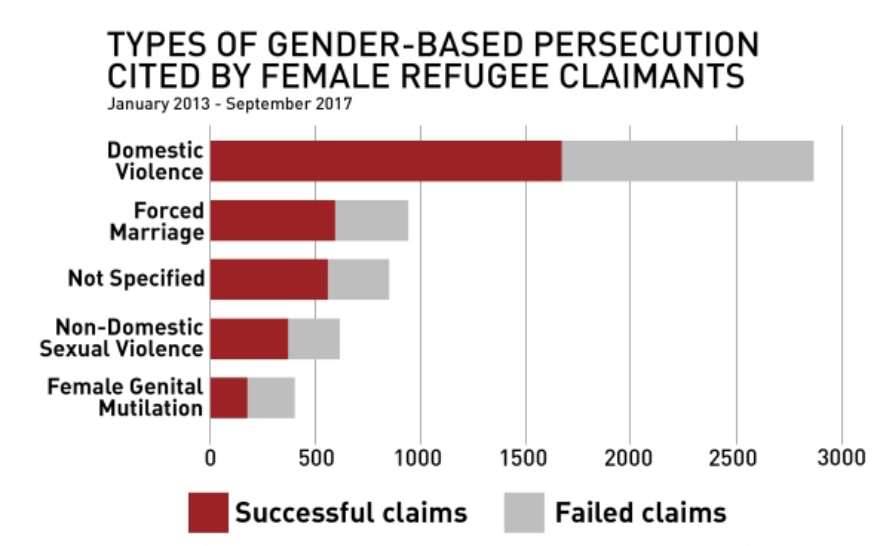
A CBC News investigation reveals more than 15 per cent of female asylum seekers who arrived in this country in the past five years said they did so to escape persecution for being a woman. It’s the most common reason women seek refuge in Canada, ahead of religious, ethnic or political persecution.

Gender persecution includes practices such as forced marriage and female genital mutilation, as well as domestic abuse at the hands of a partner or family member, which accounted for half of the claims in the data obtained by CBC.

The Immigration and Refugee Board (IRB) decided on nearly 3,000 domestic violence claims between 2013 and 2017, accepting 58 per cent of them.

Claims based on domestic violence are, like all refugee claims, assessed based on two elements: the risk an individual faces and to what degree they can be protected in their home country, said Catherine Dauvergne, dean of the University of British Columbia’s Peter A. Allard Law School and an expert in refugee and migration law.

“In cases of domestic violence, or really any persecutory harm which happens in the private sphere, the analysis almost always ends up focusing on what kind of state protection is available,” she said.

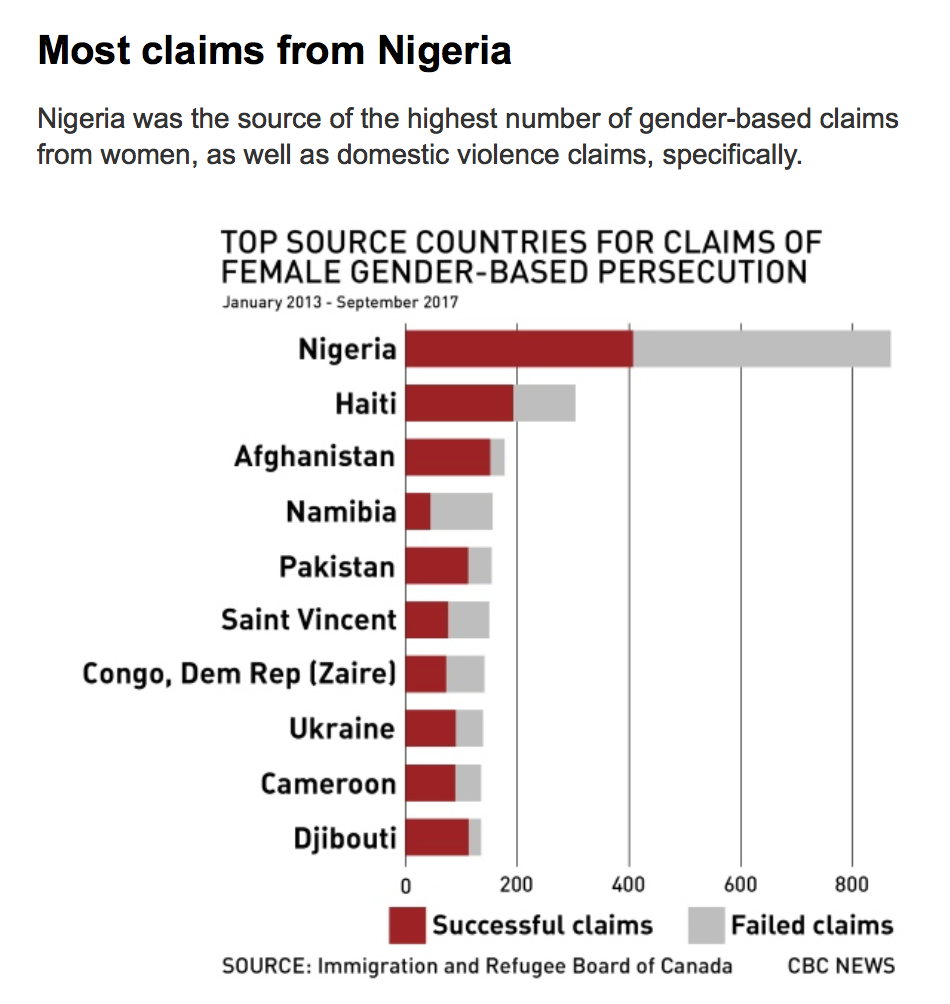
“The high number of claims that you’re seeing in this dataset is really reflective of the lack of organized, regular, reliable, dependable protection for women in all sorts of places around the world.”Nigeria was the source of the highest number of gender-based claims from women, as well as domestic violence claims, specifically.

In many parts of Nigeria, people believe women should be subservient to men, said Comfort Ero, a Nigerian-Canadian author and women’s rights advocate.

A woman who goes to the police to report domestic abuse would typically be sent home, Ero said, and even chastised by police for betraying her husband.

via Gender persecution the top reason women seek asylum in Canada – Canada – CBC News

Taking Back the Language | Noah Rothman

Nice reminder that language can but both ways by Rothman:

Canadian Prime Minister Justin Trudeau stumbled into controversy this week, although it was perhaps unwarranted. Trudeau became the subject of derision and mockery when he interrupted a woman at a town hall to correct her use of the term “mankind,” suggesting that she replace this dated designation with the more inclusive “peoplekind.” He only offered his proposal after enduring several minutes of a rambling new-age monologueregarding the chemical composition of “maternal love.” Trudeau’s interjection was probably flippant, but neither his interlocutor nor his critics seemed to notice. It’s hard to blame them.

When it comes to subservience to the many demands that identity politics makes on language and behavior, Canada’s prime minister takes a back seat to no one. It’s only prudent to assume Trudeau’s mawkishness is earnest. What’s more, the fact that “gendered” nouns and pronouns, including “mankind,” find themselves in the censors’ crosshairs isn’t exactly news. The popular grammar-checking program Grammarly flags “mankind” for “possible gender-biased language” and suggests more neutral substitutes like “humankind” or “humanity.” Learning to love unidiomatic expressions and consigning gender-specific language to history is a fixation of political activists posing as academicians, even if legitimate etymological scholars cannot support these arguments by citing linguistic corpora. Those who resent an increasingly overbroad definition of what constitutes offensive language are primed for a fight.

Language policing has been the stock-in-trade of a particular type of activist for decades, much to the consternation of both conservatives and liberals interested more in clarity than conformity. Recently, though, the intramural debate on the left over the limited utility of scrutinizing potentially objectionable speech rather than the ideas conveyed by that speech has been relegated to the back burner. That’s for a good reason.

Donald Trump’s presidency, much like his candidacy, is a brusque counterattack against “PC culture.” Often, what Trump and his supporters call “politically incorrect” language is just plain rudeness. The value of the kind of speech they find delightfully provocative isn’t its concision but its capacity to offend the right people. Thus, some self-styled arbiters of linguistic enlightenment might be tempted to dismiss Trump’s campaign against ambiguous semantics as nothing more than a brutish primal scream. If so, they would have failed to properly appreciate the threat Trump and the presidential pulpit he commands represent to their capacity to shape the terms of the debate through language. Trump isn’t limited to displays of rhetorical brute force. Sometimes, he and his speechwriters are capable of compelling eloquence.

Amid a blizzard of FBI texts, dueling intelligence committee memos, and legalisms regarding the oversight of America’s necessarily secretive espionage courts, the State of the Union address has all but been forgotten in Washington. It’s less likely, though, that a well-received speech watched by at least 46 million Americans will be so quickly forgotten across the country. And that should concern liberals because if there was any single line in that speech that won’t be overlooked, it was one that cuts at the heart of the Democratic Party’s ability to lay claim to the moral high ground. “My duty and the sacred duty of every elected official in this chamber is to defend Americans, to protect their safety, their families, their communities and their right to the American dream,” Trump said. “Because Americans are dreamers, too.” This was a masterful line. Its potency has been underestimated, and not just by those who resent the restrictive immigration policies it was designed to advance.

The name of the bipartisan 2001 “Development, Relief, and Education for Alien Minors Act” transgressed a little in order to achieve a lot for the children of illegal immigrants brought into the U.S. as minors. Referring to this demographic as “alien” is taboo, and an offense against modern sensibilities. But to describe them as “DREAMers” yields a windfall of sympathy for this already deserving group of largely naturalized non-citizens. Trump’s turn of phrase spreads the dreaming around, thus diluting the designation DREAMer of much of its unique sympathy.

Democrats might have missed the significance of this expression amid their irritation over another set phrase in that speech: “chain migration.” Trump’s use of this term during the State of the Union Address to describe the process by which legal immigrants sponsor members of their extended family to become American citizens elicited boos from Democrats. Many implied the phrase is a new invention with racist connotations, but the term has been used by policymakers (including some of these same Democrats) for decades. Maybe it was the self-evident hypocrisy, or maybe it was the contrived effort to move the goalposts. For whatever reason, the Democrats’ campaign to label “chain migration” a racist term landed with a thud. Time was that the left could dictate the terms of a debate by controlling the language of its participants, but their grip on the national dialogue may be slipping. The power of the presidency—you’ll forgive the expression—trumps the braying of the pedantic opposition.

The energy expended by political activists on policing speech is not wasted; dictating the boundaries of what constitutes acceptable discourse is a profitable and productive enterprise. If the right is getting into the game, they’re only following a course forged by their political adversaries.

via Taking Back the Language | commentary

After the ‘Trump effect’ slowed illegal immigration, numbers rise again as Central Americans fear conditions at home

Good reporting of the fluctuations and the push factors:

Illegal crossings along the U.S.-Mexico border, after declining in early 2017, began an unexpected upturn last spring that only recently receded, according to new government figures.

The figures reflect the up-and-down nature of illegal immigration and are reminders that multiple factors — from politics to weather to conditions in home countries — influence who tries to come to the United States and when.

Apprehensions on the southern border in October 2016, a month before Donald Trump’s election, topped 66,000. After Trump’s victory, the number of migrants trying to enter the U.S. illegally reached a 17-year low.

Monthly apprehensions continued to drop into 2017, hitting 15,766 in April, when the downward trend reversed. Apprehensions rose each month to 40,513 in December. Migrant advocates said the “Trump effect” discouraging illegal immigration might be wearing off.

But last month, apprehensions decreased again. It’s not clear whether the post-holiday decrease is seasonal, or whether it will continue.

There were 35,822 migrants apprehended on the southern border in January, according to figures released Wednesday by U.S. Customs and Border Protection. That’s not as many as in December, but it’s more than were apprehended each month last February to October.

 
  ()


The number of families and unaccompanied children caught crossing the border, which rose nearly every month since last spring, also dropped slightly last month to 25,980, but remained more than twice April’s total, 11,127.

In releasing the numbers Wednesday, Homeland Security spokesman Tyler Houlton noted the apprehension figures for children and families were still high.

“Front-line personnel are required to release tens of thousands of unaccompanied alien children and illegal family units into the United States each year due to current loopholes in our immigration laws. This month we saw an unacceptable number of UACs [unaccompanied children] and family units flood our border because of these catch and release loopholes,” he said. “To secure our borders and make America safer, Congress must act to close these legal loopholes that have created incentives for illegal immigrants.”

In Texas’ Rio Grande Valley, so many migrant families with small children arrive daily — more than 15,500 family members so far this fiscal year — that volunteers at a local shelter set up a play area in the corner.

When the number of unaccompanied migrant children caught crossing began to increase in April, fewer than 1,000 were apprehended a month. By last month, that had grown to 3,227. The number of family members caught crossing grew even faster during that time, from 1,118 in April to 5,656 last month.

When Elvis Antonio Muniya Mendez arrived at the shelter last month from Honduras with his 15-year-old son, the playpen was packed with the children of 100 fellow Central American migrants caught crossing the border illegally and released that day. Muniya, 36, had fled a gang that killed his 26-year-old brother the month before. He was hoping to join another brother in Indiana. He and his son were released with a notice to appear in immigration court, which he planned to attend.

“I want to live here legally, without fear,” he said.

Trump administration officials have proposed detaining more families, but that’s not happening in the Rio Grande Valley, where many are released like Muniya with notices to appear in court. The border shelter where Muniya stopped, Sacred Heart, saw the number of migrants arriving drop at the end of last year only to increase recently, said the director, Sister Norma Pimentel.

“I’ve never seen so many children be part of this migration,” Pimentel said as she surveyed the shelter, which had welcomed 60 migrants the day before.

Children who cross the border unaccompanied by an adult are sheltered by the federal Office of Refugee Resettlement and placed with relatives or other sponsors in the U.S. The agency has about 9,900 shelter beds spread out at various facilities. As of this week, the agency was sheltering 7,800 youths.

Children who cross the border with a parent may be released with notices to appear in court or held at special family detention centers. Trump administration officials have proposed detaining more of the families. But space is limited. As of Monday, the detention centers held 1,896 people. Only one of them can hold fathers, and attorneys said it’s always full, so men who cross with children are often released with a notice to appear in court.

Advocates for greater restrictions on immigration say more needs to be done to hold parents who cross with their children accountable. They say such parents put their children at risk by making the dangerous journey. Andrew Arthur, a former immigration judge now serving as a resident fellow in law and policy at the conservative Washington-based Center for Immigration Studies, said the way migrants are treated on the border encourages family migration.

“The reason the children are there to begin with is this belief that a parent with a child will not be detained,” Arthur said. That assumption, he said, is wrong.

He said Congress and the Trump administration’s unwillingness to end the Deferred Action for Childhood Arrivals program has also encouraged migrant families to make the trip now in hopes of benefiting from a “DACA amnesty,” even though the program is limited to those who grew up in the U.S.

But migrants and advocates said they were driven to cross the border more by conditions in Central America — gang violence and economic downturns — than by U.S. policies.

Ruben Garcia is director of Annunciation House, an El Paso shelter for recent migrants that saw arrivals spike at the end of last year into early January, then dip recently.

“Until there is a greater capacity to detain everyone who comes in, you’re going to see these periodic surges, waves,” Garcia said. “Many of these countries, you just cannot live in them. People will tell you ‘It’s just dangerous to walk around in our neighborhood, you can’t make a living, you’re afraid someone’s going to extort you, you’re afraid to send your kids to school.’ “