Disney accused of ‘browning up’ white actors for various Asian roles in Aladdin | The Independent

Not terribly surprising given the nature of the brand, despite its efforts to attract more international and diverse audiences:

Disney has been accused of “browning up” dozens of white actors for various Asian roles in their upcoming live-action adaptation of Aladdin.

The Sunday Times published a report claiming the company resorted to darkening white people for roles requiring skills not readily available in the Asian community, listing stuntmen, dancers, and camel handlers as examples.

The movie — directed by Guy Ritchie and based on the Disney animation of the same name — is being filmed at Longcross Studios, Surrey, a 50-minute drive from London where 1.1 million people of Indian, Pakistani, Bangladeshi and Arab heritage live.

Responding to the report, Disney said: “This is the most diverse cast ever assembled for a Disney live action production. More than 400 of the 500 background performers were Indian, Middle Eastern, African, Mediterranean and Asian.”

However, some have accused the company of not doing enough. Kaushal Odedra, who worked as a stand-in for a leading actor, told the publication he saw 20 “very fair-skinned” actors waiting to have their skin tone changed.

“On one set, two palace guards came in and I recognised one as a Caucasian actor, but he was now a darkly tanned Arab,” he claimed. “I moved inside the marquee where there were 10 extras and two were Caucasian, but they had been heavily tanned to look Middle Eastern.”

Bafta-nominated TV director Riaz Meer branded the alleged practice “an insult to the whole industry”, adding: “The talent exists and is accessible and there’s no way that Asian extras could not have been hired to meet the needs of the film.

“Failing to hire on-screen talent of the right ethnic identity to meet the clear needs of this production is just plain wrong. We expect better from all filmmakers.”

Ritchie has declined to comment on the situation. The Independent has contacted Disney for further comment.

Disney previously came under fire for creating a whole new role for a white actor in Aladdin. Billy Magnussen has been cast as a character called Prince Anders who did not appear in the original animated movie.

Egyptian-Canadian actor Mena Massoud — best known for roles in Jack Ryan and Open Heart — will play the movie’s titular character, while Naomi Scott will portray Princess Jasmine. Will Smith has been cast as the Genie, with Marwan Kenzari playing Jafar.

Aladdin reaches cinemas 24 May 2019.

via Disney accused of ‘browning up’ white actors for various Asian roles in Aladdin | The Independent

Why the sartorial choices of Salafi clerics sparked a debate on morality in Nigeria | M&G

Another illustration of the harm that Saudi Arabia has caused in spreading Salafism:

The innocuous photos of two Nigerian Islamic clerics shopping and relaxing in London sparked a fierce debate on social media platforms in northern Nigeria in early December 2017. The photos were quite unremarkable. One showed the two men sitting on a park bench; another showed them in a clothing store wearing cowboy hats. In both, they were dressed in suits. And they were wearing gloves and scarves to protect themselves from London’s cold, wet weather.

The pictures caused a fierce online debate about piety, hypocrisy, morality, the sartorial prescriptions of Islam, and the tyranny of religious authorities in Muslim-majority northern Nigeria. The violent Islamist group, Boko Haram, is active in the region, which has become a hotbed of extremism.

So, why were these ordinary images so controversial? Why did they spark heated debates among educated northern Nigerian Muslim men and women?

The answer is simple. The two men are Salafi clerics, members of a clerical order that has come to wield outsized influence over Muslims in northern Nigeria. The clerics act as enforcers of an increasingly puritan Islamic order. They are uncompromising in defining what is moral and permissible and what is haram or sacreligious. They often equate Muslims’ engagements with modernity and Western ways of life with immorality and sinful innovation or bid’ah.

This leaves them open to charges of hypocrisy when they appear to make choices seen as contradicting their teachings. And this is what happened in London. The two clerics were wearing what in northern Nigeria is considered western dress. This touched off debates between two camps of young Muslims: those who resent the growing intrusion of the clerics into their lives and are eager to criticise their adventures in a Western city, and those who continue to look on the religious figures as revered exemplars of piety.

Wahhabism and the roots of Salafi Puritanism

The Islamic sect to which the two clerics belong heightened the controversy. Sheikh Kabiru Gombe and his mentor, Sheikh Bala Lau, are prominent clerics of the Izala sect, the most visible face of a growing community of Nigerian Salafism, a branch of Sunni Islam which holds to a strict, uncompromising doctrine.

Leaders of the sect are gaining popularity and displacing mainstream Sufi clerics in the region. They accuse traditional Sufi Muslims of hobnobbing with modernity and failing to practice Islam in its pure form. Sufis are vulnerable to these accusations because their creed focuses on individual mystical paths to God rather than on outward, political and authoritarian expressions of piety.

This difference has led to an increasingly intense contest between the two sides. The photographs of the two clerics catapulted the contest onto social media, blogs and web forums.

The personalities and profiles of the two clerics contributed to the intensity of the debates.

Sheikh Gombe is known in the region for his ultra-radical Salafi theological positions  and pronouncements. He has made his voice heard in local and foreignsettings, capturing the imagination of some young Muslims in northern Nigeria. He presents an argument that being a pure Muslim means eschewing association with Western modernity. He is against modern and Western institutions such as secular film making, mixed gender socialisation and goods such as Western clothes. All, he argues, can pollute the piety of Muslims.

In my ongoing research on the historical roots of Boko Haram in northern Nigeria I call the rise of this branch of Islam the Salafi Islamic wave. Tracing its roots, I have found that it began with the slow but well-funded arrival of Wahhabism in northern Nigeria in the 1980s and 1990s. Wahhabism is the puritan strain of Sunni Islam birthed in Saudi Arabia by Muhammad ibn Abd al-Wahhab.

The Wahhabi-Salafi’s most dominant organisational umbrella was – and still is – the Izala sect, which was founded in 1978 in Jos, Nigeria, by followers of the late Sheikh Abubakar Gumi.

At the time Gumi was travelling throughout the Muslim world and spending time in Saudi Arabia as a member of both the Supreme Council of the Islamic University in Medina and the Legal Committee of the Muslim World League. He returned to Nigeria in 1986 and was recognised as the spiritual leader of the Izala anti-Sufi reform movement. The movement’s following expanded dramatically under him.

The Izala group set up schools and the best graduates were sent – on generous Saudi Arabian scholarships – to the University of Medina to study Islam under a Wahhabi curriculum with a tinge of ultra-radical Salafism. They returned in the 1990s and inaugurated a new Salafi era in northern Nigerian Islam.

In the 2000s, Medina-trained Salafi clerics, backed by Saudi money and patronage, succeeded in upstaging the old Izala clerical order through a mix of youthful charisma, theological novelty and populism. They began entrenching their strict moral code conforming, according to them, to the Islamic Sharia law.

Beyond photos and suits

Western culture and lifestyle dominate popular culture in Nigeria. For many young Muslims in northern Nigeria, Salafism’s prescriptions and prohibitions are suffocating, particularly for those who want a more pragmatic engagement with a Western lifestyle. Many believe they can pursue these lifestyle choices and still practice their religion.

But Salafi clerics and their followers see no acceptable compromise. They are increasingly making themselves custodians of public morality. They routinely condemn conduct that they associate with decadent, permissive western modernity. For example, they dictate what northern Nigerian Muslims can and can’t wear.

The debate around the two clerics was therefore not a trivial conversation about the dress and the recreational choices of two Salafi clerics. The photos were loaded with symbolism and contradictions. Participants in the online debate used the opportunity to criticise – or excuse – the perceived tyranny and hypocrisy of a powerful Salafi establishment. And to express personal anxieties and fears.

The debate about modernity, Islam, and morality has migrated to online platforms because the internet is relatively anonymous. This has given both sides greater freedom to express their views. The debate encapsulates the ongoing ideological struggle in northern Nigerian Islam between those who live and defend a modern lifestyle, and those suspicious of Western modernity and the unmediated influence of Western education and culture.

via Why the sartorial choices of Salafi clerics sparked a debate on morality in Nigeria | News | Africa | M&G

Christie Blatchford: Report shows Toronto school board was wrong to heed activists and end police program

So much for evidence-based policy and decision making:

A comprehensive, three-year research project on the value of having cops in schools has provided a stunning rebuke to the decision last fall by the Toronto District School Board to abruptly cancel its “School Resource Officer” program.

The 258-page analysis, done by two Carleton University professors and their PhD students, shows unequivocally that students overwhelmingly feel safer in school — and even report sleeping better and feeling less anxiety — with SROs.

The project actually began in 2012, long before Black Lives Matter, the amorphous activist group that was most visible — and voluble — in Toronto in the fight to see the program dropped.

That’s when the Carleton research group — headed by Linda Duxbury, a professor in the Sprott School of Business, and Craig Bennell, psychology professor at the university — received funding from the Social Science and Humanities Research Council, to conduct research on changes needed to make policing in Canada better.

Guided by a research advisory board, the team eventually undertook an in-depth look at the Region of Peel next door to Toronto.

There, Peel Regional Police has had SROs in every high school in both public and Catholic systems for more than two decades, and since the program now costs the police $9 million a year, they and the school boards wanted to know, did it work?

Researchers selected five schools that would reflect the diversity of the sprawling region itself: two were so-called “urban-grant” schools and were in socio-economically deprived parts of the region; one was in a wealthy area; two were located in middle-class districts.

Four of the five schools had ethnically diverse student bodies.

The project was a longitudinal (from 2014-2017, multi-method (quantitative, qualitative and ethnographic analysis, as well as a Social Return on Investment or SROI analysis) case study to “identify the value,” or not, of the SRO program.

(SROI analysis is a measurement tool that helps organizations to understand and quantify the social, environmental and economic value they’re creating.)

That meant researchers used both longitudinal survey data from two groups of more than 600 Grade 9 students each at two times of the year – the first, as they came into high school from elementary schools where they are no SROs, and the second, five months later, as they were about to move out of Grade 9 – and in-depth interviews with eight students, all volunteers, and none of them Caucasian.

Responses were confidential; ethics clearance was obtained from Carleton and the two school boards; a note was sent home to parents telling them about the study and offering them the chance to withhold consent.

Only three sets of parents did.

The thinking was, if the goal of the SRO program is to create a safe learning environment, the students about to leave Grade 9, who’d had five months of being in a school with an SRO, should report feeling safer.

Well, did they ever.

All students benefited one way or another by having an SRO, regardless of their gender, or whether they’d ever been arrested or stopped by the police, or whether they had been victimized. “All students … indicated that they felt significantly safer at school and less stressed and anxious” after five months’ exposure to the SRO.

And the more contact a student had with an SRO, the more likely he or she was to see the program in a positive light — and fully 75 per cent of the students felt safer because of the SRO.

Even those who had been arrested or stopped by cops “are significantly more likely than those who have not to report that they feel safe at school and less likely to experience stress and anxiety at school because they are fearful of being bullied or harassed.”

The ones who had been victimized — about 16 per cent — “are one of the greatest beneficiaries of the SRO program and can expect to gain the most from the presence of police in the high schools.”

Even with the SROs, the research found that bullying, particularly by gang members, particularly for kids on the way to and from school, is a real issue for many students in Peel Region. One can only imagine how scared some of those students might be if their schools didn’t have an SRO.

Oh, wait: You don’t have to imagine.

When the Toronto board cancelled its SRO program last fall — it had run in 45 schools — on the basis of anecdotal allegations it was racist and against its own report, which found that the majority of students liked the program but some felt targeted or uncomfortable, it abandoned evidence-based decision-making and effectively hung its students out to dry.

And by the way, using the SROI analysis, the Carleton research found that the social and economic value of having cops in the five schools cost Peel Police $660,289.

The return — that students feel safe, are engaged, can more easily embark on young adulthood successfully, while the community around the school feels safer, etc., etc. — yielded a total present value of $7,349,301.

In other words, for every dollar invested in the Peel SRO program, a minimum of $11.13 of social and economic value was created.

Toronto preferred, to use that ghastly phrase, the “fake news” of activist shouting; Peel opted for the facts.

Source: Christie Blatchford: Report shows Toronto school board was wrong to heed activists and end police program

Canada’s special forces want to attract women for a job that’s more than kicking down doors

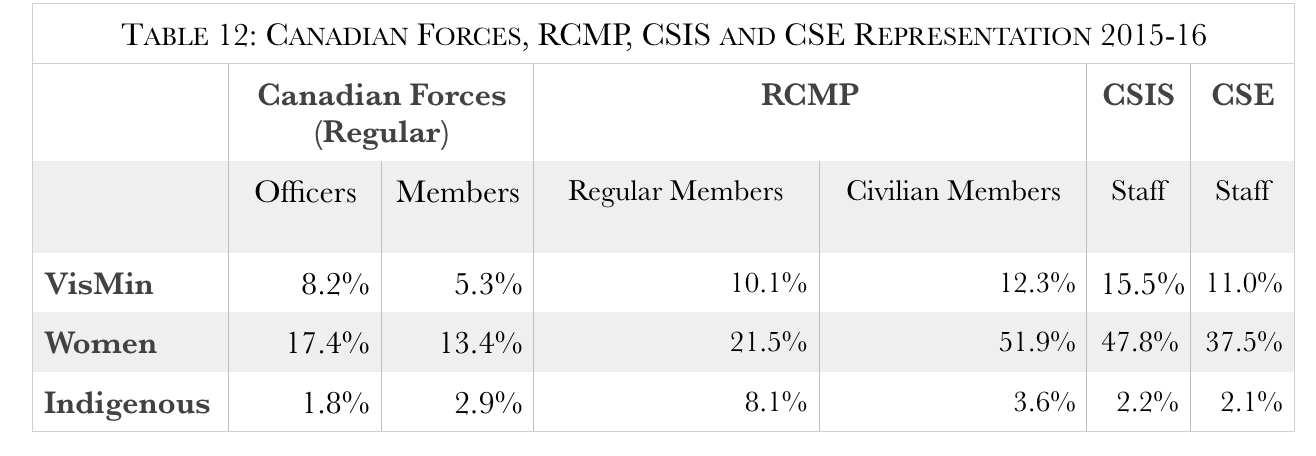
The above table  contrasts the overall representation of the Canadian Forces, RCMP, CSIS and CSE. The latter two organizations, more intelligence-driven than the CF and RCMP, indicate some hope for the strategy:

Canada’s special forces hope to recruit more than just a few good women in the coming years, says the commander of the elite force.

Maj-Gen. Mike Rouleau said the special forces, the highly trained military units that hunt terrorists and conduct covert operations, are considering how they can recruit more women.

More than just a nod toward society’s growing demand for gender balance, having more women in the unit would make it more effective, he said.

This is the future, and it is a bit of James Bond, but if you want to defeat a [terrorist] cellular-based network, you need to be in front of that cell– Steve Day, former commander of counterterrorism unit

“Having female operators would allow us to be more flexible in the battlespace,” Rouleau said in a recent interview. “It would allow us to be more under the radar in certain cases.”

In certain countries, two men walking down the street might draw attention, but having a man and woman conduct the same mission might be less noticeable, Rouleau suggested.

A former commander of the country’s elite counterterrorism unit, JTF-2, which is part of the special forces command, said the need for such mixed gender teams is something Canada’s allies have already recognized.

The more special forces are called on to fight terrorists, the more they will have to act and fight like intelligence agents, rather “door-kicking” commandos, said retired colonel Steve Day, who is now president of Reticle Security.

“Our closest allies routinely deploy male and female alongside each other to do the softer, intelligence-gathering, sensor-type operations,” he said.

“This is the future, and it is a bit of James Bond, but if you want to defeat a [terrorist] cellular-based network, you need to be in front of that cell, and at the moment, we’re not there.”

Clear criteria

Up to 14 per cent of the more than 2,200 Canadian special forces personnel are women, a percentage Rouleau said he wants to increase to 25 per cent.

That figure would be in line with the overall direction of the Canadian military, which has set the same goal.

“We’re an equal opportunity employer,” said Rouleau. “We’d love to have more women in the force.”

It is, however, easier said than done.

Rouleau noted a handful of women currently serve in both the special forces command and the unit that responds to chemical, biological and radioactive incidents.

A few have even tried out for JTF-2, but none have gone on to take the training course, because they failed to qualify, he said.

In order to be successful, Day said, a cultural change is needed within the special forces that recognizes not only the value of women in the field, but the fact that the elite troops are capable of doing more than assaulting a target.

The very first introduction of women into the special forces ranks in 2003-2004 “didn’t go over that well because organizationally we were quite immature when it came to understanding what the selection process would be,” said Day.

“There was a lot of pushback and no end of short-term grief.”

The problem is not simply gender bias, he added.

The selection process of an “assaulter” — a soldier well-suited to combat — is well documented, he said, but the criteria for choosing the best people for more intelligence-based operations is not as well defined. That needs to change, Day said.

Rouleau acknowledged his organization can do more to get out the message that “female operators are not only welcome, but in many cases, they would make us operationally more successful.”

Army under strain

The Liberal government’s defence policy, released last spring, mandated the expansion of special forces by up to 605 personnel, presenting all sorts of challenges beyond the gender issue.

At the moment, troops can only join the elite unit through the regular forces, and up to 94 per cent of those transfers come from the army.

The wider military is having its own problems.

The army currently sits at 47,000, which includes regular and reserve soldiers, as well as Canadian Rangers, who patrol the Arctic. But the regular force is short up to 1,500 troops from its allotted strength of 23,100, according to Department of Defence statistics.

Members of Canadian Forces Special Operations JTF-2 unit storm a ship during a training mission off the shores of Churchill, Man. in 2012. The nature of operations for special forces is changing to include more intelligence gathering. (Adrian Wyld/Canadian Press)

Senior defence officials insist they’re hitting recruiting targets, but retention of highly skilled members is a problem.

Drawing from an army that is struggling to keep qualified soldiers “is a concern,” said Rouleau, who acknowledged he and his staff are looking for a direct-entry model similar to a program introduced by the U.S. Army, known as 18-Xray.

“You can’t come from the street to be a special forces operator,” said Rouleau. “But that doesn’t mean in the future we won’t have a model that you can come from the street.

“I’m not saying that’s where we’re going. I’m saying we’re looking at alternate options to today’s model to make sure that we’re both capturing the talent that’s out there, but also try, if we can, to alleviate some of the pressure from the services.”

The American system gives recruits the opportunity to “try out” for special forces right away.

U.S.officials say it does not guarantee a recruit will be accepted, only that they will be given the opportunity to demonstrate they have “the right stuff.”

Source: Canada’s special forces want to attract women for a job that’s more than kicking down doors

Birth tourism brings Russian baby boom to Miami – NBC News

As in the case of similar debates in Canada, the conversation largely occurs based on anecdotal evidence rather than hard data (see my analysis of the push by the Conservative government against birthright citizenship and the relatively small numbers involved What happened to Kenney’s cracking down on birth tourism? Feds couldn’t do it alone).

The estimated annual numbers – 36,000 according to The Center for Immigration Studies which wants stricter limits on immigration – is small compared to the overall number of births of about four million (2015), or about 0.9 percent:

Lured by the charm of little Havana or the glamour of South Beach, some 15 million tourists visit Miami every year.

But for a growing number of Russian women, the draw isn’t sunny beaches or pulsing nightclubs. It’s U.S. citizenship for their newborn children.

In Moscow, it’s a status symbol to have a Miami-born baby, and social media is full of Russian women boasting of their little americantsy.

“It’s really common,” said Ekaterina Kuznetsova, 29. “When I was taking the plane to come here, it was not only me. It was four or five women flying here.”

Ekaterina was one of dozens of Russian birth tourists NBC News spoke to over the past four months about a round-trip journey that costs tens of thousands of dollars and takes them away from home for weeks or months.

Why do they come?

“American passport is a big plus for the baby. Why not?” Olesia Reshetova, 31, told NBC News.

“And the doctors, the level of education,” Kuznetsova added.

The weather doesn’t hurt, either.

“It’s a very comfortable place for staying in wintertime,” Oleysa Suhareva said.

It’s not just the Russians who are coming. Chinese moms-to-be have been flocking to Southern California to give birth for years.

What they are doing is completely legal, as long as they don’t lie on any immigration or insurance paperwork. In fact, it’s protected by the 14th amendment to the U.S. Constitution, which says anyone born on American soil is automatically a citizen.

The child gets a lifelong right to live and work and collect benefits in the U.S. And when they turn 21 they can sponsor their parents’ application for an American green card.

As president, Donald Trump has indicated he is opposed to so-called chain migration, which gives U.S. citizens the right to sponsor relatives, because of recent terror attacks. And as a candidate, he called for an end to birthright citizenship, declaring it in one of his first policy papers the “biggest magnet for illegal immigration.”

“You have to get rid of it,” he said on “Meet the Press” on NBC. “They’re having a baby and all of a sudden — nobody knows — the baby is here. You have no choice.”

In a twist, as the Daily Beast first reported, condo buildings that bear the Trump name are the most popular for the out-of-town obstetric patients, although the units are subleased from the individual owners and it’s not clear if building management is aware.

There is no indication that Trump or the Trump Organization is profiting directly from birth tourism; the company and the White House did not respond to requests for comment.

Roman Bokeria, the state director of the Florida Association of Realtors told NBC News that Trump- branded buildings in the Sunny Isles Beach area north of Miami are particularly popular with the Russian birth tourists and Russian immigrants.

“Sunny Isles beach has a nickname — Little Russia — because people who are moving from Russian-speaking countries to America, they want … a familiar environment.”

“They go across the street, they have Russian market, Russian doctor, Russian lawyer,” he added. “It’s very comfortable for them.”

Reshetova came to Miami to have her first child, hiring an agency to help arrange her trip. The services — which can include finding apartments and doctors and obtaining visas — don’t come cheap. She expects to pay close to $50,000, and some packages run as high as $100,000. Bokeria says some landlords ask for six months rent up front.

One firm, Miami Mama, says it brings about 100 Russian and Russian-speaking clients to the U.S. per year, 30 percent of them repeat clients. The owners are Irina and Konstantin Lubnevskiy, who bought Miami Mama after using the firm to have two American children themselves.

The couple says they counsel clients to be completely transparent with U.S. immigration officials that they’re expecting.

“We tell every client, ‘You have the documents, you have to tell the truth. This is America. They like the truth here,'” Konstantin said.

“I would like the American people to understand they don’t have to worry,” he added. “Those who come here want to become part of the American people.”

But Miami Mami has drawn scrutiny from law enforcement. In June, it was raided by the FBI, and an employee was convicted of making false statements on passport applications. The owners say they knew nothing about it, fired the worker and their business license was renewed.

Federal prosecutors declined to comment on the case, and the FBI said it could not discuss “an active investigation.”

There is no official data on birth tourism in the United States. The Center for Immigration Studies, which wants stricter limits on immigration, estimates there are 36,000 babies born in the U.S. to foreign nationals a year, though the numbers could be substantially lower. Florida says births in the state by all foreign nationals who live outside the United States have jumped 200 percent since 2000.

Customs and Border Protection says there are no laws governing whether pregnant foreign nationals can enter the country or give birth here.

“However, if a pregnant woman or anyone else uses fraud or deception to obtain a visa or gain admission to the United States, that would constitute a criminal act,” the agency said.

When federal agents raided California “maternity hotels” catering to Chinese clients in 2015, authorities said in court papers that some of the families falsely claimed they were indigent and got reduced hospital rates.

In Miami, the Jackson Health System said 72 percent of international maternity patients — who represented 8 percent of all patients giving birth last year — pay with insurance or through a pre-arranged package.
via Birth tourism brings Russian baby boom to Miami – NBC News

When ‘harmony’ is not good enough: James Hoggan

James Hoggan, author of I’m Right and You’re an Idiot, on the balance between confrontation and collaboration and the need for dialogue.

The challenge is how to have vigorous yet respectful conversations:

When I was chair of the David Suzuki Foundation I asked Canadian problem solving guru Adam Kahane to speak at our board retreat when it met at the Brew Creek Centre in Whistler.

I invited him because of his work as a facilitator in hot spots around the world.  Like many of the thought leaders I interviewed for my book, I’m Right and You’re an Idiot, Adam encouraged me to consider the role warlike rhetoric plays in creating gridlock and inaction on environmental problems such as climate change.

I found his methodology for dialogue, called transformative scenario planning, a hopeful alternative to the growing political polarization.

During his talk to our board, Adam got into a brief but heated disagreement with David Suzuki who argued that in some cases dialogue is a waste of time. David spoke about the CEO of a consortium of companies who wanted to discuss international criticism of the Alberta oil sands regarding its environmental performance.

David said he would be willing to engage with the CEO if he would first agree to certain basic principles: that we are all animals and that we need clean air, clean water, clean soil, clean energy and biodiversity. The CEO declined. Adam challenged Suzuki on this, saying that seeking such an agreement in advance was unreasonable and unproductive.

Adam recently told me this exchange had a big impact on him. “It shook me up a lot.” Initially, he couldn’t make this new idea fit into his frame of collaboration so it stayed with him “as an unresolved tension.” He didn’t dismiss the argument because he holds David in such high esteem.

And gradually this principle seemed more important and altered Adam’s thinking about how to approach advocacy, conflict and dialogue, and this exchange became an important section of his new book, Collaborating with the Enemy: How to Work with People You Don’t Agree with or Like or Trust.

Adam writes: “I could now see that engaging and asserting were complementary rather than opposing ways to make progress on complex challenges, and that both were legitimate and necessary.”

If we suppress assertion and advocacy in an effort to engage with an opponent, “we will suffocate the social system we are working with,” and end up with feeble collaboration. He is now convinced that healthy collaboration needs to include “vigorous fighting.”

Rather than focusing on finding harmony when dealing with people who hold radically conflicting opinions, we can embrace both conflict and connection:

“If we stretch beyond our conventional, comfortable, habitual approach to collaboration we can be more successful more often, and don’t have to default to polarization, and worsen the situation.”

He recently told me it’s wrong to think we can only collaborate successfully by first forging harmonious teams that have reached agreement on where they’re going, how to get there, or who needs to do what.

Author Adam Kahane was shaken by a conversation with David Suzuki about activism.

This discussion got me thinking about how my own attitudes have evolved while searching for better ways to deal with antagonists of all kinds, including climate science deniers. Adam’s new book reinforces my experience that changing public opinion and public policy requires both advocacy and collaboration — although I’ve learned that both have their limits.

Advocates tend to overplay their hands and may unintentionally strengthen the resistance they work so hard to overcome. Collaboration on the other hand can create a false equivalence that undermines science when opposing viewpoints are both presented as legitimate, when clearly they are not.

A perfect example of this is the decades’ old debate between genuine climate scientists and climate change deniers working for industry-funded, right-wing think tanks. Any advocacy to counteract alarming environmental problems such as climate change, ocean acidification or species extinction is by its nature difficult and adversarial.

I told Adam it’s hard to collaborate with someone who says climate change is a hoax perpetrated by the Chinese, because engaging in such a specious argument only drags the conversation down to a ludicrous level. I also said when it comes to climate change, dialogue often fails, but lessons from the civil rights movement give us hope. They tell us that people who meet with resistance can eventually see results if they keep demanding it and never give up.

On the other hand, our social capacity for pluralism will either empower or prevent us from emerging from the climate crisis. Being right on the science is not enough. That’s why this book is so important. We need to develop our ability to work with the enemy, or as Thich Nhat Hanh put it, “speak the truth but not to punish.”

via When ‘harmony’ is not good enough | Vancouver Sun

‘We are not being complacent’: Liberals don’t expect sudden surge of Salvadoran asylum-seekers

We shall see how well the regularization process works and consequent impact on the numbers of asylum seekers:

The Liberal government has a contingency plan for a potential flood of Salvadoran asylum seekers, but it is not expecting a sudden surge of people crossing the border from the United States.

Immigration Minister Ahmed Hussen said the government has been “engaging intensely” with the El Salvador diaspora, among others, and believes they are deeply embedded in their American communities with children, jobs and mortgages and not likely to abruptly flee.

U.S. President Donald Trump’s administration announced Monday that 200,000 Salvadoran immigrants now allowed to live and work in the U.S. with temporary protected status will lose their right to remain in the country in September 2019.

Hussen said because there’s a lengthy 18-month time frame for people to leave or seek legal residency, he expects many will use the time to regularize their status.

“Their first choice is to remain in the U.S.,” Hussen told reporters on Parliament Hill after meeting with a joint intergovernmental task force on irregular migration.

“Having said that, we are not being complacent. We are making sure we are prepared for any eventuality, including a future influx of asylum seekers crossing our border irregularly and, in that regard, we are using the lessons that we learned in the summer to do so.”

Since August last year, the government has embarked on an outreach campaign to spread the word about Canadian laws and immigration system. MPs have been dispatched to meet with various community groups and stakeholders in Miami, New York, Dallas, Houston and Los Angeles and used social media and online marketing tools to correct misinformation.

Humanitarian message

“Our message is not only a deterrent message but it’s also a humanitarian message, because we don’t want people uprooting their lives, their deep roots in the United States, based on misinformation,” he said.

Haitians began crossing in to Canada even before a final decision had been made on their temporary status, with more than 200 people a day in the summer months.

Hussen noted that irregular crossings have declined dramatically in the last four months, and said fluctuations in numbers are seen from year to year, and from month to month.

The U.S. granted protected status to people from El Salvador in the wake of two devastating 2001 earthquakes that left hundreds of thousands in the country homeless.

Source: ‘We are not being complacent’: Liberals don’t expect sudden surge of Salvadoran asylum-seekers

And a good overview by CNN of the 10 countries currently with TPS

TPS is ending for these countries

Sudan

Status:Ends November 2, 2018, DHS announced in September 2017. This means Sudanese under TPS will have to find a different way to stay in the US or prepare to leave.
When TPS was designated: November1997
Number of people with TPS: About 1,000
Cause: Sudan was designated for TPS based on the “ongoing armed conflict and extraordinary and temporary conditions.” Sudan has been beset by conflicts, most notably the Darfur conflict, which began around 2003 when several rebel groups took up arms against the government in Khartoum. The situation in Sudan has improved in recent years, but concerns persist about its stability and human rights.
Why TPS was terminated: DHS’ then-Acting Secretary Elaine Duke had”determined that conditions in Sudan no longer support its designation for Temporary Protected Status.” The agency said nationals of Sudan could return “without posing a serious threat to their personal safety.”

Nicaragua

Status:Ends January 5, 2019, DHS announced in November 2017.
When TPS was designated: January 1999
Number of people with TPS: About 5,300
Cause:Hurricane Mitch, a Category 5 storm, devastated the country in October 1998. Mitch was particularly destructive in Nicaragua and Honduras, killing about 11,000 people in Central America.
Why TPS was terminated: “It is no longer the case that Nicaragua is unable, temporarily, to handle adequately the return of nationals of Nicaragua,” according to DHS. The agency stated that conditions affected by Hurricane Mitch have stabilized and that many of the homes destroyed by the storm have been rebuilt.

Haiti

Status:Ends July 22, 2019, DHS announced in November 2017.
When TPS was designated: January 2010
Number of people with TPS: About 58,700
Cause: A 7.1-magnitude earthquake struck in January 2010, and an estimated 220,000 to 300,000 people died. That year, DHS announced temporary refuge for Haitian nationals who were already in the US and “whose personal safety would be endangered by returning to Haiti.”
Why TPS was terminated: After seven years, the DHS stated that “extraordinary but temporary conditions caused by the 2010 earthquake no longer exist. Thus, under the applicable statute, the current TPS designation must be terminated.”

El Salvador

Status:Ends September 9, 2019, DHS announced in January 2018.
When TPS was designated: March 2001
Number of people with TPS: About 263,000
Cause: A 7.7-magnitude quake struck El Salvador in January 2001 and was the worst to hit the country in a decade. The devastation, along with two more damaging quakes the following month, spurred a decision allowing immigrants from El Salvador who’d been in the United States since mid-February 2001 to apply for TPS.
Why TPS was terminated: After nearly 17 years, the “original conditions caused by the 2001 earthquakes no longer exist,” DHS said. It added that the US government has repatriated more than 39,000 Salvadorans in the last two years, “demonstrating that the temporary inability of El Salvador to adequately return their nationals after the earthquake has been addressed.”

Decisions pending in 2018

Syria

Status:Extended through March 31, 2018, DHS announced in August 2016.
When TPS was designated: March 2012
Number of people with TPS: About 6,200
Cause: Syria was designated for TPS because of the ongoing armed conflict. Since the civil war began in 2011, an estimated 400,000 Syrians have been killed, according to the United Nations. The Syrian conflict broke out in 2011 with the Arab Spring uprising and rebel groups’ attempts to overthrow President Bashar al-Assad’s regime.
Why it was extended: An 18-month extension was given by the DHS in 2016,because “violent conflict and the deteriorating humanitarian crisis continue to pose significant risk throughout Syria.”

Nepal

Status:Extended through June 24, 2018, DHS announced in October 2016.
When TPS was designated: June 2015
Number of people with TPS: About 13,000
Cause: TPS has protected Nepalese living in the United States since a destructive, 7.8-magnitude earthquake struck near the country’s capital, Kathmandu. The April 2015 earthquake killed more than 8,000 people, and millions of homes cracked or collapsed.
Why it was extended: Conditions in Nepal have improved following the earthquake, DHS said in its 2016 decision to extend TPS for 18 more months. But the disaster resulted “in a substantial, but temporary, disruption of living conditions,” the agency stated.

Honduras

Status:Extended through July 5, 2018, DHS announced in November 2017.
When TPS was designated: January 1999
Number of people with TPS: About 86,200
Cause:Hurricane Mitch, a Category 5 storm, devastated the country in October 1998. Mitch was particularly destructive in Nicaragua and Honduras, killing about 11,000 people in Central America.
Why it was extended: DHS postponed its decision, triggering an automatic six-month extension. Its then-acting secretary Elaine Duke had announced there was not enough information to make a formal decision.

Yemen

Status:Extended through September 3, 2018, DHS announced in January 2017.
When TPS was designated: September 2015
Number of people with TPS: About 800
Cause: A civil war broke out when Houthi rebels drove out the US-backed government, led by President Abdu Rabu Mansour Hadi, and took over the capital, Sanaa. The crisis quickly escalated into a multi-sided war leading to airstrikes in 2015. At least 10,000 people have been killedin the war, according to the United Nations, with millions more displaced.
Why it was extended: DHS granted an 18-month extension in 2017, because of the ongoing armed conflict in Yemen. It cited “continued deterioration of the conditions for civilians in Yemen” and said returning Yemeni nationals to the country would “pose a serious threat to their personal safety.”

Somalia

Status:Extended through September 17, 2018, DHS announced in January 2017
When TPS was designated: September 1991
Number of people with TPS: About 500
Cause: Somalia was designated for TPS after the country descended into civil war after dictator Siad Barre’s ouster in 1991. Nearing three decades of conflict, much of the country’s governance structure, economic infrastructure, and institutions have been destroyed.
Why it was extended: “The security situation in Somalia remains fragile and volatile,” according to DHS. The agency said Somalis couldn’t safely return to the country. “Somalia continues to experience a complex protracted emergency that is one of the worst humanitarian crises in the world,” it stated in 2017.

Decision pending in 2019

South Sudan

Status:Extended through May 2, 2019,DHS announced in September 2017.
When TPS was designated: November2011
Number of people with TPS: About 50
Cause: South Sudan had been designated for TPS based on “ongoing armed conflict and extraordinary and temporary conditions.” The country gained independence from Sudan in 2011 but remains torn by conflict.
Why it was extended: The ongoing armed conflict and the conditions have “persisted, and in some cases, deteriorated, and would pose a serious threat to the personal safety of South Sudanese nationals if they were required to return to their country,” according to DHS.

Malaise autour de la création d’une «Journée nationale contre l’islamophobie»

Valid debate between a commemoration versus a national day.

I prefer the existing day, International Day Against Racial Discrimination, March 21st, rather than the “boutique” approach for each community, as a means to foster understanding of the common experience many groups have faced or face (agree with Conservatives on this one even if their motives are somewhat suspect given their approach to M-103):

Le débat sur une possible « Journée nationale contre l’islamophobie » prend une tournure sémantique. Plusieurs partis politiques, tant à Québec qu’à Ottawa, jugent le mot « islamophobie » trop fort et « trop chargé » pour que le 29 janvier 2017, jour où un tireur fou a tué six musulmans, porte ce combat.

« Oui, le mot “islamophobie” est chargé. Et je trouve qu’on a assez débattu de divisions autour de la présence de la religion au Québec », a déclaré au Devoir Agnès Maltais, députée péquiste et porte-parole de l’opposition officielle en matière de laïcité. Elle souligne au passage qu’il existe un Collectif canadien anti-islamophobie dont le porte-parole est Adil Charkaoui, une personnalité controversée.

La semaine dernière, le Conseil national des musulmans canadiens (CNMC) a demandé au gouvernement Trudeau de faire du 29 janvier plus qu’une simple journée de commémoration de la tuerie à la mosquée de Québec et de lui donner le titre de « Journée nationale d’action contre l’islamophobie », un peu comme le 6 décembre, jour de la tuerie de Polytechnique, est devenu une « Journée nationale d’action contre la violence faite aux femmes ».

Le bureau de la ministre du Patrimoine, Mélanie Joly, a simplement indiqué mardi qu’il « prenait acte » de la proposition.

Québec solidaire est le seul parti qui appuie la création d’une telle journée. Mais le gouvernement libéral de Philippe Couillard ne ferme pas la porte. Quant à la Coalition avenir Québec, elle rejette l’idée d’une journée nationale d’action et estime suffisant que la tragédie soit commémorée.

« Il s’agit du geste intolérable d’une seule personne et non pas celui d’une société entière. Les Québécois sont ouverts et accueillants, ils ne sont pas islamophobes. »

Oui à une commémoration

En entrevue à Radio-Canada, Boufeldja Benabdallah, vice-président du Centre culturel islamique, s’est dit déçu des positions de la CAQ et du PQ.

« Jamais nous n’avons dit que les Québécois étaient islamophobes, jamais. C’est une mince partie et c’est sur cette mince partie qu’il faut travailler, qui fait beaucoup de bruit, beaucoup de mal, et qui a tué six personnes dans leur prière. »

Tous les partis sont toutefois d’accord pour que le 29 janvier soit réservé chaque année à la commémoration de l’attentat meurtrier de la mosquée de Québec.

« Soyons honnêtes, le meilleur outil qui va aller chercher l’appui de tous, c’est la commémoration », a affirmé Mme Maltais, du PQ. Elle souligne également que le gouvernement fédéral a attendu deux ans après la tuerie du 6 décembre 1989, soit en 1991, pour en faire une Journée nationale d’action contre la violence faite aux femmes.

L’historien de l’Université Laval Patrice Groulx soutient qu’il vaut mieux d’abord passer par l’étape de la commémoration, soit du deuil, en soulignant la mémoire d’un événement. « Il y a une forme de précipitation là-dedans qui pourrait être désagréable pour certains, a-t-il indiqué. Certains groupes veulent soulever la chose pour profiter d’un certain “momentum”, et c’est tout à fait légitime. Mais il y a la manière, les mots. Il faut être prudent. »

Une commémoration d’un événement meurtrier tragique ne se traduit pas toujours en « journée nationale d’action » — l’explosion du train à Lac-Mégantic par exemple —, mais M. Groulx reconnaît que la tuerie de la mosquée a le potentiel d’en devenir une, comme ce fut le cas pour Polytechnique sous la pression populaire.

« Avec le temps, on donne un contenu, une signification différente à un événement. C’est le dépassement social. »

Même malaise au fédéral

Demeurés silencieux jusqu’ici, les partis politiques au fédéral, sauf le Nouveau Parti démocratique, se sont finalement prononcés. Encore une fois, le mot « islamophobie » semble créer un malaise.

« Ce terme-là est loin de faire consensus », a indiqué Gérard Deltell, en refusant obstinément de prononcer ce mot tout au long de l’entrevue avec Le Devoir. Le Parti conservateur préfère parler d’une commémoration, « plus rassembleuse » et « plus inclusive », lui qui avait déposé une motion à la mi-décembre proposant de faire du 29 janvier la « Journée nationale de la solidarité avec les victimes d’actes d’intolérance et de violence antireligieuse ».

La même querelle sémantique avait divisé les partis fédéraux lorsque, dans la foulée des attentats de la mosquée de Québec, la libérale Iqra Khalid a voulu faire adopter l’an dernier une motion qui condamnait l’« islamophobie ». Les conservateurs refusaient là encore d’utiliser ce terme et voulaient plus largement que soient condamnées « toutes formes de racisme systémique », pas seulement celle à l’endroit des musulmans.

Le Bloc québécois rejette aussi l’idée d’une commémoration qui cible une religion précise. Après tout, l’État doit être laïque, a fait valoir la députée Marilène Gill.

Source: Malaise autour de la création d’une «Journée nationale contre l’islamophobie»

Fighting Bias With Board Games : Code Switch : NPR

Interesting and innovative approach:

Quick, think of a physicist.

If you’re anything like me, you probably didn’t have to think very hard before the names Albert Einstein and Isaac Newton popped up.

But what if I asked you to think of a female physicist? What about a black, female physicist?

You may have to think a bit harder about that. For years, mainstream accounts of history have largely ignored or forgotten the scientific contributions of women and people of color.

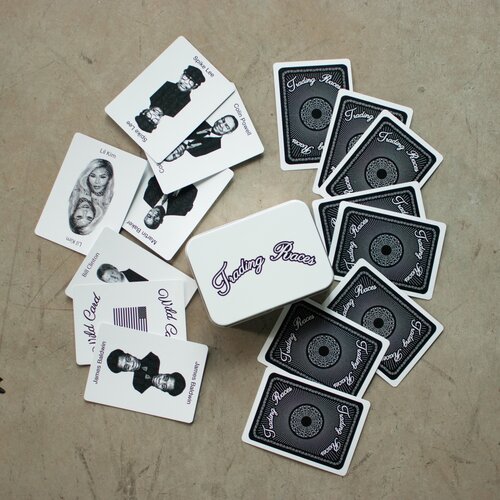
This is where Buffalo — a card game designed by Dartmouth University’s Tiltfactor Lab — comes in. The rules are simple. You start with two decks of cards. One deck contains adjectives like Chinese, tall or enigmatic; the other contains nouns like wizard or dancer.

Draw one card from each deck, and place them face up. And then all the players race to shout out a real person or fictional character who fits the description.

So say you draw “dashing” and “TV show character.”

You may yell out “David Hasselhoff in Knight Rider!”

“Female” and “olympian?”

Gabby Douglas!

Female physicist?

Hmm. If everyone is stumped, or “buffaloed,” you draw another noun and adjective pair and try again. When the decks run out, the player who has made the most matches wins.

It’s the sort of game you’d pull out at dinner parties when the conversation lulls. But the game’s creators says it’s good for something else — reducing prejudice. By forcing players to think of people that buck stereotypes, Buffalo subliminally challenges those stereotypes.

“So it starts to work on a conscious level of reminding us that we don’t really know a lot of things we might want to know about the world around us,” explains Mary Flanagan, who leads Dartmouth University’s Tiltfactor Lab, which makes games designed for social change and studies their effects.

Buffalo might nudge us to get better acquainted with the work of female physicists, “but it also unconsciously starts to open up stereotypical patterns in the way we think,” Flanagan says.

In one of many tests she conducted, Flanagan rounded up about 200 college students and assigned half to play Buffalo. After one game, the Buffalo players were slightly more likely than their peers to strongly agree with statements like, “There is potential for good and evil in all of us,” and, “I can see myself fitting into many groups.”

Students who played Buffalo also scored better on a standard psychological test for tolerance. “After 20 minutes of gameplay, you’ve got some kind of measurable transformation with a player — I think that’s pretty incredible,” Flanagan says.

Buffalo isn’t Flanagan’s only bias-busting game. Tiltfactor makes two others called “Awkward Moment” and “Awkward Moment At Work.” They’re designed to reduce gender discrimination at school and in the workplace, respectively.

“I’m really weary of saying things like, ‘Games are going to save the world,'” Flanagan says. But she adds, “it’s a serious question to look at how a little game could try to address a massive, lived social problem that affects so many individuals.”

Buffalo.

Maanvi Singh for NPR

Scientists have tried all sorts of quick-fix tactics to train away racism, sexism and homophobia. In one small study, researchers at Oxford University even looked into whether Propranolol, a drug that’s normally used to reduce blood pressure, could ease away racist attitudes. Unsurprisingly, it turns out that there is no panacea capable of curing bigotry.

There are, however, good reasons to get behind the idea that games or any other sort of entertainment can change the way we think.

“People aren’t excited about showing up to diversity trainings or listening to people lecture them. People don’t generally want to be told what to think,” explains Betsy Levy Paluck, a professor of psychology at Princeton University who studies how media can change attitudes and behaviors. “But people like entertainment. So, just on a pragmatic basis, that’s one reason to use it to teach.”

There’s a long history of using literature, music and TV shows to encourage social change. In a 2009 study, Paluck found that radio soap opera helped bridge the divides in post-genocide Rwanda. “We know that various forms of pop-culture and entertainment help reduce prejudice,” Paluck says. “In terms of other types of entertainment — there’s less research. We’re still finding out whether and how something like a game can help.”

Anthony Greenwald, a psychologist at the University of Washington who has dedicated his career to studying people’s deep-seated prejudices, is skeptical. Like Flanagan, he says, several well-intentioned researchers have proved a handful of interventions — including thought exercises, writing assignments and games — can indeed reduce prejudice for a short period of time. But, “these desired effects generally disappear rapidly. Very few studies have looked at the effects even as much as one day later.”

After all, how can 20 minutes of anything dislodge attitudes that society has pounded into our skulls over a lifetime?

Flanagan says her lab is still looking into that question, and hopes to conduct more studies in the future that track long-term effects. “We do know that people play games often. If it really is a good game, people will return to it. They’ll play it over and over again,” Flanagan says. Her philosophy: maybe a game a day can help us keep at least some of our prejudices away.

via Fighting Bias With Board Games : Code Switch : NPR

ICYMI – Black job seekers have harder time finding retail and service work than their white counterparts, study suggests | Toronto Star

Interesting study:

Black applicants may have a harder time finding an entry level service or retail job in Toronto than white applicants with a criminal record, a new study has found.

For a city that claims to be multicultural, the results were “shocking,” said Janelle Douthwright, the study’s author, who recently graduated with a Masters of Arts in Criminology and Socio-Legal Studies from the University of Toronto.

Douthwright read a similar study from Milwaukee, Wis., during her undergraduate courses and she was “floored” by the findings.

“I thought there was no way this would be true here in Toronto,” she said.

She pursued her graduate studies to find out.

Douthwright created four fictional female applicants and submitted their resumes for entry level service and retail positions in Toronto over the summer.

She gave two of the applicants Black sounding names — Khadija Nzeogwu and Tameeka Okwabi — and gave one a criminal record. The Black applicants also listed participation in a Black or African student association on their resumes.

She gave the two other applicants white sounding names — Beth Elliot and Katie Foster — and also gave one of them a criminal record. The candidates with criminal records indicated in their cover letters that they had been convicted of summary offences, which are often less serious crimes.


Both Black applicants applied to the same 64 jobs and the white applicants applied to another 64 jobs.

Douthwright explained that she didn’t submit all four applications to the same jobs because the applications for the two candidates with criminal records and the two applicants without criminal records were almost identical except for the elements she used to indicate race, so they might have aroused suspicions among the employers if they were all submitted for the same jobs.

Though the resumes were nearly identical — each applicant had a high school education and experience working as a hostess and retail sales associate — the white applicant who didn’t have a criminal record received the most callbacks by far.


Of the 64 applications, the white applicant with no criminal record received 20 callbacks, a callback rate of 31.3 per cent. The white applicant with a criminal record received 12 callbacks, a callback rate of 18.8 per cent.

The Black applicant with no criminal record, meanwhile, received seven callbacks, a rate of 10.9 per cent. The Black applicant with a criminal record received just one callback out of 64 applications, a rate of 1.6 per cent.

Lorne Foster, a professor in the Department of Equity Studies at York University said Douthwright’s study bolsters the thesis that “the workplace is discriminatory on a covert level.”

“We have a number of acts that protect us against discrimination and many people think that because of that strong infrastructure discrimination is gone,” he said.

That’s not the case. “Implicit” or unconscious bias is a persistent issue.

“All of these implicit biases are automatic, they’re ambivalent, they’re ambiguous, and they’re much more dangerous than the old-fashioned prejudices and discrimination that used to exist because they go undetected but they have an equally destructive impact on people’s lives,” Foster said.

“It’s an invisible and tasteless poison and it’s difficult to eliminate.”

Individual employers, he said, should take a proactive approach to ensure their hiring practices are inclusive or at least adhering to the human rights code by testing and challenging their processes to uncover any hidden prejudices.

He pointed to the Windsor Police Service, who shifted their hiring practices when they discovered their existing process was excluding women, as an example.

They were one of the first services to do a demographic scan of who works for them, said Foster, who worked on a human rights review of the service.

Through that process they realized there was a “dearth” of female officers. They realized that the original process, which involved a number of physical tests “where there was all this male testosterone flying around,” was inhibiting women from attending the session.

In response they organized a series of targeted recruitment sessions and were able to hire five new women at the end of that process, Foster said.

“We all need to be vigilant about our thoughts about other people, our hidden biases and images of them,” he said.

via Black job seekers have harder time finding retail and service work than their white counterparts, study suggests | Toronto Star