Implications of Paradkar’s arguments is that essentially we should have a completely open door rather than managed immigration programs.
And rather than only commentary, some numbers with respect to the Haitians in Canada who were obliged to leave after the 2014 change, versus regularizing their status, would be helpful:
However, the outrage also reveals a society more eager to be scandalized by the President’s words than upset by government actions that harm those same lives for whom they are purporting to demand respect.
Trump’s words on Haiti are particularly galling, given what its citizens have endured and American and Canadian modern roles in undermining that nation’s democracy.
Trump pulled the plug on a humanitarian program that allowed some 60,000 Haitians to remain in the U.S. under special immigration status while their homeland recovered from devastating disasters.
Canada cancelled its own program of giving Haitians special status and began asking Haitians to pack their bags in 2014 under Stephen Harper. That cancellation was completed in 2016, under Justin Trudeau with little fanfare.
Yet, Trudeau is the good guy of the global immigration crisis. Remember that viral tweet that was so celebrated after Trump moved to ban immigrants from Muslim-majority countries? “To those fleeing persecution, terror & war, Canadians will welcome you, regardless of your faith. Diversity is our strength #WelcomeToCanada”
Last year, poor Haitians who took Canadian goodness seriously, trying to cross unguarded points from the U.S. into Canada had the lowest acceptance rate — at 17 per cent — for asylum claimants between February and October.
Individual Canadians have been generous after the Haitian earthquake. More recently, Montrealers have been moved to help Haitian asylum seekers.
Still, the overall lack of indignation over the continued rejection of Haitians suggests a Canadian comfort with discriminatory attitudes so long as they’re not overt, Trump style.
Just because a municipal official saw men praying at a community hall doesn’t make that place a mosque, a Quebec judge has ruled, thwarting a bid by the city of Mascouche, a suburb outside Montreal, to shut down a Muslim centre.
The judgment is the latest twist in a series of disputes where municipal officials in Quebec have tried to curtail the operations of mosques and Islamic centres by citing zoning regulations.
Mascouche was trying to shut down the Essalam community centre, saying that the building, in a strip mall, had a zoning that forbids places of worship.
“This ruling will have a significant reach for all municipalities in Quebec that have to deal with this kind of situation,” Mascouche Mayor Guillaume Tremblay said in a statement sent to The Globe and Mail.
In his ruling, Quebec Superior Court Justice Pierre Labelle said that Mascouche had engaged in a fallacious form of reasoning – “a sophism,” he said – when it argued that since people pray in a place of worship, a community centre that allows prayers must be a place of worship.
“To that extent, any individual or collective prayer held in a residence, school or workplace would turn that location into a place of worship,” Justice Labelle said in his decision released Wednesday.
Similar stories have been public controversies for years in Quebec.
A year ago for example, Quebec Superior Court Justice Jean-Yves Lalonde decided in favour of the Badr Islamic Centre in its dispute against the city of Montreal. The city had told the Badr centre that it could no longer hold religious activities after a zoning amendment in the Saint-Léonard borough. However, the judge found that city employees had acted in bad faith and he ruled that the centre had an acquired right.
Justice Lalonde noted that the new locations where Montreal allowed places of worship tended to be in industrial areas, which was inconvenient to Muslims. “The move by the city … creates ghettoization, access problems and is a form of discrimination compared to traditional Catholic churches, which are generally in residential areas,” the judge wrote.
In the Mascouche case, Justice Labelle said the city had not acted in bad faith but held a rudimentary, ill-informed grasp of religious rights.
The problem began in the spring of 2015, when Mascouche Muslims sought a permit to use a hall for community events that included prayers and religious conferences. At the time, several Quebec municipalities were dealing with mosque controversies.
In Montreal, then-mayor Denis Coderre used a zoning change to block the polarizing imam Hamza Chaoui from opening an Islamic community hall in the city’s east end.
In Shawinigan, a Muslim cultural centre relocated after town council initially allowed a zoning change, then rescinded its decision after a public backlash.
By the end of the year, the Mascouche Muslims amended their application, removing mentions of religious activities. They were granted a permit in March of 2016.
Some residents then complained that the hall was being used like a mosque, alleging that more than a 100 people gathered in the evening to pray, Justice Labelle said in his ruling.
The city took action the night of June 29, 2016. It was during the month of Ramadan, when observant Muslims fast during the day and gather for communal meals and prayers after sunset.
Around 11:30 p.m., a city bureaucrat and two police officers showed up. They reported finding about 30 men praying in a room. Others who were in the room and outside were not praying. A week later, the city rescinded Essalam’s permit, saying that the hall’s use for religious activities contravened zoning. Essalam hired the high-profile constitutional lawyer Julius Grey and challenged the decision.
Justice Labelle noted that the zoning bylaw only talked about prohibiting places of worship but other city documents talked about a ban on religious activities. “The court is of the opinion that city cannot extend its ban beyond the very words of its bylaw,” he wrote.
He also said Mascouche engaged in sophism when it equated holding prayers with the presence of a place of worship. “The initial premise is not universal because prayers can be uttered in all places and not exclusively in a place of worship.”
While he chided Essalam for being disingenuous about holding prayers in its hall, Justice Labelle said the city was obstructing religious freedom.
Mascouche has 30 days to appeal Justice Labelle’s decision.
From earlier experience with similar issues at Service Canada, the issue is not limited to website design or organization but more significantly reflects the intrinsic complexity of programs and processes. A more productive approach often involves simplification and streamlining of programs rather than trying to address more fundamental issues through web redesign:
It turns out Canada’s immigration officials are as confused as prospective immigrants and travellers by the information provided on their own department website.
“We expect clients to know just what to do because ‘it’s on the website,’ ” says an internal Immigration Department document from last year.
“Yet, even for immigration officers like ourselves, we often find the website to be confusing and not user-friendly.”
The document, prepared for an immigration management retreat last winter, shows senior officials grappling with how to improve communication with clients, including ways to simplify government response “to make it more responsive to the client’s actual needs.”
Also on the meeting agenda was a discussion about ways to combat the misinformation that clients face in bulletin boards, by immigration consultants and fraudsters.
Immigration lawyer and policy analyst Richard Kurland, who obtained the document through an access to information request, said he was not surprised by management’s concerns.
“Reducing correspondence is good for everyone. All that needs to be done is to allow (applicants and their lawyers) more access to their own file information,” said Kurland in an interview.
The ride-hailing service Uber, which allows users to follow the driver’s route on a phone app, should inspire change, he added.
“You should be able to see what is happening in your case all along the processing journey.”
The managers also complained about the huge workload created by people applying for visas to visit Canada. Many were initially refused because they were confused what documentation was required. However, they do get approved in their second attempt.
“While it is obvious to officers what we need to see, there is very limited information available on our official outlets helping to point applicants in the right direction,” said the immigration management’s meeting agenda.
Canada processes more than a million visitor visa applications a year and one out of five is rejected. Someone applying for a visa may just state the purpose of the visit as “travelling,” for example, without specifying he or she is here to see a Canadian sibling.
The department’s “vague and generic” refusal letters is the main cause of repeat applications from confused people over Canadian requirements, according to the document.
Kurland said the document underscores the need for immigration officers to be more flexible when processing applications that may include mistakes.
“How is the public supposed to get it right when these managers struggle?” he asked.
Think-tanks are an ever-present, yet somehow under-examined feature of the public policy landscape. Think-tanks get a lot of press, at least partly because they are adept at issuing press releases advertising their work to the media, complete with pullquotes and readily available experts for radio and TV hits. Academic studies — the sort of work written by professors for professors — pass almost unnoticed, mainly because most of it is not relevant to current policy debates, and because peer-reviewed publications are not so readily accessible. But is visibility the same thing as credibility?
It would seem not. Carey Doberstein, a political scientist at the University of British Columbia, recently published a study in Canadian Public Policy on the credibility gap — he calls it a “credibility chasm” — between academic research and research published by think-tanks and advocacy organizations. Interestingly, his study is not carried out among the general population, but among policy analysts in the provincial governments of British Columbia, Saskatchewan, Ontario and Newfoundland and Labrador.
Participants in the study were asked to read and evaluate the credibility of different studies in two areas of provincial competence — minimum wages and income-splitting. The analysts were asked to evaluate a set of five or six studies produced by academics, think-tanks and advocacy groups. Doberstein very sensibly does not draw inferences about credibility from these evaluations: one study is hardly enough to evaluate the credibility of one group, or even of one researcher. He focuses instead on how the source of a study affects policy analysts’ perceptions of its credibility.
Instead of sending the studies out to the analysts under their proper affiliations, Doberstein randomly altered them. For example, a study on the effects of an increase in the minimum wage written by researchers at the University of Toronto and published in a peer-reviewed journal was sent out with the correct affiliation to one group of analysts, under the name of the Canadian Centre for Policy Alternatives (CCPA) to another group, and under the name of the Fraser Institute to yet another group. Similarly, in addition to being sent out under its own name to one group, a CCPA study would be sent out as a University of Toronto study to a different group, and represented as a Fraser Institute study to yet another set of analysts, and so on. Two advocacy groups, the Wellesley Institute and the Canadian Federation of Independent Businesses, rounded out the minimum wage exercise, and a similar mix of academic, think-tank and advocacy groups was used for the income splitting case.
This randomisation strategy allows Doberstein to identify the reputation effects of the various sets of researchers: How is a study’s credibility affected by its affiliation? The answer is: pretty much in the way you’d expect. Adding a university affiliation to a think-tank or advocacy group study increases analysts’ perceptions of its credibility, while adding a think-tank or advocacy group’s name to an academic study makes it less credible. Generally, credibility among policy analysts declines as you move from university affiliations to think-tanks to advocacy groups.
These results aren’t hard to explain. Policy analysts know full well that advocacy groups cannot be expected to publish anything that does not fit their stated agendas, so a study showing (once again!) that the data supports their previously-held position is not a particularly strong signal. Doberstein finds a similar effect among think tanks: Think tanks with a more stridently ideological focus (CCPA, the Fraser Institute) are viewed as being less credible than the relatively neutral C.D Howe Institute.
Is this good news or bad? On the positive side, it shows that policy analysts are well aware of the incentives facing various sets of researchers, and know enough to put their work in context. On the downside, one might have hoped that analysts could set all that aside and evaluate the research on its own merits. Of course, that’s an ideal that almost no one can match: this is why so many academic journals use double-blind peer review, in which neither authors nor reviewers are identified to each other.
Perhaps the more interesting question is why advocacy groups and ideologically-driven think-tanks even bother to produce reports that are discounted so heavily by policy analysts. One answer might simply be that their reports aren’t written for the benefit of analysts; they’re written for the benefit of their donors. People like to have their beliefs confirmed, and they’re willing to pay to have someone tell them that they were (once again!) right.
This discussion also provides some insight into the challenges facing the media, particularly as it concerns the markets for news and opinion. Asking people to pay someone to tell them what they want to hear is a viable business model, and many digital outlets — from The Rebel through Canadaland to Rabble — are in the process of filling out that landscape. (It also raises the question of why the CBC would want to cut into this action with its CBC Opinion site. There’s no obvious market failure here that needs a public-sector fix.)
News, on the other hand, has the elements of a pure public good: everyone benefits from knowing the basic facts of what is going on, and technology has made it almost impossible to control access to news once it’s been published. Profits from advertising revenues can no longer finance news gathering to the same extent that they used to, but academic researchers can still fall back on teaching to cross-subsidize their research work. If you really want to make an academic researcher sweat, ask her to imagine trying to make a living from her research alone.
Le directeur général des élections du Québec (DGEQ) a reçu une demande d’accommodement raisonnable pour contourner un règlement jugé discriminatoire par certains partis politiques, a appris Le Devoir. Il s’agit d’une femme portant le hijab qui, souhaitant se présenter aux prochaines élections provinciales, a demandé une dérogation lui permettant de joindre à son dossier de candidature une photo d’elle avec son voile, ce qui est actuellement interdit par le DGEQ.
« C’est la première demande d’accommodement raisonnable qu’on a eue à ce sujet », a confirmé Stéphanie Isabelle, porte-parole du DGEQ. Elle reconnaît toutefois avoir déjà reçu des commentaires et critiques incitant à modifier le règlement.
L’article 6 du Règlement sur la déclaration de candidature mentionne en effet que la photographie jointe au dossier doit donner « une vue de face complète du candidat à partir des épaules, tête découverte », ce qui empêche toute personne portant un turban, un voile ou même un bandana, de se présenter. Cet article a été vivement contesté auprès du DGEQ par divers partis politiques, dont Québec solidaire et le Parti vert, qui souhaiteraient présenter les candidats de leur choix, sans entrave pour une question de couvre-chef.
Le Devoir avait révélé il y a deux semaines qu’en 2014, le DGEQ avait refusé la candidature de Fatimata Sow, qui se présentait pour le Parti vert dans La Pinière, parce qu’elle avait fourni une photo d’elle coiffée d’un hijab. Craignant les répercussions négatives sur sa candidature, l’aspirante candidate n’avait pas voulu rendre son histoire publique à l’époque et avait renoncé à se présenter.
Modification possible
N’hésitant pas à parler de « discrimination systémique », le chef du Parti vert, Alex Tyrrell, a multiplié les démarches, notamment auprès de la ministre Kathleen Weil, anciennement à l’Immigration et récemment aux Institutions démocratiques. Celle-ci a récemment déclaré que le pouvoir de modifier le règlement appartenait au DGEQ actuel, Pierre Reid, qui a confirmé qu’il était en train de revoir ce règlement dans son ensemble. « Depuis l’automne, en prévision des prochaines élections, on est en révision de notre matériel électoral et ça inclut le formulaire de déclaration de candidature », a réitéré au Devoir Stéphanie Isabelle.
Seul le Québec possède une telle obligation. L’exigence de fournir une photo « tête découverte » n’existe pas aux niveaux fédéral et municipal, une preuve étant l’élection du député et chef du Nouveau Parti démocratique, Jagmeet Singh. Elle n’existe pas non plus pour obtenir une carte d’assurance maladie du Québec, un permis de conduire ou un passeport, où la loi interdit d’être photographié avec un couvre-chef, sauf si celui-ci est porté tous les jours pour des raisons religieuses ou médicales.
Des partis peu bavards
C’est d’ailleurs ce qu’a fait valoir la future candidate en soumettant sa demande d’accommodement au DGEQ au début du mois de décembre. Elle préférerait toutefois que le règlement soit modifié au lieu de bénéficier d’un accommodement, qui n’a généralement pas bonne presse.
Interrogé sur la procédure à suivre lorsqu’une demande d’accommodement est soumise, le DGEQ a dit qu’il n’y a pas de « procédure prévue pour le moment dans la loi électorale ». Une modification au règlement servirait à régler le problème, mais elle devra être approuvée par l’Assemblée nationale et suivre les étapes, jusqu’à la publication dans la Gazette officielle.
Après plusieurs jours de sollicitation, les principaux partis politiques se sont montrés très avares de commentaires. Le Parti québécois a dit qu’il discutera peut-être de la question à son prochain caucus à la fin de janvier, tandis que le Parti libéral du Québec s’est contenté de dire qu’il se conformera à la Loi électorale et aux règlements du DGEQ. La Coalition avenir Québec n’a pas souhaité faire de commentaires.
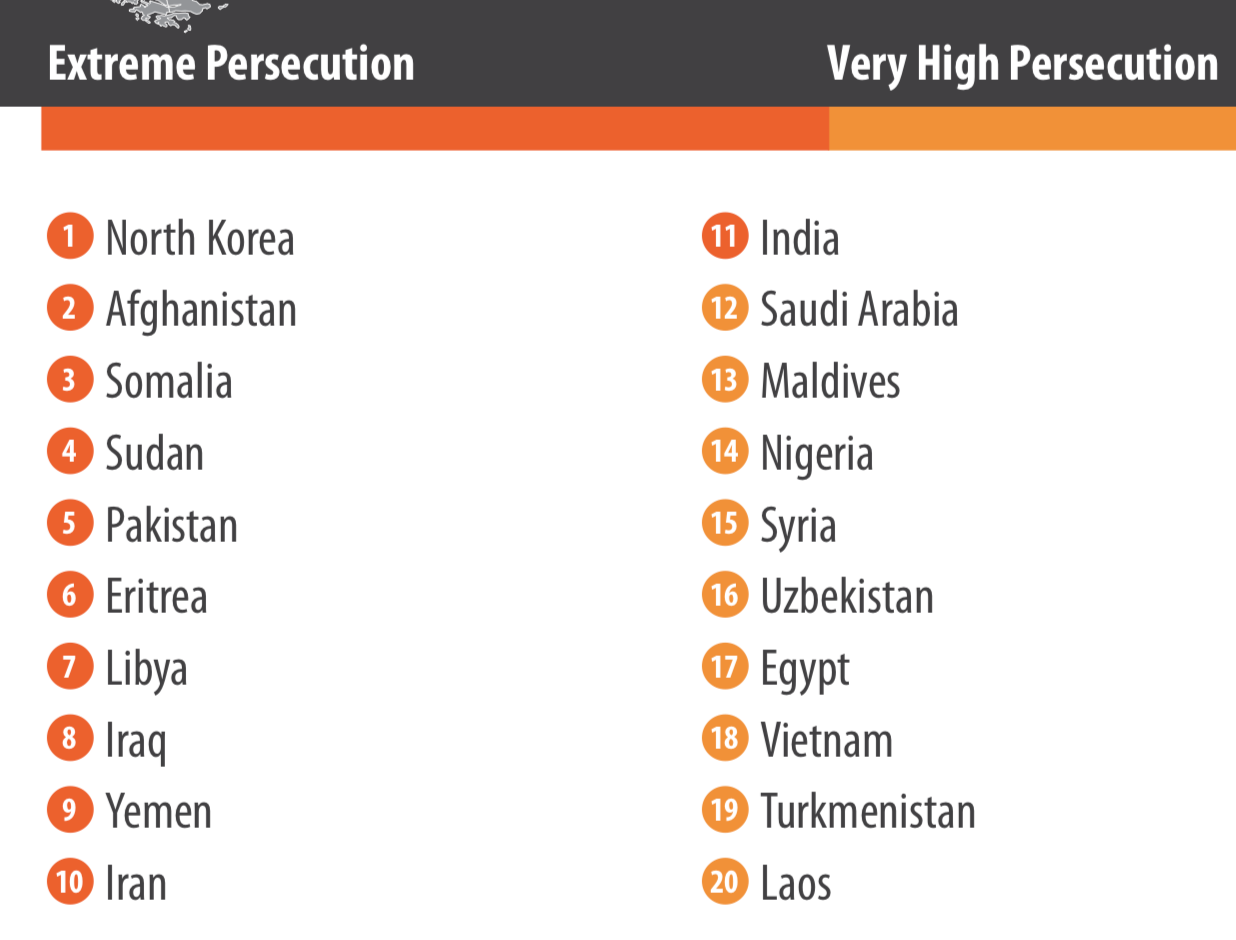
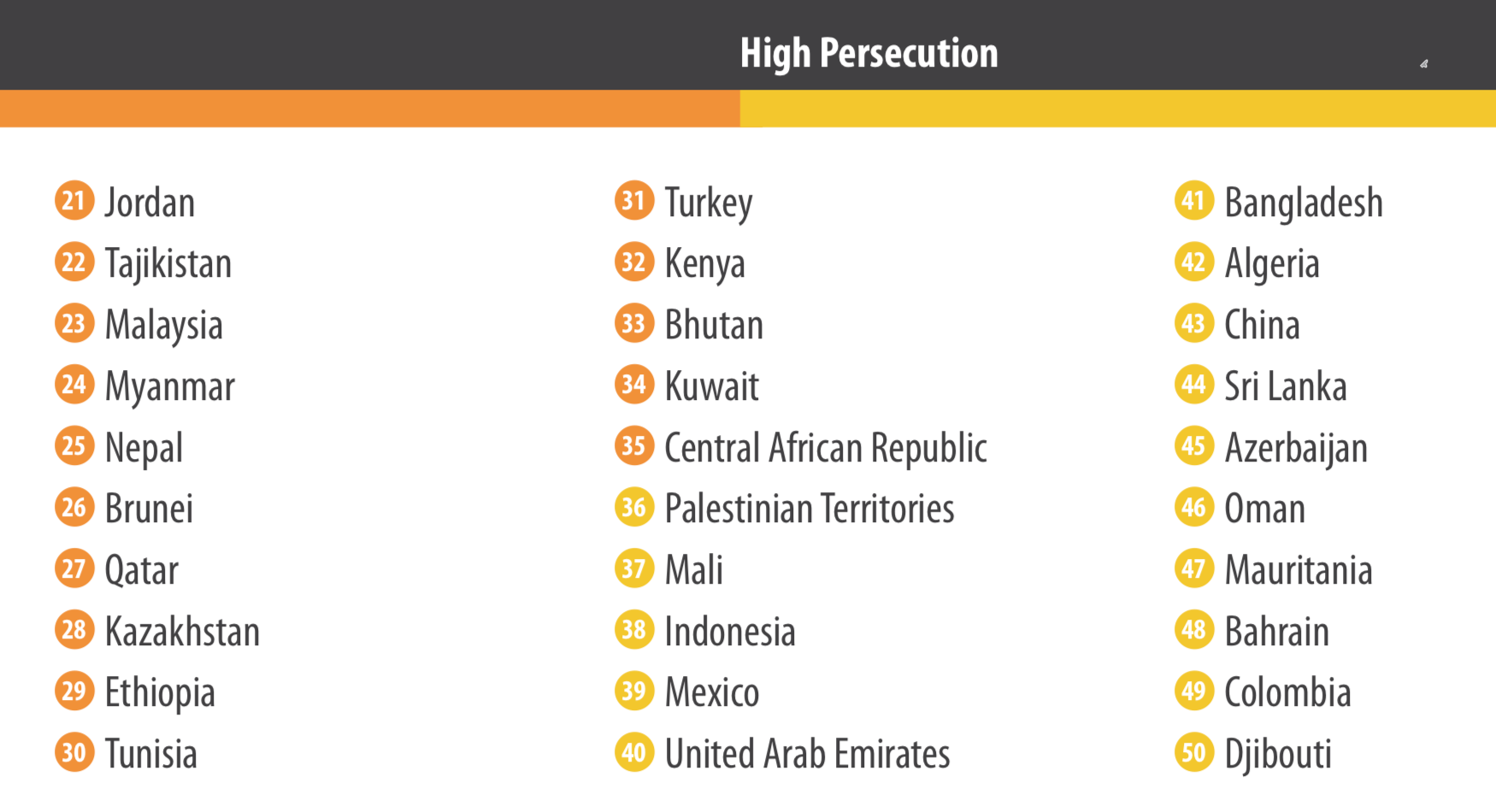
While written from an evangelical perspective, and thus I find some of the relative rankings questionable, nevertheless the report captures worrisome trends in some countries:
Doors USA released its annual list of the most dangerous countries for Christians. Among those where anti-Christian hostility has grown are India and Turkey, two important U.S. allies.
KELLY MCEVERS, HOST:
To be a Christian in certain countries can be dangerous. That’s the conclusion from a group that tracks Christian persecution around the world. NPR’s Tom Gjelten says some of these countries are close allies of the U.S.
TOM GJELTEN, BYLINE: Among the 50 countries on this watch list are ones you’d expect. North Korea is the worst place to be a Christian. Afghanistan is a close second. Most are countries where Islamist radicals target non-Muslims. The list was prepared by Open Doors, a faith-based group that serves beleaguered Christians abroad. David Curry, the group’s CEO, says persecution in Muslim countries has gotten worse over the past year.
DAVID CURRY: Nine of the top 10 on the World Watch List this year and the massive majority on the top 50 have the driver of Islamic extremism. This isn’t to taint all of Islam, but we have to be clear that there is an Islamic extremist element which must be addressed.
GJELTEN: What’s notable is where extremism is growing. Turkey, whose autocratic leader President Trump has cheered, is among the half-dozen countries where Christian persecution has increased the most. Egypt and India are two more U.S. allies where conditions have rapidly deteriorated. In India, it’s not Islamist extremism but Hindu nationalism that’s a problem. Curry opened his presentation this week with the story of a nun in India who was raped by Hindu extremists only to have evidence of the attack destroyed and the attackers acquitted.
CURRY: That’s what justice is like in India today.
GJELTEN: Trump counts Indian Prime Minister Narendra Modi as a friend, but Curry holds Modi personally responsible for the growing anti-Christian sentiment in India. He suggests the United States could use economic leverage to support Christians in India, a country, he points out, with which the United States has massive commerce
CURRY: And yet they’re number 11 on the World Watch List. Twenty-two languages, 720 dialects in India, yet Modi wants to have one religion.
GJELTEN: It’s not only Christians who are targeted in India of course. Hindu nationalists there have repeatedly attacked the Muslim minority. Curry says his organization’s country report card offers a to-do list for where governments should focus their human rights interventions. Tom Gjelten, NPR News.
Immigration lawyer Andy Semotiuk in Forbes offers his solutions to the increased number of asylum seekers. The first one, essentially applying the safe third country agreement to those who arrive at border points that are not designated ports of arrival, appears more realistic than expecting the current US admin to take back asylum seekers:
An American solution Canada could use
The American Immigration and Nationality Act has a provision that better deals with this problem than anything Canada has in its legislation. Section 235(b)(2)(C) of the U.S. act states:
Treatment of aliens arriving from contiguous territory –
In the case of an alien … who is arriving on land (whether or not as a designated port of arrival) from a foreign territory contiguous to the United States, the Attorney General may return the alien to that territory pending a proceeding under section 240.
The provision, though not always popular with all quarters in the legal community, enables American officials to hold migrants at bay in Mexico until their removal proceedings are held.
What needs to be done immediately
In my view, three things need to be done immediately in the Canadian situation.
Firstly, the government of Canada needs to clearly state publicly that, as a general rule, while migrants from America who seek to come to Canada may or may not be facing prosecution for their illegal presence in the U.S., they are definitely not currently facing imminent persecution from the U.S. government. Therefore, they should not be crossing illegally into Canada.
Secondly, Canada should adopt a measure similar in nature to the American one mentioned above, so the country can turn migrants away when they cross the border illegally.
Finally, Canada should make immediate arrangements with the U.S. to return illegal entrants to U.S. officials until hearings can be scheduled at a later date. In this way the migrants can be dealt with fairly through appropriate hearings when they can be scheduled, but not at the cost of their immediate presence in Canada. In this way their cases will not negatively impact the debate about welcoming genuine refugees and immigrants to Canada but will be dealt with fairly in deserving instances.
Look forward to any comments by Canadian economists on this good example of gender-based analysis:
It is not difficult to find an all-male panel at the annual January mega-gathering of American economists. They are as common as PowerPoint presentations and pie charts. One such panel this year met to sleepily critique President Trump’s economic policies, but it was overshadowed by another panel, two ballrooms away, that jolted a profession that prides itself on cool rationality.
That panel on Friday was stocked with women, each of whom presented new research that revealed a systemic bias in economics and presaged a move by the field’s leaders to promise to address some of those issues.
Paper after paper presented at the American Economic Association panel showed a pattern of gender discrimination, beginning with barriers women face in choosing to study economics and extending through the life cycle of their careers, including securing job opportunities, writing research papers, gaining access to top publications and earning proper credit for published work.
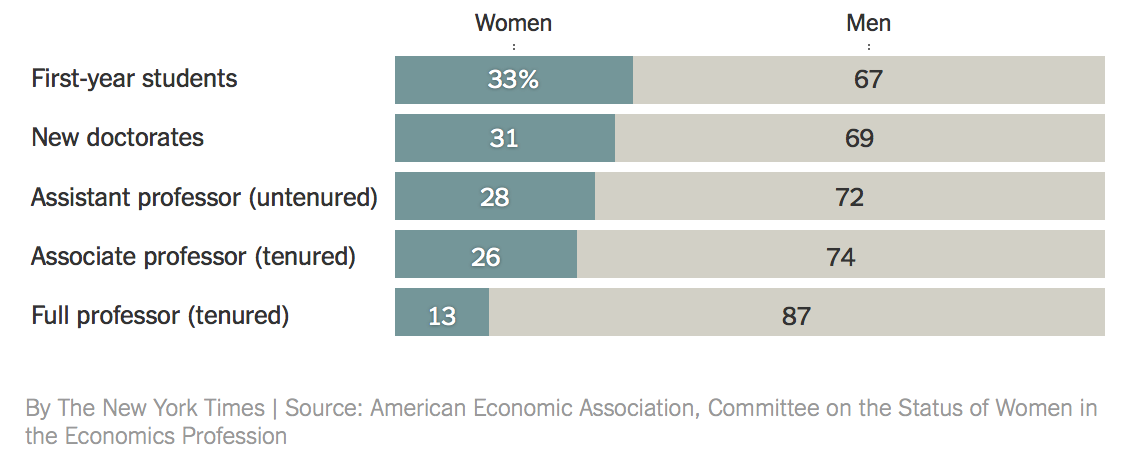
Economics departments have gradually increased their share of female faculty members over the past 20 years. But only one in five tenure-track economics professors is a woman, according to the American Economic Association’s Committee on the Status of Women in the Economics Profession.
In many parts of the profession, gender progress stagnated over the last decade. About one in three new economics doctoral students was a woman in 2016, and fewer than one in three assistant professors were women. In both of those cases, the share of women was essentially unchanged from 2006.
A Shrinking Pipeline of Women in Economics Departments
A 2016 survey of 126 economics departments with doctoral programs found that while the female share of doctoral students and faculty has increased significantly since the 1970s, the representation of women drops at each step on the track to full, tenured professor.
The focus on gender bias in economics began simmering in August, when Alice Wu, an economist from the University of California, Berkeley, detailed in a research paper how the website Economics Job Market Rumors, a much-read, anonymous job-rumor forum and message board for economists, had become a hotbed of harassment, with female economists frequently described in often sexual and crude terms.
But the barriers women face in this long male-dominated field extend well beyond online harassment. Women must be significantly clearer writers than men to have their work accepted to major economic journals, according to a paper, titled “Publishing While Female,” that Erin Hengel, a University of Liverpool economist, reported at the conference. They must also wait longer to have their papers published in journals.
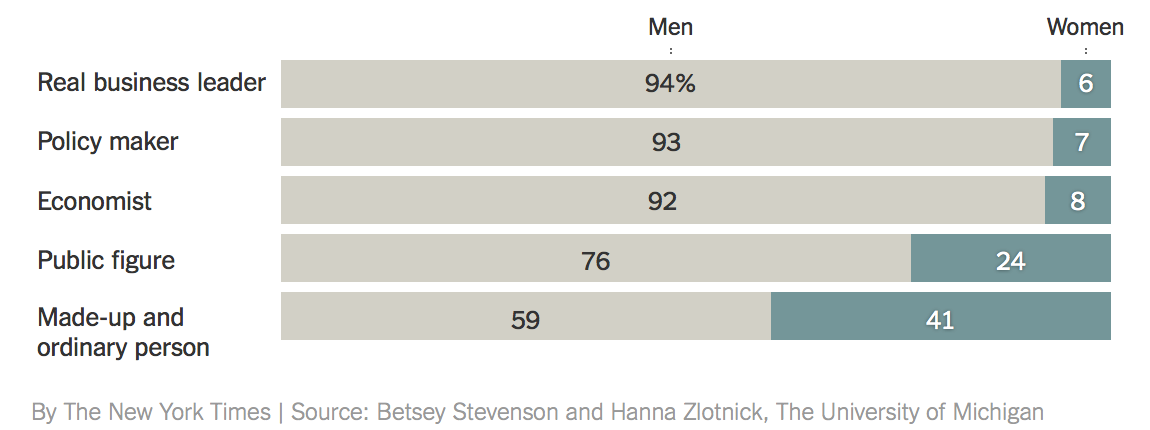
The bias creeps into the most popular introductory economics textbooks, which refer to men four times as often as they do women. Ninety percent of the economists cited in those textbooks are men, Betsey Stevenson, a University of Michigan economist, told the panel on gender issues in economics, based on a paper she is about to complete. When women are mentioned in textbook examples, they are more likely to be shopping or cleaning than running a company or making public policy.
Missing From Economics Textbooks: Women
An analysis presented at a January gathering of economists found that men make up the vast majority of people mentioned in economics textbooks, even dominating references to business leaders and policy makers.
The reckoning in economics comes amid a larger national examination of bias and abuse toward women in the work force, across industries including entertainment, manufacturing and journalism. But the existence of bias in the field of economics is rattling a profession that, at its core, functions through objective interpretation and extrapolation of data, statistics and evidence.
Leaders of the American Economic Association announced on Friday night that they would begin to address bias concerns more seriously, by setting up an alternative to the online jobs site and drafting a code of conduct for economists. But many economists said that those steps were late, and that they left much work to be done to ensure fairness for women in the field, where the rate of entry for women lags that of math, engineering and other hard sciences.
“The time had come for the organization to make a more proactive statement,” said Peter L. Rousseau, the chairman of the economics department at Vanderbilt University and the association’s secretary-treasurer. He cast the decision as responding to evidence in a way that was natural for the profession. “Economists, I think, are just very objective in their view of the world,” he said.
In interviews during and after the conference, prominent women in economics described how their profession throws barriers in their professional paths, and they criticized the male-dominated leadership in the field for moving slowly to tear those barriers down.
“I don’t think it’s because we don’t know what is implicit bias. We know,” said Rhonda Sharpe, the president of the National Economics Association, which was founded to promote the professional development of minorities in the field. “It’s whether we stand up and call it out, and usually we don’t.”
The annual conference brings together several economics groups, the largest among them the American Economics Association. Before this year’s conference, two economists — Heidi Hartmann, the president of the Institute for Women’s Policy Research, and Michael Reich, a labor economist at Berkeley — circulated a petition calling on the association’s leaders to establish their own job market website where comments would be moderated and sexist postings blocked. The petition was eventually signed by more than 1,000 economists, and, on Friday, the association agreed to start its own job site.
“I see this as a big deal,” Abigail Wozniak, an economist at Notre Dame who was active in advocating a new job market site, said by email. “I think the reaction of the A.E.A. was driven in part by a recognition that economics can become more inclusive on a number of dimensions.”
Janet Currie, chairwoman of Princeton’s economics department, and Claudia Goldin, an economist at Harvard, pointed to a recent study that found that women get significantly less credit than men when they co-write papers with them, as reflected in the way the paper affects their chances of receiving tenure.
When the co-author is a man, “people don’t say anything about it, it’s just normal,” Ms. Currie said. “When it’s a woman, it’s: ‘Oh, everything she wrote is with co-authors. How do we know she’s any good?’”
She said the behavior, detailed in a paper by Heather Sarsons of Harvard, was related to a more widespread phenomenon. “There are lots of examples of when a woman says something, no one pays attention,” Ms. Currie said. “A man says the same thing, everyone says it’s great. It happens a lot.”
Sarah A. Jacobson, an environmental economist at Williams College, recounted an experience during graduate school that she said was indicative: A well-respected female economist delivering a talk at her department was repeatedly interrupted by male economists when trying to answer questions from the audience.
“In the middle of the seminar, a male economist I respect turned around — they’re in the audience — and they were explaining the answer for her, on her behalf,” Ms. Jacobson said.
“You see it all the time,” she added. “You occasionally see it if a male is presenting. You see it pretty often if a woman is presenting.”
Kate Bahn, an economist at the Center for American Progress, said that when she was in graduate school, she was told she was not invited to a regular poker game with her male cohorts, because it included “locker-room talk.” She also noticed that her specialties, labor and gender economics, were viewed as more associated with women, and thus less rigorous.
“What there really needs to be is a broader cultural change,” she said.
Ms. Hengel, the University of Liverpool economist, used readability tests to conclude that papers written by female economists are on average up to 6 percent better-written than those of men, and that those by women languish in peer review a half-year longer than those of men.
She became interested in the topic as a graduate student, she said, when watching a male friend teach a course and noticing the difference in how students reacted to him compared with how they reacted to her.
“When you’re teaching something, when you really nail an explanation, the front row just lights up,” she said. But she watched her friend’s class light up, “even though he wasn’t nailing it.”
Ms. Sharpe, of the N.E.A., said the bias against African-American women, who continue to make up a tiny slice of the economics profession, was especially pronounced. Ms. Sharpe’s data show that only 52 black women earned economics doctorates between 2006 and 2015, a slight increase from the 46 who earned them in the previous decade.
“All of this conversation about misogyny with women is not having a conversation about black women,” she said. “I think of us as the incredible invisible woman.”
Ms. Stevenson’s analysis of the seven leading introductory economics textbooks found that female economists were all but invisible. More than 90 percent of real-world business leaders mentioned in the books were men. Three in five fictional characters whom the authors invented to illustrate a concept were men.
Only 6 percent of the policymakers referred to in the textbooks were women. One woman accounted for more than half of those references: Janet L. Yellen, the chairwoman of the Federal Reserve, who is about to be replaced by a man.
The best analysis and description I have seen regarding the concerns (non-issue in Canadian Census):
Many census experts say adding a citizenship question could throw a wrench into an already-complicated project.
“It certainly raises the level of risk of getting a bad count or a count that doesn’t that fairly represent everyone,” says John Thompson, a former Census Bureau director who left the agency last year.
Asking about citizenship is not new to the census. Census takers first asked about it in 1820 to tally up the number of “foreigners not naturalized.” While the topic has been included in questionnaires for smaller Census Bureau surveys, the last time all U.S. households were asked about it was in 1950, when the questionnaire included “If foreign born, is the person naturalized?”
Over the years, Republican lawmakers in Congress have introduced proposals calling for citizenship questions to reappear on census questionnaires, including former Sen. David Vitter of Louisiana and Rep. Steve King of Iowa.
Some experts fear, however, that reintroducing a citizenship question to all census participants in 2020 could discourage people from participating at a time of growing distrust in sharing personal information with the government.
In a recent memo written by Census Bureau staffers, researchers said that survey takers conducting field tests last year noticed a “new phenomenon” of increased fear among immigrant participants, many of whom referenced concerns about the “Muslim ban” and Immigration and Customs Enforcement. “Respondents reported being told by community leaders not to open the door without a warrant signed by a judge,” the researchers wrote in the memo, adding that they saw “respondents falsifying names, dates of birth, and other information on household rosters.”
A ‘chilling effect’?
Democratic lawmakers say they’re worried that a citizenship question would dampen census participation among not only non-citizen immigrants but also U.S. citizens from mixed-status families, who may worry about putting immigrant relatives without legal status at risk if they answer the government’s questions.
The Commerce Department, which oversees the Census Bureau, has received a letter from a group of Democratic senators calling the Justice Department’s request “deeply troubling.” The signers include Sen. Dianne Feinstein of California and two members of the Senate committee with oversight of the Census Bureau — Sen. Tom Carper of Delaware and Sen. Kamala Harris of California.
“This chilling effect could lead to broad inaccuracies across the board, from how congressional districts are drawn to how government funds are distributed,” the lawmakers wrote.
The Commerce Department declined to comment on the letter.
Federal law prohibits the Census Bureau from releasing any data identifying an individual. But federal agencies and researchers can request census data on specific population groups.
“As we learn more and more about the ability to combine data from diverse sources, assuring protection of identities is known to be a very difficult task,” says Robert Groves, who served as the Census Bureau’s director under President Barack Obama until 2012.
These privacy concerns could raise costs for the Census Bureau, which sends census takers to visit households that do not initially respond to questionnaires. The Government Accountability Office has described this follow-up work the bureau’s “largest and most costly field operation.” For the 2010 census, it cost more than $2 billion in today’s dollars to visit around 50 million addresses, according to a recent GAO report.
A case for better data?
Many civil rights advocates are questioning the Justice Department’s reasoning for requesting a citizenship question.
Since the Voting Rights Act was enacted in 1965, the federal government has enforced the law’s Section 2 protections against racial discrimination in voting using estimates of the number of voting-age citizens in the U.S. Those estimates have been based on data from either a small sample group of census participants who completed the so-called “long-form” questionnaire or, as in recent years, from the Census Bureau’s American Community Survey, which is sent every year to about one in 38 households.
“As I know from my prior experience as the chief government enforcer of the Voting Rights Act, the Justice Department has never needed to add this new question to the decennial census to enforce the Voting Rights Act before,” Vanita Gupta, who served in the Justice Department under President Obama and is now the president and CEO of The Leadership Conference on Civil and Human Rights, writes in a letter to Commerce Secretary Wilbur Ross.
Michael Li, a voting rights attorney at the Brennan Center for Justice at New York University School of Law, adds: “None of the civil rights groups that routinely bring Section 2 claims around the country have been hankering for this change.”
Still, in its letter to the Census Bureau, the Justice Department argues that citizenship data collected through the census, which is conducted with every household in the U.S., would be more comprehensive than the data from the American Community Survey’s smaller sample of participants.
“I think the Justice Department is right in saying that they need accurate small-area statistics for certain voting rights cases, especially on citizenship,” says Thompson, a former Census Bureau director.
But he adds that he finds it “strange” that the Justice Department’s request did not acknowledge the potential risks from adding a citizenship question.
“It could very well introduce a large undercount of the non-citizen population, but I don’t think anyone knows that,” Thompson says. “But if I were making decisions, before I would put it on the census, I would want to know that.”
Asked if there’s any opportunity to know that at this point through research, he replied: “I don’t think so.”
There are more than two years until the next Census Day, which is scheduled for April 1, 2020. But the bureau faces a strict timeline until then to prepare for the count. It must submit all of the 2020 census questions to Congress by the end of March, the same month it is set to collect responses in Rhode Island’s Providence County in the last scheduled field test of how the 2020 census will be conducted.
If the Census Bureau does not include a citizenship question in its upcoming report to Congress, federal law does give Secretary Ross some wiggle room. Before the upcoming headcount begins, he can submit a separate report to add the question if he “finds new circumstances exist which necessitate” the change.

 Multicultural Meanderings