Morneau advisers urge sweeping changes to cope with looming tech disruption

Following its earlier report urging an increase of immigration levels to 450,000 per year, the Barton Commission suddenly recognizes technological disruption and its impact on the labour force – [Canada] “can no longer rely on the old formula for economic growth, which emphasized investments in machinery and equipment, and population growth.”

Ironic, to say the least.

The earlier recommendation of increased immigration would have benefited from analysis of the possible impact of technological disruption. Perhaps a revised immigration recommendation is needed?:

Canada is ill-prepared for the effects of widespread technological disruption reshaping the global economy, Finance Minister Bill Morneau’s expert panel of economic advisers are warning in a set of reports scheduled for release this week.

To prevent the country’s economic growth from falling behind that of other nations, the group is recommending a modernization of Canada’s tax and regulatory systems to make them more innovation-friendly.

In addition, it is calling for a $15-billion spending surge to retrain workers so their skills are up to speed in a rapidly shifting labour market.

The recommendations are contained in advance drafts of the latest reports from the 14-member group, formally known as the Advisory Council on Economic Growth, obtained by The Globe and Mail.

“The latest wave of recommendations is geared towards preparing our economy … to capture the opportunities and handle the disruption coming over the next decade,” said council chair Dominic Barton, global managing director of consultancy McKinsey & Co. Mr. Barton was one of several council members who spoke with The Globe about their third set of recommendations to government since the council’s formation in March, 2016.

“The world is going through a period of unprecedented change, which offers many opportunities but also brings significant volatility,” the council writes in one of the documents, received by Mr. Morneau earlier this month. “Canada must be prepared to navigate this change and volatility. It can no longer rely on the old formula for economic growth, which emphasized investments in machinery and equipment, and population growth.”

The new reports come as Mr. Morneau crafts his third budget, for release in early 2018. They likely provide a sense of policy themes under consideration given the government’s close co-operation with the council and quick action on several of its past calls. Proposals that have been adopted include the launch of an infrastructure bank, the creation of a federal entity to promote foreign investment into Canada, and changes to boost immigration levels and hasten the process for high-skilled foreigners to move here. A spokesperson for Mr. Morneau said the minister has had good discussions with the council and will carefully review its suggestions as he prepares the budget.

…The new reports focus on preparing Canadians for an economy rapidly shifting away from the production and sale of physical goods to the commercialization of digital services and intellectual property. That is being accompanied by changes in how work is done, and by whom – or by what. According to a recent McKinsey study, 45 per cent of activities performed by humans could be automated using existing technology. “Already, robots can build your car, take your lunch order, review your legal case history, sell you insurance or examine your X-rays,” reads one council report. The council says at least 10 per cent of the Canadian work force – about two million people – face job losses by 2030 and will struggle to find new jobs “unless they acquire new formal qualifications.”

The council acknowledges that federal and provincial governments are aware of the challenges and do fund training programs. Ottawa promised significant changes in the previous budget to existing agreements to transfer job-training funds to provinces and territories plus an additional $2.7-billion in related spending over six years. Federal Employment Minister Patty Hajdu said in an interview that negotiations to revise the transfers are going well and results could be announced in early 2018. The government previously responded to an earlier growth-council recommendation by setting up a new organization to study and report on Canada’s skills needs.

But council member Ilse Treurnicht, former CEO of Toronto’s MaRS Discovery District said, “much more needs to be done given the wave that’s headed our way. It will take an all-hands effort.” She added that other countries are experimenting with retraining efforts, but “it is still early in the process.”

The growth council calls for a “jolt to the system” with the creation of a “third pillar” alongside the education system and regimes for funding retirement and unemployment insurance. “The focus has to be about providing skills upgrading capabilities and opportunities for people who are in the labor market,” said council member Michael Sabia, CEO of the Caisse de dépôt et placement du Québec.

At the heart of the council’s proposed $15 billion-per-year skills funding boost would be a new $2.5-billion-per-year government fund for training employed adults. The $15-billion amount would be jointly funded by government, industry and individuals. Mr. Sabia said it was “premature” to say how costs would be split. The council also calls for the government’s employment centres to be transformed to provide not only help for the unemployed but also career and training guidance for working adults and employers. “What we’re really saying is … the country has to get on with the discussion that’s required about how are we are going to deal with this issue,” he said.

via Morneau advisers urge sweeping changes to cope with looming tech disruption – The Globe and Mail

Poll: Discrimination Against Women Is Common Across Races, Ethnicities, Identities : NPR

Another in the series of NPR polls on discrimination, with the usual richness of data including the “intersectionality” between race and gender:

Discrimination in the form of sexual harassment has been in the headlines for weeks now, but new poll results being released by NPR show that other forms of discrimination against women are also pervasive in American society. The poll is a collaboration with the Robert Wood Johnson Foundation and the Harvard T.H. Chan School of Public Health.

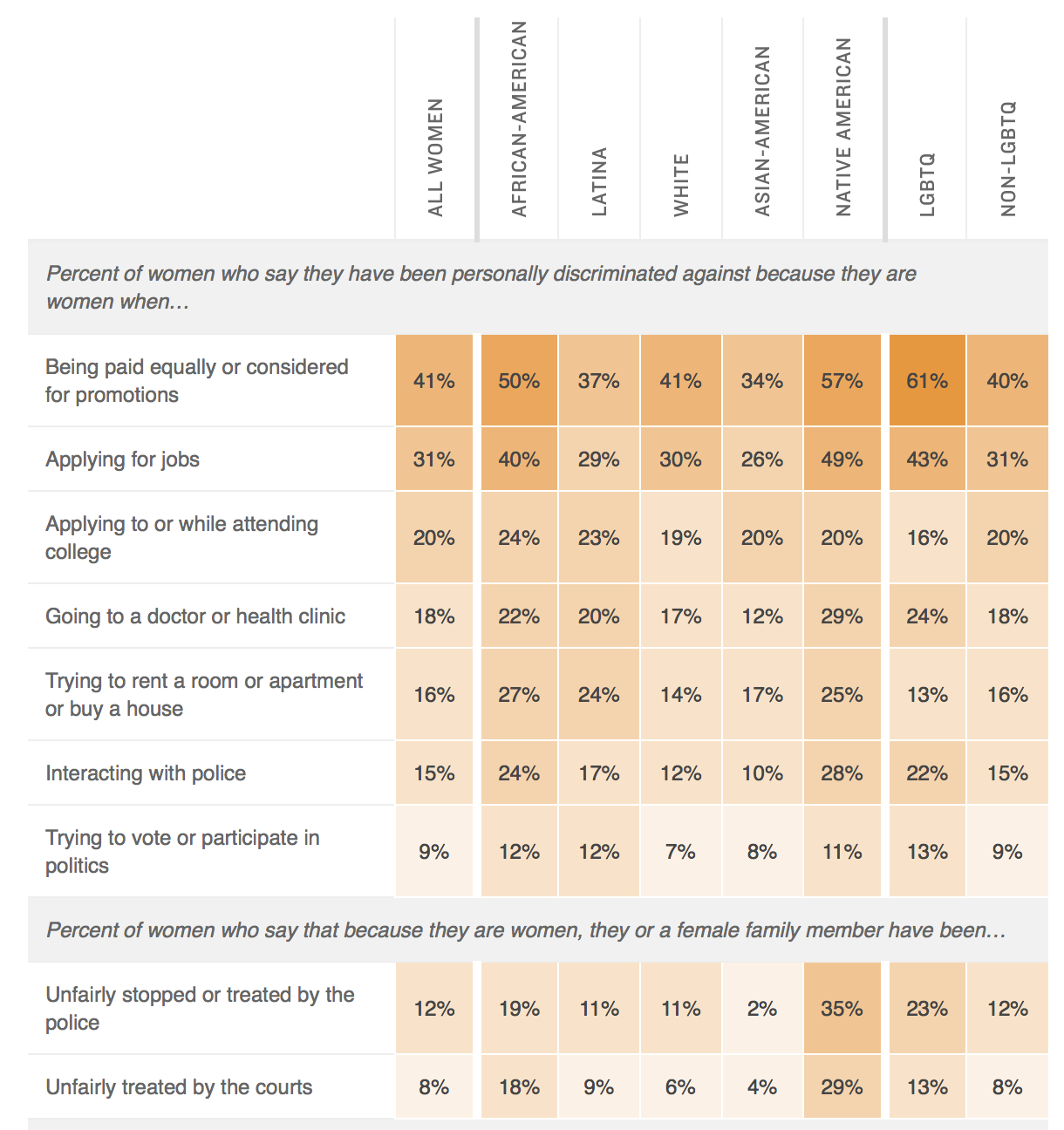
For example, a majority (56 percent) of women believe that where they live, women are paid less than men for equal work. And roughly a third (31 percent) say they’ve been discriminated against when applying for jobs because they are women.

Overall, 68 percent of women believe that there is discrimination against women in America today.

The chart below shows that the experience of gender discrimination is not monolithic — women in each racial, ethnic and identity group have particular problems in employment, education, housing and interactions with law enforcement, the courts and government. Several groups of women also avoid seeking health care out of concern they will face discrimination.

On nearly every measure, Native American women had the highest levels of discrimination based on gender. In our series, “You, Me and Them: Experiencing Discrimination in America,” we have highlighted several of these situations, including unfair treatment by the courts in majority-Native areas.

NPR will livestream an expert panel discussion on Native American issues at noon ET on Tuesday.

One of the patterns that emerged from the poll and our subsequent reporting is a gulf between high- and low-income areas when it comes to experiences of discrimination. This gap is also apparent in the gender data crunched by our Harvard team. The graph below illustrates the stark differences based on income when it comes to several everyday experiences people have in their own neighborhoods.

A snapshot in time

Our poll — which was fielded from late January to early April — before this fall’s intense news coverage of sexual harassment — also captures what women were feeling and experiencing before the recent scandals.

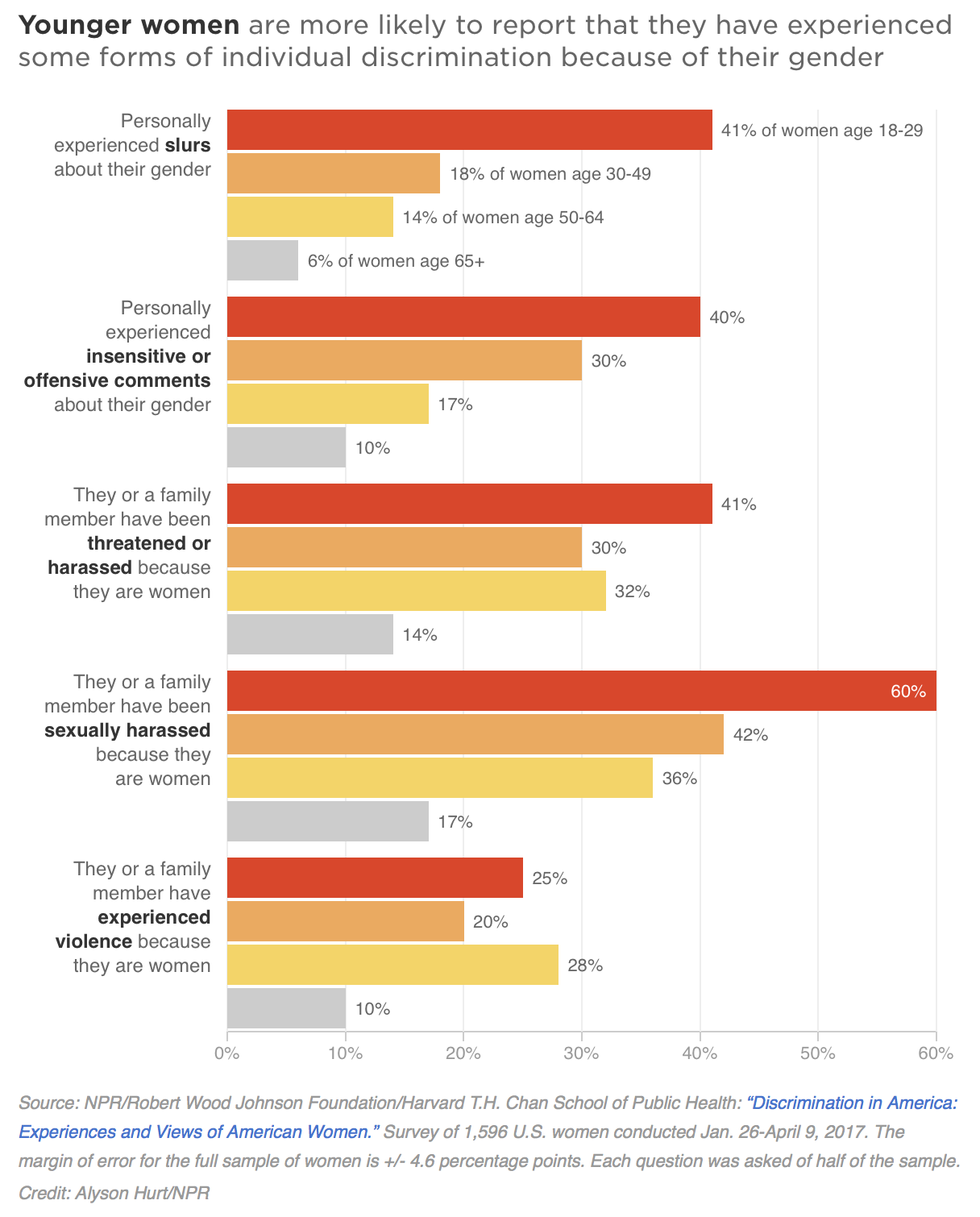
We found that 37 percent women overall reported they or a female family member had been sexually harassed because they are women at some point in their lives. But there was a wide range of responses based on age, with 60 percent of those 18 to 29 years old saying they or a female family member had been sexually harassed because they are women, versus 17 percent of women 65 and over.

“Our survey highlights the extraordinary level of personal experiences of harassment facing women today, as reflected in the news,” says Robert Blendon, co-director of the poll and professor of health policy and political analysis at the Harvard Chan School. “These national conversations may have affected how people viewed or responded to their own experiences in our survey, or their willingness to disclose these experiences.”

Indeed, a poll released last week by Quinnipiac University, asking specifically about sexual assault, suggests women may be more comfortable reporting such experiences now that more women are coming forward and revealing past abuse. (Our poll differs from Quinnipiac in that we asked a broader question: “Do you believe that you or someone in your family who is also a female has experience sexual harassment because you or they are female?”)

The survey from NPR, the Robert Wood Johnson Foundation and the Harvard Chan School was conducted from Jan. 26 to April 9, 2017 among a nationally representative probability-based telephone (cell and landline) sample of 1,596 women. The margin of error for total female respondents is 4.6 percentage points at the 95 percent confidence interval. Complete methodological information is in the full poll report.

via Poll: Discrimination Against Women Is Common Across Races, Ethnicities, Identities : NPR

EU chiefs ‘IGNORE’ ethnic minority staff ‘despite promoting diversity’ | Express.co.uk

The numbers are telling:

Statistics published by the Politico website show minorities make up just one per cent of EU institutions.

Part of the reason for the EU’s deliberate colour blindness stems from countries like France where there is huge opposition to compiling statistics on race.

But critics say that has led the bloc to become a “bubble” for rich white people and no longer reflects the continent it purports to represent.

Is the EU too white?

British Conservative MEP Syed Kamall said there was a clear divide between those high up in Brussels and the staff performing low-level jobs.He told the site: “If you want to see diversity in the European institutions, look at the faces of the cleaners leaving the building early in the morning and contrast that with the white MEPs and officials entering.”

One MEP’s assistant, Rachael Moore, even accused politicians at the European Parliament of ignoring her as one of the few “black faces” andclaimed she was subjected to security checks for no good reason.

She said: “It’s like I am not even there — they just look straight at my boss.

“They don’t look or reply to me when I ask a question. I get looks like ‘you’re not supposed to be here’.”

She went on: “I don’t sound like anything in particular on the surface.

“There is shock, a blank stare when they see me for the first time. It plays on my daily life.”

There is a lack of diversity at EU institutions

British Conservative MEP Syed Kamall said there was a clear divide between those high up in Brussels and the staff performing low-level jobs.

And Sarah Chander from the European Network Against Racism (ENAR) told Politico there was an “audacity” in Brussels where “every single one” of those promoting multiculturalism were white.

She said: “Many working in the Brussels bubble feel that working on progressive issues gives them a sense of immunity for the overwhelming whiteness of their institutions and organisations.”

It is not the first time concerns have been raised about a lack of representation in the EU corridors of power.

The ENAR penned a letter to Jean Claude-Junker earlier this year calling for changes to its diversity strategy.

It came after the Commission published a new policy on boosting the number of women, people with disabilities and LGBT staff working at its buildings, but ignored their race.

The letter said: “The European Commission has been widely criticised for under-representation of racial, ethnic and religious minorities within its workforce.

“Many commentators have argued that the European Commission must better reflect the diversity of the European society.

“Particularly at senior levels, the issue of under-representation is acute.

“This points to a trend of structural discrimination within the European Commission and jeopardises the equal inclusion of racial, ethnic and religious minority staff.”

But last year Alexander Winterstein, deputy chief spokesman for the Commission, defended its policies.

He claimed: “If you walk through our corridors you will see people from all walks of life, from all over Europe.”

via EU chiefs ‘IGNORE’ ethnic minority staff ‘despite promoting diversity’ | World | News | Express.co.uk

House of Commons gearing up for Indigenous languages in chamber

Interesting:

Ottawa is boosting its roster of Indigenous language interpreters in the House of Commons, even as MPs grapple with whether to move beyond the chamber’s two official languages, English and French.

An extra interpretation booth has already been added to the new Commons chamber in the West Block, slated to open next fall as the existing chamber gets a 10-year makeover. From there, specialists will be able to interpret Indigenous languages like Cree and Ojibway, as well as other languages, in real time.

“Given that there are approximately 60 different Indigenous dialects in Canada, grouped in 10 families, the capacity of qualified freelance interpreters in Indigenous languages is extremely limited,” warns an internal briefing note from Public Services and Procurement Canada (PSPC), obtained by CBC News under the Access to Information Act.

An artist’s rendering of the temporary House of Commons chamber, in the West Block, to open next fall. The new chamber has been fitted with a extra booth that can be used for simultaneous interpretation of Indigenous languages used by MPs. (Government of Canada)

“The [Translation] Bureau is working to develop this capacity and has assigned a senior interpreter to work on assessing and building capacity. Other factors to be considered are related to security clearance, travel (distances and costs are significant), and the ability to assess language skills in Indigenous languages, which is limited, as well.”

The July 2017 document indicates the government is gearing up for a potential linguistic watershed: the first simultaneous interpretation of an Indigenous language ever provided in the Commons chamber.

The issue has been forced by Robert-Falcon Ouellette, Liberal MP for Winnipeg Centre, who gave a speech in Nehiyo, or Cree, in the chamber on May 4. One of every five people in his riding is Indigenous.

Ouellette provided 48 hours’ notice of his speech, but there was no simultaneous interpretation into English and French — prompting him to ask the Speaker of the House to rule on a question of privilege.

Ruled against

Geoff Regan ruled against Ouellette, while acknowledging some MPs might find the situation “woefully inadequate.”

Regan then wrote to the Commons committee on procedure and house affairs, on Sept. 25, suggesting MPs study the issue. The committee has agreed, and is expected to hold hearings early in the new year.

“I want the grandmother who’s sitting in a reserve in her community to be able to turn on a channel and to listen to the Cree language, and listen to the great debates going on in our Parliament,” Ouellette said in an interview.

The Commons chamber has echoed with many languages over the years, including Japanese, Cantonese, Punjabi and Italian, and even a 1983 exchange between two members in Latin and Greek.

Indigenous languages heard in debate have included Dene-North Slavey, Inuktitut, Ojibway, Salishan and Cree, including comments from New Democrat MP Romeo Saganash after the 2011 federal election.

But simultaneous interpretation in languages other than English-French has been restricted to those rare occasions when a foreign dignitary has visited, requiring an extra booth be set up in the crowded chamber.

The Translation Bureau did provide simultaneous interpretations for two Indigenous senators in the Upper Chamber for a 2009 pilot project. And two Commons committees received simultaneous interpretation of Indigenous languages for a total of 14 days in 2016, including during visits to Kuujjuaq and Iqaluit, says the briefing note.

via House of Commons gearing up for Indigenous languages in chamber – Politics – CBC News

EUROPP – The question of citizenship in the Brexit divorce: UK and EU citizens’ rights compared

Some interesting polling data. No surprise that “on average British citizens are more supportive of their rights abroad compared to EU-27 citizens’ rights in the UK:”

One of the key priorities for the EU during the Brexit negotiations is safeguarding citizens’ rights. This refers to 3.5 million EU citizens living in the UK and 1.2 million UK nationals living in EU countries. The EU supports equal treatment in the UK of EU27 citizens as compared to UK nationals, and in the EU27 of UK nationals as compared to EU27 citizens, in accordance with Union law. In her Florence speech on 22 September, the UK Prime Minster, Theresa May, offered to incorporate legal protections for EU citizens living in the UK into UK law as part of the exit treaty.

However, since the UK triggered Article 50 on 29 March, there has been little substantive progress in the Brexit negotiations with the question of citizens’ rights being one of the primary sticking points. A European Parliament resolution criticised the lack of sufficient progress on this issue, with the Parliament’s Brexit chief, Guy Verhofstadt, arguing that ‘citizens’ rights are not being well-managed’ suggesting the possibility of a potential European Parliament veto of the Brexit deal.

Against this background of uncertainty, it is important to understand how citizens’ rights feature in the hearts and minds of the British public. To do so, we designed a survey, conducted by YouGov for the University of York on 29 June just a few days after official negotiations for departure began between the UK and the EU on 19 June. The key questions we sought to address were:

  • What is the opinion of British citizens on the rights of EU citizens in the UK as part of the Brexit divorce?
  • How do attitudes towards the rights of UK citizens abroad compare to attitudes towards the rights of EU citizens in the UK?

Our sample consisted of 1,698 individuals and was representative of the general British population in terms of age, gender, education, social grade, region, political attention and EU referendum vote. We broke down the question of citizens’ rights into four subsequent components that relate to freedom of movement in the EU, i.e. the right to freely work, reside and do business in another EU member state, as well as receive welfare.

UK citizens’ attitudes towards EU-27 citizens’ rights in the UK

Overall, British public opinion is dispersed on EU-27 citizens’ rights in the UK, as shown in Figure 1. There is much more support for doing business in the UK as opposed to working and living in the UK. The least support is observed on the question of access to welfare where we may observe comparatively much more disagreement and potentially a level of polarisation among the electorate.

On a scale from 0 to 10, where 0 denotes full disagreement and 10 full agreement, approximately a quarter of the respondents (24.16%) fully disagree that EU citizens should be allowed to claim welfare benefits in the UK. If we were to add those who have responded below 5, i.e. the middle point of the scale, then this proportion reaches 50% of the respondents. This shows that opposition to EU citizens’ accessing welfare benefits in the UK is much higher to opposition to EU citizens’ right to live, work and do business in the UK, which is at 20.84%, 19.57% and 9.25% respectively. Put differently, the majority of British citizens tend to be in favour of EU citizens living, working and doing business in the UK, but they are not as happy for them to claim welfare benefits in their country.

UK citizens’ attitudes toward UK citizens’ rights in the EU-27

How do these findings compare to how British citizens view their own rights abroad? Here the picture is slightly different. Figure 2 shows that on average British citizens are more supportive of their rights abroad compared to EU-27 citizens’ rights in the UK. Overall, fewer people disagree that UK citizens should have the right to live, work, do business and claim welfare benefits in other EU countries (responses below point 5 on the scale). These percentages range from 14.74% disagreeing that UK citizens should have the right to live in an EU country, 14.04% being hostile to UK citizens having the right to work in the EU, only 7.74% disagreeing that UK citizens should be able to do business in other EU countries, and 44.9% arguing that UK citizens should not receive welfare abroad. The latter number on UK citizens’ welfare rights in other EU countries is about 5 percentage points lower than those who oppose EU citizens’ welfare access in the UK. That being said, however, British citizens are similarly polarised on the question of welfare access even if this concerns their own nationals abroad.

Our findings suggest that although the question of EU immigration is very important among the public, and – as we know – contributed to how people voted in the Brexit referendum in 2016, it is much more nuanced and potentially contradictory than we had previously thought.

First, often – at least in the British case – some nationals may have ‘double standards’ not viewing non-nationals having equal rights to themselves. This might undermine the UK government’s popularity following a Brexit divorce deal that guarantees equal rights for both UK nationals in EU member states and EU-27 citizens in the UK.

Second, the British public is much more agreeable to EU citizens’ living, working and doing business in the UK, but they are considerably less comfortable with them sharing welfare. This suggests that it is the social aspect of EU citizenship that is the key issue featuring in the hearts and minds of the majority of the British public. This could be because the anti-EU campaigns, parties and individuals heavily politicised the welfare aspect of EU integration during the Brexit referendum, by for example associating EU membership costs with a deficit in the NHS.

via EUROPP – The question of citizenship in the Brexit divorce: UK and EU citizens’ rights compared

Government hiring outside contractor to create Canada’s new citizenship test

This is encouraging as it means that the government is serious about maintaining some of the integrity measures introduced by the previous government such as multiple versions of the test to reduce potential cheating. It is also encouraging that the tender requires field testing of questions, one step the previous government largely skipped.

That the tender is out suggests that the revised study guide is close to finalization but that roll-out of the guide and test is unlikely before late 2018 or early 2019:

The federal government is turning to the private sector to help draft the latest version of the Canadian citizenship test.

A request for proposal went out on Tuesday morning, with Immigration, Refugees and Citizenship​ Canada (IRCC) explaining that it needs help to “develop a pool of (400) multiple choice official questions, a test blueprint, and 15 versions of the Canadian citizenship knowledge test.”

The value of the contract is, as of right now, undetermined. But bidders have until mid-January to submit their proposals and the contract is slated to last one year, likely ending in early 2019.

A spokesperson for IRCC said a rollout date for the new test has not yet been determined.

The Liberal government is also in the process of overhauling the study guide that is used by citizenship hopefuls to prepare for the test. That work is being done internally, however, and isn’t finished yet. It’s unclear how work on the test could begin before the guide is complete.

The request for proposal documents note that “significant revisions” are being made to the guide, and the citizenship test “will need to be updated to reflect the new version.”

“As we have done in the past, we will partner with testing experts to ensure that the test reflects the content presented in the completed study guide,” wrote department spokesperson Remi Larivière in an email.

“This will support the success of our clients while ensuring they obtain and demonstrate the knowledge required for citizenship.”

…The written test is just one of many steps toward citizenship. People hoping to become Canadian citizens must first prove they know about the country’s history, demographics, geography, politics and much more. Right now the test contains 20 multiple-choice questions, and applicants must get at least 15 correct to pass. That’s not expected to change.

via Government hiring outside contractor to create Canada’s new citizenship test – National | Globalnews.ca

2016 Census Environics Presentation: Release 6 – Education, Labour, Journey to work, Language of work, Mobility, migration

Really good detailed series of slides on the latest Census release. Not just for policy and data nerds:

via 2016 Census: Release 6 Education, Labour, Journey to work, Language of work, Mobility, migration

Douglas Todd: Is it OK to ask, ‘Where are you from?’

I remember my mother always bristled when asked “where are you from,” as for her, as a former refugee, it somehow placed her as an “other” rather than Canadian.

That being said, if the question emerged later in a conversation, and was framed as a matter of interest in the person, it was less objectionable.

I often ask as I am curious about the life stories of people that I meet but leave it to later in a conversation and usual preface it with some words to minimize the risk of it being perceived as a micro-aggression. Asking about origins or ancestry generally works better:

One of the many troubles with the movement to eradicate micro-aggressions is it’s based on an “open concept” characterized by intrinsically fuzzy boundaries, says clinical psychologist Scott Lillienfeld of Emory University.

Microaggressions are distinct from explicit acts of racial discrimination and superiority. They are said to represent implicit prejudice, under-the-radar acts purported to damage their victims.

But, as Lillienfeld writes in the magazine, Aeon, there is no scientific evidence they harm anyone. And, perhaps worse, they put everyone in a double bind. People can be charged with being micro-aggressors, Lillienfeld says, for both showing interest (“Where are you from?) and for not showing interest (“I don’t see colour”).

In other words, a micro-aggression is entirely subjective, requiring what cognitive behavioural therapists term “negative mind-reading,” which they encourage clients to avoid.

I took the “where are you from?” issue to University of B.C. social psychologist Ara Norenzayan, a Lebanon-raised specialist in global diversity studies.

“As you can imagine, I’ve had my fair share of being asked this question! I guess I look and sound ambiguous, so people can’t easily place me,” Norenzayan said.

“It all depends on how it’s done. I’ve had experiences that were a wonderful opportunity to share different cultural experiences and backgrounds: When the question comes from a place of empathy and genuine curiosity.

“And I’ve had experiences that were quite annoying and the conversation hit a brick wall, when it was out of context and I sensed a lack of openness and curiosity. I think in a place like Vancouver, where half the population was born outside Canada, the question could be an excellent invitation to learn about and celebrate Canada’s diversity, if it’s … non-judgmental.”

So, somewhat like Norenzayan, I urge North Americans, and especially Metro Vancouverites, to err on the side of asking about national, ancestral or ethnic origins. It involves a social risk, of course, because whether one is being judgmental is in the eye of the person being asked.

But it’s probably better than succumbing to silence, not to mention mutual suspicion. We have to step up our social game to counter the slow death of community that appears to be occurring across question-phobic Metro Vancouver.

Even though it might be easy for me to say — since I’m a journalist and it’s our job to come up with questions — I’d urge residents to start asking about a whole variety of things.

Would it be so bad if we relaxed a little bit, and biased ourselves to getting to know one another? You never know, we might meet someone we like.

via Douglas Todd: Is it OK to ask, ‘Where are you from?’ | Vancouver Sun

The Politics of the Ostrich: On Pascal Bruckner’s “Un racisme imaginaire: La querelle de l’islamophobie et culpabilité” – Los Angeles Review of Books

Good long review and discussion of Islamophobia by Reza Zia-Ebrahimi, King’s College London, one of the more comprehensive ones I have seen.

Highly recommended for members of the Canadian Heritage committee studying Islamophobia, among others:

OVER THE PAST DECADE, the prominent French intellectual Pascal Bruckner has emerged as one of the figureheads of a sustained assault on any public discussion of Islamophobia and the consequences it may have on its victims. He has published op-eds with titles such as “L’invention de l’islamophobie” (the invention of Islamophobia) and “L’islamophobie n’existe pas!” (Islamophobia does not exist!), where he has outlined many of the ideas that the reader will find in Un racisme imaginaire. Thus, those familiar with the man’s writing will find little novelty in this book. To add perplexity to disappointment, the book also lacks focus: indeed, in addition to declaring Islamophobia imaginary, Bruckner devotes significant sections of his book to shadow-box and disparage all the usual scarecrows of the French neoconservative movement: the 1968 generation, multiculturalism, the left under all its manifestations, “political correctness,” sociologists, anthropologists, occasionally the anglo-saxons, and rather consistently — “Islam.” It would take me far more than the space I have been here granted to address all the issues he raises, and will focus on what is the central theme of Un racisme imaginaire: the existence or inexistence of Islamophobia.

Bruckner opens his book by declaring point-blank that his objective is to “delegitimize the term Islamophobia, instil doubt about it, flank it with permanent inverted commas.” He does not therefore even pretend that he is going to engage with objective data, or carry out empirical research. His first round of attack uses etymology to delegitimize the term Islamophobia, and in doing so Bruckner essentially paraphrases the French journalist Caroline Fourest, who claimed in 2003 that Islamophobia as a term was the brainchild of the Iranian 1979 Revolution. [1]According to this theory, the Iranian “mullahs” coined the term to suppress women who refused to wear the Islamic veil. The argument is put forth without a shred of evidence, and as a historian of modern Iran who is familiar with the 1979 Revolution and the discourse of its founders and ideologues, I can confidently assert here that the claim is simply a fabrication and widely acknowledged as such (even by Fourest herself who, embarrassed, edited the online version of her 2003 article accordingly). Undeterred, Bruckner continues to promote the now discredited theory, and another one, also initially made by Fourest, according to which Islamophobia re-emerged during the controversy surrounding Salman Rushdie’s book The Satanic Verses and the fatwa against his life. As with the previous claim, no evidence is to be found, no quotation is reproduced, no source is referenced. And for good reason: the claim is fallacious. It took me about 10 seconds and a simple Google search to find a 2015 article where Rushdie declares, “Today, I would be accused of Islamophobia.” Which means that back in 1989 he was not.

Although the term Islamophobia occurs in French texts as early as the 1920s (something recognized by Bruckner), its present-day use cannot be traced to the machinations of Islamists as the Islamophobia negationists would have us believe, but is rooted in a conceptual need to name forms of hostility and discrimination experienced by Muslims. The origins of the term’s present-day incarnation is thus to be found in a 1997 report called Islamophobia: A Challenge for Us All, by a UK-based think tank dedicated to the study of racism, the Runnymede Trust. This fact is widely acknowledged by the literature on Islamophobia, that Bruckner sadly ignores throughout his book, thus seriously weakening its core argument. The purpose of Bruckner’s genealogy is simply to suggest that the term Islamophobia is tainted by some original sin, its origins invariably leading to some mad, bearded fanatic. The Iranian mullah story also presents the added advantage of pitting Islamophobia against the struggle of women against the Islamic veil. Two conceptual birds are hit with the same rhetorical stone, but it remains that it is this genealogy, rather than Islamophobia itself, that is imaginary.

The second negationist argument put forth by Bruckner relates to the instrumentalization of Islamophobia, which then becomes — in his words — “a weapon of mass destruction of the intellectual debate.” Islamophobia, he claims, was maliciously coined by “fundamentalists and their Marxist allies” (or “Islamo-gauchisme” as he calls the alliance) to write off as racist anyone attempting to criticize or reform Islam. Of course, it is perfectly conceivable that if you criticize “Islam,” someone might label you an Islamophobe. Bruckner has not reinvented the wheel: Islamophobia, just like any other concept, designation, or idea, can be instrumentalized. Disappointingly, Bruckner does not come up with many examples to illustrate what he believes is a new form of blasphemy law: first, he refers to a few cases in which French Catholic groups sued film directors for blasphemy. That his first example is one from the world of catholic militancy is telling enough. His second example refers to the Organization of the Islamic Conference’s attempt — supported by many non-Muslims states — to ban the defamation of religions in international law. An attempt that — it is worth stressing — has so far miserably foundered, making one wonder why it is a relevant example in the first place. Indeed, no “legitimate criticism of Islam” has ever been “silenced” as a result of that effort. Bruckner mentions a few other cases of clashes in the polemics of Islam in Europe, but none in my view where the accusation of Islamophobia was either central to the controversy, or — indeed — succeeded in forcing anyone into silence. He is right in pointing out that the terrorists who opened fire on the staff of Charlie Hebdo in January 2015 silenced, for good, individuals that they considered to have blasphemed against Islam. Nobody disputes that murdering individuals in cold blood is criminal and shocking. But then again, why should our ability to discuss Islamophobia be undermined by the actions of murderous jihadists? Would we not let them win by doing so? By refusing to discuss Islamophobia, we make it impossible to challenge the jihadist view that Europe is fundamentally Islamophobic and that Muslims have no place there, a view that according to most serious scholarship is one of their top recruitment pitches.

I can think of a perhaps more convincing example, not of the charge of Islamophobia as a tool for censorship, but as a tool for political expediency. When Austrian authorities banned rallies in Austria in favor of President Recep Tayyip Erdoğan’s constitutional referendum in January 2017, the Turkish Foreign Ministry spokesperson called them racist and Islamophobic. No doubt, this is a case of political instrumentalization of the labels racism and Islamophobia, although I should rush to stress that the Turkish declaration had no effect whatsoever on the Austrian government, which seems to indicate that the accusation of Islamophobia is far from carrying the magical effects that Bruckner associates with it.

Provisional conclusion: Despite the paucity of Bruckner’s examples, instrumentalization is possible. That being said, Bruckner’s argument remains illogical. Ask yourself: Does the instrumentalization of a concept mean that the concept itself is inherently bankrupt? Does the phenomenon it refers to henceforth cease its tangible, objective, existence? The claim runs in the face of the most basic form of common sense. Let me illustrate my point. Many on the farther corners of the left liberally use the term “fascist” to discredit ideas or individuals that they find to be too far to the right of the political spectrum. For instance, many hard-left sympathizers in France routinely call the supporters of Marine Le Pen’s Front National party “fascists.” This is an instrumentalization of the concept of fascism designed to discredit one’s political adversaries. However, does this polemical usage mean that the concept of fascism is intrinsically flawed? Does it in itself negate the facts of history? Does it mean that Benito Mussolini was never born, and that the National Fascist Party never took power? Of course not, such flawed reasoning challenges basic rationality.

Another perhaps closer example: Few would deny that some instrumentalize anti-Semitism to silence any criticism of the state of Israel. Benjamin Netanyahu calls the BDS movement anti-Semitic. The Anti-Defamation League (ADL) calls Jimmy Carter (the US president who oversaw the Camp David Accords between Israel and Egypt) an anti-Semite because he criticizes Israeli policies. The ADL joined forces with the American Israel Public Affairs Committee (AIPAC) to push through a bill that would criminalize criticism of Israel in the United States as anti-Semitic (the legislation failed on the Congress’s floor). In all these cases, anti-Semitism is instrumentalized to pursue a political agenda: silence criticism of Israel. Yet, does this instrumentalization automatically invalidate the legitimacy of anti-Semitism as a concept, an analytical category, an objective historical phenomenon, and a lived experience for many Jews around the world? Are we to suddenly believe that Jews were never subjected to slander, hostility, discrimination, segregation, and an attempt at genocide? Of course not. But it is exactly such profoundly flawed arguments that Bruckner and his like-minded negationists put forth to have us believe that Islamophobia is imaginary. A word or a concept cannot be held hostage by those who use or abuse it.

The third argument is perhaps the most mystifying and audacious. Bruckner, again following Fourest and her fallacious Iranian genealogy of Islamophobia, claims repeatedly that Islamophobia is used by repressive Muslim states as “a tool of domestic police against Muslim reformers and liberals.” Here again, Bruckner does not provide a single example. And again for good reason: taking the claim at face value would mean that the religious police in Iran or Saudi Arabia initially had their hands tied in the back. They were incapable of repressing what they perceived as anti-Islamic deviance, because they lacked the wordthat would allow them to do so. And then one day, hallelujah, the term Islamophobia was invented and now they could freely repress religious reformers, secularizing intellectuals, and unveiled women. The reasonably critical reader is left flabbergasted by the daftness of the argument. One keeps reading, hoping that Bruckner will attempt to strengthen his case, or cover his tracks … in vain.

Islamophobia is not defined as criticism of Islamic practices in any dictionary, encyclopedia, or scholarly work on the topic. It is generally defined as hostility toward, and discrimination against, people perceived as Muslims. As such, it stands to reason that Islamophobia is a reality. The European Union and the United Nations have programs in place that attempt to quantify Islamophobia. The hostility aspect of Islamophobia manifests itself in acts of degradation or vandalism against mosques or Islamic centers and cemeteries. Hostility also manifests itself in daily acts of aggression, anything from verbal abuse to physical attack and even murder. The number of such acts is constantly increasing in spite of Bruckner’s claim (based on one single year) that the opposite is true: in my hometown of London alone, the Metropolitan Police registered 1,300 Islamophobic hate crimes in the 12 months leading to March 2017, a whopping 370 percent increase over 2013. We have also recently witnessed an unprecedented number of murderous acts: in January of this year, a gunman known for his anti-Muslim views opened fire in a Québec City mosque, killing six and injuring 19. Individuals carrying such acts are not criticizing Islamic practices, they target individuals that they perceive as Muslims for their “Muslimness” and nothing else. When in July of this year a man drove his car into a crowd leaving the Finsbury Park Mosque in London killing one, he shouted, “I want to kill all Muslims” and “This is for London Bridge,” indicating that he considered all Muslims as collectively responsible for an earlier jihadi attack.

Islamophobia can also kill people on the left, as they are seen as the natural allies of “Islam” (what Bruckner calls islamo-gauchisme). When in 2011 Anders Behring Breivik cold-bloodedly murdered 77 innocent people, mostly young members of the Norwegian Labour Party, he believed that by killing left-wing militants he was curtailing the Islamization of Europe. Like Bruckner, Breivik believes that the left and “Islam” are in bed together in an attempt to Islamize Europe. Interestingly, a flick through Breivik’s tedious manifesto 2083: A European Declaration of Independence shows that this latter’s criticism of the term Islamophobia is similar to Bruckner’s, thus revealing broader ideological affinities.

The second aspect of Islamophobia is the experience of discrimination. Some very serious studies show identifiable and quantifiable forms of discrimination against individuals with Muslim-sounding names in the practices of the state or of private entities. For instance, it has been shown by Patrick Simon that if you have a Muslim-sounding name you are at a disadvantage in the dispensation of public housing in France. [2] A compelling study by Adida, Laitin, and Valfort has shown that you are 2.5 times less likely to be shortlisted for a job if you bear a Muslim-sounding name than someone with identical qualifications but a non-Muslim-sounding name. [3] Again, theology has nothing to do with any of this; this type of discriminatory attitude proceeds from deep-seated prejudices against Muslims as a group, something that can reasonably be called Islamophobia so that the phenomenon has a name.

In light of these examples (that could be multiplied), the question is not whether Islamophobia exists, because it does beyond any doubt. Rather, the question is why are Bruckner and other negationists so keen to convince us that it does not. Why do they recoil in horror when they hear the term? I would like to offer an explanation. If one were to grossly divide the French opposition according to various forms of racism, one would end up with two camps. The first group includes the spiritual disciples of Hannah Arendt, who see totalitarianism as the main impetus behind the Holocaust, and are mainly concerned with anti-Semitism as the supreme form of racism. The second group includes the spiritual disciples of Frantz Fanon, who espouse one form or the other of anti-imperialism, and are more focused on colonial and postcolonial forms of racism, including Islamophobia. The two groups are obviously not as neatly separated as I make it appear: after all Hannah Arendt herself contended in the second volume of The Origins of Totalitarianismthat racism was made necessary by European imperialism, and that the two were part and parcel of the history of the totalitarian state. Be that as it may, one can consider Bruckner as a thinker clearly anchored within the first group, genuinely concerned about anti-Semitism, and consistently in favor of Israeli and American foreign policies, including this latter’s disastrous invasion of Iraq. He abhors third-worldism, which he scathingly (and indiscriminately) attacked in his 1983 book The Tears of the White Man. Bruckner is one of the most vehement critics of anything smacking of anti-racism, which he considers as racism (you have to admire the audacious inversion). Any acknowledgment of wrongdoing in colonial history is nothing more than “self-hatred.” Therefore, one could claim that Bruckner belongs to an exclusivist strand within the group concerned with totalitarianism, emphatically opposed to any discussion linking colonialism and racism, and rejecting out of hand any claim that postcolonial forms of racism matter or even exist. Beyond the sometimes wild exaggerations and hyperbolic language necessitated by such immoderate stances, the recurrent vocabulary of totalitarianism is an indication of Bruckner’s categories of analysis, perfectly valid otherwise, but here radically disconnected from the topic at hand: he repeatedly claims that Islamophobia is comparable to “totalitarian propaganda,” the censorship methods of the Soviet Union, and a world akin to Orwell’s dystopian novel 1984.

In a vision of the world influenced by Samuel Huntington’s The Clash of Civilizations, where a neat, clearly delimited, liberal and democratic “West” is pitted against an equally neat, delimited, but repressive and hostile “Islam,” Muslims can only be represented as oppressors, or as oppressed by other Muslims. He claims that even in Myanmar, Muslims are victimized by their own kind, a lie that is frankly detestable in light of current events. In this rigid mental straitjacket, there is no possibility of envisioning a Muslim being simply a victim, especially of a Westerner’s racism, and God forbids a French person’s racism.

It is this ideological baggage that explains the recurrent attempts to delegitimize any discussion of, or research on, Islamophobia. Not because Islamophobia does not exist — it obviously does — but because it is an inconvenient truth that challenges the rather simplistic us versus them, black versus white, ideational universe described above. Bruckner pours ridicule on Muslims who experience gratuitous antagonism or discrimination, by contending that being subjected to racism is not humiliating or traumatizing, but it is a prize, a status, a cachet, that Muslims cunningly seek. Worse, it is a usurpation of the status of the realand exclusive victims of racism: Jews. He contends that by complaining of Islamophobia, Muslims try to pass for Jews, or rather — as he scornfully puts it — “substitute Jews.” He rightly contends that Jews can be “racialized,” and that as a result anti-Semitism is a form of racism. However, he denies that racialization can be applied to Muslims. In other terms, you are born a Jew but being Muslim is voluntary. This curious contradictory claim runs in the face of a significant literature that highlights that anti-Semitism and Islamophobia are bothcharacterized by discursive dynamics that “racialize” the followers of a faith into a group with inherent psychological characteristics.

How can a thinker so genuinely touched by the plight of the victims of anti-Semitism be so insensitive to the plight of victims of Islamophobia? The answer is inescapable: for Bruckner, there is a hierarchy of racisms. Some are unacceptable, some are acceptable, a binary that reflects a hierarchy of humankind in Bruckner’s mind.

Anyone who opens Bruckner’s book hoping that he might be the long-awaited freethinker who will at long last transcend the above described divide between the opponents of anti-Semitism and colonial racisms, and make the overdue point that racism is always unacceptable, will be disappointed. Un racisme imaginaire is a collection of hackneyed attacks on the field of Islamophobia studies, and not a work concerned with objective facts. It is a cross between a long rant and an ideological pamphlet. Undoubtedly, there will be no shortage of readers happy to absolve its shortcomings and its ideological fanfare as the mostly positive reviews in the French media suggest. Yet, it remains that the book is addressed to a public that has already made up its mind on Islamophobia. For the rest of us, who expect claims to be backed up with a modicum of evidence or rational argumentation, the book is merely a primary source, a document that helps us gauge the state of the intellectual debate in the age of “fake news” and “alternative facts.”

via The Politics of the Ostrich: On Pascal Bruckner’s “Un racisme imaginaire: La querelle de l’islamophobie et culpabilité” – Los Angeles Review of Books

Being on social assistance draws more spite than race, colour, gender . . . but not more than being Muslim: survey | Toronto Star

Some interesting insights, particularly with respect to contacts or not between groups:

While racial profiling and sexual harassment may have grabbed the public spotlight, being poor and living on assistance is more likely to elicit hostility and prejudice than race, skin colour or gender — although being Muslim is marginally worse for this.

According to an Ontario Human Rights Commission survey released Friday, one in five Ontarians have negative feelings against those on social assistance, surpassing their unfavourable views against all other groups, except Muslims, who were disliked by 21 per cent of the respondents.

The statistically validated survey of 1,501 Ontarians was the first attempt by the province’s human rights watchdog to measure public awareness, perception and attitudes towards different groups, and learn about personal experiences of discrimination in order to guide its strategic plan in the next five years.

“It is important for institutions, such as the commission, to try and reach people we may not encounter in our day-to-day work, just to get a sense more broadly what some of the sentiments are,” said its chief commissioner, Renu Mandhane.

“It will provide useful info for the commission, for the government and community, about how we can more effectively advance the public discourse about human rights.”

The questionnaire, conducted earlier this year, found 63 per cent of respondents believed race or colour to be one of the most common reasons for discrimination in Ontario, followed by sexual orientation (34 per cent), disability (25 per cent) and creed or religion (24 per cent).

While almost half of the survey participants said they experienced some form of discrimination in the past five years, seven in 10 of Indigenous respondents said they received prejudicial treatment over the time period.

Only four per cent of respondents say they were victims of discrimination as a result of being on social assistance, but those who are unemployed, from the LGBTQ community, who have disabilities, are on a low income and have less education were way more likely to say so.

“People on social assistance tend to map out against the (human rights) code grounds . . . racialized, Indigenous, people with disabilities, single parent. What this data shows us is that even stripping that away, there is a unique form of discrimination that poor people face,” Mandhane said.

“There is a private member’s bill in Ontario right now to include social conditions in the code. This is a solid foundation for the need to have our code modernized to account for the fact that poor people face unique discrimination.”

Mandhane said the lack of exposure to people from different backgrounds can breed ignorance and prejudice.

When asked about how often they came into contact with specific groups, some people were more insulated from diversity than others:

  • 1 out of 10 respondents said they rarely or never interacted with someone with a different ethnic origin or creed and religion
  • 14 per cent had few contacts with people of colour
  • One quarter had no dealinsg with immigrants
  • Two out of five seldom or never interacted with Indigenous or aboriginal people
  • 61 per cent hardly knew of a refugee
  • 66 per cent had little to do with transgender people.

The commission will “start to look at how we reach young people and teach them about human rights. Every time there is some discussion about curriculum, it is a very polarized environment,” said Mandhane.

“But 89 of respondents would support more human rights education in schools, which suggests that this cuts across demographics, across the regions, across income levels and should be a solid basis to move forward on that commitment.”

In response to people in religious and cultural attire, most respondents said they were comfortable seeing someone wearing a Christian cross, Jewish kippah or traditional Mennonite clothing. One out of five felt discomfort with men wearing turbans or women in hijab (head scarf). However, 46 per cent of people disapproved of a niqab or veil covering a woman’s face.

While seven per cent of respondents said they experienced sexual harassment in the past five years, one in 10 women say this happened to them, compared to just three per cent of men.

Four in 10 people believed it was sometimes justified for police to profile certain groups, namely Muslims, Arabs, homeless people, South Asians, young people, Blacks and people with mental health disabilities and addictions.

via Being on social assistance draws more spite than race, colour, gender . . . but not more than being Muslim: survey | Toronto Star