RCMP questionnaire for asylum seekers targeted Muslims, asking them about head coverings, terrorist groups

Kellie Leitch’s value testing in action:

The emergence of an RCMP questionnaire targeting Muslim asylum seekers in Quebec sparked criticism Thursday that the Liberal government mismanaged last summer’s massive flow of migrants from the United States.

The questionnaire was used at the Quebec border crossing that saw an influx of thousands of asylum seekers from the U.S., many of them of Haitian descent who were concerned about the Trump administration’s decision to cancel a program that allowed them to stay in the country.

Among other things, the questionnaire asked opinions about religious practice, head coverings associated with Muslim women and terrorist groups with mainly Muslim members.

Toronto immigration lawyer Clifford McCarten said he obtained a copy of the document from a client seeking refugee status, who had been given the three-page, 41-question document by mistake.

“He was shocked by the questions,” said McCarten, who provided a copy to The Canadian Press.

The man was originally from a Muslim country, he added.

“Canada is a very liberal country that believes in freedom of religious practice and equality between men and women. What is your opinion of this subject? How would you feel if your boss was a woman? How do you feel about women who do not wear the hijab?” says the questionnaire, which also asked the same question about other head and body coverings, including the dupatta, niqab, chador and burka.

A spokesman for Public Safety Minister Ralph Goodale said the government found out on Tuesday about the existence of the questionnaire from a “stakeholder” who takes an interest in the work of the department.

Public Safety Spokesman Scott Bardsley said the department was immediately concerned and the document is no longer being used by the RCMP.

“Some of the questions were inappropriate and inconsistent with government policy,” Bardsley said in an emailed statement.

Bardsley said the document was only used “locally,” but would not say whether there would be repercussions for any of the Mounties involved in its creation.

He referred those questions to the RCMP, but a spokeswoman said Thursday the Mounties would not be granting interviews on the topic. In a written statement, the RCMP said the “interview guide” was used by its Quebec C Division and “has been revised to better evaluate individuals coming into the country whose origin is unknown, while being respectful of their situations.”

McCarten said the existence of the document raises questions about the federal government’s competence in managing the sudden surge of arrivals from the U.S.

“If, in fact, this was a local detachment making this decision — which I find a bit hard to believe — then it’s deeply concerning that one of the most, if not the most problematic crisis spot in Canadian immigration and refugee policy right now . . . doesn’t have a federal strategy for how screening is happening.”

The New Democrats said the government needed to show more leadership in dealing with the influx of asylum seekers.

“Canadians need to be assured that security measures are in place, but this looks more like religious profiling,” Matthew Dube, the NDP public safety critic said in a statement.

“Either the minister was aware this was taking place and did nothing or he doesn’t have a handle on what practices are being used.”

Jenny Kwan, the NDP immigration critic, said the government needs to provide more answers on how the questionnaire was used.

“The number of times someone prays should have no bearing on their refugee status. That is not who we are,” she said.

Other questions asked the applicants to specify their religion and “how often” they practice their religion.

McCarten said the RCMP needs to conduct security screening, but the questions being asked don’t cover all potential threats to Canada.

“It appears to instruct RCMP officers to be asking questions to the exclusion of other types of concerns, specifically the right-wing, white supremacist violence happening in the U.S. and that we have a history of in Canada,” he said.

“It asks questions that are discriminatory, that reflect a kind of institutional bias and an institutional ignorance of the RCMP of the nature of risk.”

He said asking a Muslim their opinion of head coverings is “absurd” and akin to “asking a Jewish person what their opinions are about men who don’t wear the yarmulke.”

McCarten said the document reflects on the RCMP as a whole, and shows “a kind of Islamaphobic bias that is animating how it does its business.”
Source: RCMP questionnaire for asylum seekers targeted Muslims, asking them about head coverings, terrorist groups | National Post

Brexit vote creates surge in EU citizenship applications | The Guardian

Although the overall numbers are still relatively low, the increase is notable and to be expected. Good summary of the available data:

At least 17,000 Britons sought the citizenship of another EU member state in the year after the Brexit vote, a Guardian analysis shows.

While comprehensive figures for the previous year are not available, the larger countries surveyed all reported a jump in applications, suggesting a significant overall increase.

Figures collated from requests to London-based EU embassies and interior ministries across the bloc show that EU citizenship applications from UK residents and Britons living in other member states surged in the 12 months after the referendum

Responses received from 20 countries showed the greatest number of applications were for Irish citizenship with almost 9,000 applications from UK residents and Britons living in Ireland in the 12 months from July 2016, the month after the referendum took place.

The Irish embassy in London received 8,017 applications from UK residents between July 2016 and the end of June 2017 compared with just 689 in the full year of 2015. There was also a surge in applications from British residents in Ireland: 894 applications were made in the year from 1 July 2016, compared with just 104 the previous year.

An overall agreement on Britain’s article 50 withdrawal from the EU is far from settled, and the EU chief negotiator, Michel Barnier, said on Thursday that sufficient progress had not been made on the issue of citizens’ rights for the estimated 1.2 million Britons living in other EU countries and 3.6 million EU citizens who are residents of the UK.

Dora Kostakopoulou, a professor of EU law and European integration at Warwick University, said the main reasons for the surge in applications was because people wanted security of residence and were seeking to retain EU citizenship rights, including the right to travel and live in the 27 countries that will remain members of the EU after the UK leaves.

“They value European citizenship and therefore they do not wish to lose this status as a result of Brexit,” she said. “So gaining citizenship of (another) member state would guarantee their existing status and their existing rights.”

The Guardian contacted the UK-based embassies and interior ministries of the other member states requesting the number of citizenship applications made by UK residents and Britons living in the respective countries.

In the first eight months of 2017, 2,129 Britons living in France applied for French citizenship, figures from the interior ministry show. This compares with 1,363 applications in the whole of 2016 and just 385 in 2015. These figures exclude those made directly to the French embassy in London.

Just over 1,700 UK residents applied for German citizenship in the 12 months following the Brexit vote, compared with just 63 applications in the full-year 2015. About 90% of these were made under restoration of the basic law for the Federal Republic of Germany which confers citizenship rights on the descendents of people whose citizenship was renounced on political, racial or religious grounds in Nazi Germany.

One of them is London-based Jon Landau, the chief operating officer at tech startup Wazoku. He, his father, uncle and son all applied for citizenship on the grounds that Landau’s grandfather lost his German citizenship in the 1930s.

“As soon as the Brexit vote became clear, I started looking more seriously into the application process. Becoming a German citizen isn’t just about my future, but also about my young son’s opportunities. I want to ensure that he will see himself as a European citizen, with all the possibilities and freedoms of travel, study and work that I’ve enjoyed,” he said.

There was also a large increase in German citizenship applications among Britons living in Germany. The Federal Office for Statistics (Destatis) recorded 2,865 such applications last year, up from 622 in 2015. Figures for 2017 are not yet available.

The Swedish migration authority reported a steep increase in applications by British citizens: 1,965 Britons applied for Swedish citizenship domestically and abroad in the year to the end of June 2017, more than double the previous year.

British applications for Danish citizenship more than doubled to 604 in the same period compared with the previous year.

In Spain, where foreigners can apply for nationality after 10 years’ residence but must renounce their prior citizenship, the numbers seeking citizenship are relatively low: data on the number of people taking Spanish knowledge tests with the Instituto Cervantes shows there were 579 applications in the year after the Brexit vote.

As the test was only made compulsory in October 2015, it is not possible to compare this with the previous year period, but the average number of applications per month shot up from nine to 58 after June 2016.

One of the largest proportionate increases was recorded in Italy where the number of applications rose more than eightfold from 70 in the 12 months to the end of June 2016 to 593.

Applications for Finnish citizenship trebled to 115 applications while the number of applications for Cypriot and Greek citizenship quadrupled to 306 and 45 respectively.

There were about 170 applications in the Netherlands in the 12 months after the vote compared with just 40 in the full year of 2015.

Dawn MacFarlane, who has lived in Holland for the past 19 years and is awaiting a decision on her Dutch citizenship, said: “I actually considered myself a European citizen so I never felt the actual need to change my citizenship to Dutch even though I’ve been here a long time.”

However, she became concerned after the Brexit vote about her entitlements should she become unemployed and she said her feelings about the UK changed after the result.

“I just feel that being part of Europe is a very important part of my identity. For a large part of my life, I felt more European than British. I am Scottish first and I would have been British but the European feeling overpowered the British part.”

The Austrian embassy said it usually received about 10 applications per year, but that rose to 35 in the year following the Brexit referendum. A further 37 applications were received across the country’s nine states compared with just 15 between July 2015 and June 2016.

Other countries reported more modest increases in the number of UK residents seeking citizenship in the 12 months following the vote: the Czech republic recorded 27, up from 11, while Slovakia had 24 applications, up from 15.

No Britons were recorded as having applied for citizenship of Estonia and Slovenia.

The Guardian did not receive responses or got incomplete figures from Bulgaria, Croatia, Latvia, Malta, Poland and Portugal, and a Belgian official said its figures were not centrally collated.

Citizenship applications differ from applications for passports which can only be obtained by existing citizens. Irish passport applications made by UK residentshave soared since Brexit: more than 100,000 Irish passports were issued in the UK in the first six months of 2017, up from 65,000 in 2016.

People born in other countries are automatically Irish citizens if they or either of their parents were born in Ireland (including Northern Ireland) before 2005. However, foreign-born individuals with an Irish grandparent or a parent who, although an Irish citizen, was born outside the country, must apply for inclusion in the foreign births register in order to gain citizenship.

Source: Brexit vote creates surge in EU citizenship applications | Politics | The Guardian

White Nationalism Is Destroying the West – The New York Times

Good piece:

When rapid immigration and terrorist attacks occur simultaneously — and the terrorists belong to the same ethnic or religious group as the new immigrants — the combination of fear and xenophobia can be dangerous and destructive. In much of Europe, fear of jihadists (who pose a genuine security threat) and animosity toward refugees (who generally do not) have been conflated in a way that allows far-right populists to seize on Islamic State attacks as a pretext to shut the doors to desperate refugees, many of whom are themselves fleeing the Islamic State, and to engage in blatant discrimination against Muslim fellow citizens.

But this isn’t happening only in European countries. In recent years, anti-immigration rhetoric and nativist policies have become the new normal in liberal democracies from Europe to the United States. Legitimate debates about immigration policy and preventing extremism have been eclipsed by an obsessive focus on Muslims that paints them as an immutable civilizational enemy that is fundamentally incompatible with Western democratic values.

Yet despite the breathless warnings of impending Islamic conquest sounded by alarmist writers and pandering politicians, the risk of Islamization of the West has been greatly exaggerated. Islamists are not on the verge of seizing power in any advanced Western democracy or even winning significant political influence at the polls.

The same cannot be said of white nationalists, who today are on the march from Charlottesville, Va., to Dresden, Germany. As an ideology, white nationalism poses a significantly greater threat to Western democracies; its proponents and sympathizers have proved, historically and recently, that they can win a sizable share of the vote — as they did this year in France, Germany and the Netherlands — and even win power, as they have in the United States.

Far-right leaders are correct that immigration creates problems; what they miss is that they are the primary problem. The greatest threat to liberal democracies does not come from immigrants and refugees but from the backlash against them by those on the inside who are exploiting fear of outsiders to chip away at the values and institutions that make our societies liberal.

Anti-Semitic and xenophobic movements did not disappear from Europe after the liberation of Auschwitz, just as white supremacist groups have lurked beneath the surface of American politics ever since the Emancipation Proclamation. What has changed is that these groups have now been stirred from their slumber by savvy politicians seeking to stoke anger toward immigrants, refugees and racial minorities for their own benefit. Leaders from Donald Trump to France’s Marine Le Pen have validated the worldview of these groups, implicitly or explicitly encouraging them to promote their hateful opinions openly. As a result, ideas that were once marginal have now gone mainstream.

….

“It’s the great replacement,” his friend added, echoing the title of a 2010 book by the French writer Renaud Camus, which paints a dark picture of demographic conquest in the West. “They want to replace us.”

As Mr. Camus explains in the book: “You have a people and then, in an instant, in one generation, you have in its place one or several other peoples.” He finds it scandalous that “a veiled woman speaking our language badly, completely ignorant of our culture” is legally considered as French as “an indigenous Frenchman passionate for Romanesque churches, and the verbal and syntactic subtleties of Montaigne and Rousseau.” In Mr. Camus’s eyes, groups like Pegida are heroic. He praises the group as a “liberation front” that is battling “a colonial conquest in progress” where white Europeans are “the colonized indigenous people.”

Ms. Le Pen, the leader of France’s far-right National Front party, has a similar fear, and she sees birthright citizenship as the vehicle for replacement. Although she doesn’t use the term favored by many Republicans in the United States (“anchor babies”), she insists, as she told me in an interview last May, that “we must stop creating automatic French citizens.”

This argument has a long pedigree. It can be traced back to the Dreyfus Affair, when the virulently anti-Semitic writer Maurice Barrès warned that immigrants wanted to impose their way of life on France and that it would spell the “ruin of our fatherland.” “They are in contradiction to our civilization,” Barrès wrote in 1900. He saw French identity as rooted purely in his bloodline, declaring, “I defend my cemetery.”

Today’s version of the argument is: if you have foreign blood and don’t behave appropriately, then you don’t get a passport.

Calais and Charlottesville may be nearly 4,000 miles apart, but the ideas motivating far-right activists in both places are the same. When white nationalists descended on Charlottesville in August, the crowd chanted“Jews will not replace us” and “you will not replace us” before one of its members allegedly killed a woman with his car and others beat a black man; last week, they returned bearing torches and chanting similar slogans.

Just as Mr. Trump has plenty to say about Islamic State attacks but generally has no comment about hate crimes against Indians, blacks and Muslims, the European far-right is quick to denounce any violent act committed by a Muslim but rarely feels compelled to forcefully condemn attacks on mosques or neo-Nazis marching near synagogues on Yom Kippur.

Doing so might alienate their base. Alexander Gauland, a co-leader of the newest party in the German Parliament, is adamant that his Alternative for Germany is “not the parliamentary arm of Pegida,” although he did acknowledge in an interview that “a lot of people who march with Pegida in Dresden are people who could be members, or friends, or voters” for the party. Like Mr. Trump, Mr. Gauland and Ms. Le Pen would never admit to being white nationalists, but they are more than happy to dog-whistle to them and accept their support.

Those who worry that a godless Europe and an immigration-friendly America are no match for Islamic extremists have ignored an even greater threat: white nationalists.

Their ideology is especially dangerous because they present themselves as natives valiantly defending the homeland. Because they look and sound like most of their co-citizens, they garner sympathy from the majority in ways that Islamists never could. White nationalism is in many ways a mirror image of radical Islamism. Both share a nostalgic obsession with a purist form of identity: for one, a medieval Islamic state; for the other, a white nation unpolluted by immigrant blood.

If the influence of white nationalists continues to grow, they will eventually seek to trample the rights of immigrants and minorities and dismiss courts and constitutions as anti-democratic because they don’t reflect the supposed preferences of “the people.” Their rise threatens to transform countries that we once thought of as icons of liberalism into democracies only in name.

Andrew Sullivan: On-line dating and the increase in interracial marriage:

Interesting:

Just when I had given up on the web, I stumble across some new data. Yep, it appears that dating apps are changing our society, by becoming the second-most common way straights meet partners, and by expanding the range of people we can meet. (For gay men, it’s almost the only way people meet for sex and relationships.) But here’s what’s intriguing: Correlated with that is a sustained, and hard-to-explain, rise in interracial marriage.

Or so say two researchers, Josue Ortega at the University of Essex in the U.K. and Philipp Hergovich at the University of Vienna in Austria. Money quote: “It is intriguing that shortly after the introduction of the first dating websites in 1995, like Match.com, the percentage of new marriages created by interracial couples increased rapidly,” say the researchers. “The increase became steeper in the 2000s, when online dating became even more popular. Then, in 2014, the proportion of interracial marriages jumped again.” That was when Tinder took off.

No, there’s no causation proven, but the authors, running various computer models on the effects of wider online social networks, are stumped to come up with an alternative explanation. (Fewer white people as a proportion of the population can’t account for the sharpness of the rise.) Again: “The researchers start by simulating what happens when extra links are introduced into a social network. Their network consists of men and women from different races who are randomly distributed. In this model, everyone wants to marry a person of the opposite sex but can only marry someone with whom a connection exists. This leads to a society with a relatively low level of interracial marriage. But if the researchers add random links between people from different ethnic groups, the level of interracial marriage changes dramatically.” Even more encouraging, the marriages begun online seem to last longer than others.

I wonder if online dating doesn’t just expand your ability to meet more people of another race, by eliminating geography and the subtle grouping effect of race and class and education. Maybe it lowers some of the social inhibitions against interracial dating. Online, people don’t have to flirt with someone of another race while being observed by their peers, and more people have the courage of their own desires. It’s always seemed to me that racism is deeply ingrained in human nature, and always will be, simply because our primate in-group aversion to members of an out-group expresses itself in racism, unless you actively fight it. You can try every law or custom to mitigate this, but it will only go so far. But blur the races with miscegenation, and you add one more powerful solvent to the racism we all have somewhere in our lizard brains.

Source: Andrew Sullivan: Trump’s Mindless Nihilism

Friedman: Why Canadians should be proud of the Holocaust Monument

Rabbi Daniel Friedman is Chair of the National Holocaust Monument Development Council puts the plaque controversy in context:

Last month, Canada unveiled our incredible Holocaust Monument. Let me tell you about my proudest moment that day. It wasn’t when, for the very first time, I walked into the awe-inspiring monument. It wasn’t when, alongside our prime minister, I addressed the nation. And, despite my great reverence for them, it wasn’t when I met the hundreds of inspiring survivors and generous donors.

My proudest moment was watching Justin Trudeau step off stage after his speech. Just then, he noticed a familiar face towards the back of the room, that of Tim Uppal. Uppal is the former MP who introduced the Holocaust Monument bill in Parliament. When Trudeau spotted him, he strode up to the back of the room, grabbed Tim by the hand, and escorted him to the front. At the end of the ceremony, the prime minister turned and gave him a big hug.

That’s the epitome of Canadianism. You see, Tim Uppal was a Conservative MP. Trudeau could have snubbed his former rival and basked all alone in the glory of his government’s day in the sun. But he chose to include him, making sure that he was every much a part of this historic hour.

That’s why Canadians deserve the monument we’ve built together. Many in the world today pay lip service to eradicating hatred and promoting love, respect and tolerance for all humankind. But they never miss an opportunity to attack those who don’t agree with their views, attacks often having little to do with any real matter of substance.

The monument is the product of a partnership between many organizations. Designed by the Lord Cultural Group and Daniel Libeskind, built by the National Capital Commission, facilitated by Canadian Heritage, and overseen by the Monument Development Council, a lot of people have coordinated their efforts to build this piece of our nation.

Along the way we had disagreements. Some bigger, some smaller. Along the way, we made mistakes. Some bigger, some smaller. Along the way we switched governments, which meant a whole host of new players and opinions entering the fray. But we’re Canadians. And we figured it out. We didn’t point fingers. We didn’t politicize things. We were proud of the fact that the Monument bill passed unanimously.

On the big day, we suddenly realized that an egregious error had been made. In amongst the debates over wording and plaque positioning, somehow the one plaque that introduced the others – and made no sense outside the context of the plaques detailing the Nazi genocide of six million Jews along with homosexuals, the disabled and others – ended up mounted all on its own on a separate wall. Visitors to the site were rightly disturbed to encounter this major injustice to the memory of the six million Jews for whom the monument was built. All of the parties involved are deeply remorseful and we apologize unconditionally for the pain we have caused by this oversight.

I want to thank the Trudeau government for acting expeditiously to amend the plaque as soon as the error was brought to its attention. Mistakes happen; most can be fixed quickly and decorously. Without questioning, the government did the right thing, which has been our experience with Trudeau’s government throughout. And that’s why when I saw his interaction with Tim Uppal at the unveiling, my respect for our leader grew ever stronger.  The man is a true Canadian. The man is a mensch.

Canadians don’t look for fights. We seek opportunities to embrace and boost other people who are different from us, whether those differences involve political views, religion or skin colour. The last thing we would want to politicize is the Holocaust.

The National Holocaust Monument was initiated by the Stephen Harper government. It was brought to fruition under the Trudeau government. We live in the most tolerant country in the world, and probably, of all time. Let us never take that blessing for granted. Let us be a little more forgiving of one another. And let us continue to work together, across party lines, ethnic lines and religious lines, to lead the international community, and make this world a better, safer place for all peoples.

Source: Friedman: Why Canadians should be proud of the Holocaust Monument | Ottawa Citizen

Inside the progressive think tank that really runs Canada [Canada2020]

Good long read by Anne Kingston:

To study Canada 2020, it’s useful to have some grid paper to better map its myriad interconnections, many which reveal the two degrees of separation that define Canadian politics. Three of its co-founders—Smith, Tim Barber and Eugene Lang, all well-connected Liberals—were also principals in the Ottawa-based Bluesky Strategy Group, a firm whose services include lobbying and media relations (Lang left Bluesky and Canada 2020 in 2013). Pitfield, the fourth named co-founder, has impeccable Liberal bona fides: the son of Senator Michael Pitfield, clerk of the Privy Council when Pierre Trudeau was PM; a lifelong friend of Justin Trudeau, helping him write the stirring 2000 eulogy to his father that paved his way to political office. Pitfield, who also worked for the Canada China Business Council founded by billionaire Paul ­Desmarais, is married to Anna Gainey, elected president of the Liberal Party of Canada in 2014; he ran digital strategy for Trudeau’s leadership bid and also for the 2015 federal Liberal campaign.

Connections between Canada 2020, the Liberal Party and Bluesky can look like a Venn diagram on steroids. Bluesky and Canada 2020 are based at 35 O’Connor St., where the party rented space for a temporary “volunteer hub” during the election. Pitfield intersects with the Liberals professionally via his company Data Sciences Inc., which has an exclusive agreement to manage the party’s digital engagement; two Data Sciences staffers sit on the Liberal Party’s board of directors.

Where there is Liberal news, there’s often a Canada 2020 connection. Take the recent controversy over Rana Sarkar, named Canada’s consul general to San Francisco at a salary twice the listed compensation. Media focused on his friendship with Gerald Butts, Trudeau’s senior adviser. But Sarkar has deep Canada 2020 links, too: he was named to its advisory board in 2015, is the author of a chapter in one of its “policy road maps,” and has participated in its speaker series. The bottom line: to understand this big-L Liberal moment in Canadian politics, you have to understand Canada 2020.

When asked about the organization’s genesis, co-founder Tim Barber points to an Oct. 2003 New York Times Magazine story, “Notion Building,” about the Center for American Progress (CAP), which had recently been founded by John Podesta. Bill Clinton’s former White House chief of staff (and later an Obama adviser) wanted to take on the right with an enterprise that could book liberal thinkers on cable TV, create an “edgy’’ website, and recruit scholars to research and promote new progressive policy ideas. CAP wasn’t an organ of the Democratic Party, Podesta insisted, though history points to it being just that.

Podesta hates the term “think tank,” Barber says. “I do too. It’s way too passive and conjures days gone by. His view was that there’s an opportunity for organizations to put as much time into marketing and communicating big ideas as coming up with those big ideas.”

Source: Inside the progressive think tank that really runs Canada – Macleans.ca

Artist Ai Weiwei Talks Refugees and Art | Time.com

Worth reading:

The Chinese artist and activist is taking on migration issues and the rise of nationalism with a documentary and his biggest public art project to date

Your exhibition in New York City is called “Good Fences Make Good Neighbors.” What’s it about?

Before the Berlin Wall collapsed, about 11 nations had border [walls] and fences. Now it’s jumped to 70, so you have seen the tendency to exclude and to defend. New York is a city that is made of immigrants. This is not a normal kind of public art; it uses the city as a ready-made and develops projects through the city’s boroughs, especially the immigrant areas, using bus shelters and subway stops.

Some people support President Trump’s wall because they’re worried about being overwhelmed by people from other countries. What would you say to them?

There’s a lot of talk about the potential danger. It’s saying, “We are better than them. They are the danger. They are the problem.” It’s trying not to recognize humanity as one. It’s against the ideology that we’re all created equal, and it’s a violation of our understanding of human rights and human dignity, and it’s just such a backward movement.

How do you walk the line between making art that connects as art, and art that connects as a political statement?

First, I’m an artist. Absolutely, my art is with me in all my activities. My defense of human rights or freedom of speech is really related to the very essential core of the art practice.

There’s a discussion going on about Confederate statues in the U.S. Do you think they should be removed?

I support the freedom of speech. I think that is what we have to defend, and even though those statues may not be pleasant, they still reflect where we come from. If you see what happens in China, the party constantly changes reality and history to its own favor, which really establishes a totally tyrannical control.

You lived in the U.S. for a little while as an art student in the ’80s. Were you in the country legally?

Nobody ever asked me that question. I came to the U.S. as a student. But I dropped out of school and so I became an illegal alien in New York City for years. Nobody ever checked–not even when I brought a lot of trouble to the police, when we had the [Tompkins Square Park] riots.

Why did you pull back on social media?

I grew up in a society in which no individual voice can be heard, whether you are a President or company leader or poet. So when social media provided me such a possibility, I got absolutely lost in it. I was kind of completely wild, and I spent, like, 24 hours a day [with it]. It was just never enough. After so much argument about those very essential values, I lost my voice. It’s just like a singer lost his voice because I repeatedly talked about those big issues. And then one day I had a chance to develop artworks.

You paid a price for your father’s work as a poet when he was exiled. How do you feel about your son in that context?

I was born while my father was being purged, and I grew up in this exiled condition; he cleaned public toilets in a very remote area. And then for 30 years, he was forbidden to write anything. But he is today the most patriotic poet, loves his nation, his people and the fight for the independence of the nation. At the time I was arrested, my son was only 2½. When I went into detention, the only thing I felt sorry about is I thought I was going to be sentenced to over 10 years. So my son’s condition really made me become much softer. I have to protect his safety, have to send him to Germany to a safe ground and also I have to take this exile path with him.

Source: Artist Ai Weiwei Talks Refugees and Art | Time.com

Why did Vikings have ‘Allah’ embroidered into funeral clothes? – BBC News

Interesting:

Researchers in Sweden have found Arabic characters woven into burial costumes from Viking boat graves. The discovery raises new questions about the influence of Islam in Scandinavia, writes journalist Tharik Hussain.

They were kept in storage for more than 100 years, dismissed as typical examples of Viking Age funeral clothes.

But a new investigation into the garments – found in 9th and 10th Century graves – has thrown up groundbreaking insights into contact between the Viking and Muslim worlds.

Patterns woven with silk and silver thread have been found to spell the words “Allah” and “Ali”.

The breakthrough was made by textile archaeologist Annika Larsson of Uppsala University while re-examining the remnants of burial costumes from male and female boat and chamber graves originally excavated in Birka and Gamla Uppsala in Sweden in the late 19th and mid-20th centuries.

She became interested in the forgotten fragments after realising the material had come from central Asia, Persia and China.

Larsson says the tiny geometric designs – no more than 1.5cm (0.6in) high – resembled nothing she had come across in Scandinavia before.

“I couldn’t quite make sense of them and then I remembered where I had seen similar designs – in Spain, on Moorish textiles.”

Unlocking a puzzle

Larsson then realised she was not looking at Viking patterns at all but ancient Arabic Kufic script.

There were two words that kept recurring. One of them she identified with the help of an Iranian colleague. It was the name “Ali” – the fourth caliph of Islam.

But the word next to Ali was more difficult to decipher.

To unlock the puzzle, she enlarged the letters and examined them from all angles, including from behind.

“I suddenly saw that the word ‘Allah’ [God] had been written in mirrored lettering,” she says.

Larsson has so far found the names on at least 10 of the nearly 100 pieces she is working through, and they always appear together.

The new find now raises fascinating questions about the grave’s occupants.

“The possibility that some of those in the graves were Muslim cannot be completely ruled out,” she says.

“We know from other Viking tomb excavations that DNA analysis has shown some of the people buried in them originated from places like Persia, where Islam was very dominant.

“However, it is more likely these findings show that Viking age burial customs were influenced by Islamic ideas such as eternal life in paradise after death.”

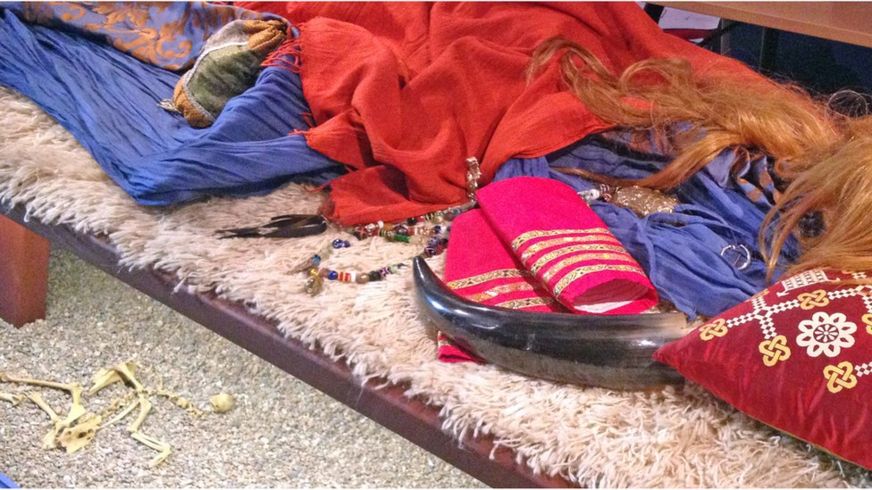
A past exhibit shows what a Viking woman’s boat grave in Gamla Uppsala may have looked like - similar to the tombs the above fragments were found in
Image captionA museum display gives a sense of what the Viking woman’s boat grave in Gamla Uppsala may have looked like – similar to the tombs the fragments were found in

Her team is now working with the university’s department for immunology, genetics and pathology to establish the geographic origins of the bodies dressed in the funeral clothes.

Historic first

Contact between the Viking and Muslim worlds has long been established by historic accounts and the discovery of Islamic coins across the northern hemisphere.

Two years ago, researchers re-examined a silver ring from a female tomb at Birka and found the phrase “for Allah” inscribed on the stone.

Again the text was Kufic, developed in the Iraqi town of Kufah in the 7th Century – one of the first Arabic scripts used to write down the Koran.

What makes Larsson’s discovery so interesting is that it is the first time historic items mentioning Ali have ever been unearthed in Scandinavia.

Source: Why did Vikings have ‘Allah’ embroidered into funeral clothes? – BBC News

ICYMI: Deradicalization must be tailored to Canadian cities, says expert

Sounds sensible but will leave it to others with more expertise to comment:

The radicalization of young Canadians is most often a local problem that requires programs tailored to specific cities, towns or even neighbourhoods.

That’s one the preliminary findings by the Canada Centre for Community Engagement and Prevention of Violence.

The federal government set aside $35 million over five years for the centre, which was announced in August 2016. It works within the Department of Public Safety to provide training, support research and provide national leadership on counter-radicalization strategies for provinces, territories and municipalities.

“There’s a whole number of risk factors, and that’s the challenge — there’s no agreement on what the best assessment tool is or what all the risk factors are,” Ritu Banerjee, executive director of the centre, told CBC News.

People may be exposed to an assortment of extreme views, from Islamism to neo-Nazism, online, through their family, at their place of worship or school or in all these areas.

“So what you do out in Calgary might not necessarily work in Montreal or may not necessarily work in Moncton. So you have to be conscious of the local realities and the local needs,” said Banerjee.

More than a year after the creation of Canada Centre, the government has yet to fill the top job of special adviser, who would formally shape and oversee the centre’s work.

A senior government source with knowledge of the file told CBC News the government had tentatively filled the job earlier this year but the candidate backed out. The search has been renewed and the department said it expects to fill the job by the end of the year.

Social workers on front lines

Meanwhile, Banerjee and her staff have approved funding for several projects through the agency’s community resilience fund. One initiative in Montreal trains front-line social workers who deal with vulnerable youth but likely were never educated about terrorism and national security threats.

“They’re familiar with gang-related violence, they may be familiar with drugs, mental health issues, but the minute you start talking about terrorism, people get scared or people get nervous. So they need specialized support and training,” Banerjee said.

Another of Canada Centre’s early takeaways is that governments are not well placed to debate extremist ideologies.

“We recognize that it’s very difficult for a government to do that because we don’t have the credibility to do that and it would be perceived as propaganda,” Banerjee explained.

“Counter-arguments to a stated proposition have to be very much tailored to a specific audience. You have to be very careful and thoughtful about the approach you use, whether it’s face-to-face, whether it’s online and if you’re doing it online, what platforms you use. And then, who is actually delivering the message.”

Banerjee says research suggests intervening early to teach children how to think critically and be digitally literate is key to building community resilience to extremism.

Source: Deradicalization must be tailored to Canadian cities, says expert – Politics – CBC News

Brexit: Dutch nationals living in Britain will be allowed dual citizenship | The Guardian

Dutch pragmatism:

The new Dutch government will allow its citizens living in the UK to take up dual citizenship, according to a coalition agreement announced on Tuesday, which pledges to prioritise both its people and EU unity in the Brexit negotiations.

After a record 208 days, agreement was struck between four parties on Tuesday to form a centre-right government led by the liberal prime minister, Mark Rutte.

The blueprint – agreed by Rutte’s People’s Party for Freedom and Democracy, the Christian Democrats, the centrist and pro-European Union D66 party and the faith-based Christian Union – spells out plans for tax cuts, lessons in national identity and an experiment with state-sanctioned cannabis plantations over the next four years.

It also pledges to fight for the Dutch fishing industry in the Brexit negotiations, maintain solidarity with the EU in the talks with the UK, and legislate to allow its citizens living in Britain the chance to have dual citizenship.

The document says: “The cabinet will prepare proposals for the modernisation of nationality law. It concerns an extension of the possibility of possession of multiple nationalities for prospective first generation emigrants and immigrants.”

Until now, Dutch nationals who take British citizenship to avoid having to leave the UK after Brexit would have been stripped of their Netherlands passports due to limits on dual nationality.

Even as late as July, Rutte defended the policy, telling reporters that “countering dual nationality remains one of this cabinet’s policies”, in response to a petition with 22,000 signatures calling for a government rethink.

About 100,000 Dutch nationals living in Britain face an uncertain future after March 2019. The UK and EU are yet to reconcile their differences on the citizens’ rights issue.

Sophie in ‘t Veld, a Dutch MEP, said her party, the liberal D66, had pushed for the change to help Dutch citizens in the UK.

She said: “It is a major step forward, but it doesn’t apply immediately. We will have to legislate. But when we do, people who emigrate will have the right to dual nationality, although their children will have to choose their single nationality at some point.

“The document also pledges to maintain EU solidarity in the talks, which may disappoint some in Britain but that is the way it is.”

Source: Brexit: Dutch nationals living in Britain will be allowed dual citizenship | World news | The Guardian