The Daily — Aboriginal peoples in Canada: Key results from the 2016 Census

The Daily’s summary of the Census findings regarding Indigenous peoples (assume StatsCan will eventually shift to that term):

Today, Statistics Canada is releasing its first results on First Nations people, Métis and Inuit from the 2016 Census of Population. Information about past and future releases from the census can be found through the 2016 Census Program release schedule.

Aboriginal peoples have lived in what is now Canada long before the arrival of the first European settlers. Indeed, the history of Canada would be incomplete without the stories of First Nations people, Métis and Inuit. The same is true of its future.

Past censuses have emphasized two key characteristics of the Aboriginal population: that Aboriginal peoples are both young in age and growing in number. The 2016 Census reaffirmed these trends. New data also reveal both the changing nature and the diversity of the First Nations, Métis and Inuit populations.

In 2016, there were 1,673,785 Aboriginal people in Canada, accounting for 4.9% of the total population. This was up from 3.8% in 2006 and 2.8% in 1996.

Since 2006, the Aboriginal population has grown by 42.5%—more than four times the growth rate of the non-Aboriginal population over the same period. According to population projections, the number of Aboriginal people will continue to grow quickly. In the next two decades, the Aboriginal population is likely to exceed 2.5 million persons.

Two main factors have contributed to the growing Aboriginal population: the first is natural growth, which includes increased life expectancy and relatively high fertility rates; the second factor relates to changes in self-reported identification. Put simply, more people are newly identifying as Aboriginal on the census—a continuation of a trend over time.

The First Nations, Métis and Inuit populations continue to be significantly younger than the non-Aboriginal population, with proportionally more children and youth and fewer seniors. However, they too are aging—in 2016, those 65 years of age and older accounted for a larger share of the Aboriginal population than in the past.

The data provide a portrait of the rich diversity of First Nations, Métis and Inuit populations. More than 70 Aboriginal languages were reported in the 2016 Census. Growth was observed in the Aboriginal population in urban areas, as well as First Nations people living on reserve and Inuit in Inuit Nunangat. Aboriginal children were more likely to live in a variety of family settings, such as multi-generational homes, where both parents and grandparents are present.

Rapid population growth among First Nations people, Métis and Inuit

The Aboriginal peoples of Canada—First Nations people, Métis and Inuit—include a diverse range of histories, cultures and languages.

The First Nations population—including both those who are registered or treaty Indians under the Indian Act and those who are not—grew by 39.3% from 2006 to reach 977,230 people in 2016.

The Métis population (587,545) had the largest increase of any of the groups over the 10-year span, rising 51.2% from 2006 to 2016.

The Inuit population (65,025) grew by 29.1% from 2006 to 2016.

The Aboriginal population is young but also aging

The Aboriginal population is young. The average age of the Aboriginal population was 32.1 years in 2016—almost a decade younger than the non-Aboriginal population (40.9 years).

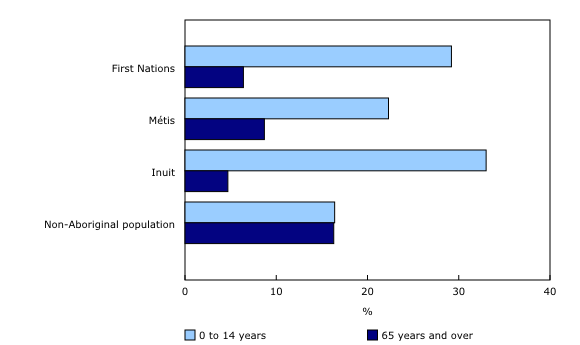
Chart 1  Chart 1: Share (in percentage) of the population aged 0 to 14 years and 65 years and over by Aboriginal identity, Canada, 2016
Share (in percentage) of the population aged 0 to 14 years and 65 years and over by Aboriginal identity, Canada, 2016

Chart 1: Share (in percentage) of the population aged 0 to 14 years and 65 years and over by Aboriginal identity, Canada, 2016

As shown in the 2016 Census release on age and sex, seniors outnumbered children for the first time in Canada. This was not the case among Aboriginal peoples.

Around one-third of First Nations people (29.2%) were 14 years of age or younger in 2016—over four times the proportion of those 65 years of age and older (6.4%). For Métis, 22.3% of the population was 14 years of age or younger, compared with 8.7% who were 65 years of age and older. Among Inuit, one-third (33.0%) were 14 years of age or younger, while 4.7% were 65 years of age and older.

While the Aboriginal population is younger than the rest of the population in Canada, it is also aging. In 2006, 4.8% of the Aboriginal population was 65 years of age and older; by 2016, this proportion had risen to 7.3%. According to population projections, the proportion of the First Nations, Métis and Inuit populations 65 years of age and older could more than double by 2036.

First Nations population growing both on and off reserve

First Nations people possess a rich cultural heritage of diverse languages, histories and homelands. There are more than 600 unique First Nations/Indian Bands in Canada. The First Nations population includes those who are members of a First Nation/Indian Band and those who are not, as well as those with and without registered or treaty Indian status under the Indian Act.

The number of First Nations people with registered or treaty Indian status rose by 30.8% from 2006 to 2016. There were 744,855 First Nations people with registered or treaty Indian status in 2016, accounting for just over three-quarters (76.2%) of the First Nations population. The other 23.8%, which did not have registered or treaty Indian status, has grown by 75.1% since 2006 to 232,375 people in 2016.

Among the 744,855 First Nations people with registered or treaty Indian status, 44.2% lived on reserve in 2016, while the rest of the population lived off reserve. There was growth for both on reserve (+12.8%) and off reserve (+49.1%) First Nations populations from 2006 to 2016.

Over half of First Nations people live in the western provinces

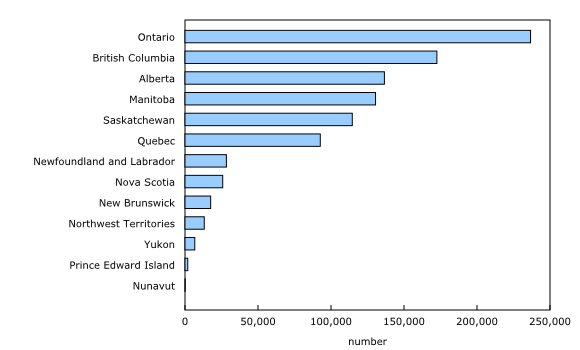
The First Nations population was concentrated in the western provinces, with more than half of First Nations people living in British Columbia (17.7%), Alberta (14.0%), Manitoba (13.4%) and Saskatchewan (11.7%). By comparison, 30.3% of the non-Aboriginal population lived in the western provinces.

Almost one-quarter (24.2%) of the First Nations population lived in Ontario, the largest share among the provinces, while 9.5% lived in Quebec.

A further 7.5% of the First Nations population lived in the Atlantic provinces and 2.1% lived in the territories.

While First Nations people accounted for 2.8% of the total population of Canada, they accounted for one-tenth of the population in Saskatchewan (10.7%) and Manitoba (10.5%), and almost one-third of the population in the Northwest Territories (32.1%).

First Nations people accounted for a smaller share of the population in Quebec (1.2%), Ontario (1.8%) and the Atlantic provinces (3.2%).

Chart 2  Chart 2: First Nations population by provinces and territories, Canada, 2016
First Nations population by provinces and territories, Canada, 2016

Chart 2: First Nations population by provinces and territories, Canada, 2016

First Nations population doubles in Atlantic Canada

While the First Nations population in the Atlantic provinces is relatively small (73,655 or 7.5% of the total First Nations population), it more than doubled (+101.6%) from 2006 to 2016. A significant part of this increase most likely stemmed from changes in self-reported identification, that is, people newly identifying as First Nations on the census.

Over this 10-year period, the First Nations population grew by 48.7% in Ontario and 37.5% in Quebec.

While the First Nations population grew at the slowest pace in Western Canada (+32.2%), the region saw the largest total increase in the First Nations population (+134,550) in Canada.

Ontario has the largest Métis population

Métis hold a unique cultural and historic place among the Aboriginal peoples in Canada, with distinct traditions, culture and language (Michif). Today, the Métis population is present in every province, territory and city in Canada.

There were 587,545 Métis in Canada in 2016, accounting for 1.7% of the total population.

Most (80.3%) of the Métis population lived in Ontario and the western provinces. For the first time, Ontario had the largest Métis population in Canada at 120,585, up 64.3% from 2006 and accounting for one-fifth (20.5%) of the total Métis population.

The Métis population grew by 32.9% in the western provinces from 2006 to 2016, to 351,020 people.

Alberta had the largest Métis population in the western provinces, accounting for 19.5% of the total Métis population. About the same number of Métis lived in Manitoba and British Columbia (15.2%), while Saskatchewan was home to 9.9% of the Métis population.

There were 69,360 Métis living in Quebec in 2016, accounting for 11.8% of the total Métis population. Meanwhile, 7.2% of the Métis population lived in the Atlantic provinces and 0.8% lived in the territories.

Chart 3  Chart 3: Métis population by provinces and territories, Canada, 2016
Métis population by provinces and territories, Canada, 2016

Chart 3: Métis population by provinces and territories, Canada, 2016

The Métis population grew at the fastest pace in Quebec (+149.2%) and the Atlantic provinces (+124.3%) from 2006 to 2016. Meanwhile, the Métis population grew by 64.3% in Ontario and by 32.9% in the western provinces. In the territories, the size of the Métis population was relatively unchanged from 10 years earlier.

Nearly two-thirds of Métis live in a metropolitan area

Of the three Aboriginal groups, Métis were the most likely to live in a city, with 62.6% living in a metropolitan area of at least 30,000 people.

There were eight metropolitan areas with a population of more than 10,000 Métis in 2016: Winnipeg, Edmonton, Vancouver, Calgary, Ottawa–Gatineau, Montréal, Toronto and Saskatoon. Combined, these areas accounted for just over one-third (34.0%) of the entire Métis population.

Winnipeg had the largest Métis population at 52,130 in 2016, up 28.0% from a decade earlier.

Almost three-quarters of Inuit live in Inuit Nunangat

Inuit are the original people of the North American Arctic. In Canada, Inuit have inhabited communities stretching from the westernmost Arctic to the eastern shores of Newfoundland and Labrador for uncounted generations. This area, known as Inuit Nunangat, refers not only to the land, but also to the surrounding water and ice, which Inuit consider to be integral to their culture and way of life. For more information, please visit the Inuit Tapiriit Kanatami website.

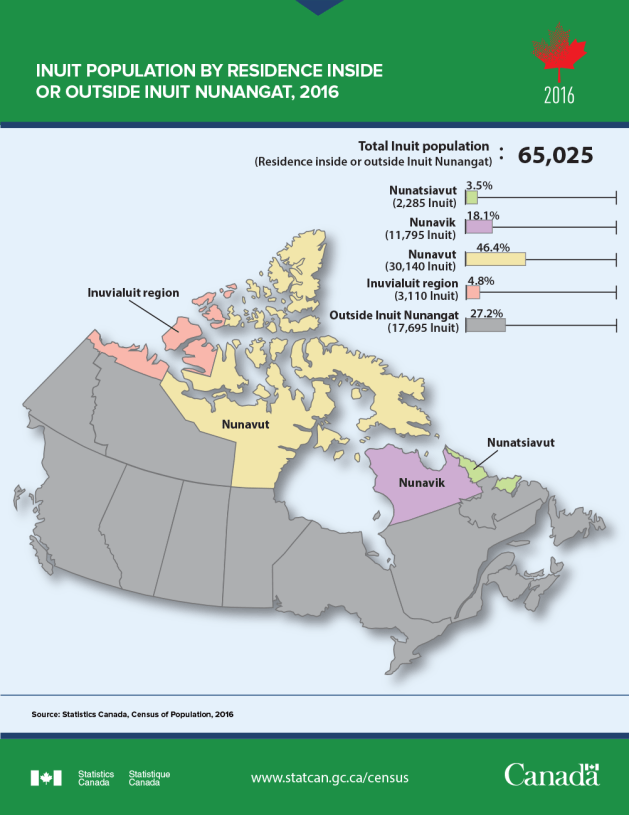
There were 65,025 Inuit in Canada in 2016, up 29.1% from 2006. Close to three-quarters (72.8%) of Inuit lived in Inuit Nunangat.

Map 1  Thumbnail for map 1: Inuit population by residence inside or outside Inuit Nunangat, 2016
Inuit population by residence inside or outside Inuit Nunangat, 2016

Thumbnail for map 1: Inuit population by residence inside or outside Inuit Nunangat, 2016

Among Inuit in Inuit Nunangat, the majority (63.7% or 30,140) lived in Nunavut in 2016, while one-quarter (24.9%) lived in Nunavik, whose communities encircle the western, northern and northeastern coastlines of Quebec. Another 6.6% lived in the Inuvialuit region, which is located in the Western Arctic, while 4.8% lived in the communities of Nunatsiavut, along the northeastern coast of Newfoundland and Labrador.

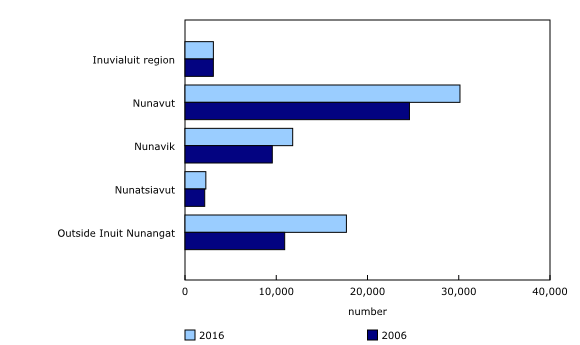
Chart 4  Chart 4: Inuit population by Inuit area of residence, 2006 and 2016
Inuit population by Inuit area of residence, 2006 and 2016

Chart 4: Inuit population by Inuit area of residence, 2006 and 2016

Inuit population growing inside and outside Inuit Nunangat

From 2006 to 2016, the Inuit population grew by 20.1% inside Inuit Nunangat. Outside of Inuit Nunangat, the Inuit population grew by 61.9%.

Among the four regions of Inuit Nunangat, the Inuit population grew the fastest in Nunavik (+23.3%) and Nunavut (+22.5%) over the 10-year period. In Nunatsiavut, the Inuit population grew by 6.0%, while in the Inuvialuit region the population was relatively unchanged.

Outside of Inuit Nunangat, the highest proportion of Inuit lived in the Atlantic provinces (30.6%). Most Inuit in the Atlantic provinces lived in Newfoundland and Labrador (23.5%), which accounted for almost one-quarter of the population of Inuit outside of Inuit Nunangat.

Over one in five Inuit (21.8%) outside of Inuit Nunangat lived in Ontario, while 28.7% lived in the western provinces. Just over 1in 10 (12.1%) lived in Quebec, while 6.8% lived in the Northwest Territories (not including the Inuvialuit region) and Yukon.

Many Inuit, outside of those living in Inuit Nunangat, lived in a city. Outside of Inuit Nunangat, 56.2% of Inuit lived in a metropolitan area of at least 30,000 people. Of Inuit living outside of Inuit Nunangat, the largest Inuit populations were in Ottawa–Gatineau (1,280), Edmonton (1,110) and Montréal (975).

The Aboriginal population living in metropolitan areas is growing

The increase in the urban population of Aboriginal peoples has been taking place for decades in Canada. This change has often been misunderstood simply as the movement by First Nations people away from reserves and into cities. In fact, the First Nations population continues to grow both on and off reserve.

Like the overall population growth of First Nations people, Métis and Inuit, the urbanization of Aboriginal peoples in Canada is due to multiple factors—including demographic growth, mobility and changing patterns of self-reported identity.

In 2016, 867,415 Aboriginal people lived in a metropolitan area of at least 30,000 people, accounting for over half (51.8%) of the total Aboriginal population. From 2006 to 2016, the number of Aboriginal people living in a metropolitan area of this size increased by 59.7%.

The census metropolitan areas (CMAs) of Winnipeg (92,810), Edmonton (76,205), Vancouver (61,460) and Toronto (46,315) had the largest Aboriginal populations. Among all CMAs, Aboriginal people accounted for the highest proportion of the population in Thunder Bay (12.7%), Winnipeg (12.2%) and Saskatoon (10.9%).

Chart 5  Chart 5: Number of First Nations people, Métis and Inuit by selected census metropolitan areas, 2016
Number of First Nations people, Métis and Inuit by selected census metropolitan areas, 2016

Chart 5: Number of First Nations people, Métis and Inuit by selected census metropolitan areas, 2016

The Aboriginal population more than doubled in seven CMAs from 2006 to 2016: St. John’s, Halifax, Moncton, Québec, Saguenay, Sherbrooke and Barrie. Among all CMAs, the Aboriginal population grew the fastest in St. John’s (+237.3%), Halifax (+199.0%) and Moncton (+197.9%).

Over the same period, Aboriginal population growth was slowest in Regina (+26.4%), Winnipeg (+37.1%) and Saskatoon (+45.4%). However, even in Regina, where Aboriginal population growth was the slowest among all CMAs, the Aboriginal population grew at a faster pace than the non-Aboriginal population.

Aboriginal children more likely to live in a family with at least one grandparent

Understanding the characteristics of young children aged 0 to 4 years is important, as early childhood experiences influence not only current but also future well-being.

There were 145,645 Aboriginal children aged 0 to 4 years enumerated in the 2016 Census, accounting for 8.7% of the total Aboriginal population. Of this group, 60.1% lived with two parents.

Just over one-third (34.0%) of Aboriginal children aged 0 to 4 years lived with a lone parent. First Nations children aged 0 to 4 years (38.9%) were the most likely to live with a lone parent, followed by Métis (25.5%) and Inuit (26.5%) children in the same age group. However, many children living with a lone parent also lived with grandparent(s). In 2016, 10.5% of Aboriginal children aged 0 to 4 were living with a lone parent and grandparent(s).

About one in six (17.9%) Aboriginal children aged 0 to 4 lived with grandparent(s) in 2016, either with a parent present or without. Inuit children in this age group were most likely to live with grandparent(s) (22.8%), followed by First Nations (21.2%) and Métis (10.5%) children.

For more information on the family characteristics of young Aboriginal children, see the article “Diverse family characteristics of Aboriginal children aged 0 to 4“.

More than 70 Aboriginal languages reported

Language both shapes and is shaped by the culture to which it belongs. Aboriginal languages—grouped into 12 language families—have been central to the history of First Nations people, Métis and Inuit in Canada and continue to play a vital role to this day.

There is a great diversity of Aboriginal languages in Canada. There were more than 70 distinct Aboriginal languages reported in the 2016 Census, more than 30 of which had at least 500 speakers.

There were 260,550 Aboriginal people who could speak an Aboriginal language in 2016, up 3.1% from 2006.

In general, the number of First Nations people, Métis and Inuit who could speak an Aboriginal language was higher than the number with an Aboriginal mother tongue. This suggests that people are learning an Aboriginal language as a second language.

The article “The Aboriginal languages of First Nations people, Métis and Inuit” contains more information on the diversity of Aboriginal languages in Canada.

Source: The Daily — Aboriginal peoples in Canada: Key results from the 2016 Census
Quebec’s face-covering bill unites rivals who together question the government’s competence: Hébert

Chantal Hébert on the comedy of errors with Bill 62 implementation:

With the law that prescribes that provincial and municipal services be rendered and received with one’s face uncovered, Quebec Premier Philippe Couillard has achieved the impossible. His Liberal government has reconciled the two opposite camps in the Quebec religious accommodation debate behind the notion that it is running a gong show.

A week after the adoption of the controversial law, one would be hard-pressed to find a good word about the just-adopted Bill 62 anywhere in the province’s media.

Even Quebec Liberal party insiders privately admit that they are flabbergasted by the improvisation that has attended the government foray into the religious accommodation minefield.

Over the past few days, Quebec Justice Minister Stéphanie Vallée has offered conflicting interpretations of her own law, convincing critics that she is making up the rules that pertain to its application as she goes along.

Last week for instance, Vallée fended off allegations that her bill was discriminatory by arguing that the obligation to uncover one’s face to board a city bus would apply as equally to transit riders sporting large sunglasses as to the Muslim women who wear the niqab or burqa. They all would have to remove their face coverings for what she described as “the duration of the rendering of the public service.”

On Tuesday, Vallée walked back her talk, insisting that the prescription to uncover one’s face applied only to “interaction” between a citizen and a public servant. On that basis, most people could presumably board a bus or presumably take out a library book without showing their faces.

In Quebec, library cards do not feature photographs. Neither do transit passes except in the case of students and senior citizens who are expected to show proof of age to pay a reduced rate.

In any event, the minister assured that no one would ever be thrown off a bus on account of Bill 62 because — she said — someone who did not comply with the law would be left at the bus stop.

The minister’s convoluted explanations did little to reassure those who feel that the bill is a discriminatory solution in search of a problem. It is estimated that there are less than 300 Muslim women who wear a face-covering veil province-wide.

Moreover, as elsewhere in Canada it is already impossible in Quebec to obtain government-issued ID cards such as a driver’s license or a health card without allowing one’s picture to be taken with one’s face uncovered

Vallée’s latest take on her own bill also confirmed the fears of those who feel it is much too narrow

The PQ opposition is working on a more muscular version of Bill 62. It will feature the imposition of a secular dress code on public servants in positions of authority such as judges or police officers. The party also wants to explore the notion of banning face-covering veils from all public places. A pequiste government would use the notwithstanding clause of the Constitution to shelter its law from the Charter of Rights and Freedoms

The Coalition Avenir Québec also has proposals that go well beyond the Liberal law. Both opposition parties will campaign on their proposals in next fall’s provincial election.

Meanwhile, opponents and proponents of state-enforced restrictions on the rights of religious minorities are united in questioning the competence of the Liberal government.

It is increasingly unclear what constituency Premier Couillard expected to satisfy with the government’s ill-conceived law.

The premier does have a well-documented tendency to political tone-deafness. Earlier this month he seemed surprised and frustrated that a cabinet shuffle that left his ministerial frontline essentially unchanged did not elicit rave reviews about his government sporting a new face.

At the time of the shuffle, Couillard maintained Vallée in her justice role even if she had consistently seemed to be in over her head in that portfolio.

Over the past week there has been a chorus of calls for Bill 62 to be withdrawn in its entirety. It would be pretty unprecedented for a ruling party to shelf a law it has just used its majority to adopt.

Until it is replaced by a government of a different stripe or possibly struck down by a court, Bill 62 will likely remain on the books where it primarily stands as a token of political turpitude.

Source: https://www.thestar.com/news/canada/2017/10/25/quebecs-face-covering-bill-unites-rivals-who-together-question-the-governments-competence-hbert.html

Liberals’ judge selection has new bias, lawyers association says

Some valid concerns regarding diversity of experience and practice – in meeting the needs for  “identity” aspects of diversity, necessary to think also about these other aspects:

After appointing five women and no men to the bench in the Maritimes, the Liberal government is being told its commitment to diversity has a large blind spot – but not over the gender issue.

The Liberal government stressed diversity in launching a new process for appointing judges in October, 2016. For the first time, applicants are being asked about their race, gender identity, Indigenous status, sexual orientation and physical disability. Members of the committees that screen candidates are receiving training in “unconscious bias.”

Three of the five appointees in the Maritimes since then specialized in insurance law when they were lawyers, the Atlantic Provinces Trial Lawyers Association said in an open letter to federal Justice Minister Jody Wilson-Raybould on Wednesday. And all three worked for the same regional law firm, Stewart McKelvey.

“Their background is representing insurance companies in personal injury claims against the average Joe,” said Brian Hebert, president of the Atlantic lawyers association. “We’re hoping this isn’t a trend.”

In Prince Edward Island, six of the eight sitting judges on the Supreme Court and the Court of Appeal are from Stewart McKelvey. The Globe and Mail attempted to reach the managing partner of the firm’s Charlottetown office, and other managing partners, without success.

The Atlantic lawyers’ group represents plaintiffs in personal-injury cases – that is, individuals who in many cases sue insurance companies. “We represent the average person who has to fight insurance companies,” Mr. Hebert said.

“It’s a concern when we see judges being appointed from the same practice background, because we believe that as lawyers, we’re human, we’re influenced by our clients that we serve day-in, day-out, the culture of the firm that we’re in, the type of law that we practice.”

A spokesman for the Justice Minister said that only two of 12 judges appointed in Atlantic Canada since the Liberals took office in 2015 – a slightly different time-frame from the one referred to in the lawyers’ group letter – were, at the time of their appointment, with Stewart McKelvey.

“Minister Wilson-Raybould’s appointments in Atlantic Canada and throughout the country are based entirely on merit,” the spokesman, Dave Taylor, said in an e-mail.

“They respond to the needs of the courts, as identified through close consultation with Chief Justices. … The minister has been proud to appoint such outstanding candidates to the bench, as our government works toward building a judiciary that fully reflects the country it serves.”

Mr. Hebert said the appointees are highly qualified and he is not critical of the quality of appointments. Nor is his group critical of the lack of men appointed under the new process.

Christa Brothers, a former partner at Stewart McKelvey, was appointed to the Supreme Court of Nova Scotia in July; Tracey Clements, a partner at the same firm in Charlottetown, was named to the PEI Supreme Court in March; and Chantal Daigle, who chaired the recruitment office for the Saint John office of Stewart McKelvey from 2013-15, and who became a partner in 2004, was appointed last week to the Family Division of the New Brunswick Court of Queen’s Bench, after a year as case management master of that same court.

The other two appointees were not from law firms. One was a long-time provincial court judge promoted to the appeal court in Nova Scotia and the other was a lawyer from the Antigonish Legal Aid Office named to Nova Scotia’s Supreme Court.

“The reason we want women on the bench,” Mr. Hebert said, “is so that when women’s issues are before the court, or when women appear in court, there is a balancing of views. Same thing with race or other areas where we would want diversity. What we’re saying is the same considerations apply when you’re talking about the professional background of lawyers that are on the bench. There has to be a balance between the large-firm, insurance defence lawyers and other lawyers who are fighting for the rights of plaintiffs.”

In its letter, the association said a more diverse judiciary will bring “varied perspectives to the development of the law and the concept of justice itself.” 

Source: Liberals’ judge selection has new bias, lawyers association says – The Globe and Mail

Antigua & Barbuda To Slash Citizenship Investment Threshold – Investment Immigration

Canadian policies having an impact by reducing the major incentive of visa free travel:

Antigua & Barbuda has seen a dramatic 95 per cent decline in the most popular stream of its citizenship-by-investment program after Canada withdrew visa-free access to passport holders in June 2017.

The Caribbean island will cut the investment threshold for its National Development Fund (NDF) in half – from $200,000 to $100,000 – to try and stimulate interest from high net worth candidates.

A representative of the country’s Citizenship by Investment Unit (CIU) told the country’s Daily Observer newspaper that access to Canada was previously ‘the country’s most compelling advantage’. Without that access, the Antigua citizenship program is left to compete entirely based on investment threshold.

Opposition lawmakers say slashing the threshold will result in the destruction of the program.


Antigua & Barbuda Investor Citizenship: Investment Requirements

National Development Fund One-time investment of US $200,000 (soon to drop to $100,000)
Real Estate US $400,000 in real estate property in Antigua & Barbuda. In case of joint investment, each applicant must contribute a minimum amount of $400,000. The real estate must be held for a period of at least five years.
Business $1,500,000 in an approved business. In case of a joint investment application, the total investment must be for a sum of not less than $5 million with each applicant contributing at least $400,000.

Antigua & Barbuda initially reacted to Canada’s decision by cutting the fee for its program to $25,000 from $50,000 for a family of four.

However, this clearly did not have the required effect.

Ottawa announced on Monday, June 26, 2017 that all citizens of the Caribbean nation would require a visa as of 5.30am on Tuesday, June 27, 2017.

“After carefully monitoring the integrity of Antigua & Barbuda’s travel documents, the government of Canada has determined that Antigua & Barbuda no longer meets Canada’s criteria for a visa exemption,” a Canadian government statement said.

The statement added that Canada needed to protect “the integrity of our immigration system and ensuring the safety of Canadians”.

The move was likely linked to concerns over the integrity of the Antigua and Barbuda Investor Citizenship Program.

The program is one of the cheapest in the region, and effectively meant people could buy their way to visa-free travel into Canada.

Complete Overhaul

Politicians in Antigua & Barbuda called for a complete overhaul of the program following Canada’s move to impose a visa restriction.

The leader of the Caribbean country’s Democratic National Alliance (DNA) says Canada’s decision was a direct result of outside suspicions on how the CIP is operated.

Historically the programs have been viewed as a way for people to hide money, but many of the countries in the region have taken steps to clean up their acts.

DNA leader Joanne Massiah says Antigua & Barbuda is sacrificing the reputation of the country to try and get as much investment as it can from the CIP.

St Kitts Visa Restriction

Canada made a similar move to impose a visa restriction on travellers from St. Kitts & Nevis in 2014.

According to sources, authorities had evidence of people linked to terrorist organizations and criminal gangs buying St. Kitts passports to enter Canada without immigration screening.

Since then, St. Kitts has overhauled its investor residence program, although Canada is yet to lift the visa requirement.

Source: Antigua & Barbuda To Slash Citizenship Investment Threshold – Investment Immigration

The Daily — Immigration and ethnocultural diversity: Key results from the 2016 Census

On Census Day, 21.9% of the population reported they were or had ever been a landed immigrant or permanent resident in Canada. This proportion is close to the 22.3% recorded during the 1921 Census, the highest level since Confederation.

In 2016, Canada had 1,212,075 new immigrants who had permanently settled in Canada from 2011 to 2016. These recent immigrants represented 3.5% of Canada’s total population in 2016.

The majority (60.3%) of these new immigrants were admitted under the economic category, 26.8% were admitted under the family class to join family already in the country, and 11.6% were admitted to Canada as refugees.

For the first time, Africa ranks second, ahead of Europe, as a source continent of recent immigrants to Canada, with a share of 13.4% in 2016. Asia (including the Middle East) remains, however, the top source continent of recent immigrants. In 2016, the majority (61.8%) of newcomers were born in Asia.

Toronto, Vancouver and Montréal are still the place of residence of over half of all immigrants and recent immigrants to Canada. More immigrants are settling in the Prairies and in the Atlantic provinces.

In addition to contributing to the social and economic development of the country, immigrants and their descendants play a significant role in shaping and enriching the ethnic, cultural and linguistic composition of the Canadian population. The 2016 Census results released today show the various facets of diversity in Canada.

More than one in five Canadians are foreign-born

According to the 2016 Census, there were 7,540,830 foreign-born individuals who came to Canada through the immigration process, representing over one-fifth (21.9%) of Canada’s total population. This proportion is close to the 22.3% recorded during the 1921 Census, the highest level since Confederation.

The proportion of the foreign-born population was much lower from 1951 to 1991, when it ranged from 14.7% to 16.1%. Since then, this proportion has been continually rising, to 19.8% in the 2006 Census and 20.6% in the 2011 National Household Survey.

This increasing share is due to the large number of immigrants admitted into Canada each year, the gradual rise in the number of deaths and the relatively low fertility levels in Canada.

According to Statistics Canada’s population projections, the proportion of Canada’s foreign-born population could reach between 24.5% and 30.0% by 2036.

Figure 1: Number and proportion of foreign-born population in Canada, 1871 to 2036

About 6 in 10 recent immigrants were admitted under the economic category

With the 2016 Census, it is now possible to classify immigrants admitted to Canada since 1980 by various admission categories.

In Canada, immigrants are selected based on three main objectives: to enhance and promote economic development; to reunite families; and to fulfill the country’s international obligations and uphold its humanitarian tradition.

Among recent immigrants living in Canada in 2016, approximately 6 in 10 were admitted under the economic category, when principal applicants, spouses and dependants were taken into account. Almost half (48.0%) of recent economic immigrants were admitted through the skilled workers program and more than a quarter (27.3%) under the provincial and territorial nominees program.

Furthermore, nearly 3 in 10 recent immigrants were admitted under the family class to join family already in the country, and approximately 1 in 10 recent immigrants were admitted to Canada as refugees.

Refugees accounted for a higher proportion (24.1%) of immigrants admitted from January 1 to May 10, 2016, as a result of the many Syrian refugees who landed during this period.

The situation is different for immigrants who were admitted during the 1980s and were still living in Canada in 2016. A smaller proportion were economic immigrants: 4 in 10 immigrants were admitted under this category, while over 3 in 10 immigrants were sponsored by family, and approximately 2 in 10 immigrants were refugees.

Figure 2: Distribution (in percentage) of immigrants living in Canada, by admission category and year of immigration, 2016

Additional information is available in the infographic “Gateways to Immigration in Canada” as well as in data products and reference products.

More immigrants are settling in the Prairies

Over the past 15 years, the share of recent immigrants in the Prairie provinces has more than doubled. The percentage of new immigrants living in Alberta rose from 6.9% in 2001 to 17.1% in 2016, a higher share than in British Columbia (14.5%). In Manitoba, the percentage increased from 1.8% to 5.2% during the same period. Saskatchewan’s share also grew, from just under 1.0% in 2001 to 4.0% in 2016.

In 2016, the Atlantic provinces were home to 2.3% of all recent immigrants in Canada. Each of the Atlantic provinces received its largest number of new immigrants, which more than doubled the share of recent immigrants in this region in 15 years.

Ontario, Canada’s most populous province and the place of residence of most of the country’s immigrants, received 39.0% of recent immigrants in 2016. This share decreased from 55.9% in 2001.

British Columbia also saw its share of recent immigrants decrease over the past 15 years, from 19.9% in 2001 to 14.5% in 2016.

In 2016, 17.8% of recent immigrants lived in Quebec, a higher share than in 2006 (17.5%) and in 2001 (13.7%). Overall, Quebec had the second highest number of recent immigrants in 2016, after Ontario.

The territories had the fewest number of recent immigrants. In 2016, 2,100 newcomers, or 0.2% of all recent immigrants, settled in the territories.

Several factors can explain changes in the geographic distribution of new immigrants. For example, certain provinces received a large number of immigrants under the Provincial and Territorial Nominee Program: over 50% of recent immigrants living in Prince Edward Island, New Brunswick, Manitoba, Saskatchewan and Yukon were admitted under this program. At the national level, 16.4% of all recent immigrants were admitted under this program.

Moreover, many new immigrants chose to settle in areas with an established community from their home country.

The economic conditions in the various receiving regions undoubtedly played a major role in the geographic distribution of immigrants. According to the Labour Force Survey, Alberta had the largest employment growth from 2011 to 2016 (+7.8%) compared with the national average (+5.0%).

Figure 3: Distribution (in percentage) of recent immigrants in Canada, by provinces and territories, 1981 to 2016

Census metropolitan areas in the Prairies receiving a higher share of recent immigrants

In 2016, the Regina, Winnipeg, Calgary, Saskatoon and Edmonton census metropolitan areas (CMAs) were the place of residence of a share of recent immigrants that was almost twice that of each CMA‘s share of the total population in Canada. For example, 4.3% of new immigrants settled in Winnipeg, while 2.2% of Canada’s total population lived in this CMA.

Nevertheless, Toronto, Vancouver and Montréal, the three most populous CMAs in the country, together are still the place of residence of over half of all immigrants (61.4%) and recent immigrants (56.0%) in Canada. In comparison, just over one-third (35.7%) of Canada’s total population lived in these three CMAs.

In 2016, immigrants represented 46.1% of Toronto’s population, 40.8% of Vancouver’s and 23.4% of Montréal’s.

For the first time, Africa accounts for the second largest source continent of recent immigrants

In 2016, 13.4% of recent immigrants were born in Africa, a four-fold increase from the 1971 Census (3.2%). Africa thus ranked second, ahead of Europe, as a source continent of recent immigrants to Canada.

Nigeria, Algeria, Egypt, Morocco and Cameroon were the top five countries of birth of recent African-born immigrants in 2016.

As a result of shifts in Canada’s immigration policies and various international events relating to movements of migrants and refugees, the percentage of recent immigrants born in Europe has decreased from one census to the next, falling from 61.6% in 1971 to 16.1% in 2006 and to 11.6% in 2016.

Asia (including the Middle East) remained the top source continent of recent immigrants. The majority (61.8%) of newcomers to Canada from 2011 to 2016 were born in Asia. This is a slightly higher proportion than was observed in the 2006 Census (58.3%) and in the 2011 National Household Survey (56.9%).

Asian countries accounted for 7 of the top 10 countries of birth of recent immigrants in 2016: the Philippines, India, China, Iran, Pakistan, Syria and South Korea.

Newcomers from the Americas and Oceania represented 12.6% and 0.7%, respectively, of recent immigrants to Canada.

Almost half of the foreign-born population is from Asia

Changes in the main source countries of immigrants have transformed the overall portrait of Canada’s foreign-born population. In 2016, almost half (48.1%) of the foreign-born population was born in Asia (including the Middle East), while a lower proportion (27.7%) was born in Europe.

Furthermore, African-born immigrants represented a growing share of the foreign-born population, increasing from 1.4% in the 1971 Census to 8.5% in the 2016 Census.

In 1871, in the first census held after Confederation, the foreign-born population was mainly from the British Isles (83.6%).

One hundred years later, the 1971 Census showed that individuals born in the British Isles still accounted for the largest group of foreign-born population, but their share had decreased significantly to 29.5%. The majority of the foreign-born population were from other European countries and the United States, while 10.9% of foreign-born were from other parts of the world.

Current immigration trends—if they continue—and the aging of established cohorts of immigrants mean that from 55.7% to 57.9% of all immigrants would be born in Asia by 2036, and from 15.4% to 17.8% would be born in Europe. The proportion of immigrants born in Africa is projected to increase to between 11.0% and 11.9% in 2036.

Figure 4: Distribution of foreign-born population, by region of birth, Canada, 1871 to 2036

More information on recent and past trends with regard to immigration to Canada is available in the video “Welcome to Canada: 150 Years of Immigration” and in the infographic “Immigrant population in Canada“, as well as in various immigration data products.

Two in five Canadian children have an immigrant background

First- and second-generation children of immigrants contribute to the renewal of the population and to the diversity of Canada’s population.

According to the 2016 Census, almost 2.2 million children under the age of 15 were foreign-born (first generation) or had at least one foreign-born parent (second generation), representing 37.5% of all Canadian children. This is an increase from 2011, when this proportion was 34.6%. This population of children with an immigrant background could continue to grow and could represent from 39.3% to 49.1% of children under the age of 15 by 2036.

In 2016, the majority (74.0%) of these first- or second-generation children were from countries of ancestry in Asia, Africa, the Caribbean and Bermuda, Central and South America.

For more information, please see the document entitled “Children with an immigrant background: Bridging cultures” from the Census in Brief series.

The vast majority of immigrants report being able to conduct a conversation in English or French

The language composition of immigrants has changed over the past 100 years. The percentage of immigrants with English or French as a mother tongue decreased from 71.2% in 1921 to 27.5% in 2016, mirroring changes in the source countries of immigrants over the same period. Overall, statistics are presented on about 200 languages for the 2016 Census.

English and French remain the languages of convergence and integration into Canadian society. In 2016, the vast majority of the 7.5 million immigrants (93.2%) were able to conduct a conversation in English or in French. This means that only 6.8% of immigrants reported not being able to conduct a conversation either in English or in French.

More detailed analyses of immigrants and language are available in the document “Linguistic integration of immigrants and official language populations in Canada” in the Census in Brief series.

Over 250 ethnic origins

Past and recent sources of immigration have strongly influenced the current ethnic and cultural make-up of Canada’s population.

Many ethnic origins were reported in the 2016 Census. The list of origins includes different groups associated with Aboriginal peoples. It also includes European groups that first settled in Canada, as well as various groups that subsequently settled in this country. Overall, statistics are available for over 250 ethnic origins.

More detailed analyses are included in the document on “Ethnic and cultural origins of Canadians: Portrait of a rich heritage” from the Census in Brief series.

Growth of the visible minority population

The increase in the number of immigrants from non-European countries, as well as their children and grandchildren born in Canada, has contributed to the growth of the visible minority population in Canada.

In 2016, 7,674,580 individuals were identified as belonging to the visible minority population as defined by the Employment Equity Act. They represented more than one-fifth (22.3%) of Canada’s population. Of this number, 3 in 10 were born in Canada.

The visible minority population has grown steadily since the 1981 Census, when data for the four Employment Equity groups (women, Aboriginal peoples, visible minorities and persons with disabilities) were first derived. At that time, the 1.1 million people belonging to a visible minority represented 4.7% of the total Canadian population.

If current trends continue, the visible minority population would continue to grow and could represent between 31.2% and 35.9% of the Canadian population by 2036.

Figure 5: Number and proportion of visible minority population in Canada, 1981 to 2036

The visible minority population is made up of a number of groups, which themselves are diversified in many respects.

South Asians, Chinese and Blacks were the three largest visible minority groups, each with a population exceeding one million.

According to the 2016 Census, 1,924,635 people reported being South Asian, representing one-quarter (25.1%) of the visible minority population and 5.6% of the entire Canadian population.

Chinese was the second largest visible minority group, with 1,577,060 individuals, representing 20.5% of the visible minority population.

The Black population in Canada surpassed the one-million mark for the first time in 2016. This visible minority group, the third largest in terms of number, comprised 1,198,540 individuals (15.6% of the visible minority population) in 2016, compared with 945,670 in 2011.

The fourth and fifth largest visible minority groups, Filipinos and Arabs, almost doubled their numbers in 10 years and had the highest growth rates among visible minority groups from 2006 to 2016.

They were followed by Latin Americans, Southeast Asians, West Asians, Koreans and Japanese.

Source: The Daily — Immigration and ethnocultural diversity: Key results from the 2016 Census

M-103 committee hears calls for better data and a definition of Islamophobia

Nice to see the Post addressing its previous lack of balance in its coverage of the M-103 hearings. And most of the recommendations mentioned below are reasonable and innocuous, unlike some of the earlier fear mongering:

Better hate crime data, more training for law enforcement and a clear definition of Islamophobia are some of the recommendations the House of Commons heritage committee has heard most frequently as part of its racism and religious discrimination study required by Motion 103.

The anti-Islamophobia motion M-103 touched off a firestorm of controversy en route to its passage in March. Put forward by Liberal MP Iqra Khalid, it asked the government to “recognize the need to quell the increasing public climate of hate and fear.” Though it is not a law, critics have claimed it will lead to the stifling of free speech by preventing people from criticizing Islam.

Many of the recommendations heard by the heritage committee this fall amount to little more than calls for better education and more support for victims of hate crimes.

Witnesses testifying before the committee have repeatedly raised the lack of data on racism and hate crimes, calling it a significant problem. In June, Statistics Canada reported that hate crimes targeting the Muslim population had increased by 61 per cent between 2014 and 2015, and that hate crimes overall had increased by five per cent. But the agency also noted that the reported data “likely undercounts the true extent of hate crime in Canada, as not all crimes are reported to police.”

Last week, the Centre for Israel and Jewish Affairs (CIJA) testified that the collection of hate-crime data “varies widely by police department,” and urged the federal government to “establish uniform, national guidelines and standards.”

On Monday, Serah Gazali of Frog Hollow Neighbourhood House, a community organization in Vancouver, said Canadians also need better education about their rights and their options for reporting hate crimes. “I think (victims) talk about it within themselves and perhaps it’s normalized,” she said. “So they don’t think of it as something that needs to be really addressed.”

Other witnesses have called for police officers to receive more training about how to deal with victims reporting such crimes.

Some have also argued that Canada’s existing hate-crime laws must be strengthened or better enforced.

“Federal government resources should be allocated to support the development of dedicated local police hate-crime units,” CIJA CEO Shimon Fogel included among his recommendations to the committee. “These units have been integrated into several police services across Canada, and have constituted an unmitigated success.”

The delegation from Frog Hollow Neighbourhood House, which was presenting recommendations from a community round-table organized with help from NDP MP Jenny Kwan, said the government “should strengthen laws against hate speech and crimes by providing a much more clear and inclusive definition of hate crime and Islamophobia.”

Witnesses throughout the hearings have suggested that Islamophobia, the term at the heart of the motion, needs to be better defined. “The term Islamophobia has been defined in multiple ways, some effective and some problematic,” Fogel argued. “Unfortunately, it has become a lightning rod for controversy, distracting from other important issues at hand.”

On Monday, Gazali went further, suggesting that Islamophobia should explicitly be criminalized. The Criminal Code of Canada currently forbids the public incitement or promotion of hatred “against any identifiable group,” and the Canadian Human Rights Act prohibits discrimination on grounds including race, national or ethnic origin and religion.

Since the hearings began last month, a number of witnesses have recommended an updated national action plan against racism, similar to a plan released in March by Ontario. The federal government first released its own action plan in 2005, but Shalini Konanur, executive director of the South Asian Legal Clinic of Ontario, said the old plan is “too general.” [Note: the previous action plan, CAPAR, was largely symbolic, with the one meaningful initiative being the collection of police-reported hate crimes data.]

The Ontario plan, she said, targets four pillars: Islamophobia, anti-black racism, Indigenous racism and anti-Semitism. “Within those four pillars, there are very clearly identified targets for what the government hopes to do within the next five years,” she told the committee in September.

Education and employment are other areas where action is needed, according to some witnesses. Ayse Akinturk, an executive with the Muslim Association of Newfoundland and Labrador, pointed to the challenges many immigrants encounter in trying to work as professionals in Canada. “I think recognition of foreign credentials, international credentials should become a much facilitated procedure,” she said Monday. “It takes really a lot of effort and years, at the end of which people give up and try to find other solutions to make a living for themselves.”

Others have recommended mandatory anti-racism training for government employees, and that Ottawa should work with the provinces to improve childhood education on diversity and multiculturalism.

In recognition of a shooting at a mosque in Quebec City that left six people dead earlier this year, Ihsaan Gardee, executive director of the National Council of Canadian Muslims, recommended that Jan. 29 be declared a “national day of remembrance and action on Islamophobia in Canada.”

Source: National Post

Political typology: Race and discrimination, opinions about immigrants and Islam | Pew Research Center

As always, Pew’s findings, broken down by political leaning, are of interest and highlight just how divided the United States is on these issues:

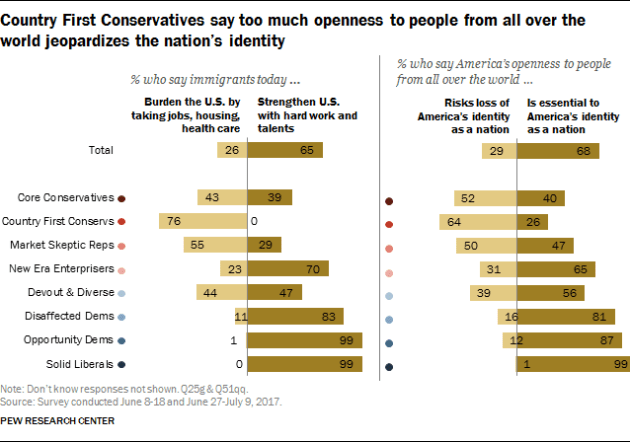
Views of immigrants and nation’s ‘openness’

When it comes to attitudes about immigration, Democratic-leaning groups hold almost universally positive attitudes toward immigrants and support the idea of America being open to people from all over the world. Virtually all Solid Liberals say that immigrants strengthen the society and that openness is “essential” to America’s identity as a nation (99% each).

The only group on the political left that holds ambivalent views of immigrants is Devout and Diverse, a group that is racially and ethnically diverse and also has the lowest family incomes and levels of educational attainment of any typology group.

The Republican-leaning groups are sharply divided in views of immigrants and the nation’s openness to people from around the world. About three-quarters of Country First Conservatives (76%) say immigrants are a burden on the country – the largest share of any typology group. Country First Conservatives also are most likely to say that the U.S. risks losing its identity as a nation if it is too open to people from around the world (64% say this).

Compared with Country First Conservatives, Core Conservatives and Market Skeptic Republicans have more divided views of immigrants and whether too much openness risks the nation’s identity. New Era Enterprisers have the most positive views among Republican-leaning groups: 70% view immigrants as a strength and 65% say America’s openness is “essential to who we are as a nation.”

Islam and violence

A large majority of Core Conservatives (79%) say Islam is more likely than other religions to encourage violence among its followers.

And roughly the same percentage of Solid Liberals (83%) say Islam does not encourage violence more than other religions.

The views of other typology groups divide along partisan lines, with one exception. As with views of immigration, Devout and Diverse differ from other Democratic-leaning groups in their views of Islam and violence.

Devout and Diverse are divided – 47% say Islam is more likely to encourage violence, 44% say it is not – while sizable majorities in other Democratic groups say Islam does not encourage violence more than other religions.

Catholic school sex education plan won’t be taught if it arrives as advertised: Notley

After Ontario, now Alberta has the sex education battles:

Alberta Premier Rachel Notley says an alternative sex education curriculum being crafted by Catholic school officials will never be taught if it arrives as previously advertised.

In an interview with The Canadian Press, Notley says the health and well-being of students comes first.

“Nowhere do the rights of religious freedom extend to that person’s right to somehow attack or hurt others – and that’s what’s happening here,” Notley said Tuesday. “We will not use public dollars to have sexual health programs that deny science, that deny evidence, and that deny human rights.

“They can continue to work on (the proposal) all they want, but we ultimately approve the curriculum that goes into schools – and this kind of curriculum will not happen.”

Karl Germann, president of the Council of Catholic School Superintendents of Alberta, could not be reached for comment.

The Alberta government is currently rewriting teaching plans across the board for kindergarten to Grade 12.

Catholic school superintendents are crafting an alternative sex education curriculum that they want the province to approve for their schools.

They say the government’s teaching plan clashes with faith-based instruction by including, among other topics, homosexual relationships and gender identity different from one’s biological sex.

In documents filed with the province, the superintendents also take issue with sexual consent by a partner in marriage. They say it is only one of many factors to be considered along with morality, family and wellness.

Notley said consent is paramount and there is no debate.

“Consent is the law in Alberta and under no circumstances will any child in Alberta be taught that they have to somehow accept illegal behaviour in a sexual relationship. The end.”

Notley said her government respects the role of parental choice in education.

“Parents have the right – and they have had the right for a very, very long time – to pull their kids from curriculum and education around sexual health. And they will continue to have that right,” she said.

“But under no circumstances will we enforce or condone a sexual health curriculum that normalizes an absence of consent, refuses to talk about contraception and other things that protect the health of sexually active young people, or in any way marginalizes sexual minorities. That’s not on.”

Education Minister David Eggen echoed Notley’s remarks, particularly around consent.

“There’s no (room for) negotiation for that, I can tell you,” Eggen said in Calgary Tuesday. “Teaching consent is a basic health and safety issue for students in regards to sexuality, and it needs to be strengthened if anything.”

Notley’s government plans to introduce legislation in the fall legislature sitting to strengthen protections for minority students.

It would compel all schools that receive public money to establish anti-discrimination codes of conduct, adopt policies to protect LGBTQ students, and to affirm students’ legal right to set up gay-straight alliances.

Eggen has said many schools have been working with the province on such rules, but 20 of them, mostly private institutions, have been resisting.

Private schools get 70 per cent of their funding from the government.

Eggen has said the bill is also aimed at blunting a proposal from United Conservative leadership candidate Jason Kenney that school officials tell parents when their children join a gay-straight alliance, so long as it doesn’t bring harm to the youngster.

Advocates say there is no way to be sure that a child wouldn’t be ostracized or face harm. Eggen said the legislation will make it clear the decision remains with the student.

Source: Catholic school sex education plan won’t be taught if it arrives as advertised: Notley – The Globe and Mail

I will return Saudi Arabia to moderate Islam, says crown prince | World news | The Guardian

An ambitious cultural transformation. Long needed but hard to underestimate the likely resistance to change among some. And unclear whether it will extend to their promotion of Salafism/Wahabism abroad.

The reference to a return to “moderate Islam” is somewhat questionable; when I lived there, about 30 years ago, it was anything but moderate and the mutawa (religious police) had a pretty free hand:

Saudi Arabia’s crown prince, Mohammed bin Salman, has vowed to return the country to “moderate Islam” and asked for global support to transform the hardline kingdom into an open society that empowers citizens and lures investors.

In an interview with the Guardian, the powerful heir to the Saudi throne said the ultra-conservative state had been “not normal” for the past 30 years, blaming rigid doctrines that have governed society in a reaction to the Iranian revolution, which successive leaders “didn’t know how to deal with”.

Expanding on comments he made at an investment conference at which he announced the launch of an ambitious $500bn (£381bn) independent economic zone straddling Saudi Arabia, Jordan and Egypt, Prince Mohammed said: “We are a G20 country. One of the biggest world economies. We’re in the middle of three continents. Changing Saudi Arabia for the better means helping the region and changing the world. So this is what we are trying to do here. And we hope we get support from everyone.

“What happened in the last 30 years is not Saudi Arabia. What happened in the region in the last 30 years is not the Middle East. After the Iranian revolution in 1979, people wanted to copy this model in different countries, one of them is Saudi Arabia. We didn’t know how to deal with it. And the problem spread all over the world. Now is the time to get rid of it.”

Earlier Prince Mohammed had said: “We are simply reverting to what we followed – a moderate Islam open to the world and all religions. 70% of the Saudis are younger than 30, honestly we won’t waste 30 years of our life combating extremist thoughts, we will destroy them now and immediately.”

The crown prince’s comments are the most emphatic he has made during a six-month reform programme that has tabled cultural reforms and economic incentives unimaginable during recent decades, during which the kingdom has been accused of promoting a brand of Islam that underwrote extremism.

The comments were made as the heir of the incumbent monarch moves to consolidate his authority, sidelining clerics whom he believes have failed to support him and demanding unquestioning loyalty from senior officials whom he has entrusted to drive a 15-year reform programme that aims to overhaul most aspects of life in Saudi Arabia.

Central to the reforms has been the breaking of an alliance between hardline clerics who have long defined the national character and the House of Saud, which has run affairs of state. The changes have tackled head-on societal taboos such as the recently rescinded ban on women driving, as well as scaling back guardianship laws that restrict women’s roles and establishing an Islamic centre tasked with certifying the sayings of the prophet Muhammed.

The scale and scope of the reforms has been unprecedented in the country’s modern history and concerns remain that a deeply conservative base will oppose what is effectively a cultural revolution – and that the kingdom lacks the capacity to follow through on its economic ambitions.

The new economic zone is to be established on 470km of the Red Sea coast, in a tourist area that has already been earmarked as a liberal hub akin to Dubai, where male and female bathers are free to mingle.

It has been unveiled as the centrepiece of efforts to turn the kingdom away from a near total dependence on oil and into a diverse open economy. Obstacles remain: an entrenched poor work ethic, a crippling regulatory environment and a general reluctance to change.

“Economic transformation is important but equally essential is social transformation,” said one of the country’s leading businessmen. “You cannot achieve one without the other. The speed of social transformation is key. It has to be manageable.”

Alcohol, cinemas and theatres are still banned in the kingdom and mingling between unrelated men and women remains frowned upon. However Saudi Arabia – an absolute monarchy – has clipped the wings of the once-feared religious police, who no longer have powers to arrest and are seen to be falling in line with the new regime.

Economically Saudi Arabia will need huge resources if it is to succeed in putting its economy on a new footing and its leadership believes it will fail to generate strategic investments if it does not also table broad social reforms.

Prince Mohammed had repeatedly insisted that without establishing a new social contract between citizen and state, economic rehabilitation would fail. “This is about giving kids a social life,” said a senior Saudi royal figure. “Entertainment needs to be an option for them. They are bored and resentful. A woman needs to be able to drive herself to work. Without that we are all doomed. Everyone knows that – except the people in small towns. But they will learn.”

In the next 10 years, at least five million Saudis are likely to enter the country’s workforce, posing a huge problem for officials who currently do not have jobs to offer them or tangible plans to generate employment.

The economic zone is due to be completed by 2025 – five years before the current cap on the reform programme – and is to be powered by wind and solar energy, according to its founders.

The country’s enormous sovereign wealth fund is intended to be a key backer of the independent zone. It currently has $230bn under management. The sale of 5% of the world’s largest company, Aramco, is expected to raise several hundred billion dollars more.

Source: I will return Saudi Arabia to moderate Islam, says crown prince | World news | The Guardian

Why Quebec’s Bill 62 is an indefensible mess: Wells

Another great analysis and critique by Paul Wells, going through the issues one-by-one:

Before we begin: Look, I’m one of the good anglos, the ones who’ve lived in Quebec (largely in French) (and enjoyed it), understand at least some of its distinct ways and can recite at least some of the catechism by heart. In this July column I walked readers through the Quiet Revolution and its revolt against the dominance of the Roman Catholic church, to help explain why attitudes toward so-called ostentatious religious signs are often different there. “The Quiet Revolution in Quebec was specifically a rebellion against religious influence,” I wrote then. “Progressive politics in many other parts of the country has been a politics of generalized tolerance; in Quebec progressive politics was often a politics of specific resistance.”

That column won respectful comments from many in Quebec and a long Reddit thread of the imagine-finding-something-so-reasonable-in-Maclean’s-of-all-places variety, along with heaps of scorn from some anglophone colleagues. Chris Selley at the National Post is still subtweeting.

Anyway, having thus re-established my credentials, I’m here to tell you that Bill 62, the so-called “Act to foster adherence to State religious neutrality,” is a ludicrous claptrap that the government of Philippe Couillard should withdraw before it collapses in court under the weight of its own absurdity. Here’s why.

The bill ostracizes behaviour that isn’t religious. Obviously inspired, or provoked, by the face coverings worn by a tiny number of women in Quebec who profess the Muslim faith, the bill hasn’t the guts to say, “Muslim women shouldn’t cover their face.” So it says instead that nobody may cover their face. “Personnel members of bodies must exercise their functions with their face uncovered, unless they have to cover their face, in particular because of their working conditions or because of occupational or task-related requirements,” the bill says. “Similarly, persons receiving services from such personnel members must have their face uncovered.”

This means, as we’ve seen, that if you cover your face for any reason except workplace safety, you can’t do work for the Quebec government—or receive its services—for the duration of the covering. The justice minister, Stéphanie Vallée, has said that this extends to sunglasses. Surely scarves, ski hats and beards are a no-no too. All of which is odd, because this is supposed to be about religious neutrality—it says so right there in the bill’s title—and yet no provision restricts any specifically religious behaviour or garb.

It permits all sorts of religious behaviour. Since the bill limits only face covering, it establishes no prohibition against public servants wearing crucifixes, turbans, kippehs or indeed any Muslim-associated garment short of a veil. So in seeking to establish “religious neutrality,” it forbids things that aren’t religious and has no effect on a wide range of things that are. Faut le faire, as we say.

It tells a lie about Quebec. The bill’s tiny number of supporters—almost all of whom say it is insufficient in itself but that it serves as a kind of handy limbering-up exercise for the really repressive anti-headgear measures that must follow—purport that it is valuable because it reminds everyone that state actors must refrain from identifying their religion, because “the State has no religion.”

But the State isn’t Leviathan, the aggregate total of all human activity on its behalf. In a modern democracy, the State is plural. The state isn’t colourless: it has the skin of whichever bus driver or file clerk you’re talking to at the moment. It isn’t dimensionless: it is as tall or short as the judge or cop you’re facing. It isn’t even devoid of political opinion, for its members are free to vote. And it isn’t faithless in retail, only wholesale. While the Quebec government has no established religion—never mind the crucifix over the Speaker’s chair in the National Assembly, it’s just there for dramatic irony—its employees are, of course, free to turn toward whatever deity they dread or cherish, or to ignore them all.

What they aren’t supposed to do, of course, is impose their religion on others. But that leads me to the bill’s worst outrage:

It reintroduces the coercive State. If the best (and still none too good) argument for Bill 62 is that “the State has no religion,” then it is absurdly out of bounds for the bill to dictate how the citizen must behave in her interactions with the government, on vaguely, passively-aggressively half-assed religious grounds. Even if every public servant in Quebec were made to read the collected works of Richard Dawkins, spayed or neutered, chopped or stretched to measure, issued the regulation skin tone, accent, wardrobe and whatever else were necessary to telegraph the State’s neutrality on a hundred relevant axes of faith, appearance, socio-economic status and whatnot else—even if you stipulate that the State may do that to its own emissaries, then it’s still really weird for the State to require an equivalent neutrality of the citizen.

Here we see Bill 62 dipping into the territory Richard Hofstadter described in his classic essay The Paranoid Style in American Politics: the odd propensity of groups to imitate, unconsciously, the behaviour they most despise in the opposing groups they fear or target. Hofstadter was describing anti-Communist groups in the Cold War United States, imposing the same secrecy, rigid organization and even penchant for falsification that they feared in Stalinism. But Hofstadter specified that the instinct was owned by neither the left nor the right, and that it wasn’t restricted only to Cold War contexts. The paranoid style is easy to spot in all kinds of contexts where people worry too much.

What’s wrong with Islam, after all? The Couillard government’s response comes in layers: (i) nothing, which is why the bill doesn’t name Islam; (ii) terrorism, though of course, most Muslims shun and hate terrorism, and at any rate, wearing a niqab on the bus has nothing to do with terrorism, so never mind; (iii) coercion—in this case, the belief that some women wear certain clothes because they know men who require it. Well, ain’t it the damnedest thing, then, that Bill 62 seeks to fight coercion with coercion. A singularly time-limited, bashful, unevenly applied, hypocritical coercion, but coercion all the same. Orwell said some things are so stupid only an intellectual could believe them. Similarly, some things are so reminiscent of the overweening Catholic Quebec state of the mid-20th century that only in the name of purging such authority could anyone dream them up.

The fear at the root of bills like C-62 and the substantially more odious Parti Québécois Charter of Quebec Values is that noxious ideas will spread: that the most backward and extreme interpretations of Islam will win converts simply by being permitted to exist. But that’s silly. There’s no perceptible rate of conversion to Judaism in Outremont simply because a lot of Hasidim live there. Muslims don’t make me Muslim by standing near me.

If the State has no religion, then the simplest way to express this principle—after unscrewing the crucifix from the National Assembly’s rear wall—is to forbid the active promotion of religion while on the taxpayer dime. Proselytizing, in other words. If the guy at the SAQ folds religious tracts in with your wine receipt, it’s okay for the government to say that’s a no-no. If your Jewish or Muslim doctor tries to trade a hernia operation for a conversion, that could be seen as going a step too far, and appropriately sanctioned. That all of this sounds ridiculous, because of course there is no doctor or liquor sales clerk who acts like that, is simply further evidence that there is no real problem here to solve.

The Quebec Liberal Party could have been the one to say so. But a characteristic of the Quebec Liberal Party, going back decades, is that it keeps forgetting that a “Quebec consensus” exists only to the extent that every player in the society’s elite chooses to play. On religious accommodations as on various elements of the national unity debate, if courageous leaders would simply say, “I disagree,” there would therefore be no consensus.

The Couillard government having failed to do so, it has fallen to just about every serious commentator in Quebec to point out Bill C-62’s obvious incoherence.  Many are doing it in a curious two-step: the bill is terrible, but isn’t it awful that those obtuse anglophones outside Quebec, with their worship of multiculturalism, don’t understand it. We are reminded that France has laws similar to Bill C-62. As if comparison were justification. As if any element of France’s relations between Muslims and the non-Muslim majority were worth copying. The enclaves where communities rarely mingle? The very low rate of integration?

Bill C-62 deserves criticism because it is a terrible bill. Its title doesn’t match its contents, it permits and forbids things with no logic, it would lead to a government whose actions would be less just and less coherent than they already are. I don’t associate sloppy work with any ideal of Quebec, and I’m surprised that some of the province’s politicians and commentators think anyone should.

Source: Why Quebec’s Bill 62 is an indefensible mess – Macleans.ca