Canada should welcome up to 30,000 DACA young people facing deportation in U.S. – Senator Omidvar

As long as they come through the regular immigration program, meet the requirements, and are part of current levels, suspect most Canadians would be comfortable with accepting Dreamers:

Canada could gain from the Trump administration’s decision to end a program that has allowed young, undocumented immigrants to remain in the United States for years, says Ontario Independent Sen. Ratna Omidvar.

In an interview on CBC News Network’s Power & Politics, Omidvar said the program’s beneficiaries are precisely the kind of immigrants Canada should be pursuing for its economic migrant program.

“These individuals are low-hanging fruit for us,” Omidvar told host Rosemary Barton. “They speak fluent English, they’ve been educated in the U.S., most of them have been to college or university, some of them have work experience. They understand the North American working culture.”

“On top of that, in order to qualify to be a ‘Dreamer’ you have to have biometrics testing, you have to have a criminality check. So this is America’s loss but it could be Canada’s gain.”

People who reside in the U.S. under this program are often called “Dreamers” after the Development, Relief and Education for Alien Minors Act (DREAM). The bill was crafted to help those brought to the U.S. as children by allowing them to live there providing they graduate from school and have no criminal record.

The act has been struggling to become law since 2001, and has often seemed close to bipartisan success. But in recent years more Republicans have turned against it.

The estimated 800,000 young people who migrated to the U.S. illegally with their parents and are now living there under the DACA program face deportation to a country they now have little connection with, after U.S. Attorney General Jeff Sessions announced Tuesday the Trump administration would rescind DACA.

Omidvar proposes that Canada give “special consideration” to 10,000 to 30,000 of these young people either through the existing economic stream or as international students.

An opportunity for Canada

“We know that international students have already been identified by our system as priorities for permanent residency,” said Omidvar. “And in truth, we have not done so well in turning an aspiration into a reality because most international students still choose to go back.

“So, here are people who could apply for international student programs. Universities and colleges could come up with some special initiative or special outreach — college-to-college, university-to-university — maybe even a special scholarship program. But over time, they would be top of the line for economic integration,” Omidvar added.

While Omidvar is sensitive to the fact that Canada is in the midst of complex trade negotiations with both the U.S. and Mexico (the country of origin for many DACA young people) she says if Canada fails to reach out, other countries could reap the benefits:

“Just as this is an opportunity for Canada, it is also an opportunity for other countries — including source countries of origin like Mexico and other Latin American countries.

“These young people have resiliency. They understand how the American system works. They understand American insecurities and securities. And if their personal safety can be guaranteed in source countries, maybe this is the new elite that will participate in nation building in those countries which their parents left, 20-plus years ago.”

Larry Smith, the Conservative leader in the Senate, declined to comment.

The Obama-era Deferred Action for Childhood Arrivals (DACA) program is a temporary reprieve from deportation, renewable every two years (for a fee), but has no path to citizenship.
Canada should welcome up to 30,000 DACA young people facing deportation in U.S., senator says – Politics – CBC News

Andrew Potter: Don’t be so free to set limits on your right to hear

The first part of the article provides a useful account of the rationale for free speech along with its purpose, and why some free speech is subject to less protections than free speech that meets these core principles: “search for truth, the quest for self-development and the fostering of democracy.”

But then, when Potter turns to the right to hear, he seems to ignore the question of whether the right to hear should also be subject to the same test of core principles or not. Perhaps his next column?:

After a few hundred years of working on it you’d think by now we’d have a handle on this freedom of expression thing. But it’s 2017 and here we are, still arguing about who has the right to speak, on what platforms, to which audiences and in what contexts. We don’t agree on much, except that free speech is a good thing except when it isn’t. And increasingly, it isn’t more often than it is.

This failure to take free speech seriously is a thoroughly bipartisan affliction. The monkey-king leaders of the alt-right and their talking muppet servants like Ann Coulter and Milo Yiannopoulos have effectively turned hate speech into performance art, with no real interest in either the consequences of the hate or in the value sincere debate can contribute to democracy.

And the ctrl-left, from campus snowflakes to the just-in-it-for-the-riot forces of antifa, happily play into their hands, from whining about safe spaces to forcibly and violently preventing people from exercising their legitimate civil liberties.

But there’s a bigger problem at work, which is that this sort of behaviour from both sides is not actually at odds with the most common understandings of free expression and its rationale. In fact, just the opposite is the case: most of the current attempts to restrict free speech are natural extensions of the justifications for it.

If you ask most people why free speech is a good thing, they’ll point out that it’s in the constitution. But why is it in the constitution? Well, maybe because it’s good for democracy, for artistic ennoblement, or self-discovery, or because it is the foundation of scientific inquiry or for the search for truth more generally.

What all of these justifications for a right to free expression have in common is that they are consequentialist in nature. That is, they ground the defence of freedom of speech in the effects speech has. On the whole, we believe that allowing broad protections for freedom of expression results in good things for society.

Actually, the court goes even further. It has identified what it calls the “core principles” that are served by free expression, which include the search for truth, the quest for self-development and the fostering of democracy. As the court sees it, speech that doesn’t serve these goals is not necessarily entitled to the same constitutional protections.

Lots of people have pointed out that this amounts to a reverse-onus clause. In theory, it should be up to the state to explain why it should have the right to limit speech, but in Canada we are well down the road to a place where people have to justify to the courts why their speech should be permitted. It’s not a long toss from there to the bizarro-land conclusion that entire groups can be silenced on the grounds that this silencing is an effective way of serving the goals that free speech serves more generally.

We got here because the problem is with the way we framed the question in the first place, as a debate over the benefits of free speech and the consequences we are willing to tolerate. Instead, what we should be focused on is the right of people to hear what others have to say, and how this fits into a broader account of individual freedom.

What’s the difference? If you turn the free speech debate on its head and treat it as a right to hear what someone has to say, the constitutional rationale for it becomes a lot clearer: The right to hear or read something and judge its worth or merit for yourself is the basis for being treated as an equal, rational and autonomous agent. We shield things from children precisely because we don’t think their rational faculties are sufficiently well developed. They don’t know how to evaluate something by their own lights. That’s why a big part of parenting is bringing kids along the path to autonomy, teaching them to judge and think for themselves.

Hearing what people have to say and judging its merits for yourself is the mark of being an adult. And part of being an adult is having the right to make mistakes, to make bad judgments or decisions, and take responsibility for what follows.

It just so happens that a society made up of autonomous individuals making independent rational judgments about what others have to say is the basic condition for the possibility of a liberal democracy. The fact that so many people, on the right and the left, are willing to have their right to hear limited by governments, universities or even social media mobs, is a further sign of the relentless infantilization of our culture — and goes a long way toward explaining the current crisis of liberalism

This line of defence has a solid philosophical and legal pedigree. Probably the best-known version is found in John Stuart Mill’s essay On Liberty, where he argued that the right to speak was limited by the harms that result. But this focus on the consequences of speech is firmly embedded in the Supreme Court’s interpretations of the freedoms outlined in section 2 of the Charter of Rights and Freedoms. The court’s take, through various rulings from Taylor to Keegstra to Whatcott, has been relentlessly consequentialist, always taking care to weigh the guaranteed right to free expression against the harms — both actual and hypothetical — that might come from hate speech.

Actually, the court goes even further. It has identified what it calls the “core principles” that are served by free expression, which include the search for truth, the quest for self-development and the fostering of democracy. As the court sees it, speech that doesn’t serve these goals is not necessarily entitled to the same constitutional protections.

Lots of people have pointed out that this amounts to a reverse-onus clause. In theory, it should be up to the state to explain why it should have the right to limit speech, but in Canada we are well down the road to a place where people have to justify to the courts why their speech should be permitted. It’s not a long toss from there to the bizarro-land conclusion that entire groups can be silenced on the grounds that this silencing is an effective way of serving the goals that free speech serves more generally.

We got here because the problem is with the way we framed the question in the first place, as a debate over the benefits of free speech and the consequences we are willing to tolerate. Instead, what we should be focused on is the right of people to hear what others have to say, and how this fits into a broader account of individual freedom.

What’s the difference? If you turn the free speech debate on its head and treat it as a right to hear what someone has to say, the constitutional rationale for it becomes a lot clearer: The right to hear or read something and judge its worth or merit for yourself is the basis for being treated as an equal, rational and autonomous agent. We shield things from children precisely because we don’t think their rational faculties are sufficiently well developed. They don’t know how to evaluate something by their own lights. That’s why a big part of parenting is bringing kids along the path to autonomy, teaching them to judge and think for themselves.

Hearing what people have to say and judging its merits for yourself is the mark of being an adult. And part of being an adult is having the right to make mistakes, to make bad judgments or decisions, and take responsibility for what follows.

It just so happens that a society made up of autonomous individuals making independent rational judgments about what others have to say is the basic condition for the possibility of a liberal democracy. The fact that so many people, on the right and the left, are willing to have their right to hear limited by governments, universities or even social media mobs, is a further sign of the relentless infantilization of our culture — and goes a long way toward explaining the current crisis of liberalism.

Source: Andrew Potter: Don’t be so free to set limits on your right to hear | National Post

ICYMI – Attitudes to Islam in Europe are hardening: The Economist

Good summary of recent European polling and worrisome (and correct) fear of further polarization:

IF integration means doing a bit better in education and the job market, then there are grounds to be optimistic about the status of Muslim communities across western Europe. But when you ask Europeans how they feel about Islam and its adherents, then the picture is much harsher and in some ways getting worse.

Those are the broad impressions left by a raft of recently published surveys on the subject. The authors of a study by Germany’s Bertelsmann Foundation, focusing mainly on Britain, France, Germany, Switzerland and Austria, found some encouraging indicators on schooling and employment but still reported a big income disparity between Muslims and non-Muslims.

Professional progress was “not accompanied by an equal level of…social acceptance,” noted the report, which looked not at refugees but longer-standing Muslim residents. The authors were troubled by the finding that 20% of respondents did not want Muslim neighbours. That number would almost certainly have been higher if the study had looked at countries further south and east. A poll by Pew Research, an American think-tank, found that a majority of people in Hungary, Italy, Poland, Greece and Spain harboured hostile attitudes to Islam while only a minority of northwestern Europeans held similar views.

The Bertelsmann report welcomed the fact that in France, only one in ten Muslims leaves school before turning 17, compared with about a third of Muslim youngsters in Germany. But learning doesn’t seem to guarantee earning. In neither Germany nor Switzerland was there much difference between the employment rate of Muslims and non-Muslims. In France, by contrast, the jobless rate was 14% for Muslims compared with 8% for non-Muslims.

Moreover, there are some clear signs of hardening attitudes. In England, around four people in ten acknowledged that they have become more suspicious of Muslims following terrorist attacks in London and Manchester. That was one of the findings of the latest study published by Hope Not Hate, an anti-extremism lobby group.

Looking at a series of recent data, it concluded that in many ways sentiment in England was gradually becoming more liberal and tolerant of diversity, but Islam and the reactions it inspired were a clear exception. About half the population apparently thought Islam posed a “threat to Western civilisation” while a quarter regarded it as a “dangerous” religion because of its perceived capacity to incite violence. The picture changes depending on how the question is framed. The pool of respondents who opined (50% versus 22%) that the Muslim faith was a civilisational threat also agreed by a clear majority that it was wrong to blame an entire religion for a few extremists.

In Germany, a widely-quoted poll last year found that more than half the population believed that Islam did not belong in their country. But attitudes to Muslim people, as opposed to their religion, can sometimes be much more emollient, albeit varying a lot with the respondent’s political ideology.

Pew found that half the Germans who hewed to the political left thought Muslims were making a good effort to adapt to the country’s way of life, compared with one in five of those who leaned rightwards. The numbers for Britons of right and left were almost exactly the same. Given the many different ways in which progress (or regress) can be measured, the state of Islam in Europe may always be a vessel that some see as half-empty and others see as half-full.

What’s worrying is that almost every terrorist movement aims to polarise feelings in a way that drives people into opposing camps. The terrorist who claims to represent a certain community often hopes that the authorities, and perhaps society as whole, will stigmatise that community and provoke in it a defensive mood, so that violence starts to seem like a reasonable option. Historically, such polarising tactics have often worked.

Although things have not yet reached that point, these poll results suggest something sinister: it’s perfectly conceivable that the murderous van-drivers and knife-wielders who claim to speak for Muslims in Europe could enjoy a similar “success” in polarising sentiment across the continent.

Source: Attitudes to Islam in Europe are hardening

ICYMI – UN calls out Ottawa over lengthy immigration detention stays

No major surprises:

A United Nations committee has urged Ottawa to limit the use of immigration detention and drop a bilateral pact that turns asylum-seekers back at the U.S. land border.

The UN Committee on the Elimination of Racial Discrimination makes the recommendations in its recent review of how Canada’s government policies and programs are affecting minority groups.

“The Committee recommends . . . immigration detention is only undertaken as a last resort after fully considering alternative non-custodial measures. Establish a legal time limit on the detention of migrants,” said the report released in Geneva this week.

Canada should also “rescind or at least suspend the Safe Third Country Agreement with the United States of America to ensure that all individuals who attempt to enter the State party through a land border are provided with equal access to asylum proceedings,” the report said.

Ottawa has been under intense criticism for its handling of migrants in detention and the surge of asylum seekers attempting to cross into Canada at unmarked points along the U.S. border.

A Star investigation, Caged by Canada, this year into immigration detention in Canada found a system that indefinitely warehouses non-citizens away from public scrutiny in high-security criminal detention facilities.

Some of the detainees are former permanent residents who were convicted for crimes and await deportation. Others are failed refugees waiting for removal or people deemed inadmissible to Canada, flight risks or dangers to the public. More than 100 of the detainees had spent at least three months in jail, and one-third of them have been held for more than a year.

“We raised the issue of indefinite detention of non-status immigrants and their children, and the committee has listened,” said Shalini Konanur, director of the South Asian Legal Clinic of Ontario.

The Safe Third Country agreement, introduced in 2004, prevents refugees from making asylum claims in both the U.S. and Canada, which clogs the system. Claimants are barred from entering the other country for asylum unless they belong to one of four exemption groups.

However, the ban does not apply to those who sneak through unmarked points along the border, pushing some asylum-seekers to trek through no man’s land, mostly commonly in Quebec, B.C. and in Manitoba, where hundreds walked in the dead of winter this year, sometimes overnight, to Emerson.

“Given the current xenophobic political climate in the U.S.A., it is no surprise that the committee has called on Canada to rescind or at least temporarily suspend the Safe Third Country Agreement. Canada cannot turn a blind eye to what is happening down south,” said Debbie Douglas of the Ontario Council of Agencies Serving Immigrants.

A Harvard University Law School review in February also warned about the negative effect of President Donald Trump’s administration on refugees and urged Prime Minister Justin Trudeau to consider pulling out from the bilateral deal.

Hursh Jaswal, a spokesperson for Immigration Minister Ahmed Hussen, said Canada has a robust asylum system and the Safe Third Country Agreement is an important tool for the orderly handling of refugee claims on both sides of the border.

“While the executive order affected the U.S. system for resettling refugees from abroad, it did not impact the U.S. system for handling domestic asylum claims,” Jaswal said. “Our government is monitoring the situation closely and will carefully evaluate any new developments for potential changes to the domestic asylum system in the U.S.”

On immigration detention, a spokesperson for Public Safety Minister Ralph Goodale said the government is committed to improving the system.

“We need to minimize the use of provincial jails and try to avoid, as much as humanly possible, the holding of children in detention,” said Scott Bardsley, adding that Ottawa is investing $138 million to expand alternatives to detention, improving detention conditions, providing better mental health services and reducing reliance on provincial jails for immigration holding.

“Under the new government, the number of immigration detentions has decreased, despite an increase in visitors to Canada,” Bardsley said.

The UN committee also raised alarm over the treatment of migrant workers in Canada.

“Although the temporary foreign worker program conducts inspections, temporary migrant workers are reportedly susceptible to exploitation and abuses, and are sometimes denied basic health services, and employment and pension benefits to which they may make contributions,” it warned.

The report called on Ottawa to collect race-based economic and social data to improve monitoring and evaluation of its programs that aim at eliminating racial discrimination and disparities.

On a positive note, the committee praised Ontario for establishing the anti-racism directorate; Quebec, for passing a bill on combating hate speech and incitement to violence; and Ottawa for its condemnation of Islamophobia, as well as progress made in addressing discrimination against Indigenous peoples, resettling 46,000 Syrian refugees and restoring health care funding for refugees.

Source: UN calls out Ottawa over lengthy immigration detention stays | Toronto Star

ICYMI: How Canada has been secretly giving asylum to gay people in Chechnya fleeing persecution

Good long read on the Government’s program to give asylum to Chechnyan gays (the Conservative government was similarly supportive of Iranian LGBTQ asylum seekers: Canada a haven for persecuted gay Iranians: Kenney | canada.com):

For three months, the federal government has been secretly spiriting gay Chechen men from Russia to Canada, under a clandestine program unique in the world.

The evacuations, spearheaded by Foreign Affairs Minister Chrystia Freeland, fall outside the conventions of international law and could further impair already tense relations between Russia and Canada. But the Liberal government decided to act regardless.

As of this week, 22 people – about a third of those who were being sheltered in Russian safe houses – are now in Toronto and other Canadian cities. Several others are expected to arrive in the coming days or weeks.

“Canada accepted a large number of people who are in great danger, and that is wonderful,” said Tanya Lokshina, Russian program director for Human Rights Watch, a New York-based organization, in a telephone interview. “The Canadian government deserves much praise for showing such openness and goodwill to provide sanctuary for these people. They did the right thing.”

“It’s important that our community, who are concerned about them, know that they’re here, that they’re safe” – Kimahli Powell, executive director of Rainbow Railroad

The decision may be seen as controversial. Homosexuals in many parts of the world are harassed, imprisoned, even – as happened recently in Indonesia – publicly flogged.

And the government is struggling to accommodate thousands of mostly Haitian asylum-seekers flooding into Canada from the United States, even as opposition politicians demand that Ottawa find a way to plug the loophole that lets them in.

But the Liberals decided the situation was unique: Chechen security forces were rounding up gay men in a program, placing them in need of immediate rescue.

Source: How Canada has been secretly giving asylum to gay people in Chechnya fleeing persecution – The Globe and Mail

Number of asylum seekers dwindles as Ottawa’s messaging appears to pay off

Encouraging. But like all numbers, too early to say if an ongoing trend, as a result of better messaging and outreach, or a dip reflecting the start of the school year or, indeed, some mixture of the two:

An effort to inform potential asylum-seekers that crossing the border is no free ride to a new Canadian life appears to be working as their numbers continue to rapidly dwindle – but the start of the school year is also playing a role.

The United Nations High Commissioner for Refugees, which is monitoring the reception of asylum seekers at the most popular irregular crossing south of Montreal, says the number of processed claims has plunged to 10-50 on recent days from a peak of several hundred daily arrivals earlier in the summer.

Nearly 8,000 arrivals came in July and the first half of August in Quebec, the bulk of whom were Haitians who are threatened with removal from the United States by the Trump administration. The Quebec government says about 2,700 of them are under 18.

Jean-Nicolas Beuze, Canadian representative for the UNHCR, says while the information campaign has helped, other factors are also at play. The school year started in Quebec last week and will be in full swing in most of North America this week and it’s a major factor for migrant people who move around the globe.

“When you see the number of children, it helps explain the reduction,” Mr. Beuze said. “We see this everywhere. You don’t move with family during the school year unless bombs are falling on your head or you’re being individually persecuted.”

In recent weeks, the federal government and Haitian community leaders and media have spread word in the United States that asylum claims for Haitians who have lived long-term in that country are unlikely to succeed.

About half of Haitian asylum-seekers have been accepted in Canada in recent years, but those who have lived in the United States for six years or more under the country’s temporary protected status (TPS) permits will face questions about why they didn’t claim in the United States, hindering their chances.

“I think the message is getting through,” said Jean-Ernest Pierre, an immigration lawyer and community radio host in Montreal who has made appearances south of the border lately. “People understand better that nothing is guaranteed. Canada doesn’t want Haitians.”

Mr. Beuze, whose agency has conducted interviews with asylum claimants, said many are surprised to learn there are long delays for finding housing and getting work permits.

While conventional wisdom has taken hold that the vast majority of Haitian border crossers were among 50,000 holders of the TPS permit who have lived in the United States for 7-16 years with special permission, Mr. Beuze said more of them may have been just transiting through the United States than initially believed. He could not offer a statistical breakdown, however, nor have federal or provincial officials.

Wracked by a terrible economy, a massive cholera epidemic imported by UN troops, the fallout from a shattering earthquake and Hurricane Matthew in 2016, Haiti has had an exodus of people looking for a better life. Tens of thousands went to Brazil, Chile and Venezuela after hearing they might find work there. About 40,000 of them started making their way north mostly by land last year according to U.S. Homeland Security and about 10,000 have arrived in the United States through Mexico.

Steve Forester, an immigration policy co-ordinator with the Institute for Justice and Democracy in Haiti, said it is “premature and unwise” for TPS holders to head to Canada right now, but it’s a different story for Haitians who more recently landed in the United States and have no status or protection.

He said getting a fair immigration hearing in the United States is increasingly difficult, particularly for those in detention who don’t have access to translation and legal services. “It’s not insane for people without status to try their luck in Canada, given the Trump administration’s general attitude.”

Mr. Forester said the struggle to get the Trump administration to extend TPS protection beyond the January deadline “is an uphill battle,” but Haitians with status in the United States should stay put for now.

He also said the lifting of the TPS protection in January means holders return to their previous immigration status. They won’t all immediately be deported. “Having status in the U.S. will do nothing good for claims in Canada,” he said.

Mr. Beuze said getting good information on the precise origins and reasoning of the Haitian asylum-seekers in Canada has been challenging. Many of them are wary of authority figures and fear accidentally damaging their claims, he said.

Mr. Pierre hosted a public radio town hall for Montreal’s Haitian community on Sunday in front of hundreds of people, but he heard surprisingly few queries about the Haitian immigrants from the crowd.

The new arrivals are causing as much controversy among Haitian-Canadians as the wider community, he said. “They’re our compatriots, but they’ve imposed their presence here. People who have lived here for 20 or 30 years are Canadian through and through. Giving welfare to people who have never worked here isn’t that popular with them, either.”

Mr. Pierre, however, hammered home how dire the situation is in Haiti, given what Mr. Forester described as the “triple-whammy” of earthquake, cholera and hurricane. “People are starving after crops failed with the 2016 hurricane,” Mr. Pierre said. “They’re just doing what any of us would do.”

Source: Number of asylum seekers dwindles as Ottawa’s messaging appears to pay off – The Globe and Mail

New head of Peel school board vows to support marginalized students

Good set of initiatives, will be interesting to see how they work out through the ongoing evaluation planned:

“Teaching is very much about meeting students halfway through understanding and empathy,” he said. “And some of our students need more from us. They need us to identify, understand, minimize and eliminate the marginalization they experience so they can rise.”

That includes Black, LGBTQ and Indigenous students, and those who live in poverty, he said.

It was Joshua’s first opportunity to introduce himself at the annual back-to-school kickoff held by the Peel board. But it wasn’t long before he was sharing the stage.

…The voices of students who are struggling or feel marginalized “are sometimes difficult to hear,” he said in his remarks. “Our backs go up. We think, ‘have I said this to a student?’ Our discomfort should lead to self-reflection.”

Those voices also underscore the need for more training to help staff meet the diverse needs of the children and youth they teach. In a survey last year, mental health was an area staff requested more help with, he noted. And additional training will be provided to help equip them with strategies to support students with anxiety and other conditions.

In the past year, the board has announced initiatives to address the needs of Black students after surveys revealed many felt excluded, subject to suspicion and harsher discipline, and that they faced lower expectations for careers and university and were streamed into courses below their abilities.

In response, the board presented a plan starting with mandatory bias and anti-racism training for all staff, which begins this fall. It also pledged to revise curriculum to include the history and experiences of Black Canadians throughout, and to create mentoring programs aimed at getting more Black students involved in taking on leadership roles.

It committed to collecting race-based statistics at a time when boards across the province are being encouraged to take that step.

Peel’s first student census to provide that information is expected to be completed by December 2018.

Its first workforce census earlier this year found that while visible minorities make up more than half of Peel Region, only about a quarter of staff and teachers at the board identify as “racialized.”

Joshua says Peel’s 153,000 students need to see themselves reflected in the people who teach them and what they learn in their classrooms.

“If students see themselves reflected in the curriculum, if they believe their identities are validated and their narratives are included they will be engaged,” he told staff last week.

He said the board will be working with York University professor Carl James to measure the impact of the steps it is taking and what more should be done.

“I’m encouraged with the conversations we’ve had, and the fact the board has had these discussions with the community,” said James, who last spring published a major study on the barriers faced by Black students in the GTA.

“They’ve put in place a number of processes that I think should bode well,” he said in an interview, adding that it has the potential to become a model for other boards.

Source: New head of Peel school board vows to support marginalized students | Toronto Star

Toronto imam who was face of ‘completely false’ Harvey story calls out ‘industry of hate’

Good case study on fake news and some of the motives behind it:

Toronto imam Ibrahim Hindy set out to perform the hajj pilgrimage in Mecca in Saudi Arabia this week knowing it would be one of the most memorable experiences of his life, but he had no idea when he was away that he would become the face of a disturbing online story that would be shared thousands of times.

On Saturday, Hindy said he awoke to the sound of his phone buzzing incessantly and learned someone had put a photo of him front and centre in a story claiming that a mosque outside flood-ravaged Houston had refused help to hundreds displaced by tropical storm Harvey.

Screenshots of his face under the article titled “Hurricane victims storm and occupy Texas mosque who refused To help Christians” filled his social media feed. The problem, said Hindy, was he had never heard of the mosque or even been to Texas.

‘The whole thing was kind of surreal’

“The whole thing was kind of surreal,” Hindy told CBC News. “I’m in the middle of a desert, just minding my own business, and somehow I get dragged into this thing out of nowhere.”

At first, Hindy decided to ignore the article. It was so outlandish, he said, there’s no way anyone would believe it.

“But as I thought about it more, I thought this is the kind of thing that can actually be dangerous,” he said. “It’s going out there, it’s inflaming emotions, it’s getting people riled up on the basis of things that are completely false and completely made up. And frankly, someone could see my image there and think that I’m this terrible person and come after me.”

The article was posted on TheLastLineOfDefense.org, whose about section reads: “While everything on this site is a satirical work of fiction, we are proud to present it to those who will have called it real anyway.”

If the numbers are any indication, they did. By Sunday, the article had been shared over 1,800 times and picked up by at least two other sites, where it gained more than 2,500 more shares.

Staying power due to ’emotional content’

The story is a followup to one posted a day earlier claiming the “Ramashan Mosque” turned away hundreds of Harvey victims “because it’s against their religion.” A search on Google Maps turns up no such building.

TheLastLineofDefense told CBC News on Monday they sometime use “random images” that may be recognized. They say they won’t stop writing fake articles but are “taking even more steps to label it exactly as what it is.”

“We also file DMCA notices to the hosting companies of any sites that steal our material,” they wrote in an email.

The site say they’ve removed Hindy’s image as a courtesy and issued a personal apology to the imam.

But Hindy says he’s received no apology.

TheLastLineofDefense issued an article early Monday morning acknowledging the story was fake and accusing Canadian media of having inflated it into a bigger one.

“The site is fictitious and run by liberal trolls, who turn around and expose the people who respond as racists after they share the post,” it claimed, adding “the imam from Toronto is a fine man.”

“His religion is one of peace; his brothers and sisters opened their holy places and their homes before the storm,” the response said.

But real or not, Hindy said, the episode highlights how anti-Muslim sentiment, and hate in general, sells.

“People will read them and they’ll buy it because it exploits their fear of Muslims, it exploits their prejudice and so they’ll click their links and they’ll go to their websites and these people will make money off them — but in doing so, they’re really sowing discord,” he said. “This really shows you this industry of hatred and the way that it operates.”

Source: Toronto imam who was face of ‘completely false’ Harvey story calls out ‘industry of hate’ – Toronto – CBC News

Settlement agencies unprepared for volunteer surge amid refugee crisis: report

Not surprising given how rapidly public interest soared after the Alan Kurdi death and photo and 2015 election:

Many settlement agencies in Ontario were overwhelmed by a unexpected surge of volunteers looking to help the tens of thousands of Syrian refugees arriving in Canada since 2015 but were unable to tap into the additional help, a new study has found.

A report, published by the Together Project, which matches newcomers with groups of five or so volunteers, found the settlement sector was unprepared to deal with the surge of volunteer interest from Canadians. Many of the agencies did not have the experience or support to effectively mobilize the volunteer interest, the report stated.

“They didn’t have the institutional structures ready to take on board a lot of new volunteers,” said Craig Damian Smith, Together Project’s co-founder and research director. “People we talked to in the settlement sector said their phones were ringing every day and there were hundreds of people calling and wanting to volunteer but they had difficulty integrating these volunteers. Some people referred to it as too much help.”

Although the refugee crisis existed since 2011 when the war in Syria began, many Canadians hadn’t taken notice until the summer of 2015 – when images of the hundreds of thousands of refugees arriving on Europe’s shores were widely shared. The attention towards the crisis reached its peak on Sept. 2, 2015 when the world reacted in grief to the image of Alan Kurdi – a 3-year-old Syrian toddler who drowned trying to escape the war and was found on a beach.

Mr. Smith said around 80 per cent of the dozens of volunteers questioned in the study were driven to help after seeing media coverage of the crisis in 2015 as refugees crossed Europe for refuge. The study conducted surveys and field research across the province speaking to volunteers and settlement organizations.

The three-month, qualitative study identified ways to fill the gaps in service by fostering collaboration between the settlement sector, volunteer initiatives and volunteers. One of the main findings was that independent volunteer initiatives are necessary to integrate newcomers because settlement agencies do not have the history or capacity to efficiently recruit or manage large numbers of volunteers.

The Arab Community Centre of Toronto, which normally received around 10 volunteer applications a month, started receiving up to 40 a month in 2016, when the government was trying to resettle up to 50,000 Syrian refugees.

As the agency put all their resources and effort into supporting the unprecedented amount of newcomers, Zeena Al Hamdan, a manager at the centre, said it became difficult to accommodate the number of people wanting to help because they needed to be trained, recruited and screened.

Ms. Al Hamdan said her team had to act fast and implement structural changes in order to retain the volunteer interest. The centre recruited two volunteer co-ordinators responsible for supporting and integrating those wanting to help. Ms. Al Hamdan said she feels the organization is now ready to accommodate future surges in interest.

Effectively harnessing volunteer energy is an important part of ensuring support for refugee newcomers and integration, said Mr. Smith. His initiative aims to emulate the private sponsorship model by providing government-assisted refugees with a social support network of five or more volunteers.

John Scully, a volunteer at the Together Project, said he was driven to help because he felt he could learn from the experience and also make a difference in other people’s lives. Along with six other volunteers, he was matched with a family of four Syrian refugees. The volunteers help the newcomers with everything from filling applications to helping them preper for a driver’s test.

“I thought I could help out a little bit to provide an opportunity to some of the Syrian families to see a welcoming face and provide them with the chance to get support from us,” Mr. Scully said. “We visit once a week, and it is always something we look forward to very much.”

Source: Settlement agencies unprepared for volunteer surge amid refugee crisis: report – The Globe and Mail

Douglas Todd: Three million people snap up Canada’s 10-year visas

A further update on the 10 year visa (Douglas Todd: New 10-year visas stoke housing booms in Vancouver …):

The global appetite for Canada’s new 10-year visas appears insatiable, especially in China.

More than three million people from countries with which Canada has long had travel restrictions have obtained the 10-year, multiple-entry visas since the program began in 2014.

With almost half the 10-year visas being handed out in Mainland China, where Prime Minister Justin Trudeau’s government this year opened seven new visa offices, the province of B.C., more than anywhere in Canada, has experienced a surge of visitors.

Immigration specialists say the 10-year visas are having multiple effects on Canada.

They’ve markedly boosted tourism. And they’ve helped re-connect globally far-flung families for extended periods.

But they have also been vulnerable to abuse by rich trans-nationals with families in Canada who seek to avoid paying Canadian income taxes on their global income.

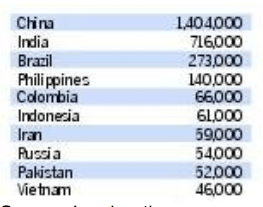
More than 1.4 million Mainland Chinese have gone through the vetting process to obtain Canada’s 10-year visa, which allows visits of up to six months at a time.

More than 716,000 people from India have also obtained multiple-entry visas, followed by 273,000 from Brazil and 140,000 from the Philippines.

The federal government says Mainland China visitors now spend $1 billion a year in Canada. Travel from that country has soared and China has become Canada’s third largest source of visitors after the U.S. and the U.K.

Countries in which Canada’s 10-year visas have proved most popular

George Lee, a Burnaby immigration lawyer who was born in China, says Metro Vancouver hotels, retailers and restaurants are responding to the swelling stream of Chinese visitors by hiring more Mandarin-speaking employees and even making sure their staff “serve Coca-Cola warm,” the custom in China.

In addition, Lee said wealthy Mainland Chinese visitors are increasingly buying hotels, resorts and residential real estate in B.C., particularly in Metro Vancouver and on Vancouver Island.

“Vancouver has become a global village,” Lee said. “When we encounter a new trend … some, if not most, dislike it. They feel challenged and intimidated. But eventually people will get used to it.”

Immigration lawyer Sam Hyman believes the 10-year visas not only help boost tourism from China, India, Brazil and elsewhere; they also help far-flung relatives reunite for extended periods of time in Canada — without having to go through the process of applying for permanent resident status.

For instance, Hyman has worked with many Latin American families who immigrated to Canada in the past couple of decades. Their offshore parents and other relatives, he said, have been applying for 10-year visas to come to Canada as “seasonal visitors,” staying for months at a time.

Would-be visitors from countries that have reciprocal visa arrangements with Canada obtain the multiple-entry visas through a detailed application and vetting process (unlike visitors from visa-exempt countries such as the U.K., the U.S., France, Australia and Mexico, who have more open access to Canada).

Each foreign national who obtains a 10-year visa must prove to Immigration Department officials they have closer ties with their home country than with Canada, a declaration that reduces the chances they would ever apply for refugee status.

Canadian statistics on international border arrivals indicate the exceedingly popular 10-year visas have contributed to a sharp upturn in travellers from key countries.

The number of Mainland Chinese visitors to Canada swelled by 23 per cent in 2016 alone — with 312,000 choosing to come to B.C. out of a nationwide total of 610,000.

More Indian visitors, 71,000, also came to B.C in 2016, out of a national sum of 215,000.

However, Brazilian visitors tended to opt for other parts of the country, with just 17,000 stopping in B.C. out of a Canada-wide total of 214,000.

While Hyman applauds the positive effects of the 10-year visas, he also points to a downside: “People who really abuse the system.”

Because of loopholes in Canadian tax law, Hyman said, it is possible for rich foreign nationals to take advantage of the 10-year visa to avoid paying Canadian taxes on their global income.

Because of loopholes in Canadian tax law, Sam Hyman said, it is possible for rich foreign nationals to take advantage of the 10-year visa to avoid paying Canadian taxes on their global income.

Hyman said the popularity of the 10-year visas has come at the same time tens of thousands of foreign nationals, many of whom were the principal applicants for their family’s permanent resident status, are relinquishing the status for themselves.

This would normally mean they give up the chance to become Canadian citizens.

But Hyman and other immigration specialists say several Canadian tax loopholes allow trans-nationals “to transfer unlimited wealth” to spouses, children and other family members in Canada.

And in many cases, said Hyman, those family members use the breadwinner’s money to invest in real estate, particularly in Metro Vancouver.

Meanwhile, the breadwinner, typically the father, can earn money in his homeland or another country while spending up to six months at a time in Canada on a multiple-entry visa.

Since the breadwinner can therefore claim he is not a “resident of Canada for tax purposes,” he is not expected to declare his worldwide income to the Canada Revenue Agency.

At the same time, Hyman said, the breadwinner’s family members receive access to taxpayer-subsidized Canadian educations, health care and social services, without any member of their family paying significant, or any, taxes to the Canada Revenue Agency.

Hyman urges the federal Liberals to close the loophole that allows foreign nationals to relinquish their permanent residents status — but, years later, apply for it again; sponsored by their spouses or children who had become citizens of Canada.

Source: Vancouver Sun