How the New Immigration Is Shaking Old Europe to Its Core – NYTimes

Good in-depth critical reviews of both books. Murray is of the Mark Steyn alarmist school, Chin takes a more balanced and interesting look:

In the mid-1890s, the German sociologist Max Weber warned against “the continual swarm” of cheap Polish laborers arriving in Germany. According to him, a “free market policy, including open borders in the east, is the worst possible policy at this point.” And not just for economic reasons. The likely integration of these aliens would threaten the “social unification of the nation, which has been split apart by modern economic development.” For Weber, a German nationalist, the “influx of Poles” was “far more dangerous from a cultural viewpoint” than even of Chinese “coolies.”

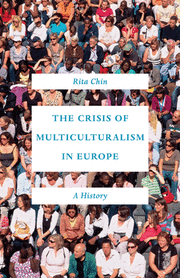
Compared with Weber’s rhetoric about Germany’s “struggle for existence” and his strictures against Catholics and Jews as well as Poles and Chinese, there is nothing overtly racist about the denunciations Rita Chin quotes in “The Crisis of Multiculturalism in Europe” by opponents of multiculturalism — which for them is shorthand for the nonwhite laborers Europe expediently imported after World War II to reconstruct its shattered economy. The political scientist Samuel Huntington’s comment that “multiculturalism is in its essence anti-European civilization” — approvingly cited by Douglas Murray in “The Strange Death of Europe” — also seems coded in comparison. But as demagogues across Europe and America rant against immigration and promise to build a strong and unified national community through exclusion, it is hard not to feel déjà vu.

Racial nationalism was commonplace in the late 19th century, the radically disruptive first phase of economic globalization. Hierarchies of race, ethnicity and religion were imposed on non-Western peoples as Europeans scrambled for territories and resources abroad, followed enviously by Americans. Exclusion was also central to their frantic effort to build political communities at home. Old bonds and solidarities had frayed in societies split apart, as Weber wrote, by modern economic development. Many of the aggrieved became eager to recreate and purify the social body, and to preserve “our” identity against people stigmatized as the “other” through their names, skin color or religious practices. Mass immigration to Western Europe and America, which peaked in the late 19th century, heightened the fantasy of a lost communal wholeness. So did unregulated flows of refugees: Pogroms in Russia sent thousands of Jewish survivors to Western Europe. (Weber’s warnings against the Polish “swarm” reflected a then widespread anxiety about Ostjuden.)
Virulent anti-Semites flourished in Austria-Hungary, Germany and France as the 19th century ended, while lynchings of blacks by white mobs in the United States became more common. The United States in the 1880s had pioneered racialized immigration policy, passing laws aimed at keeping Asians out. The Jim Crow laws that institutionalized segregation in the 1890s were accompanied by a mass hysteria in the United States against immigrants. Fears of degeneration haunted even powerful white men like Theodore Roosevelt. In 1905, amid widespread paranoia about the Yellow Peril, he warned of “race suicide,” exhorting white people to strengthen themselves against their rising nonwhite rivals.

History repeats itself as unfunny farce when, a century after Roosevelt, another macho president amplifies white fears of losing out in the struggle for existence. “The fundamental question of our time,” Donald J. Trump asserted in Warsaw in July, “is whether the West has the will to survive.” Indeed, the fear of decline has intensified as globalization appears to enfeeble once mighty Western nation-states while empowering those previously stigmatized as the Yellow Peril. As in the late 19th century, demagogues displace the anxieties of powerless people onto a clearly identifiable social group: immigrants or refugees. The mechanism of scapegoating — catalyzing mass disaffection and providing it with a simple culprit — has gone into overdrive in Europe and America as crisis besets the second phase of globalization.

In his surprisingly literate screed, the Norwegian mass murderer Anders Behring Breivik called his country the “most suicidal” in Europe for accommodating nonwhite minorities. The first sentence of Douglas Murray’s book, a handy digest of far-right clichés, claims that all of Europe “is committing suicide.” Like his numerous precursors, ranging from Max Nordau, the author of the popular “Degeneration” (1892), to Breivik, Murray goes on to depict Europeans as culturally and spiritually debauched. Evidently, they are not only helpless before the hordes of virile foreigners rampaging through their continent, but also keenly complicit in their own destruction.

“Only modern Europeans,” Murray writes, “are happy to be self-loathing in an international marketplace of sadists.” It is never quite clear which European masochists Murray, an associate editor of The Spectator in Britain, is talking about. A majority of his own countrymen, as a recent poll revealed, are proud of their former empire, and one might even argue that a xenophobic fantasy to regain imperial glory and power fueled Britain’s decision to leave the European Union last year. What is more, Murray does not seem wholly relieved, like most of us, that the vast majority of Germans regret their country’s Nazi past, and are determined not to repeat it. He offers a stalwart defense of the thuggish outfit Pegida (People Against the Islamization of the Occident/West) against criticism by German politicians and journalists; he claims that the English Defence League (a gang of hooligans shunned by its own founders for its “far-right extremism”) “had a point.” More disturbingly, he rates Hungary’s prime minister, Viktor Orban, a self-declared fan of authoritarian democracy, as a better sentinel of “European values” than George Soros.

Needless to say, Murray’s threnody for Europe is as fundamentally incoherent as its late-19th-century originals. It never strikes him, or other secondhand vendors of fixed and singular identities, that nowhere in the world have individuals been the exclusive heirs of a single culture or civilization. Europe as well as America has been a melting pot of diverse influences: Persian, Arab and Chinese, in addition to Greek, Roman, Germanic and Anglo-Saxon. As the Indian writer Rabindranath Tagore, a horrified witness to Europe’s suicidal nationalism in the early 20th century, once wrote: “In human beings differences are not like the physical barriers of mountains, fixed forever — they are fluid with life’s flow, they are changing their courses and their shapes and their volumes,” in what is a “world-game of infinite permutations and combinations.”

Murray’s retro claims of ethnic-religious community, and fears of contamination, call for close analysis. Their toxic effects, which have been amply verified by history, make it imperative to explore the deeper sources of contemporary anxieties: political, social and economic upheavals. And this is what Rita Chin’s book does, synthesizing the endless debates over multiculturalism into a vivid picture of postwar Europe. Lucidly written and resourcefully argued, it is a superb example of a scholarly intervention in a public debate dominated by unexamined prejudice.

Chin’s parents were ethnic Chinese forced to leave Malaysia after the end of British rule and to move through many “different cultural worlds as students, employees, colleagues, neighbors, friends and in-laws.” She wishes her reader to understand the multiple and perennially shifting identities of immigrants “in a world where much of the political discourse is quick to demonize them as groups.” Accordingly, she declines to accept identities — British, German or European — as unalterable essences. Rather, she explores the specific ideas that many in post-1945 British, French, Dutch and German societies have used to clarify their identity; and she never ceases to historicize what to a tub-thumper like Murray seems self-evident.

The very notion of Europe, for instance, began to emerge out of European encounters with Muslim populations during the Crusades. European self-consciousness was then sharply demarcated in remote trading posts and colonies vis-à-vis subjugated and supposedly racially inferior peoples. But, as Chin writes, the “reversal of migratory patterns” after World War II “shifted the process of European self-definition in a dramatic way”: “Instead of Europeans moving outward into the world as they had done for hundreds of years, people from around the world began to settle in Europe, filling the demand for labor created by wartime destruction.”

For Chin, an associate professor of history at the University of Michigan, this is the crux of the problem: “In the past, groups perceived as incompatible with European identity were usually located beyond European borders. But now they are firmly established within Europe itself.” In the 19th century, nation-states premised on homogeneous populations needed foreign lands and resources in order to expand; and they had the brute power necessary to enforce hierarchies of race, class and education that kept the “natives” in their place. This supremacy has been progressively weakened, first by the urgencies of postwar reconstruction, then by the accelerated flows of technologies, goods and capital in recent decades of globalization.

Chin pays little attention to the socioeconomic traumas that have led to an acute obsession with immigration: deindustrialization, the shrinking of the welfare state, the fragmentation of working classes and the rise of extreme inequality. Nor does she go into a pre-1945 history of immigration in Europe, and the projection of internal problems on to various “outsiders” — Jewish, Italian, Portuguese, Irish, Polish. But she is consistently acute on how European elites since 1945 have reacted to the darker-skinned strangers in their midst, ignoring, misrepresenting and marginalizing them at first, and then turning them into a problem, often broadly identified as “multiculturalism.”

Multiculturalism, in Chin’s account, appears largely to be a problem for people who have long been accustomed to an identity built on domination and exclusion, and are panicked by its slow crumbling. Certainly, immigration was not a problem foisted on Europe from the outside; the fates of Europeans and non-Europeans were inextricably connected in the 19th century by conquest, colonization and trade. Yet historical amnesia played an outsize role in dealing with nonwhite workers who were never expected to stay in Europe, let alone integrate or assimilate. Chin describes how people from the Caribbean who began to arrive in Britain after 1948, for instance, were seen as “colored immigrants” when in fact they were British citizens. An unreconstructed racism (exemplified by the commonplace sign “no dogs, no blacks, no Irish”) remained for many years the appalling fate of people who had shaped, like millions of toiling workers and peasants in the imperial provinces, the privileged destiny of the rich in the metropolitan center.

A backlash against multiculturalism began to gather force after the economic crises of the 1970s. The controversy over Salman Rushdie’s “The Satanic Verses” accelerated it. Black people had long been seen as culturally predisposed to crime and hooliganism. But after the Ayatollah Khomeini, wrongly identified by the uninformed as the sole representative of more than one billion Muslims, issued his fatwa against Rushdie, Islam began to seem incompatible with “Western values” too. Diversity has come to seem unworkable to many as the unequal world made by imperialism unravels, and Europe suffers terrorist attacks, economic crises and huge influxes of refugees from the countries it once brusquely made and remade in Asia and Africa. Chin vigorously tackles the “shared presumption,” recklessly echoed by even mainstream politicians in Britain, France and Germany, that multiculturalism is a failure. “Declaring multiculturalism ‘dead,’” Chin argues, “is a way of white Britons, Germans and French telling immigrants, ‘We don’t recognize you; you aren’t a part of our society.’”

Surely, the many populations that now exist in every part of Europe cannot be homogenized, except through the savage ethnic cleansing practiced in almost every European country in the first half of the 20th century. In any case, as Chin asks, “what exactly do Europeans imagine as a replacement for multiculturalism? How will they come to terms with multiethnic diversity moving forward?” Chin offers no simple answers, but her questions have never seemed more urgent as Europeans (and Americans) seem to move forward to their grim past.

White people must understand that racism is real: Coren

Good commentary:

The one constant and reliable conclusion about people who argue that racism no longer exists is that they are white. And naive of course. It’s a crass statement, to be thrown in with claims such as unions have outlived their usefulness, fascism and Communism are as bad as each other, poverty a result of laziness, and the rest of the reactionary mantra. The lions of the suburbs preaching, as it were; gratingly comfortable and darkly unworldly in their invincible smugness.

The bunch of banality can usually be dismissed but lately a number of influential and even respected journalists have joined in. Sometimes they couch their arguments with a vague intelligence, often in tabloid hysteria, but the theme is repetitive: traditional values are under attack, political correctness is oppressing us, free speech is moribund, and radicals are violent and unreasonable. We’re all going to hell in a handbasket and the world has to know about it.

Most of the writers are middle-aged, as am I. In my case not only middle-aged but a white, middle-class man to boot. As such do I find some of the claims and demands of many young progressives to be shocking? Yes. But does that mean that they are wrong? No. If I can break out of my comfort zone there’s no excuse for anybody else.

Thing is, aging needn’t be synonymous with conservatism. In fact, the maxim that we become more right wing as we grow older is often the opposite of the case. Life experience, years of parenting, an increasingly safe distance from the daily economic struggle faced by younger people, the sobering reality of immortality, should all lead one to become more empathetic and reasonable.

It should also make us braver and not more fearful, but it’s fear — even hysterical fear — that seems to characterize so many of the comments from this new right collective of journalists and pundits.

Judging from what they say and write they are threatened and intimidated by the anti-Fascist movement, by Black Lives Matter, by students asking for language to be more inclusive than it used to be. Yet while these may be new movements in their specifics, there is nothing new in a fresh generation wanting a better world. When my uncle went off to Spain as a 16-year-old to fight against Franco, his parents in London were outraged. They later celebrated him as a hero.

Complacency is the last refuge of the privileged. It’s nasty in the bar or the social club but unacceptable in the pages of national newspapers. This increasingly militant wallowing in nostalgia, this reverence for a time that never was, doesn’t expand but simply destroys the debate. Yes of course such attitudes will attract fans but that says nothing — the politically blind leading the politically deaf.

It’s like the boorish parent bemoaning the music their teenagers listen to and the clothes they wear. You become figures of fun at best but at worst you’re causing harm. After one recent article denying that there was very much racism in Canada I asked a Black friend about his experience. Had he ever been stopped by the police?

He laughed. That was all. Laughed. It wasn’t a laugh of contempt but of resignation. Of course he had been stopped, several times. Is it really too much to ask those who will never be treated thus to make a small leap of empathy? Isn’t that what real journalists are supposed to do?

In the case of racism for example, it might be one thing to question some of the actions of radical groups in the Black community but quite another to refuse to understand why they were radicalized in the first place. The majority, those who enjoy power, is always frightened by anger but that does not mean that anger is not justified. As for students, socialists, and social justice campaigners, remember that liberation has to breathe. Give it some room, allow for the a few rough edges, let go and enjoy the ride.

Terms such as racism, sexism, homophobia, Islamophobia, transphobia and the rest did not develop from a vacuum and without cause. They are, alas, undeniably real. Getting old is inevitable, being young at heart, mind and soul is a choice. Do not go gently into that dark night of irrelevance.

Source: White people must understand that racism is real: Coren | Toronto Star

Latvian lawmakers divided over president’s citizenship initiative – Xinhua

Different take from most European countries (but in process of being rejected):

Latvian President Raimonds Vejonis has put before lawmakers a new bill that would allow non-citizens’ children to become Latvian citizens at birth, but one of the partners in Latvia’s center-right government coalition has already promised to block its passage in parliament, local media reported.

The rightist National Alliance has said it will exercise its veto rights under the coalition agreement to prevent the draft law from being adopted.

Vejonis proposes to stop registering non-citizens’ children, born after June 1, 2018, as non-citizens and grant them Latvian citizenship unless their parents choose to register them as citizens of some other country. The president believes that this would help consolidate the Latvian nation on the basis of common values.

The president reminded that non-citizenship status was introduced in Latvia and its neighbor Estonia as a temporary solution in the early 1990s. At present, however, babies born to non-citizens are only registered as non-citizens in Latvia.

“Ending the registration of children as non-citizens is a symbolic step that would end the divisions purposefully created between various groups of Latvia’s society,” Vejonis said, adding that doing away with non-citizenship would enable consolidation of Latvia’s society, allowing to devote all efforts to the country’s development.

If the bill is adopted, it would apply to approximately 50 to 80 newsborns a year. Last year, 52 babies born in Latvia were registered as non-citizens.

Although the president’s initiative has already been endorsed by the opposition leftist Harmony party, Edgars Tavars, the leader of the ruling Green Party, a group of lawmakers who recently left the ruling center-right Unity party to form a new liberal party, as well as Ombudsman Juris Jansons, its future is quite uncertain because the National Alliance’s resistance, which can threaten the coalition’s stability.

Latvian Prime Minister Maris Kucinskis said Tuesday morning that he would not risk a disintegration of the current government coalition and that the president’s citizenship proposal would therefore be rejected.

Under the current legislation, effective since 2013, non-citizens’ children can be registered as Latvian citizens if at least one of the parents has expressly declared such a wish.

Since the mid-1990s when non-citizens made up 29 percent of Latvia’s population, their share has contracted to 11 percent, according to the data of the Latvian citizenship and migration authority.

Source: Latvian lawmakers divided over president’s citizenship initiative – Xinhua | English.news.cn

ICYMI: Rewriting history? That’s how history is written in the first place – Macleans.ca

Worth reading – the counterpoint to some earlier commentary:

If you’ve been following the debate over whether Sir John A. Macdonald—prime minister, lawyer, architect of Confederation, corrupt politician, and functional alcoholic—should have his name removed from schools and buildings in Ontario, you’ve likely encountered histrionic reactions from those who decry such efforts as erasing history or re-writing our past or genetically engineering political correctness into Canadians.

The “history is under attack!” responses are predictable, but that’s not their critical deficiency. No, the greatest weakness in that argument is that it fetishizes a particular account of history, ignoring what history is, what it represents, and what it does. Many of the quickest takes about the “problem with re-writing history” are sops for old-school culture, mopping up buckets of indignation from those whose historical experiences and values seem rather well-represented in our official accounts of our past, as well as our acknowledgements and celebrations of events and figures.

This all started last week when the Elementary Teachers’ Federation of Ontario (ETFO) cracked open Pandora’s box by passing a motion to “examine and rename schools and buildings named after Sir John A. Macdonald.” The impetus for dropping the sometimes-beloved whiskey-soaked codger? “[H]is central role as the architect of genocide against Indigenous peoples.” I’d say the punishment fits the crime here, except it doesn’t; being structurally complicit in the deaths of many peoples and their culture while initiating an ongoing history of violence against the descendants of those peoples seems to warrant a rather more severe reprimand. But let’s set that aside.

This debate has been a long time coming. We should have had it in earnest a long time ago, given changes to the makeup of Canadian society and the longstanding injustices that remain woefully and shamefully under-addressed or unaddressed entirely, especially our relationship with Indigenous peoples. But the debate thus far hasn’t sufficiently acknowledged one crucial consideration: revisiting our history—reassessing it and how we think about it—is central not only to correcting the record in some cases, but also to moving forward as a country. History is not a static moment or series of moments; history is an ongoing project that connects past generations to the present, and it is built by human beings who make choices about what we admit to, what we ignore, what we celebrate, and what we condemn.

The preferences, norms, and values of a society change over time; the present is a reflection of what we want to represent us, right now—and so it is perfectly reasonable, and often necessary, for a country to revisit what in its history it chooses to emphasize and celebrate. This is, after all, how history is written in the first place.

Now, no one is suggesting that we completely strike Macdonald and other historical figures who are implicated in practices or actions we now find unacceptable or abhorrent from the history books. No one is arguing that we should forget Macdonald’s legacy as a critical part of Confederation. We’re not turning the porch light off and pretending we’re not home should he pop by.

All the ETFO and others are suggesting is that in some instances, we should choose not to celebrate and honour Macdonald by naming schools and buildings after him, which seems rather reasonable given that he was complicit in the abusive and murderous residential schools system as well as other (what we would now call) crimes against Indigenous peoples. If a democratic society chooses to live its history by shifting who and what it emphasizes and celebrates, then bully for it—especially if a shift in focus is used to foreground and address historical and contemporary injustices and to renew efforts at healing persistent wounds. This reassessment of the past and how we live in the present is only controversial if your understanding of history is static and your commitment to your country is monolithic.

Historian Sean Carleton captured this line of argument well, reminding us that history is always political and never objective, and that while facts are objective, history is not. “We need to remember that both naming and renaming are political things that need debate,” Carleton said in a piece that ran in the Calgary Herald. “Names are not neutral and that’s what I think is somewhat frustrating about the claim that changing the name is erasing history.” Precisely.

Cherie Dimaline, a Métis woman, wrote in Today’s Parent that history is indeed political, as well as ongoing and alive in the present, especially the Canadian history of violence against Indigenous peoples. “It strikes me as particularly ironic that they’re worried about history being lost. After all, the very fact that we send our children to schools named after the architect of Indigenous genocide through the residential schools attempts to remove our story, negate our well-being and ignore our continued survival,” she writes. “It is, in fact, a push to actively lose history….I hear all the time that colonization happened 400 years ago, that it’s so far gone that we shouldn’t be so sensitive…. Colonization didn’t happen 400 years ago; it began 400 years ago and continues today. Right now.”

Carleton and Dimaline remind us that history is ongoing and disputed; as we live, and make choices about how we remember and view our own histories, we create history anew, whether we care to acknowledge that or not. Those who oppose dropping Macdonald’s name from schools and buildings smuggle in a comfort with a broad conceit of history that isn’t universally shared, one that carries water for some but not for others; one person’s “re-writing of history” may be another’s rectification of history. A sophisticated understanding of where we come from takes this understanding of history for granted as a starting point and accepts that the past is more than a series of fixed written records, and our conception of it certainly isn’t objective.

As long as we humans have had history, we’ve been re-writing it. In fact, our history is the history of “erasing”—that is, revisiting and revising—our past. Canada is no exception to this practice, and nor should we be. Indeed, it may be the case that the best way to continue as a country is through an ongoing and vigorous debate about who we are, where we come from, what we value, and what we choose to celebrate, emphasize, and honour in our public spaces.

Source: Rewriting history? That’s how history is written in the first place – Macleans.ca

ICYMI: ‘Deeply Worrying’ Fears Around Muslims And Islam Revealed In Damning Report | HuffPost UK

Not too surprising:

Britons’ attitudes towards Muslims and Islam have “worsened” with more than half of all respondents to a new survey believing the religion “poses a threat” to the West.

“The fear and hostility displayed towards Muslims is deeply worrying, despite most people claiming that they stand firm against extremists’ attempt to conflate their heinous actions with that of an entire religion,” Hope not Hate (HnH) chief executive Nick Lowles said of the finding’s of the charity’s Fear And Hope 2017 report which was released on Wednesday.

“Clearly there is a lot of work to be done here, both by those tackling hate crimes and misinformation, and potentially by Muslim communities themselves.”

The report, billed as “one of the most comprehensive studies of English attitudes towards contemporary issues”, found that despite views on immigration “softening”, attitudes towards Muslims and Islam have “simultaneously worsened among the more hostile sections of society”.

The report, based on a Populus survey of 4,000 people in “six identity tribes” across England, found that 52% of respondents believe Islam “poses a threat to the West”. As a result of recent terror attacks 42% of those surveyed were now “more suspicious” of Muslims and a quarter of Brits believe Islam is a “dangerous religion that incites violence”.

The study found older people were more prone to Islamophobia, “painting a worrying set of views” which HnH said would require “significant effort” to address.

Anti-hate charity Tell Mama told HuffPost UK that it was not surprised by the survey’s findings and called on mosques and Islamic institutions to do more to “break down barriers”.

“We know, given the levels of aggression towards victims, that there is a foothold taking place within small sections of the UK, around anti-Muslim hatred,” Tell Mama director Iman Atta said.

“For the survey to show that 25% of Brits believe that Islam is a dangerous religion, is concerning and we need more mosques and Islamic institutions to engage with their neighbours and break down barriers that there may be. Also, for 52% of respondents to believe that Islam poses a threat risk to the West shows that a lot more work needs to be done by Muslims and NGO’s to counter such growing divisions.”

Atta added:  “We are the vanguard of trying to tackle anti-Muslim hatred and we call upon others to join us in standing against all forms of hatred, including anti-Muslim hatred. There is much work to be done and clearly, there is a long road ahead. If we do not challenge this, it will strengthen Islamist extremism as well as alienating large numbers of Muslims.”

Source: ‘Deeply Worrying’ Fears Around Muslims And Islam Revealed In Damning Report | HuffPost UK

Brexit in Germany: ′Citizenship is not a panacea′ for Brits | DW | 13.09.2017

People having to make choices and the instrumental nature of citizenship:

Along with financial settlement and trade, the rights of citizens are a crucial part of the divorce talksbetween the UK and EU. But progress has been slower than many had hoped. In the meantime, anxiety grows among many of the three million EU citizens in the UK and 1.2 million Brits living and working in the EU. Chancellor Angela Merkel has sought to reassure the 100,000 Britons living in Germany that no one will be sent home, but with an election on the horizon, future conditions are anything but clear. Merkel’s advice? Go for German nationality, as she told one British expat: “to put yourself on a completely safe track.”

In Germany, Brits have been scrambling to get citizenship, which they seem to see as an insurance policy, not only to be able to remain in the country but also to retain the broader palette of rights they enjoy as EU citizens. Germany’s Statistics Office released figures in June revealing an “extraordinary increase” in the number of British citizens granted German passports in 2016. Overall naturalizations increased by 2.9 percent in comparison to 2015, whereas the number of Brits granted German citizenship soared by 361 percent to 2,865. While the agency does not specifically gather information on motivation to acquire citizenship, it did note that the surge was “quite obviously due to Brexit.”

For those who are well settled in Germany, applying is an administrative burden, but the requirements are not especially onerous: Those who have lived in the country for eight years (seven, if they pass a German-language integration test) — or for three years and been married to a German for two — are eligible to apply. Other requirements include proof of language proficiency, financial independence, a clean criminal record and a fee of 255 euros ($304).

Time limit for dual citizenship

Nick Wolfe, 29, a lawyer in Munich, says his recent application is “purely pushed on by Brexit” as well as the tight timeframe: “If you want to take German citizenship, you have to renounce your previous one, unless you are an EU citizen. What the relevant authorities here have been saying is that if you actually receive your German citizenship before March 2019, you’re okay. If you receive it afterwards, you will have to give up your British nationality to take up your German one.”

…And if it came to it, Wolfe would find it hard to give up his British nationality: “There’s a very emotional connection to it. So that’s why it’s obviously best if you can have both.”

Indeed, time is running out to submit a citizenship application. The city of Munich received 271 in the first six months of this year and granted 88. But each local authority handles applications separately, and requirements and processing times can vary wildly. In some places applicants wait up nine months just for an initial appointment, a further few months for an appointment to submit their application and then six to 12 months for processing, taking the amount of time to receive citizenship beyond the March 2019 deadline.

“It’s really complicated and there’s no one that gives you any real guidance on it,” Nick Wolfe said. “So you’re kind of at their mercy.”

Brits abroad as bargaining chips

Ingrid Taylor heads the Bavarian branch of the “British in Germany” campaign, which along with the broader “British in Europe” coalition represents UK citizens in the EU, and is awaiting the outcome of a citizenship application she submitted last November.

She speaks scathingly of the lack of support from the British government: “Because we are disenfranchised no one cares about us,” she says, referring to the fact that Brits lose their right to vote in Britain after 15 years of residence abroad. “They’re not going to look after our interests — because we can’t vote, there’s no gain in it for them.”

But fast-track citizenship cannot be the sole solution, according to Jane Golding, chair of the British in Europe: “Citizenship is not a panacea for all the issues. What we’ve had as EU citizens is a really complex bundle of interlinked rights: your right to free movement; to residence; to equal treatment; to work; to have your qualifications recognized; all sorts of rights about pensions and healthcare, all in one bundle. And you need all of them in order to live and work and have a life in another country.”

For Golding, it’s now crunch time: The bargaining-chip status of Brits in the EU must end, and rights must be guaranteed.

“We are a finite group of people who in good faith, and with legitimate expectations, thought that our rights were for life. What we are asking is that all of our rights, our complex bundle of rights are simply guaranteed.”

And as the withdrawal agreement is taking much longer to draw up than hoped, they are also asking for citizens’ rights to be ring-fenced for the rest of the negotiations: “Because we are people, these are people’s lives, and we have been living in limbo and uncertainty for all this time.”

Source: Brexit in Germany: ′Citizenship is not a panacea′ for Brits | Germany | DW | 13.09.2017

John Ivison: Liberals turn against seafood producer in name of Indigenous reconciliation

Competing claims. Funny how the government has been criticized for symbolism and “empty words” and then is also criticized when it proposes something substantive which affects the interests of others, particularly in this case, private sector interests:

In its annual report, Clearwater Seafoods warns shareholders that its international operations are subject to economic and political risk. The domestic operations were obviously not considered precarious — after all, what could go wrong when you have a friend in the prime minister?

A year ago, Justin Trudeau was pictured in Hangzhou, China with Alibaba Group founder Jack Ma, waving around a Clearwater lobster that had recently been made available for sale on Ma’s e-commerce site T-Mall.

But politics is a fickle mistress. Promoting a growing Canadian seafood producer in Asia was a top priority when the cameras were rolling in China, but those ties have been severed now that Clearwater is an impediment to a project even closer to the prime minister’s heart: Indigenous reconciliation.

Last Thursday, the Department of Fisheries put out an innocuous-looking press release that said it will use 25 per cent of the existing total allowable catch of Arctic surf clams to issue a new license that will be open to expressions of interest from “Indigenous entities” from the four Atlantic provinces and Quebec.

Fisheries minister Dominic LeBlanc said that by “enhancing access” to the surf clam fishery for Indigenous groups, “we are taking a powerful step toward reconciliation.”

But one group’s “enhanced access” is another’s lost business.

Surf clams Clearwater Seafoods

Clearwater has, to this point, controlled all the quota available, meaning that its clam business — providing those brilliant red tongues that look so appealing in sushi — is about to shrink by a quarter.

The company is keeping its own counsel — it would say only that it was reviewing the decision — but Rex Matthews, the mayor of Grand Bank, Nfld., where Clearwater has a processing plant, did not mince his words.

In a letter to LeBlanc, he said he had received the news “with a sense of shock, disbelief, disappointment and discouragement.”

His town is “reeling and flabbergasted” that the government would take nearly 10,000 tonnes of allowable catch from a quota that has been granted to Clearwater for years, he said.

“This decision by your department has shattered the dreams of those employees who will see harvesting vessels tied up early in the year and their plant closed for at least four to five months of the year. These employees will now be forced onto the payroll of the federal government through the EI system, whereas before they were productive, contributing and proud members of society.”

The mayor goes a little far when he accuses the government of “expropriating” Clearwater’s quota. It is, after all, a public resource and quota does not confer property rights to the fishery or the fish.

But Clearwater deserves credit for developing the Arctic surf clam fishery into a $92-million market through continuous investment.

Clearwater successfully harvested its full quota in 2016 for the first time because it added a new $70-million factory-at-sea vessel to its existing fleet of three. Further, it is in the process of building a new $70-million harvesting vessel as replacement for one of the older ships.

You don’t make those kinds of investments if you think you are about to lose the right to fish.

LeBlanc said in an interview in St. John’s Tuesday that discussions to open up the market have been going on for over a year.

“It’s not a surprise,” he said — which will apparently come as news to the mayor of Grand Bank.

Earlier this summer, the government decided not to increase the current quota, a move that would have allowed new entrants and one that, ironically, Clearwater opposed.

LeBlanc said that his hope is that at some point, the data will show the stock is healthy enough to increase the quota. He said the government hasn’t taken existing quota from anyone yet — it has simply called for proposals from Indigenous groups to see whether any are prepared to come forward, potentially in partnership with an experienced offshore operator, to profit from the clam fishery. “We want to see if commercially and operationally, it’s viable. It’s an expensive undertaking to go 120 miles offshore with a large vessel,” said LeBlanc.

Quite who might be prepared to invest $70-million or so in a new clam-fishing vessel is not clear. Calls to Membertou First Nation in Sydney, N.S., one of the likely applicants, were not returned. One potential partner, Louisbourg Seafoods of Nova Scotia, said it would not partner in a venture where it would not be the majority shareholder.

Source: John Ivison: Liberals turn against seafood producer in name of Indigenous reconciliation | National Post

ICYMI – In Praise of Equipoise: David Brooks

Good piece by Brooks on the need to get out of one’s bubble and the risks of attachment to a single identity:

Group victimization has become the global religion — from Berkeley to the alt-right to Iran — and everybody gets to assert his or her victimization is worst and it’s the other people who are the elites.

The situation might be tolerable if people at least got to experience real community within their victim groups. But as Mark Lilla points out in his essential new book, “The Once and Future Liberal,” many identity communities are not even real communities. They’re just a loose group of individuals, narcissistically exploring some trait in their self that others around them happen to share. Many identity-based communities are not defined by internal compassion but by external rage.

How do we get out of this spiral?

The first step is to just get out. Turn the other cheek, love your enemy, confront your opponent with aggressive love.

Martin Luther King is the obvious model here. “Love has within it a redemptive power,” he argued. “And there is a power there that eventually transforms individuals. … Just keep being friendly to that person. … Just keep loving them, and they can’t stand it too long. Oh, they react in many ways in the beginning. … They react with guilt feelings, and sometimes they’ll hate you a little more at that transition period, but just keep loving them. And by the power of your love they will break down under the load.”

The second step is to refuse to be a monad. Maalouf points to the myth that “‘deep down inside’ everyone there is just one affiliation that really matters.” Some people live this way, hanging around just one sort of person, loyal to just one allegiance and leading insular, fearful lives. In fact, the heart has many portals. A healthy person can have four or six vibrant attachments and honor them all as part of the fullness of life.

The more vibrant attachments a person has, the more likely she will find some commonality with every other person on earth. The more interesting her own constellational self becomes. The world isn’t only a battlefield of groups; it’s also a World Wide Web of overlapping allegiances. You might be Black Lives Matter and he may be Make America Great Again, but you’re both Houstonians cruising the same boat down flooded streets.

The final step is to practice equipoise. This is the trait we should be looking for in leaders. It’s the ability to move gracefully through your identities — to have the passions, blessings and hurts of one balanced by the passions, blessings and hurts of several others.

The person with equipoise doesn’t feel attachments less powerfully but weaves several deep allegiances into one symphony. “A good character,” James Q. Wilson wrote, “is not life lived according to a rule (there rarely is a rule by which good qualities ought to be combined or hard choices resolved), it is a life lived in balance.” Achieving balance is an aesthetic or poetic exercise, a matter of striking the different notes harmonically.

Today rage and singularity is the approved woke response to the world — Donald Trump or Bernie Sanders. But you show me a person who can gracefully balance six fervent and unexpectedly diverse commitments, and that will be the one who is ready to lead in this new world.

ICYMI – After Ahok: Indonesia Grapples with the Rise of Political Islam | The Diplomat

Unfortunate trend:

Five months after its closure, the doors of the Al-Hidayah mosque were sealed with wooden planks and crisscrossed with yellow police tape, as if it some kind of grisly crime had taken place within. Barred from entering their house of worship by official order, four young men held their midday prayer in the heat outside, their bodies bent towards a large sign driven into the concrete by the local authorities. Its message was emblazoned in red: “Activities are banned.”

In February, police converged on this green-tiled mosque in Depok, 15 kilometers south of the Indonesian capital Jakarta, to enforce an order sealing off the building until further notice. The order followed a clamor from Islamic fundamentalists, who held protests calling for the expulsion of this small congregation of Ahmadi Muslims from the district. “We had a permit to build this mosque, so we have no idea why they sealed it,” said Abdul Gofur, 42, the caretaker of the site.

The unpretentious Al-Hidayah mosque, a box-like building lacking the otherworldly dome and minaret of many Muslim houses of worship, has a long history of run-ins with the local authorities. Gofur said the mosque had been “sealed” six times since 2011, and has survived a concerted campaign from hardline vigilante groups, including the notorious Islamic Defenders Front, or FPI, which sees Ahmadis as heretics and apostates.

On June 23, two nights before Idul Fitri (as Eid al-Fitr is known in Indonesia), the festival marking the end of the fasting month of Ramadan, Gofur said that white-robed militants pelted the building with eggs and paint, and strung up spray-painted banners calling for the expulsion of the Ahmadiyah. The 400-strong congregation has erected its own signs reading, “Love for All, Hatred for None.”

The Ahmadi minority numbers around 500,000 people scattered across this island nation of 260 million. The sect is not officially recognized in Indonesia, which acknowledges just six religions: Islam, Protestantism, Catholicism, Hinduism, Buddhism, and Confucianism. While most Ahmadiyah see themselves as Muslims, they cleave to unorthodox tenets: the sect has its own holy text, the Tadzkirah, and does not regard Muhammad as the final prophet – a belief that many Indonesians see as heresy. As a result, they have become both a subject of official discrimination, and a target for religious vigilantes.

Things got particularly bad after 2007, when a leading clerical body declared the Ahmadiyah a deviant sect; the following year, then-President Susilo Bambang Yudhoyono signed a decree banning Ahmadi Muslims from disseminating their faith. Following the decree, mosques were shuttered and burned, and members of the community were subject to violent attacks. In February 2011, west of Jakarta in Banten province, three Ahmadi men were beaten to death by a mob; the perpetrators received only light sentences. According to the Jakarta-based Setara Institute for Democracy and Peace, which monitors religious freedom in Indonesia, there have been a total of 546 violent incidents against Ahmadi Muslims since 2007.

Source: After Ahok: Indonesia Grapples with the Rise of Political Islam | The Diplomat

ICYMI: Critics say TDSB rushed vote to suspend program that puts police in high schools | Toronto Star

Getting the process right, including gathering evidence, is as important as the substance. The Board failed in this regard (see Christie Blatchford: School policing program latest casualty of the tyranny of a minority):

The Toronto District School Board’s decision to suspend a controversial program that places armed police officers in high schools has come under criticism from officials who say the move was made in haste. But advocacy group Black Lives Matter said the decision marked a step forward.

TDSB trustees voted Wednesday night to discontinue the Student Resource Officer initiative, pending a review of the practice, due in November.

“It was felt that the presence of (officers) during the review when we were asking people to talk about them might be intimidating and create a potential bias,” TDSB Chair Robin Pilkey told the Star.

About 16 votes were cast in favour of suspension and six votes were cast against, said Pilkey, who voted to suspend.

The Student Resource Officer program, in place since 2008, has garnered a mix of praise and criticism since its inception. Some students, parents and school staff have said the presence of armed, uniformed police improves safety, and gives teens a chance to get to know local officers.

Others have expressed concern that the program leads to criminalization of relatively minor schoolyard problems and alienates marginalized students who may not feel comfortable around police.

In June, the TDSB ordered a review of the program to take place this fall.

A report on the planning for the TDSB review of the program was scheduled for Wednesday night’s board meeting, prompting Trustee Marit Stiles to draft a motion for the program suspension.

“Earlier in the day, I circulated to all trustees a motion I intended to introduce related to the report (on the review),” Stiles told the Star. “It was introduced during the meeting as business arising from the (review) report.”

The trustees debated the suspension issue for at least an hour, Stiles added.

The decision to suspend the program was “unfortunate,” Mayor John Tory told reporters on Thursday.

The Toronto Police Services Board, of which Tory is a member, has commissioned its own review of the SRO program, to be completed in Spring 2018.

“The school board decided they would take a different approach, and, before that review is done, cancel the program,” Tory said.

“I wasn’t prepared to rush to judgment to say the program was perfect or imperfect,” he added.

At least one trustee has said board officials should have been given time to consult their communities before the vote.

Trustees would normally have a week or two to discuss a motion like this, “but we had no chance to do any of that,” Trustee Pamela Gough, who voted against the suspension, said.

“My decision last night not to support it was basically a status quo until we hear the evidence and we hear the voices of the people actually in the schools,” she added.

“Evidence-based decision making is better than taking a stab in the dark on a topic, especially when the motion, came with such short notice.”

Stiles acknowledged that not all the trustees were comfortable with suspending the SRO program, but added that officials have had ample time to consider the public’s feelings about the practice.

“We’ve been talking about the future of the SRO program for quite some time,” Stiles said.

“I think if enough trustees were concerned about that we would have seen a vote against the motion,” Stiles added.

The controversy over the Student Resource Officer program erupted in May after a review of the nearly decade-old program was one of the items on the agenda of the Toronto police board meeting. A group of teachers and school workers presented a detailed report about the negative impact the program in schools. A motion to suspend the program was deferred to June.

Things became more heated at the June board meeting, where 74 people spoke against uniformed police officers in school. Protestors from Black Lives Matter and other groups filled the auditorium at police headquarters. The meeting was disrupted a couple of times as tensions rose and board members were heckled. At the end of a long night, the board decided to postpone the decision over the motion until the end of the year.

It was no different during the board’s August meeting where Toronto police chief Mark Saunders presented a plan to have Ryerson University perform a review of the contested program. Activists attended the meeting calling for board members to resign. They also carried signs saying “We’re here for Dafonte,” in reference to Black teen Dafonte Miller who was allegedly beaten by an off-duty Toronto police officer and his brother.

Responding to the decision of the TDSB to suspend the program, Black Lives Matter put out a statement: “Last night, Toronto District School Board Trustees voted to temporarily suspend the School Resource Officer (SRO) program for the start of the school year. The program will be suspended to allow for the TDSB to conduct a review of the program, its effectiveness, and hear from students from marginalized communities about their experiences with cops in schools.

“While this is not a full victory, this is an important step forward. After years of activism from groups like Education Not Incarceration (ENI), and the Latinx, Afro-Latin-America, Abya Yala Education Network (LAEN), the TDSB has undertaken a thorough review of the program to happen throughout the fall.

“Toronto Police Services Board are also conducting their own (questionable) review of the program. This review will be overseen by a committee comprised of TPS board chair, the Chief of Police, amongst others. We remain skeptical of any instance in which cops are reviewing other cops.

“It’s time to hear from students themselves about their experiences with police surveillance, criminalization, profiling, and their experiences with armed police officers in their classrooms. The work has only begun.”

Forty-six of the TDSB’s 113 high schools had student resources officers in 2016-2017, though one has since closed and three others suspended the program due to “schedule issues.”

Five schools have an officer assigned solely to them last year. The rest shared one or two officers with other TDSB and Toronto Catholic District School board institutions.

The SRO program has been in place since 2008, instituted in large part as a response to the murder of 15-year-old Jordan Manners, in the halls of C.W. Jefferys Collegiate Institute in North York.

As part of the TDSB’s review of the SRO program, the board’s research department will conduct a written survey of staff and students at participating schools.

Source: Critics say TDSB rushed vote to suspend program that puts police in high schools | Toronto Star