The Rebel’s fast running out of friends. Better late than never, I suppose.

Great column by Susan Delacourt:

It’s been a remarkable few days for political penitence.

Just as Donald Trump finally got around to disavowing neo-Nazis and the Ku Klux Klan (it only took him two days), the founders of Rebel Media in Canada also decided that now was the time to make a stand against racism.

Ezra Levant, one of those founders, declared that Rebel Media would have nothing to do with the alt-right, while Brian Lilley simply walked away from the online outlet, saying he could no longer put up with “a lack of editorial and behavioural judgment, that left unchecked, will destroy it and those around it.”

Was anyone else reminded of that scene in Casablanca where the police captain pronounces himself “shocked, shocked” to learn there’s gambling going on at Rick’s — just before the croupier hands him his winnings? Did it truly take Levant and Lilley this long to become troubled by the thought that that their online outlet — a bizarre spinoff of the defunct Sun TV — might be whipping up hatred toward other races and cultures?

While it’s good to see MPs like Michelle Rempel and Lisa Raitt distancing themselves from the racist strain of modern conservatism, one really has to ask the question: Why now? Shouldn’t the last straw have come long before now — say (just to pick an example out of the air), when one of Rebel’s commentators, Gavin McInnes, went off the anti-Semitic deep end during a trip to Israel last spring?

Perhaps we should be relieved that events in Charlottesville this weekend are axing the connections between mainstream conservatives and the racists in the base. But a lot of damage had been done before last weekend, too. It’s a shame that the disavowals can’t be retroactive.

In one of her Twitter posts on Monday, Rempel stated: “Flirting with or giving a wink and a nod to Nazism and white supremacy for clicks and likes is disgusting.” Yes, that’s definitely true today. It’s been true for a while, actually.

Reminds me of another Casablanca quote: “Welcome back to the fight.” Once upon a time, conservatives and progressives could agree that racism was a blight on society and democracy. Now it’s a wedge issue. Worse yet, it’s a business model.

The worst kind of politics cuddles up to racists to get votes. The worst kind of business makes a profit from hate. Make no mistake: Rebel Media has been flirting with both practices for some time now.

Start with the politics. For an example of just how far some conservative politicians were willing to go to woo racist votes, take a look back to not so long ago — earlier this year, in fact, when Rebel Media was holding rallies against the anti-Islamophobia motion introduced in the Commons after the Quebec mosque massacre.

open quote 761b1bAppeals to the head and heart may not work on those who have calculated that there’s big money to be made in whipping up intolerance. Hitting them in the wallet might work better.

It is completely defensible in a democratic society to disagree with government motions in the Commons. But some of the stuff being uttered at these rallies was absolutely vile and racist — so disgraceful I wouldn’t repeat it here in this column.

Faith Goldy, the same Rebel Media personality who was at the Charlottesville rallies last weekend, was whipping up the crowd at a Toronto rally last February, mocking critics who called the rally racist, even as one woman in the crowd seemed moved to give a Nazi salute. No kidding. You can check it out on the Torontoist website, which called the rally “bonkers” and “chilling.” (Look at the raw video coverage and you might agree with that appraisal.)

I don’t recall much contrition from Rebel Media back then over that flirtation with Nazi symbolism, nor any official disavowals from many voices on the right at the time either.

In fact, Rebel Media was seen by many as an player to be cultivated during the Conservative leadership race. At that same Toronto rally, held at Canada Christian College, leadership hopefuls Kellie Leitch, Chris Alexander, Brad Trost and Pierre Lemieux came to address the audience. Not one of these candidates acknowledged the racism elephant in the room.

“It’s good to be in a room with severely normal people,” Leitch actually told the crowd. None of these would-be Conservative leaders won the race, of course, though Lemieux and Trost, combined, did remarkably well with their armies of anti-abortion advocates.

Andrew Scheer won the leadership. His campaign manager, Hamish Marshall, was listed as a director on Rebel Media’s federal incorporation records. At a pro-Trump rally held on Parliament Hill, long after Scheer’s victory, Goldy proclaimed Scheer to be one of “our people.”

Perhaps it’s Scheer’s influence reining in the racism at Rebel Media now. One would think that anyone who wants to be prime minister in Canada wouldn’t want to be carrying that kind of baggage during the next campaign.

Optimists believe Trump’s approach to politics is still toxic here. Cynics might suggest that the business model for racist media outlets is crumbling. Is that why Levant and Lilley needed to clean up Rebel Media’s act?

As iPolitics’ own Bea Britneff has been reporting, an anonymous outfit called Sleeping Giants has been aggressively campaigning to stop firms from advertising on Rebel Media.

That’s a very good thing, because — and it’s sad to have to say this — the best way to fight the spread of this online toxin is to go after the money that fuels it. Appeals to the head and heart may not work on those who have calculated that there’s big money to be made in whipping up intolerance. Hitting them in the wallet might work better.

Rebel Media has been making serious money and gaining serious ground abroad. Take a look at this excellent piece by Jason Markusoff in Maclean’s from a few months ago, which shows how Rebel Media has been expanding its international reach by making its message ever more outrageous and unhinged.

The most lamentable thing about Rebel Media isn’t just what its commentators have said. It’s that it has shown there is a considerable market for racism in this country — money to be made, careers to be built, from sowing hate and intolerance.

So here’s the good news: The experiences of the past few days suggest the market has reached a limit. Or so we hope.

Source: The Rebel’s fast running out of friends. Better late than never, I suppose.

Does Canada take the threat of far-right extremism seriously?

Worth noting the contrasting assessments:

Yet the outburst of deadly racist violence in Charlottesville, Va., last weekend is not without parallels in Canada. Recent estimates suggest there are dozens of active white supremacist and neo-Nazi groups across the country.

They advocate everything from biological racism to anti-Semitism to radical libertarianism. Members of groups such as the Heritage Front, Freemen of the Land and Blood and Honour have been charged with dozens of crimes, including murder, attempted murder and assault.

Roughly 30 homicides in Canada since 1980 have been linked to individuals espousing some form of extreme right-wing ideology.​ 

But the pattern of right-wing extremist violence in Canada is too inconsistent to merit being prioritized over the threat posed by Islamic extremists, according to two former members of the security establishment.

“I do think right-wing extremism is a national security problem, but we’re not devoting the resources to it because we don’t need to,” said Phil Gurski, a former CSIS analyst who now runs a security consulting business.

“I have seen nothing to suggest that they pose an equally dangerous threat as that posed by Islamist extremism, which in and of itself is still a fairly minor threat in Canada.”

The limited national security resources devoted to right-wing extremism is also based on a belief that such groups are fractious, ideologically incoherent and engage mainly in lower-level crime such as robbery or graffiti, said Stephanie Carvin, a former national security adviser for the Canadian government.

“The violence that results [from right-wing extremist groups] tends to be dealt with more at the police level than the national security level,” said Carvin, who teaches courses about security and terrorism at Carleton University in Ottawa.

“If you just look at the sheer number of cases of individuals who are foreign [jihadist] fighters, or potential foreign fighters or returnees, it still outweighs the potential actors on the far right.”

A dangerous oversimplification?

As recently as January, just days before the deadly shooting at a Quebec City mosque, a threat assessment based on input from Canada’s intelligence and law enforcement agencies determined there was “no indication that right-wing extremists pose a threat to migrants.”

CSIS’s own website says the threat posed by the extreme right has “not been a significant a problem in Canada in recent years. Those who hold such extremist views have tended to be isolated and ineffective figures.”

But the Quebec City shooting, which police believe was carried out by an individual holding anti-immigrant views, raised questions about the accuracy of the security establishment’s estimation of right-wing extremism.

James Ellis, a Vancouver-based terrorism scholar affiliated with the Canadian Network for Research on Terrorism, Security and Society (TSAS), said it’s a dangerous oversimplification to portray the majority of far-right groups in Canada as too disorganized to pose a serious threat to national security.

“You’re essentially taking your eye off the ball,” said Ellis, who until recently maintained the Canadian Incident Database, which tracks acts of terrorism between 1960 and 2015.

“The data suggests that right-wing extremism is certainly on par if not exceeding the threat from Islamic terrorism cropping up within Canada itself.”

Source: Does Canada take the threat of far-right extremism seriously? – Montreal – CBC News

Les migrants haïtiens doivent savoir ce qui les attend, croit un élu new-yorkais

Hopefully this kind of initiative, along with Canadian consulate outreach to Haitian and other communities in the USA, will reduce the flow:

Venu de la Grosse Pomme pour vérifier si le Canada est vraiment l’eldorado imaginé par de nombreux ressortissants haïtiens, le conseiller municipal new-yorkais Mathieu Eugène promet de remettre les pendules à l’heure auprès de la communauté en rentrant chez lui.

«Je vais pouvoir mieux informer mes frères et mes soeurs qui croient trouver ici la terre promise, a souligné M. Eugène. La perception des Haïtiens aux États-Unis, c’est que le Canada va accueillir à bras ouverts tous ceux qui ont un TPS [Temporary Protected Status], mais ils ne savent pas ce qu’est la réalité.»

L’élu était à Montréal mardi à l’invitation du conseiller de la Ville du district de Saint-Michel Frantz Benjamin, avec qui il a rencontré plusieurs leaders de la communauté haïtienne, en plus de visiter un centre d’hébergement de demandeurs d’asile.

Des gens paniqués

M. Eugène représente un quartier de Brooklyn où résident de nombreux citoyens d’origine haïtienne. Connu et respecté dans la communauté, il voit défiler dans son bureau des gens paniqués qui viennent d’apprendre que leur TPS, un statut de protection temporaire accordé aux Haïtiens après le tremblement de terre de 2010, viendra à échéance dans six mois, et qu’ils devront alors retourner dans leur pays d’origine.

Se fiant naïvement à de fausses informations qui circulent sur le web et sur les réseaux sociaux, ou à des rumeurs propagées par des connaissances, relate Mathieu Eugène, ils croient améliorer leur sort en gagnant le nord du 49e parallèle.

«Ils vivent du désespoir et de la désolation devant la menace d’être déportés en Haïti. Ils ont entendu dire que la situation sera peut-être meilleure ici. Confrontés à des difficultés, ils en sont rendus à penser que le Canada est la solution.»

«Je vais leur donner des informations justes et leur dire d’y réfléchir à deux fois, mais c’est difficile de les décourager ou de prévenir leur décision de venir au Canada. Je ne peux pas contrôler tous les Haïtiens», note-t-il toutefois.

Mathieu Eugène a l’intention d’organiser une conférence de presse à New York et même des rencontres d’information, pour expliquer aux migrants qui craignent l’expulsion du pays de Donald Trump que le même sort les attend peut-être dans la contrée de Justin Trudeau, même si les messages du premier ministre sur Twitter peuvent sembler très accueillants.

Mais pour lui, la priorité est cependant de poursuivre les pressions politiques aux États-Unis afin que soit prolongé le statut de protection temporaire pour les Haïtiens, ce qui n’est pas une mince tâche, étant donné les prises de position de l’administration Trump.

«C’est une lutte que l’on mène depuis longtemps, et on va continuer», a-t-il promis.

Nouvelle plongée dans l’incertitude

Dans la communauté haïtienne de Montréal, on espère que le message de M. Eugène sera entendu aux États-Unis, parce que bien des demandeurs d’asile risquent de voir leurs espoirs déçus, a expliqué Chantal Ismé, vice-présidente du conseil de la Maison d’Haïti, au visiteur new-yorkais.

«La plupart des personnes qui traversent la frontière actuellement ne répondent pas aux critères pour obtenir le statut de réfugié, a-t-elle fait valoir. Peut-être que certaines personnes seront acceptées, mais à cause du grand nombre de personnes qui arrivent et des délais qui s’allongent, les délais seront très longs avant d’avoir une réponse. Ces gens fuient l’incertitude pour être plongés dans une autre incertitude. Si leur demande est refusée, ils seront déportés vers Haïti, pas vers les États-Unis! C’est la précarité qui les attend à nouveau.»

«Le Canada les accueille temporairement, et notre approche humaine leur laisse peut-être croire que c’est le paradis ici, renchérit Ninette Piou, directrice du centre N A Rive. Mais la route est encore longue ensuite et le processus est plein d’écueils.»

Source: Les migrants haïtiens doivent savoir ce qui les attend, croit un élu new-yorkais | Isabelle Ducas | Actualités

Québec étend la portée de son projet de loi sur la neutralité religieuse | Le Devoir

More on Quebec’s Bill 62 and its expansion to municipalities and municipal services:

La volonté du gouvernement Couillard en matière de « neutralité religieuse » s’étendra aux élus municipaux, employés des villes, travailleurs, visiteurs et utilisateurs des musées et des transports en commun — qui devront tous se présenter « à visage découvert » pour fournir ou obtenir des services.

C’est à tout le moins ce que prévoient les amendements présentés mardi par la ministre de la Justice, Stéphanie Vallée, à l’ouverture de l’étude détaillée du projet de loi 62.

Les demandes d’accommodements seront toujours possibles pour un motif religieux, mais seulement si elles respectent des critères essentiellement jurisprudentiels, comme le principe de l’égalité homme-femme ou de la contrainte excessive au bon fonctionnement d’un organisme. « Je pense que c’est important de cadrer le principe de la neutralité religieuse, de cadrer l’analyse des demandes d’accommodements pour des motifs religieux […] et j’espère que, ce faisant, on va amener une certaine paix sociale », a déclaré la ministre Vallée. Cela dit, « c’est important de faire la nuance : ce n’est pas parce qu’on demande un accommodement que, nécessairement, on y a droit », a-t-elle affirmé plus tard.

L’étude du projet de loi, qui a été déposé en juin 2015, a été reportée au mois de février. Au lendemain de l’attentat de la mosquée de Québec, le gouvernement avait alors choisi d’oeuvrer à la « bonification » du projet de loi visant à faciliter l’intégration des immigrants au marché du travail. Malgré les retards cumulés, Québec espère toujours adopter le projet de loi avant la fin de son mandat, en octobre 2018.

Dans les réseaux de transport et les municipalités, dont les noms apparaissent pour une première fois dans le projet de loi, les réactions au changement de cap du gouvernement ont été rares et succinctes. « Après vérification, nous ne semblons pas avoir été consultés sur l’amendement. Si nous sommes assujettis à la loi d’une façon quelconque, nous la respecterons, une fois qu’elle sera adoptée », a répondu la Société de transport de Montréal. « On nous a avisés de la possibilité d’un amendement en juillet. Nous avons réservé nos commentaires et les ferons à la suite de la rencontre de notre conseil d’administration, le 24 août », a aussi fait savoir la Fédération québécoise des municipalités.

La Ville de Montréal a quant à elle rappelé qu’elle est d’accord avec le fait que les services fournis par des employés de l’État doivent être rendus à visage découvert. Elle a cependant demandé à Québec « de respecter son autonomie et sa capacité de gérer la question de la tenue vestimentaire de ses employés et les conditions qui permettent à ses citoyens d’obtenir des services ».

Le projet de loi 62 ne concerne pas nommément les signes religieux, mais prévoit la prestation et la réception de services « à visage découvert ». En vertu des nouveaux amendements, le principe de « neutralité religieuse » sera exigé dans les municipalités, les sociétés de transport en commun, mais aussi les musées, la Caisse de dépôt et placement du Québec ou Héma-Québec, entre autres. Est-ce donc dire qu’une personne qui montera à bord d’un autobus ou d’un wagon de métro devra dévoiler son visage ? « Moi, je ne suis pas ici aujourd’hui pour analyser chaque cas d’espèce, parce qu’on pourrait être ici jusqu’à 17 heures », s’est bornée à répondre la ministre Vallée, soucieuse de ne pas aborder d’exemples précis. En pleine consultation sur le projet de loi, en novembre, elle s’était retrouvée en porte à faux avec le premier ministre lorsqu’elle avait déclaré — en opposition aux paroles de Philippe Couillard — que le niqab et la burqa ne seraient pas autorisés durant les examens de conduite de la Société de l’assurance automobile du Québec.

Neutralité ou laïcité

Le libellé du projet de loi, « favorisant le respect de la neutralité religieuse de l’État », a continué de déranger les partis d’opposition, qui souhaitent tous que le Québec inscrive une fois pour toutes la laïcité dans sa législation. « La neutralité, c’est beaucoup plus objectif », s’est défendue la ministre Vallée. « C’est une séparation entre l’État, les institutions et la religion », a-t-elle ajouté, en rejetant la définition voulant plutôt qu’elle reconnaisse toutes les religions comme étant sur un pied d’égalité.

Autre consensus dans l’opposition, celui dégagé par la commission Bouchard-Taylor, qui suggérait d’interdire le port de signes religieux à toutes les personnes « en position d’autorité coercitive », à savoir les magistrats, les procureurs, les policiers et les gardiens de prison. À cette liste, la Coalition avenir Québec a choisi d’ajouter les enseignants du primaire et du secondaire. Le parti avait renoncé à cette demande en février, dans l’espoir d’obtenir l’unanimité au sujet du projet de loi. « On aurait pu régler ce dossier-là avec un compromis que le gouvernement a refusé, donc nous, on revient à notre position d’origine », s’est résignée la députée Nathalie Roy. Le Parti québécois a quant à lui suggéré d’interdire le port du tchador, du niqab et de la burqa aux employés de l’État, « au motif qu’ils représentent un symbole d’oppression qui va à l’encontre du droit à l’égalité entre les femmes et les hommes ». « La longue bataille pour l’égalité des hommes et des femmes est si importante et chère au coeur des Québécois et des Québécoises […] il n’est pas question que l’État représente un recul sur cette bataille », a plaidé la porte-parole de l’opposition officielle en matière de laïcité, Agnès Maltais.

Source: Québec étend la portée de son projet de loi sur la neutralité religieuse | Le Devoir

To the James Damores of the world: Focus on your own flaws: Marie Henein

Great column by Henein on the Google/Damore controversy. Witty and pointed:

As debate rages about whether it was fair to fire Google employee James Damore for the now-infamous Google manifesto that explored women’s so-called limitations, I can’t help but think, why can’t everyone just leave my gender alone? Once again, we are being filleted, dissected, and discussed as though we barely exist. Yet another round of public debate began about how our under-representation in various fields and in leadership roles has nothing to do with hundreds of years of inequality but rather is attributable to insurmountable biological limitations. Writers in article after article actually went out of their way to justify Mr. Damore’s view of women. Was this seriously still happening?

A recent column explained that our biological differences, among other things, makes female lawyers better negotiators but worse litigators. Just as I was about to switch jobs, the author kindly pointed out that I was an outlier. I didn’t know whether to be flattered that I am some sort of unicorn, concerned that I am considered more male in my disposition (a comment I have been the recipient of since elementary school) or disappointed that I now had to break it to countless talented female litigators that they should probably give it up and limit themselves to negotiation or more gentle, womanly professions. I look forward to more enlightenment on what our biology allows us to do. Given that technology, science, leadership roles, or any jobs requiring assertiveness are clearly out, we better hurry up as scores of young girls are being grossly misled into thinking they can actually do what they wish.

Mr. Damore, in the course of his unscientific stream of consciousness, unequivocally makes the following point: “The distribution of preferences and abilities of men and women differ in part due to biological causes and that these differences may explain why we don’t see equal representation of women in tech and leadership.” (Note: the italics are mine; the asinine quote is his.) He then goes on to mansplain – which was nice given the female biological aversion to ideas – that it is highly unlikely we are going to resolve the problem ourselves. He points out that females do not succeed because they are more inclined toward feelings and aesthetics rather than ideas. Women in general, he argues, have a stronger interest in people rather than things; our extroversion is expressed as gregariousness instead of assertiveness; we are agreeable, neurotic, and have a low stress tolerance. I get it. We feel more and think less. We are an emotional, under-thinking, overstressed gender. But it’s not all bad news: we have a hell of a lot of empathy and mushy feelings.

Golly gee, if only I could overcome my natural biological disposition toward feelings rather than ideas, maybe I could understand Mr. Damore’s point. Or just maybe his biological disposition skews toward feelings rather than well-articulated, grounded, scientific ideas. Who knows? Maybe I can find a man to explain it all to me.

Look, if you want to debate the pros and cons of diversity policies, knock yourself out. If you want to dispute a company that extends certain benefits or opportunities differentially, go right ahead. There are ways to meaningfully challenge an employer’s policies. But a manifesto explaining to a substantial portion of your colleagues that they are underperforming because they were made that way – that has very little to do with meaningful discussion.

Let me be clear, you can say whatever you wish. I am a staunch believer in freedom of speech and the expression of opinions, even offensive ones. Fragility of mind when faced with opposing thought and shouting people down does not in any way advance our pressing democratic goals. And there is no crime in being stupid, but if you are an employee you are fireable. Mr. Damore should have thought of that, but perhaps his biological male assertiveness got in the way.

So I have a proposal for the James Damores of the world: why don’t you focus on your own biological inadequacies, and stop thinking about ours. After all, you know them best. He and his compatriots can feel free to write as many manifestos explaining male deficiencies, of which my feeling, female self – with aggressive male undertones – is convinced there are many. This exercise would consume both time and thousands of pages, but please, please leave my gender alone. We do not need you to explain what you perceive to be our limitations, thank you very much. We do not need to be told that we will fail and not lead because we are “more compassionate” or our brains are wired differently. We’ve got this. Focus on yourself. If only Mr. Damore had spent 8 of his 10 pages setting out the flaws in his personality, he probably would still have a job. The only inferiority that Mr. Damore definitively demonstrated is his own.

Finally, a word of advice: Girls, do not bother to read the manifesto. It isn’t worth your time. Read about Marie Curie instead who said: “We must believe that we are gifted for something, and that this thing, at whatever cost, must be attained.”

She was a scientist, by the way. Mr. Damore didn’t mention her.

Source: To the James Damores of the world: Focus on your own flaws – The Globe and Mail

Twitter Account Names and Shames Far-Right Activists At Charlottesville : NPR

Not comfortable with this trend, whether practiced by the right or left. Agree with the comments by NYU visiting professor David Clinton Wells cited later in the article:

The names and faces of individuals who were part of last weekend’s white supremacist rally in Charlottesville, Va., are being plastered all over the Internet by civil rights advocates. It’s part of an effort to shame the people who participated. But, it’s a tactic that can also snare some innocent people in its net.

“Yes!You’re a racist” is the name of a Twitter account that’s been very active in posting pictures of white supremacists at the Charlottesville rally. Logan Smith, who runs the account, thinks other people should see the faces of white supremacists.

“They’re not wearing hoods anymore — they’re out in the open,” Smith says. “And if they’re proud to stand with KKK members and neo-Nazis and anti-government militias, then I think the community should know who they are.”

Smith says he didn’t attend the rally, but he’s been getting pictures from activists who were there. They share them through social media. He re-posts them on his Twitter account. And on Twitter people are happy to help him make these individuals even more public.

“Immediately, as soon as I posted those photos people (were) saying ‘Oh! I went to high school with this person. I had a class in college with that person. I recognize this person as a prominent white supremacist in my area.’ ”

After getting more information, Smith would add names and places to the photos and that has had some consequences in the real world.

Cole White, who used to work at a hot dog restaurant in Berkeley, Calif., “voluntarily resigned” on Saturday after his employer confronted him to discuss his participation in the rally.

The father of participant Jeff Tefft felt he needed to post a letter in a local newspaper disavowing his son. Although Pearce Tefft says he and his family are not racists, once his son’s face and name were posted on social media they became the targets of people upset with his son.

David Clinton Wills, a visiting Professor at NYU who follows social media, says he’s actually troubled by the way that anti-racist activists are using Twitter. “Never in my lifetime did I remotely think I would vaguely defend the rights of a possibly very hateful person,” says Wills who happens to be black and Jewish.

Nonetheless, he says “it scares me to call that activism because it seems more like a certain condemnation and a certain judgement that ironically flies in the face of democracy itself.”

Wills sees a lynch mob mentality on both the left and the right when they try to use social media to shame people.

Just last week, Google was at the center of another social media storm when a memo by a company employee critical of diversity efforts at the company went viral. When Google fired the employee web sites on the right, critical of the company’s actions, released names of Google employees. Those employees were then harassed online.

For Wills the historical parallel is Nazi Germany. Wills says the Third Reich encouraged citizens to name people they thought were enemies of the state. “When that became a power that your neighbor could execute or your neighbor could use against other people the power became unchecked.”

Wills says all kinds of people began to get caught up in the drag net of laws and declarations of enemies. Wills knows that social media activists are still very far from the evil that was the Third Reich. But, he thinks maybe people should take a deep breath and think before they press the send button with someone else’s name in the message.

And it’s also important to remember that a picture doesn’t tell the whole story; it can be photo-shopped. Someone could have an ax to grind and try to make it look like an individual is a racist.

Smith who runs the ‘Yes! You’re a racist” Twitter account” says he’s willing to risk a mistake to speak out. “Ever since the days of the KKK burning crosses in people’s yards, they depend on people remaining silent” Smith says. “And no matter the risk I’m not going away.”

And neither are the people who disagree with Smith. One thing is certain — in the age of social media anyone who wants a soap box can have one.

Source: Twitter Account Names and Shames Far-Right Activists At Charlottesville : All Tech Considered : NPR

How Tech Companies Lose Women During the Hiring Process – The New York Times

Some good suggestions on how to walk the talk on diversity in the recruitment process:

When my company is approached to help diversify some of America’s most gender-unbalanced tech teams, here’s how it usually goes in the introductory meeting: A well-meaning executive boasts that his company has been financially supporting a number of nonprofit coding organizations that aim to train female engineers. He tells us he’ll have a booth at the Grace Hopper conference, the largest annual gathering of women in tech. He complains about how hard it is to “move the needle” on diversity numbers, especially when a staff is in the thousands.

But what the executives don’t give as much thought to are some of the simplest determinants of how successful a company will be in hiring diverse candidates. Will women have any input in the hiring process? Will the interview panels be diverse? Will current female employees be available to speak to candidates about their experiences? Many times, the answer to each of these questions is no, and the resistance to make simple changes in these areas is striking.

My colleagues and I often see companies work to make themselves appealing to candidates by emphasizing perks like Ping-Pong tables, retreats and policies that let employees bring their dogs to work. Those things can be appealing to candidates of any gender. But one size doesn’t fit all: We have to tell these companies to talk just as proudly about their parental-leave policies, child-care programs and breast-pumping rooms. At the very least, they need to communicate that their workplaces have cultures where women are valued. They need to show they’re not places where attitudes like that of the now-infamous Google engineer who wrote a memo questioning women’s fitness for tech jobs dominate.

At first, the executives balk at my suggestions and even wonder if explicitly talking about the place of women is sexist. But I remind them that when it comes to gender, they have to play catch-up, after long histories of eroding trust by grilling women about how they’ll be able to do the job with children at home and years of negative stories in the press with tales of how women are mistreated at tech companies. Candidates rightfully want assurances about whether the companies have improved — or whether they even care. Treating everyone the same won’t accomplish that.

Silicon Valley companies are in love with themselves and don’t understand why the love isn’t always returned by the few women to whom they extend employment offers. That’s why they’re so proud of so-called boomerangs — candidates who have left a company for reasons that may or may not be related to how it treats women and, after advancing their careers elsewhere, return. Executives hope these employees will add to their diversity numbers and provide evidence that the company has evolved. But even potential boomerangs are looking for hiring-process hints that they’ll be able to thrive. They want to know, what policies have changed for us? Is the environment more inclusive? Can I have a family without compromising my career? When tech firms in Silicon Valley and beyond decide to proactively answer those questions as part of their regular processes, they have a chance to successfully recruit and hire more women.

I’m often asked which companies are getting diversity and inclusion right in Silicon Valley and across the country. Most aren’t. But some are seeing small successes. Last year, we worked with a company that set a goal that women would make up 50 percent of the engineers on one of its teams. They did it by holding a webinar led by female employees, with 100 female candidates who asked questions about how the organization was changing to become more inclusive to women. They asked recruiters to follow up with the candidates to offer fuller responses and address other concerns. The company realized it needed to take extra time to convince women that it truly valued them.

It worked. The women hired through that effort are all still at the company. Now we’re working with it to bring in even more female engineers. When the next round of candidates show up for interviews, this is one place in tech that will have a story about an inclusive culture that it’s proud to tell.

Killings of Blacks by Whites Are Far More Likely to Be Ruled ‘Justifiable’ – The New York Times

Impressive large scale study with disturbing conclusions:

When a white person kills a black man in America, the killer often faces no legal consequences.

In one in six of these killings, there is no criminal sanction, according to a new Marshall Project examination of 400,000 homicides committed by civilians between 1980 and 2014. That rate is far higher than ones for homicides involving other combinations of races.

In almost 17 percent of cases when a black man was killed by a non-Hispanic white civilian over the last three decades, the killing was categorized as justifiable, which is the term used when a police officer or a civilian kills someone committing a crime or in self-defense. Over all, the police classify fewer than 2 percent of homicides committed by civilians as justifiable.

The disparity persists across different cities, ages, weapons and relationships between killer and victim.

To understand the gaps, The Marshall Project obtained dozens of data sets from the Federal Bureau of Investigation and examined various combinations of killer and victim. Two types of “justifiable homicide” are noted: “felon killed by private citizen” or “felon killed by police officer.” (In a bit of circular logic, the person killed is presumptively classified as a felon, since the homicide could be justified only if a life was threatened, which is a crime.)

The data were processed to standardize key variables and exclude more than 200,000 cases that lacked essential information or were homicides by the police. The resulting data detail the circumstances of each death: any weapons used; information on the killer’s and victim’s race, age, ethnicity and sex; and how police investigators classify each type of killing (“brawl due to the influence of alcohol,” “sniper attack” or “lover’s triangle,” for example).

Little large-scale research has examined the role of race in “justifiable” homicides that do not involve the police. The data examined by The Marshall Project are more comprehensive and cover a longer time period than other research into the question, much of which has focused oncontroversial Stand Your Ground laws.

In the United States, the law of self-defense allows civilians to use deadly force in cases where they have a reasonable belief force is necessary to defend themselves or others. How that is construed varies from state to state, but the question often depends on what the killer believed when pulling the trigger.

“If there are factors — even if they’re stereotypes — that lead the defender to believe he’s in danger, that factors in, whether it’s a righteous cause or not,” said Mitch Vilos, a Utah defense lawyer, gun rights advocate and the author of “Self-Defense Laws of All 50 States.”

Self-defense decisions by regular people, much like those involving the police, are made quickly and with imperfect information. As a result, a homicide can be ruled self-defense when the killer faced no actual threat but had a reasonable belief he or she did.

That is where irrational fear can come into play. The police, prosecutors and juries may be apt to give killers the benefit of the doubt in situations when they were faced with someone who seemed “dangerous.”

“Tell me that it doesn’t factor in if the person is black when they’re approaching the suspect,” Mr. Vilos said. “It contributes to the decision to pull the trigger because of the fear associated with the stereotype.

“Right or wrong, that’s what’s happening, in my opinion.”

The vast majority of killings of whites are committed by other whites, contrary to some folk wisdom, and the overwhelming majority of killings of blacks is by other blacks.

U.S. Muslims are concerned about extremism in name of Islam | Pew Research Center

Useful poll and analysis:

Most Americans are worried about Islamic extremism, and most Muslim Americans share these concerns.

About eight-in-ten U.S. Muslims (82%) say they are either very (66%) or somewhat concerned (16%) about extremism committed in the name of Islam around the world, about the same as the share of the general public that feels this way (83%), according to a new Pew Research Center survey. Only about one-in-six U.S. Muslims (17%) and Americans overall (15%) say they are “not too” or “not at all” concerned about extremism carried out in the name of Islam worldwide. Among both groups, concern about extremism is up 10 percentage points since the Center’s last survey of U.S. Muslims in 2011.

Muslim American women are particularly worried about global extremism in the name of Islam. Nearly nine-in-ten U.S. Muslim women (89%) say they are at least somewhat concerned about it, up 16 points since 2011. A smaller share of U.S. Muslim men (75%) say they feel this way. 

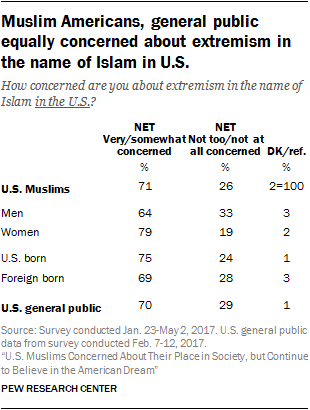
While U.S. Muslims are slightly less worried about Islamic extremism in the United States than around the world, their concern about domestic extremism is still high. About seven-in-ten American Muslims (71%) say they are at least somewhat concerned about extremism in the name of Islam occurring in the U.S. As with global extremism, the level of concern among Muslim Americans about extremism in the U.S. is very similar to the general public’s (70%).

Despite their concerns about Islamic extremism, only 17% of Muslim Americans say there is a great deal (6%) or fair amount (11%) of support for extremism among U.S. Muslims. Most say there is not much support for extremism (30%) or none at all (43%) among the U.S. Muslim community. This contrasts with the views of Americans in general. Compared with Muslims, twice as many people in the general public (35%) say there is at least “a fair amount” of support for extremism among Muslims who live in the U.S.

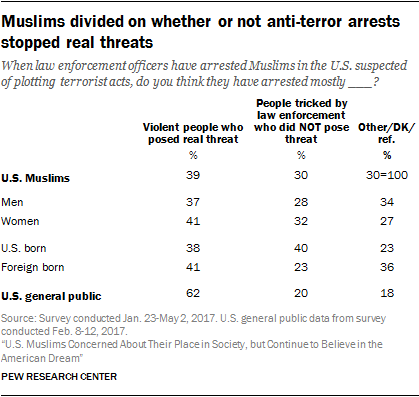
Muslim Americans also differ from the general public in their views on undercover sting operations and other police efforts to disrupt terrorist plots. Four-in-ten U.S. Muslims (39%) say that when law enforcement officers have arrested Muslims on suspicion of plotting terrorist acts, they have mostly arrested “violent people who posed a real threat.” But 30% say such arrests have mostly involved “people who were tricked by law enforcement and did not pose a real threat,” while an additional 30% say they are not sure or express no opinion.

The general public is less divided on this question: 62% of U.S. adults say anti-terror arrests have mostly stopped real threats, while only 20% say authorities mostly have entrapped people who did not pose a real threat.

Both Muslims and the general public also were asked if there are circumstances under which targeting and killing civilians can be justified in order to further a political, social or religious cause. Roughly eight-in-ten U.S. Muslims (84%) say such tactics can rarely (8%) or never (76%) be justified. The share of Muslims who say such tactics can often or sometimes be justified (12%) is similar to the share saying this among the general public (14%). And Muslims are more likely than the public as a whole to say that targeting civilians for political, social or religious causes can never be justified.

Source: U.S. Muslims are concerned about extremism in name of Islam | Pew Research Center

NGOs tell UN panel Canada is failing on racism: Paradkar

Shree Paradkar reports on the NGO critique of Canada’s record in combatting racism (Debbie Douglas of OCASI, Avvy Go of the Chinese & Southeast Asian Legal Clinic, Shalini Konanur, of the South Asian Legal Clinic of Ontario).

While their points are largely valid, they portray a completely bleak picture when surely the reality is more nuanced. This may be the nature of the process when their role is to prevent an alternative view to the more positive portrayal of the government response.

But it is surprising, given that all three are Ontario based, that they do not mention the province’s anti-racism strategy as an example that the federal government should emulate.

And surely, is the change of federal language towards diversity and inclusion, the increased diversity of appointments, and other policy initiatives of the current government not worthy of note, while allowing for criticism where needed?

Every day when I read news from around the world, I have occasion to feel thankful to be in Canada.

Yet, I was surprised this weekend to hear many Canadians, revolted by the events unfolding in Charlottesville, Va., say: At least we’re not as bad. In reality, our history, too, involves slavery, indentured labour, brutal oppression and colonization. Our country, too, has thriving right-wing extremism.

It’s not Canadian to be flashy and to shout out our deeds from the rooftops. The flip side of this modesty is, when history judges those actions to be misdeeds, we are able to dismiss them as trivial because they were not as glorified as they were down south.

The dismissal allows us to masks the past and ease our collective conscience.

It’s precisely a recognition of those past misdeeds, their present consequences and a reckoning of current laws that a group of prominent Canadian NGOs are seeking in Geneva Monday, when they ask a UN body to hold Canada’s feet to the fire for failing to keep its promises to end discrimination.

The Colour of Poverty — Colour of Change and its members are asking the United Nations Committee on the Elimination of Racial Discrimination (CERD) to recognize how Canada has “failed to comply with its international human rights obligations . . . and domestic human rights laws.”

“Racism is a matter of life and death,” for Indigenous peoples, their joint statement says, citing dismal socio-economic health indicators, suicides, murders and disappearances of thousands of people.

Both Indigenous and Black people are disproportionately poor and disproportionately represented in the criminal justice system.

“This is not the first time we brought this concern to the CERD committee, and yet very little has changed in more than a decade of our submitting shadow reports,” said Debbie Douglas, executive director of the Ontario Council of Agencies Serving Immigrants (OCASI).

The NGOs are calling for a national action plan on racism for Canada that would commit to combating discrimination in hiring, and funding anti-racist organizations.

Chiefly, it is seeking the collection of “disaggregated” data across all government departments.

This kind of data collection that specifies identities such as race, gender or disability is the minimum Canada needs so it can measure the impact of its policies whether in health or housing or jobs.

How do you try to solve a problem when you can’t quantify it?

“For instance,” says Avvy Yao-Yao Go, clinic director at the Chinese & Southeast Asian Legal Clinic, “Under the Federal Employment Equity Act, the federal government has data on the representation of women, ‘visible minority,’ Indigenous peoples and people with disabilities in the federal public service.

“However, we do not know, for instance, of the “visible minority” categories, what are the percentages for people of African descent versus people of Chinese descent versus people of South Asian descent. Or under (the category of) women, how many are women of colour and from which communities.” [Comment: Actually we do from census data – see my Federal Employment Equity and Religious Minorities in the Public Service)]

Or, take Canada’s immigration law that allows people detained for immigration purposes to be detained indefinitely. More than 6,000 people were held in 2016-17, the agencies say, although more than 90 per cent of them were not considered a security threat.

“We recently participated in a case in federal court that sought to challenge indefinite detention,” says Shalini Konanur, executive director of the South Asian Legal Clinic of Ontario.

“During that case we spoke with several detainees, and the vast majority were racialized. Currently, there is no race-based data being collected about detainees but we know anecdotally that racialized persons in Canada are disproportionately impacted by indefinite detention.”

The NGOs also want the federal and provincial government to remove barriers to the recognition of international training, and to amend the Ontario Human Rights Code to stop discrimination based on police data.

They are drawing attention to domestic laws that discriminate against specific groups.

In addition to immigrant detainees affected by law, migrant farm workers and caregivers such as nannies — the majority of whom are people of colour — are also vulnerable.

Migrant agricultural workers do not have access to permanent resident status. As for caregivers, their once guaranteed pathway to permanent residence was revoked in 2014.

Both groups have their work permit tied to a specific employer leaving them vulnerable to exploitation.

“While migrant workers contribute to social entitlement programs in Canada, their temporary status largely precludes them from accessing these programs,” said Amy Casipullai, an OCASI staffer.

The UN committee is expected to release its review on Aug. 25.

Source: NGOs tell UN panel Canada is failing on racism: Paradkar | Toronto Star