Evil Soros; Invisible Finkelstein-Orban’s Anti-Semitism – The Forward

Good long read on the complex relationships between Orban, Soros and Finkelstein:

At the time, conservatives and liberals from across the spectrum hailed Soros’s work.

In the difficult years of post-communist transition, Soros’s foundations provided humanitarian assistance in the form of school breakfasts and hospital equipment. Today, his foundations still provide some funding to nongovernmental organizations in Central and Eastern Europe — in particular in the human rights field. CEU, in the heart of Budapest, was designed as an English-language magnet school for Central and Eastern Europe’s best and brightest, and has become world-renowned.

 Soros, Konrád observed in his open letter to the prime minister, “devoted a considerable part of his fortune to young students’ needs, allowing the state to direct its resources elsewhere. He established a number of outstanding institutions in Hungary, even though in 1944 this land dealt with him so callously that it nearly cost him his life.”

Yet despite Orbán’s bristling against Soros as a foreign influence, his Fidesz party has been working for nearly a decade with Finkelstein, a New York-born secular Jew who is not afraid of embracing the very stereotype that Orbán deploys against Soros. Asked by Ronald Reagan biographer Craig Shirley early on in their friendship whether he pronounced his last name as “Finkelsteen” or “Finkelstine” (with a long ‘i’), the consultant replied, “If I was a poor Jew, it would be Finkelsteen, but since I am a rich Jew, it’s Finkelstine.”

Finkelstein, moreover, is a gay rich Jew, long married to a male partner. Nevertheless, the self-professed libertarian, who first imbibed his ideology as a Columbia University student directly from libertarian icon Ayn Rand, has been critical to putting in office as prime minister a man with the declared goal of converting Hungary from a liberal democracy into a more authoritarian, government-heavy “illiberal state,” one with restricted rights for gay men and lesbians. In 2014, Orbán praised Russia, Turkey and China as “successful nations…none of which is liberal and some of which aren’t even democracies.”

“I don’t think that our European Union membership precludes us from building an illiberal new state based on national foundations,” he said.

Over the decades, Finkelstein, who worked early on for Richard Nixon’s 1972 presidential campaign, has rarely let his ideology interfere with his choice of clients, as long as those clients were on the right. Some estimate that at one point in the 1980s, half of Republican U.S. senators were Finkelstein clients. But over the past two decades, Finkelstein’s focus shifted abroad, where he did his most high-profile work for Israel’s Netanyahu.

GEB International, a consultancy under the leadership of Finkelstein and fellow strategist George E. Birnbaum, has taken credit for the election of Ariel Sharon and the success of Avigdor Lieberman’s Yisrael Beiteinu party in 2009. Finkelstein also reportedly orchestrated the 2012 alliance between Likud and Yisrael Beiteinu.

Through GEB International, Finkelstein has been providing consulting services to Fidesz since 2008, helping shape the party’s strategy in both local and national elections, including its control of a two-thirds majority in parliament.

Finkelstein’s successes — in the United States, Israel and Central Europe — can be attributed in large part to his approach to political communication.

“He likes campaigns that have signature issues, where the candidate would be known for one issue or a series of related issues,” Shirley said.

This approach has been evident in Orbán’s campaigns, which often focus on one simple message repeated over and over again — as has been the case with the prime minister’s repeated attacks on Soros.

…Orbán’s relationship with Hungary’s Jewish community, estimated at roughly 120,000 people in a country of 10 million, is complex. According to a recent survey, about 37% of Hungarians hold anti-Semitic views, telling pollsters that they “agree” or “completely agree” that “there’s too much Jewish influence in Hungary.” This was an increase from previous years: In 2013, only 27% gave positive replies to this question.

Growing up outside Budapest, Orbán likely had little exposure to Jews, who reside primarily in Budapest, before he moved to the capital to attend university. When he initially began his political career as a young, liberal anti-Communist in the late 1980s, however, he befriended Jewish Hungarian intellectuals and dissidents. Unusual for a Hungarian not of Jewish origin, Orbán’s eldest daughter, born in 1989, was given the Hebrew name Ráhel.

But very few Hungarian Jews supported Orbán’s nascent political party, and as Orbán began moving more and more to the right and adopting a nationalist stance, he alienated much of the Jewish community.

“During the [2013] World Jewish Congress in Budapest… Orbán spoke about ‘us’ the Hungarians and the ‘Jews,’” Pfeifer recalled. In the United States, he pointed out, it would be unimaginable for a sitting president to refer to “Americans” and “Jews” as separate groups.

For many Hungarian Jews, Orbán crossed a red line in 2014, when his government constructed a memorial to the “victims of German occupation” that many, including the U.S. State Department, saw as rejecting Hungary’s own complicity in the Holocaust. The Jewish community has since set up a permanent informal memorial to the victims of the Holocaust as a protest against what it sees as the government’s distortion of history.

But Orbán’s rhetoric on Soros over the past months has raised new concerns about government-sponsored anti-Semitism.

Konrád told Orbán in his open letter, “The real turning point for me was that, in the interest of the arbitrary extension of your power, you dipped into the hypocritical repository of political anti-Semitism and pulled out its shrill slogans with both hands.”

Not everyone shares this view.

“Prime Minister Viktor Orbán’s policies aren’t anti-Semitic at all,” the Federation of Hungarian Jewish Communities, known as MAZSIHISZ, said in a statement to the Forward. “His government supports the large Jewish organizations in achieving their goals, the Jewish community is not a victim of any kind of official discrimination, and there’s no real chance that it will change in the foreseeable future.”

Similarly, Slomó Köves, executive rabbi of EMIH Unified Hungarian Jewish Congregation, an affiliate of Chabad, told Hungarian state media May 12 that he “does not know of an internationally accepted norm” by which anti-Soros rhetoric is considered anti-Semitism.

Both Köves’s Chabad operation in Hungary and MAZSIHISZ receive significant funding from the government. Köves did not respond to emailed questions from the Forward.

Source: Evil Soros; Invisible Finkelstein-Orban’s Anti-Semitism – The Forward
Douglas Todd: Some immigrants’s values contrast with ‘Canadian’ values

The fallacy in Todd’s article and related analysis is his assumption that values are static, not dynamic. Values can and do change  over time and over generations.

The Canadian benchmark in the World Values Survey includes the 20 percent of the population which is foreign-born as well as the 17 percent who are second generation immigrants. In other words, the Canadian baseline is not “old-stock” white Canadians but a mix of “old” and “new” stock.

So what he presents as a duality is actually a more complex mix that emerges through the Hegelian integration dynamic between immigrants (first and second generation) and the increasingly diverse “host” society.

Todd’s analysis also assumes that first generation immigrants have completely identical values than the population of their country of origin, which may or may not be true given that Canada tends to select more highly educated immigrants.

That is not to say that there are no value differences among groups on any range of issues, but just caution against overly simplistic depictions and assumptions:

In his unscientific yet credible book, McGoogan considers how the nine million Canadians who claim Scottish or Irish heritage have strengthened certain values in Canada — such as “independence” (exemplified by rebel Michael Collins), pluralism (exemplified by gay writer Oscar Wilde and mixed-race B.C. governor Sir James Douglas) and “democracy” (exemplified by egalitarian poet Robbie Burns and prime minister Sir John A. McDonald).

“Did the ancestors of more than one-quarter of our population arrive (in Canada) without cultural baggage? No history, no values, no visions?” McGoogan asks. “Surely the idea is ridiculous.”

Indeed, it’s absurd many Canadians assume people arrive from Ireland, Egypt or China without both individual and ethno-cultural traits.

So it’s especially worthwhile to learn about values widely held in Canada’s biggest immigrant-source countries.

The top sources of immigrants to Canada include China, India, South Korea, Iran and the Arabic-speaking countries of the Middle East, all of which have had their values measured by the WVS.

How do the values emphasized in these countries play out in Canada’s major cities, where the potential for inter-cultural exchange is high in schools, businesses and neighbourhoods?

We’ll start with Montreal, where one of five residents is foreign born, many from Arabic-speaking countries.

A particularly valuable question the WVS asks parents is: “What qualities would you most like to see in your children?”

As The Vancouver Sun and Province’s online interactive chart shows, it turns out more than 65 per cent of parents from Arabic-speaking countries, such as Egypt, Jordan and Iraq, strongly stress “obedience.”

However, only 30 per cent of Canadian parents name “obedience” as an important quality, suggesting the contrast could make for intriguing interactions in Montreal schools.

What do we discover when we turn to Metro Vancouver and Toronto, where foreign-born people make up almost half the population and two of the largest immigrant-source countries are China and India?

It turns out only 16 per cent of parents in China strongly emphasize obedience. But the stress on obedience rises to 56 per cent among mothers and fathers in India.

What about “hard work?” It can determine success in the competitive fields of education and business, not to mention in whether a potential friend goes skiing?

The WVS found 90 per cent of parents in China say hard work is a crucial value. That emphasis declines slightly among the parents of India. Meanwhile, the proportion of all Canadian parents who want their children to work hard is only 54 per cent.

However, Canadian parents are not too different from the parents of China and India in regards to “unselfishness.” While 47 per cent of Canadian parents emphasize unselfishness, so do 35 per cent of Chinese and Indian parents. That’s unlike South Korean parents, only 12 per cent of whom stress the virtue of self-sacrifice.

The lesson of the WVS is that values are all over the map, literally.

And it’s especially true when it comes to religion.

More than nine of 10 parents in the Muslim-majority countries of Egypt and Iraq, for instance, strongly emphasize “religious faith.”

But fewer than one in 10 parents in Germany and China — and just three in 10 in Canada ­— care if their children believe in God.

The World Values Survey, like all polls, is imperfect, missing subtleties and regional variations. But it’s a reminder the sooner we take ethnocultural differences seriously, the sooner we become knowledgeable about why people are the way they are.

The implications can be significant. We may start to recognize, for instance, why people with roots in China tend to vote for certain Canadian political parties, while those linked to India are inclined to vote for others.

And — unless we’re utter moral relativists — the sooner we understand ethnocultural differences, the sooner we might take seriously the values we ourselves are ready to stand for, reject or tolerate.

Source: Douglas Todd: Some immigrants’s values contrast with ‘Canadian’ values | Vancouver Sun

Whether it’s a nick or full circumcision, female genital mutilation is about control: Paradkar 

Paradkar on FGM and the Dawoodi Bohras, a small sect of Ismaili Shia Muslims from India and Pakistan:

Circumcision of boys, a controversial and emotionally charged topic, is almost always by medical doctors (and not by a razor blade in a dark room), so you could say there is some comfort in a reduced risk of harm.

Science scrambled to catch up with that cultural practice and has thrown up contradictory results.

Female circumcision has no known medical benefits.

Then there is an added insult in the Bohra community. Circumcision of boys is openly celebrated. For girls, “it’s a very secretive practice,” says Doctor. “Often, the men don’t even know it’s happening to their daughters.”

So shrouded is it in secrecy that a celebration held after the cutting doesn’t even mention the girl has undergone khatna, the circumcision.

Get wounded, then hide in shame.

Like parents who circumcise their boys, women do this to their girls believing it to be in their interest.

In reality, in whose interest is it?

“It does damage to nerve endings,” says Doctor. “There’s psychological harm that makes them (women) afraid of sex. There’s pain during sex, risk of infections.”

Stories by affected women indicate it’s about male sexual insecurities.

“When a woman’s urge is moderated, many sins are eliminated from society,” says a young woman in A Pinch of Skin.

Urge to do what? To seek attention? To have sex? To have orgasms?

There’s no clarity on this, because talking about sex is taboo, as is talking about genitals.

The taboo allows for vagueness to conveniently mask what is essentially a caging of female desire.

Circumcision, whether it’s a symbolic nick, as some now claim, or a removal of the clitoral hood or clitoris, is a mark of sexual control over female bodies in this traditionally entrepreneurial culture where men travelled far as traders and were away from their wives and families for a long time.

It’s an interference that hoodwinks women into confining little girls in a chastity belt.

No such restraints for the travellers.

Source: Whether it’s a nick or full circumcision, female genital mutilation is about control: Paradkar | Toronto Star

Commentary: Competition for benefits of second citizenship is global | Caribbean News Now

Rationalization of Caribbean citizenship investment programs by pointing to comparable programs among developed countries. These programs will always be at risk for abuse and minimal benefits:

The point is: there is a demand in the global market for second citizenships. It is a demand worth billions of dollars, and many governments, including some who criticise the Caribbean for its CIPs, are very much involved in it.

The world’s top destination for millionaires seeking another citizenship is Australia. The second is the United States. And, neither of them has been a passive recipient of millionaires and their money. Both have active programmes, designed to lure millionaires to their shores. These programmes are cast as schemes for permanent residence leading to citizenship; they differ only in the length of the process, not in the purpose of them.

In 2012, Australia introduced a ‘golden ticket’ investor visa for US$3.8 million that has attracted more than 1,300 millionaires. It also has a cheaper programme at $770,000 that allows temporary residence and takes longer to get a permanent visa.

For 27 years, the United States has been operating what is called an ‘EB-5’ programme. It requires a $500,000 investment for a two-year visa, which can be turned into permanent residence and eventually citizenship. Since 2012, the programme has generated at least $8.7 billion for the US economy. While, originally, it was meant to help finance projects in low-income areas, it has been used to attract Chinese millionaires to invest in high-end real estate projects.

Until three years ago, Canada was the third highest beneficiary of visa-investment programmes. Canada scrapped the programme in 2014, but two months ago, Quebec announced that, on the May 29, it will launch the Quebec Immigrant Investor Programme. For CAN$800,000 that programme provides permanent residence leading to citizenship in Canada. Not surprisingly, the programme, while open for 1,900 applicants, is providing for 1,330 applicants from the Peoples Republic of China.

In the Australia programme, nearly 90 percent of the 1,300 who signed-up were from China.

The point is many of the governments that express concern about Caribbean CIPs, run such programmes themselves earning billions of dollars and targeting the same millionaire communities as do the Caribbean jurisdictions.

The Caribbean has a right to a share of the feast on the global table, and not just to the crumbs that remain after others have fed themselves. Those, who continuously condemn the CIPs, also fail to acknowledge that all the governments, including those in industrialised nations that operate these programmes – by whatever name they are called – do so as a means of bringing revenues and investment into their countries. Small Caribbean countries have the same motivation; they have adopted these programmes out of economic necessity.

But, having said all that, Caribbean countries with CIPs should be aware that the critics hang their disapproval of CIPs on the peg of money laundering, tax evasion and terrorism. They claim that CIPs can be used for these purposes, even though they have failed to explain how or to produce evidence of instances where it has occurred.

That is why what is crucial to the success of these programmes and their acceptability, is vigorous, intense and transparent scrutiny of the applicants for citizenship. For the programmes to be successful, they certainly need applicants of high worth – and, in this regard, Caribbean jurisdictions must create new and exciting reasons why their citizenship is competitive and desirable – but they also require great comfort by the governments of countries to which the successful applicants will travel.

Source: Commentary: Competition for benefits of second citizenship is global | Caribbean News Now

ICYMI: Safeguarding Islam’s past for future generations – BBC News

Worth noting (but uneven, as Saudi Arabia’s development of Mecca and Medina illustrates):

A recent conference in Bahrain brought together experts in Islamic archaeology to discuss the lessons of the past and how to safeguard Muslim heritage for future generations.

Under the blistering Bahraini sun archaeologist Salman Al Mahari and his team are excavating a section on the western side of the Al-Khamis mosque site.

With its twin minarets the mosque used to act as a landmark for ships at sea guiding them to land in the 14th century.

But today, excavating the mosque has a far more important function as Islamic archaeology takes on the extremists at their own game.

At a recent conference in Manama, the capital of Bahrain, archaeologists working in over 14 Islamic countries around the world participated in a first of its kind conference.

Islamic Archaeology in Global Perspective brought together some of the most distinguished scholars working in the field of Islamic archaeology to share first hand their recent practical experience in countries torn apart by war, and to investigate the various influences on the science of archaeology.

New Zealander, Alan Walmsley, Professor of Islamic Archaeology and Art at the University of Copenhagen says his investigations aim to disseminate a fuller account of social, cultural, and economic developments in Arab and Islamic history. “I interrogate faded and misinformed historical narratives,” he explains.

He begins by unpicking past Western interest in Bilad Al-Sham, an historic region of the Middle East known as Greater Syria.

“Islamic discoveries were incidental to the objective of archaeological interest in Greater Syria,” he says.”The focus of digs were on the Biblical, Hellenistic and Classical past. These earlier periods took precedence in research.”

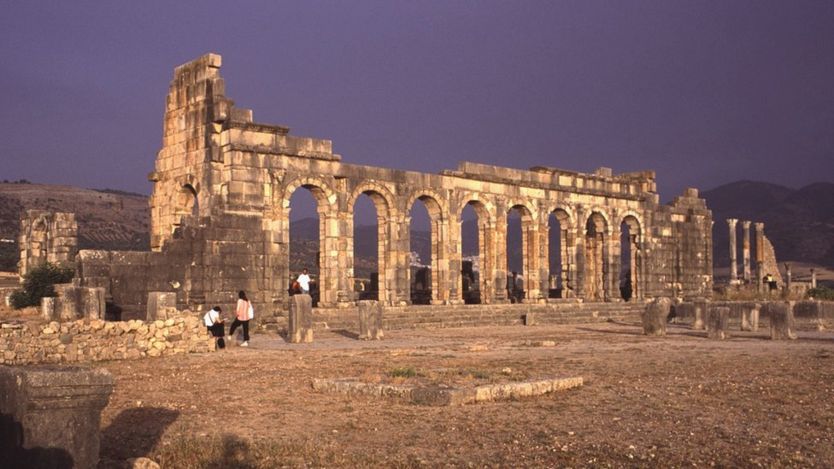
VolubilisImage copyrightRICHARD DUEBEL
Image captionThe site of Volubilis in Morocco is a Roman and Islamic site

Animosity between Islam and the West compounded the lack of interest in Muslim remains according to Alastair Northedge, professor at the Universites de Paris 1.

He spoke in the context of his recent trip to Iraq, about the West’s overwhelming concerns with their own past. “There is quite a good example in Iraq,” he says. “Babylon seems to belong to the West.”

Corisande Fenwick, a lecturer in Archaeology of the Mediterranean at University College London (UCL) took time to describe painstaking research into food remains indicating when pork was no longer consumed and so revealing the pace at which Islam was established across the Maghreb region.

She attributes the Western assessment of archaeological finds prior to the mid-1950s to a colonial interpretation.

“If you go back before independence, archaeology is all driven by colonial scholars,” she says.

“They were attracted by the exotic nature of their finds. That reinforced the idea that the Islamic world was somehow different and needed to be controlled by colonial powers,” she adds.

But it is not just a Western agenda that has shaped excavations in the Muslim world. Alastair Northedge also notes that Muslims themselves have not always been concerned with protecting the material heritage of the great spiritual sanctuaries.

“It is not just Mecca and Medina, but also Shia shrines in Najaf and Karbala in Iraq” he says.

“There seems to be a preference for building something new rather than conserving the old because the emphasis is on the spiritual nature of these places not their materiality.”

But a wider vision is coming and the rise in the number of excavations throughout the Gulf area attests to a burgeoning interest in the material past. St John Simpson, archaeologist and senior curator at the British Museum, says that a revival of interest in Islamic archaeology is long overdue.

“It’s part and parcel of a search for Muslim cultural identity,” he explains. It is also an opportunity to redress earlier misconceptions.

“Since the 19th century and continuing though much of the 20th century commercial excavations led by dealers have in parts of the world flooded the market with objects which were traditionally celebrated by art historians,” Dr Simpson says. “They celebrated the beauty of those pieces and therefore reconstructed material cultures on the basis of those objects.”

Source: Safeguarding Islam’s past for future generations – BBC News

Transition from temporary foreign workers to permanent residents

Former Minister Alexander’s asserted before CIMM during its study of C-24 that:

…it’s very important to distinguish between the two different broad categories of status that non-Canadian citizens can have here. One is temporary resident status and the other is permanent resident status. We are saying that the time that will count toward citizenship is permanent resident status. We don’t want those lines to be blurred. (28 April 2014)

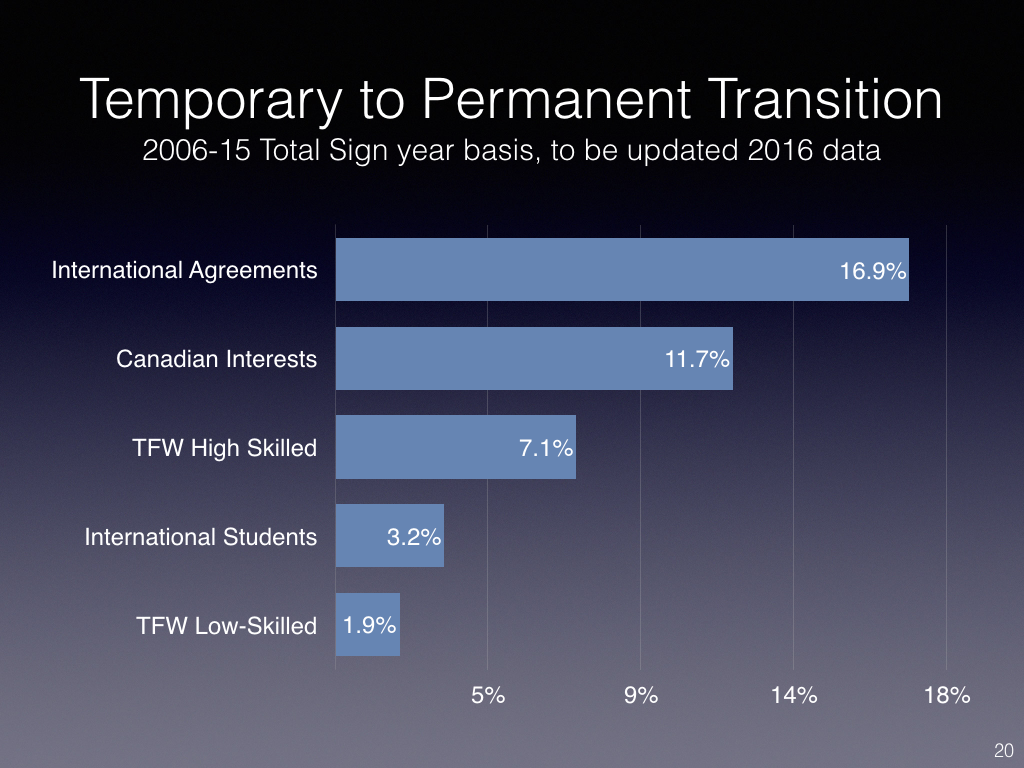
This latest Statistics Canada belies that dichotomy, as do IRCC’s Open Data data sets (my chart below based upon this series – Transition from Temporary Resident to Permanent Resident Status.

There were 310,000 temporary work permit holders on December 31, 2015, accounting for 1.7% of the national employed workforce. The number of TFWs has more than quadrupled since 2000 (Immigration, Refugees and Citizenship Canada 2017).

Over the 2000s, immigration to Canada was increasingly drawn from TFWs. For instance, the proportion of newly landed adult immigrant men already holding a job in Canada rose from 16.3% in 1999 to 28.9% in 2010. Most of this increase consisted of immigrants who had high-paying jobs in Canada before attaining permanent resident status.

About 9% of TFWs who came to Canada between 1995 and 1999 became permanent residents within five years of receiving their first work permit. This was the case for 13% of those who came to Canada between 2000 and 2004, and for 21% of those who came between 2005 and 2009.

Most transitions from TFW status to permanent resident status occurred within the five years following receipt of the first work permit. The rate rises another 1 to 3 percentage points by the 10th year, with little increase observed thereafter.

Transition rates

The rate of transition to permanent residence varied by type of work permit. Among those who came to Canada between 2005 and 2009, the five-year transition rate was highest among those in the Live-in Caregiver Program (LICP), at 56%, and the Spouse or Common-law Partner category, at 50%. The lowest rates for transition to permanent residence were among those in the Seasonal Agricultural Workers Program (SAWP), at 2%, and the Reciprocal Employment category, at 9%.

A large difference in the transition rate by type of work permit is a result of government policy. For example, while all those in the LICP are allowed to apply for permanent residence after two years of full-time work as domestic workers, SAWP workers have no dedicated stream for transition, and may only be employed for a maximum of eight months per year. Their SAWP permits, however, can be renewed over many years.

Source: Transition from temporary foreign workers to permanent residents

Manchester attack: It is pious and inaccurate to say Salman Abedi’s actions had ‘nothing to do with Islam’ | The Independent

Patrick Cockburn on Salafism and Saudi Arabia’s role in spreading fundamentalism. Bit over the top in terms of wording used, but basic point about Saudi Arabia’s role valid:

In the wake of the massacre in Manchester, people rightly warn against blaming the entire Muslim community in Britain and the world. Certainly one of the aims of those who carry out such atrocities is to provoke the communal punishment of all Muslims, thereby alienating a portion of them who will then become open to recruitment by Isis and al-Qaeda clones.

This approach of not blaming Muslims in general but targeting “radicalisation” or simply “evil” may appear sensible and moderate, but in practice it makes the motivation of the killers in Manchester or the Bataclan theatre in Paris in 2015 appear vaguer and less identifiable than it really is. Such generalities have the unfortunate effect of preventing people pointing an accusing finger at the variant of Islam which certainly is responsible for preparing the soil for the beliefs and actions likely to have inspired the suicide bomber Salman Abedi.

The ultimate inspiration for such people is Wahhabism, the puritanical, fanatical and regressive type of Islam dominant in Saudi Arabia, whose ideology is close to that of al-Qaeda and Isis. This is an exclusive creed, intolerant of all who disagree with it such as secular liberals, members of other Muslim communities such as the Shia or women resisting their chattel-like status.

What has been termed Salafi jihadism, the core beliefs of Isis and al-Qaeda, developed out of Wahhabism, and has carried out its prejudices to what it sees as a logical and violent conclusion. Shia and Yazidis were not just heretics in the eyes of this movement, which was a sort of Islamic Khmer Rouge, but sub-humans who should be massacred or enslaved. Any woman who transgressed against repressive social mores should be savagely punished. Faith should be demonstrated by a public death of the believer, slaughtering the unbelievers, be they the 86 Shia children being evacuated by bus from their homes in Syria on 15 April or the butchery of young fans at a pop concert in Manchester on Monday night.

The real causes of “radicalisation” have long been known, but the government, the BBC and others seldom if ever refer to it because they do not want to offend the Saudis or be accused of anti-Islamic bias. It is much easier to say, piously but quite inaccurately, that Isis and al-Qaeda and their murderous foot soldiers “have nothing to do with Islam”. This has been the track record of US and UK governments since 9/11. They will look in any direction except Saudi Arabia when seeking the causes of terrorism. President Trump has been justly denounced and derided in the US for last Sunday accusing Iran and, in effect, the Shia community of responsibility for the wave of terrorism that has engulfed the region when it ultimately emanates from one small but immensely influential Sunni sect. One of the great cultural changes in the world over the last 50 years is the way in which Wahhabism, once an isolated splinter group, has become an increasingly dominant influence over mainstream Sunni Islam, thanks to Saudi financial support.

The culpability of Western governments for terrorist attacks on their own citizens is glaring but is seldom even referred to. Leaders want to have a political and commercial alliance with Saudi Arabia and the Gulf oil states. They have never held them to account for supporting a repressive and sectarian ideology which is likely to have inspired Salman Abedi. Details of his motivation may be lacking, but the target of his attack and the method of his death is classic al-Qaeda and Isis in its mode of operating.

The reason these two demonic organisations were able to survive and expand despite the billions – perhaps trillions – of dollars spent on “the war on terror” after 9/11 is that those responsible for stopping them deliberately missed the target and have gone on doing so. After 9/11, President Bush portrayed Iraq not Saudi Arabia as the enemy; in a re-run of history President Trump is ludicrously accusing Iran of being the source of most terrorism in the Middle East. This is the real 9/11 conspiracy, beloved of crackpots worldwide, but there is nothing secret about the deliberate blindness of British and American governments to the source of the beliefs that has inspired the massacres of which Manchester is only the latest – and certainly not the last – horrible example.

Source: Manchester attack: It is pious and inaccurate to say Salman Abedi’s actions had ‘nothing to do with Islam’ | The Independent

Government accused of hoarding Canadian history in ‘secret’ archives

Hard to know whether deliberate policy or, what I think may be more likely, lower priority and capacity constraints:

Some of Canada’s leading historians say the federal government is putting the country’s historical record at risk by hoarding piles of documents inside secret archives that together would make a stack taller than the CN Tower.

Historian Dennis Molinaro of Trent University discovered ministries and agencies are stockpiling millions of decades-old papers rather than handing them over to Library and Archives Canada for safekeeping and public access. He’s launched a petition to try to convince the government to set them free.

The Canadian Historical Association (CHA) has joined his campaign and is calling on the government to mark Canada’s 150th anniversary by overhauling the laws on access to government records.

“It’s very disturbing that there are caches of documents about which we know very little. We don’t even know the extent of this,” said CHA president Joan Sangster, a colleague of Molinaro’s at Trent in Peterborough, Ont., where she teaches labour and women’s history.

As part of his research, Molinaro has been asking government departments to hand over information about Canada’s Cold War domestic spy and surveillance programs run by the RCMP. Last fall, the federal government initially refused his access-to-information request for the papers (which were never transferred to the national archives) concerning a 65-year-old top secret RCMP wiretapping program dubbed Project Picnic.

One day after CBC News reported on Molinaro’s battle with the bureaucracy, officials notified him they would release the 1951 “secret order” that authorized the wiretapping program targeting suspected Soviet spies and other subversives, signed by Prime Minister Louis St-Laurent.

‘Secret or shadow archive’

Access-to-information officials have told Molinaro the Privy Council Office holds at least 1.6 million more pages from the era, many of which could concern Cold War counter-espionage programs. He’s also learned many more intelligence-related records dating back four, five and six decades are being held by the Communications Security Establishment (CSE) and the departments of Justice and Foreign Affairs.

He’s been told in email exchanges that there’s currently no public list to help him — or any other researcher — understand, let alone access, these mountains of papers kept inside closed government storerooms.

“The government seems to be, in essence, running some kind of secret or shadow archive,” Molinaro told CBC News.

Keeping millions of records from the national archives is “appalling,” he said.

“You’re hiding the historical record from the Canadian people.”

He says the problem extends far beyond his own research interest of domestic surveillance.

“Think of how many events from the Cold War … The Cuban Missile Crisis … RCMP counter-intelligence operations, foreign intelligence operations,” he said. “What else is there on other topics? On Indigenous affairs and relations? What else is in different government institutions on a variety of topics?

“We don’t know.”

CBC News asked various government departments to identify how much historical material they keep that’s more than 30 years old — and why.

The Privy Council Office (PCO) revealed it has “1,430 cubic feet” (40.5 cubic metres) of government records dating back many decades.

docsgraph

PCO says transfer of these cabinet documents, discussion papers and records to Library and Archives Canada (LAC) is “time-consuming” and first requires wide consultation to ensure classified information isn’t released improperly.

The office says it’s looking at recommendations to declassify a large block of “legacy” information from 1939-1959, and considering transferring cabinet minutes and documents from the 1980s to LAC.

The CSE, Canada’s electronic spy agency, acknowledges it, too, is struggling to sort 128 linear metres of boxes of “legacy” records that are more than three decades old before handing them over to LAC.

The Foreign Affairs Department, Canadian Security Intelligence Service and the RCMP all declined to say how much historical material they continue to store.

Source: Government accused of hoarding Canadian history in ‘secret’ archives – Canada – CBC News

The Benefits of Citizenship in Nicaragua for High-Net-Worth Individuals

Nicaragua must have one of the cheapest programs – USD 100,000:

Are you a high-net-worth individual that travels internationally? Are you frustrated by lack of access to countries on your current passport? Open up your destination options with the power of citizenship by investment.

Citizenship by investment allows wealthy individuals the opportunity to gain a second passport that enables them a high level of access to many first-world nations. Your second passport will give you the freedom to effortlessly travel the world.

Save time and eliminate the hassle of travel with a second passport. By directly investing in the Nicaraguan economy, you qualify for nationality and the benefits that come from being a Nicaraguan passport holder.

The Benefits of Nicaraguan Citizenship for Investors

Freedom of travel is vital for any investor. Time spent in transit, or applying for visas in person can feel frustrating, especially when you have more pressing business issues to attend to.

There are many different citizenship by investment programs available from a variety of countries. However, Nicaragua offers very good value for money when you consider the advantages.

  • Affordable cost of living and fantastic real estate prices.
  • Stable government and economic conditions.
  • Good schooling and favorable tax laws.
  • Friendly locals and good public services.

Nicaragua does not require you to reside in the country for any specific period of time to keep your citizenship. You have complete freedom of movement to live anywhere in the world that you desire and still reap the advantages of a Nicaraguan passport holder. Here’s what you can expect from your second passport;

  • No restrictions on travel to 112 countries, no visa required.
  • Live & work in any of the 26 countries in the Schengen zone.
  • Pension & medical programs.
  • 5-year, renewable passport with drivers license and national ID card.
  • 60 day processing period.

With all of the advantages available to you, it’s easy to understand why Nicaraguan passport is ranked among the top 50 in the world to hold.
The Process – How CBI Programs Work

By directly investing in the Nicaraguan economy, you are entitled to nationality and a second passport. This direct investment is offered in two different formats for the investor to choose from.

  • Purchasing real estate in Nicaragua, to the value of US$100,000 or more.
  • Making an investment of US$100,000 into the Nicaraguan “Sociedad Anónima” corporation, refundable after the investment term has expired.

Receive Your Second Passport by working with CBI Professionals

Source: The Benefits of Citizenship in Nicaragua for High-Net-Worth Individuals

Australia: Turning statistics into art: Exhibition explores multiculturalism, changing landscapes through numbers | SBS News

Interesting approach and exhibit, and link to Indigenous peoples:

A new art exhibition will explore the changing faces – and numbers – behind one of Australia’s biggest multicultural districts.

The exhibition ‘looking at me through you’ enlisted a group of artists to incorporate statistics from Deloitte Access Economics into a series of contemporary art pieces that reflect and challenge people’s perceptions of greater Western Sydney.

Campbelltown Arts Centre will showcase the works from May 27 to July 23.

“We asked 12 artists to look at Western Sydney through statistics, which are very neutral and subjective, and come up with some ways to tell the Western Sydney story through contemporary art,” director Michael Dagostino said.

“Rather than looking at the negative stereotypes that are portrayed in the media and other people’s lenses, we look through it and say ‘look, there’s different possibilities’.”

The pieces include models, portraits and short films exploring multiple themes unfolding throughout Campbelltown and beyond, ranging from urban development to political and cultural identity.

Artist James Nguyen chose to focus on the changing nature of land usage by creating a communal herb garden in the Arts Centre’s amphitheatre, inspired in part by his Vietnamese heritage.

“When you’re a migrant one of the first things to prove that you’re a contributing member of society is to acquire land, to build your own home, start your family,” he said. “So it’s that whole thing of linking success to settlement.”

But Nguyen added that many migrants ignore the history of the land they now occupy.

“A lot of migrants feel they don’t have the responsibility of acknowledging Aboriginal sovereignty,” he said.

“The reality is you have to deal with the histories that are already there. As migrants, I think there’s a role for us to acknowledge that sovereignty.”

Damien Shen, an artist of Chinese and Indigenous descent, was also keen to illustrate Campelltown’s Indigenous history and legacy.

After meeting with local elder Aunty Glenda Chalker, he painted portraits of her, along with her son and grandson.

“I’ve always been fascinated with people’s faces,” he said. “The history is often in the skin.

“You see the face, you’re looking into the eyes, and you can almost get a sense of what someone’s soul is like. I find it quite gripping.”

Source: Turning statistics into art: Exhibition explores multiculturalism, changing landscapes through numbers | SBS News