After St. Petersburg bombing, a notable absence: Russian anti-Islam backlash – CSMonitor.com

Interesting take:

Russia has been at war with Islamic enemies for over 500 years. Over the centuries, it fought long battles to subdue Tatars and other Muslim tribes who are now part of Russia. It also waged wars against the Persian and Turkish empires, incorporating many of their former territories into Imperial Russia.

Today, some of Russia’s most “troublesome” minorities are traditionally Muslim people with long histories of conflict with Russia, such as Chechens and Crimean Tatars. But so are some of its most successful and prosperous regions, especially Tatarstan, which has found its own formula for quelling internal Islamist extremism and co-existing, sometimes uneasily, with Moscow.

That’s one reason why most Russians don’t see Muslims as a faceless “other,” but are able to differentiate between different groups of them, says Alexey Malashenko, an Islam specialist with the Moscow Carnegie Center.

“We’ve been living among and, yes, sometimes fighting these people for hundreds of years. We know them,” he says. “The average Russian can tell the difference between a Chechen, a Tatar, an Uzbek, and a Tajik and, believe me, there are big differences. There is a great deal of xenophobia under the surface in Russia, and sometimes it comes out,” as it has in occasional urban race riots between Russians and migrant laborers – who are especially numerous in big cities like Moscow.

“But overt anti-Muslim political appeals, such as you do see in some Western countries, are absolutely impossible in Russia. Our authorities do not need or want the instability that could result from playing that card,” he says.

Vladimir Putin and other Russian leaders have been very careful to separate Islam from terrorism, and to make that a frequent public message.

Two years ago Mr. Putin presided, alongside Turkish President Recep Tayyip Erdoğan and the president of the Palestinian Authority, Mahmoud Abbas, at the inauguration of the $170 million new Moscow Cathedral Mosque, a huge downtown temple that can accommodate 10,000 worshipers. With an eye both to Russia’s millions of Muslims and Russia’s growing role in the Middle East, he used the occasion to condemn Islamist extremism.

“We see what’s happening in the Middle East where terrorists of the so-called Islamic State discredit a great world religion, discredit Islam by sowing hate, killing people, and destroying the world’s cultural heritage in a barbaric way. Their ideology is built on lies, on open perversion of Islam. They are trying to recruit followers in our country as well,” he said.

The powerful Orthodox Church has also walked a cautious line. When Russia intervened in Syria almost two years ago, church officials hailed it in potentially inflammatory terms as a “holy war.” But the church, too, has been at pains to stress that it is a fight against “terrorism,” not Islam, and has repeatedly called for an alliance between moderate Christians and Muslims to combat extremism.

Familiar suspicions

Still, a more familiar Islamophobia bubbles not far beneath the surface. While Russia’s authoritarian political culture keeps it mostly bottled up for now, any survey of the country’s freewheeling social media will turn up plenty of small but clearly active groups who express the kind of militant anti-immigration, anti-foreigner, and anti-Muslim views that are familiar in the West.

“Potentially, any foreign citizen coming here is a threat,” says Valentina Bobrova, a leader of the National Conservative Movement, a small group in the central Russian city of Podolsk. “Islam … is an aggressive religion. We feel that it is attacking, trying to seize territories, minds, and souls in Russia, just as it is in Europe.”

And the story of Ilyas Nikitin, a Russian Muslim whose photograph was mistakenly circulated as a suspect in the St. Petersburg bombing, is a cautionary signal of how quickly grassroots suspicion and ill-will can erupt. Despite being cleared by police, he was subsequently forced off an airplane when terrified passengers complained, and arrived at his home in the west Siberian city of  Nizhnevartovsk to find he’d been fired from his job.

“You can’t say there is Islamophobia in Russia,” says Rais Suleymanov, an expert with the security services-linked Institute of National Strategy. “But when some act of terrorism is committed by radical Islamists, average people are quick to project all of their underlying fears onto that [Islamic] doctrine.”
Source: After St. Petersburg bombing, a notable absence: Russian anti-Islam backlash (+video) – CSMonitor.com

How to defeat racism? Get to know one another: Nawaz

Zarqa Nawaz’ concluding para worth noting:

Today we have parents freaking out because Muslim teenagers want to pray in schools. If anyone can get a teenager to put their smartphones away for five minutes to commune with God, good luck to you. Praying is a dying art. Ask white people, even the Irish ones. One local is offering $1,000 to students to videotape hate speech at a Muslim prayer service. But why stop there? Any group that promotes hate should face the same scrutiny.

As my friend Sheema Khan said at the Woodrow Lloyd Lecture at the University of Regina last week, fighting racism means recognizing “alternative facts” that are spread about Muslims by anti-Muslim bigots. We’re actually not clamouring for sharia, at least not the kind white people worry about. We like the sharia that gets us boneless, skinless chicken thighs at Wal-Mart and interest-free loans at the bank. If we were going to dig holes and stone adulterers, Donald Trump’s former wife Ivana Trump would have been the first person to convert years ago.

And speaking of the U.S. President, he didn’t create the racists. He just emboldened them to speak out and act out. And we know that hate speech has a clear link to hate crimes, which have spiked against Muslims since he was elected. It isn’t a stretch to think his rhetoric may have resulted in the mass murder of Muslims in Quebec City. That scares me. Whenever I try to talk to my kids about my feelings, they just record me on Snapchat, use the filters that transform me into a high-pitched, squeaky, hysterical rodent with bug eyes and floppy ears, and send the video to all their friends as an example of their nutty mother who worries too much.

So this is what I say to myself every day. We’ve been down this path before. Most people at their core are inherently good. We fear what we don’t know and the only way to defeat racism is to get to know each other, whether through our neighbours, colleagues, teachers, students, books, plays or television shows. A hundred years ago, no one would have believed that two men of Irish heritage, Brian Mulroney and Ronald Reagan, once part of a despised minority, would be leading their respective countries. Racism is part of human nature, and will always be with us – just ask black people in the United States – but that doesn’t mean we shouldn’t try to rise above it.

Source: How to defeat racism? Get to know one another – The Globe and Mail

How School Administrators Are Dealing With Incidents Of Hate : NPR

Good article with number of telling examples, along with a description of an ADL program in action:

One of the gold standards in teaching tolerance is a program run by the Anti-Defamation League called “A World Of Difference.” The number of schools calling and asking for the program has jumped five-fold recently. Brookline High School reached out after being hit with two incidents of racist and anti-Semitic graffiti. Administrators recruited 30 students to go through three full days of training — to learn to run tolerance workshops for their peers.

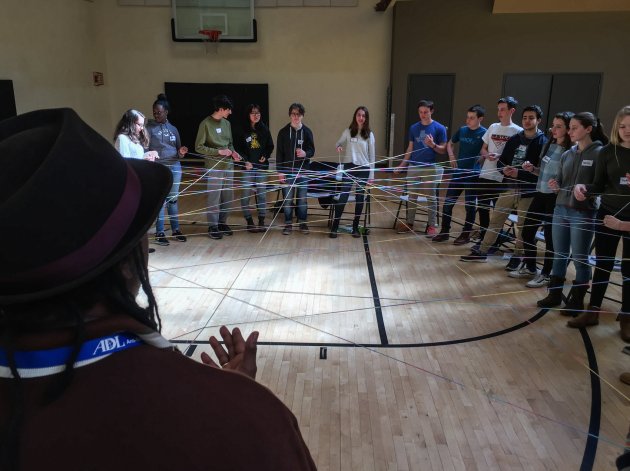
“Ok, folks! Showtime!” bellows the ADL’s New England Senior Training Consultant Rob Jones from the front of a gymnasium. His dreadlocks swinging out from under a felt fedora, Jones bounces around the circle of students, grilling them on what they’ve learned from the exercises they’ve done so far and getting them ready to be leaders instead of participants. They begin by practicing how they will introduce themselves to classmates when they run a workshop.

Rob Jones, a training consultant with the Anti-Defamation League, leads Brookline High School students in building a “web of unity.”  Tovia Smith /NPR

“My name is Josh Gladstone,” starts one. “I’m doing this program because I have seen many issues at the high school, and even though we attempt to have a couple of assemblies, I don’t think it’s enough.”

The students role-play and rehearse everything from ice-breakers to exercises meant to encourage empathy and bystander intervention. Jones coaches and corrects. “You don’t wanna preach,” he tells one. “You do not wanna come off as better than [them]… like you really need to help them. We’ve all laughed at jokes we shouldn’t have laughed at and made comments we shouldn’t have made. We’re all trying to learn together.”

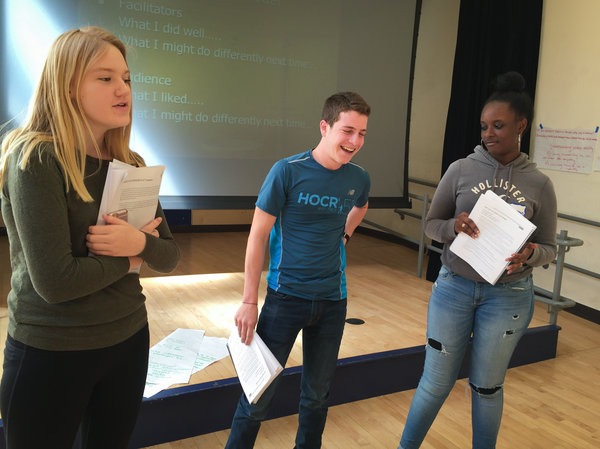
After participating in tolerance workshops for two days, Maddie Kennedy (left), Josh Gladstone and Raven Bogues practice being presenters before they run the same workshops for their peers.  Tovia Smith /NPR

Indeed, even in their left-leaning “bubble” — as some Brookline students call it — they’ve seen an uptick in hate.

Junior Talia Vos, who moved to Brookline from Mexico, says she felt it the day after the election. She was in the hallway between classes and yelled out to a friend –- in Spanish — to save her a seat.

“A group of boys behind me, they started chanting, ‘build a wall!'” she recalls. “It’s just these new social norms of how we treat each other.”

After 30 years of doing this work, Rob Jones worries that many of the communities that need these programs the most are also in denial.

“Certain populations just won’t talk about it because they don’t get it — they don’t get it,” he says. “They’re like, ‘we don’t have any issues.’ But boy, they have a lot of bigoted behavior.”

Along with prevention, many schools these days are also quickly learning the art of “the healing response.”

In Brookline, after the hateful graffiti was found, students banded together to re-paint the table that was vandalized to “reclaim it from hate.” Other schools have called in professional facilitators to moderate a “community conversation.”

Following the KKK graffiti in Attleboro, dozens of students mobilized to counter the hate with kindness. They wrote “love notes” to each of the high school’s nearly 2000 students, staffers and teachers.

Source: How School Administrators Are Dealing With Incidents Of Hate : NPR Ed : NPR

German government rejects conservatives’ call for Islam law – The Washington Post

Of note:

The German government says there’s no need for new legislation to regulate Islamic organizations in the country.

Members of Chancellor Angela Merkel’s center-right Christian Democratic Union party have called for a ban on foreign funding of Islamic organizations, and for Muslims to get statutory rights to pastoral care from an imam in prisons and hospitals.

Government spokesman Steffen Seibert said Monday that such a law was “a non-issue” at the moment and noted that religious freedom is guaranteed by the German constitution.

The arrival of hundreds of thousands of Muslim migrants in Germany in recent years has rekindled public debates about the country’s relationship with Islam.

A recent report by public broadcaster ARD found that the Islam preached in some mosques is more conservative than in many Muslim countries.

Douglas Todd: Exaggerating extent of racism is all too easy

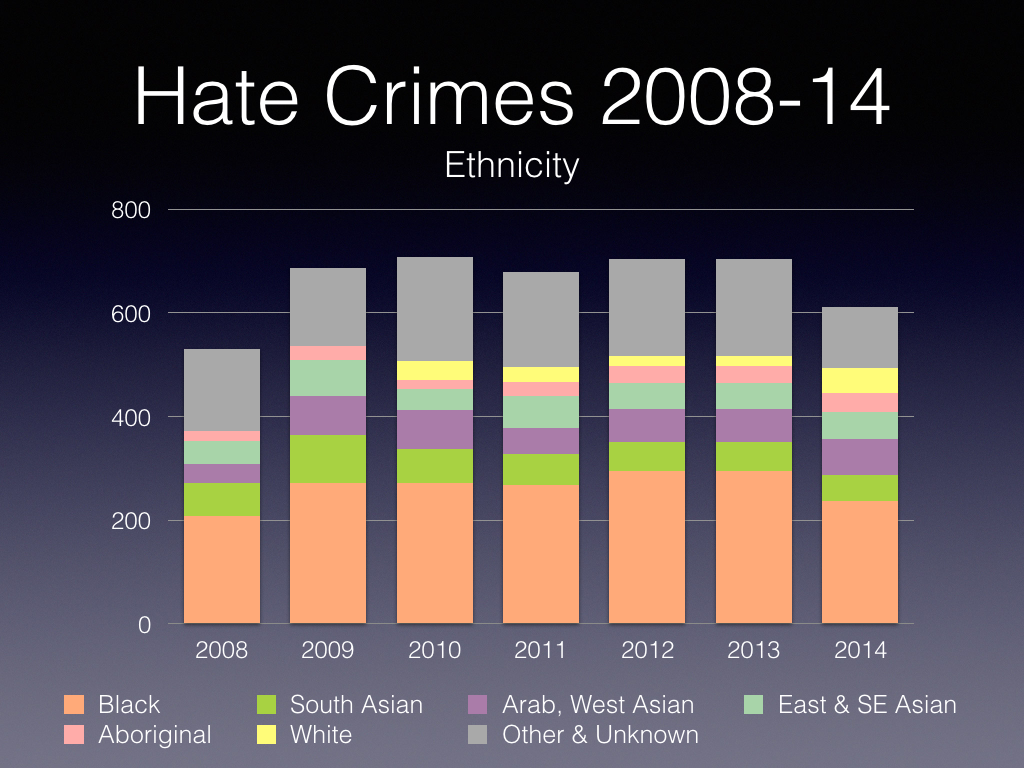
While polling data is important, I find blind cv tests (Applying for a job in Canada with an Asian name: Policy Options) and hate crime stats (StatsCan police reported as per the above charts) to be better indicators of racism and discrimination.

Under-estimating racism and discrimination is as much a risk as over-estimating:

It’s virtually impossible in a lifetime to avoid interaction with an extremist — including the activist that Hiebert says regularly shows up at Vancouver anti-racism events, where he eagerly hands out xenophobic leaflets.

When Hiebert conducted a survey years ago that tried to identify Canadians hostile to others, he found only two to three per cent fit the bill as out-and-out racists.

Even though the Vancity report tries to go further and advise British Columbians to “combat” their own “subconscious bias,” the credit union’s officials seem unaware the concept of “unconscious racism” has been criticized even by psychologist Mahzarin Banaji, who invented the term.

Former B.C. premier Ujjal Dosanjh is among those worried about the exaggeration of racism. Even though B.C. was home to some racism decades ago, Dosanjh said many now trot out the label to make themselves look good or to stifle debate.

Ethnic Chinese leaders in B.C., including Albert Lo, Justin Fung and Clarence Cheng, have also warned about the divisiveness of inaccurately claiming racism, particularly in a province struggling with unaffordable housing, foreign capital and unequal wealth.

Could the world really be so wrong about Canada and B. C.? A Gallup poll conducted in more than 50 countries discovered 84 per cent believe Canadians are “tolerant of others who are different,” the highest ranking of any country.

China, Russia and India were at the bottom of the list. Fewer than 34 per cent of global respondents rated residents of those major immigrant-source countries as tolerant.

Indeed, discrimination cuts unpredictably across cultures. A 2016 Angus Reid survey found recent immigrants to Canada were slightly less likely than native-born people to accept homosexuals, or approve of “marrying someone from a different cultural or religious background.”

So, are British Columbians accepting of diversity?

There is no simple answer. It appears the vast majority are highly respectful of difference, while a relative few are not.

Environics Institute pollster Keith Neuman answers the question about a region’s acceptance levels by quoting the Nigerian writer Chimamanda Ngozi Adichie, who has become known for warning of the “danger of a single story.”

And it’s hard to think of a more treacherous single story about B.C. than the one alleging racism is alive and well.

Source: Douglas Todd: Exaggerating extent of racism is all too easy | Vancouver Sun

A black woman in tech makes $79,000 for every $100,000 a white man makes – Recode

Impressive large-scale data analysis that show the extent of bias in the hiring process:

It’s no secret that the technology field can be brutal to anyone who isn’t a white male. New data shows just how those inequalities play out in today’s tech workers’ paychecks.

Nearly two in three women receive lower salary offers than men for the same job at the same company, according to Hired, a job website that focuses on placing people in tech jobs such as software engineer, product manager or data scientist. That’s slightly better than last year, when 69 percent of women received lower offers.

Women, on average, were paid 4 percent less than men for the same kind of job, the study found.

For the study, Hired mined data from 120,000 salary offers to 27,000 candidates at 4,000 companies. In general, applicants to these tech fields skew male (75 percent), but that doesn’t account for the disparity in who gets interviewed.

Companies interviewed only men for a position 53 percent of the time; 6 percent of the time, they interviewed only women.

“Not only are women getting lower offers when they actually get offers, but a large amount of time, companies have openings and they’re not interviewing women at all,” said Jessica Kirkpatrick, Hired’s data scientist.

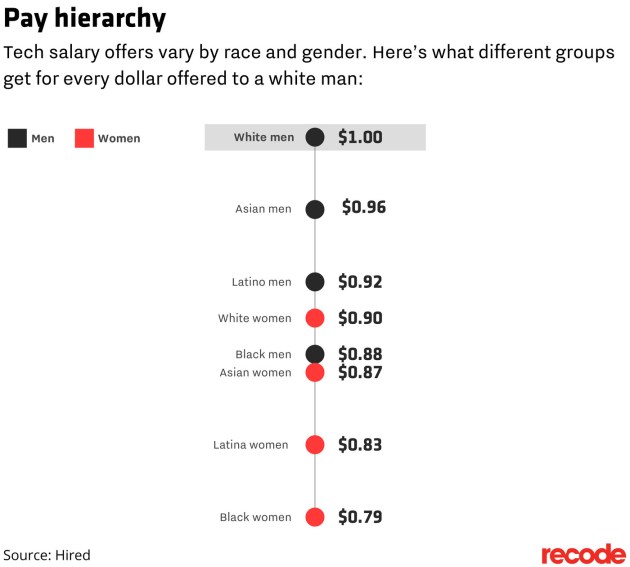
Hired’s data also breaks down offer salaries by race, compared with a white man in the same job. The effects of race are even more dramatic:

  • Black women are offered 79 cents to every dollar offered to a white man.
  • Black men make 88 cents.
  • Latina women make 83 cents.
  • White women make 90 cents.

Additionally, LGBTQ women and men are offered less money than their non-LGBTQ counterparts.

There are numerous reasons for this pay inequity. Part of the problem is that women, minorities and LGBTQ people ask for less than white males for the same position.

According to Kirkpatrick, these groups ask for less because people base their salary expectations on what they’re already making. For these groups, their lower pay often reflects a lot of historical inequities accrued over their careers, like being denied raises or promotions.

By not offering people comparable wages, Kirkpatrick said that companies are jeopardizing their job retention. “When people figure out what their teammates are making, it’s ultimately not good for maintaining talent and creating a collegial environment,” she said.

It also makes Silicon Valley’s already tight talent pool even smaller.

Source: A black woman in tech makes $79,000 for every $100,000 a white man makes – Recode

Trudeau’s Senate representative slams ‘obstructionist’ Conservative delay tactics in new report [e.g., C-6]

The Conservative caucus use of procedural delaying tactics is certainly evident with respect to C-6 Citizenship Act changes:

In a scathing new document, the government’s representative in the Senate slams Conservatives for “zealously” delaying government bills.

In the 21-page “discussion paper,” Sen. Peter Harder says “obstructionist” senators are “time-wasting,” delaying the Liberal government’s agenda and blocking Senate modernization to score their own “partisan points.” He proposes an all-party “business committee” set schedules based on individual bills to ensure House business doesn’t indefinitely stall in the Senate.

The committee idea itself is a “very good” one, says Conservative senator Stephen Greene, but Harder “made the acceptance of the structure a bit difficult on our side because he took a few potshots at Conservatives, and the reaction on our side might not be too pleasant, to put it mildly.”

Greene said Conservatives are using tactics available to any opposition, and that Liberals have used in the past. “Filibustering and delaying tactics are not bad things in and of themselves, if they’re used with restraint,” he said. “From Sen. Harder’s point of view, it might look excessive, but from the Conservative point of view, it’s not.”

The paper, dated Friday, is being circulated to senators this week following further delays for the Liberals’ citizenship bill, C-6. The bill, which repeals major elements of Harper-era citizenship legislation (Bill C-24), has languished in the Senate since last June.

Voting on a third-reading amendment to the bill was delayed throughout the evening last Thursday by various adjournment motions from the Conservatives. It was a longer-than-average evening with lengthy waiting periods in between votes on the motions. At one point, the Independent Senators Group ordered pizza for itself. Greene called the session a “trainwreck.”

“The apparent strategy is to hinder the progress of government bills, even those that seek to enact clear election promises, for as long as possible,” Harder writes in his paper, listing other examples of delays.

“Some Senators would prefer for the Senate to remain stuck in time, available as a platform to advance partisan interests. … Sober second thought has become a game of procedural cat-and-mouse.”

Harder says a business committee would make collaborative decisions on time management with input from leaders of each caucus or group, the bill’s sponsor and critic, and the chair of the committee to which the bill would likely be referred.

Source: Trudeau’s Senate representative slams ‘obstructionist’ Conservative delay tactics in new report | National Post

The Trump administration is weighing what to do about the spouses of high-skilled immigrants [H-1B] – Recode

Recruitment opportunities and advantages for tech companies operating in Canada:

The Trump administration’s next immigration target could be a program that allows the spouses of some high-skilled engineers to work in the United States.

Under former President Barack Obama, the government tried to help tech companies and other firms who employed H-1B visa holders by allowing their spouses to seek jobs here. The policy specifically focused on the families of H-1B workers who pursue green cards to become permanent U.S. residents.

Under Trump, however, the government has sought to rethink federal immigration programs. And in court documents quietly filed this week, the Trump administration indicated that it is reconsidering spouses’ rights, too.

Without much fanfare, the Justice Department’s lawyers asked a federal appeals court on Monday to pause consideration of a case challenging the Obama-era policy’s legality. The DOJ sought 180 days so the administration can decide “whether to revise” its rules.

The move drew sharp criticism from immigration reform advocacy groups, including the Mark Zuckerberg-backed FWD.us, which feared that the Trump administration had essentially paved the way to abandon the aid Obama extended to spouses.

“We strongly feel they should keep this regulation in place, and they should not deny a quarter million people” the ability to work, said Todd Schulte, the president of FWD.us, in an interview Tuesday.

The DOJ’s court move, however, raised additional alarm in light of previous comments made by Jeff Sessions, now the country’s attorney general. While serving in the U.S. Senate, the Republican lawmaker had been especially critical of the H-1B program. And Sessions sharply rebuked the Obama administration in 2015 after it issued its rules to permit the spouses of some H-1B holders to seek employment.

Fearing that the DOJ might ultimately choose not to defend the case, an immigration rights organization called Immigration Action sought to intervene“on behalf of thousands of its members who currently possess employment authorization as spouses of H-1B visa holders,” it said in a statement in March.

Earlier this week, the Trump administration promised greater scrutiny of the H-1B program. It pledged more targeted “site checks” to ensure that the program has been administered properly, along with greater scrutiny for computer programmers who apply for those visas. Both measures are viewed as early attempts to crack down on outsourcing firms like Infosys — and not on tech giants like Google, which told employees late Monday that they likely would not be affected.

Source: The Trump administration is weighing what to do about the spouses of high-skilled immigrants – Recode

Pope to meet with UK imams in bid to promote moderate Islam – The Washington Post

More effective approach than his predecessor:

Pope Francis is scheduled to meet Wednesday with four British imams two weeks after the London extremist attack, part of his effort to encourage Muslim leaders who renounce using religion to justify violence.

The audience was scheduled long before the March 22 attack, in which a man mowed down pedestrians on Westminster Bridge, killing three, before fatally stabbing a policeman on the grounds of Parliament.

The head of the British Muslim Forum, Muhammad Shahid Raza, said in an interview Tuesday that the pope’s support and message of solidarity after the attack “strengthened our position that we, like other communities, condemn all terrorist activities.”

Francis will try to further the cause later this month when he visits Al Azhar university in Cairo, Sunni Islam’s main center of learning.

Cardinal Vincent Nichols, the Roman Catholic archbishop of Westminster, is accompanying the imams to the Vatican. He said the aim of the visit was to help promote Muslim leaders who denounce violence carried out in God’s name.

The Muslim community slowly is gaining the confidence to speak out and condemn Islamic extremism, Nichols said.

“That is the voice that has to be heard to counter the rather more undifferentiating, unappreciative and even hostile voices that view Islamic people in Britain as somehow alien and unwelcome,” he said.

Source: Pope to meet with UK imams in bid to promote moderate Islam – The Washington Post

Nearly half of Canadians view Islam unfavourably, [Angus Reid] survey finds

No real surprise here apart from a remarkable increase in comfort of Sikhs compared to their 2015 survey:

Even though Canada has been praised for its religious and culture diversity, almost half of Canadians view Islam in an unfavourable light compared to other faiths, according to a new survey.

The Angus Reid Institute released results Tuesday on how Canadians view various faiths and religious symbolism in society.

The study found that 46 per cent of Canadians view Islam and clothing associated with the religion unfavourably compared to how they view other religions to likes of Christianity and Buddhism.

In terms of wearing religious grab in public, 88 per cent of those surveyed supported a person wearing the nun`s habit or a turban (77 per cent) compared to those wearing a niqab (32 per cent) or a burka (29 per cent).

However, the survey noted that more people are beginning to view Islam in a more favourable light, with Quebec residents leading the way.

According to the survey, those in Quebec who say they view the Islam faith more favourably has more than doubled since 2009, jump from 15 per cent to 32 per cent. More Quebecers are also seeing Sikhism (32 per cent) and Hinduism (50 per cent) in a more positive light.

The survey was conducted online between February 16 and 22, just over two weeks after Alexandre Bissonnette allegedly opened fire inside a Quebec City mosque killing six men during evening prayers.

Source: Nearly half of Canadians view Islam unfavourably, survey finds – National | Globalnews.ca