After Egypt attack, sectarianism and extremism go hand in hand: Hellyer

Good commentary and linkages:

Here is something else we know. The primary targets of the attacks today were Christian – their Christian identity is what singled them out for the attackers, and they paid for that identity with their lives. No one should be under any delusion in this regard – IS propaganda spoke specifically about Christians, and Christians were specifically targeted. This deadly sectarianism has to be identified as what it is – hateful, bigoted, and murderous.

But blood doesn’t know those boundaries. Among the dead today, Egyptians shared pictures of Muslims who died in the blasts – more than half a dozen Muslims, men and women, who died in the course of their duty, as police officers, protecting the security of their Christian compatriots. Had they not fulfilled their duty, many more in Alexandria would likely have paid the ultimate price. Their being Muslim did not immunize them from the crimes of the attackers. It wouldn’t.

Indeed, it is also being reported that the Egyptian security services dismantled a bomb in a mosque in Tanta today – a mosque that is known particularly for an adherence to Sufism, which is part of normative Sunni Islam, historically. But the likes of IS, informed as they are by an extremist form of Wahabism which rejects much of normative Sunni Islam in the first place, may have targeted the mosque anyway.

There will be those from the majority Muslim community who made the ultimate sacrifice to protect their Christian compatriots. There will be those who marched on the church to show solidarity with their Christian compatriots, which likewise happened in Tanta by imams. It’s one type of model. It’s a model which, regrettably if ironically, is rejected by anti-Muslim bigots in the West, many of whom took the opportunity today to further Islamophobia. Hatred, it seems, also loves company.

But there will also be those who will deceitfully condemn the murders on the one hand – and create the conditions for the sectarianism that inspired it on the other. Sectarian incitement has been an issue that far too few have been willing to tackle head-on when it comes to the pro-Islamist universe – and that includes the Muslim Brotherhood. For years, anti-Christian populist sentiment is a currency that too many in these movements traffic in – and too little attention is given to confronting it.

It would be wrong and inappropriate to associate the entirety of the Islamist camp with the radicalism of the likes of IS – but likewise, it would be the height of naiveté and an utter fallacy to assume that sectarianism is only a problem in the pro-IS faction. It goes far beyond that. Condemning the attacks, for example, in English, while propagating conspiracies and “false flag” theories about them in Arabic, only means that the mood music for sectarian incitement is left unchecked even further.

To avoid further tragedy, we need to recognize that sectarianism and radical extremism remain crucial problems to resolve.

Source: After Egypt attack, sectarianism and extremism go hand in hand – The Globe and Mail

Samara’s 2017 Democracy 360 Second Report Card on How Canadians Communicate, Participate and Lead in Politics – Visible Minority Methodology Issues

While I have great respect for the work Samara does and continues to do, as exemplified in their latest report, I would be remiss in not pointing out some serious methodological mistakes made with respect to visible minority representation.

Their diversity numbers:

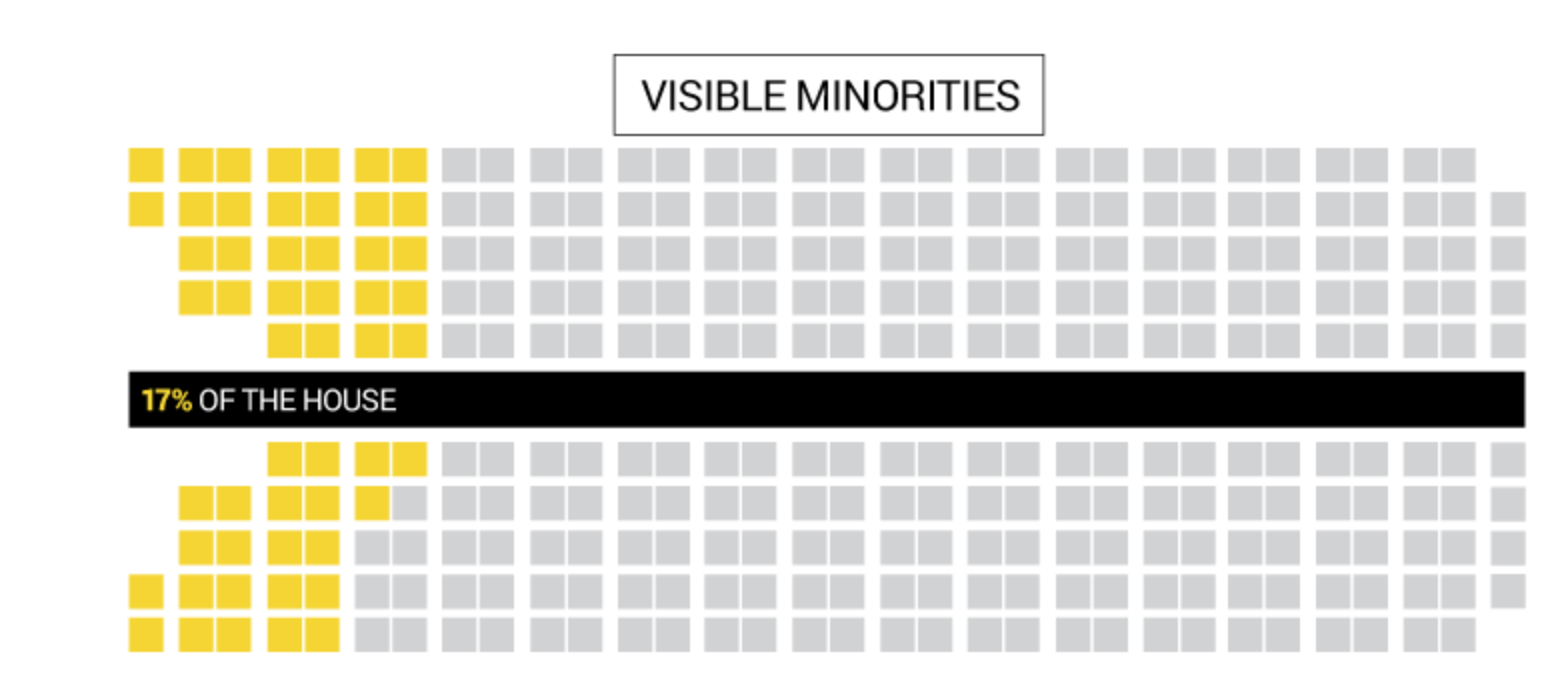
While our current Cabinet was selected to be more reflective of the Canadian population, Parliament generally, with 74% men, still has a long way to go. Women represent half of Canada’s population, but they are only 26% of its MPs. Visible minorities are better represented—they make up 17% of MPs and 19% of the population. Indigenous MPs make up 3% of the House and 4% of the population. In terms of representation of the youngest cohort of voters Canadians, representation has lost ground since 2015. Only 4% of MPs in the 41st Parliament are aged 18 to 30, a cohort that comprises 17% of the Canadian population.

The two mistakes are:

  • Using the wrong baseline for visible minority representation. Samara uses the overall population of visible minorities (19 percent) rather than the correct baseline of 15 percent, those visible minorities who are also Canadian citizens and thus able to vote. This is the second time that this incorrect baseline has been used and should be corrected for future reports; and,
  • Their count of the number of visible minority MPs is wrong. The correct count is 47, not the 53 indicated in the chart below.

The corrected numbers show visible minorities forming 14 percent of the House of Commons (2015 election), compared to 15 percent of the visible minority voting population. A good result.

Samara and I have shared our respective data sets and discussed these concerns and they have been forthcoming on the reasons for the discrepancies. Their count of visible minorities included some Indigenous MPs and Alexandra Mendès (but not Pablo Rodriguez) and they used the overall visible minority population to be consistent with their earlier report.

For future reports, my main recommendations:

  • for women, foreign-born and Indigenous MPs, use the authoritative parlinfo biographical information which would avoid mis-categorization of Indigenous as visible minority MPs;
  • use existing analysis rather than re-inventing the wheel. Erin Tolley, Kai Chan and I all came up with the 47 number (Erin and I compared notes to ensure that neither of us missed anything, Kai did his work independently; and,
  • use the population of visible minorities who are also Canadian citizens as the baseline, not the total visible minority population.

Their numbers for foreign-born, women and Indigenous MPs are correct, taken from the parl.gc.ca site (however the graphics are not – 40 versus the correct figure of 41 foreign-born, 81 versus 88 women, 9 versus 11 Indigenous peoples).

Source: 2017 Democracy 360

ICYMI: America’s Cult of Ignorance – The Daily Beast

An excerpt from Tom Nichols’ The Death of Expertise:

So why all the fuss? What exactly has changed so dramatically for me to have written this book and for you to be reading it? Is this really the “death of expertise,” or is this nothing more than the usual complaints from intellectuals that no one listens to them despite their self-anointed status as the smartest people in the room? Maybe it’s nothing more than the anxiety about the masses that arises among professionals after each cycle of social or technological change. Or maybe it’s just a typical expression of the outraged vanity of overeducated, elitist professors like me.

Indeed, maybe the death of expertise is a sign of progress. Educated professionals, after all, no longer have a stranglehold on knowledge. The secrets of life are no longer hidden in giant marble mausoleums, the great libraries of the world whose halls are intimidating even to the relatively few people who can visit them. Under such conditions in the past, there was less stress between experts and lay people, but only because citizens were simply unable to challenge experts in any substantive way. Moreover, there were few public venues in which to mount such challenges in the era before mass communications.

Participation in political, intellectual, and scientific life until the early 20th century was far more circumscribed, with debates about science, philosophy, and public policy all conducted by a small circle of educated males with pen and ink. Those were not exactly the

Good Old Days, and they weren’t that long ago. The time when most people didn’t finish high school, when very few went to college, and when only a tiny fraction of the population entered professions is still within living memory of many Americans.

Social changes only in the past half century finally broke down old barriers of race, class, and sex not only between Americans in general but also between uneducated citizens and elite experts in particular. A wider circle of debate meant more knowledge but more social friction. Universal education, the greater empowerment of women and minorities, the growth of a middle class, and increased social mobility all threw a minority of experts and the majority of citizens into direct contact, after nearly two centuries in which they rarely had to interact with each other.

And yet the result has not been a greater respect for knowledge, but the growth of an irrational conviction among Americans that everyone is as smart as everyone else. This is the opposite of education, which should aim to make people, no matter how smart or accomplished they are, learners for the rest of their lives. Rather, we now live in a society where the acquisition of even a little learning is the endpoint, rather than the beginning, of education. And this is a dangerous thing.

Human rights chief praises police oversight report’s focus on race and diversity

It all starts with data:

The provincial government’s commitment Thursday to require police watchdogs to collect race-based statistics is evidence Ontario is in “a very unique moment” when it comes to recognizing the need for such data, says Ontario’s chief human rights commissioner.

One day after the release of Ontario Justice Michael Tulloch’s broad-ranging report on police oversight in Ontario, Renu Mandhane said the judge’s work provides a detailed road map to rebuild trust between community and police oversight agencies at a time of “historic levels of distrust.”

Shortly after the release of Tulloch’s 129 recommendations — many aimed at increasing transparency within the police watchdogs — Ontario Attorney General Yasir Naqvi committed to act on the key recommendation that civilian oversight bodies, including the Special Investigations Unit (SIU), begin collecting demographic data such as statistics on race, ethnicity and indigenous status.

Currently, none of Ontario’s civilian watchdogs — the SIU, the Office of the Independent Police Review Director (OIPRD) and the Ontario Civilian Police Commission (OCPC) — collect statistics on race or any demographic data on religion, age, mental health status, disability, or indigenous status of complainants and alleged victims.

That move shows “the conversation has shifted in terms of the collection of data,” Mandhane said in an interview Friday, but stressed the importance of ensuring the data is both collected and then publicly reported; Tulloch recommended an advisory board be established to develop “best practices on the collection, management, and analysis of relevant demographic data.”

“There needs to be real thought about who is going to receive the data and making sure they have the resources to effectively analyze the data,” Mandhane said.

Tulloch’s race-based statistics recommendation was one of several praised by rights groups and advocates, who appreciated the emphasis placed on diversity, cultural training and the focus on indigenous communities. The report states Ontario’s oversight bodies must be “both socially and culturally competent.”

During consultations with First Nations communities in particular, Tulloch said there was consensus that the oversight bodies “lack cultural sensitivity and often are disrespectful of Indigenous peoples.” During consultations, he was told of cases where an SIU investigator arrived in a First Nations community following an incident, spoke briefly with someone from the community, and had no further contact.

“Equally troubling, some First Nations communities in the north described having to wait days for SIU investigators to arrive on scene. In some cases, matters were closed without talking to members of the community and the leadership,” the report states.

To begin to remedy fraught relationships, Tulloch recommended mandatory social and cultural competency training for watchdog staff — developed and delivered in partnership with the communities they serve.

The report also says Ontario’s police watchdogs should reflect their diverse communities, meaning the oversight bodies must take initiatives to hire people from communities currently under-represented within the organizations.

“This includes all individuals at the oversight bodies: the directors, the investigators, the adjudicators, and the staff dedicated towards outreach, communications, administration, affected persons services, and so forth,” the report states.

The move toward greater diversity is long overdue, said Julian Falconer, a Toronto lawyer who has represented many families of people killed by police and who also practices in Thunder Bay.

In his submission to Tulloch during the review process, he says he was “quite blunt” about the lack of diversity when it comes to the director of the SIU.

Source: Human rights chief praises police oversight report’s focus on race and diversity | Toronto Star

ICYMI: Les allophones fréquentent les écoles francophones au Québec: From 15 percent in 1971 to 89 percent

A dramatic shift:

La très grande majorité des élèves dont la langue maternelle est autre que le français ou l’anglais fréquentent les écoles francophones au Québec: au primaire et au secondaire, ils sont passés de 15 à 89 % entre 1971 et 2015, rapporte l’Office québécois de la langue française (OQLF).

«Une progression très marquée», soit six fois plus d’élèves, note l’Office, qui a publié deux rapports vendredi, soit un sur l’enseignement collégial et un autre sur les établissements préscolaires, primaires et secondaires.

L’OQLF relève aussi une hausse importante de près de 20 points de pourcentage depuis 1976 du nombre d’anglophones qui fréquentent l’école en français, cette proportion atteignant même 28 % en 2015.

D’ailleurs, cette année-là, la très grande majorité des élèves du Québec – toutes langues maternelles confondues – apprenaient leur alphabet à l’école en français, soit 90 % de ceux du préscolaire, primaire et secondaire.

Mais cette fréquentation accrue de l’école française n’est pas toujours un choix: ces chiffres s’expliquent en partie par l’adoption par le gouvernement du Québec en 1977 de la Charte de la langue française qui oblige certaines catégories d’enfants à fréquenter l’école en français au primaire et au secondaire. Au niveau collégial toutefois, ils ont la liberté de choisir.

«C’est sûr que le fait que la Charte a été adoptée, et les nouvelles normes pour l’inscription à l’école de la langue française, cela peut être un des facteurs qui a joué», a souligné en entrevue le porte-parole de l’OQLF, Jean-Pierre Le Blanc.

Il est ainsi à noter qu’entre 1986 et 2015, la proportion d’élèves admissibles à l’école anglaise a chuté chez les anglophones et les allophones, respectivement de 12 et de 26 %.

Chez ceux ayant une langue maternelle tierce, la plus grande portion de la hausse de fréquentation de l’école en français est survenue dans les années suivant l’adoption de la Charte, entre 1976 et 1991, est-il noté dans le rapport.

Source: Les allophones fréquentent les écoles francophones au Québec | Stéphanie Marin | Éducation

Chris Selley: Hate religion in public schools? Yell at your MPP, not your school board

Chris Selley on the violent opposition of some for religious accommodation by allowing prayers to take place in Peel Region schools, rather than a more measured discussion of the form and limits of any accommodation:

But the OHRC’s interpretation of the Ontario Human Rights Code makes it plain: only cost and health and safety may stand in the way of a religious accommodation. Wiffly concepts like “secularism” may not. So whether you’re a perturbed secularist, vexed feminist, scandalized menstrual-rights advocate or fulminating Islam-hater, there’s no point aiming your complaints at the local school board. You should call your MPP.

That probably won’t get you anywhere either, frankly. Secularism and feminism are all well and good, but the New Democrats are unlikely to align with the Qur’an-stompers. The Liberals think religious accommodations are the Pope’s pyjamas. And after John Tory’s faith-based schools debacle and Patrick Brown’s sex-ed switcheroo, the Progressive Conservatives are scared stiff of this stuff. (Opposing prayer in public school isn’t exactly home-run conservative policy, anyway.)

Nevertheless, it’s not Ontario’s educators you should be bothering — it’s Ontario’s legislators. They made this world. The schools are just living in it.

Source: Chris Selley: Hate religion in public schools? Yell at your MPP, not your school board | National Post

C-6: Senate Debate – Language and Knowledge Testing Age

In addition to the amendment proposed by Senator McCoy to restore procedural protections for those accused of fraud or misrepresentation, and the forthcoming amendment allowing minors to submit citizenship applications on their own (see C-6: Senate bill would let children become citizens separately from parents), Senator Griffin proposed a (compromise?) amendment, proposing a cut-off age of 60 for knowledge and language testing, compared to the current 65 of C-24 and the proposed 55 of C-6.

To her credit, she went back to the Mulroney and Chrétien eras to find justification for 60 being an appropriate cut-off.

I would, however, take issue with the Library of Parliament’s assertion, according to Senator Griffin’s speech, that it was “not decided at either the political or the senior departmental levels.”

Inconceivable. Any such change would have to be signed off by the Deputy and Minister. Moreover, as the timing of April 2005 was prior to the 2006 election, with the main target being new Canadian voters in key ridings.

One of the problems with all the age proposals is the lack of good evidence and policy analysis of their rationale. ATIP records show that there was no such analysis done in 2005 when then Minister Volpe reduced the cut-off to 55, none in 2014 when then Minister Alexander raised it to 65, and again none in 2016 when then Minister McCallum reduced it back to 55. (I didn’t make any ATIP requests earlier than 2005).

And while good policy and political arguments have been made on both sides of the issue, it is unfortunate that various governments appear to have made their policy choices without documented consideration of departmental analysis, suggesting that the decisions were primarily political.

Her research prompted more research by the Bill’s sponsor, Senator Omidvar, indicating that there was more departmental involvement and advice than ATIP records show.

In the end, the Senate approved the amendment, meaning the Government will need to decide whether to accept this (and other amendments) or, as in the case of assisted dying, send it back to the Senate unchanged.

Have included the text of Senators Griffin and Omidvar to provide the flavour of the debate:

Senator Griffin:

Honourable senators, today I rise to speak to Bill C-6. I want to propose an amendment to the bill, but first I want to give you my reasons why.

The age of 55 to demonstrate sufficient language proficiency is too low and should be increased. This is in part due to the fact that a permanent resident at age 49 to 50, after a five-year waiting period, could become a Canadian citizen at age 55 without any knowledge of either French or English.

I think an amendment to increase that level to 60 years of age is particularly important to people in Atlantic Canada, Quebec and rural Canada.

Note that I support a waiver on compassionate grounds. This is found in section 5(3) of the Citizenship Act. I respectfully disagree with routine waivers simply because an applicant is 55.

I am proposing age 60 due to the evidence-based recommendations by studies during the Brian Mulroney and Jean Chrétien governments. According to the Library of Parliament, the age of 55 for an exemption from the requirements is a more recent trend that was not decided at either the political or the senior departmental levels.

As well, the Library of Parliament analyst cannot find any record of age 55 being transmitted through ministerial instruction. The age of 55 appears to have been decided at a middle management level via an instrument of delegation.

The age exemptions for language and knowledge were never defined in statute prior to the Conservative government’s changes to the Citizenship Act that legislatively set the age to 65.

Prior to this point, there was a requirement for all permanent residents who wished to acquire citizenship to satisfy the knowledge and language requirements, and individuals who could not fulfill these requirements had to request a waiver.

In the early 1980s, the criteria for a routine waiver was set at 65 and over. By 1994, the waiver was lowered to 60. At some point between 1994 and 2014, the waiver was again lowered, this time to 55. But these lowerings were never done at the political level.

Studies from the Mulroney and Chrétien eras recommended using 60 as the benchmark for waivers. In particular, in 1994, the House of Commons committee from the Chrétien government advocated against the routine waiving of language requirements for older applicants.

To paraphrase its report, the Immigration Committee felt that Canadians must be encouraged to obtain a degree of knowledge in one of the official languages. The committee viewed citizenship as a two-way street, and older immigrants should be encouraged to walk as far along that street as possible. The committee warned that routine waiving of language requirements is a form of misplaced passion that could ghettoize people and hinder participation in the broader Canadian mosaic.

The Salisbury-Addison Convention indicates that the Senate should generally not defeat major campaign platform commitments. Effectively, the Senate must defer to the wisdom of the electorate on major platform commitments. However, the lowering of the exemption age to 55 is not a campaign promise. The closest phrase is found in the backgrounder brief called “A New Plan for Canadian Immigration and Economic Opportunity” which states:

“We will repeal the unfair elements of Bill C-24 that create second-class citizens and the elements that make it more difficult for hard-working immigrants to become Canadian citizens.”

With creativity and imagination, the government could claim that this promise implies the repeal of the age requirement in statute and a restoration of the traditional waiver system. It is clear that entrenchment in statute of age 55 is not contemplated in this promise.

At present, there is a paradox where middle management decision-makers have gradually lowered the age requirement while the lifespan of Canadians is increasing. Age 55 is quite young. I do note with a certain degree of irony that this issue is being debated in this chamber where our average age for a senator is 65.

I draw attention to the comment that former minister John McCallum made to the House of Commons Immigration Committee about the language requirements.

“We did not have consultations specifically on the economic implications of returning to the 55 to 64, but I’m told neither did the previous government on the impact going the other way. So we are reverting to the status quo ante and our predecessors didn’t consult our moving away from it.”

The minister is incorrect in his statement. As discussed earlier, a return to the status quo ante implies not defining 55 in statute and there was no political or senior management direction supporting lowering the age to 55. I stress the lower age runs contrary to the evidence-based recommendations from the Mulroney and Chrétien eras.

One of the primary elements of citizenship is participation in the democratic process, and as a reflection of the smaller population in Atlantic Canada, elections and civic engagement are key elements to successfully integrating into the community.

For example, in Prince Edward Island, the average provincial riding size is about 4,000 people. In the case of my home riding, Vernon River—Stratford, in the last election, after a recount, the two top candidates were tied so the returning officer, according to law, flipped a coin to decide the winner.

Several other ridings were decided by fewer than 100 votes, so this highlights the point that every vote is important and new citizens do have a right to vote, whether or not they can understand the candidates. It is difficult in Eastern Canada for individuals to participate fully in society and in the democratic process without having a working knowledge of either French or English.

I note that a significant number of committee witnesses who spoke to Bill C-6 focused on the national security provisions of the legislation. With respect to age requirements, a cursory examination appears to show none of the witnesses were from Atlantic Canada and the vast majority were from Ontario.

In light of this, I’m putting forward this amendment to highlight that legislative amendments on Canadian citizenship must involve more stakeholders than solely those from the larger population centres.

As well, I’ll point out that in proposing this amendment I am fulfilling the Prime Minister’s vision that senators examine and revise legislation while representing regional, provincial and minority interests.

Senator Omidvar:

Honourable senators, I find I’m rising yet one more time to speak to you about Bill C-6. I wish that were not the case but I wanted to start off on a positive note.

Thank you, Senator Oh, for sharing your amendment with us and your notes. It makes all our jobs so much easier when we understand what you’re thinking. I agree with our facilitator, Senator McCoy, that in fact this should become not just good practice but standard practice. I look forward to working with all those who make these agreements to further this idea.

I would also like to thank my colleague Senator Griffin for her interest and her contribution to the dialogue and debate on this very important bill. And in particular I want to thank her for her readiness and willingness to step up to the plate. I spoke to her yesterday — I think it was eight o’clock in the morning — and I asked whether she would be ready to speak on her amendment. She blinked maybe once and then said “yes,” so kudos on your responsiveness, really.

I will say as much as I admire my colleague from beautiful P.E.I. — and I have learned something about P.E.I. in my conversations with her — I do not support this amendment and I will be voting against it.

First, honourable senators, let me remind everybody this is a repeal bill. It means it repeals certain provisions to take them back to where they were before, not to another place, not to tweak it, to massage it or find another playing field, but to bring it back to where we were before, and that was age 55.

Second, changes to the Citizenship Act were part of the election promise. The Liberal government was elected on a platform with a particular mandate and this change is part of it. As the Prime Minister said, “We will repeal the unfair elements of Bill C-24 . . . that make it more difficult for hard-working immigrants to become Canadian citizens.”

Senator Griffin is absolutely right; she has done her research very well. There is no particular reference to age, but I believe that lowering the age exemption is part and parcel of this promise and one that I am personally delighted that the Prime Minister has chosen to keep.

Senator Griffin is proposing to raise the waiver age for exemption of language and knowledge testing from 55, which is in the bill, to 60 — five years. And I would like to focus my comments on why five years matter and to whom.

I would like to start with evidence, just as Senator Griffin did. She pointed to some research in the Mulroney and Chrétien eras. I won’t dwell too much on this point. I just want to remind everyone that the source of immigrants to Canada has diversified significantly since then, especially in the 1990s, which would not be captured in the statistics available at that time. Policy recommendations at that time made sense, perhaps, for a country of primarily European immigrants.

But I wanted to look for recent evidence, so I turned to one of the most knowledgeable people in the field of citizenship, and that is Andrew Griffith, the former Director General in the Department of Citizenship and Immigration. He filed an access to information request to find the documentation behind the 2014 decision to raise the waiver age from 55 to 65, and the department returned his request with zero documentation. Mr. Griffith concluded: “We are in an evidence-free zone.”

But did I find some evidence. I looked for it in a different place with a different lens, and I found it in the gender-based analysis that was conducted for Bill C-24. No gender-based analysis was conducted for Bill C-6 because it was felt it still held in that one year. This is what we know, because it is what the GBA said: that from 2000 to 2004, when the waiver age was 60, which is exactly what Senator Griffin is proposing to do, applicants aged 55 to 60 had a 5 per cent lower test pass rate than the rate of all other age groups. In other words, testing impacted those aged between 55 and 60.

I went back a little further in history, and I determined that it was in 2005, under Prime Minister Paul Martin, that the age was lowered from 60 to 55. The Minister of Immigration was Joe Volpe, in Prime Minister Paul Martin’s cabinet. I just picked up the phone yesterday, called him and was lucky enough to find him. I said, “Mr. Volpe, can you remember if there was evidence behind your decision?” We are dealing with memory, I understand, but he was very clear when he said to me that he relied on evidence to make this decision, and the evidence was collected by the department and concluded that testing poses a particular barrier for older immigrants.

He went on to say that it didn’t make sense to deprive them of the opportunity to become citizens. It didn’t make sense that one could only be an exemplary citizen or a good citizen if you could pass a test.

There is some other evidence that I will cite briefly. We know there is a falling rate of applications for citizenship; this is documented, again, by Andrew Griffith. He found a nearly 50 per cent drop in applications in the first nine months of 2016 compared to the same period in 2015. I want to remind us all what Senator Eggleton said: The fees for citizenship applications have risen an astronomical 500 per cent. It costs roughly $630 per person to apply for citizenship.

I want you to consider someone who is 55 years old, who is lower income, who is supporting a family and putting food on the table, and they have to then put $630 on the table for a citizenship application test, and they are nervous about passing it. So I conclude that testing has a disproportionate impact on older immigrants and therefore constitutes a disincentive.

Let me talk a little bit about who this change will impact. It’s a small minority, by the way, of citizenship applicants. Historically, only about 8 per cent of the total number of citizenship applications received each year has come from this age group. Who are they? We are not talking about people who choose to come to Canada for the labour market. Their age would, in fact, be a great disqualifier. We are talking about refugees, parents, grandparents and spouses. In particular, I am talking about women who have come to Canada as sponsored spouses, a parent or as a refugee.

Elke Winter, Associate Professor of Sociological and Anthropological Studies at the University of Ottawa, testified during witness hearings on Bill C-24 that, for the “less educated, non-European-language speakers, and the economically vulnerable,” it makes citizenship much harder to obtain.

Let me restate what I have pointed out in both of my speeches on Bill C-6. Sadly, I think there are way too many people who need to hold down more than two jobs simply to make the rent and pay their bills. These people, again, many of them women, work in factories where they operate within a context where language acquisition either does not matter or is not necessary.

Again, these women aged 55 and over are good enough to work, good enough to raise their children, good enough to send them to university and good enough to pay taxes, but they are not good enough to become Canadians.

I have heard no credible evidence that changing the age one way or another is an incentive to learning a language. But I have heard that it is a real barrier based on your socio-economic status, your gender and your race. I feel I am hugely disadvantaged in this chamber because I do not speak French. I think it is a big disadvantage. I know I can try to learn it, but I figured out that it would be incredibly difficult to get up to the fluency of Senators Pratte and Dupuis. I try to listen to them, but I know it is hard. I am someone who has a natural tendency to learn languages — I speak six of them — but I know now it would be too hard to learn that language.

Barriers like being too poor, too busy, too badly needed at home, too fearful and too risk-averse: for vulnerable people, a barrier is a barrier. I’m afraid I cannot see an incentive in it.

Miss Avvy Go of the Metro Toronto Chinese and Southeast Asian legal clinic reminded us that your ability to learn a language depends on your mental health, family status, income, working hours and more.

I will agree with each one of you that we need to spend more money on languages. Language is invaluable for those who have it, and we should strive to open our official languages to include more of our citizens. But we should not do this by erecting barriers. We should not do it at the cost of disenfranchisement.

We heard yesterday that language requirements can be waived on humanitarian and compassionate grounds. Senator Eggleton posed the very pointed question: How many times has this policy actually been applied?

Today, in the morning, I was speaking to the director generals and deputy ministers of the department. I asked them this question, and there was, sadly, no answer.

Let me make an assumption: If passing a test is a challenge, I wonder how much more challenging it would be to arrange a waiver. But I do have some very concrete evidence about the good things that happen when you do become a citizen. It is scientifically proven that you have a greater attachment to the labour market. You develop a greater sense of belonging to Canada and its institutions. You have a greater investment in ownership, and you invest in this country in many ways. I really believe this is the spirit of what both Senator Griffin and I want.

Senator Griffin made a very interesting point about political participation. Her story, about the one vote being decided in a coin toss, was fascinating. Senator Griffin is rightly anxious that more people participate in the democratic process. But she is also anxious that they participate in it in an informed way. Well, frankly, I’m not sure whether other Canadians are well-informed about our system or not. We don’t have a test for them, and they participate in it.

But I do know this: Immigrants have a knowledge of civics from an unusual source of information, and this is from a flourishing ethnic press, both online and offline. I spoke to Naomi Alboim, a distinguished professor from Queen’s University, who said to me that not being able to speak the language does not mean you don’t understand the democratic process and the rights and responsibilities attached to it. She pointed to the ethnic press and its prevalence and role in civic education.

So I did some research this morning. I had some fun. I discovered that the largest immigrant group on Prince Edward Island is Mandarin-speaking. There is a Mandarin-English publication called Ni Hao PEI. It’s a quarterly newspaper. And I looked at the top news stories in 2017. They were not about mainland China politics. Here are three headlines: Get to know a farmer!; P.E.I. farmland — the new investment of choice; P.E.I. rural schools: natural decline or time for change?

I don’t think we should assume that Canadian civics and curiosity requires a certain degree of English and language. You can get it from other sources.

I have a case in point. My mother lives with me; you have heard me talk about her. She is a delightful mother, close to 90 years old, although she wants to be 85. She got her citizenship in the late 1980s, when she was much younger. I do not remember what tests there were, but there were tests. In the meantime, the bars on language and knowledge testing has been raised. It’s become digital. I doubt whether she would pass.

Here is also something that is true: She is up on politics, sometimes more than I am, because she is glued to the wonderful South Asian television channel called OMNI. She has her daily dose of Bollywood drama. But she quizzes me often, especially when I come home from the Senate, on things she has heard about on the South Asian news. This became really clear to me when we were talking about assisted dying, because it’s a matter relevant to her. She asked me every day: What is the access? What are the provisions? Who will administer it? She really gave me the run-through.

I reject the notion that if your English or French is not good enough to pass a test it is not good enough to understand how to participate in the political process. Let us try telling that to all our Italian, Greek, Polish and Ukrainian immigrants.

Let me conclude with five years. Five years is a long time. I’m a rookie senator today. In five years, I hope to be a halfway competent senator. Let me think about what happens to a low- income woman who is 55 years old.

Source: C-6 Debates: Language and Knowledge Assessment April 5

C-6 Debates: Language and Knowledge Assessment April 6
C-6: Senate bill would let children become citizens separately from parents

The Senate continues to play a larger role in legislation. In this particular case, the comparison countries used are not the usual ones (Australia, NZ, UK, USA) but rather Norway and Denmark.

Interesting, given that overall their citizenship regime is much more restrictive than in Canada, save in this instance:

Tens of thousands of children could benefit from a proposed amendment to the Citizenship Act to allow Canadian residents under the age of 18 to apply on their own for Canadian citizenship, say advocates.

Ontario Senator Victor Oh proposed legislation on Thursday that asks Canada to follow the lead of Norway and make it possible for minors to apply for citizenship separately from their parents.

The proposal would apply to a cross-section of youths in Canada — including asylum seekers, children estranged from their parents, young people with criminal convictions, and minors who don’t want to follow their parents back to nations such as India and China that don’t allow dual passports.

Canadian law currently requires permanent residents who want to apply for citizenship to be at least 18 years of age or to be included in a parent or guardian’s immigration application.

That “places some highly vulnerable minors at risk of removal once they become adults,” says a brief prepared by the senators.

A change in the citizenship law could have significant consequences for thousands of young people in Ontario and B.C., where three out of 10 residents are foreign-born.

In addition, the senators’ amendment is a response to the growing number of unaccompanied minors seeking asylum in Canada, which rose by more than 50 per cent to 3,400 in 2016.

Senator Ho’s motion, which has been supported by B.C. Senator Mobina Jaffer, echoes similar recommendations made last year to an Ottawa citizenship committee by Vancouver East NDP MP Jenny Kwan and Winnipeg Conservative MP Michelle Rempel.

“This would be the biggest push forward for children’s rights in Canada in decades,” said Vancouver immigration lawyer Richard Kurland, who helped the senators draft the proposal.

Currently, the only way that a Canadian resident under 18 can apply for citizenship on their own is on “compassionate” grounds. But that avenue is rarely used.

In contrast, Norway allows citizenship applications from youth who have been in the country for five of the previous seven years. Denmark is open to youths becoming immigrants on their own if they have gone to school in the country for four years.

The background paper accompanying the complex legislative proposal said it would make it possible for the following kinds of young people to become Canadian citizens through their own application process:

• “Unaccompanied minors,” that is young people who arrive in Canada unaccompanied by an adult. The brief argues many are at risk of exploitation and abuse by traffickers.

• Children who have gone into “protective custody” because of physical or sexual abuse by their parents or guardians.

• Children who are orphans, or who have run away from their parents or guardians.

• Children of parents who are permanent residents but who do not meet language requirements to become citizens.

• Children who as young adults become convicted of a criminal offence.

Kurland said the revised application process would also be open to minors whose parents have applied for immigration status but who have worked outside of Canada for so long that the parents fail to meet requirements for citizenship.

In addition, the immigration lawyer said new legislation would allow a youth in Canada to follow a different route from their Canadian-resident parents — who might decide against becoming citizens of Canada because they don’t want to give up the passport of their homeland.

Unlike Canada, China and India, which are two of the largest sources of immigrants to Canada, do not allow dual citizenship.

Source: Senate bill would let children become citizens separately from parents | Vancouver Sun

In Canada, Where Muslims Are Few, Group Stirs Fear of Islamists – The New York Times

More on the extreme right in Canada, making the New York Times (see earlier Inside Quebec’s far right: Take a tour of La Meute, the secretive group with 43,000 members):

Some experts warn that groups like La Meute, however much they eschew violence, create an enabling environment in which hate can grow. “They are embedded in a broader cultural ethos that bestows ‘permission to hate,’” said Barbara Perry, a professor at the University of Ontario Institute of Technology who has written extensively on right-wing extremism in Canada.

The conversation within La Meute’s private Facebook page can border on hateful. In response to one person’s request about what could be done to prevent construction of a mosque in the neighborhood, another follower suggested pouring pig’s blood on the ground and letting Muslims know the land had been desecrated.

While primarily confined to French-speaking Canada, La Meute lies on a continuum of conservative thought that is propelling politicians like Kellie Leitch, a member of Parliament who is vying for leadership of Canada’s Conservative Party. Ms. Leitch once proposed a tip line for people to report “barbaric cultural practices,” and has suggested that immigrants be screened for “Canadian values” so that the country can maintain “a unified Canadian identity.”

Mr. Beaudry, the son of a onetime lumberjack and heavy equipment operator, joined the Canadian Army when he was 17 and spent years in Germany. He retired from the army after a car accident in 2002 and subsequently spent several months working as a private contractor in Afghanistan. He was greatly influenced by the specter of Taliban rule.

He said he and his friends were motivated by the 2014 killing of two soldiers in Canada in separate episodes, both at the hands of Canadian extremists who had converted to Islam. “We realized something was happening,” Mr. Beaudry said, adding that terrorist attacks in France and Belgium followed soon after.

He said that the primary goal in founding La Meute was to educate members and others about the growth of political Islam in Canada.

Mr. Beaudry spoke specifically about the group’s opposition to the niqab and the burqa, Islamic styles of dress that cover women’s faces. Only a tiny sliver of the Canadian population adopts them, but “if people cannot blend with the society,” Mr. Beaudry said, “it becomes a cancer and if you want to save your life, you have to take action.”

He also believes a parliamentary motion passed last month that condemns Islamophobia is a move to silence criticism of political Islam and is the first step toward an Islamic anti-blasphemy law.

On the private Facebook page, La Meute’s leaders quiz followers, screening for the most informed and dedicated who might fill positions in the hierarchy.

Mr. Beaudry said La Meute was assigning followers to 17 geographic “clans,” each with officers and staff, “so people know who to report to and where to go when things happen.” He said five clans were “fully operational,” and he expected all to be formed by the end of the year.

The group has transportation cells that take people to meetings and has medical units to care for the injured. Some members recently started an online radio station. Last month, La Meute fielded about 400 people in four cities to protest the anti-Islamophobia motion.

“We are trying to teach people that they have much more political power, they matter much more than the majority believes,” Mr. Beaudry said. “We want to influence our world, our politics.”

Canadian antisemitism statistics should be taken with a pinch of salt – The Jewish Chronicle

The StatsCan annual reports do separate out “mischief” (“non-violent offences,” about two-thirds of the total) from more serious hate crimes:

Here in Montreal, extremist imams can be seen on YouTube calling for the death of Jews at mosques, and chants of “death to the Jews” can be heard in Arabic at anti-Israel rallies.

The issue is also pretty cut and dried when synagogues are defaced with large swastikas, Jewish school libraries are burned down (as happened in Montreal in 2004), or small pipe bombs go off at Jewish institutions, such as happened in Montreal in 2007.

But what makes the issue murkier is whether real antisemitism is always involved, and a recent police report released report in Toronto bears that out.

According to the city’s Hate Crimes Unit, for the 12thconsecutive year – 12th! – Jews were the main victims in almost 30 per cent of hate-motivated crimes against minority groups, significantly ahead of black, Muslim, and the LGBTQ communities.

To me, this makes no real sense. Why should Jews be more targeted than other minorities, and for so many years in a row?

I got no help in answering this question from the unit itself. As a matter of policy, I was told, it does not publicly disclose who reports a “hate crimes” incident, other than to acknowledge that it might come from any individual or organisation.

That latter part resonated with me since it’s kind of an open secret that certain Jewish organisations have a vested interest in creating the public impression that antisemitism in Canada is perpetually “on the rise.”

So anything, in a way, can be seen and reported as a “hate crime”: from a swastika finger-painted in the snow by a stupid teenage kid to an idiot making a bigoted comment at a supermarket.

And if they are designated as “hate crimes,” those numbers can really add up! For the Jews, 12 years in a row, it appears.

It’s not irrelevant, in that context, to recall that in 2010, Canadian journalist Jonathan Kay criticised one Jewish org, B’nai Brith Canada, for its “absurd contention” that antisemitism is a growing problem in Canada.

In other words, “hate crimes” stats are pretty broad, open-to-interpretation – and dubious. The numbers should be taken with a big pinch of salt.

Of course there are serious antisemitic incidents in Canada. Of course there are. But the call as to what is truly a hate crime seems too often open to interpretation and involves too many vested community interests to get a truly accurate picture of the reality on the ground.

Source: Canadian antisemitism statistics should be taken with a pinch of salt – The Jewish Chronicle