Integration Presentations in Denmark and Sweden

No blogging this week as speaking on the Canadian approach to integration at a seminar organized by the Canadian Embassy and the Centre for Migration Studies, University of Copenhagen Wednesday and the Malmö Institute for Studies of Migration, Diversity and Welfare Friday.

It has been fun to put together this deck, updated with 2016 citizenship data, which tries to show how the various elements – immigration, settlement, citizenship and multiculturalism – work together to facilitate integration.

Given some difficulties I had reconciling data sets, Temporary Foreign Worker Program and International Mobility Program data is only up to 2015.

The pdf version can be found here: Integration – Copenhagen April 2017.

Babies show racial bias at nine months, U of T study suggests

A pair of interesting studies, with some caveats by other researchers:

Two new University of Toronto studies suggest racial bias can develop in babies at an early age — before they’ve even started walking.

Led by the school’s Ontario Institute of Child Study professor Kang Lee, in partnership with researchers from the U.S., U.K., France, and China, the studies examined how infants react to individuals of their own race, compared to individuals of another race.

“The goal of the study was to find out at which age infants begin to show racial bias,” Lee said. “With existing studies, the evidence shows that kids show bias around 3 or 4 years of age. We wanted to look younger.”

The first study looked at 193 Chinese infants from three to ninth months, recruited from a hospital in China, who hadn’t had direct contact with people of other races. The babies were then shown videos of six Asian women and six African women, paired with either happy or sad music.

The study found that infants from three to six months old didn’t associate sad or happy music with people of the same race or of other races, which indicates they “are not biologically predisposed to associate own- and other-race faces with music of different emotional valence.”

However, at around nine months old, the reactions were different.

According to the study, nine-month-old babies looked at their own-race faces paired with happy music for a longer period of time, as well as other-race faces paired with sad music. Lee says this supports the hypothesis that infants associate people of the same race with happy music, and other races with sad music.

That’s not to say parents are teaching their children how to discriminate against other raced individuals, Lee says.

“We are very confident that the cause of this early racial bias is actually the lack of exposure to other raced individuals,” he said. “It tells us that in Canada, if we introduce our kids to other-raced individuals, then we are likely to have less racial bias in our kids against other-raced people.”

Andrew Baron, an associate professor of psychology the University of British Columbia, said while the goal of the study is “terrific,” there are many reasons infants would look for longer amounts of time at faces of different races. For example, he says an infant could spend more time looking at an own-race face because it is familiar, or at an other-race face because it is different and unexpected.

“It’s impossible to draw that conclusion about association from a single experiment when you could have half a dozen reasons why you would look longer that don’t support the conclusion that was made in that paper,” said Baron, who was not involved in the studies, but specializes in a similar field — the development of implicit associations among infants.

“There’s multiple reasons — and contradictory reasons — why we look longer at things. We look longer at things we fear, we look longer at things we like. That’s an inherent tension in how you choose to interpret the data.”

The second study took a closer look at that bias and how it affects children’s learning skills.

Researchers showed babies videos of own-race and other-race adults looking in the same direction that photos of animals appeared (indicating they are reliable) and looking in the wrong direction of the animals (indicating they are unreliable).

The study found that when adults were reliable and looking in the direction of the animals, the infants followed both own- and other-raced individuals equally. The same results occurred when the adults were unreliable and looking in the wrong direction.

However, when the adults gaze was only sometimes correct, the children were more likely to take cues provided by adults of their own race.

“In this situation, very interestingly, kids treated their own-raced individuals — who are only 50 per cent correct — as if they were 100 per cent correct,” Lee said.

“There is discrimination, but only when there is uncertainty.”

The first study was published in Developmental Science and the second was in Child Development.

The study was conducted in China, Lee says, because the researchers were able to control the exposure to other-raced individuals.

Lee said he has been trying for nearly 10 years to organize a study looking at babies born into mixed-race families. He suspects infants born into mixed-race families would show less racial bias.

When it comes to parents who want to try to eliminate racial bias from a young age, Lee says exposure is key.

“If parents want to prevent racial biases from emerging, the best thing to do is expose their kids to TV programs, books, and friends from different races,” he said.

“And the important message is they have to know them by name . . . it’s extremely important to know them as individuals.”

Source: Babies show racial bias at nine months, U of T study suggests | Toronto Star

This is the Jeff Bezos playbook for preventing Amazon’s demise – Recode

Lots of interesting insights into Bezos’ thinking.

The one I found the most interesting, given my government background, was on the need for quick decision-making and related implications (impossible in government context given risk concerns but nevertheless helpful as a prompt to think more deeply about government processes):

High-Velocity Decision Making

Day 2 companies make high-quality decisions, but they make high-quality decisions slowly. To keep the energy and dynamism of Day 1, you have to somehow make high-quality, high-velocity decisions. Easy for start-ups and very challenging for large organizations. The senior team at Amazon is determined to keep our decision-making velocity high. Speed matters in business – plus a high-velocity decision-making environment is more fun too. We don’t know all the answers, but here are some thoughts.

First, never use a one-size-fits-all decision-making process. Many decisions are reversible, two-way doors. Those decisions can use a light-weight process. For those, so what if you’re wrong? I wrote about this in more detail in last year’s letter.

Second, most decisions should probably be made with somewhere around 70% of the information you wish you had. If you wait for 90%, in most cases, you’re probably being slow. Plus, either way, you need to be good at quickly recognizing and correcting bad decisions. If you’re good at course correcting, being wrong may be less costly than you think, whereas being slow is going to be expensive for sure.

Third, use the phrase “disagree and commit.” This phrase will save a lot of time. If you have conviction on a particular direction even though there’s no consensus, it’s helpful to say, “Look, I know we disagree on this but will you gamble with me on it? Disagree and commit?” By the time you’re at this point, no one can know the answer for sure, and you’ll probably get a quick yes.

This isn’t one way. If you’re the boss, you should do this too. I disagree and commit all the time. We recently greenlit a particular Amazon Studios original. I told the team my view: debatable whether it would be interesting enough, complicated to produce, the business terms aren’t that good, and we have lots of other opportunities. They had a completely different opinion and wanted to go ahead. I wrote back right away with “I disagree and commit and hope it becomes the most watched thing we’ve ever made.” Consider how much slower this decision cycle would have been if the team had actually had to convince me rather than simply get my commitment.

Note what this example is not: it’s not me thinking to myself “well, these guys are wrong and missing the point, but this isn’t worth me chasing.” It’s a genuine disagreement of opinion, a candid expression of my view, a chance for the team to weigh my view, and a quick, sincere commitment to go their way. And given that this team has already brought home 11 Emmys, 6 Golden Globes, and 3 Oscars, I’m just glad they let me in the room at all!

Fourth, recognize true misalignment issues early and escalate them immediately. Sometimes teams have different objectives and fundamentally different views. They are not aligned. No amount of discussion, no number of meetings will resolve that deep misalignment. Without escalation, the default dispute resolution mechanism for this scenario is exhaustion. Whoever has more stamina carries the decision.

I’ve seen many examples of sincere misalignment at Amazon over the years. When we decided to invite third-party sellers to compete directly against us on our own product detail pages – that was a big one. Many smart, well-intentioned Amazonians were simply not at all aligned with the direction. The big decision set up hundreds of smaller decisions, many of which needed to be escalated to the senior team.

“You’ve worn me down” is an awful decision-making process. It’s slow and de-energizing. Go for quick escalation instead – it’s better.

So, have you settled only for decision quality, or are you mindful of decision velocity too? Are the world’s trends tailwinds for you? Are you falling prey to proxies, or do they serve you? And most important of all, are you delighting customers? We can have the scope and capabilities of a large company and the spirit and heart of a small one. But we have to choose it.

Source: This is the Jeff Bezos playbook for preventing Amazon’s demise – Recode

We all thought having more data was better. We were wrong. – Recode

Interesting set of arguments against the use of big data in all circumstances and the value of small, focussed data sets:

For years, the mantra in the world of business software and enterprise IT has been “data is the new gold.” The idea was that companies of nearly every shape and size, across every industry imaginable, were essentially sitting on top of buried treasure that was just waiting to be tapped into. All they needed to do was to dig into the correct vein of their business data trove and they would be able to unleash valuable insights that could unlock hidden business opportunities, new sources of revenue, better efficiencies and much more.

Big software companies like IBM, Oracle, SAP and many more all touted these visions of data grandeur, and turned the concept of big data analytics, or just Big Data, into everyday business nomenclature.

Even now, analytics is also playing an important role in the Internet of Things, on both the commercial and industrial side, as well as on the consumer side. On the industrial side, companies are working to mine various datastreams for insights into how to improve their processes, while consumer-focused analytics show up in things like health and fitness data linked to wearables, and will soon be a part of assisted and autonomous driving systems in our cars.

Of course, the everyday reality of these grand ideas hasn’t always lived up to the hype. While there certainly have been many great success stories of companies reducing their costs or figuring out new business models, there are probably an equal (though unreported) number of companies that tried to find the gold in their data — and spent a lot of money doing so — but came up relatively empty.

The truth is, analytics is hard, and there’s no guarantee that analyzing huge chunks of data is going to translate into meaningful insights. Challenges may arise from applying the wrong tools to a given job, not analyzing the right data, or not even really knowing exactly what to look for in the first place. Regardless, it’s becoming clear to many organizations that a decade or more into the “big data” revolution, not everyone is hitting it rich.

Part of the problem is that some of the efforts are simply too big — at several different levels. Sometimes the goals are too grandiose, sometimes the datasets are too large, and sometimes the valuable insights are buried beneath a mound of numbers or other data that just really isn’t that useful. Implicit in the phrase “big data,” as well as the concept of data as gold, is that more is better. But in the case of analytics, a legitimate question worth considering: Is more data really better?

In the world of IoT, for example, many organizations are realizing that doing what I call “little data analytics” is actually much more useful. Instead of trying to mine through large datasets, these organizations are focusing their efforts on a simple stream of sensor-based data or other straightforward data collection work. For the untold number of situations across a range of industries where these kinds of efforts haven’t been done before, the results can be surprisingly useful. In some instances, these projects create nothing more than a single insight into a given process for which companies can quickly adjust — a “one and done” type of effort — but ongoing monitoring of these processes can ensure that the adjustments continue to run efficiently.

Of course, it’s easy to understand why nobody really wants to talk about little data. It’s not exactly a sexy, attention-grabbing topic, and working with it requires much less sophisticated tools — think Excel spreadsheet (or the equivalent) on a PC, for example. The analytical insights from these “little data” efforts are also likely to be relatively simple. However, that doesn’t mean they are less practical and valuable to an organization. In fact, building up a collection of these little data analytics could prove to be exactly what many organizations need. Plus, they’re the kind of results that can help justify the expenses necessary for companies to start investing in IoT efforts.

To be fair, not all applications are really suited for little data analytics. Monitoring the real-time performance of a jet engine or even a moving car involves a staggering amount of data that’s going to continue to require the most advanced computing and big data analytics tools available.

But to get more real-world traction for IoT-based efforts, companies may want to change their approach to data analytics efforts and start thinking small.

Source: We all thought having more data was better. We were wrong. – Recode

Canadians may be vacating the pews but they are keeping the faith: poll

Interesting poll that gives some sense of “religiosity,” in terms of beliefs, compared to general religious affiliation:

Beneath Canadians’ widespread abandonment of places of worship and their negative view of even the word “religion,” a new poll has found a solid core of faith that continues to shape the country.

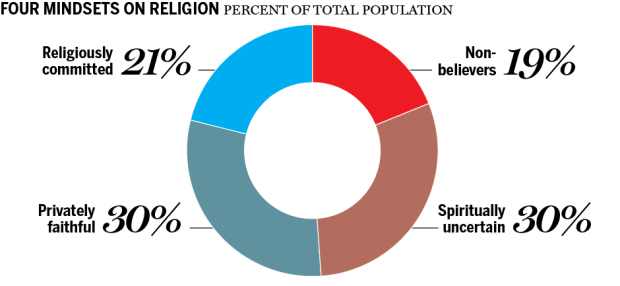
The survey, conducted by the Angus Reid Institute in partnership with Faith in Canada 150, grouped respondents into four categories according to their answers on a range of questions gauging their beliefs and religious practices.

“We have a society that has a secular government and there is a general assumption of faith being very private,” said Ray Pennings, executive vice-president of think tank Cardus. “On the other hand, when you actually take a look at everyday society, the majority of people are people of faith to one degree or another, and faith informs and influences many of the ways we deal with each other on a day-to-day basis.”

Mike Faille/National Post//Angus Reid

Mike Faille/National Post//Angus Reid

The poll classifies 21 per cent of Canadians as religiously committed, meaning they hold a strong belief in God or a higher power and regularly attend religious services. At the other end of the spectrum, 19 per cent of Canadians are pure non-believers.

It is the swath in between, equally divided between what the pollster terms “privately faithful” and “spiritually uncertain,” that offers the greatest insight into Canadians’ evolving beliefs and practices.

The privately faithful, 30 per cent of respondents, “are people who actually believe in God, believe in heaven, believe in an afterlife,” said Angus Reid, the institute’s founder and chairman. “They have largely not been involved in organized religion. They will go to funerals and weddings and that sort of thing, but their faith is largely a private matter, and it’s really driven by their prayer. They pray on a regular basis.”
Mike Faille/National Post//Angus Reid

Mike Faille/National Post//Angus Reid

The spiritually uncertain, also representing 30 per cent, “seem to be a bit confused about where they want to be,” Reid said. “On some issues they kind of side with the non-believers, but they haven’t given up totally on everything.

“They continue to believe that there’s a God, but they’re uncertain about the role of God.”

The poll is part of a multi-faith effort initiated by Cardus called Faith in Canada 150, which aims to highlight the role religion has played historically and continues to play in Canada. The initiative, which has a budget of roughly $1-million, was denied federal funding as part of official 150th anniversary celebrations.

Source: Canadians may be vacating the pews but they are keeping the faith: poll | National Post

And the accompanying op-ed by Ray Pennings of Cardus:

Despite this religious openness, the same polling indicates a significant disconnect between the perception and reality of faith’s role in today’s Canada.

Simply put, religion has an image problem in Canada. In fact, the word “religion” is more likely to be seen negatively than positively, according to this new poll. Moreover, just over half of Canadians say they disagree with the claim that religion’s overall impact on the world is positive.

About half of Canadians polled say they’re uncomfortable around those who are religiously devout. Throw in terms like born-again, theology and evangelism, and just 15 per cent of respondents associate those words with a positive meaning.

But how well do Canadians actually understand the role faith plays in everyday life? Asked what’s most important in life, the 21 per cent of Canadians who are religiously committed are most likely to prioritize family life, honesty and concern for others.

Conversely, concern for others was a lower priority for non-believers. Instead, they are more likely to select a comfortable life, self-reliance and good times with friends as important. Not to put too fine a point on it, but those who are most likely to pray to God, attend religious services regularly and read the Bible or another sacred text seem most oriented toward others and their welfare.

What about Canadians’ emotional lives? The religiously committed are the happiest amongst us. Fully 47 per cent of them say they’re very happy or extremely happy overall, compared with 35 per cent of non-believers. They also report the highest levels of happiness among friends and in their communities. None of that is terribly surprising. If anything, it simply confirms what other research has shown. It makes sense, then, that the religiously committed are also more likely to be “very optimistic” about the future.

When it comes to community engagement and charitable giving, once again it’s the religiously committed who report the strongest involvement. Slightly more than half of non-believers say they are uninvolved in community groups or activities. That percentage drops to 17 per cent of the religiously committed. In fact, 41 per cent of the religiously committed have at least some involvement in their community, with another 42 per cent reporting heavy involvement.

Almost a third of the religiously committed say they regularly volunteer compared with 13 per cent of non-believers. Dare we ask about charitable giving?  Only 12 per cent of non-believers say they try to donate to whatever charities they can. That jumps to 43 per cent among the religiously committed. These are not selfish people.

The numbers present a clear picture: Religiously committed Canadians tend to be the most concerned about others, the happiest and most generous. So, why do Canadians have a negative view of religion? Arguably, the story of faith in Canada is not being well told. The narrative around faith is often negative. Religion is frequently presented as something that divides rather than unites people within communities.

That is part of the reason why Faith in Canada 150 exists, to showcase the role of faith in making Canada the country that it is. That legacy is a story worth telling.

Source: It is time to change the narrative around religion in Canada


Greek Orthodox Bishop calls on Erdogan to denounce Islam and be baptised | Neos Kosmos

Hard to understand the point of this letter:

Greek Orthodox Bishop, Metropolit Seraphim of Piraeus has caused controversy by urging Turkish President Recep Tayyip Erdogan to convert to Orthodoxy with Russian President Vladimir Putin as his godfather. And no, it’s not a joke.

In a 37-page letter to Erdogan written in Greek, Metropolit Seraphim asks the Turkish leader to denounce his Islamic faith and be baptised in the Ecumenical Patriarchate of Constantinople.

“If you want to save yourself and your family you should convert to Greek Orthodox Church, the only real faith,” Seraphim writes, reports Keep Talking Greece.

“We propose and we advise you to come to the arms of the Greek Orthodox Church before the end of your life on earth.

“Otherwise, you will unfortunately find yourself, your family and your people in the same place where Allah, Muhammad and his followers are, ie. in the place of suffering, eternal and unending hell.”

He calls on Erdogan to “repent, cry, be humble and believe in Christ,” and claims that “the Holy Trinity of God will open the arms for you”.

If Erdogan is to heed the Metropolit’s advice, he says that the Orthodox faithful on earth and in heaven will rejoice and “the angels in heaven after your enter the true Church!”

In the extensive letter, the Bishop also analyses Greece’s 400 years under Ottoman rule, the Treaty of Lausanne, Turkey’s recent history and the country’s efforts to join the European Union.

Despite concluding his letter with “honour, respect and honest brother love”, it contains a number of remarks in which he insults the Koran, the Prophet Muhammad, and describes Islam as a sect rather than a religion.

Source: Greek Orthodox Bishop calls on Erdogan to denounce Islam and be baptised | Neos Kosmos

C-6 Citizenship Senate Debates – Amendments update

As somewhat expected, the amendment allowing minors to submit citizenship applications independently, passed 47 to 24 votes (a similar amendment had been defeated during the House’s review of C-6).

As also expected, the Conservative amendment to “repeal the repeal” of the residency requirements was defeated, 51 to 28 votes.

No one argued about the intent of the amendment to allow minors to submit applications independently.

The main arguments used against this amendment were thus less substantive and more process. Senator Harder noted that the waiver provision of 5(3) had been used for 14 cases since January 2015 (always refreshing to have actual numbers rather than only individual cases cited). The “success” rate was 97 percent (not sure how this number was arrived as 13/14 is 93 percent), with applications processed in a “timely manner.”

Other points made by Senator Harder and other independent senators were around the point whether this amendment would be more appropriately considered in a broader review of the Citizenship Act rather than the more narrow focus of C-6.

In response, Senator Jaffer, the co-sponsor of the Bill, provided a number of examples that the amendment would cover. She noted that compassionate grounds cases can take many years and had largely been used for the “most extreme” cases and had largely been used for medical reasons. She had been “promised’ many times  that “We will deal with it in a few years,” with no follow-up and thus was skeptical of such assurances.

So far, the full Senate has approved three amendments:

  1. Restoration of procedural protections in cases of fraud and misrepresentation (Senator McCoy, see Senate amends Liberal citizenship bill to allow court hearings in fraud casesThe Senate has voted to amend the citizenship law to allow Canadians the right to a court hearing before their citizenship is stripped for fraud or misrepresentation);
  2. Raising the language and knowledge exemption age to 60 from 55 (Senator Griffin); and,
  3. Providing minors the right to submit an application on their own (Senators Oh and Jaffer)

The fourth amendment, sponsored by Senators From and Stewart-Olsen, would have “repealed the repeal” of the four years out of six physical presence, along with the minimum number of days required. This prompted a point of order by Senator Lankin asking that the Speaker rule the proposed amendment out of order as it negated the relevant provisions of Bill C-6. In the end, the Speaker allowed the amendment which was defeated 51 to 28.

Source: Debates 11 AprilDebates 12 April

Liberal bill would automatically increase user fees for federal services by rate of inflation

This kind of fundamental legislation should not be part of an omnibus bill but needs to be debated separately. As I have written before (The impact of citizenship fees on naturalization – Policy Options), CIC/IRCC obtained an exemption from the User Fees Act for citizenship fees in Budget 2013.

This allowed the department to raise fees twice in one year with minimal consultation and arguably misleading Parliament both with respect to the impact of the exemption (i.e., fee increases would not lead to a decline in applications) and that the second increase (from $300 to $530) was not mentioned during the C-24 hearings in either the House or Senate:

The Liberal government has introduced a bill that would significantly increase the fees that Canadians pay for a variety of federal services, such as campsites, fishing licences and passports.

In an omnibus budget bill brought forward Tuesday, the government proposes a new Service Fees Act that would automatically hike hundreds of fees by the level of inflation each year.

The move would also make it much easier for departments to apply for fee increases to better match the cost of providing services to individual Canadians and businesses. The proposed law is slated to come into effect April 1 next year.

The federal government collected about $2 billion in various fees in 2014-15, the latest year for which figures are available, but estimates it cost $3.4 billion to provide those services — resulting in a massive shortfall of $1.4 billion.

FedBudget 20170322

Finance Minister Bill Morneau’s last budget only hinted at the significant changes in user fees being contemplated. Over the four years, starting April 1, 2018, the government expects to collect $364 million in additional fees. (Justin Tang/Canadian Press)

The measure was briefly mentioned in last month’s budget document, which estimated aggregate fee revenues would increase by $36 million in 2018-2019, and by $147 million in extra revenues by 2021-2022.

The measure does not target specific fees. Rather, it replaces 13-year-old legislation that effectively froze fees by making it too onerous for departments to apply for increases as costs rose.

Federal officials estimate only about 20 per cent of all federal fees are captured by the User Fees Act of 2004. But the new legislation would capture almost all fees, and would require government to report in detail to Parliament each year on the amounts collected versus the cost of providing services.

Opposition critics have called the measure a tax grab, which can especially hurt low-income Canadians.

But a spokesman for Treasury Board President Scott Brison, who is shepherding the new user-fee regime, says the bill would relieve taxpayers of the unfair burden of paying for services enjoyed by individuals and corporations, while it also increases transparency.

Exempts some fees

“The government is always looking for ways to minimize costs for taxpayers and making the fee system transparent,” said Bruce Cheadle.

“We want to give everyone equal access to high-quality government services and we’re going to ensure middle-class Canadians aren’t disproportionately footing the bill for this.”

The new bill exempts some fees from the new regime, including fees under the Food and Drugs Act and some fees considered too small to be material.

The government also suggests that some costs, such as those related to food safety, will not always be fully charged back to users because there is a public good also attached to some government services.

CBC News first reported on the government’s plans in February, citing an internal briefing note for Brison that argued fees have been largely frozen since 2004 as departments shied away from the complex regulatory process of arguing for increases.

The briefing note from August 2016 said 84 per cent of existing user fees have not changed in 13 years, and cover a diminishing fraction of the actual cost of delivering the services.

Despite the fresh measures to increase fees, Brison last year eliminated all retrieval, processing and reproduction fees under the Access to Information Act. And this year, Parks Canada is waiving entry fees for its national parks and historic site to celebrate Canada’s 150th anniversary.

Source: Liberal bill would automatically increase user fees for federal services by rate of inflation – Politics – CBC News

This is what you get wrong when you talk about diversity in the workplace – Recode

Just one more approach to help people understand and appreciate diversity issues:

A lot of tech companies say they want to make progress on diversity and inclusion. Code2040, a nonprofit that gets its name from the year people of color are projected to be the majority of the U.S. population, argues that just saying that isn’t enough. Businesses need to act.

“It’s often positioned as an add-on,” Code2040 CEO Laura Weidman Powers said on the latest episode of Recode Decode, hosted by Kara Swisher. “What really needs to be the case is to change the core of what you’re doing. We’re not saying, ‘Keep hiring the way you’re hiring and also do this diversity thing on the side.’ [We are saying,] ‘You need to change the way you hire in order to be more inclusive.’”

You can listen to Recode Decode on iTunes, Google Play Music, TuneIn, Stitcherand SoundCloud.

Code2040 focuses specifically on “underrepresented minorities” — black and Latino/Latina students who have 18 percent of computer science degrees but only three percent to five percent of the jobs in Silicon Valley.

Powers said that since the nonprofit launched in 2012, Code2040 has found more and more support for its annual “fellows program,” which charges companies to connect them with talented minorities whom they might otherwise overlook. This summer, it will place more than 100 black and Latino students in tech offices.

But there’s still a long way to go. She said managers and employees, even the ones who mean well, often fall into traps that set everyone back — for example: “unconscious bias” training that doesn’t give attendees the ability to apply anything they learn.

“Talking about unconscious or implicit bias can seem to let people off the hook,” Powers said. “It’s been shown if you do unconscious bias training and it’s like, ‘Hey, everybody’s got bias,’ then the takeaway is, ‘Oh, phew, it’s not me! It’s just humans because we need to learn how to be scared of snakes so you make assumptions!’ You can get farther away from making progress.”

“Folks go to our trainings, they go back to their desks, and there’s half a dozen black and Latino interns who are working there,” she added. “They actually get a chance to see: ‘How inclusive is my culture? What is the experience of these individuals coming through?’ That makes a big difference, putting a face to the work and actually having a chance to build those skills.”

Source: This is what you get wrong when you talk about diversity in the workplace – Recode

Unfettered hate speech fuels Chinese fear of Islam | The Japan Times

Of interest:

A flood of angry anti-Muslim rhetoric on social media was the first sign of how fiercely suburban middle-class homeowners in the central Chinese city of Hefei opposed a planned mosque in their neighborhood. It quickly escalated into something more sinister.

Soon a pig’s head was buried in the ground at the future Nangang mosque, the culmination of a rally in which dozens of residents hoisted banners and circled the planned building site.

Then the mosque’s imam received a text message carrying a death threat: “In case someone in your family dies, I have a coffin for you — and more than one, if necessary.”

“How did things get stirred up to this point?” the imam, Tao Yingsheng, said in a recent interview. “Who had even heard of the Nangang mosque before?”

On the dusty plains of the Chinese heartland, the bitter fight over the mosque exemplifies how a surge in anti-Muslim sentiment online is spreading into communities across China, exacerbating ethnic and religious tensions that have in the past erupted in bloodshed. It is also posing a dilemma for the ruling Communist Party, which has allowed Islamophobia to fester online for years as part of its campaign to justify security crackdowns in the restive region of Xinjiang.

“It has let the genie out of the bottle,” said James Leibold, a professor at La Trobe University in Australia who has tracked the growth of anti-Muslim hate speech on China’s internet.

Interviews with residents and an examination of social media show how a few disparate online complaints by local homeowners evolved into a concerted campaign to spread hate.

Key to it was an unexpected yet influential backer: a Chinese propaganda official, 2,500 kilometers (1,500 miles) away in Xinjiang, whose inflammatory social media posts helped draw people into the streets on New Year’s Day, resulting in a police crackdown.

First mosque in 1780s

A stone inscription outside its gate shows the original Nangang mosque was established in the 1780s by members of the Hui minority, the descendants of Silk Road traders who settled across China centuries ago. In its present form, the mosque has served the area’s 4,500 Hui for decades, its domed silhouette partially hidden by overgrown shrubs in the countryside beyond Hefei’s last paved boulevards.

Over the past 10 years urbanization has come to Hefei, with sprawling development reconfiguring the landscape and its demographic flavor, and Hui leaders had been pushing for years to relocate their mosque to a more convenient urban location.

City planners in November finally selected a site adjacent to the newly built Hangkong New City condominiums, with its $200,000 two-bedroom units, faux-Mediterranean styling and a Volvo dealership across the street.

The project’s homeowners — overwhelmingly members of China’s ethnic Han majority — began complaining on China’s popular microblog Weibo. Some complained the mosque would occupy space promised for a park. Others warned that safety in the area would be compromised.

Others were more blunt: Han residents were uncomfortable that a center for Hui community life would be less than 100 meters from their building, a homeowner who later identified himself in messages to the AP by his surname, Cheng, wrote in a petition posted in December. “And the less said about what happens on Eid al-Adha, the better,” Cheng wrote, referring to the Islamic holiday in which animals are slaughtered for a sacrificial feast. “It’s absolutely shocking.”

Source: Unfettered hate speech fuels Chinese fear of Islam | The Japan Times