How will we know when police have earned their way back to Toronto Pride?: Robyn Urback
2017/04/01 Leave a comment
Valid questions by Robyn Urback:
If the issue is more so about visibility, as some BLM supporters say, noting that police are still welcome to participate in Pride as long as they’re not wearing their uniforms, then perhaps Pride should consider also asking clergymen not to wear their collars during marches and parades.
The religious leaders who choose to join in on Pride activities — such as those from the Metropolitan Community Church of Toronto — are obviously open, welcoming and inclusive, though some Pride-goers might find the symbols triggering because of the many religious groups and institutions that are not so open, welcoming and inclusive.
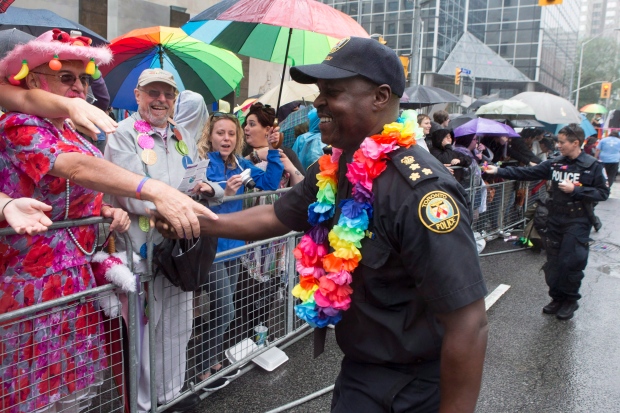
Police Chief Mark Saunders greets the crowd during Toronto’s Pride parade in 2015. (Chris Young/Canadian Press)
But if we accept that the police are being singled out because of the severity of their brutality against Canada’s black and LGBT communities — both past and present — which is a defensible position, then perhaps it would be prudent for BLM to define some sort of tangible criteria delineating how, and when, and by what measure police conduct would be acceptable enough for them to participate in the marches again.
Revoking the ban
At what point will police be distant enough from their past, like the Canadian Forces, innocuous enough in their present, like the education system, and adequately inoffensive in their image, like religious leaders, to once again be able to show their solidarity?
If we accept the notion that individuals have to carry misdeeds of the people before them — and the reputations of the worst among them — then it makes sense to prohibit any uniformed officer from participating in Pride activities.
But if we recognize that people are more than simply facets of the groups to which they belong, we’d know better than to paint them all with the same brush.
 About Andrew
 Multicultural Meanderings