More federal action needed to restore lost Canadian citizenship rights: Rock and Axworthy

Former Ministers Alan Rock and Lloyd Axworthy argue in favour of the proposed expansion of voting rights for non-resident Canadians in Bill C-33 and repeal of the first generation limit to the transmission of  Canadian citizenship.

The main weaknesses in their arguments:

  • Reinforces a global, more instrumental concept of citizenship, without a meaningful connection to Canada;
  • C-33 only requires a citizen to have been born in Canada in order to have voting rights, irrespective of how little time spent in Canada;
  • Repealing the first generation limit means a further weakening of the meaningfulness of citizenship and connection to Canada, as again the second or subsequent generations could retain citizenship without having lived in Canada;
  • Immigrants wishing to become citizens to be physically present in Canada (four out of six years currently, three out of six as proposed in Bill C-6) and retention after the first generation should, at a minimum, require residency;
  • Like others, they exaggerate the number of Canadians with connections to Canada. Passport data shows about 630,000 active non-resident adult passport holders, not the 2 to 3 million cited. This is a minimal connection test (taxation data shows about 130,000);
  • The exemption to the first generation limit for public servants serving abroad recognizes the fact that they work directly for the government, rotate regularly back to Canada, and pay Canadian taxes. This is quite different from those who spend their entire life abroad, do not return regularly for more than short visits, and for the most part, don’t pay Canadian taxes; and,
  • Largely targeted towards globally mobile professionals, Ministers Rock and Axworthy’s proposal fails to consider the implications for the broader population, whether it be the many non-resident Canadians who simply live their lives abroad without making “important global contributions” or resident Canadians who may feel that granting citizenship without residence devalues the meaning of being Canadian. 

    Their proposal is largely targeted towards those globally mobile professionals without considering the implications to the broader population of non-resident Canadians.

Canada’s former Minister of Democratic Institutions, Maryam Monsef, recently observed that in the 21st century, there are many good reasons why Canadians choose to live overseas, and that there is no reason to create barriers to their participation in democratic processes.

We agree, but would go further. Canadians living and working overseas face government barriers not only in participating in democratic processes, but also in passing along citizenship. These must be addressed.

The occasion for the comments made by Ms. Monsef – recently appointed Minister of Status of Women – was the introduction of legislation to repeal provisions of the federal Fair Elections Act. Adopted in 2014, this statute provides, amongst other things, that Canadians living overseas can vote only within five years of leaving Canada, and must have the stated intention of returning home.

In repealing this provision through Bill C-33, An Act to amend the Canada Elections Act, the federal government will remove one important penalty for Canadians living and working overseas. However, it is overlooking a potentially even greater disincentive.

A little-known 2006 amendment to the Citizenship Act limits Canadian citizenship to just the first-generation of children born to or adopted by Canadians who live outside Canada. Thus, children born to or adopted by Canadian parents who are travelling, studying, or working abroad become citizens of Canada at birth or at the time of adoption, but their children are not entitled to Canadian citizenship if they are born outside Canada.

This is harmful for at least two reasons.

First, the amendment to the Citizenship Act strikes us as discriminatory, and out of step with the principle that “a Canadian is a Canadian is a Canadian,” as articulated by Prime Minister Justin Trudeau. The amendment effectively creates two classes of Canadians: those who can pass along citizenship to their children and those who cannot. Furthermore, the amendment discriminates in favour of federal employees and military personnel who serve outside Canada. Under the current legislation, they are explicitly exempted from the limits on citizenship imposed by the amendment.

Second, Canada is deeply interconnected economically, socially and culturally with communities and countries around the globe. Canadians have a long history of important global contributions in international finance, peacekeeping, United Nations’ service, and humanitarian action, to name a few. We should be encouraging Canadians to venture beyond our borders to contribute to the broader global community, whether this be as students, travellers, or professionals – now, more than ever. Unfortunately, the current provisions of the Citizenship Act may have the opposite effect, by deterring Canadians from going overseas to work.

To date, the government has sought to justify this provision based on “simplicity and transparency.” We respectfully submit that any administrative advantages are substantially outweighed both by the principles of fairness and equity required by Canadian law, and by the importance of maintaining Canada’s standing in, and contributions to, the community of nations.

In terms of scope of impact, it is worth considering that at any point in time, 2-3 million Canadians live, work, or travel overseas. If even 0.5 per cent of these people have children overseas, this would amount to 10,000-15,000 children whose rights are limited and whose options are narrowed by this legislation each year. These numbers underscore the urgency and importance of addressing this matter quickly.

As the Government moves to restore voting rights to Canadians living overseas, it should also restore another fundamental birthright by allowing foreign-born descendants of Canadians who were themselves born outside our country to begin life with Canadian citizenship.

Source: More federal action needed to restore lost Canadian citizenship rights – The Globe and Mail
Judge shortage causing unnecessary legal trauma: MacKay

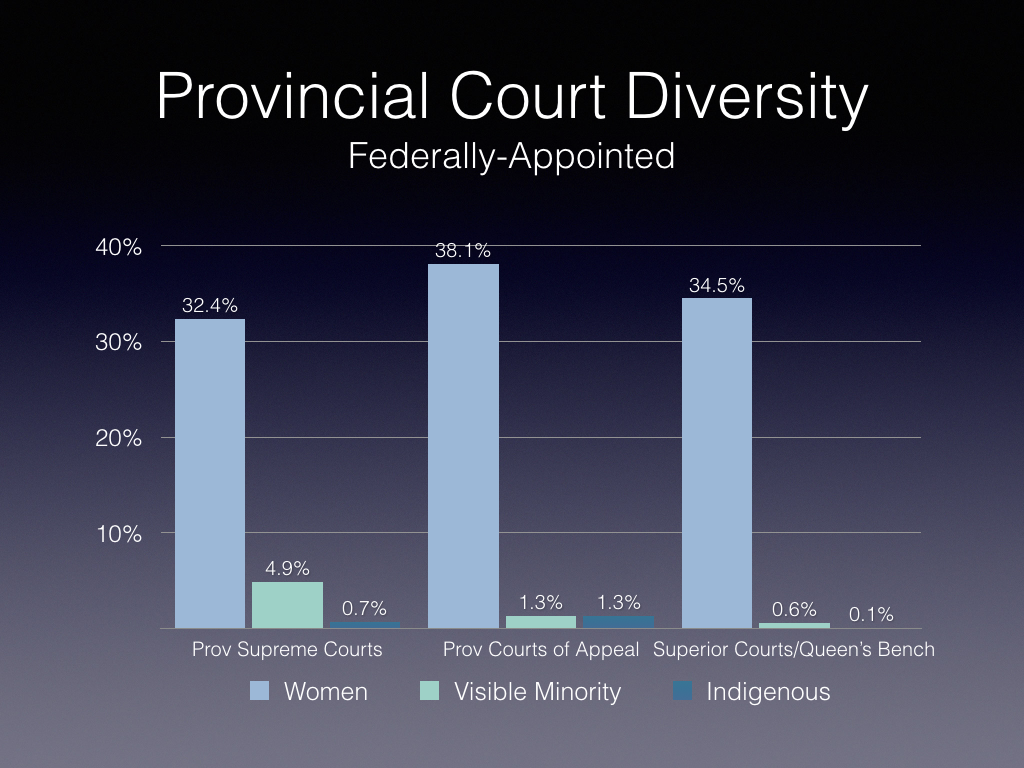
While MacKay is right to criticize the government for its delay in appointing judges, his assertion that under the Conservative government ‘s, “We appointed a judiciary that represented “the face of Canada,” a diverse bench predicated and built on inclusion of all races, creeds, and genders in the legal community across Canada” is false as shown in my 2016 analysis: Diversity among federal and provincial judges – Policy Options).

In contrast, appointments to date of the current government show a marked increase: 57.4 percent women, 6.4 percent for each of visible minorities and Indigenous peoples.

The federal government has a fundamental responsibility to appoint a sufficient complement of judges such that our courts can function properly. Its failure in that regard creates a constitutional crisis that goes to the very rule of law that underpins our justice system.

A lack of judicial appointments in the context of increasing pressure to conduct timely trials equals a systemic miscarriage of justice. With caseloads where they are, the system is at its breaking point.

Add to this difficult dynamic the recent Supreme Court of Canada ruling in the R v Jordan decision, which mandates criminal trials must be heard within 18 months for the so-called lower courts, and 30 months for the Superior ones. Absent compelling circumstances, “delinquent” prosecution equals administrative dismissal.

Due to this artificial prescription dozens of cases have been tossed, including murder and sex assault cases. No trial. No verdict. Worse still, the victims and their families are left without recourse or remediation and no one is accountable. Not fully appreciated as yet, this jarring situation stands to worsen due to the arbitrary deadline, which provides no consideration for the seriousness of the offence.

Against this backdrop we note inertia from the federal government on the appointment of judges to hear these languishing cases. Canadians face an alarming scenario of serious violent charges being vacated due to the acute shortage of judges. “Justice delayed is justice denied” is a maxim never more appropriately invoked than now.

As minister of justice (2013-15) I oversaw the appointment of more than 230 judges; prior to that my government prioritized hundreds more. We appointed a judiciary that represented “the face of Canada,” a diverse bench predicated and built on inclusion of all races, creeds, and genders in the legal community across Canada.

Vacancies on the federally appointed bench is at an all-time high. Sixty-two empty seats of the 840 federally appointed judges, against 14 (the lowest in decades) when my government left office. In June 2015, we appointed a record 22 women: over 60 per cent of the judges appointed on that occasion. We appointed more judges on one day (43) than the current government has in 16 months in office.

Source: Judge shortage causing unnecessary legal trauma: MacKay | Toronto Star

The budget’s gender-based analysis forgot to look at one thing — men: Neil Macdonald

Valid question to ask, as no reason why GBA could not also look at areas where males are struggling or disadvantaged.

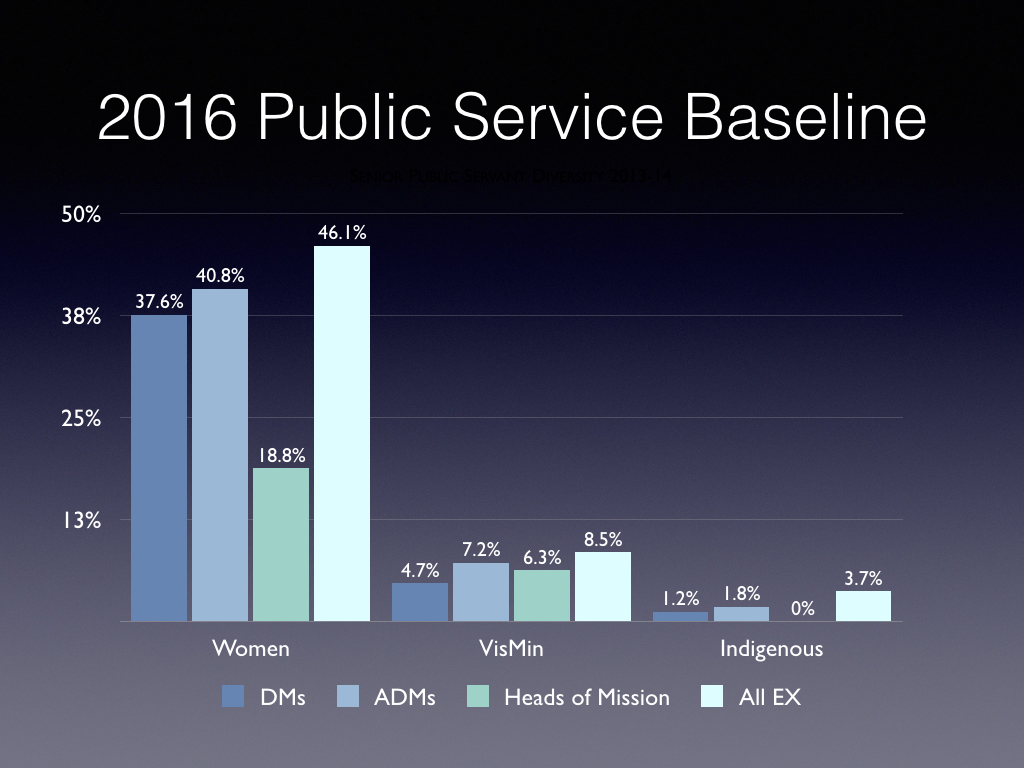
However, assertion that “women own government” and citing the figure that women form 71 percent of the public service ignores that women are overwhelmingly concentrated in support and admin positions (see my analysis Federal Employment Equity).

In terms of executive-level positions, the chart above shows that while considerable progress has been achieved, not yet at parity for the most senior positions (DMs and ADMs):

Every liberal, after all, is raised to believe that male privilege is the anchor determinant in our society, and that being born male — especially a white male — confers possession of the keys to society’s ignition.

And yet.

Here are a few things the budget’s gender-based analysis ignores, and might be worth addressing next time:

Women do much better than men in school.

That wasn’t the case even 20 years ago, but as Statistics Canada puts it: “Today, the situation is completely different. Education indicators show that women generally do better than men.”

The gap begins in kindergarten, where girls earn better marks than boys, and continues right through university.

“More girls than boys earn their high school diploma within the expected timeframe, and girls are less likely to drop out. More women than men enrol in college and university programs. A greater percentage of women leave these programs with a diploma or degree.”

If that trend continues, and there is no reason to believe it won’t, it isn’t hard to see what lies ahead: an increasingly uneducated and unemployable male population.

“It is quite troubling that increasing numbers of young men are dropping out,” says Philip Cross, former chief economic analyst for Statistics Canada. “They don’t tend to do well in public school, and they’re constantly told that if you don’t go to university, you might as well not be in our society, and they know they probably aren’t going to university, so they just drop out. An increasing number of men are not in the labour force and not going to school. This is not good.”

Women have not yet caught up to men in the private sector, but they own the public service, by far the single biggest employer in the country.

According to Statistics Canada, women not only comprise 71 per cent of Canada’s 4.1 million public sector jobs at all levels of government, but“gender parity now exists in the public sector with respect to women’s representation in leadership positions.”

Meaning that while women are still a designated group for the purposes of preferential hiring in the public service, they now have most of the jobs and at least half of the most senior jobs.

Cross puts it rather bluntly: “Women are overrepresented in government, and government jobs are the best jobs. Best job security, best pension benefits, best everything.”

Further, he says, women now dominate the feeder positions for all the most senior jobs in government.

The overwhelming majority of people who have lost their jobs in the resource sector out west and the manufacturing sector, mostly in Ontario, are men.

As Springsteen sang, these jobs are going, boys, and they ain’t coming back.

“There is a certain type of man who you wanted in the oil sands, out of town, blowing things up,” says Cross. “Those people still exist, and now they are jobless, and what do we do with them now?”

Exact figures are difficult to find, but Janice MacKinnon, a university professor and former NDP finance minister in Saskatchewan, says it’s a “staggering number.” And those jobs that do come back will demand higher skill levels.

She notes there is absolutely nothing in the budget’s gender-based analysis about those jobs, or what to do about their disappearance.

“Where’s the strategy on that?” she asks. “If you are going to look at gender, that’s fine, but there are areas where boys and men are struggling, and they need to be documented, too.”

MacKinnon even goes so far as to say that being a white male entering the current job market is a disadvantage.

Cross puts it another way: “Historically, our economic system has favoured men, but the trend is in the opposite direction.”

He would dearly like someone to ask the government why none of its gender-based analysis addressed any of the forgoing.

So I wrote one of the prime minister’s senior advisers to ask.

The reply: “It is a reasonable question to ask.”

But, um, no answer.

Source: The budget’s gender-based analysis forgot to look at one thing — men: Neil Macdonald – CBC News | Opinion

Nova Scotia tackles racial profiling in stores: ‘It’s about a societal transformation’

Helpful initiative:

More than a decade after racial profiling was identified as a festering problem among some police forces, it is now being addressed in another sector: retailing.

After years of complaints about retail staff who routinely follow, search, ignore, insult and provide poor service to visible
minorities, one province has decided to do something about it in a big way.

On Monday, the Nova Scotia Human Rights Commission launched a free, online training program aimed at preventing a problem that has sparked a growing chorus of complaints across the country.

National campaign planned

The 20-minute interactive course for front-line service staff — described as the first of its kind in Canada — has already attracted attention from businesses in other provinces and the United States, and plans are in the works to roll out a national campaign.

“As a proud African Nova Scotian and seventh-generation Canadian … I am acutely aware of the problems associated with navigating race relations in our society,” Rev. Lennett Anderson of the African United Baptist Association of Nova Scotia told a news conference at the Halifax Chamber of Commerce.

“The need for a campaign such as this is a desperate one … It is worthy of our celebration.”

Report showed poor treatment

The retail sector is Canada’s largest employer, with over two million people working in an industry that generated $59 billion in payroll in 2015.

Christine Hanson, CEO of the Nova Scotia Human Rights Commission, said the need for such a training program was reinforced in 2013 when the commission released a groundbreaking report that concluded Aboriginal people and African Canadians more often reported being treated poorly by retail staff than did any other group.

“In fact, people from all racialized groups, including Asian, Latin American and Middle Eastern people, reported being treated poorly by staff far more than did white people,” the report said.

“In the focus groups, several participants commented on being made to feel ‘lower class’ or like ‘second-class citizens’ when shopping.”

Targets of offensive language

The report went on to say that Aboriginal people, African Canadians, and Muslims were all targets of offensive language and were treated as if they were physically threatening and potential thieves.

“A person who is a member of a visible minority group is three times more likely to be followed in a store, and four times more likely to be searched,” Hanson said.

The online program, called “Serving All Customers Better,” includes a quiz about immigration and visible minorities. It also cites statistics from the 2013 report and clearly spells out what the law says.

The course also cites some examples, at one point quoting a worker who said: “I worked for a retailer who said, ‘The eagle has landed,’ when a black person walked into the store. I quit my job over it.”

A cross-country issue

Examples of consumer racial profiling continue to make headlines across the country.

In October 2015, the Human Rights Tribunal of Ontario agreed with a woman who said she faced discrimination as a black person when she was confronted by a Shoppers Drug Mart employee who demanded to search her backpack on suspicion of shoplifting. The tribunal ordered the store to pay Mary McCarthy $8,000.

And in February 2015, Calgary university student Jean Ventose said he was racially profiled when he was followed by a security guard inside a local Walmart, apparently for no reason. He posted a video on the encounter on Facebook, which received more than one million views and 10,000 reactions in two days.

In August 2016, one of Canada’s largest grocery chains withdrew its appeal of a human rights decision that found an employee of Sobeys had discriminated against a black customer in May 2009 after falsely accusing her of being a repeat shoplifter.

Sobeys said it reached a settlement with the Nova Scotia Human Rights Commission and would apologize to Andrella David, pay her $21,000 in compensation, and develop a staff training program on racial profiling.

The company faced a boycott by a group of 19 churches in the province.

Repeated racial profiling

As well, Nova Scotia’s first black lieutenant-governor, Mayann Francis, came forward to reveal that she, too, had been the victim of repeated racial profiling while shopping.

At the time, Francis said Nova Scotia was in a state of denial when it came to racial profiling, saying she had often been the victim of “shopping while black” since she left her viceregal post in 2012.

“It does not matter how successful you are, it still can happen to you,” said Francis, who had previously served as CEO of the province’s human rights commission.

“It’s just so wrong and so hurtful and I know how I feel when I’m followed in the stores … They’re stalking you.”

Source: Nova Scotia tackles racial profiling in stores: ‘It’s about a societal transformation’ – Nova Scotia – CBC News

Lisée reproche à Couillard de faire le procès des Québécois

Denial or identity politics?

Le chef du Parti québécois, Jean-François Lisée, a livré une charge à fond de train, lundi, contre le gouvernement de Philippe Couillard, lui reprochant de mettre les Québécois au banc des accusés dans un procès sur le racisme.

M. Lisée réagissait à l’annonce, la semaine dernière, de la nomination d’un comité-conseil devant jeter les bases d’une consultation sur le racisme systémique.

M. Lisée a qualifié l’exercice de «procès en racisme qui va être organisé par l’État québécois contre les Québécois».

Selon le chef péquiste, le gouvernement libéral met en place tous les ingrédients pour faire ce qu’il appelle «une recette pour augmenter le racisme» en voulant se pencher uniquement sur le racisme et la discrimination, tout en refusant de mettre des balises sur les accommodements religieux et les signes religieux.

Le chef péquiste soutient qu’on ne peut «faire reculer le racisme au Québec» sans agir sur ces deux axes en parallèle.

Jean-François Lisée se dit convaincu qu’une consultation sur le racisme systémique ne pourra qu’«attiser le ressentiment de la majorité et soulever la colère de la minorité, parce qu’il y en a du racisme au Québec».

«Que ce soit M. [Justin] Trudeau avec son islamophobie, M. Couillard avec ses déclarations que tous ceux qui sont en désaccord avec lui alimentent la xénophobie, (…) cela fait partie d’un contexte qu’on essaie d’imposer aux Québécois pour les culpabiliser, les stigmatiser», a-t-il dit.

Canadians Adopted Refugee Families for a Year. Then Came ‘Month 13.’ – The New York Times

Good long and nuanced read on the challenges of one Syrian family and their Canadian sponsors:

One year after Canada embraced Syrian refugees like no other country, a reckoning was underway.

Ordinary Canadians had essentially adopted thousands of Syrian families, donating a year of their time and money to guide them into new lives just as many other countries shunned them. Some citizens already considered the project a humanitarian triumph; others believed the Syrians would end up isolated and adrift, stuck on welfare or worse. As 2016 turned to 2017 and the yearlong commitments began to expire, the question of how the newcomers would fare acquired a national nickname: Month 13, when the Syrians would try to stand on their own.

On a frozen January afternoon, Liz Stark, a no-nonsense retired teacher, bustled into a modest apartment on the east side of this city, unusually anxious. She and her friends had poured themselves into resettling Mouhamad and Wissam al-Hajj, a former farmer and his wife, and their four children, becoming so close that they referred to one another as substitute grandparents, parents and children.

But the improvised family had a deadline. In two weeks, the sponsorship agreement would end. The Canadians would stop paying for rent and other basics. They would no longer manage the newcomers’ bank account and budget. Ms. Stark was adding Mr. Hajj’s name to the apartment lease, the first step in removing her own.

“The honeymoon is over,” she said later.

That afternoon, her mind was on forms, checks and her to-do list. But she knew that her little group of grandmothers, retirees and book club friends was swimming against a global surge of skepticism, even hatred, toward immigrants and refugees. The president of the superpower to the south was moving to block Syrians and cut back its refugee program. Desperate migrants were crossing into Canada on foot. Stay-out-of-our-country sentiment was reshaping Europe’s political map. In a few days, an anti-Muslim gunman would slaughter worshipers at a Quebec City mosque.

Ms. Stark and her group were betting that much of the world was wrong — that with enough support, poor Muslims from rural Syria could adapt, belong and eventually prosper and contribute in Canada. Against that backdrop, every meeting, decision and bit of progress felt heightened: Would the family succeed?

Ms. Stark’s most crucial task that day was ushering the Syrian couple to a budget tutorial. Banks were new to them. So were A.T.M. cards. Because the sponsors paid their rent and often accompanied them to make withdrawals, the couple had little sense of how to manage money in a bank account.

Some of Canada’s new Syrian refugees had university degrees, professional skills, fledgling businesses already up and running. But the Hajjes could not read or write, even in Arabic. After a year of grinding English study, Mr. Hajj, 36, struggled to get the new words out. He longed to scan a supermarket label or road sign with ease and had grown increasingly upset about his second-grade education, understanding how inadequate it would prove in the years to come.

The ‘yes, but’ solution to religious conflict: Marmur 

Good column by Marmur:

It shouldn’t have needed a massacre in a Quebec Islamic cultural centre in January to rouse Canadians to show that they care for the safety of their Muslim neighbours. Mercifully, the initiative of Yael Splansky, the senior rabbi of Holy Blossom Temple in Toronto, did that by getting people of all faiths to form rings of peace around mosques.

It shouldn’t have needed the desecration of gravestones in Jewish cemeteries in American cities last month to move people to show solidarity with their Jewish neighbours. Mercifully, the impressive voluntary efforts by Muslims to restore the broken graves and their offers to guard Jewish burial places did that.

One of the explanations why Jewish-Muslim co-operation and mutual affirmation are so difficult in our time is because the Israeli-Palestinian conflict is in the way, however futile it may be for Jews and Muslims in North America to fight the battles of the Middle East.

Muslims and Jews here would do much better had they been acting according to the “yes, but” formula suggested by Peter Berger, arguably the most influential sociologist of religion in our time.

In an essay in The American Interest he writes that it’s possible to be religiously committed and yet have reservations, e.g., “I am Catholic, but …” In our context it should be possible to say, “I’m committed to Muslim-Jewish co-operation but I disagree with, or even deplore, the others’ attitude to and treatment of my co-religionists in the Holy Land.”

As much as I’d like all Muslims to publicly affirm that Israel is a Jewish state, I don’t need such declarations in order to co-operate with Muslim neighbours in Toronto or even in Jerusalem. After all, Christians and Jews have learnt to work purposefully together for the good of the society in which they live despite very different views about, for example, Jesus.

Yet disagreement on this and other issues that adherents consider to be fundamental doesn’t prevent them from working together in celebration of what they do agree on, and in the service of the society in which they live. They know that the perfect is the enemy of the good.

That’s why Jewish-Muslim dialogue needs Christians to show how, despite countless centuries of prejudice and persecution, it has become possible to co-operate and help protect each other. Christians are needed as catalysts in the Muslim-Jewish dialogue.

 The apparent absence of statements on behalf of faith communities in Canada in support of the motion M-103, which calls on the government to fight racism and religious discrimination, may have contributed to the opposition to it.

The sponsor of the motion, Liberal backbencher Iqra Khalid, is said to have received ominous threats from fanatical opponents and apparently now has special security protection. Some politicians also appear to be using Khalid’s effort as an excuse to rouse reactionary elements in society in the guise of legitimate opposition.

It’s possible the “Islamophobia” that figures prominently in the motion is too ambiguous and controversial a term. “Anti-Muslim bigotry,” as suggested by former Attorney General Irwin Cotler, might have been better.

Perhaps other language could have been used to clarify the intention of the motion. However, all parties could nevertheless support it by following Peter Berger’s “yes, but” principle: Yes, I disagree with certain words, but I fully support this effort to curb anti-Muslim bigotry.

More vigorous responsible religious voices might have injected much needed sanity into the debate. Surely, every effort to prevent attacks of the kind we’ve seen in Quebec, in American cemeteries and elsewhere is a religious imperative. M-103 can become yet another wholesome tool in the struggle.

Source: The ‘yes, but’ solution to religious conflict: Marmur | Toronto Star

Job program for immigrants aims to fill labour gaps outside GTA

Good initiative:

Apoorvya Kapoor started applying for jobs in Canada even before she arrived from India last May, but none of the 200-plus resumes she sent out to GTA employers yielded a response.

Frustrated with the grim employment prospects, the new immigrant attended a job fair in Mississauga in November put on by the Peel Newcomer Centre and a staff member asked if she would consider relocating outside of Greater Toronto.

“You go to all these websites and 95 per cent of the job postings are within the GTA,” said Kapoor, who has an undergraduate degree in biomedical engineering and a master’s degree in hospital administration from India. “I just never thought about that.”

That’s the mindset the Peel newcomer service agency is hoping to change with an innovative program, called the Rural Employment Initiative, which aims to connect newcomers with job openings in smaller Ontario communities.

Currently, the program serves any employer outside the GTA, but ultimately it hopes to focus on communities with populations under 10,000.

“Youth from these communities are leaving for the big cities to study and when they finish school, they don’t go back,” said Oliver Pryce, the project’s co-ordinator.

“These communities have all these unmet labour market needs. We are hoping to fill these gaps with newcomers who are willing to relocate and work outside of Greater Toronto.”

The project is the brainchild of the Peel Newcomer Centre and the Ontario Association of Community Futures Development Corporation, a federally-funded group representing 61 rural communities. The employment initiative itself is funded by the Ontario Trillium Foundation.

Over the past year, Pryce has been reaching out to municipal economic development departments, local business sectors and employment services in smaller communities. So far, the project has already established partnerships in Huron County, Owen Sound, Thunder Bay, Windsor and Woodstock.

While local employers and stakeholders are committed to offering leads for job openings, the newcomer centre will provide the communities with diversity awareness training — and more importantly, screen newcomers and refer suitable job candidates to them for consideration. The program will also connect relocated immigrants with newcomer services in their new community.

Since the project shifted into high gear in November, it has received more than 100 job leads, drawn 90 newcomers interested in relocating and made three successful matches.

The jobs, many in the manufacturing sector, include auto parts production, mining, information technology, health care, project management and marketing.

“When a client (immigrant) comes to us, we make sure they understand what it means by rural and what it means to move to these communities. We give them the tools where to look for those opportunities in smaller communities,” said Pryce.

“We look at their family structure. When you move, it’s not just one person, but your family and children are involved. We look at their resumes and credentials to ensure their job readiness.”

Source: Job program for immigrants aims to fill labour gaps outside GTA | Toronto Star

Fewer Canadians being refused entry at U.S. land border

Always important to have the numbers and data to inform discussion and debate, both the numbers of refusals as well as overall numbers of people crossing the border:

Fewer Canadians are being turned away at the U.S. land border in recent months despite mounting concerns that Donald Trump’s immigration policies are making it much harder to cross, The Canadian Press has learned.

Refusals of Canadians at American land crossings dropped 8.5 per cent between October and the end of February compared with the same five-month period a year earlier, according to U.S. government statistics

The total number of Canadian travellers denied entry also dropped: 6,875 out of 12,991,027 were refused entry, a refusal rate of 0.05 per cent.

Between October 2015 and February 2016, 7,619 out of 13,173,100 Canadian travellers were denied entry to the U.S., a refusal rate of 0.06 per cent.

About 180,000 fewer people attempted to cross the border in the most recent figures.

The figures, confirmed by U.S. Customs and Border Protection, contrast with recent anecdotal reports of Canadians denied entry into the U.S., with many placing the blame on the policies of the Trump administration, including its controversial attempts to ban arrivals from several predominantly Muslim countries.

A further breakdown of the border data shows a sharp drop in Canadian refusals at the U.S. border in the first two months of this year as 2,600 Canadian travellers were denied entry, compared with 3,500 for the same two-month period of 2016.

‘Much more cautious about crossing the border’

But Canadian immigration and civil liberties advocates caution the numbers don’t tell the whole story.

Immigration lawyer Lorne Waldman said he is fielding more calls than ever from people planning a trip to the U.S. and wanting to make sure they have the paperwork they need. The decreased rate of refusal could be just that people are now better prepared than they used to be, and so fewer are being turned away as a result, he said.

“People in Canada used to take it for granted that they could just go to the border . . . but that’s no longer the case,” he said.

Douglas Todd: The narrow view from the migration sector bubble

Todd on his experience at Metropolis (I had the pleasure of meeting and chatting with him, as I always find his columns of interest).

His critique about the Metropolis bubble could of course be repeated with respect to most conferences. As could his critique of attendees being dependent of government cheques. Being dependent on private sector funding doesn’t make one more objective.

However, all that being said, it is a valid critique that Metropolis does not include a wide range of perspectives in both the plenaries and workshops, something that the conference organizers, as well as individuals like me who organize workshops, should keep in mind.

As well as the general point that one should be mindful of one’s bubble, and make efforts to get outside it, whether as Todd did by coming to Metropolis or ensuring that one’s media includes a range of perspectives (the main lesson that I learnt working under former Minister Jason Kenney as recounted in Policy Arrogance or Innocent Bias: Resetting Citizenship and Multiculturalism):

I just spent a few days with Canadians who work with immigrants, refugees, international students and other migrants.

The almost 1,000 people at the 2017 Metropolis Conference in Montreal are on the front lines of an effort central to a country with arguably the world’s highest per capita in-migration.

Each year, Canada spends roughly $1.2 billion on the so-called “settlement sector.” Its mission is to assist more than 300,000 new immigrants and refugees a year while supporting 325,000 foreign students and more than 300,000 temporary foreign workers.

Migration is a mass phenomenon in Canada, unlike in most nations. Many settlement workers live in the cities that draw most migrants: Foreign-born people make up 23 per cent of Montreal’s population, 45 per cent of Metro Vancouver’s and half of Greater Toronto.

Workers in the settlement-sector form an influential Canadian subculture. One person at Metropolis affectionately referred to them as “activists with pensions.” Immigration Minister Ahmed Hussen spoke twice and told them they greatly influence public policy.

I began wondering, however, how much these upstanding people represent the Canadian population. Do their values correspond at all to opinion poll results or with the issues Canadians follow through the media?

The vast majority at the taxpayer-funded Metropolis conferences live on government paycheques or grants. They are in the Immigration Department, the Heritage Department, public research universities and taxpayer-financed non-profit organizations.

Their theme is humanitarianism. Metropolis participants repeatedly said Canada should bring in more immigrants, refugees and foreign students, migrants are a “vulnerable population” and taxpayers should spend more on them.

Borrowing from Canadian scholars Keith Banting and Will Kymlicka, it’s fair to say almost all at the 19th national Metropolis event would be among the one-third of Canadians who unconditionally support multicultural, refugee and immigration policy. I did not hear disapproval.

They would definitely not be among the slightly smaller proportion of people that Banting and Kymlicka found at the opposite end; those opposed to Canadian-style immigration and multiculturalism.

It’s also not likely many attendees would be in the middle group of Canadians — the roughly 40 per cent (domestic and foreign-born) who generally support official multiculturalism, but with conditions.

Given what I witnessed, and the titles of hundreds of Metropolis presentations, critical discussion was muted. Orthodoxy seemed to reign.

It’s understandable. A lot of livelihoods, research grants and vested interests are at stake.

And, anyways, most attendees seemed keen on what they do. A few, indeed, seemed boastful.

There were basically only two things attendees would criticize.

Immigration Minister Ahmed Hussen told Metropolis delegates they greatly influence public policy. But to what extent do they reflect a cross-section of Canadians?

One was the alleged shortage of funding for settlement organizations, refugee agencies and foreign students. As a keynote speaker said, “We always have to do more.”

The second thing subject to criticism was the “media” and, by extension, Canadians themselves. Each was occasionally referred to as “tolerant” but more often chastised for being xenophobic.

Source: Douglas Todd: The narrow view from the migration sector bubble | Vancouver Sun