Parliamentary secretary changes: fewer visible minorities

election-2015-and-beyond-implementation-diversity-and-inclusion-025

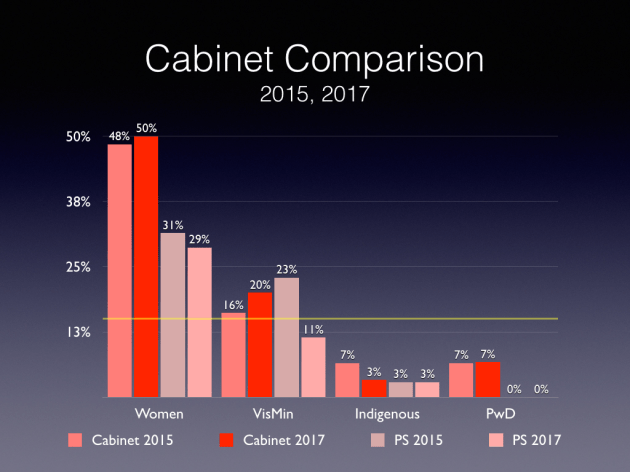
With the announcement Thursday of the changes to parliamentary secretaries, there has been a slight decline in the number of women and a halving of the number of visible minorities.

This largely reflects the number of visible minority parliamentary secretaries who were dropped (Anju Dhillon, Emmanuel Dubourg and Greg Fergus) and that none of the new parliamentary secretaries are visible minority.

The PMO press release indicates 34 parliamentary secretaries but the actual ‘parliamentary secretaries tab’ has 35: the number I have used for this analysis.

Is Kellie Leitch for real? When the Tory insider pushes her Trump-light message, who’s listening?

Good long read by Richard Warnica on Kellie Leitch’s leadership strategy, and the degree to which there is a ‘market’ for her use of identity politics, both within the party and the country more generally. Her campaign is a bit of a litmus test of Canadian resilience to xenophobia and anti-immigration messages:

Her appeal, then, is to a narrower slice of the Trump constituency, one engaged more by identity issues and immigration than economics and jobs. The question for Leitch is whether there are enough of those voters to carry her to victory in the Conservative race, let alone in a general election.

Pollsters and analysts from all three major parties are generally skeptical, though few rule out the idea entirely. Many see her values campaign more as a tactical attempt to stand out in the early going of the race than a genuine expression of belief. “She’s running against the mainstream, which helps her get headlines and raise money in the short term,” said Brad Lavigne, a longtime senior NDP campaign official. “But the bet is the short-term exposure that she’s getting now will come to haunt her if she were to win, because there is not a significant audience for this among general election voters.”

That’s not to say there is no constituency at all for that message in Canada. Compared to Europeans and Americans, Canadians are still relatively open to things like foreign investment, immigration and multiculturalism, according to pollster Frank Graves, the president of Ekos Research. But that support is not as strong as it once was, and it’s been going down for years. “A lot of people think Canada doesn’t have the same forces that produced Trump or Brexit,” Graves said. “It absolutely does. They’re a little bit muted, but they’re here.”

That audience is also disproportionately concentrated among Conservative supporters, the people Leitch needs to capture the leadership. Graves polled Canadians on support for Trump in November. A significant majority of Liberal, NDP, Green and Bloc supporters disapproved of the job he was doing as president-elect. But a majority of Conservative supporters — 57 per cent — approved. So when the Leitch team flicks at Trump’s themes or parrots his campaign, they aren’t necessarily poisoning the well, at least not the one they need to drink from right now.

Tim Powers, a longtime Conservative strategist and outspoken Leitch critic, believes at the very least she could use the Trump message to sell memberships. “I probably have responded as strongly as I have because I believe that they have the potential to win by playing off fears and discontent and misunderstandings,” he said. “I think I’m not alone in that. There is still a good portion of Canadian society that harbours an older, traditional version of the country. And some of that traditional version is good and some of it is not so good.”

There are also those in other parties who will admit, quietly, that Canadians of all stripes are not nearly as allergic to nationalist anti-immigrant messages as some would like to pretend. One senior Liberal said the party’s own internal polling shows that Canadians on the whole don’t love immigration, and that even on the refugee issue that captivated and helped turn the last election in the Liberals’ favour, the polling was pretty mixed.

Lietaer believes Leitch may find particularly fertile ground for her message in Quebec, where debates over cultural values, immigration and assimilation have raged for years. The Conservative Party actually won more votes and more seats in Quebec in 2015 than it did in 2011. Many attribute that marginal bump, concentrated in the Quebec City region, to the prominence of the debate over the niqab in the campaign.

“A student of mine told me, a few months later, that he had been working as an election worker and he said that the words at the end of the campaign were “niqab, niqab, niqab,” said Louis Massicotte, a political scientist at Laval University. “The general feeling here was that it was a good idea for the Conservative candidates to raise this issue.”

All of that said, the general consensus among the dozen or so strategists, pollsters and party insiders interviewed for this story, was that while Leitch may find an initial, vocal audience for her anti-Canadian values and anti-elite message, her potential for long-term growth is probably limited. “I don’t see what the second ballot strategy is here, because it’s such a polarizing issue,” said Lietaer.

Indeed, several strategists suggested Leitch’s best hope is to win on the first ballot, an exceedingly difficult task in a race with 14 candidates, a preferential ballot and an arcane system of dividing points between all of Canada’s 338 ridings. For Leitch, that job will be made even harder by the fact that, according to multiple Conservative sources, her campaign strategy has offended wide swaths of the party.

“Among the rank and file of the party, and frankly anybody I talk to in the party, anybody I know in the party, everybody is really, really right pissed off at her for doing this,” said Yaroslav Baran, who ran communications for Stephen Harper’s 2004 Conservative leadership campaign. Officially neutral at the time of his remarks, Baran announced his support for Michael Chong, one of Leitch’s rivals, this past week.
Source: Is Kellie Leitch for real? When the Tory insider pushes her Trump-light message, who’s listening? | National Post

As Popularity Of Citizenship-By-Investment Grows, Tighter Vetting By Some Countries Should Be Recognized | The Daily Caller

More on citizenship-by-investment programs, by Lanny Davis, who consults with countries to ensure appropriate due diligence in reviewing applications. Ironic that he also cites Dominica as a good example the same day that this other story came out where the process failed (Dominica says ‘due diligence followed’ before granting citizenship to arrested Iranian national):

Recent U.S. media reports, however, have focused on these “bad apples” or atypical anecdotal stories of abuses.  These reports fail to report the examples of nations who have raised, not lowered, their standards of vetting and oversight, so that Americans can gain the advantage of a passport that doesn’t put a potential “death” target on their backs when they seek to travel on business or for family vacation reasons.

For example, take the government of St. Kitts and Nevis (SKN), twin islands in the Caribbean 1,200 miles southeast of Miami. In the SKN citizenship-by-investment program’s infancy, a handful of wrongdoers obtained St. Kitts and Nevis passports. Rather than ignore their shortcomings to remain competitive in the contest of attracting potential investors, government leaders acknowledged the deficiencies and overhauled their program. I should know—I was hired to conduct an independent review of the country’s revamped program.

On December 4, 2015, I was retained by Prime Minister, the Honorable Timothy Harris, Head of the Government of the Federation of Saint Kitts and Nevis. We were asked to conduct an independent review of the increased efforts of the St. Kits and Nevis Government to enhance and strengthen its vetting and background checking procedures under its CBI.

With a staff that has nearly doubled in size, led by Mr. Les Kahn, an internationally respected former consultant to IPSA International, the unit has added many additional layers of vetting. Each layer requires a written report to explain why a specific recommendation was made, and that report stays in the file as it moves upstream. In addition to conducting internal investigations, unit officials collaborate at length with international partners (including the U.S. government) through established law enforcement channels. Under Mr. Khan’s leadership, the Unit has willingly revoked previously issued problematic passports. St. Kitts and Nevis now operates one of the most stringent CBIs in the world. In addition to conducting internal investigations, Unit officials collaborate at length with international partners (including the U.S. government) before deciding to issue the passport.

Another example is the nation of Dominica, another beautiful island nation in the Caribbean, Prime Minister, Dr. the Honorable Roosevelt Skerrit, with whom I have met twice and who is a most impressive leader of his small island, has been steadfast in his commitment to a rigorous vetting process that involves criminal, character and ethics checks by international law enforcement agencies for all citizenship applicants. For PM Skerrit, having a legitimate and transparent CBI is about more than reputation—it has massive implications for his small nation’s economy. In 2016, the CBI accounted for 39.2% of the country’s total revenue. These resources are critical to rebuild the country and its economy in the wake of tropical storm Erika.

No matter a country’s size and stature, in an age of terrorism and increased need in the global economy for Americans to travel without fear, the citizenship-by-investment programs of small democracies that need such investments ought to be available with appropriate high-level vetting standards.   International media should take the time to investigate and differentiate between those nations who are” selling” passports without regard to the “bad actors” buying them vs. those governments who have put a high level of regulation and oversight into place and continue to raise their standards before issuing passports, knowing they will depress revenues from such bad actors.

Source: As Popularity Of Citizenship-By-Investment Grows, Tighter Vetting By Some Countries Should Be Recognized | The Daily Caller

Refugee advocates urge Canada to keep borders open amid Trump directives

Yet another aspect of Canada that will be affected by decisions of the Trump administration:

Refugee advocates are urging Canada to keep its borders open to the world’s most vulnerable people as U.S. President Donald Trump orders the construction of a wall with Mexico and cracks down on illegal immigration.

As promised during the election campaign, Mr. Trump signed executive orders Wednesday to build a wall along the U.S.-Mexico border and strip federal grant money from “sanctuary” states and cities that shield illegal immigrants. Canadian refugee advocates say it’s critical that Canada continue to welcome newcomers, especially amid an unprecedented global refugee crisis that has displaced more than 65 million people.

“It’s absolutely devastating news for refugees around the world,” said Janet Dench, executive director of the Canadian Council for Refugees. “What is happening in the U.S. makes even more important Canada’s openness to refugees because the options are significantly smaller when the U.S. closes its doors.”

Without mentioning Mr. Trump or his policies, Immigration Minister Ahmed Hussen’s office said Wednesday that Canada has “always been welcoming of newcomers and will continue to do so.”

Experts say Canada could see an increase in the number of Mexican immigrants and refugees as a result of Mr. Trump’s anti-immigration sentiments and a recent Canadian policy change. Mexicans who feel unwelcome in the United States may now be looking a little further north to Canada, where the Liberal government lifted a visa requirement for Mexican travellers just last month. The visa requirement had been in place since 2009 when the Conservatives imposed it after a rise in invalid refugee claims from Mexico.

“The spike in Mexican immigration in general, but particularly refugee claims, is definitely going to happen in Canada,” said Toronto-based immigration lawyer Chantal Desloges. “You couldn’t imagine worse timing. We just lifted the visa requirement and now to have things shut down in the U.S., that’s going to be a definite driver.”

The government is prepared to reinstate the visa requirement if the number of Mexican asylum seekers surpasses 3,500 within any 12-month period.

Conservative immigration critic Michelle Rempel said the Mexican visa issue could backfire on the Liberals, especially given the fact that they were warned against it. Immigration department officials opposed the decision last year, arguing that Mexico’s poor human-rights record, high crime rates and low standard of living would drive Mexican refugee claimants to Canada.

“When the government lifted this visa requirement against the advice of bureaucrats and public servants without a formal review, I think Canadians started thinking, ‘Why are they doing that?’” Ms. Rempel said.

Chris Friesen, director of settlement services at Immigrant Services Society of B.C., said his organization is developing contingency plans for a possible influx of Mexican arrivals, including the preparation of housing and legal services.

However, Mexican refugee claimants hoping to flee Mr. Trump’s America and claim status in Canada won’t be able to do so, due to a special arrangement between Canada and the United States. Under the Safe Third Country Agreement, refugee claimants are required to request protection in the first safe country they arrive in and since the United States is considered a safe country by Ottawa, they are not allowed to make a claim in Canada after doing so in the U.S. A few exceptions are made for some refugee claimants, such as unaccompanied minors.

Mexicans aren’t Mr. Trump’s only target. The President is expected to sign executive orders in the coming days blocking the issuing of visas to people from seven Muslim-majority countries in the Middle East and North Africa: Syria, Sudan, Somalia, Iraq, Iran, Libya and Yemen.

NDP immigration critic Jenny Kwan called on Mr. Hussen to present a plan to Canadians outlining how the government will address the implications of Mr. Trump’s immigration policies.

Source: Refugee advocates urge Canada to keep borders open amid Trump directives – The Globe and Mail

Rogers TV Drops Arabic-Language Show Following Complaint of Antisemitism

B’nai Brith report, not yet seen on mainstream media (saw this on right-wing Canada Free Press site):

Rogers TV, which runs community programming throughout Canada, has pulled the plug on an Arabic-language show called AskMirna after B’nai Brith Canada drew its attention to antisemitic messages promoted in the program.

AskMirna, which describes itself as “presenting an accurate, positive, inspiring and entertaining image of the Arab-Canadian community,” dedicated an entire episode to “Nakba Day,” in which Palestinians annually mourn the establishment of the State of Israel and call for its destruction. This included an interview with Nazih Khatatba, who described Jewish suffering as “fairy tales” and engaged in Holocaust denial


Khatatba, a leader of Palestine House in Mississauga, Ont. has a history of inciting violence against Jews. In December, 2014, he lauded the terrorists behind the Har Nof synagogue massacre in Jerusalem that left six dead in his al-Meshwarnewspaper. The incident was later investigated by the Canadian Security Intelligence Service (CSIS).

In other episodes of AskMirna, Palestinian-Canadian children are shown dancing to songs that praise terrorism against Israel, which is labelled “the rapist entity.”

“Antisemitic propaganda delivered through music and television is rampant in the Middle East, and constitutes a significant barrier to peace between Israel and the Palestinians,” said Michael Mostyn, Chief Executive Officer of B’nai Brith Canada. “We cannot allow such hatred to be imported into this country, potentially radicalizing Canadian youth.”

Colette Watson, Senior Vice-President of Television and Broadcast Operations for Rogers Communications, told B’nai Brith that “…there is no room on Rogers TV, community television or anywhere in Canadian media for hate of any kind.”

Trump’s order to ban refugees and immigrants triggers fears across the globe – The Washington Post

And so it begins:

President Trump’s executive order to tighten the vetting of potential immigrants and visitors to the United States, as well as to ban some refugees seeking to resettle in the country, will shatter countless dreams and divide families, would-be immigrants and human rights activists warned.

The draft order, expected to be signed as early as Thursday, calls for the immediate cessation of ongoing resettlement of Syrian refugees in the United States, rejecting visas for visitors and immigrant hopefuls based partly on their ideology and opinions.

A copy of the draft orders was leaked Wednesday to civil rights groups and obtained by The Washington Post.

“I feel devastated,” said Ibrahim Abu Ghanem, 37, a father of three in the Yemeni capital, Sanaa, whose father and two brothers live in the United States. “This means all my plans are going to go down the drain.”

If the order is enacted, among those immediately affected would be potential immigrants and visitors from seven Muslim countries — Yemen, Iraq, Syria, Somalia, Iran, Libya and Sudan — that are considered by the Trump administration as nations whose citizens “would be detrimental to the interests of the United States.” For the next 30 days, they will not be allowed entry into the United States, even if they have visas and relatives who are U.S. citizens.

Activists protest Trump’s orders to crack down on refugees and undocumented immigrants

The order also calls for halting all admission and resettlement of refugees for 120 days pending the review of vetting procedures. For Syrian refugees, the ban will remain in place until further notice.

Once restarted, annual refugee admissions from all nations would be halved, from a current level of 100,000 to 50,000.

For those affected, the fear is that the order will be a harbinger for even greater restrictions on the horizon for Muslim immigrants, refugees and visitors — fulfilling Trump’s campaign promises of “extreme vetting” of foreigners seeking entry into the United States and installing “a Muslim ban.” Somalia, Syria, Iraq and Iran are among the leading countries of origin of recent refugees to the United States.

“It’s going to be devastating,” said Denise Bell, senior campaigner for refugee and migrant rights for the watchdog group Amnesty International. “Refugees are not a threat. They are the ones fleeing horrific violence. They are trying to rebuild their lives. They want the same safety and opportunities that any of us would want.”

“And so we are scapegoating them in the guise of national security. Instead, we are betraying our own values. We are violating international law,” she said.

Since Wednesday, as news of the impending order spread, lives were quickly affected across the world, particularly among the citizens of the countries immediately targeted. For them, it’s already difficult to get visas or immigrate to the United States. Vetting has been stringent since the Sept. 11, 2001, terrorist attacks, say human rights activists. Even so, many potential Muslim immigrants went through long screening processes, often lasting years, to gain entry to the United States. Now, many find themselves in an emotional and bureaucratic limbo.

Google offers a glimpse into its fight against fake news

Challenge to know how much the issue is being addressed without any independent watchdogs:

In the waning months of 2016, two of the world’s biggest tech companies decided they would do their part to curb the spread of hoaxes and misinformation on their platforms — by this point, widely referred to under the umbrella of “fake news.”

Facebook and Google announced they would explicitly ban fake news publishers from using their advertising networks to make money, while Facebook later announced additional efforts to flag and fact-check suspicious news stories in users’ feeds.

How successful have these efforts been? Neither company will say much — but Google, at least, has offered a glimpse.

In a report released today, Google says that its advertising team reviewed 550 sites it suspected of serving misleading content from November to December last year.

Of those 550 sites, Google took action against 340 of them for violating its advertising policies.

“When we say ‘take action’ that basically means, this is a site that historically was working with Google and our Adsense products to show ads, and now we’re no longer allowing our ad systems to support that content,” said Scott Spencer, Google’s director of product management for sustainable ads in an interview.

Nearly 200 publishers — that is, the site operators themselves — were also removed from Google’s AdSense network permanently, the company said.

Not all of the offenders were caught violating the company’s new policy specifically addressing misrepresentation; some may have run afoul of other existing policies.

In total, Google says, it took down 1.7 billion ads in violation of its policies in 2016.

Questions remain

No additional information is contained within the report — an annual review of bad advertising practices that Google dealt with last year.

In both an interview and a followup email, Google declined to name any of the publishers that had violated its policies or been permanently removed from its network. Nor could Google say how much money it had withheld from publishers of fake news, or how much money some of its highest-grossing offenders made.

Some fake news site operators have boasted of making thousands of dollars a month in revenue from advertising displayed on their sites.

‘I always say the bad guys with algorithms are going to be one step ahead of the good guys with algorithms.’– Susan Bidel, senior analyst at Forrester Research

The sites reviewed by Google also represent a very brief snapshot in time — the aftermath of the U.S. presidential election — and Spencer was unable to say how previous months in the year might have compared.

“There’s no way to know. We take action against sites when they’re identified and they violate our policies,” Spencer said. “It’s not like I can really extrapolate the number.”

A bigger issue

Companies such as Google are only part of the picture.

“It’s the advertisers’ dollars. It’s their responsibility to spend it wisely,” said Susan Bidel, a senior analyst at Forrester Research who recently co-wrote a report on fake news for marketers and advertisers.

That, however, is easier said than done. Often, advertisers don’t know all of the sites on which their ads run — making it difficult to weed out sites designed to serve misinformation. And even if they are able to maintain a partial list of offending sites, “there’s no blacklist that’s going to be able to keep up with fake news,” Bidel said, when publishers can quickly create new sites.

Source: Google offers a glimpse into its fight against fake news – Technology & Science – CBC News

Is your gender really necessary on a passport? | Toronto Star

Interesting to see where the government ends up on this but encouraging that the MP responsible for advising the PM, Randy Boissonault, on the issue recognizes the balance: “Any policy changes have to also ensure good policy making in the future … we want to make sure that we’re being respectful and inclusive, and yet not erasing what knowledge we have.”

There is also a need for federal-provincial consultation and likely coordination to avoid situations such as when Ontario removed gender from health cards, making it more difficult for some to get a passport (New gender-neutral Ontario health cards make it harder to get a … – CBC):

In what transgender rights activists are calling a “landmark” development, the Canadian government has settled a human rights case that could pave the way for gender markers to be scrubbed from passports, birth certificates and other identity documents.

Ottawa is also undertaking a government-wide review to assess how it collects and uses sex and gender information — a move that advocates for transgender rights are hailing as a major victory in the fight to remove “male” and “female” markers from identity documents.

“To my knowledge, this would be like a world first, for a government to proceed to review all of its gendering practices,” said barbara findlay, a lawyer and member of the Gender-Free ID Coalition, an advocacy group calling for gender-neutral identity documents.

“It’s a seismic shift in the way that we understand what gender means and how we should be using it.”

Wednesday’s announcement caps a five-year battle launched by findlay’s client, 32-year-old Torontonian Christin Milloy, who was repeatedly denied in her attempts to update the gender information associated with her social insurance number.

In January 2012, the transgender activist and web developer filed a human rights complaint against Employment and Social Development Canada (then known as Human Resources and Skills Development Canada), which oversees the SIN register.

A settlement was only reached last week, however. While its terms are confidential, an exception was made for some details to be publicized.

“As a government, we feel that this settlement is a step in the right direction,” said Jean-Yves Duclos, Minister of Families, Children and Social Development, in a statement posted online.

“My department is committed to reviewing its data collection to determine when it is justifiable to ask an individual for their gender as a condition of receiving a government service or for other legitimate purposes.”

In the settlement, ESDC acknowledged that personally-identifiable sex and gender information can only be collected from Canadians if there are “legitimate purposes” for doing so. It remains unclear how “legitimate purposes” will be defined, but Milloy believes the acknowledgement is “revolutionary.”

“Now the onus is on government to prove why they need the data,” she said.

Since Milloy filed her complaint, the ESDC has stopped requesting supporting documentation from people looking to change their gender associated with their SIN.

The government department is also changing its procedures to let people opt out of responding to sex or gender questions. It will further provide at least three options — male, female, and a third option — when the question is asked.

“We are encouraged by this change, and we hope that all governments in Canada are inspired to remove gender markers (“male or female”) on documents wherever possible, and make any remaining markers more gender inclusive,” Marie-Claude Landry, chief commissioner of the Canadian Human Rights Commission, said in a written statement.

“What it comes down to is the ability for people to choose how they define themselves and under what circumstances. There is nothing more unique or personal than our identity and gender.”

Gender markers can be fraught for people who are transgender, gender fluid or have a non-binary gender identity.

The wrong gender on a driver’s license can “out” someone as transgender — making them vulnerable to discrimination or transphobic violence — and the letters “m” and “f” fail to accurately represent people who identify as both or neither.

Current processes to change gender information can also be onerous, expensive or invasive.

While some have proposed adding an “X” option to identity documents, the Gender-Free ID Coalition argues that “in our transphobic society, a third option puts a target on the forehead” of people who are gender diverse. Furthermore, they don’t see how a government can verify someone’s sex (not only are some people intersex, biological sex is now understood to comprise a variety of factors, like chromosomes, genitalia and secondary sex characteristics) or gender identity (which can be fluid and reflects how someone feels inside).

They prefer a different solution: eliminating gender markers altogether.

“You wouldn’t be entitled to ask somebody’s race, sexual orientation or religion — and gender is exactly the same,” said findlay.

She said the routine practice of asking for gender information hearkens back to a time when “men and women had utterly different rights” — for example, when women were prohibited from owning property, voting, or marrying other women.

“But those legalized inequalities are gone,” she said. “There is no longer a reason to maintain that information.”

Transgender rights activists don’t oppose the collection of de-personalized gender information for census surveys and demographic research. Lawyer Nicole Nussbaum says the goal is to push for “deliberate and purposeful collection of information.”

The government-wide review is aimed at achieving just that, according to Edmonton Centre MP Randy Boissonnault, special advisor to the prime minister on LGBTQ2 issues.

He said that the review will try to understand how sex and gender data is collected and used, and where it might be necessary for informing policy and funding decisions. He said that Canadians with gender-diverse identities are also poorly represented in datasets, something he hopes to see fixed.

“If we’re going to, as a government, get to the point where we can have respectful gender markers on official documents, then we also need to know how we collect that information as a government,” he said.

“Any policy changes have to also ensure good policy making in the future … we want to make sure that we’re being respectful and inclusive, and yet not erasing what knowledge we have.”

Boissonnault doesn’t have a timeline yet for how long the government review process will take. But Milloy’s case is sure to have an immediate impact in courtrooms and tribunals across the country, where other battles over gender markers are still playing out.

Source: Is your gender really necessary on a passport? | Toronto Star

White Women Should Check Their Privilege After Women’s March | Lauren Sandler

A reminder of white ‘privilege’:

We unravel the powerful statements of intersectionality that we heard from that stage when we congratulate ourselves for the safety of the march. That safety is a privilege, among many privileges. We must consider the racial and economic factors behind the fact that there’s a different state system for women with skin privilege — and economic privilege. Failing to do so reinforces the oppression so many of us said we were marching to dismantle. The absence of an intimidating law-enforcement presence at the Washington march, in contrast with the policing of gatherings and communities of color, is part of a story we must tell if we are to speak the truth of this march. Not every woman there was a woman of privilege, whether it be due to the color of their skin or their financial comfort.

“I spent a fortune to come here,” one woman told me, who had flown in from Colorado and stayed at the Renaissance hotel where rooms were more than $800 a night. “Didn’t we all?” I’m glad that she came. I’m glad I had the funds to share an AirBnb with my friend who drove us down there ($150 per night for each of us). I’m glad I brought my 8-year-old daughter; I’m glad she brought her son. My mother flew down from Boston on JetBlue, with a ticket she bought the morning President Trump gave his acceptance speech, and Hillary Clinton gave her concession. I’m glad she had that privilege.

On my mother’s plane, flight attendants wore pink cat-ear hats, took pictures with the women who filled every seat to protest and cheered the marchers over the P.A. I’m glad for that too. But would they have taken pictures and cheered if the flight had been filled with people flying down to march against a Muslim registry? Would my mother have traveled as swiftly from the tarmac to the entrance to the metro? Would the flight attendants have donned hats in solidarity with those marchers? There’s a beautiful picture of a white cop in uniform wearing one of those pink hats, smiling alongside the march route in Portland. It’s hard to imagine him in a Black Lives Matter armband alongside a march for racial justice or wearing a button in support of immigrant rights.

Another photo has been circulating of three white women in pink hats smiling into their own phones near a black woman holding a sign reminding us that many white women voted for Trump. The image has been divisive. But that sign does not state an alternative fact — nor should we ignore that 94% of black women voted against Trump. These things are simply true. Just as our march was given the benefit of the doubt by law enforcement. (And surely no one in public relations was a fan of the optics of men in uniform roughing up a mass of white ladies.)

If we want a true women’s movement, our joyous, contagious celebrations must beware of self-congratulation. There is much to cheer in this historic, women-led moment that united so many of us. But we can’t fail to be clear-eyed about existing injustice as we fight against gender inequality. If we want a true women’s movement, that means not just marching on behalf of our own lady-parts but against injustice for all. It means loudly and affirmatively answering another sign that went viral after the march, the one that says, “I’LL SEE YOU NICE WHITE LADIES AT THE NEXT #BLACKLIVESMATTER MARCH, RIGHT?”

I felt optimism and hope and pride in our stunning numbers — in Washington, around the country and around the world. But I have to confess: I don’t think I’ve quite felt the magic like so many millions of other protesters did on Saturday and in the aftermath of our historic march. There is much to cheer, but instead of congratulating ourselves for showing up peacefully when it was our privilege to do so, let’s fight until everyone’s civil liberties are equally protected. Let’s listen to each other as well as chant. It’s not always going to be pretty or selfie-ready in a pink hat. But if we want to build a movement, we must march forward together, even if we blister along the way.

Population Projections for Canada and its Regions, 2011 to 2036

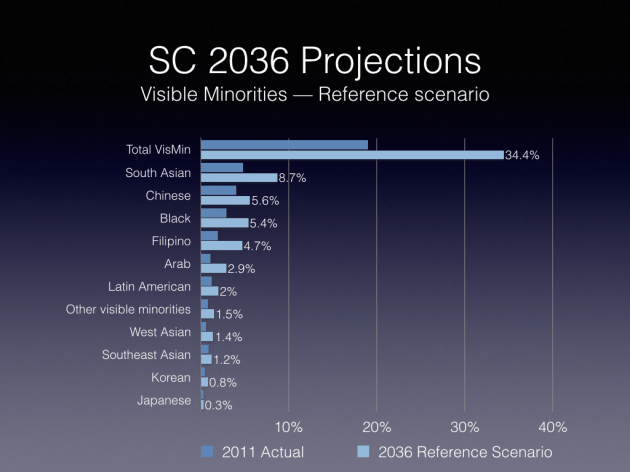
sc-2036-vismin-002While I expect most of my readers will have seen the media reports on the latest population projections and will be familiar with the trends, here is the StatsCan summary of their findings.

One of the more striking findings is the likelihood that despite federal and provincial efforts to diversify where immigrants choose to settle and remain, relatively little change is seen from the current concentration in the major census metropolitan areas.

And as is currently the case, Montreal is likely to remain less diverse in terms of immigrants and visible minorities compared not only to Toronto and Vancouver but also Calgary and Winnipeg.

The other finding is the large increase in the number of second generation immigrants, where one in five is expected to be in 2036.

The full report is worth reading given the range of detailed information it provides even if, like all scenarios and projections, a note of caution is required.

And overall, given these trends, it is even more important to ensure that we get our immigration, citizenship and multiculturalism policies right to ensure our continued relative success in integrating newcomers and their children into Canadian society.

Immigrant and second-generation populations

  • Based on the projection scenarios used, immigrants would represent between 24.5% and 30.0% of Canada’s population in 2036, compared with 20.7% in 2011. These would be the highest proportions since 1871.
  • In 2036, between 55.7% and 57.9% of Canada’s immigrant population could have been born in Asia, up from 44.8% estimated in 2011, while between 15.4% and 17.8% could have been born in Europe, down from 31.6% in 2011.
  • The proportion of the second-generation population, i.e., non‑immigrants with at least one parent born abroad, within the total Canadian population would also increase. In 2036, nearly one in five people would be of second generation, compared with 17.5% in 2011.
  • Together, immigrants and second-generation individuals could represent nearly one person in two (between 44.2% and 49.7%) in 2036, up from 2011 (38.2%).

Languages

  • According to all scenarios used for these projections, the population whose mother tongue is neither English nor French would be up and could account for between 26.1% and 30.6% of Canada’s population in 2036, versus 20.0% in 2011.
  • As in 2011, immigrants would make up the majority—close to 70% in all scenarios—of the population whose mother tongue is neither English nor French. However, close to 40% of these other-mother-tongue immigrants would have adopted English or French as the language spoken most often at home, either alone or with other languages.

Visible minority status

  • According to the results of these projections, in 2036, among the working-age population (15 to 64 years), of special interest for the application of the Employment Equity Act, between 34.7% and 39.9% could belong to a visible minority group, compared with 19.6% in 2011.
  • In all the projection scenarios, South Asian would still be the main visible minority group in 2036, followed by the Chinese. However, the most rapidly growing groups would be the Arab, Filipino and West Asian groups, given that they represent a higher proportion in the immigrant population than in the population as a whole.

Religion

  • The proportion of people who report having no religion in the total population would continue to increase, and could represent between 28.2% and 34.6% in 2036 (compared with 24.0% in 2011). This proportion would be similar to Catholics (between 29.2% and 32.8% in 2036, down from 2011 [38.8%]). In 2036, Catholicism would remain the religion with the largest number of followers.
  • The number of people affiliated with non-Christian religions could almost double by 2036 and could represent between 13% and 16% of Canada’s population, compared with 9% in 2011. The Muslim, Hindu and Sikh faiths, which are over-represented among immigrants compared to their demographic weight in the population as a whole, would see the number of their followers grow more quickly, even if it would continue to represent a modest share of the total Canadian population.

Regional analysis

  • The results of the different scenarios show that in all provinces and territories, the number and the proportion of immigrants in the population would increase between 2011 and 2036.
  • Based on all the projection scenarios, the geographic distribution of immigrants among the various regions in 2036 would be similar to the estimate in 2011. The vast majority (between 91.7% and 93.4%) would continue to live in a census metropolitan area (CMA). The three primary areas of residence for immigrants would remain Toronto (between 33.6% and 39.1%), Montréal (between 13.9% and 14.6%) and Vancouver (between 12.4% and 13.1%).
  • According to all the scenarios for these projections, more than one in two people in 2036 would be an immigrant or the child of an immigrant in Toronto (between 77.0% and 81.4%), Vancouver (between 69.4% and 74.0%), Calgary (between 56.2% and 63.3%) and Abbotsford – Mission (between 52.5% and 57.4%). In 2011, the corresponding proportions were 74.1% in Toronto, 65.6% in Vancouver, 48.0% in Calgary and 49.7% in Abbotsford – Mission.
  • The results of the projections show that the proportion of the working-age population (aged 15 to 64) who belong to a visible minority group would increase in all areas of the country, in all the scenarios. This proportion would surpass 40% in Toronto, Vancouver, Edmonton, Calgary, Winnipeg and Abbotsford – Mission. It would remain lower in non-metropolitan areas.
  • The results of the projections indicate that religious diversity would be up in all areas considered by 2036. The increase would be more substantial in areas that were the most homogeneous in 2011, i.e., Quebec (excluding Montréal) and in the Atlantic provinces, primarily because of the rise in the proportion of people who reported having no religion.
  • The most religiously diverse areas in 2011 would remain as such in 2036. Among them, Toronto, Vancouver, Calgary and Edmonton, which had a large proportion of immigrants among their population in 2011, would continue to be diverse, in particular as a result of the increase in the proportion of persons reporting a non-Christian religion.

Source: Population Projections for Canada and its Regions, 2011 to 2036