‘International leadership:’ MPs chart new course by bringing Yazidi genocide survivors to Canada

Not to be underestimated:

With less than four months to move as many several thousand Yazidis to Canada from conflict zones and refugee camps, MPs will learn from officials this week about the complex security and operational hurdles ahead.

Last month, the House of Commons unanimously adopted a Conservative motion to provide assistance and asylum to survivors of ISIS genocide, mainly from within the Yazidi ethnic minority group. Now, the government must develop a quick action plan that steps outside the traditional United Nations process.

The Yazidi genocide survivors are currently trapped in high-conflict areas in Northern Iraq or waiting in refugee camps in Syria, Greece and Turkey.

On Thursday, MPs on the citizenship and immigration committee will hear about the biggest challenges, first from Canadian officials who were dispatched to northern Iraq on a fact-finding mission, then from German officials about their own experience helping to rescue Yazidi refugees.

Liberal MP and committee chair Borys Wrzesnewskyj said Canada could chart a new process for the world by helping the most vulnerable victims of atrocities outside the UN regime.

Calling this a “new reality,” he said Canada must not wring its hands in the face of horrors, but rather adapt and act with moral authority.

‘International leadership’

“There’s clearly a lack in the established frameworks, and perhaps this is a role Canada can take on internationally and lead in,” Wrzesnewskyj told CBC News. “The fact we’re taking in a number of genocide survivors — women and girls who have gone through unimaginable horrors — we’re taking international leadership by doing this.”

Despite the tremendous challenges, he hopes the committee can provide parliamentary oversight to Canada’s process, and even provide a template for other countries to follow.

“There is almost a personal element to this, and we want to make sure we do this in a way that Canadians can point to with pride and say, ‘We made a difference for these genocide survivors,'” he said.

Yazidis are one of the oldest religious and ethnic minorities in the world with a 6,000-year-old culture, based mainly in northern Iraq.

Source: ‘International leadership:’ MPs chart new course by bringing Yazidi genocide survivors to Canada – Politics – CBC News

The stem-cell struggle: Multiracial patients’ hunt for a match

As someone who has undergone this gruelling treatment, and who did not have the same challenges in finding a donor (mine was from Germany), important to encourage minorities to consider being a donor to improve the chances of those who need this treatment:

Hundreds of Canadians are waiting for stem-cell transplants, but only half of them will find a donor, according to Canadian Blood Services. For multiracial patients, the chances of finding a match are infinitely smaller. As Vancouver filmmaker Jeff Chiba Stearns discovers in his new documentary Mixed Match, it is akin to finding a needle in a haystack or winning the lottery.

Stem cells, which are typically collected from blood or bone marrow, are cells that can develop into other types of blood cells, including the white blood cells that make up one’s immune system. For those with blood disorders and cancers, such as leukemia, a stem-cell transplant can be life-saving.

For Mixed Match, which is showing at the Toronto Reel Asian International Film Festival on Nov. 15, Chiba Stearns spent six years filming multiracial recipients, donors and families who’ve searched the world over for a match. The Globe spoke with Chiba Stearns about why patients’ chances of survival are linked to their lineage.

Why is it so hard for people of mixed race to find suitable donors?

A lot of people think of it as blood. You know, like, I have type O-negative blood. But this has to do with your genetic background, what you would call a “genetic twin.” Basically, when you’re trying to find your genetic twin, a lot of times, it’s someone who has similar ancestry, so someone who comes from the same place you came from because that would mean your immune systems would be very similar.

So, say, in Japan, which is a very homogeneous country, they have a very small pool of people in their registry, but you can still find a match most of the time. What happens when we start mixing is our genetics get a little more complex.

….Why do some people object to recruiting donors by specific ethnic groups?

When it comes to race and ethnicity, the idea of filling out the box and categories can be a little challenging to some people because maybe they don’t want to be labelled or put in boxes.

But at the same time, this is how we categorize people because we need to know, if I am part Japanese and part European, where do we need to start looking? Do we look in Japan’s registries? Do we look overseas?

And sometimes these categories may not be as accurate as people think because it’s self-identified race and identity. We don’t always know. Sometimes it opens up skeletons in the closet, like people may not have realized their great-grandma was Korean, for example, and nobody talked about that.

The idea of race in medicine is sometimes controversial because there have been drugs targeted specifically to African-Americans. Or when people say cystic fibrosis is mainly a “white people” disease, or certain types of diseases are more common in certain races, I think that’s when you get racial scholars coming up in arms because it’s dividing people by race.

It gets complicated, though. As you showed in your documentary, someone with Latino heritage might end up being a good match for someone who’s Asian.

This is why it’s tricky because we often say, if you’re Chinese, you need to find another Chinese donor. But there are rare cases, where, let’s say, an African-American person has donated to someone who’s Caucasian. It may not be a perfect match, and that’s probably what’s happening: These probably aren’t perfect matches.

That’s why I think we always encourage anybody and everyone to sign up. And because registries ask for self-identified race, sometimes you just don’t know whether there’s some kind of mixing in one’s heritage.

Source: The stem-cell struggle: Multiracial patients’ hunt for a match – The Globe and Mail

It’s a good year to be a racist creep: Note to Leitch: Maybe now is not the time to be sucking up to Trump – Kheiriddin

 Good column:

Is Donald Trump’s presidency paving the way for the ascent of the alt-right around the world — including Canada?

From French politician Marine LePen to British leader Nigel Farage, to a host of far-right European parties in between, the jubilation in certain circles is palpable. Le Pen, leader of the French far-right National Front (FN), told the BBC that Trump had “made possible what had previously been presented as impossible.”

“A new world is emerging,” she tweeted. “The global balance of power is being redefined because of Trump’s election.”

Farage, whose UKIP party exploited anti-immigrant sentiment to push the United Kingdom out of the European Union, met privately with Trump in New York on Saturday — to the great consternation of British Prime Minister Theresa May, whom Farage accused of “betraying the national interest” by not giving him an official go-between role.

Here at home, Conservative leadership candidate Kellie Leitch swiftly congratulated Trump on his victory. “Tonight, our American cousins threw out the elites and elected Donald Trump as their next president … It’s an exciting message and one that we need delivered in Canada as well.”

Trump’s message wasn’t simply anti-elitist, of course. It was anti-minority, anti-women and anti-democratic. Fast forward a few days, and Leitch was reduced to insisting she’s “not a racist” when defending her position to CTV News.

Not exactly the sound bite of the year, Kellie — and not an easy one to walk away from. Leitch might want to reconsider her vocal support for Trump’s message just as it’s being so wholeheartedly embraced by the American white supremacist movement.

However one describes Trump’s style of government (populist? fascist?) one thing is clear: It’s notconservative.

Andrew Anglin, proprietor of the Daily Stormer, a leading far-right website popular with neo-Nazis, said of Trump: “Our Glorious Leader has ascended to God Emperor. Make no mistake about it: we did this.” In a similar vein, former Klu Klux Klan leader David Duke said, “We won it for Donald Trump.” The KKK is planning a victory parade in North Carolina to celebrate Trump’s victory.

Trump himself is doing little to allay concerns that extremist views will animate his government. Instead, he appears to have swung the White House doors wide open to the alt-right. On Monday, Trump appointed Stephen K. Bannon as his senior advisor, to work “as equal partners” with new Chief of Staff Reince Priebus. Bannon was executive chairman of the Breitbart news website, which featured a headline that called conservative commentator Bill Kristol a “Republican spoiler, renegade Jew” and publishes a columnist named “Milo” who claims that feminism makes women ugly and birth control makes them “Unattractive and Crazy”.

However one describes Trump’s style of government (populist? fascist?) one thing is clear: It’s notconservative. Conservatism — of the Edmund Burke, William F. Buckley and Ronald Reagan variety — is dead. Those who condemned the French Revolution for its murderous rampages, championed the cause of individual liberty and decried the dictatorial regime of the former Soviet Union would be permitted to say little in the new Trump universe. The Republican party is now headed by a narcissistic demagogue who talks of reinstating the Assad regime in Syria, tearing up free trade agreements and teaming up with Russian President Vladimir Putin on foreign policy.

Buckley, considered the philosophical godfather of American conservatism, actually wrote about Donald Trump in 1990:

“What about the aspirant who has a private vision to offer to the public and has the means, personal or contrived, to finance a campaign? … Look for the narcissist. The most obvious target in today’s lineup is, of course, Donald Trump. When he looks at a glass, he is mesmerized by its reflection. If Donald Trump were shaped a little differently, he would compete for Miss America. But whatever the depths of self-enchantment, the demagogue has to say something. So what does Trump say? That he is a successful businessman and that that is what America needs in the Oval Office. There is some plausibility in this, though not much. The greatest deeds of American Presidents — midwifing the new republic; freeing the slaves; harnessing the energies and vision needed to win the Cold War — had little to do with a bottom line.”

It is wrenching to contemplate how the party of those great achievements, from Abraham Lincoln to Ronald Reagan, has come to be the party of a bottom feeder like Trump.

Source: It’s a good year to be a racist creep

‘I am not a racist,’ Conservative contender Kellie Leitch says

Breaks one of the basic rules of political communications: don’t repeat the accusation and thus draw more attention (for the record, I don’t believe Leitch as a person is a racist but she and her campaign are deliberately stoking xenophobia and racism in their identity politics):

Conservative leadership candidate Kellie Leitch says her enthusiasm for Donald Trump does not make her a racist.

During an exchange on CTV’s Question Period, rival candidate Michael Chong suggested Leitch was importing the divisive style practised by the U.S. president-elect.

Leitch proposes screening newcomers for Canadian values, and says she shares some ideas with Trump on immigration.

The exchange comes as candidates for party chief prepare to debate today at a conference centre just south of Ottawa.

They sparred earlier this week in Saskatoon over immigration, carbon pricing and the proposed Trans-Pacific Partnership trade deal.

Twelve people are running to be the next Conservative leader, who will be chosen in May.

Leitch has attracted headlines – and some barbs from other leadership contenders – for her immigration screening proposal, which she has yet to flesh out. She denies endorsing the controversial Trump.

“I am not a racist,” Leitch said during the CTV segment aired today. “I am not a person who’s out groping other individuals. I do not do those things and I don’t think that the Canadians who support the ideas I’m talking about do those types of things.”

Source: ‘I am not a racist,’ Conservative contender Kellie Leitch says

Canadian values drive us together, not apart: Catherine Clark

A reminder of Progressive Conservatives:

I’ve watched with growing unease the development of a discussion purporting to be about “Canadian values.” I am not at all concerned about the fact that we’re having the discussion – Canadians have always engaged in active conversations about health care, or the environment or the cultivation of an entrepreneurial spirit, or where, how or why Canada acts internationally. Our responses to those questions have always been framed through a uniquely Canadian lens.

What does concern me is what’s not being said, and why this sudden initiative is being framed as a discussion about “values.” The underlying current is that these discussions are less about what we want to celebrate or improve about our country and more about who we want to weed out.

Canada has a long history of welcoming to our shores people from all around the world who must first pass through our robust immigration or refugee system. We regularly welcome the world’s best and brightest, but also people who would be persecuted or in peril in their homelands. I’m not sure I can think of anything more Canadian: a careful system that screens all applicants combined with a tolerant population welcoming of newcomers. And in Canada, with the exception of our indigenous peoples, we are all newcomers of some sort.

A recent Nanos poll highlights what Canadians themselves think of Canadian values. When asked what makes them proud to be Canadian, respondents chose equality, equity and social justice as their top pick, followed by our reputation as peacekeepers and a bit further down by multiculturalism and diversity and respect for others.

When asked to describe their top three Canadian values to someone who was not Canadian, the top choices were rights and freedoms, respect for others, and kindness and compassion.

In a global climate where so many seek to deliberately sow division and fear, Canadians should be justifiably proud of those answers. And we should remember them in the months and years ahead, because those are the values that will keep Canada seen as a beacon of light in a world which needs all the light it can get.

Source: Canadian values drive us together, not apart – The Globe and Mail

Australia: Repealing 18C will consign the idea of a ‘fair go’ to the dustbin of Australian history | Richard di Natale

Australian Green Party Senator di Natale on the proposed watering down of anti-discrimination legislation:

Malcolm Turnbull is a smart man. He must understand that section 18C of the Racial Discrimination Act just sets the minimum standard of engagement in a respectful, multicultural society and all that is required is that any public debate on matters of race and culture be conducted “in good faith”.

And he must also know that the 18C debate is a proxy. When certain far-right politicians say they want to repeal 18C, what they’re really saying is that they want to repeal multiculturalism itself.

Just last year we celebrated forty years of the visionary Racial Discrimination Act, the final death-knell of the White Australia policy and a signal moment in our journey towards becoming the world’s most successful multicultural society.

Multiculturalism – the celebration of cultural differences within our diverse Australian nation – is one of Australia’s great strengths, a source of our prosperity and happiness. Multiculturalism is a source not only of cultural capital, but financial capital as well. When we attack it we become poorer in every respect.

By reviving the toxic debate about section 18C, Malcolm Turnbull has given in, yet again, to those who seem determined to consign the notion of the “fair go” to the dustbin of Australian history. What we politicians say in our nation’s parliament has a direct impact on communities – right down to how children are treated in playgrounds and on their way to and from school. Opening up 18C just gives cover for some people to be racist.

Source: Repealing 18C will consign the idea of a ‘fair go’ to the dustbin of Australian history | Richard di Natale | Opinion | The Guardian

Trump win reveals new white extremism in middle America: Saunders

Good long and sobering read by Doug Saunders on white extremism/radicalisation (exit poll data indicates that Trump did slightly better with minorities than Romney but still the white/minority divide is striking):

“You’d better watch yourself – I wouldn’t go anywhere near there,” she said. It was the source of fear, the inner-city “hell” of Donald Trump’s speeches. That Ybor City has become an upwardly mobile place has escaped notice. (It was also, not coincidentally, the site of peaceful anti-Trump protests this week.)

Her anxieties fall into one of the biggest mysteries of far-right support among white people: the phenomenon that has traditionally been called the “halo effect.”

By contrast, white people who live in areas where they’re immersed in longstanding populations of immigrants and minorities – that is, in big cities – don’t generally tend to vote for the politics of racial intolerance. That’s called the “contact effect” – you don’t get anxious about immigration if you live around immigrants. But people who live in mainly white areas that adjoin cities with greater diversity often show very high levels of support for people like Mr. Trump.

“The general consensus in the literature is that you get the strong anti-immigration sentiment when you have a relatively low local share of minorities and immigrants coupled with a high rate of change,” says Eric Kaufmann, a professor of politics at the University of London and author of The Rise and Fall of Anglo-America: The Decline of Dominant Ethnicity in the United States. “That is, if you live in a very white area but you’re close to an increasingly diverse area.”

Prof. Goodwin’s research suggests that it is instead white people in areas with sudden changes in immigration numbers who tend to become intolerant. But Prof. Kaufmann says this is an initial effect, after which they typically become more tolerant after a few years, when the contact effect has been able to kick in.

In other words, proximity is a bigger driver of extremism than is actual experience: It is not economic decline or immigration that cause people to become right-wing radicals, but proximity to those things, from a vantage of white security that feels threatened by the unknown.

…The propensity of white people to turn to radicalization does seem to be much more rooted in deep psychological anxieties than in anything material or economic.

“It all largely comes under the rubric of cultural and social identity motivations, and not personal economic circumstances – the notion of the ‘left behind’ voter is quite flawed in my mind,” says Prof. Kaufmann.

What is particularly surprising is that the personal circumstances of most Trump voters have improved during recent years: His movement is not a knee-jerk reaction to an actual economic setback (which would have been more the case in 2008 or 1980, when different sorts of U.S. politics prevailed). Rather, it is based on a deeper psychic sense of loss, one not so solidly moored in lived reality.

Carol Anderson, a historian at Atlanta’s Emory University who recently published the book-length study, White Rage: The Unspoken Truth of our Racial Divide, sees the turn toward Trumpian extremism as a psychological response among many white people not to any actual loss – the Trump voters are typically more well-off people, who have gained in recent years – but to a sense of relative loss of influence caused by the increasingly equal status of black and brown Americans.

“When you’re talking about the angst and anxiety and feeling of being stifled and that kind of despair, what I see is that, as African-Americans advance in this society in terms of gaining their citizenship rights, that there is a wave of what I’ve been calling ‘white rage,’ which are the movements within legislative bodies and within the judicial sector in terms of policies and laws and rulings that undercut that advancement,” Prof. Anderson said during a panel last month organized by the online publication, Politico.

“You know, if you’ve always been privileged, equality begins to look like oppression,” she said, in what may be the most definitive phrase to describe the crisis of white extremism. “That’s part of what you’re seeing in terms of the [white] pessimism, particularly when the system gets defined as a zero-sum game – that you can only gain at somebody else’s loss.”

Of course, the American experience has not been zero-sum: The inclusion of minorities and immigrant groups into the middle-class economy over the last five decades has not diminished living standards or earnings; they’re better than they were in the 1950s. Trade with Mexico and China did hurt employment in the 1990s, but it is not doing so today; the economic precariousness of the Rust Belt is caused by technological change, not by trade or immigrants.

But a psychology of wounded ethnic pride – and often of wounded virility – has overtaken a large part of the white community, and not generally the part that is actually feeling economic pain. If those of us worried about the extremists in our midst want to root them out and turn them around, we need to speak to this underlying sense of loss. It may not be rational or realistic, but it has become profound enough that it has provoked the most extreme and dangerous political event of the century.

Source: Trump win reveals new white extremism in middle America – The Globe and Mail

Could Caribbean Economic Citizenship Programmes Cash In On Donald Trump’s Election Victory? | Caribbean360

Not only interest in Canada:

According to a statement issued by citizenship advisory firm Henley & Partners yesterday, “in the hours since Donald Trump was confirmed as the next President of the United States, there has been a sharp increase in the number of Americans enquiring about alternative residence and citizenship programmes.”

It said similar sharp increases were also noted after major events such as the United Kingdom’s vote to leave the European Union, Brexit. However, Henley & Partners did not indicate how many of the inquiries had translated into actual Citizenship by Investment (CBI) applications, or to which CBIs any applications were made.

“Such spikes happen when citizens become uncertain about the future of their country. They seek safer options for their families,” it added, noting that as the chance that Trump would win the election increased on Tuesday night, the Canadian Immigration website crashed because of an overload of visitors.

Speaking from the 10th Global Residence and Citizenship Conference in London, Henley & Partners’ chief executive officer Eric Major said there was similar interest among Americans looking for alternative citizenships and residences when George W. Bush was running for re-election in 2004.

“We are seeing a comparable trend emerging now among wealthy Americans who wonder what the next four years will hold. There has been a significant increase in enquiries to the Henley & Partners website since the news broke,” he said.

Henley & Partners noted that in contrast to 12 years ago, there are now many more residence and CBIs  programmes available to choose from worldwide. Among them are CBIs in the Caribbean nations of Antigua and Barbuda, Dominica, Grenada, and St. Kitts and Nevis.

…Meantime, leading Caribbean academic Sir Hilary Beckles said people should expect “migration of larger numbers of Caribbean people back to the region and significantly back to Latin America” because of Trump’s win.

The Vice Chancellor of the University of the West Indies issued the warning as he contended that presidency had “reconstructed the white global supremacy system”.

Sir Hilary suggested that Trump’s election was a retrograde step that would take the US back by several decades to the days of “plantation America” when blacks had little to no civil rights and white supremacy was key.

Source: Could Caribbean Economic Citizenship Programmes Cash In On Donald Trump’s Election Victory? | Caribbean360

Catching up

The main story over the past few weeks has of course been the US presidential election and Trump winning the presidency. Far too much commentary both before and after to follow, with the full consequences to be seen once Trump selects his Cabinet and other senior appointments, and his initial acts in office (the appointment of Steve Bannon of Breitbart as chief strategist is hardly encouraging).

As chance would have it, we were visiting the Dachau concentration camp near Munich on voting day. While my knowledge of the Holocaust is generally quite good from books, film and Holocaust centres, along with my time as Canadian head of delegation to the International Holocaust Remembrance Alliance, nothing can bring the horror and scale of horror than visiting an actual site.

In the film Denial (well worth seeing), about Deborah Lipstadt’s legal battle against Holocaust denier David Irving, her lawyer takes time during his visit to Auschwitz to pace the  the camp, as he needs to come to grips with its scale  as part of his preparation of his strategy for the case.

But one of the more interesting moments in the current context was our guide’s discussion of the rise of Hitler and how both the political leadership and institutions failed to prevent his rise. While always aware of the perils of Godwin’s Law, there are some uncomfortable parallels with the rise of Trump, reinforced with Republican control of both houses of congress, and the related authoritarian and undemocratic tendencies among some.

Of course, one of the stories making the rounds is the degree to which Americans vowing to move to Canada will actually do so. Some articles that provide a good selection of immigration experts and lawyers essentially say unlikely (Don’t expect to just pack up and move to Canada, Americans told, Americans eye move to Canada, but immigration not so easy, and in the New York Times, As Americans Look North to Flee Donald Trump, Canada Peers Back in Worry, where I am quoted).

Other news items that I have been following include:

Immigration levels for 2017: Interesting, in contrast to the expectations of much higher immigration levels based on comments by the Minister and the recommendations of the Barton committee of 450,000 per year, the end result was more modest: a new baseline of 300,000, and increase of about 15 percent compared to the previous government. Moreover, there is some rebalancing towards the economic stream (58 percent compared to 54 percent in 2016, but still lower than the 63 percent under the Conservatives).

citizenship-data-slides-033There have been a number of articles pro or against a “big Canada” of 100 million by 2100. I am more convinced by the critical pieces, particularly those by Munir Sheikh, How can immigration improve our standard of living? and Tony Keller A supersized Canada is so 20th century.

Diversity of appointments: With the 41 judicial appointments and 28 Senate appointments in 2016, we can see that the government is largely living up to its commitment to improve diversity (56.1 percent women, 4.9 percent visibility minorities, 7.3 percent Indigenous with respect to judges; 57.1 percent women, 21.4 percent visibility minorities, 7.1 Indigenous with respect to Senators), with the government committing to diversity reporting.

Citizenship judge appointments: It appears that, along with other GiC appointments, there have been delays in appointing citizenship judges, with the result that the number of judges available has dropped to 13 from 26 in place September 2015. As C-24 largely reduced the role of judges to presiding over citizenship ceremonies, this likely has less impact than stated in the article, Waiting to become Canadian: Citizenship ceremonies delayed by judge shortage,
compared to the fee increase and other changes  I have flagged (The impact of citizenship fees on naturalization – Policy Options).

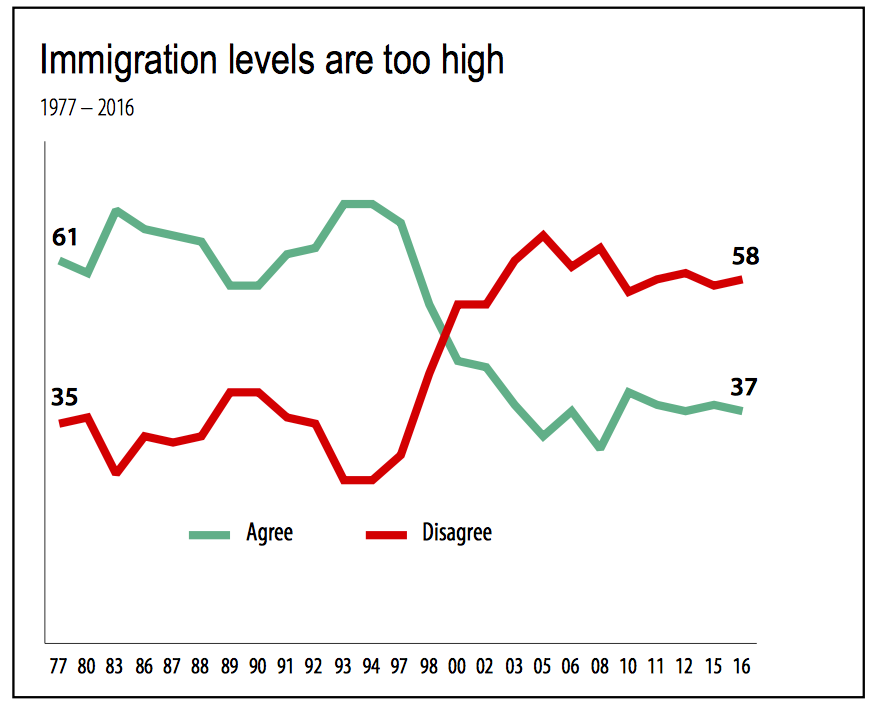
Support for immigration and multiculturalism: A series of somewhat contradictory polls and interpretations, starting with Angus Reid, CBC-Angus Reid Institute poll: Canadians want minorities to do more to ‘fit in’, where roughly two-thirds of Canadians believe immigrants should adopt Canadian values while a similar two-thirds believe immigration levels are just about right. Environics Institute’s Focus Canada – Fall 2016 Canadian public opinion about immigration and citizenship 20 year tracking of support for immigration shows little recent change:

Environics Focus Canada 2016

Environics Focus Canada 2016

Nick Nanos’s survey of What makes Canadians proud of their country? has the following results:

“Asked an open-ended question about what made them proud to be Canadians, the top unprompted response was our commitment to equality/equity/social justice (25.2 per cent), followed by our reputation as peacekeepers (19.4 per cent), multiculturalism (12.0 per cent) and respect for others (11.3 per cent).”

All of which helps explain the divergence of positions among Conservative leadership candidates, ranging from those openly playing identity politics (Blaney, Leitch) to those with inclusive approaches (Chong, Obrai, Raitt).

Candice Malcolm continued her obsessive coverage of Minister Monsef (see Jason Ling’s Some Folks Really Want to Deport Maryam Monsef) and the question of birthplace and possible misrepresentation by her mother in her immigration and citizenship applications. Malcolm legitimately asks whether the government is treating her case differently than other such cases, given a number of revocations in what appear to be comparable cases (Lawyers lose battle for moratorium on contentious part of citizenship law).

However, unless I have missed it, Malcolm has remained silent on whether she supports the C-24 changes that removed the previous right to recourse to the Federal Court, without providing any right to a hearing, unlike Farzana Hassan, who objects to the “unfairness of the law” while still questioning Monsef’s story (Monsef shouldn’t be above the law).

Kellie Leitch misses the point about immigration: Vic Satzewich

Worth reading in its entirety. Point regarding some of weaknesses of standardized language testing also relevant to citizenship:

It is gratifying to know that Kellie Leitch has read my book Points of Entry: How Canada’s Visa Officers Decide Who Gets In, holding it up and referring to it in Wednesday night’s Conservative leadership debate and featuring it on her website. She focuses on two of several findings from my research: that visa officers conduct very few face-to-face interviews and that they are under pressure to meet processing targets. But she missed the broader point of the book, which is pro-immigration.

Her interest in creating policy to screen immigrants for Canadian values sounds like a return to a time when visa officers assigned points for what was then called “personal suitability.” But there was little consistency in how immigration officers assigned such points.

Not surprisingly, applicants and their immigration lawyers and consultants appealed refusals because they felt those points were inappropriately assigned and, during the 1980s and 90s, the Federal Court was clogged with hundreds of appeals.

By 2002, the difficulty of defending those appeals was so high that judgments about personal suitability were taken out of the assessment. Senior officials within the immigration department were also uncomfortable with the lack of consistency and transparency by which those points were applied. There is little reason to believe that Immigration, Refugees and Citizenship Canada will be better positioned to standardize what they look for when it comes to screening for conformity with “Canadian values.”

Even if it were practical to screen for “Canadian values,” coming up with a universal set of our nation’s values would be impossible.

The French had considerable difficulty doing this in 2009 when Nicholas Sarkozy launched a “national identity” debate. After three months of divisive debate that involved more than 100 townhall-style meetings, no consensus emerged. The only concrete policy recommendation that resulted from the debate was that the French flag ought to be flown in schools.

Likewise, interviewing every applicant for a visa would bring our immigration system to a grinding halt because interviews take time and resources. The immigration processing system is already slow, and to interview the 1.3 million people who apply every year for a visa to test for Canadian values would be a logistical nightmare.

Do I think we need more and better screening of immigrants and should we do more interviews with visa applicants?

In my research I did find it surprising that we do not interview many visa applicants any more. In some cases, more interviews would be useful, but not as a blanket policy, and not as a way to screen for Canadian values.

One place where interviews might be useful is with language assessment. The immigration department has yet to find the perfect mechanism to assess language skills. Today, it uses standardized language tests administered by third parties. Whether a passing grade on such a test gives a true indication of English or French language abilities is of some debate. Language skills make an obvious difference in terms of how successfully individuals make out in the job market and in school. Can interviews with applicants be used to help inform decisions about an individual’s language abilities? Perhaps, but even that has its pitfalls when it comes to transparency and consistency of decision-making.

One thing that the immigration department does not do very well, however, is to prepare newcomers for life in Canada, particularly in terms of how difficult the first few years will be.

We select immigrants for high levels of education and training and they come already prepared to work hard to achieve their dreams, but we do a woefully bad job telling them how difficult it will be to get a job that they are trained to do once in Canada.

Interviews with skilled worker applicants could have value if those interviews focused on giving detailed and practical advice and directions about how to negotiate the credential recognition process and the vagaries of the Canadian job market.

What Ms. Leitch is proposing is a solution in search of a problem. I would encourage her to read more academic research by social scientists, and even “commit sociology.” If she does, she will find that there is considerable evidence that immigrants do actually integrate into Canadian society.

Source: Kellie Leitch misses the point about immigration – The Globe and Mail

And a good interview with Satzewich in iPolitics:

Author cited by Leitch torpedoes her pitch for immigrant ‘values’ screening