Let’s Give Cities A Greater Role In Managing Migration | Harald Bauder

Worth reflecting upon:

National migration policies play an important part in ordering our society based on origin and status. Canadian temporary foreign workers and international mobility programs have resulted in more than 350,000 foreign workers living in Canada in 2014, often without the same economic rights and entitlements that Canadian citizens take for granted — including the right to stay.

Cities have a different approach to migration. They are not in the business of controlling who crosses and settles within their boundaries, or ordering their communities based on where residents are coming from. Rather, their role is to be inclusive and provide access to resources and services for all residents.

Granted, some city administrations are eager to enforce national migration policies and actively participate in the border regime. Research by my colleague at York University, Liette Gilbert, shows how smaller towns such as Hérouxville, Quebec, and Hazleton, Pennsylvania, have introduced measures that erode the rights of migrants and control their presence.

Many other cities, however, resist exclusionary national policies and border regimes. For example, by declaring themselves sanctuary cities, Toronto and Hamilton have recognized that the residents who are denied status by national policies are nevertheless members of their communities. In this way, dozens of sanctuary cities throughout North America are seeking to build inclusive urban communities in which all residents can equally participate — independent of the order which border regimes impose.

In a globalized world, nation states are increasingly failing to cope with the human need for security and desire to migrate.

Urban communities are also highly responsive to global developments and the need for people to migrate for work and opportunity, and to escape from war and oppression. Take Lifeline Syria as an example: this initiative was spearheaded by civic leaders of Greater Toronto to mobilize fellow residents to sponsor Syrian refugee families and help these families settle in their communities. While the federal government is an important partner in this initiative, it is the urban community that has demonstrated leadership.

Cities are demanding a greater role in managing migration and are asserting their independence from national migration policies that disenfranchise large portions of their residents.

In a globalized world, nation states are increasingly failing to cope with the human need for security and desire to migrate. As cities fill this void, they must maintain their inclusive approach and resist being absorbed into the deadly border regime.

Source: Let’s Give Cities A Greater Role In Managing Migration | Harald Bauder
Chief statistician resigns over government’s failure to ‘protect the independence’ of StatsCan

So both the Harper and Trudeau governments have lost a chief statistician on points of principle:

Canada’s chief statistician has resigned in protest over what he says is the federal governments’ failure to protect Statistics Canada’s independence.

Wayne Smith says the government’s decision to create Shared Services Canada and centralize all information technology services across government has compromised Statistics Canada’s ability to fulfil its mandate.

“I have made the best effort I can to have this situation remediated, but to no effect,” Smith said in a note to the National Statistical Council, which advises him. “I cannot lend my support to government initiatives that will purport to protect the independence of Statistics Canada when, in fact, that independence has never been more compromised,”

“I do not wish to preside over the decline of what is still, but cannot remain in these circumstances, a world-leading statistical office.”

Shared Services was created by the previous government to centralize and standardize information technology across the federal government in a bid to save money. It has struggled to meet expectations with several agencies, including the RCMP and the Canadian Forces, which have complained of data centre crashes, red tape, bad customer service and unpaid bills.

Smith said he had issued a warning that ever since Statistics Canada began relying on Shared Services for its IT, the research department had begun losing control of the information it collects from Canadians through operations such as the long-form census.

In the note, Smith argued that Shared Services holds “an effective veto over many of Statistics Canada’s decisions concerning the collection, processing, storage, analysis and dissemination of official statistics through denial or constructive denial of essential services.”

“Statistics Canada is increasingly hobbled in the delivery of its programs through disruptive, ineffective, slow and unaffordable supply of physical informatics services by Shared Services Canada,” he added.

Failure to convince government

Smith wrote in a separate note to staff that he tried to convince the Liberal government to correct the situation.

“I have not succeeded,” he wrote.

“I believe it is the professional duty of a national statistician to resign if the independence of the national statistical office — as envisioned in documents endorsed by Canada such as the United Nations Fundamental Principles of Official Statistics and the OECD Recommendation on Good Statistical Practice — is compromised.”

 ‘I think we do need to re-examine this whole approach to trying to centralize government services and cut costs.’– Erin Weir, NDP MP

In a statement issued by her office, Public Services Minister Judy Foote said the government “is committed to effective, efficient and secure service delivery to Canadians through modernizing government operations.”

Source: Chief statistician resigns over government’s failure to ‘protect the independence’ of StatsCan – Politics – CBC News

More detailed article with commentary by Kathryn May and quotes by former Chief Statistician Ivan Fellegi: Chief statistician butted heads with federal government over Shared Services Canada — and lost

Canadians cannot be overly impatient with integration of immigrants, Justin Trudeau says

Worth noting the PM’s understanding of the integration process:

Prime Minister Justin Trudeau used the example of Italian grandmothers in Montreal on Thursday to explain why Canadians shouldn’t be “overly impatient” with the integration of newcomers.

Being fearful of immigrants is “nothing new” in Canada and around the world, he said, explaining that Italians and Greeks settling in Montreal in the 1950s faced similar kinds of discrimination as do Muslims and other immigrants today.

“The first generation is always going to have challenges in integrating,” Trudeau said during a panel discussion with London Mayor Sadiq Khan.

“There are districts (in Montreal) where Italian grandmothers still pretty much only speak Italian and don’t speak that much French or English. But their kids and grandkids are seamlessly and completely integrated into Montreal and the only difference is they tend to be trilingual and not just bilingual.”

The prime minister was taking part in a day-long conference hosted by Canada 2020, which describes itself as a progressive think-tank.

Asked by the panel moderator what can be done to reduce fear of and discrimination against newcomers, Trudeau replied that what’s happening in Canada and around the world is “nothing new.”

Italians, Greeks faced ‘tremendous distrust’

Italians and Greeks who settled in the northern part of Montreal and in other Canadian cities “faced tremendous discrimination, tremendous distrust.”

“This country didn’t happen by accident,” Trudeau continued. “And it won’t continue without effort. When we think about integration and success we can’t be overly impatient.”

He said citizens should “keep a solid pressure” to ensure human rights and the country’s Charter of Rights and Freedoms are respected by all Canadians.

Trudeau also referred to his time visiting places of worship around the country such as mosques and temples.

He was recently criticized online and in some Canadian media for visiting a mosque in Ottawa where women and men were kept separate.

Engage with all communities, Trudeau says

The prime minister said Canadians should engage with all communities.

“The question is, do you engage or participate or say ‘I’m not going to talk to you until you hit the norm or the perfect ideal that we all aspire to’,” he said. “I think (the latter) is wrong.”

Khan said Canada “has become a beacon of how a civilized G7 country should treat those who are vulnerable and need help.”

He also praised Trudeau for his “progressive” politics and said the prime minister’s election in October 2015 inspired him.

Source: Canadians cannot be overly impatient with integration of immigrants, Justin Trudeau says – Montreal – CBC News

Suspicion of immigrants is a Canadian value: Cole

Element of truth in what Cole writes but lacks balance and nuance in failing to acknowledge attitudes and policies have and continue to evolve.

And are some of the ‘values’ talked about only a “reflection of our colonial, white, British, monarchical heritage,” or are they not broader and more universal?:

Conservative MP and party leadership contender Kellie Leitch doesn’t really want a conversation on Canadian values. The callous Leitch, who has been insisting lately that we consider a values test for prospective immigrants, simply wants to boost her brand by playing to racist and xenophobic fears of some Conservative party supporters. Modern conservative groups keep questioning immigrants’ values because they know their liberal political opponents, who are prone to the same prejudiced scapegoating, will struggle to condemn them.

Many have criticized Leitch’s proposal by saying it is impractical, since no one person or group can define or determine Canadian values. That’s a nice idea, but in practice we know the values our politicians attempt to sell us are a reflection of our colonial, white, British, monarchical heritage. There are such things as Canadian values, and they explain how our politicians have been peddling a fear of foreigners for the last 150 years.

Suspicion of all immigrants who are not white, or are not members of the former British Empire, is a Canadian value. Canada’s founding prime minister, John A. Macdonald, argued that Chinese immigrants to Canada were unfit to vote because they exhibited “no British instincts or British feelings or aspirations.” Macdonald didn’t need to cloak the authority of the state in the language of wanting a “conversation” about immigrants, as Leitch does today. In his time, there was no conversation to be had.

Assurances that we no longer live in the 19th century are beside the point. Every politician from Macdonald to Leitch has been able to bank on significant support by distinguishing between British or Canadian values and those of everyone else. Yes, even many newer immigrants echo these suspicions of outsiders’ customs or beliefs. They may hail from countries that our government is wary of. The pressure on these newcomers to conform — to validate the wisdom of the system that chose them, to scrutinize those who come after them — must be overwhelming.

Of course, all of this is only possible because of another fundamental Canadian value: erasure. Our modern mythology suggests that indigenous people were never here, or that if they were, their values and customs gave way to a superior British way of life. Our history books and our educational resources for prospective new Canadians have little to say about the values and traditions of indigenous people. British colonialism made outsiders of people who had been here for thousands of years, and cast their values aside.

That’s how a white man in a red coat who carries a weapon and patrols stolen land has come to symbolize the enforcement of Canadian values. We are taught to honour the force Mounties used to Anglicize this land, to view the guy in red as a symbol of honour and patriotism, no matter what despicable crimes he carries out. The values of dominance and separation enforced by the modern RCMP, and the Canadian Border Services Agency, are not universal or self-evident — they are steeped in centuries of racism, colonialism, and white supremacy.

Leitch may not win her leadership contest, but the fact her naked appeal to prejudice can still spur “debate” in this country says it all. Polls suggest a majority of Canadians agree with Leitch’s call to screen immigrants for good values. Few of us really care about the content of the questionnaire. What we care about is our very Canadian right to demand that immigrants be questioned, scrutinized, and weighed against the comfort and well-being of those already established here.

Conservatives are more likely to support the traditional dominant values openly. It was Leitch who announced a 2015 Conservative campaign proposal to create a “barbaric cultural practices hotline.” Prime Minister Justin Trudeau, who has cast himself as being far more progressive on immigration and cultural issues, had little to say about the Macarthyist snitch line — Trudeau and his party had quietly voted in favour of a Conservative law called the “Zero Tolerance for Barbaric Cultural Practices Act” only four months before the election.

Maybe one day, we will be able to have genuine conversations about human values that transcend not only borders, but so many other ideological barriers we still use to divide one another. For the moment, the state and its actors keep pretending there is something especially benevolent about being Canadian, and the culture wars continue.

Source: Suspicion of immigrants is a Canadian value: Cole | Toronto Star

Why MPs should visit mosques – and other places of worship too – Anita Vandenbeld

MP Anita Vendenbeld, one of the Liberal MPs accompanying the PM, responds to critics (see earlier ‘Feminist’ Trudeau under attack for attending gender-segregated event at Ottawa mosque):

On Monday, Prime Minister Justin Trudeau observed Eid al-Adha at a mosque in Ottawa, accompanied by a number of Ottawa area MPs. I was one of them. I did not enter through a side door – none of us did – despite claims made in coverage by the Citizen and some others. In the past, I have visited this mosque for community events, addressed the worshippers at Friday prayers, and attended funerals and celebrations. On many of these occasions, genders were not separated. In fact, I have only seen that to be the case during prayers.

I chose to wear the headscarf out of politeness. It was my choice. In the past, I have personally witnessed female guests attend that mosque without a headscarf, and without being criticized for it. When I enter anyone’s place of worship, and they ask me to wear or not to wear something, I will choose to respect the traditions and standards their community holds, as I believe most Canadians would. I have also attended religious ceremonies at a Sikh gurdwara and a Jewish synagogue where they have segregated by gender, and I will continue to do so. I will never stop going to places where people gather, and I will never stop listening to the women and men in those places.

I have spent much of my professional career overseas working in countries whose societal norms were rapidly changing. In those countries, I would wear what was socially acceptable while also fighting to give a voice to the agents of change. Many of the women who attend the Ottawa Mosque are proud feminists, friends of mine and strong voices in our community. As an MP, my job is to be there to listen to and support them. Any representative who would choose not to be present and to not listen to members of their community would be failing in their duties as an elected representative.

I am proud to have been the first non-Muslim woman to address that same mosque in 2011, speaking from the front – which is essentially the pulpit. I spoke about inclusion, diversity and equality, and I have returned to speak many times since. I have received nothing but respect from mosque leaders, many of whom I consider allies in and champions of progressive change.

After my first speech at this mosque as an elected representative, I was approached by a woman who had recently immigrated to Canada. She told me that seeing an elected leader come to the mosque made her feel, for the first time, that Canada was truly her home. I have heard much of the same and more following the prime minister’s visit.

 I encourage everyone, when visiting a mosque, to speak with some of the women present. You will learn what passionate advocates these women are for their community and appreciate their range of thoughtful and progressive perspectives.

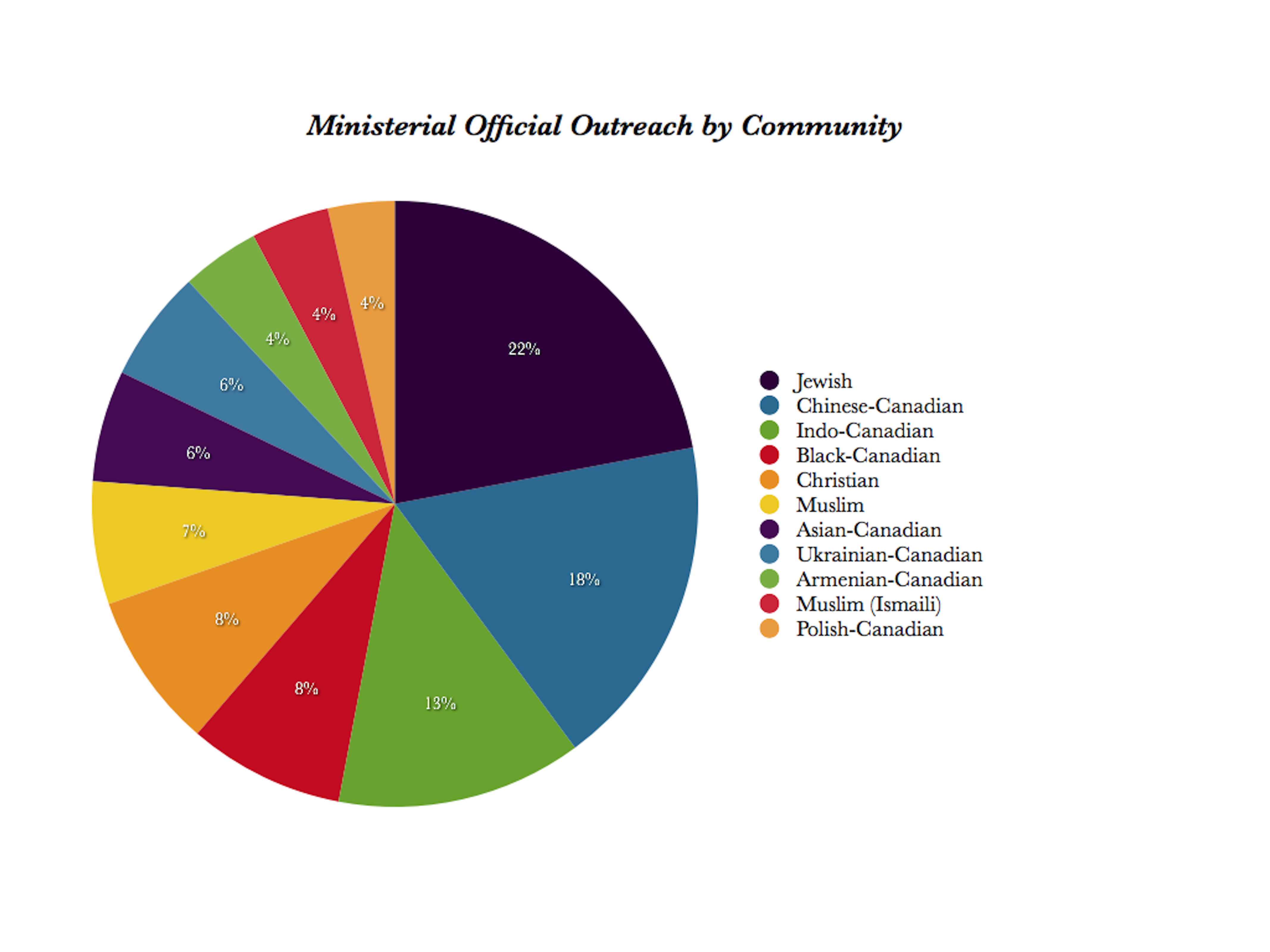
Under the previous government and Minister Kenney,  there was comparative under-attention to  Canadian Muslim groups, and of these, Ismailis were relatively more significant (chart below summarizes visits, speeches and statements, 2007-11).Chart 3- Ministerial Outreach by CommunitySource: Why MPs should visit mosques – and other places of worship too | Ottawa Citizen

Vancouver police launch big recruitment drive to reflect city’s diversity

Article would benefit from including the current diversity numbers (which Vancouver currently does not publish these):

Vancouver is launching the largest police recruiting drive in almost a decade, and the key word for this new class of officers will be diversity, officials said.

Deputy Chief Steve Rai said the police force wants hire 85 new officers by next spring, the largest recruiting figure since the pre-Olympics effort in 2008 and more than twice the size of a normal recruiting class.

Add in 20 recruits sworn in on Thursday, and that’s an addition of more than 100 officers to a police service of 1,400 — a big injection of new blood.

While the VPD has no quotas for members from specific communities, Rai said it is crucial that the police department reflects the multicultural community that it serves. With that in mind, VDP has been stepping up its outreach to cultural communities, hoping it will lead to a multicultural mix of recruits.

“You look at what happens when your police force don’t reflect the community, and you only have to look south of the border,” he said. “You see people feeling it’s ‘us-against-them,’ and there’s a lack of trust.

 “It’s about acquiring, building and maintaining public trust … We are all in this together, so it starts with citizens seeing their police forces reflecting of them and the community. It has to reflect the fact it’s not ‘us-against-them,’ but ‘we.’”

According to the 2011 census, Vancouver has 18 languages identified as “most spoken at home” by more than 1,000 residents each. Besides English, the most spoken language at home for 98,855 Vancouverites were Chinese languages. Punjabi (10,500), Tagalog (9,345), Vietnamese (7,475), Korean (5,445) and Spanish (5,245) all topped 5,000 speakers.

Rai admits that there remains a stigma in some communities about policing, stemming from experiences and perceptions of police in other countries. He said the VPD is trying to break down the walls by attending as many community events as possible, and that as the second-generation acclimatizes to Canadian culture, the acceptance level has correspondingly risen.

“I know a lot of parents who aren’t supportive of their kids to go into policing because of the stigma that exists in their countries of origin,” Rai said. “But as time passes, barriers come down. You build that trust by talking to people and being sincere.

“We understand we have to flexible with changing society norms, and we want to make sure we hire the best,” he added. “We will mentor you to be successful, no matter what your background is. I’m a 25-year member, and there’s not one day that I’ve ever regretted my decision to become a police officer. The profession sells itself.”

Source: Vancouver police launch big recruitment drive to reflect city’s diversity | Vancouver Sun

Meanwhile:

The Vancouver Police Department says street checks are not on the rise, two weeks after the police complaint commissioner expressed concern about the department’s use of the practice.

The Office of the Police Complaint Commissioner, a provincial body that oversees complaints involving municipal police, in a report late last month cited “an increasing trend in complaint allegations involving the police practice of conducting street checks.” The report, however, did not provide a total.

Street checks, or carding, can refer to stopping individuals to gather information without a reasonable suspicion of an offence. The issue has drawn significant attention in Ontario, where the provincial government announced regulations restricting carding in March after complaints were raised about privacy violations and police were accused of disproportionately targeting minorities.

Vancouver Police Chief Adam Palmer said he has not seen any numbers to validate the police complaint commissioner’s claim.

“I’ve got no data to suggest that that is the case. I’d be happy to see data if someone is providing it,” he told reporters outside a police board meeting Thursday.

A Vancouver Police Department spokesman said it conducted about 6,200 street checks last year – compared with 6,900 two years ago, and 7,300 three years ago.

…Chief Palmer said he meets with his department’s professional standards section every week but has not seen an increase in complaints involving street checks.

A spokesperson for the Office of the Police Complaint Commissioner said it has observed an increase in such complaints, but is still working to pull the exact number from its files.

 Vancouver Police Department denies that carding is on the rise 

Lisée ouvert à bannir le voile intégral

Playing identity politics and digging deeper, just as Leitch in the federal Conservative leadership race:

Jean-François Lisée s’est dit ouvert à interdire la burka et le niqab de l’espace public, jeudi. Il a du coup accentué la ligne de fracture qui l’oppose à ses adversaires de la course à la direction du Parti québécois sur la question identitaire.

L’aspirant-chef du PQ a réitéré son désir de mener une campagne incitative pour encourager les employés de l’État à ne pas porter des signes religieux. Mais il est allé plus loin en se disant ouvert à bannir le port du voile intégral en public.

« Si je suis premier ministre, mon premier devoir, c’est d’assurer la sécurité des Québécois et nous savons avec certitude que des gens recrutent chez nous et ils veulent tuer des Québécois », a-t-il déclaré.

« C’est une vraie question, a-t-il ajouté. On devrait se la poser avant que l’irréparable se produise plutôt qu’après. »

M. Lisée fait valoir que 10 pays européens ont légiféré contre le port du voile intégral. Selon lui, cette tenue vestimentaire pose un problème de sécurité, puisque les personnes qui le portent ne peuvent être reconnues par des témoins ou par des caméras de surveillance.

M. Lisée ne promet pas formellement d’emboîter le pas à ces pays. S’il devient premier ministre, il statuera sur la question avoir mené des consultations et recueilli des avis d’experts.

Source: Lisée ouvert à bannir le voile intégral | MARTIN CROTEAU | Politique québécoise

Citizenship Statistics January-June 2016: 64 Percent Drop in Applications

The release of IRCC citizenship and other statistics for the first half of the year provides an indication of what the overall 2016 numbers of permanent residents and new citizens will likely be.

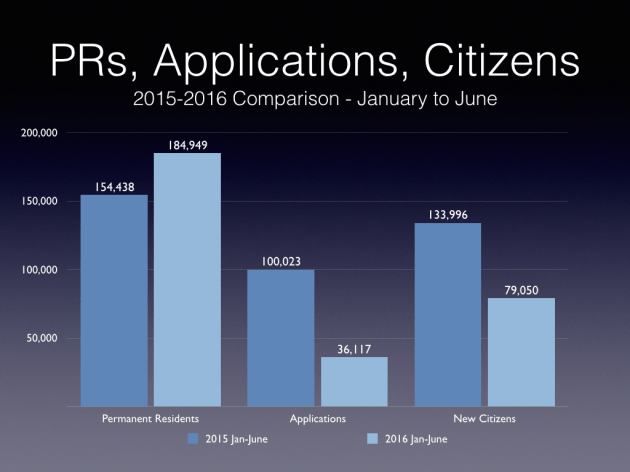
citizenship-data-slides-2015-008The chart above, year-to-year comparison, shows the expected drop (41 percent) in the number of new citizens following IRCC’s success in 2014 and 2015 in eliminating the backlog (from a high of  323,000 in 2012 to 59,000 on 30 June 2016).

The more significant news is the dramatic drop in the number of people applying for citizenship (63.9 percent), mainly reflecting the sharp increase in citizenship fees from $100 (plus $100 right of citizenship fee) before February 2014  to $530 in 2015 (the right of citizenship fee remained unchanged).

To a lessor extent, some of the 2014 changes to the Citizenship Act in C-24, such as the extension of language and knowledge testing to 55 to 64 year olds, also played a role.

If this trend continues, there will only be about 70,000 applications in 2016, compared to about 130,000 in 2015.

Of concern is that IRCC did not appear to have seriously considered the possible impact of this increase in fees when advocating successfully for an exemption to the User Fees Act and its requirements for full public consultations.

In the Canada Gazette announcement announcing the increase to $530 (Regulations Amending the Citizenship Regulations P.C. 2014-1453 December 12, 2014), IRCC stated:

“An important assumption made in the monetized analysis is that the fee increases are not anticipated to affect the demand for citizenship. The last census (2006) reports that 85% of eligible immigrants received Canadian citizenship, or approximately 228,000 individuals. The CBA assumes that the fee increase will not impact the naturalization rate as the value placed on obtaining citizenship is very high and the benefits associated with obtaining citizenship far outweigh the fee increases. Thus, the number of applications expected per year is not anticipated to fall following an increase in the fees.”

Hard to believe that such a categorical assumption could be made, in contravention of basic economics and the realities of many low-income and refugee immigrants. Pure assertion, no real evidence. It mischaracterizes the Census number, which includes all the foreign-born (about six million), not just recent immigrants whose naturalization rate is significantly less.

Approval rates increased slightly to 92.1 percent from 91.4 percent.

Processing time continues to decline from 21 months during FY 2015-16 to 18 months in the latest quarter (April-June 2016), helped by the declining number of applications.

A cynic might suggest that the previous government, in addition to implementing many of the administrative changes and business process simplification needed to reduce future backlogs, put into place a number of measures that effectively reduced demand for citizenship as part of the their objective of making citizenship “harder to get and easier to lose.”

The increase in the number of new permanent residents reflects the increase in levels for 2016.

The datasets used are from Opendata: Citizenship Application ProcessingImmigration, Refugees and Citizenship Canada Overview.

One minor irritation with the datasets of Opendata: for citizenship, IRCC has moved from calendar to fiscal year reporting unlike for permanent and temporary residents, where it remains on a calendar year basis.

While it is possible to correlate the calendar and fiscal years, IRCC should be consistent for all its data sets. While I prefer the calendar year basis given that it allows to track longer term trends consistently, I can also understand the rationale for fiscal years, given the linkage to planning, budgeting, and reporting.

But please pick one or the other and stick to it!

Note: Revisions to application numbers can occur given incomplete applications are returned to the applicant without being entered into the database. When these are subsequently resubmitted with the missing information, they are dated and counted from the date of the original application. It is unlikely, however, that any revisions will alter significantly this trend.

Canadians want to boost immigration, McCallum says after consultations

Will be interesting to see whether the Liberal government increases levels further or, as suggested in previous Globe article (Looming season of immigration politics puts Liberals, Tories on edge), shows more caution given possible public concern (IRCC’s public consultations may have drawn more from immigration advocates than those with concerns):

The Liberal government will announce Canada’s new immigration targets in November and the minister in charge said most people are telling him to boost the number of immigrants.

Speaking with reporters following a cabinet meeting on Parliament Hill, Immigration Minister John McCallum summarized the results of his recent cross-country consultations on Canadian immigration.

“I have been hearing a lot of input, and all the hundreds of people I’ve spoken to across the country, most of them, almost all of them, have advocated [for] more immigrants, whether for demographic reasons or for job-shortage reasons,” Mr. McCallum said. “But we as a government will not decide our proposal until November.”

 Canada’s 2016 immigration-levels plan aims to bring in about 300,000 permanent residents this year. That includes targets of 80,000 under family reunification, between 51,000 and 57,000 refugees and protected persons, and between 151,200 and 162,400 economic immigrants.

Canada’s immigration levels have been roughly constant over the past two decades. Between 1994 and 2014, the yearly immigration levels represented either 0.7 per cent or 0.8 per cent of the population.

In 2014, Canada accepted 260,404 immigrants, representing 0.7 per cent of the population.

Mr. McCallum said he has received a “huge amount of input” on the topic of immigration over the summer.

Mr. McCallum’s assessment of public opinion is at odds with the results of a recent Nanos Research survey conducted for The Globe and Mail that was released on Sept. 1.

That survey of 1,000 Canadians found that 39 per cent said the government should accept fewer immigrants in 2017 than the previous year. Thirty-seven per cent said Canada should accept the same amount in 2017, while only 16 per cent said the target should be increased.

Source: Canadians want to boost immigration, McCallum says after consultations – The Globe and Mail

‘Feminist’ Trudeau under attack for attending gender-segregated event at Ottawa mosque

Awkward. Valid to raise questions about appropriateness.

While in general, always better to engage and be present, PMO needs to think more about the guidelines when accepting such invitations or choosing locations. Respect should be mutual, while I can understand women MPs covering their hair as a sign of respect, the mosque should have allowed the women MPs to enter by the front door, not the side door, equally as a sign of respect.

And that would allow the PM to support those within Muslim communities who wish for more egalitarian mosques:

Canada’s self-styled feminist prime minister was praised Tuesday by one of the world’s most powerful women for his commitment to gender equality even as he was taking it on the chin from other women for appearing at a gender-segregated event the previous day.

International Monetary Fund managing director Christine Lagarde told reporters at a Parliament Hill news conference she was “appreciative” of Trudeau’s commitment to a government that was “gender-equal.” Trudeau had just told Lagarde the next Canadian representative to the IMF would be a woman, a first for the country.

Yet, Trudeau’s appearance Monday morning at a gender-segregated mosque in Ottawa brought criticism from some of the same women who had admired his work toward gender equality.

 “Right now we have these political leaders — ironically, politically liberal leaders — who are just putting blinders on their eyes about their values,” Asra Nomani said in a telephone interview from Washington, D.C. Nomani, a former Wall Street Journal reporter who describes herself as a liberal, is the author of Standing Alone: An American Woman’s Struggle for the Soul of Islam.

“That’s the big differential for liberals, they fancy themselves as honouring the women’s body and yet the segregation by its very definition hyper-sexualizes women’s bodies. That’s the great irony.”

 Trudeau was at the mosque Monday to mark Eid al-Adha, considered the holiest of feast days for the world’s Muslims. Three female MPs accompanied Trudeau during his brief remarks, though they had to arrive by a side door and stand with their heads covered. They did not address the mosque.

Worshippers at the mosque are separated by gender. Men were on the main floor where Trudeau spoke. Women and girls were in a balcony or in other parts of the mosque. Nomani said that recent surveys indicate about two of every three mosques separate men from women, but that is up from a decade ago when only about half did.

“I will meet with Canadians regardless of where they are in Canada,” Trudeau told reporters Monday afternoon. “I will speak to inclusive growth, help for the middle class. I will talk about gender equality. I will talk about the rights of the LGBT community. We will continue to promote the values which bring us together.”

Source: ‘Feminist’ Trudeau under attack for attending gender-segregated event at Ottawa mosque | National Post