Canada’s racial divide: Confronting racism in our own backyard

Interesting long read in the Globe.

Excerpt pertains to data gaps. However, some of the gaps listed do not exist – Census/NHS data on economic outcomes is detailed as are educational outcomes, as is employment equity data in governments. Visible minorities can be broken down by the major groups, and ethnic origin provides more detail (for some of the data, see my Multiculturalism in Canada: Evidence and Anecdote Overview Deck (December 2015).

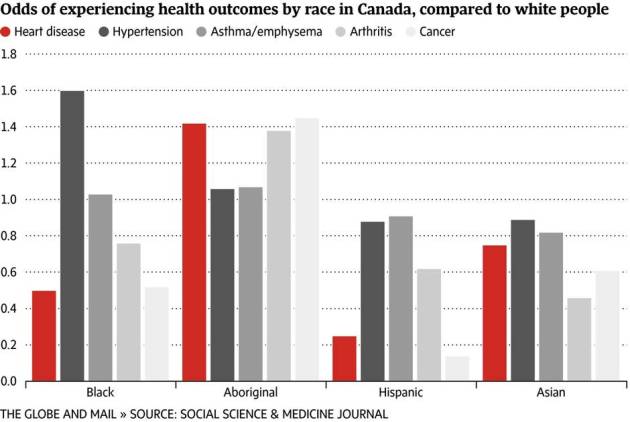
However, the points regarding health and incarceration are valid:

Part of the problem is that it’s hard to figure out, with much precision, what’s going on. Unlike the United States, where race-related data is routinely collected on everything from jobless rates to university-graduation rates, Canada “cannot tell its own story,” says Arjumand Siddiqi, associate professor at the University of Toronto’s Dalla Lana School of Public Health, who has lived and worked in both countries.

She hit a wall in 2007, when she wanted to test if race-based health inequalities varied in different societies. Most of the research at the time relied on U.S. data.

While working at the University of North Carolina, she began to analyze a joint Canada/U.S. survey of health. When she accessed the data from Canada, however, detail on race was suppressed (for privacy reasons, she was told). All she could glean was information on people who were “white” or “non-white.” She couldn’t determine whether health outcomes within racial groups varied.

“We’re left with a muddy picture. We are left not knowing whether there is a problem that is specific, widespread, changing over time, whether we need to be doing more or less with some groups.”

Health care could use more accurate information. One paper last year that looked at ethnicity and breast cancer noted that data about race or ethnicity “are rarely collected” in a systematic manner in Canada’s health-care settings.

That data deficiency “certainly does not mean that ethnoracial inequalities do not exist in Canada; indeed, lack of data often limits the ability to accurately and adequately identify health inequalities and inequities,” wrote Dr. Aisha Lofters of the University of Toronto.

In Halifax, Dr. Britton, who has four degrees, including a doctorate, has found that a dearth of data on African Nova Scotians has hurt efforts to push for racial equity in the province. “With no data being collected, what does that mean? No funding” to address specific health issues in communities.

Researchers have hit similar roadblocks trying to analyze employment outcomes, incomes or wealth by race.

One missing piece of the puzzle is jobless stats on indigenous reserves, which the government doesn’t collect on a monthly or even yearly basis. Another piece is about wages. A widely reported study released last week in the U.S. – which found the wage gap between white and black Americans is worse today than in 1979 – isn’t currently possible to conduct in Canada, says Sheila Block, senior economist at the Canadian Centre for Policy Alternatives.

In the justice system, data is lacking on the ethnicity of homicide victims and fatalities from police encounters.

People are often grouped as “visible minorities,” in the justice system. The catch-all term is “problematic,” noted U of T’s Akwasi Owusu-Bempah in a 2011 report entitled Whitewashing Criminal Justice in Canada. Lumping people together “obscures racial differences by averaging groups that are overrepresented with those that are underrepresented.”

The absence of detailed data may be hiding inequalities that, ultimately, harm police effectiveness and hurt community relations, he said.

Source: Canada’s racial divide: Confronting racism in our own backyard – The Globe and Mail

Monsef’s place of birth shouldn’t have ‘serious consequences’ – De Kerckhove, Glavin

Former Canadian Ambassador Ferry de Kerckhove injects needed knowledge about the region and refugees:

Many people have expressed sympathy for Maryam Monsef, the federal Minister for Democratic Institutions, since the disclosure that she was born in Iran, rather than in Afghanistan. But there have been criticisms – which I simply can’t fathom – from MPs such as Tony Clement and Michelle Rempel, who talked about “serious consequences” if the minister’s birthplace had not been accurately represented on her refugee and citizenship applications.

Do these people have any idea what region we are talking about? Does Ms. Rempel have any understanding of how volatile, porous and border-inconsequential the region was, where even dates of birth, when registered, between Muslim and Christian countries don’t match up? Does she, and those who chime in with her, realize that many Afghans sought refuge in Iran during both the Soviet occupation and the subsequent civil war culminating in the rise of the vicious Taliban regime?

 The Afghan city of Herat (where Ms. Monsef’s parents married and where she believed she was born) and the Iranian city of Mashad (where she was actually born) are historically and geographically close. So Afghans would travel back and forth to Iran in times of duress; although they might have not been warmly welcomed, they were at least in a safer environment than in Afghanistan.

Source: Monsef’s place of birth shouldn’t have ‘serious consequences’ – The Globe and Mail

Terry Glavin makes similar points in What you need to know about Maryam Monsef – Macleans.ca The MP’s birthplace does not matter. Her mother made a brace choice, sparing her daughters from a brutal and ruthless past macleans.ca      

Maryam Monsef case highlights ‘absurdity’ of Canadian law, refugee lawyers say

The Minister did commit during parliamentary committee hearings last spring to address the lack of due process for citizenship revocation in cases of fraud or misrepresentation. This court challenge likely reflects frustration that no action has been taken to date:

Maryam Monsef could be stripped of her citizenship without a hearing under a law the Liberals denounced while in opposition but which they’ve been enforcing aggressively since taking power, civil liberties and refugee lawyers say.

The democratic institutions minister revealed last week that she was born in Iran, not Afghanistan as she’d long believed. She said her mother, who fled Afghanistan with her daughters when Monsef was 11, didn’t think it mattered where the minister was born since she was still legally considered an Afghan citizen.

Monsef has said she will have to correct her birthplace information on her passport.

If Monsef’s birthplace was misrepresented on her citizenship application as well, that would be grounds for revocation of citizenship, regardless of whether it was an innocent mistake or the fault of her mother, said immigration lawyer Lorne Waldman.

Misrepresentation could lead to deportation

And if the misrepresentation was on her permanent residence and refugee applications, she could even be deported, said Waldman, part of a group that launched a constitutional challenge of the law Monday.

The Canadian Association of Refugee Lawyers and the British Columbia Civil Liberties Association argue that the law, known as Bill C-24, is procedurally unfair and a violation of the Charter of Rights and Freedoms.

Josh Paterson, the BCCLA’s executive director, said Monsef’s case demonstrates the absurdity of the law, which was passed by the previous Conservative government.

“The minister’s situation … is exactly the kind of situation that many other Canadians are facing right now because of this unjust process,” Paterson told a news conference.

“When we get a parking ticket, we have a right to a court hearing … You leave your garbage in the wrong place and you get a ticket, you have the right to a hearing and yet for citizens to lose their entitlement to membership in Canada based on allegations of something they may or may not have said 20 years ago, they have no hearing? It just doesn’t make any sense.”

Law to be enforced

When he was in opposition, John McCallum denounced the law as “dictatorial” and since becoming immigration minister, he’s promised to amend it to create an appeal process, Paterson said.

Nevertheless, repeated requests that the government stop enforcing the law until it can be changed have been ignored. As recently as two weeks ago, Paterson said Justice Department lawyers informed his group that the law would continue to be enforced.

Source: Maryam Monsef case highlights ‘absurdity’ of Canadian law, refugee lawyers say – Politics – CBC News

Monarchy over multiculturalism, says Leamington mayor

Questions for the mayor: just how much do we spend on multiculturalism? Just how much do we spend on the monarchy? And are the two incompatible? And what exactly does it mean to be Canadian? Only from Scotland or Great Britain?

As the royal tour makes its way through Canada, one southwest Ontario mayor is calling on Canada to scrap its current multicultural policies and focus on ties to the monarchy.

In a Facebook post Sunday, Leamington, Ont., Mayor John Paterson responded to a post criticizing the monarchy:

wdr-Screenshot-John Paterson

The original Facebook post appears to have been deleted by the poster Dharmesh Patel. But a viewer shared a screen capture with CBC News in Windsor.

When CBC reached Patel, he said he’s not personally offended by Paterson’s comments and the two remain friends. He said he believes the money spent on hosting Prince William and Kate could be better spent elsewhere.

Patel said his parents came to Canada in the 1970s and they are proud Canadians.

Paterson stood by his Facebook comments Monday, telling CBC he welcomes new Canadians from around the world. But he expects them to conform to Canadian culture.

“If you’re going to come to Canada and swear allegiance to Canada, which includes an allegiance to the monarchy, then be Canadian, that’s all I’m saying,” Paterson said. “Don’t force us to change our ways. Come to Canada and be Canadian.”

Source: Monarchy over multiculturalism, says Leamington mayor – Windsor – CBC News

PCC: Chris Alexander reconnaît le besoin de réhabiliter son image

Will be a challenge:

L’ancien ministre Chris Alexander reconnaît qu’il devra «absolument» réhabiliter son image s’il se présente comme candidat dans la course à la direction du Parti conservateur du Canada (PCC).

«La dernière campagne ne reflétait ni ma vision du pays ni la réalité de ce que nous (les conservateurs) avons accompli dans le domaine de l’immigration et de la citoyenneté», a-t-il soutenu.

«Je compte donc pouvoir clarifier les choses», a poursuivi M. Alexander en entrevue téléphonique avec La Presse canadienne, confirmant du même souffle qu’il a bel et bien l’intention de briguer la direction du parti.

Celui qui a perdu son siège en octobre dernier a été vivement critiqué après avoir présenté la promesse électorale conservatrice d’instaurer une ligne de dénonciation pour signaler des cas présumés de «pratiques culturelles barbares».

Cette annonce lui a collé à la peau.

Regrette-t-il d’y avoir pris part? L’ancien député ontarien ne le dit pas clairement.

 «Était-ce la bonne annonce pour ce jour, pendant la campagne? Probablement pas», a-t-il offert.

«Je regrette de n’avoir pas eu de l’influence sur l’ordre du jour de notre campagne, et je pense qu’il y a pas mal de gens qui partagent mes regrets», a poursuivi M. Alexander.

Celle qui était à ses côtés pour cette annonce, Kellie Leitch, avait subséquemment exprimé des regrets, mais la sincérité de cet acte de contrition a été remise en question après que la députée eut mis de l’avant sa proposition de filtrer les «valeurs anticanadiennes» des immigrants.

Cette suggestion, formulée dans le cadre de la course à la direction du PCC, a été comparée par les candidats Maxime Bernier et Michael Chong à la charte des valeurs élaborée par le Parti québécois.

À l’autre bout du fil, Chris Alexander abonde dans le même sens.

«Ce n’est pas une copie exacte, mais je vois un certain parallèle avec l’initiative échouée du Parti québécois, et je vois aussi certains échos du discours de Donald Trump aux États-Unis», a-t-il exposé.

Lui-même est en désaccord avec l’idée de Mme Leitch, car «c’est une façon de jouer sur les peurs des gens», et par ailleurs, «le Code criminel et nos lois reflètent (déjà) nos valeurs canadiennes».

Et le Parti conservateur ne devrait pas verser à nouveau dans ce type de discours qui a plombé ses chances de se faire réélire, estime M. Alexander, un ancien diplomate âgé de 48 ans qui a été ambassadeur du Canada en Afghanistan.

«On a fini par se faire percevoir comme un parti et un gouvernement non accueillant (pour les) immigrants, renfermé dans un discours assez négatif sur la sécurité et sur certains autres aspects de nos politiques d’immigration», a-t-il soutenu.

Chris Alexander compte annoncer s’il se lance dans la course à la direction avant le premier débat entre candidats. La joute oratoire, en anglais, aura lieu le 10 novembre à Saskatoon.

Source: PCC: Chris Alexander reconnaît le besoin de réhabiliter son image | Mélanie Marquis | Politique canadienne

Douglas Todd: Niqabs: The paradoxical world of Zunera Ishaq

Interesting interview with Zunera Ishaq, the woman at the heart of the niqab citizenship controversy:

How did it come to pass that the so-called “liberal” media, and prominent Canadian feminists, championed the 29-year-old suburban Toronto woman who insisted on wearing in a civil ceremony one of the world’s most provoking symbols of patriarchy?

What background was missing from the debate over the niqab?

I was able to obtain Ishaq’s responses to some of these questions this week.

Ishaq told me she respects Mulcair and Trudeau for defending her niqab, and for standing for multicultural “choice” and tolerance.

She went out of her way to say she also respects Harper, “who created all the mess. He was following his conscience.”

Our telephone conversation revealed a woman who inhabits a world of paradoxes, which the Oxford Dictionary defines as “seemingly absurd or self-contradictory propositions.”

On one hand, the famous 29-year-old Sunni Muslim sounded libertarian and morally relativistic, emphasizing “every person is free to live in a way in which he or she feels is right.”

On the other hand she also seems the opposite. She is ultraconservative on segregation of the sexes, homosexuality, abortion, obeying Islamic commands and women being “unclean” during menstruation.

As niqabs become more common in Canada — a regular sight on campuses, including the University of B.C. — it’s worth understanding the apparent contradictions associated with defending this stark symbol of gender inequality.

Since Ishaq was often portrayed as standing up for all Muslim women, it’s important to note hundreds of millions of Muslims around the world, and the majority of the 1.1 million Muslims in Canada, disapprove of the niqab.

Ishaq said she respects the many Muslims who disagree with her. That includes the imam at another Metro Toronto mosque who, not knowing she was present, criticized her for insisting on wearing the niqab.

Women rarely wear the niqab in most Muslim-majority countries, where scarves covering the hair or no headdress are more common. Niqabs have been banned in some Muslim countries, because they were used in crimes and terrorist attacks.

Ishaq’s religiously torn homeland of Pakistan, which she and her family were preparing this week to visit, is one of the few countries where Pew Research found support for the niqab, with 32 per cent saying women should cover their faces.

Only a few hardline Muslim leaders, including in Saudi Arabia, require women to wear long black abayas and press for them to cover their faces.

“Saudi Arabia has chosen that law,” Ishaq said, in one of repeated references to the supreme value she places on “choice,” including at the political level.

“I would not say that it’s wrong. I would not say it’s exactly right in Islam. So I would not like to comment.”

She agreed Islamic tradition advocates only personal “modesty.” And she acknowledged nothing in the Qur’an mandates women covering their faces.

“I do not feel that Muslim women who do not wear the niqab are lesser than me. What I’ve done is my choice, another opinion.”

Ishaq also called homosexualitya “choice,” which goes against the predominant understanding among gays and lesbians.

“Being a Muslim, it’s my view that homosexuality is not the right thing. But I have to tolerate it, without discrimination and without hatred. I have no issues with people who are homosexual. That’s their choice. But I definitely do not think it’s right.”

Source: Douglas Todd: Niqabs: The paradoxical world of Zunera Ishaq | Vancouver Sun

Canadian refugee ‘model’ isn’t exportable: Persichilli

Tend to agree regarding the non-applicability of the Canadian model – histories, geographies and situations just to different:

As for the adoption of the “Canadian model” for solving the world refugees problem, that’s an overstatement that can be of no interest in Europe. It is like suggesting a tea party in the family room to host an after-party for thousands of people attending a Toronto Blue Jays game at the Rogers Centre.

In Europe, the problem is not a lack of willingness to host refugees; in fact, they are already hosting millions. The problem is in the numbers, and those numbers are out of our reach.

Source: Canadian refugee ‘model’ isn’t exportable – The Hill Times – The Hill Times

Shared Services likely to become ‘money pit,’ says Canada’s former chief statistician who quit two weeks ago

In his words:

Canada’s former chief statistician, who publicly quit his job two weeks ago on principle to the cheers of hundreds of Statistics Canada employees, says Shared Services Canada is doomed to fail.

“There’s a really good chance Shared Services Canada will turn into a money pit,” Mr. Smith told The Hill Times after he resigned publicly as Canada’s chief statistician on Sept. 16.

Mr. Smith stepped down after fighting unsuccessfully to free Statistics Canada from Shared Services’ government IT department, which Mr. Smith said jeopardizes the number-crunching agency’s independence and integrity. As well, he said the model the government created for the government-wide IT management is doomed to fail.

…As a result of his departure, he told The Hill Times that he’s been iced-out of the deputy minister community, one he said he had never really been “in,” and, so far, said his claims have been dismissed by the government.

Mr. Smith said he thinks it’s a wrong-headed move to transfer Statistics Canada’s informatics infrastructure to Shared Services, but believes it’s the senior ranks of the bureaucracy that is pushing “extremely strongly,” in favour of the Shared Services model.

“This idea came out of the bureaucracy, the most senior bureaucracy is very committed to it, they don’t want to walk away from it. [The] Privy Council Office, Treasury Board Secretariat, and more people in the most senior ranks are strongly committed to this,” said Mr. Smith, adding that they were the ones to sell it to the current government as worth continuing.

“I think the government wants to believe it,” he said.

The $2-billion department, Shared Services, was created in 2011 by the previous Conservative government to consolidate and modernize the Government of Canada’s IT networks and personnel by 2020, a deadline it’s now uncertain about meeting, given extensive delays and potential greater costs than initially thought. Its three key tasks are to amalgamate all government email systems, merge data centres, and consolidate IT networks.

….Mr. Smith said, in principle, the job of the national statistics office is centered around information and technology, and “everything we do, from drawing samples, to collecting via the internet, to processing survey data and disseminating survey data, it absolutely requires informatics to run efficiently, and well and properly. … When the government created Shared Services Canada it took our away our authority to acquire informatics infrastructure, hardware, the servers, and the file servers we needed to do our job, and they gave that authority to SSC.”

Mr. Smith said even though he had the budget to purchase the informatics systems he wanted, the decision-making power had been taken away from him.

“Therefore they can stop me from disseminating data, from producing data, simply by withholding or failing to provide the informatics infrastructure—the computing power—to do it. And it doesn’t really matter, at the end of the day, if they do it out of malicious intent or whether they do it out of incompetence; the result is the same,” said Mr. Smith.

He said there was an “unacceptable level of risk” in its data centre infrastructure, which the two departments disagreed on where the actual drives would be located and who would have access. He said there was an inability for Shared Services to deliver the additional capacity required to move ahead with Statistics Canada’s plans to enhance its website to be more user-friendly. And he said there was, at the time he left, a “lineup” of policy departments at Statistics Canada’s door asking for new data as a result of the Liberal government’s emphasis in evidence-based decision-making.

“More money got spent, the results aren’t there, and this is simply because the decisions are outside the control of Statistics Canada now,” said Mr. Smith.

He added that although this was the state of affairs when he resigned, he’s optimistic that because of his outspoken critiques, “every effort will be made to make sure my predictions don’t come true.”

In response to the allegations last week, senior officials from Shared Services and the Treasury Board Secretariat held a technical briefing where Shared Services Canada chief Ron Parker dismissed Mr. Smith’s concerns.

Mr. Parker said that he and Mr. Smith last met at an April meeting and there were “no technical or operational issues” raised. Mr. Smith said this is utterly false.

“I was appalled … for him to contend that there was no issues is absolutely absurd,” Mr. Smith said, adding that he recalls at that meeting raising a “litany of concerns.”

Mr. Smith said he thinks the government shouldn’t go further down the enterprise-wide IT path until a business plan and accountability model have been established between Shared Services and all partner departments. He said the government should be skeptical about its ability to deliver on such a massive transformation, pointing to the Phoenix pay system debacle that’s disrupted or affected the pay for 82,000 public servants. The Phoenix pay system has cost the government more than $50-million to fix, and the $398-million Email Transformation Initiative to move all government email addresses to one your.email@canada.ca system is on hold and 18 months past when it was supposed to be fully implemented.

The complaints from Statistics Canada are not the first from a department who is unsatisfied with Shared Services work. A number of departments are unhappy about the service they’ve received and some other departments that deal with sensitive data have explored ways to opt out of the system. So far, Mr. Parker says the plans do not include any departments opting out of the agreement.

Despite this, Mr. Parker declared the benefits of the enterprise approach remain clear, and “the partners are part of that model and therefore there’s nothing, nothing in the plan that envisions opting-out.”

….The decision to resign came after months of trying to bring attention to his concerns, said Mr. Smith, who has been raising issues since before the current government was elected and after, in meetings with the minister responsible for Statistics Canada, Innovation Minister Navdeep Bains (Mississauga-Malton, Ont.), and Privy Council Clerk Michael Wernick.

He thought the government’s promise to enhance his agency’s independence would bring sea change to fix his problems with Shared Services. When it didn’t and the issues with Shared Services Canada began to dominate conversations with employees who were saying it affected their ability to do their job, he decided he needed to make it clear he was prepared to resign. After that didn’t move the needle, he submitted his resignation letter to Prime Minister Justin Trudeau (Papineau, Que.) on Aug. 3, enough time he thought for them to implement an independent appointment process for his successor. That didn’t happen and instead the government appointed Anil Arora, who was working as an assistant deputy minister at Health Canada.

“When I penned that letter I thought that the odds were overwhelmingly against it having any impact other than me winding up resigned, and my interpretation of the situation was correct,” said Mr. Smith, who didn’t hear anything from anyone in government from the point of submitting his resignation until Sept. 15, when letters came from both Mr. Wernick and Mr. Trudeau, accepting his resignation.

After the way government has handled his resignation, he thinks Canadians should be skeptical about their commitments to Statistics Canada.

While he doesn’t see himself as a whistleblower, since resigning he said he’s received a lot of encouragement from employees at the agency, who have sent him emails supporting his move and thanking him for standing up. He’s received support from the national statistics council, from provincial and territorial counterparts, and international support.

“Everybody sees the issue, and they’re all living the consequences,” Mr. Smith said.
Source: Shared Services likely to become ‘money pit,’ says Canada’s former chief statistician who quit two weeks ago – The Hill Times – The Hill Times

Good to talk about Canadian values, and let’s think it through: Andrew Cardozo

Good piece by Andrew Cardozo going through all the limitations in values testing for immigrants and proposing a more positive approach:

But this is not to say we cannot talk about Canadian values or tell newcomers—and immigration applicants, about Canadian values; that way they can know what to expect or decide not to come here if they don’t like any of our values.

The healthier way is to be strong and clear about these values, because there is no question that some of our values are not universally held or practised. Besides some Canadian-born folks who have old-fashioned ideas, there are some newcomers who come with attitudes of inequality as compared to the “Canadian norm.” Many people come here precisely because of our values and others come here without considering what that may mean for them and their families and children.

Not only is it healthier and nicer, it is a more successful way to encourage newcomers to embrace the values of our liberal democratic society. Being proudly progressive and Canadian is the best way to root out many of the attitudes of inequality and discrimination across all communities.

The thing about the uniquely “Canadian values” of equality and respect is that they are fairly clear, only fairly. Some are legislated, some are not. And it is that complex and careful balancing over time—with lots of variation and nuance—that allows for a free and peaceful society. Fundamentalist societies are the ones that allow for no deviation and they generally are not very peaceful or cohesive.

Source: Good to talk about Canadian values, and let’s think it through – The Hill Times – The Hill Times

Statistics Canada eyes the end of the short-form census

Other countries do this and makes sense, both from cost and accuracy perspectives. But complex transition:

The mandatory long-form census returned this year, a decade after it was last seen.

If things go as planned, a decade from now the short-form census won’t be seen again.

Statistics Canada is working on a plan for the 2026 census that would eliminate the mandatory short-form census that goes to every household and instead use existing government databases to conduct a virtual count of the population.

The plan would save taxpayers millions of dollars and provide the same information used by governments to plan roads, hospitals, schools and other public services.

Documents obtained by The Canadian Press under the Access to Information Act paint a detailed picture of what officials hope to have in place by 2026: a digital register of every Canadian that could be updated every five years, if not annually, and a smaller long-form questionnaire.

“This approach to replace the short-form questionnaire will require a complete redesign of the long-form questionnaire,” reads the April report provided to former chief statistician Wayne Smith.

The agency said in a statement that it hasn’t yet determined its approach for the 2021 census, but made no direct reference to the 2026 count. The statement said the agency “conducts ongoing research activities to determine the most efficient way of collecting census information.”

Source: Statistics Canada eyes the end of the short-form census – Macleans.ca