Fortunately, Canadian school system funding (at least in Ontario) is funded at the provincial level, ensuring relatively equal funding levels between schools (although parental fundraising etc means some differences):
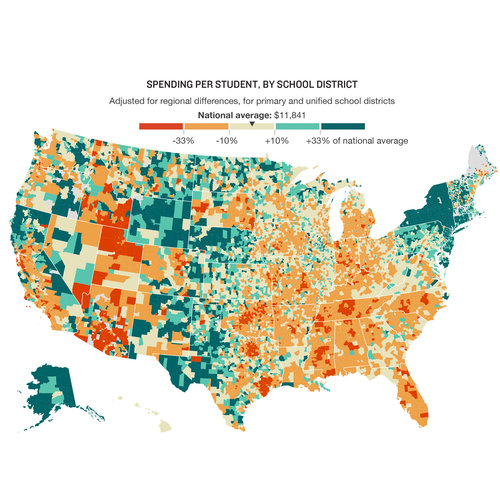
The school district of Freehold Borough, N.J., has a 32 percent poverty rate. It is fully surrounded by another school district, Freehold Township, which has a 5 percent poverty rate.
Freehold Borough is what a new report calls an “island district” — and it’s not alone. The report, from a nonprofit called EdBuild, maps 180 of these islands around the country: Districts that, by historical accident or for political reasons, lie completely inside other systems with a disparate poverty rate and often different funding levels.
And that can correlate with very different outcomes for students — something educators in Freehold Borough have long struggled with.
“Surrounding communities are able to provide a better education than we are,” says Rocco Tomazic, superintendent of the K-8 district. “It’s not supposed to be that way per the state constitution.”
As we noted in our School Money project, around half of school funding in the U.S., on average, comes from local property taxes. That means districts with high poverty often struggle with limited resources, a one-two punch.
“We have a mismatch between the way we’re funding schools and what we’re expecting schools to deliver,” says Rebecca Sibilia, the founder and CEO of EdBuild, which focuses on school finance.
Though they are rare, Sibilia argues that these island districts serve as vivid examples of a larger pattern that holds true in many places throughout the country: The resources available to your local public school may depend on your zip code, or sometimes even your specific address at birth.
Hard to believe, given all the previous and current rhetoric of the Conservatives. Kind of undermines their case even though I am sympathetic to giving priority to communities at greater risk, including the Yazidis:
As the Conservatives push for more help for Yazidis fleeing persecution at the hands of Islamic militants, new information suggests their efforts to do so while in government were minimal.
Data from a controversial audit of Syrian refugee cases ordered by former prime minister Stephen Harper late last spring reveals of 546 people reviewed, three identified as Yazidi, a Kurdish minority group which practices an ancient faith.
Immigration officials also told a House of Commons committee Monday that Yazidis were never highlighted specifically by the Conservatives as a group that should be prioritized for resettlement, even with their targeted approach to resettlement.
The data and the testimony Monday give both the Liberal and the Conservative arguments over Canada’s refugee policy some new energy after the file was a political flashpoint for most of 2015.
The Conservatives’ areas-of-focus policy drew heavy criticism, with many arguing it flew in the face of international obligations that see the UN choose who is resettled. The Tories argued that they were using the UN criteria, but were drilling down within them to ensure the most vulnerable were helped.
The Tories put religious minorities in that category, but the data obtained by The Canadian Press under access-to-information laws suggest the vast majority of landed Syrians whose files were audited were Sunni Muslim, as is the refugee population at large. About three dozen were Christian.
That few Yazidis arrived under their watch is a fact the Tories haven’t dwelled on as they have been pushing the Liberals for more action.
UN ignores ethnicity when prioritizing refugees
Since 2014, the Yazidis have been subject to forced conversions, murder, rape and enslavement at the hands of Islamic militants — actions recently declared a genocide by the UN.
The Tories now say that declaration should put them at the front of the line for resettlement to Canada.
There are, however, numerous policy roadblocks, especially the fact that most are in their home country of Iraq and as such aren’t eligible for resettlement.
Another challenge is that while a person’s faith or ethnicity might be the reason he or she became a refugee, it’s not something the UN looks at when selecting people for resettlement. In fact, the UN expressly asks states not to prioritize groups that way because the most important criteria must be vulnerability.
The Liberals repeatedly asked Immigration Department officials Monday about the policies of the previous government. While in opposition, they had argued that selecting refugees on the basis of religion — as the Tories were believed to be doing — was wrong. The Liberals have resisted calls to do so with the Yazidis.
But the Tories never gave specific instructions to track Yazidis, the officials said.
What about the Tories’ “areas of focus,” the officials were asked. Were Yazidis placed on that?
“There was no specific group put on the list,” Robert Orr, assistant deputy minister, said.
Alas it is not so. Whether or not we choose to be at war with ISIL they are at war with us. And there is very little we can do to change this.
We cannot simply defeat them in battle, as we might a conventional state: whatever progress we have made against ISIL in Iraq and Syria seems only to have diverted its energies into attacks overseas. Nor can we appease them, as we might a conventional terrorist group, even if we were of a mind to: for they have no demands, or none that we can possibly meet, such is the fantastic, end-times nature of their beliefs.
Nor can we just harden our defences, as if we could anticipate every possible avenue of attack. Protect the most prominent public buildings or infrastructure, and watch as restaurant diners and concert-goers are mown down. Guard against bombs and hijacked airplanes, and see AK-47s and trailer trucks used instead. Close the borders, and find yourself beset by homegrown jihadis. Focus on known terrorist profiles, and the enemy takes the form of “lone wolf” attackers, with no necessary connection to ISIL.
The threat — anonymous attackers, willing not only to kill in limitless numbers but to be killed themselves, and aided by all the latest technologies — is unlike any the world has ever faced. And among the challenges it presents is the psychological.
Because there is no satisfying narrative arc to this. We don’t get to go home when this is all over, because we are home and it may never be over. We have to accept this. We have to accept that some problems cannot be solved, but only endured; that some wars cannot necessarily be won, but must be fought all the same.
We are not helpless. We can make less likely the worst sorts of attacks, the kind that require greater planning, co-ordination and resources, and as such are more easily intercepted and disrupted. We can deprive ISIL of territory, starve it of funds, kill its leaders, and by these and other means deny it the mantle of prophecy on which it depends for new recruits.
And we can do much at home, notably to ward off the kind of deep-seated alienation within Muslim communities that so plagues Europe, on which terrorism thrives. It is crucial Muslims are not made to feel as if they are the enemy, collectively — every bit as crucial as recognizing the unique danger posed by ISIL, and the fundamentalist Islamic theology at its heart.
But there will be more attacks like those we have lately suffered, and probably they will be worse.
I don’t mean to say there is no chance of defeating ISIL, or that Islamist terrorism may not in time go the way of other threats to our way of life. I only mean that we cannot assume it will — not in the short term, and not even in the long. The roots of fanaticism have sunk too deep, over too much of the world, to be assured of that. When an idea, once unthinkable, has been first thought, and not only thought but acted upon, and spread to thousands if not millions of people, it will be a long time before it can be unthought.
So we must accustom ourselves to looking at this, as our adversaries do, as a struggle that may go on for decades, even generations, and understand that in the meantime there will be many more innocent deaths to mourn.
Incredible but at least her words were better than the usual “I am worry if my remarks offended anyone.” Actually, given the nature of her comments, one wonders how a MP could be so ignorant and unaware:
Naz Shah has said the comments which resulted in her suspension from the Labour party were anti-Semitic but, at the time, she “didn’t get anti-Semitism as racism”.
Ms Shah, the Bradford West MP, was suspended from the party in April amid controversy over a social media post appearing to endorse the relocation of Israelis to the US. Labour’s governing body, the National Executive Committee, has since reinstated Ms Shah.
In a Facebook post in 2014, before she became MP for Bradford West, Ms Shah shared a graphic which showed an image of Israel’s outline superimposed onto a map of the US under the headline “Solution for Israel-Palestine Conflict – Relocate Israel into United States”, with the comment “problem solved”.
Naz Shah readmitted to Labour party following anti-Semitism row
Asked by BBC Radio 4’s World at One what she thought when she now looked back at the posts, Ms Shah replied: “How stupid I was and how ignorant I was. At the time, I didn’t understand it.
“The language that I used was anti-semitic, it was offensive. What I did was I hurt people and…the clear anti-semitic language, which I didn’t know at the time, was when I said the Jews are rallying. Now that is anti-semitic.
“I wasn’t anti-semitic, what I put out was anti-semitic,” she added.
“I didn’t get anti-Semitism as racism,” said Ms Shah. “I had never come across it. I think what I had was an ignorance.”
Asked whether she thought “silly” for not knowing that it was anti-semitic, she added: “Of course. I will always own my ignorance and it was ignorant. Let’s be clear about it. It has been a journey that I’ve been on… I’ve had amazing compassion from the Jewish community. And I have to earn that trust. I have to be able to say ‘this is what I did’.
Ms Shah also explained her initial reaction to the furore: “One of the tough conversations I had to have with myself was about, God, am I anti-Semitic?
“And I had to really question my heart of hearts. Yes, I have ignorance, yes everybody has prejudice, sub conscious biases, but does that make me anti-Semitic? And the answer was no, I do not have a hatred of Jewish people.”
Government IT is one of the most complex areas given the range and scale of services needed. But this report, along with the current problems with the Phoenix pay system, provides pretty compelling evidence that the officials who sold the concept – which I support – did not adequately address implementation issues.
The political level is equally to blame for not having asked the needed questions and likely for under-resourcing the initiative:
Setbacks and shortcomings at the federal government’s tech support agency could delay Statistics Canada’s release of “mission critical” information required by the Bank of Canada, Department of Finance and commercial banks, according to a report.
The document, submitted to Canada’s chief statistician Wayne Smith, is one among more than a dozen reports, drafted at Smith’s request from all of his directors general. Smith asked for the reports in an effort to fully understand the impact of Shared Services Canada (SSC) on his department.
The memos, obtained by CBC News under access to information laws, detail how yet another federal ministry is embroiled in a dispute with SSC over services standards, red tape, billing and the capacity of IT infrastructure to keep up with departmental demands.
SSC was created by the previous government to centralize and standardize information technology services in a bid to save money.
At the end of February, in the run-up to the 2016 Census, Smith shared the results of this report with Canada’s top civil servant, Privy Council clerk Michael Wernick. The correspondence is entirely redacted except for the subject line, which reads Heightened Program Risks at Statistics Canada.
“Numerous challenges in terms of reliability, timeliness, effectiveness and affordability are being experienced, impacting delivery of programs, projects and plans across all program areas,” wrote Lise Duquet, director general of the StatsCan informatics branch.
She said the savings expected from consolidating services under SSC have not materialized, pointing to how ongoing support from the IT Help Desk is now more costly than when StatsCan operated the email service.
Lack of accountability
Despite “harvesting” $38 million from Statistics Canada with the promise to upgrade IT infrastructure, Duquet said StatisCan was told it would have to cover the cost of migrating all information to new data centres — something she said the agency cannot afford without putting its programs at risk.
Governance at SSC has been identified as a problem by other departments. Duquet echoed those frustrations, “Governance is very complex and there is a lack of accountability to deliver on expected outcomes that are critical to programs.”
Another recurring theme that surfaced in the reports is that SSC can’t or won’t meet StatsCan’s IT requirements because it refuses to upgrade computer infrastructure.
Daniela Rivandra, director general of the industry statistics branch at the agency, warned of the risk of a bottleneck of processing capacity this year. “This will translate into many programs having to delay releases and not meeting legislative requirements for providing the data,” she said.
“Having to delay their release would be unprecedented and will impact the ability of key users (e.g. Bank of Canada, Department of Finance, commercial banks, etc.) of making timely decisions, translating into considerable embarrassment to the government of Canada.”
Due to the poor level of service provided by SSC, the corporate services support division decided to self-fund a unit of 3 persons to provide support to our employees and to ensure that some SSC initiatives get done.– Yves Béland, director general StatsCan operations branch
The directors general’s reports also reveal deep concerns about branches running out of server space. Craig Kunz said the operating system on which the Consumer Price Index depends, is at an elevated risk of failure, yet SSC has frozen procurement with no apparent contingency plans.
‘Slower and lower quality service’
Telecommunications is another persistent irritant.
“Our relationship and experience with SSC with regards to telecommunications have been quite difficult to say the least,” reported Yves Béland, director general of the operations branch. “Due to the poor level of service provided by SSC, the corporate services support division decided to self-fund a unit of three persons to provide support to our employees and to ensure that some SSC initiatives get done.”
Assistant chief statistician Connie Graziadei said service is slower and lower quality, especially on the rollout of cellphones to census employees working in the field.
She described how SSC provided cellphones with the wrong area codes or “incorrect cellphone providers were sometimes assigned to a phone, making it unusable in the geography where the phone was intended to be in operation.”
In one case, an employee had an unusable phone for more than two months. A StatsCan manager sent the woman a spare phone on the Bell network, instead of Rogers. While the employee was thrilled to finally be able to do her job, a long string of emails shows SSC was more concerned about StatsCan overstepping its authority.
“You are not able to simply “re-assign” devices when there is an issue. We have procedures in place to deal with issues like Dana was having,” wrote Todd Mair of SSC on Feb. 2, 2016.
David Kudlovich of StatsCan fired back.
“Two months without a phone [is] far too long when this is the sole device they receive from SSC. Two weeks is actually far too long. There are occupational health and safety concerns when an employee doesn’t have a means of communication and the employee cannot do their job they’re hired to do,” he said.
Yet the documents show the problems continued for several more months.
While it should not be necessary (we don’t expect this from churches, temples or gurdwaras), appears a good idea in the current context:
Jawed Rathore wants to see a big Canadian flag flying from a prominently positioned flagpole in front of every mosque in the country to send the simple message that Muslims are proud Canadians.
The real estate development executive pitched the idea this week in a suburban Toronto banquet hall to a crowd of about 700 supporters of The Canadian-Muslim Vote, a non-partisan organization that made its mark by campaigning to boost turnout among Muslim voters in last fall’s federal election.
The group’s July 13 inaugural dinner to mark Eid, the end of the Muslim holy month of Ramadan, drew dozens of federal, provincial and municipal politicians, with federal Citizenship and Immigration Minister John McCallum delivering the keynote speech.
But Rathore took the podium earlier and proved a hard act to follow. The 39-year-old chief executive of Fortress Real Developments, father (as he mentioned more than once) of six children under seven, is a massively built six-three. His exuberant speaking style is as hard to ignore as his physical presence, and he offered an upbeat overview of the place of Muslims in Canada today. “For the first time ever, it’s kind of cool to be Muslim,” he proclaimed, arguing that every outburst of anti-Islamic bigotry tends to be followed by even more forceful statement of support for the Muslim community from sympathetic non-Muslims.
Still, Rathore proposed that Muslims should send a clear signal of patriotism by flying the Canadian flag in front of their mosques. In an interview with Maclean’s, he framed the initiative as a natural follow-up to the group’s push to boost the Muslim vote. (The Canadian-Muslim Vote points to exit polls that suggest the percentage of voting-age Muslims who cast a ballot might have soared to 79 per cent in the 2015 election, from an estimated 46.5 per cent in 2011.)
“We thought this would be a great opportunity,” Rathore said. “As we talked to the Muslim community about the most Canadian thing you can do, which is to vote, we [wondered], ‘What else can we do to engage with the community?’ And that’s where the team came up with this really exciting idea of getting big Canadian flags in front of every mosque across Canada.”
Although Rathore sees a high level of acceptance of Muslims in Canada, he doesn’t deny his community remains misunderstood by too many. “There’s a sense when you talk to people about Islamophobia, or even just people’s general unawareness of Islam, they think because of some of the things they see and hear that Muslims choose to exclude themselves, that Muslims choose to segregate themselves,” he said. “Nothing could be further from the truth.”
He said most Muslims want to be seen as part of the Canadian social fabric. “Nothing really says that more than a Canadian flag going up,” he said. “Sometimes the simplest medium is the most effective one.” [Note: See the Environics Institute Why Muslims are proud Canadians – The Globe and Mail which largely confirms this].
Rathore brings a business branding perspective to the image challenge facing Muslims. Fortress Real Developments, headquartered just north of Toronto, has real estate projects underway in six provinces. “You look at some of the big U.S. brands that have come north of the border, and Walmart is one of the big examples: at every supercentre they have there is a huge Canadian flag,” he said.
“When they were coming up here, there was the usual rhetoric about ugly Americans, and Walmart made the very simple gesture of saying, ‘We recognize that we are not seen as being from here, we’re outsiders, we’re strangers, and we are coming to Canada’—and they erected these huge flags.”
At the Eid dinner, Rathore showed slides of major mosques, then clicked to the same photos adorned with rudimentary illustrations of Canadian flags flying in front of them. It wasn’t high-tech, but it seemed to convey what he has in mind. In the 24 hours after the dinner, he said groups called, emailed and texted with offers to sponsor 55 flag poles at mosques. His company will pay for the first ten, though.
The Canadian-Muslim Vote plans to take the next few weeks to figure out how to proceed, Rathore said, and hopes to start putting up flagpoles in September or October.
A study showing a dearth of minority judges in Canada has advocates suggesting the country must seize a unique opportunity to increase racial diversity in a “judiciary of whiteness.”
“After many years of saying this is an important issue, it’s very disappointing to see how low the numbers are,” said Naiomi Metallic, a 35-year-old Mi’kmaq woman who is the chair of aboriginal law and policy at Dalhousie University.
Naiomi W. Metallic, an associate lawyer at Burchells LLP, is seen in Halifax on Tuesday, June 14, 2016. Metallic, a Mi’kmaq who is the chair of aboriginal law and policy at Dalhousie University, says both the provincial governments and Ottawa need to accelerate the process to establish a more diverse judiciary. THE CANADIAN PRESS/Andrew Vaughan
A May report in the online version of Policy Options magazine estimates just one per cent of Canada’s 2,160 judges in the provincial superior and lower courts are aboriginal, while three per cent are racial minorities.
Andrew Griffith, a former director general of Citizenship and Multiculturalism and author of the article, says he’s hopeful the Liberal government will follow up on promises of reforms, but he adds, “at the current level, there’s an obvious gap.”
His study was a laborious task of poring through hundreds of biographies to create a “reasonable picture” of judicial diversity, as neither the federal Office of the Commissioner for Federal Judicial Affairs nor most provinces keep statistics.
“It’s a judiciary of whiteness,” said Metallic, who is also a member of a Nova Scotia Bar Society committee trying to address racial issues in the profession, in an interview.
“Powerful institutions ought to reflect the societies they serve.”
Last month, the Trudeau government included an aboriginal judge and an Asian Canadian among federal 15 appointments, and Justice Minister Jody Wilson-Raybould has made a general commitment to increase diversity in the judiciary.
But Metallic — who graduated from the Indigenous Blacks and Mi’kmaq program at Dalhousie University over a decade ago — said she and other advocates will be watching carefully over the next year, with more than 41 vacancies currently open among federally appointed positions, and about 40 provincial positions open across the country. There are also openings in the country’s Federal Court and the Supreme Court of Canada.
Several provinces declined to provide estimates on the number of vacant judgeships.
Marilyn Poitras, a lawyer in Saskatoon who is Metis and a professor at the College of Law at the University of Saskatchewan, said having only two indigenous judges out of 101 judges in a province where 16 per cent of the population is aboriginal is unacceptable.
The country is losing out on the opportunity to gain from Indigenous perspectives on everything from sentencing to the factors that lead to crime, she said.
“When you start to incorporate Indigenous thinking into the justice model, you start talking a lot more about preventative measures and that’s where we should be taking things,” she said in an interview.
Both Poitras and Metallic point to a growing pool of minority graduates to draw from. For example, Dalhousie has graduated 175 black and aboriginal lawyers through a specialized program over the two decades — creating a pool of potential applicants for Nova Scotia’s five upcoming positions.
Griffith found that in the lower courts — where the bulk of the child welfare and criminal justice cases are heard — there were only 52 visible minority judges and 19 indigenous judges among the 1,132 judges.
In Quebec, Griffith noted three visible minority judges out of more than 500, despite bar society figures showing over 1,800 of its roughly 25,000 lawyers identify themselves as being from visible minority groups. The province said it doesn’t keep figures.
In Ontario, one of the few provinces where the judicial advisory body keeps figures on the lower court appointments, there were 24 visible minority judges out of 334 judges, even though one quarter of the province’s overall population identifies as a visible minority.
And in Nova Scotia, where Metallic practises, there are four non-white lawyers who made it to the bench — two blacks, one person of Sri Lankan descent and a Chinese-Canadian — and two indigenous judges, out 99 judges.
Robert Wright, a black social worker, says the figures should be higher in a province where the criminal justice sees an over representation of black and aboriginal accused, and child welfare cases frequently require sensitivity to cultural difference.
Wright, who was a civilian representative on the province’s judicial advisory committee, says black candidates were proposed in the past decade, but weren’t chosen.
Then, in 2009 the province amended guidelines on appointments, calling for 15 years of minimum practice — which dramatically reduced the potential list of applicants.
Like Metallic, Wright is hoping for change over the next year.
“The core issues of today include unrepresented litigants, an over-representation of aboriginal and black accused, a recognition of historical racial discrimination in the courts. These things must be perceived as the most pressing issues in jurisprudence in Canada today,” he said.
“Is the court we currently have tooled to address those issues? The answer that comes back is ‘No.'”
A reminder that racism is not just a white/black issue but that it exists among many groups.
One of the stronger legacies of former Minister Jason Kenney was his broadening the integration focus of multiculturalism to include such tensions between and among visible minority groups, not just between the “mainstream” and visible minorities.
Good initiative:
A group that represents young Asian Canadians is taking an anti-black racism education program to their parents, grannies, uncles and aunties to help break down longstanding tensions between the two minority groups.
The campaign, which follows a similar effort in the United States, aims to create a space for “open and honest conversations” about racial justice, police violence and anti-blackness in Canada’s Asian diasporas.
“The letter is meant to help Asians start having conversations within their own communities about anti-black racism, and specifically, about the anti-black racism that Asians are complicit in,” said Ren Ito, a Japanese Canadian from Toronto and one of the organizers of the Canadian campaign.
“The reality, though, is that different Asian communities are shaped by race and racism in different ways. And this means that different communities have different needs when it comes to starting conversations about anti-black racism or even about racism in general.”
A similar letter effort by Asian Americans was spurred by the recent killings of Alton Sterling in Louisiana and Philando Castile in Minnesota.
“For some of us in Canada and in Toronto in particular, the timing was also apt because we’ve had to deal with controversy and racist backlash against Black Lives Matter-Toronto for their actions during the Pride parade to hold Pride Toronto accountable for its marginalization of queer and trans people of colour,” said Ito, 28, who came here with his family from Japan at age 2 and is a PhD student at the University of Toronto.
The letters are being translated into Japanese, Korean, Tagalog, Vietnamese, Chinese, Hindi, Farsi, Punjabi, Tamil, Urdu, Spanish and Arabic to help supporters from these communities reach out to their peers and their own ethnic media, said Anita Ragunathan, another campaign organizer.
“I began the conversation about anti-black racism within our community with my parents following the murder of Trayvon Martin in Florida (in 2012). It’s an ongoing conversation, and I am hopeful that this letter will help them understand why this is so important to me and others in our generation,” said Ragunathan, 27, who was born in Toronto to Tamil immigrant parents.
“To refuse to speak against racism is to be complicit in allowing it to happen.”
Another organizer, Sun, an artist and educator who has gone by one name for about 10 years, said anti-blackness is almost a given in many Asian communities.
“Many of our communities conform and internalize these ideas in very deep and unconscious ways. This is problematic, and we need to work towards unlearning these oppressive ideas so we can build healthier communities,” said Sun, who came to Canada from Korea when she was 5.
“The media is complicit in perpetuating these biases. Our parents turn on their televisions and see images of black men as ‘thugs’ and ‘criminals.’ Victims of police brutality are not treated as such. Instead of their humanity being the focus, we hear about their records alongside photos that are meant to make them look menacing. We are brainwashed to forget that these men and women are fathers, mothers, brothers and sisters.”
Sun had first-hand exposure to her community’s anti-black sentiment when her father disowned her six years ago because she had a black partner.
This lengthy commentary is well worth reading and is should provoke considerable and deeper discussion both within and outside government beyond the online comments.
Would be interesting to hear from some of the former public servants who worked on the Act for their take:
Still, our own view, bluntly, is that both the Act and the audit culture it sustains are fundamentally wrongheaded, and have contributed to a normative culture that is a roadblock to modernization. Far from fostering genuinely efficient stewardship of public resources, this culture over-manages minor risks in government, ignores far larger ones, and stifles appropriate risk-taking and innovation. If Prime Minister Justin Trudeau’s government is serious about its focus on delivering better outcomes for Canadians, it needs to shift to a system of accountability that is itself more focused on outcomes and less on micro constraints and the avoidance of blame.
To this day, the FedAA — which was actually part of a broader program of initiatives described as the “Federal Accountability Action Plan” — stands, we would argue, as the definitive legislative monument to risk-averse, blame-avoiding institutional rigidity in the government of Canada.
So, as the Act approaches its tenth anniversary, we may well ask: Accountability for what? Has government become more accountable as a result of the act? More to the point, has the FedAA and similarly-spirited initiatives contributed to better societal outcomes? Does it position the Canadian government to evolve nimbly to meet the challenges of governing in the digital age?
…A methodologically rigorous assessment of the impact of the FedAA — like one of the need for it — remains to be conducted. To date, much reported criticism draws on a broadly negative assessment by the public service textured by compelling personal anecdotes. A public service thumbs-down is neither definitive nor something that should be casually dismissed. Indeed, a systematic survey of public service experience would make a good starting point for a robust analysis. In the meantime, however, our principal basis for assessing the FedAA remains a parsing of what the legislation did and did not do.
Before assessing the individual elements of the legislation, let’s consider its overall thrust. Did this act about accountability have anything to say about being accountable for better outcomes? For working collaboratively on horizontal files? Did it give deputy ministers the responsibility and flexibility to improve the bottom line? Indeed, did it include any inducements to work pro-actively for improvements?
On the contrary, almost every provision was a further proscription, a more refined behavioural restraint, an intensification of scrutiny to smoke out unknown misdemeanours. And more to the point, the requirements of this regime could be satisfied in a purely negative way — that is, not by actually delivering something good, but by keeping your head down and avoiding blame.
As befits accountability legislation, the FedAA strengthened internal audit requirements in government departments and designated deputy heads as “accounting officers” for their organizations, meaning that they had to account in some way to Parliament for their managerial custodianship. Now, internal auditing is itself a laudable practice — one that that should actually be welcomed by a CEO as a tool for keeping tabs on the organization. However, the actual impact of internal audits on government departments is an area that merits closer study; the decision to conduct an audit by external committees may at least initially have reinforced a tendency to see the function as something to be managed rather than embraced.
As for the accounting officer function, this was evidently structured to minimize the risk of public servants becoming politically accountable to Parliament (itself a defensible goal). Partly for this reason, the responsibility is cast heavily in terms of demonstrating compliance with Treasury Board rules. But again, that is really not an outcome-oriented focus for deputy ministerial accountability, and it is highly unlikely that disregard for Treasury Board requirements was a significant problem in the deputy community. There is also the possibility that it reinforced a siloed focus on one’s own department.
…We need to replace what the FedAA has given us — more detailed rules and more costly and powerful people to oversee them; a chilling effect on public service and engagement with the outside world; and redoubled focus on departmental siloes and accountability conceived as compliance — with a system oversight and accountability that hones in on real risks across the system and that encourages collaboration, innovation and a focus on outcomes. Are public servants accountable for ticking boxes, or for helping the government of the day improve the lives of Canadians in meaningful ways?
If there is a real risk to the effective governance in Canada today, it is the risk that government will not meet these challenges, diminish in relevance, and be beaten at its own game by external providers of goods and services with no mandate to look out for the public interest.
Felix Marquardt’s, founder of the Al-Kawakibi Foundation for Islamic Reform and the think tank Youthonomics, take on Islam and terror and, in particular, an interesting argument for showing the horrific videos:
If Muslims want to be taken seriously when we argue that our religion is one of love and peace and social justice, then we must not cede to the natural inclination to say we have “nothing to do” with the authors of the ignominious crimes committed in the name of Islam.
We have one thing in common with them. We all call ourselves Muslims. Of course, their vision of Islam is perverse and completely, well, wrong. There is a common thread between despicable acts of violence committed around the world these days. And that common thread is that the people who commit them think of themselves as Muslims.
In other words, no, there is no intrinsic “problem” with Islam, but yes, hell yes, there is a contemporary degenerescence of our religion that is threatening its very existence and future. If we, as Muslims, cannot agree on this, then we must brace ourselves, for Islam will disintegrate completely before our eyes in the coming years. To address a problem, one must first admit that there is a problem.
This brings into focus another major issue that has popped up since Thursday’s attack in Nice: the dissemination of the footage of the slaughter and its aftermath.
The French authorities are asking that people refrain from sharing the gruesome pictures and videos, claiming that doing so may galvanize or trigger other would-be kamikazes. Others argue the same thing out of respect to the families of the victims.
I have news for you: In this day and age, Islamic State admirers and supporters who want to gain access to this footage will find a way to do so.
And, as far as I am concerned, is it precisely out of compassion for the victims that I want all the people in the world who share my faith to see what is being done in the name of our religion. Images of Nazi extermination camps and the picture of the naked Vietnamese girl fleeing napalm bombings shocked the world and brought change, precisely because they shocked the world.
We are encouraged to share footage of police abusing and killing black people all over the United States to make the world aware of what is going on there, but we should hide what IS is doing in southern France? Muslims all around the world must see what is being committed in the name of their religion so they can finally confront the reality of Islam in the 21st century: Medina, Cairo …we have a problem.


 Multicultural Meanderings