Federal officials wrestling with gender neutral ID issues for more than a year

There is a complexity in the embedded links between various identity documents that does need time to sort out, given how central gender has been in the various identity cards and systems.

But clearly coming and expect the 2021 Census will include an “other” category and gender-based analysis will similarly need to be broadened:

Documents from June 2015 show officials from Citizenship and Immigration Canada were looking into what they called “identity management” issues should someone from a country that allows a third sex designation on their passports apply for Canadian immigration documents.

Internationally, there is a “growing recognition of a third sex/gender category…for those who identify as intersex, indeterminate, or unspecified,” officials from ESDC wrote as part of a presentation last year with Citizenship and Immigration Canada counterparts.

Seven countries allow a third sex designation on their passports – Australia, Bangladesh, Germany, India, Nepal, New Zealand and Pakistan.

Passport standards from the International Civil Aviation Organization, which Canada adheres to, allow governments to allow a third sex or gender category, usually marked with an ‘X,’ officials wrote in the documents obtained by The Canadian Press under the Access to Information Act.

Citizenship and Immigration Canada said it would respond Tuesday to questions posed to it on Monday.

At the same time, changing the use of sex designations in the registry of social insurance numbers would cause issues for agencies that rely on the information as part of their programs, like Employment and Social Development Canada and the Canada Revenue Agency that use the detail for gender-based analysis on income distribution, job data and even student loan recipients.

In May, the department told The Canadian Press the sex designation data from the registry is used primarily for gender-based analysis and not for determining eligibility for benefits. Federal and provincial agencies that use the information to validate identities raised concerns over the complete removal of sex information from the registry.

Source: Federal officials wrestling with gender neutral ID issues for more than a year – Macleans.ca

Robyn Urback: How can Black Lives Matter claim ‘victory’ when Pride has left so many divided?

One of the better commentaries:

BLMTO’s leaders and their allies claim their interruption was a necessary reminder that social movements often work in the interests of their wealthy white members first — early feminism is an obvious example — leaving its communities of colour to pick up the slack behind. And they’re not wrong. BLMTO can claim, with some credibility, that its disruption of the parade was important, or necessary, but it will have a hard time making the case that it did more good than bad, especially as hundreds of simultaneous Facebook fights about “pinkwashing” and “anti-blackness” enter their second day. And surely it would not tolerate a similar protest by Pride Toronto members at the Toronto Caribbean Carnival parade later this month.

Ian Willms/Getty Images

The question of future police participation in subsequent Pride events has only compounded the mess, with many accusing BLMTO of undermining recent progress made between the LGBT community and Toronto police, which included an historic apology offered by Police Chief Mark Saunders last month for a string of raids made on gay bathhouses in 1981. They claim, rightfully, that to ban future police participation in Pride events would be a step in the wrong direction, and would only alienate gay members of the Toronto Police Service, including Const. Chuck Krangle who penned on open letter urging the organization to reconsider its promise to BLMTO, arguing that “exclusion does not promote inclusion.”

Indeed, the tens of thousands of onlookers who have watched Toronto’s annual Pride Parade march down Yonge Street have surely noted the diversity of its participants: there are Liberals, Conservatives, church groups, unions, Arabs and Jews, all marching to support inclusiveness, diversity and the freedom for people to love who they love. That’s what this year’s event, and all Pride events, should be about. Instead, this year’s Pride parade left supposed allies fuming from separate corners, while BLMTO’s leaders proudly claimed victory for a job well done. It’s hard to see how starting a fight between groups that are working toward the same goals is really a cause for celebration.

Source: Robyn Urback: How can Black Lives Matter claim ‘victory’ when Pride has left so many divided?

Ontario facing ‘epidemic of Islamophobia’ survey finds

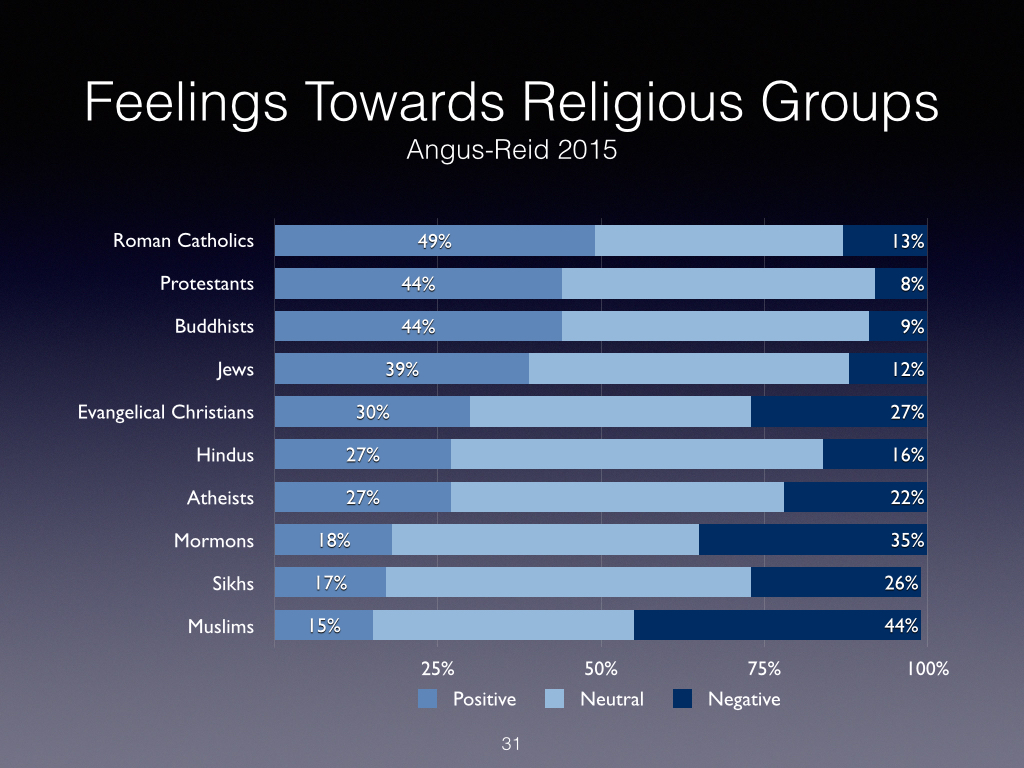
Angus Reid Religon Poll 2015 - Feelings Towards.001Consistent with most other surveys I have seen although labelling it as an ‘epidemic’ compared to other biases and prejudices appears to be an exaggeration (see chart above from 2015 Angus Reid survey):

The survey by polling firm MARU/VCR&C measured public perceptions of ethnicity and immigration in Ontario in the wake of the recent influx of thousands of Syrian refugees — almost 12,000 to this province alone.

“There is an epidemic of Islamophobia in Ontario. Only a third of Ontarians have a positive impression of the religion and more than half feel its mainstream doctrines promote violence (an anomaly compared to other religions),” said the 51-page survey to be released this week by the Ontario Council of Agencies Serving Immigrants and advocacy group Mass Minority. “These sentiments are echoed with Syrian refugees in Ontario where acceptance often coincides with acceptance of Islam.”

Ontario has seen a number of recent incidents targeting Muslims. A woman wearing a hijab was attacked at a supermarket in London in June and a Western University student from Iran was beaten by two men who taunted him and told him to go back to his country. Also, in June, an anti-immigrant group rooted in Germany held an anti-Muslim protest in Toronto.

While the survey’s respondents agreed that immigrants play a valuable role in society (72 per cent) and are an important part of our cultural identity (71 per cent), three-quarters of the survey participants said we need to focus on taking care of the people “here” instead of spending resources on refugees.

“Taken together, this suggests that Ontarians see non-immigrants as more entitled to social care. This entitlement is, in some ways, a contradiction given the inherent value that immigration offers,” said the poll of 1,009 Ontarians conducted between May 11 and 16.

The survey was funded by the province and the City of Toronto for its recently launched public awareness campaign on Islamophobia, which has sparked heated debate over its provocative posters, seen by some as reinforcing stereotypes and fuelling tensions.

The research was commissioned to take a snapshot of Ontario residents’ attitudes and perception towards immigrants and ethnic minorities as a benchmark to assess the effectiveness of the multimedia campaign. A followup survey is planned after 12 months.

While 46 per cent of Ontarians feel Canada admits too many immigrants, 45 per cent said they welcomed the right amount.

“Higher and lower levels of acceptance are associated with distinct demographic profiles,” the report said. “Less educated and rural Ontarians over-index on feelings that Canada accepts too many immigrants.”

Three-in-five residents in the province supported Ottawa’s decision to accept Syrian refugees while one-fifth of all respondents said they have participated in welcoming Syrians to Canada in various ways from donating money to furniture, volunteering and participating in a sponsorship group.

Comparing Canada’s six major mainstream religions, Islam is the most likely to be viewed by the respondents as a promoter of violence, followed by Sikhism, Christianity, Hinduism, Judaism and Buddhism.

Three-quarters of Ontarians said they feel Muslim immigrants have fundamentally different values, largely due to perceived gender inequality, the survey found.

“Opposition to Syrian refugees is higher among those with unfavourable impressions of Islam,” said the report. “Opposition is mainly because of concerns that Syrian immigration will mean less help at home. Those opposed see Canadians as needing support first and foremost.”

Source: Ontario facing ‘epidemic of Islamophobia’ survey finds | Toronto Star

Tasha Kheiriddin’s commentary seems to be unaware of the many activities by moderate Canadian Muslims to counter the narrative:

And all the public education campaigns in the world, such as those currently playing out across Toronto, won’t change the fact that fundamentalist practitioners of Islam maintain a worldview very different not only from those held by non-Muslims, but from those held by moderate Muslims as well.

As with any extremist religion-based movement, it’s the latter group that holds the key to transforming the faith and the way it is perceived. Moderate Muslims need to speak out against extremism, from the mosque to Main Street. Otherwise, radicals and their actions will continue to feed the fires of prejudice, help elect Donald Trump to the White House, and undermine the very principles of tolerance and equality which Western countries — including the millions of Muslims who call them home — hold dear.

http://ipolitics.ca/2016/07/04/are-we-becoming-more-islamophobic/

Australia: Hanson’s views on Islam take centrestage

One of the more toxic forces in Australia, elected to their Senate:

Pauline Hanson says Islam is not a religion of peace. In fact she doesn’t believe it’s a religion at all.

The One Nation leader, who’s set to return to the federal parliament after almost 20 years, insists she’s not out to offend Australian Muslims.

But she says it’s time to turn the spotlight on Islam, and what’s being preached in Australia’s mosques and taught in local Islamic schools.

She’s demanding a royal commission into whether Islam is a religion or a political ideology.

She wants to stop further Muslim immigration and halt the intake of Muslim refugees.

She wants surveillance cameras in all mosques and Islamic schools and for their teachings to be opened up to public scrutiny.

She advocates a ban on the construction of new mosques, and on the burqa and niqab being worn in public.

And she’s calling for a referendum on changing the part of the constitution that offers protection for the free practice of religion.

“You have our values, our culture, and our way of life. You don’t have a full burqa, you don’t keep putting up mosques,” she told reporters on Monday after learning she’ll take a seat in the new Senate.

“I’d like to know what they are teaching in those mosques. You can’t deny the fact that in these mosques they’ve been known to preach hate towards us.

“Is this a society we want to live in? I don’t believe it is. Do you want to see terrorism on our streets here? Do you want to see our Australians murdered?”

Ms Hanson said she didn’t want her views on Islam to dominate her first major press conference since the election.

Source: Hanson’s views on Islam take centrestage | SBS News

Housing prices: Singling out ethnicity of buyers is unhelpful | Yuen Pau Woo

While his first and third points are largely valid, the nature of Vancouver ethnic demographics and that those from China are the main source of foreign investment is a reality.

Similar to having a conversation about extremism and terrorism without making any reference at all to the link with religion and Islam in particular.

Finding a vocabulary to have an open discussion, and finding a way to respectfully but honestly debate the issues, is always a challenge.

But silence on the ethnic origin ignores the main driver:

First, most accounts of the role of Chinese buyers do not distinguish between non-residents and residents, or indeed between Canadian citizens, landed immigrants and foreign nationals. The vast majority of homes owned by Chinese people in the Lower Mainland belong to folks who have residency status in Canada — in other words, they are Canadians, not foreigners. There are hundreds of thousands of people with last names spelled in the fashion of mainland Chinese who are Canadian citizens or landed immigrants. [note I would not call those with Permanent Residents status Canadians, that term should be reserved for citizens]

Second, even if one is able to identify Chinese buyers who are truly “foreigners”, there has been little consideration given to their economic contribution to the local economy. Housing affordability, after all, is a function of both prices and income. Are these buyers connected to the international student population in B.C. that contributes about $1.5 billion a year to the local economy? How many local businesses have benefited from the investments of these high net worth individuals? The much-cited study identifying Chinese buyers of local condos looks at the numerator in the affordability equation, but totally ignored the denominator. Where is the equivalent study of their impact on jobs and incomes?

Third, and most importantly, singling out Chinese buyers is irrelevant when it comes to a public policy response. There may be a case for surcharges on foreign purchases of residential real estate and on property speculators, but any such policy would surely apply without regard to country of origin or ethnicity. After all, while China may be this year’s source of hot capital outflows, some other region could assume that role next year. Indeed, that may already be happening with the tightening of capital controls in China, the appreciation in the U.S. dollar, and heightened political uncertainty in much of the rest of the world.

So why this parlour game of pointing the finger at Chinese buyers? I don’t doubt that many researchers and writers on the subject have good intentions, but they are naive to think that singling out an ethnic group is nothing more than dispassionate analysis and a crusade against political correctness. On the contrary, they are unwittingly giving voice to darker sentiments in the populace and normalizing the language of chauvinism.

You see, I find out about their well-meaning articles and quotes when I get nasty spam messages from groups that actually don’t like Chinese people, or immigrants in general, and who gleefully hold up these articles as vindication of their beliefs. In the same way that the Brexit vote has given voice to racists in the U.K., the incessant focus on Chinese buyers as villains in Vancouver’s affordability crisis is propagating prejudice and promoting distrust.

None of the above is a dodge from discussing and dealing with the challenges of housing affordability in Vancouver. But there are no solutions to be found in singling out the ethnicity of buyers, and no winners in the divisive game of race baiting.

Source: Opinion: Singling out ethnicity of buyers is unhelpful | Vancouver Sun

We never see Trump or Brexit coming because we drown in data and biases – Implicit Bias

Good piece by Mike Ross, Davide Pisanu and Blanche Ajarrista on the risks of bias and automatic thinking and the need to be more mindful:

Three ways to diminish the risk of overreliance on analytics or biased forecasting are the use of premortems, devil’s advocates and self-reflection. Tools that we all (including the market research organizations and newsrooms of the world) can implement more systematically to avoid shocks such as the Brexit result.

  • Premortems start with imagining that you are wrong, dead wrong, and that the worst has occurred. You then ask, what could be the cause of this predictive failure? Through this type of questioning, we can identify the limitations of the available data and dig deeper to improve the quality of the quality of the information used.
  • A devil’s advocate is appointed to ensure that contrarian positions have a voice at the table when groups are making decisions, but they are also useful on an individual basis. This person’s role is to argue against the group’s intention – essentially stating why everyone else is wrong. By clearly nominating someone to take this on (or by forcing yourself to question your own assumptions in this way), we free the advocate from the constraint of not wanting to go against the position of the group and in doing so allow them to highlight our collective blind spots.
  • Self reflection (by an individual or a group) is more of a habitual practice – ensuring that you think deeply on how your background, beliefs and socioeconomic context heavily bias your views. From the people you regularly interact with to the Facebook algorithm that pushes content to your stream, your view of the world is curated by your context. Forcing yourself to acknowledge this and actively seek out opinions counter to your own will diminish the influence your personal situation has on your decision-making, broaden your context and expand the range of data you’ll use to inform your decisions.

It’s not that data and analytics are inherently bad or that our biases are not useful in decision-making, but rather that these can be flawed.

By recognizing and using a set of tools to overcome these flaws, we can be much more effective decision-makers and avoid (and perhaps profit from) the shocking and the unexpected.

Source: We never see Trump or Brexit coming because we drown in data and biases – The Globe and Mail

Conservative Christians Grapple With Whether ‘Religious Freedom’ Includes Muslims : NPR

A real test for US evangelicals in terms of their advocacy and their interpretation of religious freedom:

…. Southern Baptist leader Russell Moore warned that letting the government restrict Muslims could lead to restrictions on Christians. He believes Christianity is the only true faith, and people must choose it freely.

“Sometimes we have really hard decisions to make — this isn’t one of those things,” Moore said. “What it means to be a Baptist is to support soul freedom for everybody.”

Moore leads the Southern Baptist Convention’s Ethics and Religious Liberty Commission, which recently signed on to a legal brief supporting the right of a group of Muslims in New Jersey to build a mosque. His answer was met with enthusiastic applause — but he has also faced criticism from some fellow conservatives, including Wofford.

On a recent Sunday morning, after a fire-and-brimstone sermon, Wofford said he believes the U.S. Constitution protects all religions, including Islam. But Wofford doesn’t believe Southern Baptist leaders, who draw their salaries from dues paid by local congregations, should be advocating for the rights of Muslims.

“So what I am actually doing if I support and defend the rights of people to construct places of false worship, I am helping them go to hell. And I do not want to help people go to hell,” Wofford said.

Some Christian groups dedicated to defending religious freedom argue for equal treatment for all faiths, out of the principle that discriminating against one religion could threaten them all.

“It’s a double-edged sword,” said Matt Staver, founder and chairman of Liberty Council, which focuses on religious freedom litigation on behalf of Christians but has also represented at least one Jewish client.

“Religious freedom is for all of us or it’s for none of us,” Staver said. “If we want to pick and choose, what’s the standard? And if it’s only that might makes right, then that means it’s a political struggle and whoever is the ruling class at any particular time, they’re the ones that have their say.”

In a tense presidential election year, such debates have a tendency to become political. After the meeting with Trump in New York last week, several evangelical leaders held a press conference, where they praised Trump’s promise to protect religious liberty.

Asked how that pledge applies to Muslims, conservative columnist Ken Blackwell responded that he favors freedom for all faiths, but his primary concern is the rights of Christians.

“I was more interested in hearing Donald Trump say that he was willing and ready to defend religious liberty not just for Christians, but including for Christians, in the public square,” he said.

Pressed on Trump’s call to temporarily ban Muslim immigration — a proposal that has appeared to shift over time, but which Trump has yet to explain in detail — Blackwell said that issue will be part of an ongoing “conversation” between Trump and evangelical leaders. He said many conservative Christians see the real estate developer as more favorable to their concerns about religious freedom and other issues than his Democratic rival, Hillary Clinton.

“We’re not going to, in fact, throw him overboard” over the Muslim ban issue, Blackwell said.

Source: Conservative Christians Grapple With Whether ‘Religious Freedom’ Includes Muslims : NPR

Arabic, English language exchange creates community connections

Good small initiative bringing people together:

“With the influx of Syrian refugees and the outpouring of public desire to help, I thought it was a right time to try and start a language exchange program focussing on Arabic and English. So I started networking.”

She got a $2,500 grant from UBC’s Global Responses to the Refugee Crisis for rental costs and language materials. She found a meeting space at the Ajyal Islamic Centre in downtown Vancouver. She put the word out for participants. Twenty women signed up for the course — 10 English-speaking Canadians and 10 Arabic speakers. The participants were then divided into pairs — one English speaker to one Arabic speaker — and were told they would be responsible for each other’s instruction. Over the course’s 10-week term, each session would be divided in half between English speakers helping the Arabic speakers learn English, and then the Arabic speakers helping the English speakers learn Arabic.

For the English speakers, who knew little or no Arabic, it was tough going. But what they did find instructive were the Arabic-speaking women themselves. They hailed from Eqypt, Kuwait, Libya, Iraq and Syria. They confounded stereotype. Several were professionals. Several were refugees. Hazar AlSibaai, a civil engineer, and her 16-year-old daughter, Sana AlAyoubi, were Syrians who had spent three years in a Jordanian refugee camp before coming to Canada. Michelle Kaczmarek, a Masters student in library and information studies at UBC, was partnered with Hazar, and Shalene Takara, a clinical counsellor, partnered Sana.

“I found them very friendly and incredibly joyous,” said Kaczmarek, “and the group very diverse as well. It was important to recognize that diversity in this massive Arabic-speaking world.”

“In every class we did,” Takara said, “we focussed on a theme. One of them, for example, was about food, and Hazar and I talked about what we cooked, where we shopped, where we came from … everyday things. It was quite playful and fun, and we joked a lot, and that part was unexpected for me. I think how much we shared beyond the language exchange came as a surprise.”

Hazar, whose English is halting, said she wanted to improve her English so she might go back to school and eventually find work as an engineer here. But that, she said, would be difficult. Sana, who took English in school in Syria, spoke much more fluently, and attends high school here now. (At one point, she brought in her physics homework so Kaczmarek could help her with it.) She took the class, she said, not only to improve her English but “to engage the community here.” She hopes to go on to university and become a pharmacologist.

But life here was very different from what she knew, she said. “It’s very difficult. I need time. It’s not just about the language; it’s everything that’s different.”

Not too much can be made of 10 weeks of language lessons, of course. A feel-good story is one thing, but it doesn’t make it any easier for Hazar to find work or Sana to pass her exams. It doesn’t guarantee what little Arabic they learned would stay with Kaczmarek or Takara, or that lasting relationships would blossom between any of the 20 women. It won’t stop wars, or doors from closing.

On the other hand, they were 20 women who, despite the cultural gulf, enjoyed each other’s company. And at the end of the last session, everyone stayed late after class, sat down to a meal and broke bread together.

Source: Arabic, English language exchange creates community connections | Vancouver Sun

ICYMI: After #OscarsSoWhite, film academy invites diverse new membership

Getting the message:

Months after the #OscarsSoWhite backlash, the film academy behind the Oscars has invited a diverse blend of 683 filmmakers, movie artists and executives to join its ranks.

“We’re proud to welcome these new members to the academy, and know they view this as an opportunity and not just an invitation, a mission and not just a membership,” Academy of Motion Picture Arts and Sciences president Cheryl Boone Isaacs said in a statement Wednesday.

New members range from recent Oscar-winners such as Brie Larson, Alicia Vikander and Mark Rylance to famous names from a variety of backgrounds, including Idris Elba, America Ferrera, Vivica A. Fox, Carla Gugino, O’Shea (Ice Cube) Jackson, Daniel Dae Kim, Michael B. Jordan, Eva Mendes, Freida Pinto, Mary J. Blige and Will.i.am.

The list also features a host of Canadians, including Adam Beach, Bruce Greenwood, Rachel McAdams, Xavier Dolan, Mary Harron, Deepa Mehta, Patricia Rozema and Emma Donoghue.

Should all the invited members accept, the academy says its new class would boost the diversity of the overall membership to 27 per cent female (46 per cent of the invited members are women) and 11 per cent minority (41 per cent of the invited new members are people of colour).

Currently, the academy’s membership is 25 per cent female and eight per cent people of colour.

The youngest new member is 24, while the oldest is 91.

“This class continues our long-term commitment to welcoming extraordinary talent reflective of those working in film today,” Isaacs said.

“We encourage the larger creative community to open its doors wider, and create opportunities for anyone interested in working in this incredible and storied industry.”

Source: After #OscarsSoWhite, film academy invites diverse new membership – Arts & Entertainment – CBC News

Canada Deserves Better Than Those That Bash Multiculturalism | Jack Jedwab

Good piece by Jedwab:

Critics continue to insist that Canadian multiculturalism sends the wrong message to newcomers and their children by discouraging them from becoming more like the rest of us. The critics may however want to pay more attention to the message that multiculturalism is conveying to many non-immigrant Canadians. A March 2016 survey done by the firm Leger Marketing for the Association for Canadian Studies and the Canadian Race Relations Foundation reveals that some 52% of Canadians hold a positive view of Canadian multicultural policy, with 30% holding a negative view and 18% that do not respond.

At 63%, the youngest segment of the population surveyed aged 18-24 is most positive about multicultural policy compared with 46%, of those 65 and over who were the least positive. Those Canadians that are most positive about Canada’s multicultural policy are considerably more likely to have favorable views of indigenous peoples, immigrants, Jews and Muslims.

The most pro-multiculturalism were also far more likely to have contact with members of these groups. It is worth noting that some 85% of the most pro-multicultural have a favorable opinion of language duality in contrast with the 20% that share this favorable view amongst those most negative towards multiculturalism.

So the most negative towards multiculturalism are the most hostile to minorities, have the least contact with them and don’t like bilingualism. The most favorable value diversity, interact more frequently with diverse groups and appreciate our two principal languages. When it comes to my children, I’ll take the more forward-looking pro-multiculturalism message in a flash.

On Canadian multiculturalism day the Prime Minister’s multicultural message was bang on: “Our roots reach out to every corner of the globe. We are from far and wide, and speak over 200 languages. Our national fabric is vibrant and varied, woven together by many cultures and heritages, and underlined by a core value of respect. Today, let us celebrate multiculturalism as a vital component of our national fabric, and let us express gratitude to Canadians of all backgrounds who have made, and who continue to make, such valuable contributions to our country.”

Source: Canada Deserves Better Than Those That Bash Multiculturalism | Jack Jedwab