What should expatriates’ voting rights be? – Policy Options

My latest on expatriate voting by Canadians in IRPP’s Policy Options:

With the decision by the Supreme Court of Canada to hear the challenge to the five-year restriction on expatriates’ voting rights, it is timely to review the arguments in favour and against extending the time. In addition, we need a better idea of the number of Canadian expatriates abroad and the nature of their ongoing connection to Canada.

Starting with the number of Canadian expatriates, recent advocates have relied on the estimate from the Asia Pacific Foundation (APP) Canadians Abroad: Canada’s Global Assets of 2.8 million expatriates. This figure does not control for age or citizenship. When we do so (using the 2006 Census), the figure is just under 2 million (of whom 77 percent are aged 18 or over, and 78.1 percent of whom were immigrants had become Canadian citizens).

There is also a dearth of data on expatriates’ degree of connection to Canada, and what exists is based on anecdote rather than government data. Consular data for 2007 to 2015 show that approximately 20,000 expatriates annually accessed services for people who had been abroad for five years or more. The number of passports issued abroad was about 184,000 in 2015, and there were approximately 725,000 Canadian passport holders living abroad.

Looking at nonresident Canadians’ tax filing data, 136,310 returns were filed, which was 7 percent of the number of expatriates in 2013, the most recent year that complete data is available. While this figure may understate the proportion of nonresident Canadians filing taxes, as some may use Canadian addresses, it suggests that the vast majority of expatriates do not pay Canadian income tax. I have not seen any reliable data on nonresidents’ property taxes.

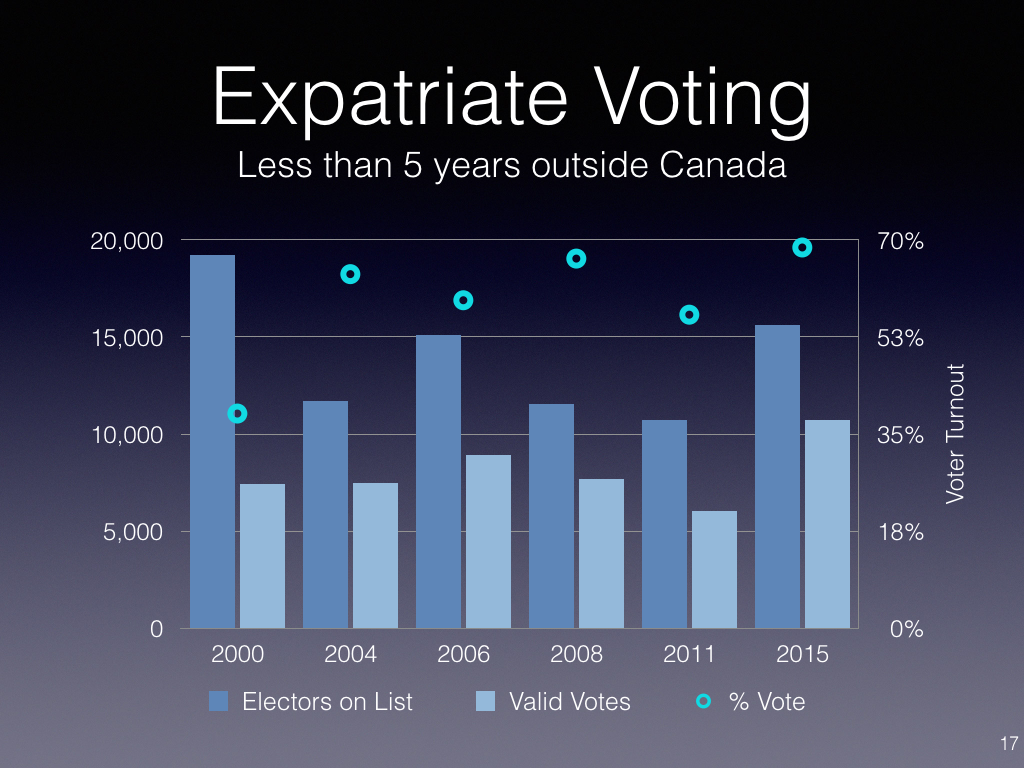
Data on voting among those who have been abroad less than five years indicates the number of expatriates who register and vote is very low. (This also applies to Canada as a whole: in 2015, out of a total of 26 million eligible voters 17.6 million voted.) Figure 1 shows the number of nonresident electors, valid votes and percentage of voter turnout for the last six elections. This data suggests that relatively few of those who have lived abroad for five years or less are politically engaged (of course, some may return to Canada to vote, but we do not have data on this).

Canadian Expatriates Data Gaps.017

Figure 1

The data we have, imperfect as it is, suggests that of the 2 million Canadian citizens living abroad aged 18 or over, the number who have ongoing active connections with Canada is likely quite low. Even advocates of expatriate voting rights, after citing the APF number of 2.8 million expatriates abroad, go on to quote the figure of “over one million” who have active connections, but they do not explain the basis for that number.

Arguments in favour of expanding the expatriates’ voting rights are based on the Charter’s protection of voting rights without qualification. The main substantive arguments, by the plaintiffs, by academics such as Semra Sevi, Peter Russell, Alison Loat and John McArther), and by former Global Affairs director general Gar Pardy, can be resumed as follows:

  • Canadians living abroad contribute to Canada and the world, and many retain an active connection with Canada, whether it is business, social, cultural, political, or academic. These Canadians’ global connections should be valued as an asset;
  • Patriotism and civic engagement are not tied to location;
  • The internet and online communities make it easier for Canadians to remain in touch with Canada and Canadian issues;
  • As Judge Laskin said in his dissenting statement in the July 2015 Ontario Court of Appeal ruling, Canadians living abroad pay “Canadian income tax on their Canadian income, and property tax on any real property they may own in Canada,” and are subject to Canadian laws and foreign policy decisions;
  • As Russell and Sevi note, the expatriate vote will not “completely change the tide of an election.
  • The five-years-or-less limitation is more restrictive than those of other Western countries; for example:
    • United States: no limitation, but expatriates are required to file US tax return;
    • United Kingdom: the limitation is fifteen years;
    • Australia: the limitation is six years, and expatriates must file an annual declaration of their intent to return at some point;
    • New Zealand: the limitation is three years, and the clock restarts when citizens visit New Zealand.
  • The Canadian five-year limitation ignores the increasing globalization and population mobility, and it sends the wrong signal to young Canadians;
  • As Jean-Pierre Kingsley, former chief electoral officer, said when he advocated eliminating the five-year limit: “The right to vote is a fundamental right of citizenship that is protected by the Charter and does not depend on place of residence.” A parliamentary committee reviewed his report in 2006 and endorsed his position.

The principle arguments against are the following:

  • The “social contract” argument, used by the Ontario Court of Appeal to uphold the policy, states that voting “would allow them [expatriates] to participate in making laws that affect Canadian residents on a daily basis, but have little to no practical consequence for their own daily lives. This would erode the social contract and undermine the legitimacy of the laws.” Examples of policies and programs that are considered part of the social contract include economic and social policies and programs, at the federal level; health care and education, at the provincial level; and policing and transit at the municipal level;
  • While some expatriates may pay Canadian taxes and may own property in Canada, the data suggests over 90 percent do not, as they pay tax where they work and live;
  • Interest in voting among expatriates appears to be low;
  • Apart from consular and passport services, most Canadian government economic and social programs are tied to residency;
  • In general, the longer the time spent abroad, the looser the bond with Canada, as family, work and local connections become more meaningful. Over time, day-to-day living — work, education, raising a family, consuming media — predominate important for expatriates, whether in the United States, Hong Kong or the Mid-East;

The Supreme Court will have to rule whether the right to vote is qualified by residence and the degree to which the social contract argument justifies certain limits.

Some of the advocates of expatriate voting, for example, Gar Pardy, argue for no limits, which Loat and McArthur also imply. Sevi and Russell imply limits, but ones that are more in line with those of other countries, but they do not indicate their preference.

To cite an extreme example of the “no limit” argument, Canadian expatriates born abroad (citizenship by descent) who have never lived in Canada would be entitled to vote, even if they had never set foot in Canada. A less extreme example is that of people born in Canada who move abroad as children and remain outside Canada. In both cases, it is hard to justify non-residents having voting rights when they have spent no time or extremely limited time living in Canada.

The “comparability” with other nations argument is more reasonable and convincing, and opens the discussion as to which option — taxation, as in the United States, extending the limitation to 15 years, as in the United Kingdom, or renewable voting rights, as in New Zealand — makes the most sense from a policy and implementation perspective. I suspect most Canadian expatriates would not welcome linking voting to filing tax returns. It would go against long-standing Canadian tax policy, and judging by US expatriates’ opposition to the over-reach of Foreign Account Tax Compliance Act, this option is likely a nonstarter.

If the Supreme Court rules against the five-year limit, my preference, would be some variant on the Australian and New Zealand approach, i.e., allowing voting rights to be renewed but requiring some action by expatriate voters to extend their right, perhaps through a written declaration or periodic visit to Canada. This does not seem to be an unreasonable obligation, and it allows for mobility but requires a concrete and a relatively easy to administer test of the expatriates’ connection to Canada.
Source: What should expatriates’ voting rights be? – Policy Options

How Brampton, a town in suburban Ontario, was dubbed a ghetto

Good long read on Brampton by Noreen Ahmed-Ullah (excerpt from her book, Subdivided: City-Building in an Age of Hyper-Diversity), the pace of demographic change and the lack of adequate municipal integration policies and programs:

Until last year, I was a reporter in Chicago, covering the inequities of the city’s public school system and writing about disenfranchised African American youths. Neighbourhoods on Chicago’s south and west sides – now those are true urban ghettos.

Here in Brampton, you don’t have abandoned homes boarded up, acting as magnets for prostitution and drug dealing. The city isn’t shutting down schools. Gang members are not opening fire at children playing on sidewalks.

So if Brampton is not a ghetto, what is it?

The sprawling suburb of subdivisions, with its high South Asian (specifically Sikh) population is what’s called an “ethnoburb” – a middle-class suburb occupied by an ethnic group. Outside the Vancouver suburb of Surrey, as well as London, England, the Brampton area is considered to be home to one of the largest Sikh communities outside of India. How it got to be that way is a lot like the story of other ethnic enclaves going back generations – people followed friends and relatives.

“It’s an interesting case because you have this clustering and clumping of particular people through market processes and social relationships,” says York University professor Roger Keil, who researches global suburbanization. “Immigrants from a particular ilk living together – that’s the common history of immigration from the Lower East Side of New York City to 19th-century Vienna.”

In Brampton’s case, the clustering was triggered by developers who kept buying farmland and converting them into endless subdivisions. Jobs at the airport, which employed South Asian immigrants for years, also fuelled the expansion, attracting South Asians first to Malton and then nearby Brampton. Within a generation, Brampton transformed from Canada’s flower-growing capital to its ninth-largest city. The population boomed from 234,445 in 1991 to 521,315 in 2011, with that number now estimated at nearly 600,000.

But the rapid demographic turnover has not been lost on long-standing residents.

Racial tensions ignite over everything from permit battles for a new temple to fireworks regulations for Diwali. In 2014, anti-Sikh flyers distributed by an immigration reform group called Immigration Watch, entitled “The Changing Face of Brampton” and asking residents “Is This Really What You Want?” sparked outrage among Sikh community groups. Another flyer distributed in March, 2015, warned of the city’s dwindling “European” population, implying the decline was a result of “white genocide.”

Whether it is “white genocide” or “white flight,” few would dispute that the town has lost a sizable chunk of its white population.

While academics shy away from using the term “white flight” to describe what happened to Brampton’s white families, residents speak freely of what they observed in their own neighbourhoods.

Back in 2005, when Gurjit Bajwa moved into his Castlemore subdivision of 3,500-square-foot homes, there were about 15 white families, out of 105. Many of those white families are now gone, with South Asians making up half the subdivision. Another 20 per cent of the families are black. This transition occurred in one of the wealthiest parts of the city, with homes valued at almost $1-million.

The 45-year-old emergency room doctor at Etobicoke General Hospital doesn’t know what drove the white families away, but he knows he too has faced the stigma of living in Brampton. Dr. Bajwa, who is Sikh, says that in the beginning he wouldn’t even tell co-workers he lived in Brampton, instead naming the neighbourhood where he lived.

“I would say I lived in Castlemore,” he said. “There was a negative connotation to Brampton. People wouldn’t say it, but it would just be a non-verbal cue like a rolling of the eyes, or ‘Oh I see.’ They were thinking: ‘You live in a ghetto. You’re a doctor, you could be living anywhere you want. You could be living in Rosedale if you wanted to. Why do you choose Brampton? Why do you choose to live in a ghetto?’”

So why did he move to Brampton?

“Two reasons,” Dr. Bajwa said. “One was housing prices. In the more established areas of Mississauga, Vaughan and Markham, the housing prices were higher. Here, they were 10 to 15 per cent lower. The other reason is that flocks tend to migrate together. If you have one community moving, they tell their relatives.”

Mrs. R, who immigrated to Canada from the West Indies 40 years ago, watched her neighbourhood change during the 15 years she lived in Brampton.

“My street was very diverse. We had West Indian, South Asians, Italian, Portuguese, Vietnamese, Filipino and Caucasian,” she recalled. “By the time we left in 2015, the neighbour on the left who was Italian was now South Asian. And the one on the right who was Korean was now South Asian. You’d walk into a bank that was mixed and now [you] see South Asian managers and South Asian bank tellers. You’d have to be living under a rock to not see that things were changing.”

And the changes were not always welcome to the non-South Asians.

Some were upset that older Punjabi and Hindi immigrants seemed to be getting by without having to learn English. Because South Asians didn’t call out a friendly “hello” or because all South Asian homes had basement apartments or because of their “smelly” cooking, some people just didn’t like having them as neighbours. They watched the “welcome mat” being laid out by businesses like banks, and were filled with resentment. When they had immigrated here from different parts of the world, no one made services like opening a bank account easy for them.

“I’ve been here longer, and I feel like an outsider,” a black resident told me.

….Kristin Good is an associate professor of political science at Dalhousie University. In her 2006 book, Municipalities and Multiculturalism: The Politics of Immigration in Toronto and Vancouver, she argues that local governments – not just their federal and provincial counterparts – have a role to play in helping communities deal with multiculturalism and the racial tensions that may arise as a community becomes more biracial than multiracial.

“As Brampton transitioned from a more diverse multicultural immigration base to a more concentrated South Asian population, that concentration creates a perception of cultural takeover in a municipality among long-standing residents and can lead to particular kinds of multiculturalism challenges,” Prof. Good says. “My theory predicts that you’ll see more of a backlash when there is concentration. Part of it is the perception that the immigrant group doesn’t want to integrate. Part of it is the sense of cultural takeover and the loss of being the majority in the place. And, part of it is that certain types of developments are perceived to cater to particular ethnic groups, and sometimes that makes longstanding residents feel excluded.”

In such cases, municipalities need to step in and foster intercultural understanding between the two groups.

Brampton’s municipal leaders never took that critical step. In fact, Prof. Good found that neither politicians in Brampton nor Mississauga had planned or reacted well to their minority population in the early 2000s.

“They were unresponsive,” Prof. Good said. “What they didn’t do were all of the things that more responsive municipalities did that follow a multicultural model of citizenship, rather than one based on a hands-off, laissez faire assimilation approach to immigrant integration.”

Source: How Brampton, a town in suburban Ontario, was dubbed a ghetto – The Globe and Mail

B.C. Japanese-Canadian internment-camp photos offer glimpses of normalcy in traumatic times

Good exhibit and reminder:

The black and white picture shows teenage girls posing for the camera with their clothes neatly pressed, their hair in perfect movie-star pin curls, but the background of a dilapidated Second World War internment camp doesn’t fit the image.

That paradox is one of the reasons Carla Ayukawa donated her mother’s photo album to the Canadian War Museum. The pictures document some of Michiko Ishii’s young life in a Japanese Canadian internment camp in southeastern British Columbia.

“These four girls, they’re all posing, but what are they standing in front of? It’s not a movie theatre or some kind of arcade, it’s a shack,” said Ayukawa. “It’s the irony of what’s going on around them and they’re still continuing on as teenagers.”

Michiko Ayukawa, right, is shown with a friend.GEORGE METCALF ARCHIVAL COLLECTION, CANADIAN WAR MUSEUM/THE CANADIAN PRESS

After Japan entered the Second World War in December, 1941, Michiko Ishii, known as Midge, her family and thousands of other Japanese Canadians were forcibly moved from coastal B.C. to internment camps.

Their houses, businesses and belongings were sold to pay for their upkeep.

News photos of the day show a bleak picture of people behind wire fences or boarding trains or trucks bound for the camps. But Midge’s photo collection of the Lemon Creek interment camp shows a different side of life that her daughter said needs to be viewed by a wider audience.

“These are good photos, such that they depict a very ordinary – or extraordinary – environment, for everyday people,” she said. “It’s not just about soldiers and guns and vehicles and war scenes. These are another dimension of the war.”

Carla Ayukawa points out Michiko in the album.

Source: B.C. internment-camp photos offer glimpses of normalcy in traumatic times – The Globe and Mail

Fear of Islam, immigrants and diversity are leading indicators of Donald Trump support – The Washington Post

Fear_of_Islam__immigrants_and_diversity_are_leading_indicators_of_Donald_Trump_support_-_The_Washington_PostHardly surprising:

That headline may be self-evident these days, but at least we have some pretty solid data to back it up.

According to a new Pew Research study, if you look just at Republican voters who think the growing number of newcomers in the United States “threatens traditional American customs and values,” more than twice as many have “warm feelings toward Donald Trump” as have cold ones. Among those who say immigrants strengthen U.S. society, it’s about 2-to-1 in the other direction.

What’s more, only 21 percent of Republicans said that immigrants “strengthen” America. But among these Republicans, only 30 percent told pollsters they have “warm feelings” about Trump and an even smaller share — 14 percent — feel “very warmly” about the presumptive Republican nominee.

The same was true of feelings about Islam and the fact that the U.S. population, in a few decades, will be mostly black, Latino and Asian, not white. In both cases, attitudes more antipathetic toward Islam and the country’s increasing diversity were more in-line with Trump support, while people who thought Islam is not more violent than other religions and that increased diversity isn’t a bad thing were colder toward Trump.

Source: Fear of Islam, immigrants and diversity are leading indicators of Donald Trump support – The Washington Post

The US Supreme Court needs to settle birthright citizenship.

One to watch given the current political climate:

Soon, the Supreme Court will decide whether to take a case of astounding constitutional importance. Its outcome could alter the rules governing citizenship, equal protection, and the power of the federal government. And it centers around a tiny chain of islands that you probably cannot find on a map.

The question: Can Congress decide that an entire group of Americans—born in America, raised in America, allegiant to America—does not deserve United States citizenship?

American Samoans, the group in question, have been Americans since 1900, when the United States acquired their territory in the midst of an imperialist expansion. Since then, residents of America’s other territories have either achieved independence or gained U.S. citizenship. But in 2016, American Samoans stand alone: Unlike people born in, say, Puerto Rico or Guam, they are not granted citizenship at birth. Instead, they are considered “noncitizen nationals,” a legally dubious term that effectively renders them stateless, a mark of second-class status imprinted on their (American) passports.

Is all of this constitutional? No, it is not. And that’s why a group of American Samoans are asking the Supreme Court to invalidate the status quo and extend citizenship to all those born in the territory. Their lawsuit arrives at a peculiar cultural moment, in the midst of an election that has thrown the definition of birthright citizenship into political (if not legal) controversy, with Republicans such as Donald Trump challenging its constitutional legitimacy. If the justices take the case, they’ll have the opportunity to definitely settle the matter of U.S. citizenship. If they do not, they’ll allow this unfortunate debate to rage on—and permit American Samoans to suffer citizenship discrimination indefinitely.

The story of birthright citizenship in the United States is, in large part, the story of the Civil War. In Dred Scott v. Sandford, the Supreme Court decision that arguably rendered a war inevitable, the justices found that black people, even those born in the U.S., were not citizens. Rather, the court held, black people were “a subordinate and inferior class of beings, who had been subjugated by the dominant race … and had no rights or privileges but such as those who held the power and the Government might choose to grant them.”

After the Civil War, Congress and the states overruled Dred Scott by passing the 14th Amendment, whose very first sentence explicitly granted birthright citizenship to “[a]ll persons born or naturalized in the United States, and subject to the jurisdiction thereof.” This clause was originally designed to give birthright citizenship to formerly enslaved people and their children. But, as the Supreme Court confirmed in a later ruling, it also promised citizenship to anyone born in America. (The only exceptions were the children of diplomats and certain Indian tribes that were then quasi-sovereign.)

Source: The Supreme Court needs to settle birthright citizenship.

Antisemitism watchdog adds (((echo))) symbol to hate list after Jews targeted: The Guardian

Appropriate reaction by Google:

US antisemitism watchdog, the Anti-Defamation League, has added the “(((echo)))” symbol, used online by white supremacists to single out Jews, to its online database of hate symbols.

The group’s decision comes days after Google removed a Chrome extension that was being used by antisemites to add triple parentheses around the names of prominent Jewish public figures including Michael Bloomberg and New York Times journalist Jonathan Weisman.

“The echo symbol is the online equivalent of tagging a building with antisemites graffiti or taunting someone verbally,” said Jonathan Greenblatt, ADL’s chief executive. “We at ADL take this manifestation of online hate seriously, and that’s why we’re adding this symbol to our database and working with our partners in the tech industry to investigate this phenomenon more deeply.”

The intersection of old-fashioned white supremacy and antisemitism with tech-savvy online groups centred around websites such as 4chan and Reddit has given rise to a movement loosely termed the “alt-right”. The echo symbol is just the latest artefact of that group’s thinking to burst into the mainstream, thanks largely to an article in late May from the NYT’s Weisman highlighting its use.

Weisman linked the antisemitism on display with the professed political support of those abusing him: the Twitter user who referred to him as “((Weisman))” went by the handle @CyberTrump.

But the denigration of Jews online extends beyond the Trump supporters highlighted by Weisman. An investigation by Mic revealed how widespread the symbol’s use has become, largely below the radar of the mainstream.

“To the public, the symbol is not easily searchable on most sites and social networks; search engines strip punctuation from results,” wrote the publication’s reporters, Cooper Fleishman and Anthony Smith. “This means that trolls committed to uncovering, labelling and harassing Jewish users can do so in relative obscurity: No one can search those threats to find who’s sending them.”

The pair trace the origins of the symbol back to far right blog Right Stuff. “In Right Stuff propaganda, you’ll often read that Jewish names ‘echo’. According to the blog’s lexicon page, ‘all Jewish surnames echo throughout history’. In other words, the supposed damage caused by Jewish people reverberates from decade to decade.” The parentheses are used to imply that same echo textually.

While many antisemites simply write out Jewish names with the parentheses manually, using it as a deliberate taunt, there was also a popular Chromeextension that automated the function. Named “Coincidence Detector” – a sarcastic reflection of the anti-semitic conspiracy that Jews control the media – it automatically flagged up common Jewish surnames to anyone who installed it.

Google removed Coincidence Detector on Thursday, citing terms and conditions that prohibit “promotions of hate or incitement of violence”, shortly after Mic wrote about the extension.

Source: Antisemitism watchdog adds (((echo))) symbol to hate list after Jews targeted | Technology | The Guardian

Liberal government’s new public appointment process fails to improve system, says Conacher

Like many such changes, the proof will only become apparent after a few years, when over 50 percent of GiC positions have been renewed or replaced.

From my perspective, the application of the diversity and inclusion agenda to appointments, hopefully accompanied by annual reporting, will help judge whether Duff Conacher or Alex Marland are correct in their initial assessments.

My take, given my focus on diversity issues, is that we will see an increase in women, visible minorities and indigenous peoples, along with other aspects of diversity, although the “values” of appointments will be largely aligned to the Liberals, just as the previous appointee values were aligned to the Conservatives.

For the baseline of current GiC appointments, see my article, Governor in Council Appointments – 2016 Baseline, or my book, “Because it’s 2015 …” Implementing Diversity and Inclusion, available as a free download (iPad/Mac version (iBooks)Windows (PDF) Version):

“The Conservatives, for most appointments, put an ad up on that website, sometimes put an ad in a newspaper, usually had a headhunter firm, for lack of a better term, do the search for candidates … the Conservatives kept on claiming ‘we’re doing this new way of appointments,’ but the key is the headhunting firm or whoever did the search would just put a list that was a completely advisory list to cabinet and cabinet or the prime minister could choose whomever they wanted,” said Mr. Conacher.

On Feb. 25, 2016, the Liberals quietly announced a new approach to governor in council appointments, which will “apply to the majority of non-judicial appointments, and will make hundreds of part-time positions subject to a formal selection process for the first time.”

“We are committed to raising the bar on openness and transparency in government to make sure that it remains focused on serving Canadians as effectively and efficiently as possible. Government must serve the public interest, and remain accountable to Canadians,” reads a quote from Mr. Trudeau on the release (there is no corresponding event or actual in-person announcement indicated).

As indicated online, the “new approach will” require all GIC opportunities to be advertised online, as well as in the Canada Gazette, and GIC candidates will complete an online profile of their personal background (including language and identity group) in order to try to ensure diversity in appointments.

“Additional online and/or print media may be used in some cases,” reads the website. “Each rigorous selection process will be based on advertised selection criteria developed for the position, and assessment of candidates against the criteria,” it reads, adding this assessment is then provided to the minister responsible.

Members of these selection committee “will be chosen to represent the interests of those who are responsible for decision-making on appointments (the minister, the prime minister), as well as individuals who bring a perspective on the specific interests and needs of the organization,” reads the frequently asked questions section.

The February release indicates this “will be” the new process for GIC appointments, and “the Governor in Council appointment process does not require the approval of Parliament,” said PMO press secretary Cameron Ahmad, when asked what’s required to formalize the new process posted online.

“The process is currently being implemented and applies to Governor in Council appointments. It was made public in February,” he said, adding “the Privy Council Office supports the prime minister with respect to governor in council appointments” when asked which department drafted the new process.

The Liberal government’s new “rigorous approach to appointments is based on the principals of open, transparent and merit-based selection processes that will support ministers in making appointment recommendations for positions in their portfolio,” said Mr. Ahmad, when asked why ultimate discretion to recommend to the GG lies with cabinet and the PM.

“The new approach raises the bar on openness and transparency in government and supports accountability to Canadians,” his response continued.

Mr. Conacher said the Liberal government’s new GIC process is ultimately “no different than what the Conservatives did,” and by allowing ministers or the PM to ignore selection committee recommendations it’s “maintained the patronage crony system.” He said he thinks the Liberals are reluctant to fully take decisions out of the hands of government because “the Liberals have a whole bunch of people who volunteered for 10 years while they lost three elections and some of those people want a reward.”

“This is one of the greatest areas of cabinet power,” said Mr. Conacher.

Mr. Conacher said instead, there should be a new process introduced federally similar to Ontario’s judicial appointments committee which has 13 members, six of whom are members of the public—though he said the “flaw” is seven members are from the ruling party. Mr. Conacher said with a minority of members from the ruling party and a majority from opposition parties, or require membership to be approved by all House leaders. This committee would “come up with a short list” of candidates and then cabinet would “have to choose from the short list.”

As well, he said all positions should be advertised widely online, including on popular public job sites (like Monster Jobs, for example).

Alex Marland, associate professor of politics at Memorial University, said if the “composition of the group of people making the [GIC appointment] recommendations have deep Liberal connections” it’s hard to “put a lot of faith that this is any more than window dressing.” But he also said he doesn’t worry about cabinet or the PM having discretion over such appointments.

“I actually think that’s necessary, because ultimately cabinet is accountable to Parliament, and ultimately cabinet has to run the government, so how could the government function if somebody is being recommended to a position and cabinet is bound to appoint someone who they realize the can’t possibly work with or who will undermine what they’re trying to do,” said Prof. Marland.

Prof. Marland said more transparency is good, and the fact that the process is publicly available “does reduce the possibility” for cronyism and at the end of the day, “you have to trust that these groups take their jobs seriously and will actually make recommendations that they believe are the right ones.”

The Liberals have also committed to review the judicial appointment process and in an email response to questions from The Hill Times, including on timing, Justice Minister Jody Wilson-Raybould said she “will work with interested stakeholders, including the judiciary, and Canadians on these appointments.”

“In the interim, our Government is moving forward on measures that will facilitate appointments to fill highly pressing judicial vacancies as soon as possible,” reads her response. There are currently about 46 vacant seats on the benches of federally appointed superior courts across Canada.

As well, back in December, the Liberals announced the creation of a new Senate appointment process with the Independent Advisory Board for Senate Appointments.

Source: Liberal government’s new public appointment process fails to improve system, says Conacher |

Ontario children’s aid societies agree to collect race data

Overdue.

But data should be used not only to identify bias and ensure consistent treatment but also by communities to discuss aspects that may be internal:

Children’s aid societies in Ontario have agreed to collect data on the race of children and families they serve, a move that comes after mounting outrage about the high number of black and aboriginal kids in care.

Mary Ballantyne, CEO of the Ontario Association of Children’s Aid Societies, says societies will have a “consistent approach” in place within a year to gather the race-based data.

“We need to have this data,” Ballantyne said. “It will help us figure out what kinds of services need to be provided to what kinds of kids.”

The goal is to ensure that families and children served across the province are being treated equitably, she added. “It is a top priority.”

Ballantyne vowed to make the province-wide race data public as soon as it is collected and analyzed.

The societies are making the commitment after an ongoing Star investigation found that 42 per cent of children and youth in the care of the Children’s Aid Society of Toronto have at least one parent who is black. Only 8 per cent of the city’s under-18 population is black.

Black community leaders have complained for years that their children are taken into care in disproportionate numbers. They’ve been pushing the government to order the collection of race-based data, arguing that the child protection system is biased against black families.

Everton Gordon, interim CEO of the Jamaican Canadian Association, called the societies’ commitment to collect race-based data a step in the right direction. He insists, however, that the statistics be used to trigger programs and reforms that will reduce the number of black kids in care.

“It’s more than just a numbers game,” Gordon said in an interview. “It speaks to a system that has embedded biases that produce disproportionality for different marginalized groups.”

Source: Ontario children’s aid societies agree to collect race data | Toronto Star

Privy Council Office’s new delivery unit increases capacity for centralized control, say experts

Will be interesting to assess in a few years but it is designed to deliver on the government’s agenda:

The Privy Council Office’s Results and Delivery Unit, created by the new Trudeau Liberal government, has increased the capacity for more centralized control over government, say experts.

But while there are early positive signs it will be used to strengthen cabinet, it remains to be seen what the effect will be in practice in the years ahead.

“We don’t really know [yet] whether it will result in centralized control, but what it does mean is that we’ve now increased capacity at the centre,” Anna Esselment, an assistant professor of politics at the University of Waterloo, said in an interview last week. “There’s always suspicion when greater capacity occurs in the centre that this will ultimately mean greater power for the prime minister.”

In a recent interview with The Hill Times, Alex Marland, an associate politics professor at Memorial University and author of Brand Command, said “central control is deepening far more than people know or seem to care about.

“The creation of delivery units in the centre of the Liberal government are an excellent example of PMO control. It is not lost on me that if the Harper administration had created those we’d be hearing howls that Canada is becoming an authoritarian state,” he said. “It is the role of academics to see beyond public personas of political leaders, especially when everyone else is distracted by them.”

The Liberal government announced the appointment of former Ontario deputy minister Matthew Mendelsohn to the new role of deputy secretary to cabinet on results and delivery on Dec. 23, putting him in charge of the PCO’s new Results and Delivery Unit (RDU).

The RDU has been created within the PCO and “will support efforts to monitor delivery, address implementation obstacles on key priorities, and report on progress to the prime minister,” as well as facilitating “the work of government by developing tools, guidance, and learning activities on implementing an outcome-focused approach,” explained PCO spokesperson Raymond Rivet in an email response to questions from The Hill Times. It’s “designed to help ministers deliver on commitments and help the prime minister track progress on the delivery of top priorities,” he said.

…As for Canada’s federal delivery unit, there are a dozen staff listed as working in the office of the deputy secretary to cabinet on results and delivery: Francis Bilodeau, assistant secretary; Valerie Anglehart, executive assistant; Christina Norris, director of operations; Craig Kuntz, director of data; Mélanie Lavictoire, cabinet committee coordinator; Bruce Wang, senior analyst; Yanic Allain, administrative assistant; and analysts Kevin Dobbie, Sophie Hashem, Karim Moussaly, and Melissa Tan.

Source: Privy Council Office’s new delivery unit increases capacity for centralized control, say experts |

Muslims Are Just The Latest In History Of Scapegoats, Author Says

All too true, similar to Canadian experience. Good interesting interview with Ardalan Iftikhar, author of Scapegoat:

IFTIKHAR: Generally speaking, islamophobia has come to mean a hatred of anything related to Islam and Muslims. And it’s important to keep in mind that if you look at the civil rights history of the United States, every minority group in America has been scapegoats. And tomorrow, it’ll be somebody else. And so that’s the key thing here, is that, you know, when you look at the presidential campaign of Donald Trump, it’s not only the Muslim ban that he’s called for. He’s called for building a wall against Latinos and said disparaging remarks against African-Americans.

The point here is that we as Americans need to focus on the things that bring us together as Americans and not things that separate us. And I feel like – as though we have always had scapegoats in the past. We have scapegoats currently. And I believe that Islam and Muslims are the current scapegoats in America today.

MARTIN: Well, in fact, in the book you write about Germans during World War I who were targets of harassment. You said at the time that they were actually the largest minority group in the United States – that German-language newspapers were shut down, German-American religious services were disrupted. You write that a German immigrant in Illinois was actually lynched after having been accused of stealing dynamite. And then of course, during World War II, the internment of the Japanese, which is something that a lot of people are familiar with. Why do you think that is?

IFTIKHAR: Well, I think that as an American society, we’ve always needed a proverbial bogeyman. I think politicians have used bogeymen to further their own political agendas, whether it’s Catholics that were coming across the pond at the turn of the 20th century to German-Americans to Japanese-Americans to anti-Semitism to Jim Crow and African-American – the African-American civil rights movement. And I think that now, in the post-9/11 civil rights era that we live in, I believe that Islam and Muslims are being used as a scapegoat. And I think that many politicians are trying to score cheap political points, and I think that Donald Trump is a perfect example of that.

MARTIN: Now I want to talk about the second part of the title of the book, though, which is that it helps our enemies and threatens our freedoms. That’s what you say islamophobia does. I mean, the premise of your book is that there is a broader, corrosive effect on the society if that mentality is maintained. Tell me why you think that.

IFTIKHAR: Well, because as I look at American history, right? Because even though the fill-in-the-blanks is Muslims today, tomorrow it could be anyone else. I mean, when the USA Patriot Act came out in 2001, you know, this was a 348-page document that trumped 50 federal laws. And it wasn’t just targeted at brown Muslims who were suspected of terrorism. This allows the federal government to come in and, without a warrant, get all of your information without even notifying you, going to college registrars, getting all their information. I mean, it affects everybody.

You know, political rhetoric leads to laws. And that’s important to keep in mind, is that again, you know, the internment camps of World War II didn’t come out of a vacuum. You had people – President Roosevelt’s general, who was the head of Pacific Command, James DeWitt, was quoted in Congress as saying once a Jap, always a Jap. I mean, this sort of anti-Japanese rhetoric was actually what led to the internment camps.

And that’s the thing, is that, you know, we can’t just see this as, you know, ha ha, this is just kind of silly political rhetoric that’s coming out. This could – you know, if somebody – if Donald Trump comes out tomorrow and says, you know, we should put Muslims in internment camps – well, you know, we’ve had them in the past. Who’s to say that we can’t have them again in the future?

Source: Muslims Are Just The Latest In History Of Scapegoats, Author Says : NPR