The census is back with a swagger

Good account of the restoration of the Census (like other data nerds, disappointed only received the short form):

Once Justin Trudeau’s party swept into power on Oct. 19, people in the know quietly warned the Liberal transition team that if they were going to restore the census, they had to act quickly. Wayne Smith, the chief statistician, even showed up for his transition briefing brandishing a hard copy of the census. Three weeks after the election, with an announcement from freshly minted Minister of Innovation, Science and Economic Development Navdeep Bains that the mandatory long-form was back, Plan A was a go.

This week, the furious preparations of the agency over the last several months come to fruition: May 10 is census day, when Canadians raise their hands to be counted. The voluntary National Household Survey that replaced the long-form census in 2011 ended up being neither the pointless disaster its staunchest critics had envisioned, nor the perfectly useful replacement its proponents predicted. It had serious limitations that caused 1,100 small communities to vanish off the statistical map; it produced a few weird findings that simply didn’t look right; and it made looking for change over time all but impossible. It did, however, offer a serviceable snapshot of the country. Now that StatsCan is returning to a mandatory long-form census—and in a hurry—the question is what will become of the evolving national portrait that underpins everything from people’s bus routes and commuter highways to their children’s schools and where they can grab groceries on their way home from work.

What was once the driest and most esoteric of citizen duties—the statistical backbone of the country that, frankly, most people were oblivious to—became an unlikely flashpoint in 2010. That July, then-prime minister Stephen Harper axed the mandatory long-form census, arguing it was inappropriate to compel citizens to answer questions about their education, work, ethnicity and housing, among other topics. Critics of the move—they were nearly unanimous among those who use census data, including researchers, municipal planners and community organizations—insisted that a mandatory census was the only way to get an accurate picture of who Canadians are and what they need.

Source: The census is back with a swagger

Obama Administration Seeks to Lower Cost of Citizenship for Lower-Income Immigrants

Something for the Canadian government to consider given the quintupling of citizenship fees in 2014-15 ($630 plus language assessment cost):

In a rule published in the Federal Register Wednesday, the Department of Homeland Security is proposing changes to the fee schedule that it says would ensure that U.S. Citizenship and Immigration Services — a largely fee-funded branch of DHS — can cover the cost of its immigration processing mission. The total adjustment amounts to an average 21 percent increase in the fee structure.

Largely exempt from the increases are, however, low income immigrants who wish to become U.S. citizens. Under the proposed rule, “DHS would charge a reduced fee of $320 for naturalization applicants with family income greater than 150 percent and not more than 200 percent of the Federal Poverty Guidelines.”

“DHS is proposing this change to increase access to United States citizenship,” the proposed rule explains.

The allowance effectively cuts in half the current cost of naturalization — $680, including the $85 biometric fee. The rule, however, also seeks an additional $45 increase in the cost of naturalization applications for immigrants who can afford it.

USCIS last adjusted its fee schedule in 2010 and the proposed rule will be open to public comment for 60 days.

Rep. Luis V. Gutiérrez (D-IL), who has been promoting naturalization and voter registration across the country as a means for immigrants to “Stand Up to Hate,” cheered the rule.

“Right now, a lot of immigrants face a difficult choice: pay $700 or so for the chance to take all the tests and apply for citizenship, or pay $450 to renew a green-card for five years,” Gutiérrez said in a statement.

“Now, the math is much better,” he continued. “You can apply for citizenship and a fee waiver and become an American citizen – with all the rights, duties and honor of citizenship – for a more attainable price or maybe even for free. The new calculation is going to mean that millions of those who are already eligible can finally take the step and apply for citizenship.”

Applicants can apply for a fee waiver if their income is below or 150 percent of the poverty line, they are receiving a means-tested benefit, or they are experiencing a “financial hardship.”

Obama Administration Seeks to Lower Cost of Citizenship for Lower Income Immigrants

‘Decrease of violent attacks against Jews, but rise in institutional antisemitism in 2015’ – Kantor Centre

Latest report from the Centre:

The number of violent attacks against Jews abroad dropped significantly in 2015 despite an increase in institutionalized anti-Semitism, an annual report released Wednesday found.

According to the Kantor Center for the Study of Contemporary European Jewry at Tel Aviv University, recorded cases of anti-Semitic violence decreased substantially throughout the world, by 46 percent. During 2015, 410 violent cases were recorded, compared to 766 in 2014. [2013 figure was 554]

“The year began and ended in a sea of blood and terror, with the massacres at the Charlie Hebdo offices and the Hyper Cacher in Paris during January and the slaughter of 130 people in Paris during November,” Dr. Moshe Kantor, president of the European Jewish Congress and the report’s sponsor, said during a press conference at Tel Aviv University.

“However, the number of violent anti-Semitic incidents worldwide decreased quite dramatically during 2015, especially after the first months of the year, in comparison to 2014,” he said.

The report attributed the drop to a “massive amount of security around Jewish institutions” in the wake of the January attacks in Paris.

It noted, however, that in “countries in Central Europe and Scandinavia where there was little increase in security, the number of incidents did not markedly decrease.”

Kantor continued that “institutional anti-Semitism” and “slander against the Jewish People as a whole” remained at the same level and perhaps higher. He highlighted the ongoing controversy seizing the British Labor party as the latest example of anti-Semitism rearing its ugly head.

“The recent events in the British Labor Party and the UK National Union of Students demonstrates that the Jews are once again targeted, this time by so-called progressive forces, when actually they uphold the most ancient and regressive of views and policies,” he said.

Source: ‘Decrease of violent attacks against Jews, but rise in institutional anti-Semitism in 2015’ – Israel News – Jerusalem Post

Elizabeth May: Top Level Of Public Service ‘Contaminated’ From Harper Years

Whoa there. While she is right to flag that the transition may be hard for some senior public servants, all understand their public service role is to serve the government of the day. Those that are uncomfortable doing so will likely retire or be moved to a less important position.

And inertia, common to all bureaucracies, is different from resistance:

Green Party Leader Elizabeth May is calling for all the top senior public servants to be removed from their current jobs because, she says, they are tainted from the Harper years and resisting change.

“It’s awkward as a person in politics, you don’t want to single out public servants,” May said. “But it can’t escape note that the deputy minister for trade negotiated the Trans-Pacific Partnership, the deputy minister at Environment Canada was Harper’s lead negotiator at Copenhagen blocking climate action…

“The deputy ministers advising [Public Safety Minister] Ralph Goodale were okay with C-51, so was the deputy minister at the department of justice,” May added.

It’s not about the public service being partisan, May told reporters Wednesday during a press conference highlighting Prime Minister Justin Trudeau‘s six months in office.

“But it’s clear that the top level of the public service is contaminated by their role in the last 10 years.”

“In my opinion, right now, there is a level of resistance against change,” May said, pointing to examples of a press release and advice from bureaucrats at the department of international trade and the Canada Revenue Agency. “There is, to put it mildly, inertia in the system.”

The Green Party leader said she isn’t accusing public servants of being Harper cheerleaders or secret Conservatives but rather she is suggesting there is a problem afoot because the deputy ministers still in place are at ease with the decisions they made during the last government.

“I’m not accusing the civil service of wishing they had Stephen Harper back. They are non-partisan. But after 10 years, it takes a while to make the shift,” she said.

“It’s not really possible to imagine that there is no loyalty to the action that you’ve personally undertaken as a senior civil servant,” May added. “There is pride in accomplishments. Logically, they were doing the right thing ‘cause their job as civil servants is to follow what they are instructed to do by the political side of government.”

Source: Elizabeth May: Top Level Of Public Service ‘Contaminated’ From Harper Years

Diversity among federal and provincial judges

This article appeared originally in IRPP’s Perspectives:

With the federal government’s general commitment to increased diversity in appointments, and Justice Minister Jody Wilson-Raybould’s current review of the judicial appointment process, there needs to be a baseline of information about the current diversity situation in order to measure implementation of these commitments.

Overall, women, visible minorities and Indigenous people are under-represented among the over 1,000 federally appointed judges (65 are in federal courts, the balance are in provincial courts). There is a similar but less pronounced pattern of under-representation among the over 700 provincially appointed judges.

Does this matter given that judges by are expected to be objective, impartial and neutral? Their legal education, training and experience prepare them for this end. However, judges are human and, like all of us, they are influenced by their past experiences, influences and backgrounds. We know from Daniel Kahneman (author of Thinking, Fast and Slow) and others that no one is completely neutral and bias-free, even if the judicial process does represent “slow” or deliberative thinking, and thus greater objectivity, rather than “fast” or automatic thinking. Diversity of background and experience is another way to improve neutrality in decision-making.

Moreover, given the over-representation of some groups who are tried in the courts, such as Black people and Indigenous people, a judiciary in which these groups are significantly under-represented risks being viewed as illegitimate to those communities. The current debate over murdered and missing Indigenous women and police carding practices exemplify this risk.
Figure 1 highlights the extent of this under-representation: there are no visible minority or Indigenous judges in the Supreme Court and Court of Appeal, no visible minority judges in the Federal Court and no Indigenous judges in the Tax Court. In all the courts except for the Supreme Court, women are significantly under-represented.

Judicial Diversity 2016 - DRAFT.009Figure 1

If we look at federally appointed judges to provincial courts (figure 2), the picture is slightly better in terms of both visible minority and Indigenous judges, but in both cases the representation is significantly lower than these groups’ population shares. In the superior courts/Queen’s Bench women are particularly under-represented, but they are better represented when the representation is compared with that of the federal courts.
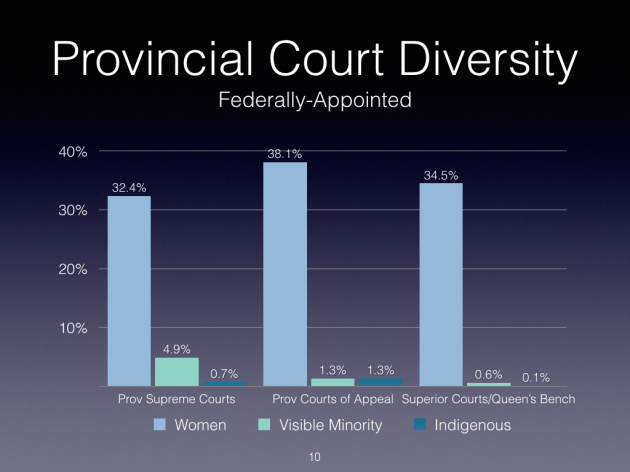
Judicial Diversity 2016 - DRAFT.010Figure 2

The picture for provincially nominated judges to provincial and territorial courts (figure 3) varies by province, but overall the provinces resemble each other in their under-representation of these groups. The Atlantic provinces, with the exception of Nova Scotia, have no visible minority or Indigenous judges. In the North, despite the large Indigenous population, there are no Indigenous judges. Quebec has relatively few visible minority judges and no Indigenous judges. Saskatchewan and Manitoba, despite their large Indigenous populations, have relatively few Indigenous judges.
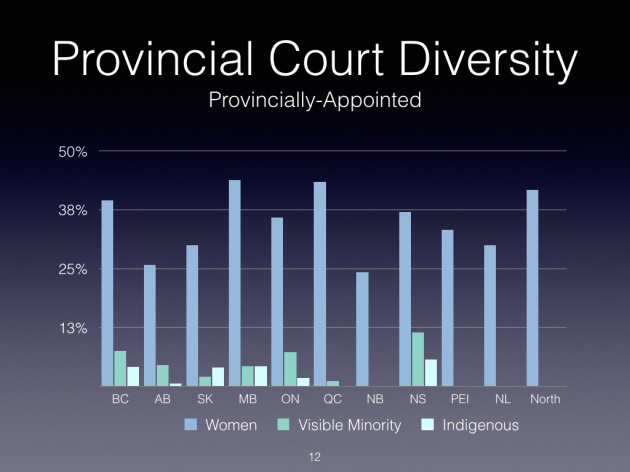
Judicial Diversity 2016 - DRAFT.012Figure 3

In the next series of charts federally and provincially appointed judges are compared for each under-represented group, by province, starting with women (figure 4). Here there is no overall trend: the federal and provincial appointment of women is similar in British Columbia, Manitoba, Nova Scotia, and Newfoundland and Labrador; in Saskatchewan, Quebec, Prince Edward Island and the North, provincial appointment of women is higher; and in Alberta the appointment of women is significantly lower, given the relatively large share of part-time and supernumerary appointments that are men (about a third of full-time judges are women).
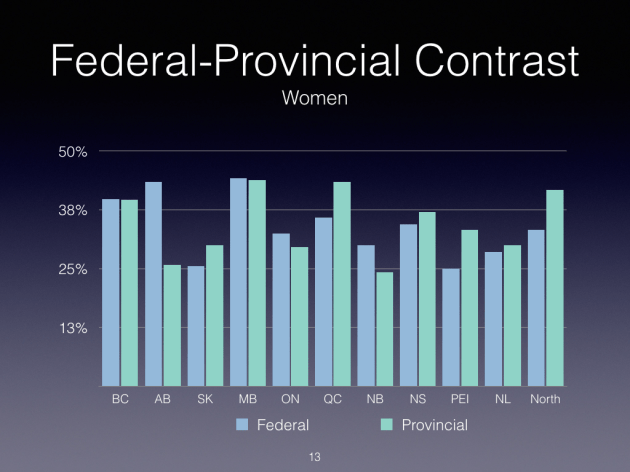
Judicial Diversity 2016 - DRAFT.013Figure 4

Looking at visible minorities (figure 5), when we compare federal and provincial appointments by province, we see a trend in all provinces except Saskatchewan: provincial judicial appointments are more representative of their populations than federal nominations, although visible minorities are still significantly under-represented.

Judicial Diversity 2016 - DRAFT.014Figure 5

Lastly, with respect to Indigenous appointments (figure 6), we see the same pattern: provincial appointments are more representative of provincial populations than federal appointments in all provinces and territories, except, surprisingly, in the North, where there are no Indigenous territorial judges.

Judicial Diversity 2016 - DRAFT.015Figure 6

Looking at senior judges (chief and associate-chief justices), there are no federally appointed visible minority or Indigenous judges, and there are only a handful number of provincially appointed senior judges (figure 7).

Judicial Diversity 2016 - DRAFT.011Figure 7

While judicial diversity is low, particularly for visible minorities and Indigenous people, the number of visible minority lawyers continues to increase. Figure 8 presents the proportions of visible minority lawyers aged 25-64 Canada-wide and in the largest provinces, which gives an idea of the size of the pool that can be drawn from. Given that visible minorities are, in general, younger than the general population, visible minority lawyers are also likely to be younger and, therefore, the percentage who would be aged 45 years old or older, the usual age people are considered for these positions, would be lower.
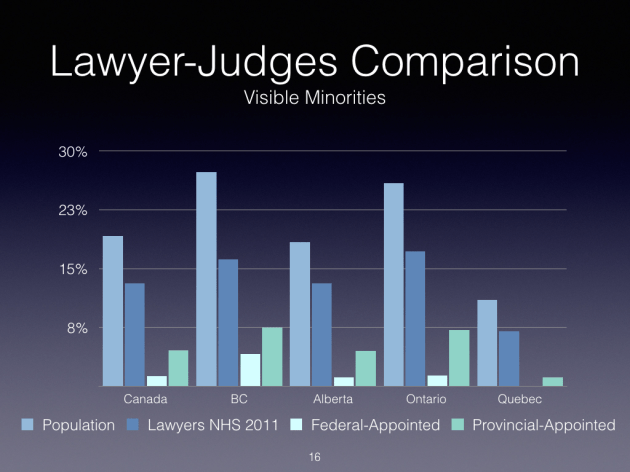
Judicial Diversity 2016 - DRAFT.016.pngFigure 8

As part of its review of the judicial appointment process, the Office of the Commissioner for Federal Judicial Affairs should expand the existing information on the gender of judges and include visible minorities and Indigenous people. With this information, the government could be held to account for its diversity and inclusion commitments, and it would be easier to track its progress over time.

The provinces and territories that do not already do this should do so, and they should use Ontario’s annual reports on appointments as a model, ensuring that the annual reports cover the overall diversity of the entire bench.

*A few notes on methodology. The federal government publishes statistics on gender but not on visible minority or Indigenous appointments. All provinces except Alberta and Saskatchewan indicate gender through the use of “Mr.” or “Madam” justice (the departments of justice provided the number of women judges). Gender information is thus complete.

To identify visible minority and Indigenous origin name checks, appointment announcements and, when available, photos and biographies were used. All provincial judicial councils or departments of justice were approached (only Ontario reports publicly but Saskatchewan, Quebec and Nova Scotia provided the breakdowns used). The Canadian Bar Association, national and regional branches, and law societies were approached and a number of individual lawyers also helped improve the quality of the data collected. I believe this provides a reasonable assessment of current diversity.
The taint of anti-Semitism from Europe’s left: Ian Buruma

Good piece by Buruma:

When the state of Israel was founded in 1948, the Soviet Union and leftists in general were sympathetic. For several decades, socialists of Russian and Polish extraction dominated Israeli politics. Zionism was not yet regarded as a noxious form of racism, along with apartheid in South Africa. Things began to change in the early 1970s, after the occupation of the West Bank and other Arab territories. Two intifadas later, the Israeli left finally lost its grip, and the right took over.

Israel became increasingly associated with the very things leftists had always opposed: colonialism, oppression of a minority, militarism and chauvinism. For some people, it was perhaps a relief that they could hate Jews again, this time under the guise of high-minded principles.

At the same time, and for much the same reasons, Israel became popular on the right. People who might have been fervent anti-Semites not so long ago are now great champions of Israel. They applaud the Israeli government’s tough line with the Palestinians. Israel, in a common right-wing view, is a bastion of “Judeo-

Christian civilization” in the “war against Islam.”

It is remarkable how often the old anti-Semitic tropes turn up in the rhetoric of these cheerleaders for Israel. But this time it is Muslims, not Jews, who are the target. Muslims in the West, we are repeatedly told, can never be loyal citizens. They always stick to their own kind. They will lie to people outside their faith. They are naturally treacherous, bent on world domination. Their religion is incompatible with Western values. And so forth.

The genuine threats coming from a violent revolutionary movement within the Islamic world can make such assertions seem plausible. But, in most cases, they should be recognized for what they are: tired old prejudices meant to exclude an unpopular minority from mainstream society. Islamist violence only helps to boost the politics of hatred and fear. Many Western warriors in the so-called war against Islam are nothing but modern-day anti-Dreyfusards.

None of this excuses the vile language of Mr. Livingstone and others like him. Left-wing anti-Semitism is as toxic as the right-wing variety. But the role of Israel in Western political debate shows how prejudices can shift from one group to another, while the underlying sentiments remain exactly the same.

Source: The taint of anti-Semitism from Europe’s left – The Globe and Mail

Politician’s cancelled visit causes tension in Indo-Canadian communities

I think the existing policy, implemented under the Conservatives, is preferred rather than reinforcing political attachment to countries of origin:

The planned visit of an Indian politician to Canada to campaign to non-resident Indians and its ensuing cancellation has caused tension in Indo-Canadian communities.

Amarinder Singh of the Punjab Pradesh Congress Committee had planned to visit Canada to hold rallies and events in the GTA and Vancouver, according to news reports out of India, but cancelled the visit after a complaint was made by a human rights group called Sikhs for Justice to Global Affairs Canada and the Indian High Commission in Canada.

Mr. Singh instead interacted with Indo-Canadians and non-resident Indians—known as ‘NRIs’—via Skype.

When asked about the Canadian government’s involvement in the re-routing of Mr. Singh’s North American political tour, foreign ministry spokesperson Francois Lasalle pointed to a government policy banning political campaigning by foreigners, and wrote in an email that “Global Affairs Canada has made this policy very clear to all foreign missions in Canada (including bringing it to the attention of the Indian High Commission in Ottawa) and will continue to do so.”

Canada’s government enacted a policy in September 2011 that reads “the Government of Canada will continue to refuse requests by foreign States to include Canada in their respective extraterritorial electoral constituencies. Also, the Department will not allow foreign governments to conduct election campaigns in Canada or establish foreign political parties and movements in Canada.”

Minister of Innovation, Science and Economic Development Navdeep Bains (Mississauga-Malton, Ont.) appeared to disagree with the government’s policy, saying that his constituents are engaged in international politics and that allowing politicians to visit communities is a matter of Charter rights.

“I think we have a very vibrant diaspora here in Canada that’s very engaged in domestic and international politics. I think we’re a country that supports a Charter. Freedom of expression, freedom of opinion, freedom of assembly. These are all Canadian attributes and we welcome any opportunity that politicians have when they want to come and engage with the diaspora, and I think that’s the message I heard from my constituents and that’s the message I relayed on to them,” he told The Hill Times.

Mr. Singh himself characterized the ban on his political action in much the same way, writing a letter to Mr. Trudeau on the matter. “It feels like a gag order that has left a very bad taste,” he wrote, according to a report from India Today.

Source: Politician’s cancelled visit causes tension in Indo-Canadian communities |

The black people in the Middle of Nowhere: The lost community of Amber Valley, AB

Good piece on the history of Amber Valley and its Black community:

Of course, 1909 Canada was no beacon of racial tolerance — as evidenced by the simple fact that Ottawa didn’t allow a second Amber Valley to take root.

In the era of the Chinese Head Tax and the Komogata Maru, it was clear that the government of Prime Minister Wilfrid Laurier made no bones about keeping out non-white immigrants. The only reason nobody had bothered to explicitly keep out blacks was because nobody in Ottawa could conceive of black people wanting to live in the Siberia-like climate of Alberta.

But it only took a surprise trainload of Oklahomans to spawn a nationwide flurry of petitions and letters demanding that the borders be closed to black immigration.

“This board of trade views with very serious concerns the influx of Negro settlers into Central Alberta,” read a 1911 petition by the Calgary Board of Trade.

If left unchecked, claimed the Calgarians, the tide of American blacks would have a “disastrous influence upon the welfare and development of this fair province.”

The basic objection was fear of a black Canada. The United States at the time had 10 million black citizens, and many in white America all too willing to see them disappear over the Canadian border. At the time, a Vancouver newspaper even published an interview with a Oklahoma immigration agent who was reportedly promising to “put a nigger and a team of horses on every quarter section of land I can get my hands on.”

Ottawa feared a black takeover of the plains that could overwhelm Canada’s existing 7 million population. By 1911, Canadian diplomats had effectively kiboshed any future Amber Valleys by warning would-be U.S. pioneers that “the American Negro may be barred on the ground that he could not become adapted to the rigorous northern climate.”

Tristin Hopper

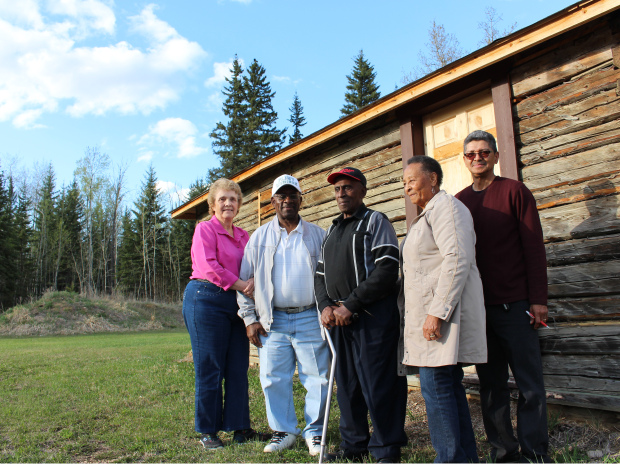
Tristin HopperThe children of Alberta’s black pioneers standing in front of the preserved Amber Valley cabin of Romeo Edwards, April 30, 2016. From left to right, Edith Edwards, brothers Elmer and Ken Edwards, Joyce Edwards and Gilbert Williams. With the exception of Edith, who grew up nearby, all four were born and raised in Amber Valley.

As with so many Western pioneer settlements, Amber Valley’s heyday was shortlived. Born-and-raised Amber Valleyans started striking out for the list of Calgary, Edmonton and Winnipeg by the 1940s, and as parents died the original homesteads were sold.

Source: The black people in the Middle of Nowhere: The lost community of Amber Valley, AB

Gaps in Ottawa’s detection of citizenship fraud, auditor finds

I did not find this OAG study all that surprising, particularly the challenges of maintaining accurate and consistent database records (e.g., spelling of addresses) and the lack of consistent follow-up to any cases flagged.

One of the lasting legacies of the Conservative government was increased attention to the integrity of the program, beyond the issues identified in the OAG report (e.g., rotating citizenship test questions, more rigorous and consistent language assessment, and the integrity measures of C-24).

But like many OAG reports, it is weak with respect to the materiality of fraud and the gaps it uncovered.

Six addresses out of 9,778 that IRCC officials missed is 0.06 percent. Other aspects are more problematic, multiple versions of addresses in particular, as well as lack of follow-up to warning flags and coordination between IRCC and RCMP or CBSA.

IRCC’s own number of revocation cases pending is 700, again a relatively small number (0.14 percent) compared to  the large numbers of new citizens in the past two years (500,000). And of course there is no comparative data in the report on permanent residency, EI, CPP or other program fraud to relate compare these numbers with.

So while any fraud is by definition unacceptable, the realities of large programs means that some degree, as small as possible, is inevitable, and ongoing attention to reducing its incidence is necessary:

Canada’s immigration department did not properly detect and prevent citizenship fraud, resulting in the review of some 700 citizenship cases as of January, according to Auditor-General Michael Ferguson’s spring report.

The report, tabled in the House of Commons Tuesday morning, found a number of concerns in the citizenship program affecting the department’s capability to prevent citizenship fraud, including the absence of a method to identify and document fraud risks.

“We concluded that Immigration, Refugees and Citizenship Canada’s (IRCC) efforts to detect and prevent citizenship fraud were not adequate,” said Mr. Ferguson in a prepared statement. “These gaps make it difficult for Immigration, Refugees and Citizenship Canada to assess the impacts of its efforts to combat citizenship fraud.”

…According to the report, the most common reasons for revoking citizenship are residency and identity fraud, and undeclared criminal proceedings.

The report found that citizenship officers did not consistently apply their own methods to identify and prevent fraud when dealing with suspicious immigration documents, such as altered passports. For example, in one region, citizenship officers did not seize any suspicious documents for in-depth analysis since at least 2010, while they did in another.

It was also found that citizenship officers did not have the information they needed to properly identify “problem addresses” when making decisions to grant citizenship. Problem addresses are those known or suspected to be associated with fraud, and used by citizenship applicants to meet residency requirements for citizenship.

“For example, one address was not identified as a problem even though it had been used by 50 different applicants, seven of whom were granted citizenship,” said Mr. Ferguson.

The problem was further complicated by poor sharing of information with the RCMP, which provides information about criminal behaviour among permanent residents, and the Canada Border Services Agency, which leads investigations of immigration fraud, said the report.

While the department did not track the exact number of citizenship fraud risks, it reported 700 pending revocation cases as of January. According to the report, revoking citizenship after fraud is discovered is “time consuming and costly.”

Source: Gaps in Ottawa’s detection of citizenship fraud, auditor finds – The Globe and Mail,

Dozens of fraudsters and suspected criminals became Canadian citizens, watchdog says in damning report

Liberals order investigation into possible citizenship fraud

C-6 Citizenship Act: Clause-by-clause review (updated)

No major surprises as CIMM reviewed the draft bill. The NDP tabled 25 amendments, the Conservatives three, and Elizabeth May eight.

The Conservatives noted their objections to the reduced residency requirements, the repeal of the intent to reside provision, the reduction in knowledge and language testing to 18 to 54 from 14 to 64, and revocation in cases of terror or treason. They also tabled an amendment having a five-year review provision (not part of the Conservatives’ C-24) which the Government-side voted down.

The Bill was approved, with a few minor amendments, largely on party lines, and will be reported to Parliament.

Amendments passed:

Clause 1

That Bill C-6, in Clause 1, be amended by adding after line 6 on page 3 the following:

“(13) Subsection 5(4) of the Act is replaced by the following:

(4) Despite any other provision of this Act, the Minister may, in his or her discretion, grant citizenship to any person to alleviate cases of statelessness or of special and unusual hardship or to reward services of an exceptional value to Canada.”

That Bill C-6, in Clause 1, be amended by adding after line 6 on page 3 the following:

“(13) Section 5 of the Act is amended by adding the following after subsection (3):

(3.1) For the purposes of this section, if an applicant for citizenship is a disabled person, the Minister shall take into consideration the measures that are reasonable to accommodate the needs of that person.”

The discussed amendments included:

Admissable

Citizenship applications by youth (under 18, NDP and CPC): Government side voted this down, arguing that Minister had adequate flexibility to waive requirement when merited.

Submission of tax returns (CPC): Richard Kurland’s recommendation to clarify the language in the Act to make it a requirement to file taxes when applying..

Accommodation for persons with disabilities (NDP): Discussion focused on existing accommodation practices, whether this also covered invisible disabilities such as cognitive or learning disabilities and whether or not existing practices and legislation like the Canadian Human Rights Act were adequate. In end, CIMM adopted unanimously to send stronger signal.

Youth criminality (NDP) and not allowing youth criminal records to be considered for citizenship: Defeated with government arguing that existing protections – serious charges, free from record for four years – were appropriate rather than wholesale ban.

Knowledge and language test (allowing interpreter for knowledge – NDP): Government stated that the knowledge test was specified in the Act. The review of Discover Canada, including its language level, would make it easier for people. However, language was critical to integration and the Government defeated the amendment.

Inadmissible (outside scope of C-6)

Restoration or creation of an appeal process in cases of revocation for fraud or misrepresentation (NDP): Although out-of-scope, the NDP noted the earlier signals of the Minister with respect to being open to reviewing the issue and expressed hope that the Minister would come back in the fall, recommending an expansion of the Immigration Appeal Division’s role to include citizenship revocation cases (for fraud or misrepresentation).

Statelessness and remaining ‘Lost Canadians’ (NDP): One of the few statelessness amendments to be considered admissible was in relation to revocation in cases of fraud or misrepresentation. Defeated. However, an amendment providing the Minister with greater discretion was passed.

Changes in oath to include TRC recommendation 94 (reference to treaties with Indigenous peoples (NDP)

Ability to suspend application processing indefinitely (NDP)