#Citizenship Act C-6 Changes: Hearings Start April 12

The first Citizenship and Immigration Standing Committee hearing took place April 12. The Minister made a summary introduction to allow more time for questions (and given he was somewhat late).

The Minister did indicate in his responses to questions that while his focus was on implementing platform and mandate letter commitments, he made the general point that he was open to considering amendments in response to the NDP’s question regarding the lack of judicial hearings in cases of revocation for misrepresentation.

Government-side questions were a mix of softball (e.g., time for C-6 to be implemented) and those that likely reflected constituent concerns with respect to knowledge and language testing, along with some that probed the rationale for certain policy choices (e.g., 3 year minimum residency rather than 2). Some MPs were better at having internalized their questions, others stuck more closely to their written material.

Surprisingly, the proposed repeal of citizenship revocation for terror or treason received comparatively little attention from the Conservatives, with the Conservative immigration critic (Michelle Rempel) focussing on the elimination of language assessment for 55-64 year olds and the possible impact on the economy, leaving it to another Conservative to question the proposed repeal, mentioning the restoration of citizenship to the convicted terrorist Zakaria Amara,  (“a terrorist is a terrorist is a terrorist”).

The Minister made his standard reply: all Canadians, whether sole or dual nationals, should be treated the same (“a Canadian is a Canadian is a Canadian”), and that the Canadian legal and penal systems were more appropriate ways to deal with terrorists.

My summary notes:

Language: No disagreement among all parties on the importance of language competency to integration and citizenship. The Conservatives focussed on the reduced age requirements to 18-54 from 14-64 and the possible impact that would have on labour market participation and outcomes. They suggested a better approach was more emphasis on language training.

The Conservatives also asked whether any economic analysis had been done on the impact of this change for 55-64 year olds and the answer was no, the Minister retorting that none was carried out when the Conservative government increased the requirement. The Minister also responded that the number of 55-64 year olds was 8 percent of the number of applicants  (data provided to me by IRCC for earlier years shows a smaller number but they may have used 2014-15):
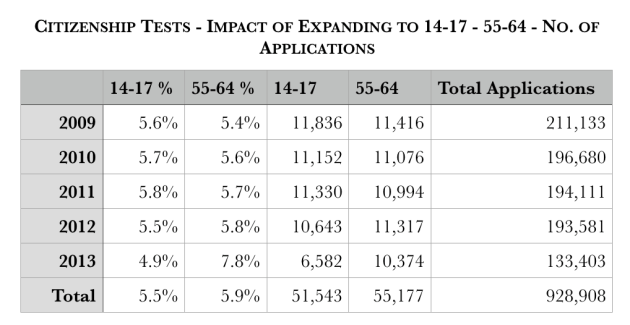
Citizenship Test Age Change ImpactSurprisingly, the Conservatives spent some time on the younger cohort affected (14-17 year olds) despite the fact that they would have all (or virtually all) been in school for 3-5 years and thus be competent in English or French (I always suspected this was a ‘backdoor’ way to ensure civics education).

The NDP focused more on the level of resources for language training, citing examples of reduced funding and wait times. The response was to emphasize the current high levels of funding for language training and additional funding for Syrian refugees. They also asked a number of technical questions regarding the level of language required (CLB-4 – basic).

Some Liberals noted that some constituents worried about the citizenship test, particularly the 55-64 year olds and asked how many people are likely to apply without the test and these worried. Officials replied that it is difficult to isolate factors, there were a number of reasons, including some dual citizens may not want Canadian citizens, but referred to the historic 85 percent naturalization rate (recent rate is significantly lower).

Knowledge test: There were a number of questions regarding the knowledge test and what happened when an applicant failed. The Minister and officials noted that the first time pass rate was 87 percent. Those who failed could write the test a second time, boosting the overall pass rate to slightly above 90 percent. Those who failed a second time could have a hearing before a judge, leading to another few percent to the overall rate. Subsequently, officials noted that typically the time to retake the test is between 2-4 weeks.

The NDP also noted some of the difficult and ‘tricky’ wording of the knowledge questions. The Minister acknowledged the point and stated that the revised citizenship guide would be written in a manner to be more comprehensible to more people.

Citizenship guide: Liberal side asked questions of planned revising of citizenship guide and degree to which the Charter would be emphasized and questions regarding religious rights. Officials noted that much of the content of the guide is prescribed by regulations (history, society, rights and responsibilities).

Physical presence requirement: Raised by Liberal MPs for cases of those working overseas with families in Canada, the Minister reiterated that citizenship required physical presence, that we did not want ‘citizens of convenience’ acknowledging that there were some hardships but nevertheless maintaining the requirement.

Fees: The NDP raised the issue of the steep increase of fees in 2014/15: from $100 to $530. Minister responded by saying that neither the platform nor mandate letter referred to fees but that he did not preclude looking at fees in the future.

Revocation (misrepresentation): The NDP raised the removal of judicial review as noted by the CBA, leaving revocation at the discretion of  the Minister. The Minister responded by stating that the Committee would hear from the CBA and that he was open to amendments in this area.

Processing times/Service standards: Liberal members raised the issue of processing times. The Minister gave credit to the previous government for a number of measures that have allowed IRCC to meet a processing time of 12 months (later officials indicated this was with respect to 80 percent of complete applications as of 1 April 2015 – incomplete ones are not counted).

International students pre-permanent residency credit: Minister reiterated measure to restore 50 percent credit for pre-permanent residency time for international students and also review possible improvements to Express Entry to make it easier for students, something that he intended to do that was not in his mandate letter. Some government members asked whether consideration would be given to more than 50 percent with the response being that 50 percent was deemed to be reasonable.

Refugee pre-permanent residency time: Chair asked whether consideration would be given to granting pre-permanent residency time to refugees or humanitarian cases. Officials noted that credit was only provided once refugees had been confirmed as protected persons and Minister added as general principle, government should not credit illegal time in Canada, only legal.

Lost Canadians: NDP raised that there were remaining cases and that the first generation limit remained an issue. IRCC officials explained the provisions of prior legislation (C-37 and C-24), that avenues were available for particular cases not addressed along with stateless persons.

Seizure of documents in cases of fraud. Conservatives asked for examples and officials indicated passports with entry and exit information. There were questions regarding the degree to which officials would have discretion with officials replying that this would be based on ‘reasonable grounds,’ with the details to be spelled out in regulations.

There was a long side discussion on the legitimate issue raised by the Conservatives regarding changes in the way that MP citizenship (and immigration) enquiries were going to be handled compared to the earlier direct channel of the Ministerial Enquiries group, leading to a Conservative motion, supported by the NDP, that officials brief the Committee prior to C-6 moving forward. Defeated on party lines although the request for a briefing (if not the timing, holding C-6 hearings in abeyance) appeared reasonable.
Komagatu Maru Apology

This has been a long-standing issue for many in the Indo-Canadian community, particularly Sikh Canadians. Reading the announcement, reminded me of the previous attempt by former Prime Minister Harper to do so at an Indo-Canadian community picnic on 3 August 2008.

It was a “drive-by” apology, to use my irreverent words, given that the PM and his party had to beat a hasty retreat after one activist seizing the mike and denouncing the fact that it was not delivered in Parliament. See Harper apologizes in B.C. for 1914 Komagata Maru incident, CBC, 3 August 2008.

My takeaway from that incident (I was present) was that any apology, if made, should be done in the House of Commons (as was the case for Japanese wartime internment, the Chinese head tax and residential school abuse). Any other approach made the community being apologized to feel second-rate, as was the case with Italian Canadian wartime restrictions (former PM Mulroney delivered an apology at a dinner) or the above case of the Komagata Maru).

So while there will be predictable debate about whether an apology is warranted, the House is the appropriate forum.

An Indo-Canadian friend of mine reminded me that neither the Government of India or Britain have ever apologized for opening fire on the ship and killing passengers.

Will be interesting to see if Italian Canadians continue to press for a formal House apology.

Text of the PM press release:

The Prime Minister, Justin Trudeau, today announced that on May 18, 2016, he will make a formal apology in the House of Commons for the Komagata Maru incident.

This year will mark the 102nd anniversary of the Komagata Maru incident, where 376 passengers of mostly Sikh descent arrived in Vancouver and were refused entry into Canada due to the discriminatory laws of the time.

The Prime Minister made the announcement at Vaisakhi on the Hill concluding a three day religious ceremony, where Sikh scriptures were read continuously to commemorate Vaisakhi.

Quotes

“As a nation, we should never forget the prejudice suffered by the Sikh community at the hands of the Canadian government of the day.  We should not – and we will not.”
– Rt. Hon. Justin Trudeau, Prime Minister of Canada

“An apology made in the House of Commons will not erase the pain and suffering of those who lived through that shameful experience.  But an apology is not only the appropriate action to take, it’s the right action to take, and the House is the appropriate place for it to happen.”
– Rt. Hon. Justin Trudeau, Prime Minister of Canada

And the full remarks of the PM at the Vaisakhi ceremony on the Hill:

This year will mark the 102nd anniversary of the Komagata Maru incident where 376 passengers of mostly Sikh descent arrived in Vancouver and were refused entry to Canada due to the discriminatory laws of the time. The passengers of the Komagata Maru like millions of immigrants to Canada since were seeking refuge and better lives for their families. With so much to contribute to their new home, they chose Canada and we failed them utterly. As a nation, we should never forget the prejudice suffered by the Sikh community at the hands of the Canadian government of the day. We should not and we will not. That is why next month, on May 18, I will stand in the House of Commons and offer a full apology for the Komagata Maru incident.

An apology made in the House of Commons will not erase the pain and suffering of those who lives through that shameful experience, but an apology is not only the appropriate action to take, it’s the right action to take and the House is the appropriate place for it to happen. It was in the House of Commons that the laws that prevented the passengers from disembarking were first passed and so it’s fitting that the government should apologize there on behalf of all Canadians. It’s what the victims of the Komagata Maru incident deserve and we owe them nothing less.

Just as we look back and acknowledge where we’re failed, so too do we need to celebrate the remarkable success of the Sikh community here in Canada and Vaisakhi is the perfect opportunity to do just that. April is a special month, not only for Sikhs but for all Canadians. It marks the anniversary of the adoption of the Charter of rights and freedoms which ensures that no Canadian needs to make the choice between their religion and activities in their day-to-day lives. The charter ensures that the five Ks are protected. As Canadian Sikhs gather with their loved ones to mark the creation of the Khalsa, it’s a chance to reflect on shared values and celebrate the successes of the past year.

What Justin Trudeau said today about the Komagata Maru incident

Federally appointed courts grow restive as Ottawa slow to fill vacancies

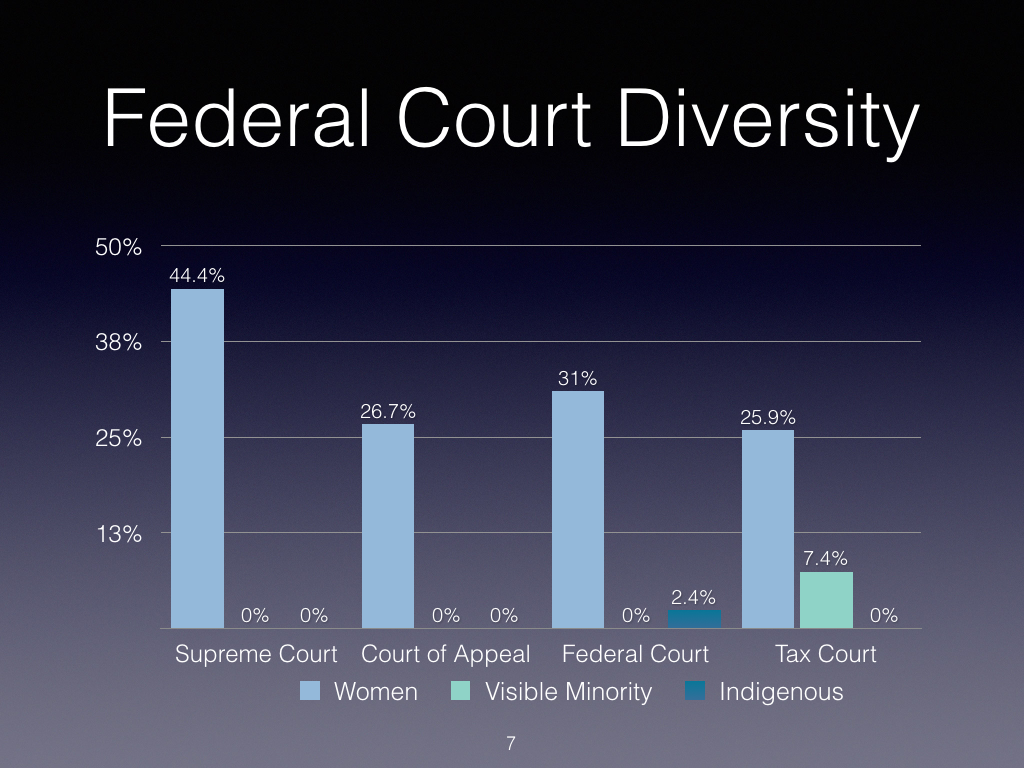
Judicial Diversity 2016 - DRAFT.001Good piece by Sean Fine of the Globe on the questions around new processes of judicial appointments.

I am currently in the process of analyzing the diversity of current federally and provincially appointed judges (preliminary federal court numbers in above chart) and hope that as part of the process review, the Government will commit to diversity statistics for visible minorities and Indigenous Canadians (some provinces already do this with respect to provincial court judges):

Ms. Wilson-Raybould would not commit to a starting date for appointments when she spoke to the judicial council, said an Alberta lawyer with knowledge of the meeting. “The government is considering the full scope of the appointments process, including the composition and operations of the Judicial Advisory Committees,” a spokeswoman for the minister said in an e-mail to The Globe.

“Any potential changes will be examined in light of the government’s objectives to achieve transparency, accountability and diversity in the appointments process and they will be carefully considering how best to achieve this goal, taking into account views of key stakeholders and interested Canadians in this regard.”

The appointments process is not up and running yet. And Ms. Wilson-Raybould has made little progress toward putting a new process in place – having not even begun consultations with the legal community and leaving a critical position unfilled.

At the system’s foundation are 17 judicial advisory committees – eight-member groups that screen candidates for federally appointed courts such as provincial appeal and superior courts, the Federal Court and the Tax Court. Several of these committees have no members at all – two of Ontario’s three committees, both of Quebec’s, plus all four committees in Atlantic Canada.

The Alberta committee, however, has all eight of its members, and met as recently as mid-March to recommend candidates for the bench, Chief Justice Wittmann said.

“Nobody is against reform if it betters the system,” he said, “but you can’t change locomotives and stop the train; the train’s got to keep running while you’re doing it.”

Criminal and civil trials that need more than five days are being scheduled for “well into 2017,” Chief Justice Wittmann said. “If the public through their elected representatives say that’s fine, well, I guess it’s fine. But there seems to be an expectation that it’s not fine.”

For the court’s judges, “it increases their stress and their sense of helplessness, because they can’t handle everything they’re asked to do. The public thinks they’re not getting the access they’ve come to expect. We cannot sacrifice quality to increase the quantity of cases that we process. It just can’t work that way.”

Ms. Wilson-Raybould has yet to discuss the system’s pressing questions with the legal community: what to do about the changes to the process that the former Conservative government put in place, whether to commit to gender parity in judicial appointments, and whether to begin tracking the numbers of visible minority and aboriginal applicants.

Source: Federally appointed courts grow restive as Ottawa slow to fill vacancies – The Globe and Mail

Key Question on U.S. Citizenship Test Changed — Charisma News

While the US Citizenship and Immigration Services likely had to make this ruling, it appears that the complainant wants religious rights to trump other rights, as seen in many of the US state initiatives against LGBT and other rights:

At issue was a segment of the exam’s study guide that suggested the First Amendment protects the citizens’ right to “freedom of worship,” rather than freedom of religion. Lankford, who is co-chairman of the Congressional Prayer Caucus and the first senator to join it, first learned of the incorrect wording in June of last year, which prompted a letter to CIS Director Leon Rodriguez.

Lankford explained his issue with the wording again Friday in his announcement applauding the change:

“At first glance, it appears like a small matter, but it is actually an important distinction for the Constitution and the First Amendment. The ‘freedom of religion’ language reflects our right to live a life of faith at all times, while the ‘freedom of worship’ reflects a right simply confined to a particular space and location.”

In a letter sent to Lankford’s office Friday, Rodriguez explained the reversal, saying that “upon further consideration,” CIS determined the change could be made because it didn’t involve adding or deleting content. Approximately 40 web-based and printed materials will be changed as a result of the decision.

“In accordance with agency policy, if the applicant’s answer to a civics question is ‘an alternative phrasing of a correct answer,’ U.S. Citizenship and Immigration Services officers will continue to accept both ‘freedom of religion’ and ‘freedom of worship’ as correct answers to question 51 when administering the naturalization exam,” Rodriguez wrote.

Question 51 reads, “What are two rights of everyone living in the United States?” The study guide originally offered the following correct answers:

  • freedom of expression,
  • freedom of speech,
  • freedom of assembly,
  • freedom to petition the government,
  • freedom of worship and
  • the right to bear arms.

The study materials will now read ‘freedom of religion’ as the correct response. Based on reprinting schedules, they expect all materials to be updated by the end of 2016.

“I applaud the Department of Homeland Security for listening to me and deciding to change their material to reflect our First Amendment right of freedom of religion,” Lankford said after receiving the notification. “We live in a great nation that allows individuals to live out their faith, or have no faith at all. To protect freedom and diversity, we must carefully articulate this right throughout the federal government.”

Source: Key Question on U.S. Citizenship Test Changed — Charisma News

Indo-Canadian women give birth to far more boys than women born in Canada

Interesting and disturbing study:

The research, presented in the Canadian Medical Association Journal and the online CMAJ Open, looks at more than 6 million births in Canada and reveals that a greater presence of boys among Indian-born mothers may in part be linked to abortions in the second trimester, when parents can learn the baby’s sex.

The birth data was compiled from databases administered by Statistics Canada and the Institute for Clinical Evaluative Sciences in Toronto between 1990 and 2011, and 1993 to 2012, respectively.

“The main implication is that among some immigrant communities, males are placed at a higher value than females. This is not just about abortions, it is about gender equality,” said lead author Marcelo Urquia of St. Michael’s Hospital. “I hope that this is conducive to a respectful debate on the value of girls and women in today’s Canadian society.”

His study newly exposes a relationship between induced abortions and the previously reported large numbers of boys among Ontario’s Indian community, said Urquia, noting the data likely explains an imbalance in the rest of Canada too. Some of the “deficit” of girls may be due to “implantation of male embryos,” said Urquia, but the data is insufficient.

While the natural odds of having a boy over a girl are slightly higher, they are consistent across the globe: up to 107 boys for every 100 girls. But Indian-born mothers living in Canada with two children had 138 boys for every 100 girls. In Ontario, that number inflated even more among Indian-born women with two daughters, who then gave birth to 196 boys for every 100 girls.

After abortions, the numbers rise dramatically: 326 boys after one abortion, 409 boys after multiple abortions, and 663 boys for every 100 girls following multiple abortions in the second trimester, when doctors can determine the sex of the fetus.

Miscarriages, or spontaneous abortions, were not linked to the births of more boys, the study found.

The implication is that the disproportionate ratios are a result of “sex discrimination fuelled by son preference” among people from Asian countries, particularly India, whose immigrants have the highest documented male to female ratio in the world, the study says. The new research focuses on immigrants from India as they contribute the most to immigrant births in the country, though disproportionate male births have been observed in other communities as well. The research found an imbalance among Chinese immigrants, but this could not be linked to abortion.

Data did not indicate how long Indian immigrants had lived in Canada and whether that impacted the sex ratio. Nor did it indicate what country the baby’s grandparents were from. These are questions for future research, said Urquia.

“We are currently looking at whether the skewed sex ratios diminish with time after immigration. The idea is that exposure to a more gender equal environment, such as Canada, will result in placing more value on females over time,” he said.

With this new research, it’s no longer a question of whether prenatal sex discrimination exists. It is evident over the last two decades across Canada. The “real question,” said researcher Abdool S. Yasseen III in a published commentary on the studies, is “why this practice persists, particularly in a Canadian society that espouses sex equality.”

For Baldev Mutta, CEO of Brampton’s Punjabi Community Health Services, it’s a question he and other community leaders will have to face. With this new research, he says, it is “time for some soul searching,” in the country’s Indian community.

Source: Indo-Canadian women give birth to far more boys than women born in Canada | Toronto Star

We’re Making the Wrong Case for Diversity in Silicon Valley: Pittinsky HBR

A different take than the usual narrow business case for diversity in favour of one that looks at organizational culture and societal benefits:

One of the most compelling reasons for aspiring to workplace diversity is the self-evident social good it brings: fairness, opportunity, and a society that appreciates and enjoys its natural diversity rather than constantly struggling to accommodate and negotiate it. Remember that throughout the 1950s and 1960s having few African Americans, few Latinos, few Asian Americans, and few white women in management and professional ranks didn’t keep U.S. businesses from creating the most successful economy on earth. But it was a problem for members of those groups and for our society. The conditions needed to be corrected for their own sakes. And, of course, there is still a lot of correcting to do.

Interestingly, the social case for diversity does become a business case when one is willing to look ahead to the longer term. The more the members of an organically diverse society enjoy that diversity and see the visible benefits of investing in shared prosperity and the common good, the more secure and resilient that society will be — possibly not at a given moment, but in the long run. Over a span of decades, a safe and resilient society is very good for business. Here in the United States, this stability goes a long way toward explaining why this country has been such an economic success. And around the globe, research finds that countries with greater social cohesion experience greater economic growth. But this is a long-term and diffuse effect, not a clear boost to anyone’s bottom line this quarter, or even the next.

A More Accurate Business Case for Diversity

Although diversity alone does not increase company profitability in the near term, there is a lot to be gained by investigating the conditions under which it does help. That is, under what conditions does diversity lead not to “us versus them” or even “us and them” but rather to the more desirable, productive, and innovative outcome — “us plus them”?

Research is starting to address this question, pointing the way to a more accurate business case for diversity. Put simply, the negative emotions that tend to go along with bias — fear, anger, contempt, and the like — are damaging. Replace those feelings with positive emotions and we all will benefit. There are, for example, solid empirical research findings suggesting that group- and team-level innovation are more likely in the context of positive emotions. Both classic and more-recent research have found that positive emotions such as joy, interest, and anticipation broaden our awareness and encourage novel, varied, and exploratory thoughts and actions. Over time, this expanded behavioral repertoire helps us build skills and resources. In contrast, negative emotions prompt narrow and immediate behaviors. We narrow our focus to shut out distractions — which is important for survival in the wild but often counterproductive in business. In studies reported by Prof. Barbara Fredrickson, participants watched films that induced positive emotions such as amusement and contentment, negative emotions such as fear and sadness, or no emotions. Viewers who experienced positive emotions then showed more creativity, inventiveness, and big-picture perceptual focus. Taken together, these research findings suggest that because positive emotions make us more open and more creative, they help us discover and build together.

Can diversity encourage such positive emotions? Yes, it can. Although as a society we focus almost exclusively on the negative prejudices, frictions, and conflicts among social groups, research has also found that many individuals have not just a lack of prejudice but also positive feelings such as admiration, comfort, and kinship toward those who are different. Research also finds that leaders who hope to tap this positive power of difference must ferret out any negative prejudices and promote those positive feelings about members of other groups. A company that does so may then expect to find that its own workplace diversity, by encouraging positive emotions, is improving its capacity for innovation.

This is in line with the accumulating body of research confirming that organizational culture plays a key role in sustained innovation. My own research, for example, finds that when we measure the presence of allophilia — positive (not just tolerant) attitudes toward a group other than one’s own — in teams and organizations, we can better predict positive outcomes such as open communication, feelings of inclusion, mentoring across genders and ethnicity, and “bringing one’s whole self” to work. Such benefits are not predicted by a company culture of mere tolerance — that is, not minding the presence of other groups but not having particularly positive attitudes towards them either.

The Case for Patience and Results

Business leaders respect results, and rightly so. But pushing businesses, in Silicon Valley or elsewhere, to increase diversity for bottom line reasons, arguing that it inherently boosts innovation, won’t do. It’s too simplistic and too often just not true.

Instead, we should rely on science to tell us more about which diversity conditions prove productive and which counterproductive. We should be encouraged that positive attitudes such as allophilia and their positive results do exist and can be measured, monitored, and developed in organizations and other groups.

Finally, we should embrace diversity because it provides a foundation for a healthy society. If we can become more disciplined and precise in learning how to create and maintain it in the right ways, this will make for a more prosperous and productive economy in the future.


Todd L. Pittinsky is Professor of Technology & Society at Stony Brook University and a Senior Lecturer at Harvard University.

Source: We’re Making the Wrong Case for Diversity in Silicon Valley

How Talking To People Can Reduce Prejudice

Interesting example of how face-to-face conversations that help people understand the other’s experiences, and identify some commonalities, can make a difference:

After the dust settled [from a previously falsified study], Broockman and Kalla went on with their experiment on transgender prejudices. LaCour’s misconduct only made them more determined to do the study for real. “There were all these volunteers who gave their Saturdays [to do the experiment],” Broockman says. “We had a certain sense of responsibility.”

They sent out surveys to thousands of homes in Miami, asking people to answer questions that included how they felt about transgender people and if they would support legal protection against discrimination for transgender people. Then volunteers from SAVE, an LGBT advocacy organization based in Florida, visited half of the 501 people who responded and canvassed them about an unrelated topic, recycling. Volunteers went to the other half and started the conversations that Fleischer thinks can help change minds.

After the canvass, the study participants answered the same questions about transgender people that they had answered before the study, including how positively or negatively they felt towards transgender people on a scale of 0 to 100. Those who had discussed prejudice they’d experienced felt about 10 points more positively toward transgender people, on average.

Broockman says that public opinion about gay people has improved by 8.5 points between 1998 and 2012. “So it’s about 15 years of progress that we’ve experienced in 10 minutes at the door,” he says.

Three months after the canvass, Broockman asked participants to fill out the survey again. They still felt more positively about transgender people than those who had gotten the unrelated canvass. “[That’s] the moment I backed away from my monitor and said, ‘Wow, something’s really unique here,’ ” he says. If the effect persists, Broockman says, the technique could be used to reduce prejudice across society.

That doesn’t mean everybody came away feeling more positive about transgender rights. Kalla says some people came away from the canvasser feeling very differently and some people not so much at all. And an uptick in 10 points on a feeling scale of 0 to 100 doesn’t sound like an epiphany. There wasn’t, however, any indication that those who started out with very negative feelings about transgender people were particularly resistant to the conversation. Broockman and Kalla published the results in Science on Thursday.

It is a landmark study, according to Elizabeth Paluck, a psychologist at Princeton University who was not involved with the work. “They were very transparent about all the statistics,” she says. “It was a really ingenious test of the change. If the change was at all fragile, we should have seen people change their minds back [after three months].” There are very few tests of prejudice reduction methods, and Paluck says this suggests the Los Angeles LGBT Center’s approach is actually far more effective than previous efforts, like TV ads.

There might be a couple of reasons for that. Broockman, now an assistant professor of political economy at Stanford University, says asking someone questions face-to-face like, “What are the reasons you wouldn’t support protections for transgender people, or what does this make you think about?” gets them to begin thinking hard about the issue. “Burning the mental calories to do effortful thinking about it, that leaves a lasting imprint on your attitudes,” he says.

Empathy may also be a factor. “Canvassers asked people to talk about a time they were treated differently. Most people have been judged because of gender, race or some other issue. For many voters, they reflect on it and they realize that’s a terrible feeling they don’t want anyone to have,” Broockman says.

The study’s conclusions differ from the conclusions of the LaCour’s falsified study from 2014 in one crucial way, Broockman says. LaCour claimed that there was only an effect from the deep canvass if it came from someone who was LGBT. “We found non-trans allies had a lasting effect as well,” Broockman says. That means canvassing is much more about conversational skill rather than identity.

It will take more studies and replications of this study before scientists know exactly what is influencing people’s opinions. But for now, the findings are a relief to David Fleischer. “To go into it with high hopes and then get this really bad piece of news, then to go forward anyway and have the accurate results? What a roller coaster of emotions,” he says.

The technique might be used to target any societal prejudice — or be used to increase prejudice, Broockman acknowledges. But even if that happens, he says, it at least will encourage people to think deeply about the issues they’re going to vote on.

Source: How Talking To People Can Reduce Prejudice : Shots – Health News : NPR

Canada can do better on getting more women elected, 60th place in world right now

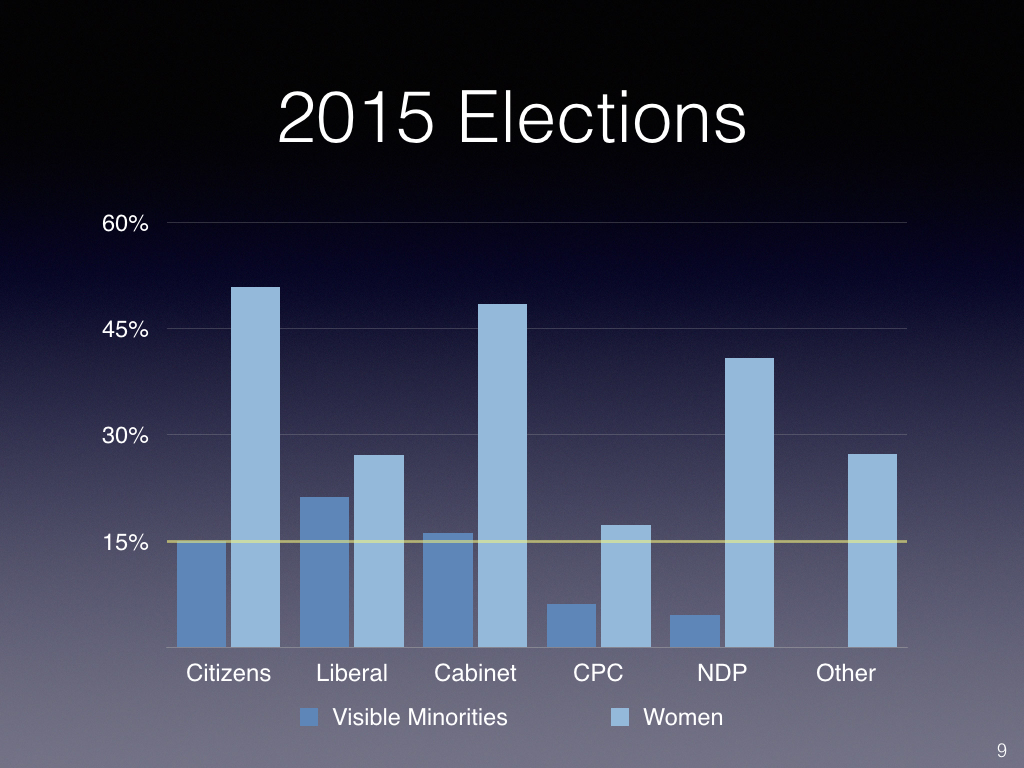
Election 2015 - VisMin and Foreign-Born MPs.002Nancy Peckford and Grace Lore of EqualVoice argue for a gender-based lens with respect to evaluating electoral reform proposals. Women who are now more under-represented than visible minorities, where all parties have made major and successful recruiting efforts:

But, it is crucial to understand that “proportional representation” is not one thing and neither is “women’s political representation.” Proportional representation systems vary widely in how individuals become candidates, how votes are cast, and how those votes are translated into seats. UBC political scientist Grace Lore, and EV’s senior researcher, has just finished a multi-country study of electoral systems in Europe and North America with a specific focus on their effect on women’s representation. The data from that research strongly reveals that while the number of women elected is an important indicator of success, so is the ability of these women to act to represent their constituents, including women.

In ‘closed list’ PR systems, parties determine a set list of pre-approved candidates and voters simply pick a party and, de facto, accept the list of candidates in the ordered that is proposed by the party. In ‘open list’ systems, voters have the opportunity to indicate preferences between candidates. In some countries that use open list proportional representation, voters can even indicate a preference for candidates from multiple parties. Like open list proportional systems, alternative vote systems give voters the chance to rank parties instead of just indicating their top choice.

These are not minor or mechanical details—they matter greatly to how one participates in the democratic process. The nuts and bolts of each system also shape the role of parties and the choices available to voters, including the possibilities for women’s political representation. Some features of electoral systems, whether based on proportional representation or not, lead to the election of a greater number of women, while potentially reducing women’s capacity to represent women’s and other interests once they are in office. Other features improve the power of individual women to have influence, but do not maximize the possibilities for the sheer number of women elected. Lore’s extensive research of electoral systems on two continents and 15 countries underscores that if women representatives are more beholden to a political party for their election (versus having a direct relationship with constituents), their lack of independence frequently prevents them from effectively advocating on behalf of other women.

In short, proportional representation is neither necessary nor sufficient to ensure women’s equal representation. Political culture matters significantly, i.e. voters and parties need to seek more women to appear on the ballot and create the conditions for their participation. More women also need to choose politics as the place to dedicate their time, energy, and skills. If we do not also tackle other systemic barriers, including inequality in access to political resources and the uncertainty of the nomination processes, we cannot count on this happening. These concerns can and should be part of the electoral reform discussion. Revisiting the rules around financing and timing of nomination races are two key areas where there is much room for improvement.

Canada can do better than its current 60th place in the global community for its representation of women. Open discussion around electoral reform provides us all—voters, parties, MPs, and organizations, with an opportunity to take action. Action, however, must be thoughtful and evidence based. A consideration of the impacts on women in politics should be incorporated at every stage of the process—from broad principals to basic mechanics.

Source: Canada can do better on getting more women elected, 60th place in world right now |

Constitutional challenge looks to revive aboriginal languages

While I understand and support the case for more initiatives for indigenous languages, the challenge remains to improve the overall educational outcomes for Indigenous Canadians:

The same section of the Constitution that enshrines First Nations treaties should, according to a growing number of legal experts and academics, also grant aboriginal people in Canada the right to schooling and public services in their ancestral languages.

“Unless we do something in this generation — the generation of my daughter — the languages will die,” says Lorena Fontaine, an assistant professor of indigenous studies at the University of Winnipeg.

Fontaine and Toronto lawyer David Leitch are preparing a constitutional challenge that argues aboriginal people have the right to be taught in their own, often endangered languages under Section 35 of the Constitution.

Section 35 guarantees aboriginal treaties, but has also been interpreted to protect customs, practices and traditions integral to aboriginal culture, which she says should include language.

“We have the right to use and develop these languages in institutions that we create,” says Fontaine, who is also a PhD student in history, peace and conflict studies and law at the University of Manitoba.

Leitch says aboriginal languages should be awarded “similar consideration” to French and English, which he says tend to dominate talk about language rights in Canada.

He would rather not have to take the case to court, and hopes the government will instead address the issue as it follows up on the recommendations of the Truth and Reconciliation Commission.

“If you’re the prime minister of Canada you can do things pretty quickly,” says Leitch, adding that Justin Trudeau’s commitment to implementing the calls to action in the TRC report is a positive sign.

‘Fundamental and valued’

The TRC’s final report said the federal government has a responsibility to provide sufficient funds for aboriginal-language revitalization and preservation.

It also said aboriginal languages are a “fundamental and valued element of Canadian culture and society.”

Source: Constitutional challenge looks to revive aboriginal languages – Aboriginal – CBC

I was vilified for telling the truth about racism in Toronto: Yusra Khogali 

In her own words:

As the movement gained traction, I became increasingly visible and increasingly the target of those who oppose our cause. Jerry Agar, a Toronto Sun columnist with a long, well-documented record of enmity to our anti-racist goals, attempted to use my visibility to discredit me. A day after the conclusion of #BLMTOtentcity, he cited the aforementioned tweet in an attempt to delegitimize an entire movement, and to position my community as undeserving of justice.

I am not a public official. I am not a police officer. The state does not entrust me with violent weaponry. I have never contributed to the mass targeting of a community. All I have done is used a turn of phrase, a rhetorical flourish, to voice my frustration and dared to be a person calling for justice.

To date, I have directly received many disturbing death threats from white supremacists across the country. Somehow a tweet I wrote out of anger months before our protest began has become a bigger media story than our protest’s many and profound accomplishments. The noise surrounding this tweet has also drowned out the discussion we sought to spark about the black lives of those who have died at the guns of police in this country. Journalists have incessantly harassed me, desperate to get a comment on the tweet. Where were they during the entire two weeks of #BLMTOtentcity? The media is part and parcel of how anti-black racism works. Too often black people are ignored or vilified when we speak the truth about our condition.

To be black in Toronto is to have been or know somebody who has been brutalized, violated or battered by the Toronto police. Our lives are plagued by institutional and individual anti-black racism that compromises our access to safety, economic freedom, proper health care, food, housing, employment, education and culturally restorative support services. To be black in this city is to fight to survive.

Mayor John Tory responded to reports of my tweet less than 24 hours after they emerged. Yet for the more than two weeks black people fought for our humanity in protest outside of police headquarters, he ignored us. That is something everyone in this city should be concerned about. Despite all the violence we endure when we resist, we can never lose sight of the issues; we must continue to seek justice and accountability for our community. We only have more work to do, and this is only the beginning. Black lives matter, here as everywhere, and they always will.

Words and turns of phrase matter. Being in the political arena and pushing for change means greater care in language in order to gain support in the broader community.
A better approach would have been a simple apology for her words, rather than politician-style avoidance, to allow discussion to move on to valid substantive issues she raises.

Source: I was vilified for telling the truth about racism in Toronto | Toronto Star