Shakespeare and religion: Shakespeare’s complex views of the Islamic world | The Economist

Another part of the richness and insight of Shakespeare:

Shakespeare, as proven time and again in other fields, was ahead of his time in his sensitivity to the Islamic world and its inhabitants. Of course, his plays reveal his own set of prejudices, fascinations and contradictions, but over the course of his career the myth of the bloodthirsty Muslim is eclipsed by a more sensitive depiction in Othello—a change possibly influenced by the visit of Morocco’s ambassador to London in 1600. In our present day, where skewed misconceptions about Islam in Europe is the norm, there is much Shakespeare can teach us about who and what we identify with.

Source: Shakespeare and religion: Shakespeare’s complex views of the Islamic world | The Economist

The Cost of Multiculturalism: Canadians Turn Blind Eye to Race Despite a Staggering Black Incarceration Rate – Atlanta Black Star

A reminder:

Black Canadians are jailed more than their white counterparts and part of the issue is that Canadians don’t believe they have a race problem. They stay silent on the issue.

Howard Sapers, a Canadian correctional investigator, presented an annual report to the parliament that showed Blacks in the country continue to be disproportionately imprisoned. Since Sapers started his position in 2005, he said has seen the Black prison population increase steadily. In total, the number of Black inmates has grown 69 percent.

Torontoist reports African-Canadians account for 10 percent of the federal prison population even though they only make up 3 percent of the general population. A similar statistic rings true for American prisons. Blacks make up 37 percent of the prison population and 13 percent of the general U.S. population.

Despite Canada’s Black imprisonment rates not being that far off from American rates, African-Canadian rights advocate Anthony Morgan says Canadians don’t think they face racial issues. Instead, the silence about the alarming rates of Black incarceration stems from the idea that it only affects Americans.

“It has a lot to do with what I’ve called Canadian racial exceptionalism,” he tells Torontoist. “If America is having a conversation about the hyper-incarceration of Black males, in order to maintain our sense of moral superiority, we can’t look into those issues as we experience them here in Canada.”

Though Morgan admits that rates of Black imprisonment are a little higher in America than in Canada, he says myths about Canada’s embrace of multiculturalism also plays a part.

“The truth of the matter is,” Morgan tells the publication, “when you look in our prison systems, if you go to our courthouses, if you go at children’s aid offices, to school detention halls, it is overwhelmingly Black kids who are being criminalized and punished. I think the generalized silence has to do with what we want to believe about ourselves as Canadians.”

Source: The Cost of Multiculturalism: Canadians Turn Blind Eye to Race Despite a Staggering Black Incarceration Rate – Atlanta Black Star

Another Canadian to head the #Citizenship by Investment Unit | Antigua Observer Newspaper

Interesting that someone who knows the Canadian immigrant to citizenship journey is now promoting investor citizenship (essentially citizenship for sale without integration):

A former senior Canadian civil servant has been named the incoming head of the Citizenship by Investment Unit (CIU) in move that the government of Antigua & Barbuda said will reassure the international community of the programme’s transparency.

According to the government’s Chief of Staff, Lionel “Max” Hurst, Chisanga Chekwe, will assume the post of Chief Executive Officer (CEO) of the CIU on or about May 16.

“He came to Cabinet in large part because Cabinet wants a Canadian to head the unit of the Citizenship by Investment Programme,” Hurst said, explaining the rationale saying. “It has to do with reassuring international partners that your programme is transparent.”

“The unit has had Antiguan head it for interim periods and they are very good at what they do. This doesn’t have anything to do with inabilities on part of Antiguan and Barbudans.”

Chekwe’s credentials were more than impressive to the Cabinet of Antigua & Barbuda according to the Chief of Staff.

He confirmed that Chekwe has served for more than five years as Deputy Minister in the Ontario Ministry of Citizenship, Immigration and International Trade. (The office a Deputy Minister is comparable with that of a Permanent Secretary).

Source: Another Canadian to head the Citizenship by Investment Unit | Antigua Observer Newspaper

Why is Ottawa still defending disenfranchisement of expats? – Sevi and Frank

The usual weak arguments by Semra Sevi and Gillian Frank.

Starting with the evidence-base on the number of expatriates. The Asia Pacific Foundation number of 2.9 million is composed of 58 percent Canadian-born and 42 percent foreign-born. For the latter (1.2 million), it does not distinguish between those who became Canadian citizens (who can vote) and those who did not, as the purpose of their study was not related to voting rights. Nor does the APF study provide an overall age profile to determine how many are of voting age.

Sevi and Frank admit as much by then later on just referring to ‘over a million’ rather than the higher figure (Canadian-born expats in the US total about 900,000 according to the OECD, total OECD figures are 1.2 million, which exclude major expatriate centres such as China, Hong Kong and the Gulf countries, but these lower figures do not include naturalized Canadians).

Moreover, none of these numbers do not measure the degree of the connection to Canada. Sevi and Frank assert that ‘many’ are connected. How many of the ‘many’ pay Canadian taxes and own property? How many have substantial business ties to Canada? Social ties? I have not seen any such data but readers may correct me.

We do have a sense of how many seek consular services (about 20,000 per year for those who have been abroad for five years or more) and the number of passports issued abroad (about 184,000 in 2015, with about 725,000 passport holders living abroad). These numbers suggest a smaller yet nevertheless significant number of ‘connected’ expatriates.

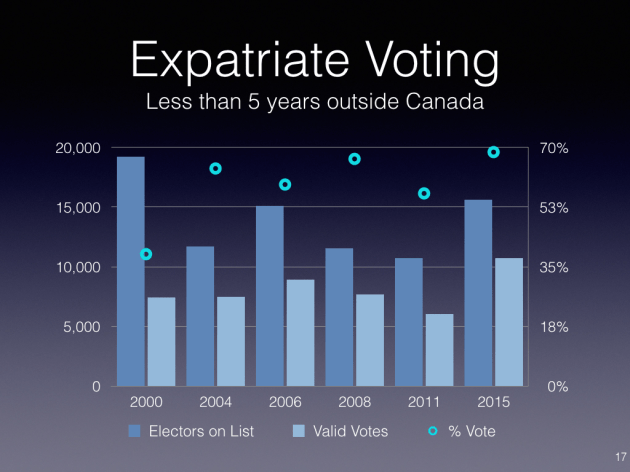
We also have voting data, for those with under 5 years abroad, that show very small numbers, as in the table below, suggesting that relatively few of those who have lived abroad for this period are politically engaged (of course, some may return to Canada to vote, but again, data is lacking).

Canadian Expatriates Data Gaps.017.png

But beyond the weak evidence base, and the challenges of determining – and implementing – a ‘connection’ test, living outside of Canada for extended periods of time invariably weakens the connection to the day-to-day reality of living in Canada, whether from the perspective of government services such as healthcare, education, transit and the like, or the related political debates and discussions.

Interestingly, neither Sevi nor Frank propose a new number if five is considered too short. 10 years, 15 years, indefinitely? Should those born abroad to Canadian parents be allowed to vote even if they have never lived in Canada?

In the hands of the Supreme Court now, for better or worse.

Despite claims of expat apathy towards Canada, many Canadians living abroad continue to maintain close ties with the country, visit family and friends regularly, pay taxes, own property, follow the news, seek consular services, and desire to continue voting in spite of the bureaucratic hurdles that prevent them from doing so. Many of these Canadians do not hold dual citizenship and cannot vote elsewhere.

The current lawsuit before the Supreme Court reflects the strong ties Canadians abroad maintain with their country, as well as their belief that the democratic process should be modernized to reflect a globalized world with a large Canadian diaspora.

In 2012, Gillian Frank and Jamie Duong, two Canadians living in the United States, filed a lawsuit to restore the right of Canadians abroad to vote. In 2014, Ontario’s Superior Court struck down the law and re-enfranchised expats. The Conservative government responded by appealing this decision and in July 2015, the Ontario Court of Appeal, in a split decision, accepted the attorney-general’s argument.

It’s 2016 and our new Prime Minister recently visited the United States where he rubbed elbows with expat celebrities and met with Canadian business leaders in Washington and New York, lauding their accomplishments while encouraging them to invest in our economy. Prime Minister Trudeau sent a message that he values citizens who reside outside of the country. As much was clear during the 2015 elections when Anna Gainey, the president of the Liberal Party, wrote to the Canadian Expat Association: “We believe that all Canadians should have a right to vote, no matter where they live, and we are committed to ensuring that this is the case.”

In early 2017, the Court will hear arguments about the rights of Canadians abroad to vote. Mr. Trudeau has an unprecedented opportunity to welcome many of these citizens back into our democratic process. One way he could do this is by not defending the litigation before the Supreme Court. Will the Liberals live up to their much-anticipated campaign promise to restore democracy to citizens living abroad? The voting rights of over a million Canadians hang in the balance.

Source: Why is Ottawa still defending disenfranchisement of expats? – The Globe and Mail

Jonathan Kay: Don’t blame the media for Islamophobia | National Post

Jon Kay’s balanced assessment in response to Haroon Siddiqui’s column (Canada’s news media are contributing to mistrust of Muslims | Toronto Star), including his dismissal of B’nai Brith’s annual antisemitism report (I always find the police reported hate crimes to be more objective, although imperfect and likely understated).

However, Elke Winter has done some interesting parliamentary and media analysis related to citizenship revocation in cases of terror or treason, presented at Metropolis 2016, that showed that despite balanced coverage, the net effect of the examples used, understandably largely Muslim, did contribute to distrust of Canadian Muslims:

Jews and Muslims have more in common than most people think. And not just on the superficial level of pork avoidance, a love of shawarma and (male) circumcision. In Canada, both the Jewish and Muslim communities are periodically riled up with claims that they are being victimized by epidemics of acute anti-Semitism and Islamophobia. These claims are baseless in both cases.

I flipped a coin. Let’s start with the Jews.

Every year, B’nai Brith Canada releases its Audit of Anti-Semitic Incidents. And every year, B’nai Brith assures us that its numbers prove that Jews are besieged by a “rising tide of anti-Semitism.”

“All one needs to do is look to the comment section of any major news site on a story examining the Israel-Hamas conflict,” declared B’Nai Brith CEO Michael Mostyn when the most recent report was published. “Almost without exception, legitimate debate and dialogue devolves to accusations of the murder of children, Zionist plots and the use of anti-Semitic language blaming the ‘Jews.’ ”

But when you examine B’nai Brith’s catalogue of supposedly horrifying anti-Semitic episodes, what you find is a menagerie of demented Internet crackpots and teenage graffiti artists spray-painting backward swastikas on fences. There is no “rising tide of anti-Semitism” in Canada. It only feels that way because whenever some loon in a strip-mall mosque does express a hate-on for Jews, the incident becomes a sensation on social media.

In other cases, the examples of anti-Semitism are padded out with hateful statements that aren’t really about Jews at all — but quite specifically about the Israeli government. The idea that criticizing Israel automatically qualifies as a form of disguised anti-Semitism has become a lazy debating trick.

Based on the scattered anecdotal reports I hear, I’d say that Islamophobia is somewhat more common in Canadian society than anti-Semitism. You rarely hear of some kid named Avi or Mordechai getting mistakenly put on a no-fly list, for instance. And this month, well-heeled spectators came out to a debate in downtown Toronto where the star performer promoted the thesis that Muslim refugees just can’t be trusted not to rape our Judeo-Christian babies. That’s bad. As was last week’s debunked and retracted Halifax newspaper story about little Muslim children plotting global Islamic conquest from the merry-go-round.

Nevertheless, hate-speech watchdogs take things too far when they suggest that the mainstream media are somehow cheerleading Canada’s fringe Muslim-haters.

This month, former Toronto Star columnist and editorial-page editor Haroon Siddiqui told an audience at the city’s Aga Khan Museum that — according to the Star’s summary — “the media have contributed to widespread Islamophobia by conflating Muslim terrorists with all Muslims.”

In his speech, excerpted in the Star, Siddiqui declared: “The biggest culprits have been the National Post and the Postmedia group of newspapers across the country, which now include the Sun chain. Hardly a week goes by without these publications finding something or other wrong with Muslims and Islam. These publications are forever looking for terrorists under every Canadian minaret. They are hunting for any imam or any Muslim who might make some outrageous statement that can be splashed as proof of rampant Muslim militancy or malevolence.”

Siddiqui and I have appeared on media panels together. I like the guy, and have found him to be quite moderate on most issues. But what he’s written here is unfair.

Yes, the media are fascinated with terrorism — because our readers are fascinated by terrorism. Just as they are fascinated with all forms of horrifying violence — including the kind caused by street gangs, natural disasters and Karla Homolka. It’s human nature. We pay attention when things go bang and boom and all bloody-like.

We also pay attention to questions of motive. And since Islamist terrorists from Islamic state of Iraq and the Levant, Boko Haram, al-Shabab and al-Qaida insistently, repeatedly and explicitly tell us that they are committing their slaughter in the name of Islam, we report that, too. When terrorists in the Middle East, Africa and South Asia stop praising Allah as they self-detonate — or, better yet, stop self-detonating altogether — we media types will be the first to report on that phenomenon, as well.

Moreover, it would be nice if Siddiqui might acknowledge that in the last two years, not one but two Canadian governments — Stephen Harper’s Tories and Pauline Marois’ Parti Québécois — have been booted out of office in large part because media commentators were disgusted by their Islamophobic fearmongering on the niqab issue. I myself was working at the National Post during the 2014 Quebec election campaign, and personally authored several articles denouncing the xenophobic messaging from PQ hardliners. In both cases, it wasn’t media Islamophobia that held sway at the polls, it was media anti-Islamophobia.

Canadians should be proud that they live in a tolerant country where both anti-Semitism and Islamophobia are marginalized and discredited sentiments. Haroon Siddiqui is correct to advocate vigilance against these forms of hatred, but he greatly exaggerates the scope of the problem.

Source: Jonathan Kay: Don’t blame the media for Islamophobia | National Post

Kellie Leitch tears up over role in barbaric cultural practices tip line – Politics – CBC News

Clear reflection and acknowledgement of a major mistake. Waiting to hear from former CIC Minister Chris Alexander whether he also has regrets:

Tory leadership candidate Kellie Leitch became visibly emotional while trying to explain her decision to front the launch of the Conservatives tip line for reporting barbaric cultural practices during the recent federal election.

The former minister in Stephen Harper’s government told CBC News Network’s Power & Politics host Rosemary Barton that she wishes she never took part in the election announcement.

“I’ve had a lot of time to think about this since the campaign took place and if could go back in time, which I can’t, I would change things,” Leitch said. “I would not have made that announcement that day.

“As minister of status of women I was focused on making sure that we eliminated violence against women and girls especially making sure we advocated for women’s rights,” she explained.

Leitch, who is also a pediatric orthopedic surgeon, said her intention was to ensure that if women and children needed to “pick up the phone” to call for help that someone would answer, but admits that “the message was lost.”

“We weren’t talking about race, we were talking about kids … but that message was completely overtaken and I regret that, and I regret that it occurred, and it shouldn’t have been done,” she said.

The Simcoe-Grey MP refused to reveal who in the Conservative Party came up with the idea for the tip line saying “this is not a time for pointing fingers at people or looking at what happened.”

When the Tories lost the election they also lost the chance to implement the promised tip line.

Source: Kellie Leitch tears up over role in barbaric cultural practices tip line – Politics – CBC News

Citizenship Act C-6 Changes: Witnesses 21 April Meeting

The last round of witnesses took place as CIMM proceeds to clause-by-clause review of Bill C-6 after next week’s recess (May 3).

As before, discussion focussed on revocation, particularly on the lack of procedural safeguards in cases of revocation for misrepresentation, language and knowledge testing requirements, and the need for exemptions with respect to the physical presence.

One of the more interesting aspects was the contrast in tone between discussions on revocation in cases of terror or treason. In contrast to the rhetoric/talking points of the previous government and witnesses supporting them, Shimon Fogal of Centre for Israel and Jewish Affairs (CIJA), which had broadly supported this provision, went out of his way to stress how he understood the government had a mandate and that he was sympathetic to many of the revocation concerns raised by others. If my memory and notes are correct, his intervention in 2014 was less acknowledging and understanding of other perspectives. While this may reflect CIJA taking a bit back to the centre after being perceived as too close to the previous government, it nevertheless provided a good example of how serious differences in opinion can be discussed openly and respectfully.

Details

Shimon Fogel of CIJA started by noting that Canadian citizenship is valued and respected, and is a balanced package of rights and responsibilities, with freedom, dignity and quality for all. Immigrants value being Canadian. Despite the restrictions on Jewish immigration capture is ‘none is too many’, Canadian Jews have made positive contributions to the Canadian story. CIGA supports the restoration of pre-permanent residency time credit towards citizenship, the retention of the physical presence requirement, and the maintenance of basic language and knowledge requirements. CIJA also supports that C-6 does not change the streamlined revocation procedures in cases of fraud or misrepresentation, citing the Oberlander case where the procedures were ‘abused’ to allow Oberlander to remain in Canada.

Other elements required further consideration. CIJA supports the intent to reside provision as an important element to reduce citizens of convenience. But safeguards are needed for those who intended but went abroad to pursue studies or other reasons. Amendments were needed to provide greater safeguards, including checks on Ministerial discretion through requiring going through the courts. CIJA continues to support revocation for terror or treason for dual nationals and wants the provision to be expanded to include war crimes and crimes against humanity. While CIJA respected the government mandate and arguments, it wished to encourage further reflection as terror and treason were not only crimes but an ‘insult to Canada.’

Elke Winter noted the importance of citizenship to nation building. She supports repeal of the national interest revocation provision, noting that this only exported the problem, was unlikely to be an effective deterrent, and that past legislation had resulted in negative stereotyping of Canadian Muslims, citing her recent study examining parliamentary debates, mainstream and social media.

Citizenship was an important step towards integration, an inclusive approach being more conducive to winning the ‘hearts and minds’ of immigrants. The reversion in language and knowledge requirements to 18-54 would encourage more to become citizens. Restoration of pre-permanent residency time was important for students and live-in-caregivers and recognized their Canadian experience. The reduction in residency requirements to 3 out of 5 years would enable Canada to retain the ‘best brains’ and most mobile immigrants. She also recommended implementation of TRC recommendation 94, adding reference to indigenous treaties to the citizenship oath.

Peter Edelmann started off by noting as a dual Swiss Canadian citizen, whose children are also entitled to Swiss citizenship, noted that he and his children as dual faced a possible risk that other Canadians did not. He welcomed the proposed repeal of the national interest revocation provision. He then focussed his remarks of revocation for misrepresentation, largely echoing Audrey Macklin and others who noted that lack of procedural protections given the single decision maker without any right to a hearing or comparable protections. He took issue that the Oberlander case justified this change, saying that the previous process did not by itself require such delays. Permanent residents charged with misrepresentation had a more rigorous process, with the right to a hearing by the Immigration Appeal Division and the possibility to present health and compassionate reasons. There was more procedural fairness around parking tickets than citizenship revocation. Misrepresentation could be serious of trivial. Citizens who citizenship was revoked did not revert to becoming permanent residents but rather foreign nationals who could be deported, and thus in a more precarious status.

Steven Green focussed his intervention on the physical presence requirement. While he welcomed the reduction to 3 years out of 5, physical presence could hurt a lot of people, citing examples of a CBC reporter assigned abroad or a university student at MIT or Harvard. He used the example of MPs, who spend most of their time in Ottawa but nevertheless were residents of their ridings, where their life was centred in terms of bank accounts, social connections etc [Note: stretch analogy in my view]. Exceptions were needed to physical presence and the government should revert to the tests used prior to C-24. The USA provided exceptions for those working for US companies, media or religious organizations abroad. The UK provided exceptions in terms of where the family lived, where the main business was located, and where were social ties. If the government were to keep this provision, exemptions should be provided, recommending working for a Canadian company, studying full-time or being a missionary. Failure to do so would mean we ‘would lose some great people.’

Avvy Go and Vincent Wong of the Metro Toronto Chinese and Southeast Asian Legal Clinic noted the importance of citizenship in terms of what we are as a people and nation. The rights and benefits are important to immigrants and their sense of belonging. Citizenship should not promote exclusion and should be a signal that Canada is a “welcoming place.” She was pleased to see the language and knowledge test requirements revert to 18-54 year olds, the repeal of the intent to reside provision and the restoration of pre-permanent residency time credit.

However, Wong noted a number of “serious” problems remained. He supported Green’s testimony on physical presence, adding that compassionate grounds should be another exemption for those who had to go abroad to look after ailing parents. A test could provide flexibility while addressing citizens of convenience. For revocation for fraud, the previous process with recourse to the Federal Court should be reinstated. The up front language test should be “scrapped” as it was a “double whammy,” both a language and financial barrier to citizenship. Requiring applicants to take the knowledge test in English or French was a barrier given that this required a higher level of language proficiency than the CLB-4 required to become a citizen. Many immigrants and refugees did not have time to take language courses.

Richard Kurland focussed on two points: an apparent loophole with respect to tax filings and the lack of procedural safeguards in cases of revocation for misrepresentation. He was pleased that the government had kept the requirement to file income taxes, as this was meant to ensure that applicants were residents of Canada not just for immigration but also tax purposes. However he saw a ‘gaping’ loophole in C-24’s provision to file taxes and proposed adding the words ‘to meet any applicable requirement’ to close it. He also, like a number of other witnesses, noted the “strategic design flaw” of having less procedural safeguards than for revoking permanent residency. He suggested adding citizenship adjudication to the IRB’s responsibilities or alternatively, downgrade their status to Permanent Residents to have a “modicum” of justice.

Discussion:

Revocation for terror or treason: The government side asked how CIJA could justify revocation for terror or treason in light of some of the arguments that this was perceived as singling out certain groups. Fogal noted that he was not incentive to these concerns, that this was a difficult issue and part of the government’s mandate. His support was philosophical and used the analogy of a marriage when the fundamental commitments have been broken, the solution was divorce. Repudiation of the central Canadian values was not just a criminal matter, it was a crime against Canada itself. Kurland noted that this was a matter for the criminal system not citizenship.

The Conservatives continued to focus on revocation. Fogal again noted his sensitivity to the points raised by Engelmann and Winter and that the government had some “compelling” arguments about not differentiating between different Canadians. But he couldn’t escape the fundamental philosophical problem. An act of terrorism is an “insult to Canada” and their has to be some recognition of that difference and redress.

Engelmann and Fogal entered a short inconclusive debate whether a marriage or parent analogy was more appropriate (one can’t renounce one’s child was Engelmann’s point while unfortunately, divorce was all too frequent). [Note: Fortunately, no one raised divorce procedural issues related to religions (permitted, not permitted, gender discrimination) but I would caution over-use of this analogy).]

Revocation for fraud: Not much new discussion here. Fogal reiterated his support for the streamlined process, stating that there was a legal and moral imperative to maintain revocation in these cases, which was fundamentally different than revocation for other reasons. Engelmann recommended the “relatively straightforward” process of the Immigration Appeal Division with respect to permanent residents, noting that not all misrepresentation was the same, using an example of someone who 25 years ago had submitted a fraudulent engineering diploma but had been living, working and raising a family since them and there may be grounds not to revoke. Green and Go/Wong responded similarly.

Intent to reside: The government side questioned CIJA on its support for the intent to reside provision and how it could be reconciled with the mobility rights under the Charter. Fogal noted that none of the situations lead themselves to simple solutions. We need to balance the degree of confidence that new citizens have to fully participate with considerations regarding citizens of convenience, citing the 2006 Lebanese evacuation and eventual return of some 15,000 Lebanese Canadians. Individuals normally enrich Canada by being in Canada. There was not a black and white solution but it was important to be mindful of citizens of convenience.

The Conservatives questioned Green on his opposition to intent to reside. Green noted later that as a practical matter, intent to reside could not be managed. Was it a one month commitment? 6 months? The intent to reside provision would not have changed the Lebanon situation one little bit. [Note: Intent to reside applied only to the period of time the application was in process but C-24 testimony indicated some concern how it would be implemented.]

Kurland noted the only way to address citizens of convenience was to have a very stiff passport renewal fee ($5-10,000) for non-resident Canadians who do not file Canadian taxes, or adopt the US approach of basing income tax on citizenship, not residency.

Physical presence:  Some discussion related to situations where the father worked abroad to support his family in Canada. Go noted access to employment issues in Canada that led to this situation, and the risk to the husband’s permanent residency status if not working for a Canadian company. She also noted that many students studying abroad will return to Canada. Green noted that many successful business people have frequent travel abroad and just can’t meet the residency requirements and have to make the choice between their business or getting citizenship.

Criminal convictions: The NDP asked about the prohibition to become citizens for those with a criminal record abroad. Engelmann noted that the existing mechanism with respect to permanent residents already dealt with these cases. If serious enough, permanent residency can be revoked. Moreover, the provision in the Citizenship Act made no allowance for the context of the foreign conviction and he recommended repeal of this provision given that IRPA addressed this concern adequately. In subsequent questioning, Go noted the problematic nature of foreign convictions, particularly in China and Vietnam where most of her clinic clients come from.

Language/Knowledge: Same general points as before regarding the importance of language to integration, the concerns regarding up-front language testing in terms of cost and difficulty, and the “double testing” of language through the knowledge test. None of today’s witnesses spoke in favour of the current approach. Engelmann noted the higher language level required in the knowledge test and cited his personal experience of only knowing scientific terms in French  [Note: during my time at IRCC/CIC, we argued unsuccessfully for Discover Canada to be written in more accessible language, along with the questions. It appears from the increase in average pass rates in 2014-15, that the questions have been made clearer and more accessible].

Go and Wong made similar points from a fairness angle, stressing the difficulty for low-income families, often refugees, noting that this effectively disenfranchised those already marginalized. Go noted an upcoming study on Chinese restaurant workers who worked long hours and did not have time to learn an official language.

Statelessness: Similar discussion as before, although Kurland noted the need to carefully scrutinize applications from stateless persons, given that they were a recruitment target for terrorists.
Women in federally regulated workforce declining: study – iPolitics

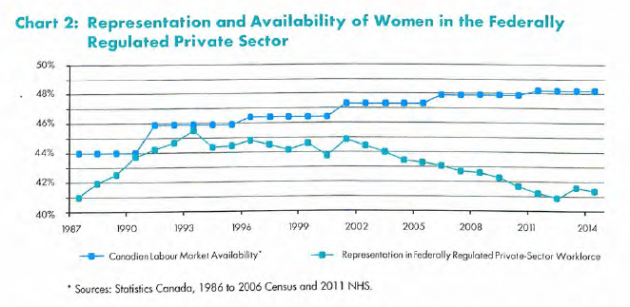
While the focus of the article is with respect to women, the other results are just as interesting (the largest federally regulated industries are telecoms, banking and transport, and the large retail presence in the first two – think of those cell phone pop-up stands or bank branches – mean strong representation of visible minorities):

The Employment Equity Act Annual Report tracks employment in federal federally regulated industries such as banking, communications and transportation.

The study found that transportation companies had the worst track record when it came to employment equity. Women made up only 27.2 per cent of the employees in private sector transportation sector companies, 14.2 per cent of the workforce were members of visible minorities and 2 per cent had a disability. The only area in which the transportation industry fared better than others was with aboriginal peoples who made up 2.8 per cent of the employees.

Screen Shot 2016-04-19 at 5.30.13 PM

The banking sector had the best track record with three of the four employment equity groups. Women made up 61.5 per cent of the workforce in banking, 30.2 per cent were members of visible minorities and 4 per cent had a disability. However, banking had the lowest proportion of aboriginal Canadians of any sector at 1.3 per cent.

Communications came up the middle with women at 37.4 per cent, visible minorities at 18.6 per cent, people with disabilities at 2.3 per cent and aboriginal peoples making up 1.8 per cent of the employees.

In a fourth category that mixed several different federally regulated industries from metal ore mining and wood to public administration or professional, scientific and technical services, 30.9 per cent of employees were women, 12.2 per cent came from visible minorities, 4.5 per cent were aboriginal and 2.6 per cent had disabilities.

…There was a gap between men and women who come from visible minorities. While 52.1 per cent of visible minority men working in federally regulated industries earned over $60,000, that dropped to 39.8 per cent of women.

Overall, employment equity in federally regulated sectors is improving, the study found.

“Employers are showing greater interest and awareness in employment equity through their commitment to implementing short-term and long-term measures in the workplace, including improvements to hiring and retention processes, accessible training and networking opportunities for advancement and overall evidence of employment equity integration into day-to-day activities.”

Source: Women in federally regulated workforce declining: study – iPolitics

Germany to consider stripping IS fighters of citizenship: document | Reuters

Unclear whether this is just the normal draft looking at options or whether it is something the government is seriously considering:

Germany’s ruling coalition plans to look into stripping Islamic State fighters of their German citizenship to prevent them from coming back to the country, a draft document seen by Reuters on Wednesday shows.

More than 800 people have traveled from Germany to Syria and northern Iraq in recent years and around 70 returnees took part in combat or military training there, the head of Germany’s domestic intelligence agency said earlier this month.

“To prevent jihadists from returning to Germany, we want to examine the legal possibilities for depriving people of German citizenship if they fight for a terrorist militia abroad and have another citizenship alongside their German one,” read the draft document, which the coalition of conservatives and Social Democrats are to discuss on Thursday.

The coalition is also considering depriving German supporters of Islamic State of identity cards and passports to prevent them from traveling to areas controlled by Islamic State, the document said.

Increasing video surveillance of public areas to better tackle threats from Islamists as well as right and left-wing extremists is another measure the coalition is considering, according to the document.

Any talk of boosting surveillance generally causes controversy in Germany, where many people still remember the Stasi secret police and its network of informants in the former Communist east.

The coalition may also consider whether people returning from fighting for IS could be given electronic tags.

Source: Germany to consider stripping IS fighters of citizenship: document | Reuters

‘We know who our people are,’ Ontario First Nations draft citizenship law

A very different approach than governments, with no generation limits and bloodline only:

First Nations in Ontario are encoding their traditional citizenship laws to fight back against the “genocidal” policies of the Indian Act, says the Grand Chief of the Anishinabek Nation.

E-dbendaagzijig, which means ‘those who belong’ in Ojibwe, is a draft citizenship law for 39 Anishinabek First Nations, representing approximately 60,000 people in Ontario.

The recent Daniels decision from the Supreme Court of Canada on the rights of Metis and non-status Indians continues to muddy the waters of First Nations citizenship, Anishinabek Nation Grand Chief Patrick Madahbee said.

“It’s up to our people to decide who has lineage to our territory,” he  said. “We know who our people are.”

The draft citizenship law recognizes a citizen as anyone who can trace their lineage, through at least one parent, to a First Nation within Anishinabek territory.

Madahbee said distinctions between status and non-status are part of the “genocide” inherent in the Indian Act and that First Nations leaders are prepared to take responsibility for Anishinabek citizens who live off reserve.

“The government has been very skillful at divide and conquer tactics,” he said. “Our chiefs have been saying, particularly in the Anishinabek territory, when we talk about E-dbendaagzijig, those who belong, we say we are responsible for our people, no matter where they live.”

Mahdabee said it’s important to change the terminology from ‘band membership’ in First Nations to citizenship.

“You can be a member of the Kiwanis Club or the Rotary Club,” he said. “You are a citizen of a nation. It elevates it.”

Band membership rules under the Indian Act have left a First Nation in central Ontario in a dire situation, Madahbee said.

As of 2013, the Mississaugas of Scugog Island First Nation did not have anyone eligible to be registered as a status Indian, he said.

“This Indian Act is genocide,” Madahbee said.

Source: ‘We know who our people are,’ Ontario First Nations draft citizenship law – Thunder Bay – CBC News