Citizenship must be about more than a genetic link

This issue was already subject of some analysis and study during my time at CIC/IRCC a number of years ago.

The previous government, which addressed adoption issues, was not prepared to move on this one.

We will see whether the current government will respond (it was not in the party platform, ministerial mandate letter or the proposed changes to citizenship in Bill C-6, so I expect not in the short-term):

The Canadian government is playing fast and loose with the definition of “Canadian.” In March 2014, the Federal Court of Appeal decided Nanakmeet Kandola, a young girl born abroad to a Canadian parent, was not a citizen because there was no genetic link between them. Nanakmeet’s mother carried and gave birth to her but she was the product of anonymously donated sperm and ova. Think of it as adoption in utero.

Yet, a child adopted by Canadian parents who fills out the same application for a Citizenship Certificate as Nanakmeet’s father did will be approved. No genetic link required.

Perversely, ex-Nazi war criminal Helmut Oberlander maintains his right to Canadian citizenship until yet another government review is completed. And shocking to some, children born to Canadian Daesh brides are considered citizens.

Where has Canada gone wrong?

The Citizenship Act dictates who is Canadian. There are three main roads to “become” Canadian — be born in Canada, immigrate and then apply when you meet all the requirements, or inherit citizenship through your parent or grandparent if born abroad. So why was Nanakmeet’s request for citizenship refused when others using the same route were approved?

The law is behind the times.

Sex and adoption were once the only ways a person was able to become a parent but times have changed. These options are now mere fence posts in the world of conception. As early as 1983, the first “test tube” birth occurred in Canada. In 2004, the Assisted Human Reproduction Act officially sanctioned fertility relationships with surrogates, where a woman carries a child for someone else, and ova and sperm donations. Today, assisted human reproduction is a full-fledged, albeit small, industry in Canada with fertility doctors, counsellors, clinics, lawyers and even agents.

Is it hypocritical for Canada to condone the birth of children through assisted fertility procedures but then deny some children citizenship because they were born through these same procedures?

The court decided Nanakmeet’s case two years ago. The majority of the court wrote, “Several important policy issues also arise because of the novelty which this case presents … These questions are worthy of further consideration and risk being answered by the Courts unless Parliament exercises its prerogative to deal with them by way of legislation.”

What changes do we need?

Canada must expand the definition of parent in the Citizenship Act to include those who use assisted fertility to become parents. Grant these children citizenship the same way naturally born and adopted children receive it. As long as a parent is legally recognized as the parent of their child, that child deserves citizenship.

As the Federal Court of Appeal warned, the government risks a host of policy issues if changes aren’t made to the law. Such issues include confusion if judges reach different conclusions with each case they decide. If genetics is the test, ova and sperm donors could pass their citizenship to children even if they aren’t parents to them. Surrogates could claim genetic links and the right to pass on citizenship to children they birth when the surrogate never parents the child. Being Canadian must mean more than having the right genetic link.

The new Liberal government and the Minister of Citizenship and Immigration, John McCallum, have shown they are sympathetic to the realities of the times by admitting Syrian refugees, shortening processing times for certain immigration applications, and proposing changes to the Citizenship Act to make it easier to become a citizen.

Source: Citizenship must be about more than a genetic link | Toronto Star
Public servants flock to PCO’s first-ever behavioural economics briefing

I am a fan of nudges and Kirkman captures the reality that current politics already incorporate nudges, and so the question is more what kind of nudge is more effective as part of policy and program design, rather than more existential questioning.

As readers already know, I am also a fan of behavioural economics, and found the insights in Kahneman’s Thinking Fast and Slow particularly relevant to policy makers who may not be as aware of their thinking processes as needed:

Elspeth Kirkman, North American head of the Behavioural Insights Team’s head of North American operations, was asked during a presentation how she responds to criticism that she’s involved in “social engineering.” She said governments cannot get away from the fact they have to encourage certain kinds of behaviour from people, so it might as well be done effectively.

“Departments and governments are already nudging people in terms of how they present information to them, how they ask them to do things, how they structure their defaults, and all we’re doing really is being mindful about that,” she said. “We’re saying, actually, let’s just understand what the implication in the way that we’re structuring that choice is.”

Eldar Shafir, a professor of psychology and public affairs at Princeton University, told the audience that sometimes more than a “nudge” is needed when it comes to public policy.

“I’m a big fan of nudges … but nudges are a very modest attempt to interfere minimally, often at a very low cost, when you’re politically somewhat helpless, in ways that that help people,” he said.

“But there’s a lot more than that. And if you think about what policy does throughout, whether it’s the design of emergency rooms or what it takes to make a nation healthy and happy, there are profound psychological questions that lie at the core of what we do.”

When asked to elaborate in what qualifies as a nudge and what’s seen as more, Mr. Shafir noted how buildings are often designed—in terms of where stairs, elevators, and parking lots are placed—to promote physical activity, and he feels buildings that are constructed in ways to encourage certain behaviours represent the kind of policy that goes beyond nudges.

Ms. Kirkman talked about an EAST model—which stands for easy, attractive, social, and timely—for creating conditions for public compliance with government policies.

She talked about using plain language and less “legalese” to make it easier for people to understand government communications. She used an example of a U.S. city that had an unfortunate practice of sending out very technically worded letters to homeowners whose properties did not meet municipal standards.

“The letter actually starts with: ‘According to Chapter 156 and/or Chapter 155 and/or Chapter 37 in the [municipal] ordinances process, we have found your property to be in violation of inspection.’ And it kind of just goes on and on and on like this, and it doesn’t actually say, ‘Hey, you need to fix your property and here’s what’s wrong with it.’ ”

In terms of making things attractive, Ms. Kirkman used an example how different styles of texting unemployed people from a job centre in the Britain to inform them about a new supermarket that was holding a job fair. She said 10 per cent of the people notified would typically attend such a non-mandatory event. However, when people’s individual names were used in the message, that increased to 15 per cent. When the message appeared to come from the unemployed people’s employment advisers, it increased to 17 per cent. Finally, that rate increased to 26 per cent when the individuals were told their advisers had booked them a time-slot at this event.

The social aspect of encouraging certain actions is shown by Mr. Treusch’s example of publicizing how most people pay their taxes, Ms. Kirkman said.

Another factor is who conveys the message, she said. She recalled how the British government once sent letters signed by the chief medical officer that advised certain physicians to prescribe antibiotics less often, and the campaign was a success. She said the message would have been less effective with this particular audience if it came from the health minister. These physicians were also told how the majority of their peers were prescribing fewer antibiotics, she added.

An example of timeliness focused on a police force Britain that was found to be much less ethnically diverse than the community it serves. Research ultimately uncovered that most applicants of minority ethnicities were failing an online test in which they were asked how they would react, as a police officer, to certain situations.

Ms. Kirkman said it’s believed the effect of “stereotype threat” was at work, where people who are part of groups that have negative stereotypes tend to perform worse in certain instances if reminded of those stereotypes just before the task.

She said when the wording of the email asking applicants to take this test was changed to be “warmer” and contain a preamble asking them to think about what it would mean to their community if they became a police officer, the gap in success in the test between white applicants and others was closed.

Source: Public servants flock to PCO’s first-ever behavioural economics briefing |

Religious institutions [temple and mosque] form unlikely partnership to aid Syrian refugees

Good to see initiatives like this:

For years, the Temple Har Zion and the Imam Mahdi Islamic Centre (IMIC) have been neighbours, even sharing a parking lot, in Thornhill, Ont. Now, the unlikely partners are about to share a major responsibility – sponsoring a group of Syrian refugees.

The religious institutions have united to privately sponsor Syrian refugees to resettle in Canada. Together, they are pooling their resources to raise a target of $60,000 in the next couple of months.

Temple Har Zion Rabbi Cory Weiss says the co-operation is “groundbreaking” for both organizations.

“It brought us together in a way that nothing else has,” Mr. Weiss told The Globe. “The more we learn about each other’s religion, the more we realize we have in common.”

Alireza Torabian, who is leading the sponsorship efforts at the mosque, says the partnership sets a good example for other Canadians.

“We are very proud that we can start a project and show Canadians that different cultural groups and religions can work together in Canada on the same common cause,” he said.

Given their proximity to one another, there has always been a relationship between the synagogue and the mosque, but last fall, Mr. Weiss and the imam of the IMIC, Seyed Reza Hosseini-Nasab, met to get to know one another better.

In December, the synagogue decided it wanted to sponsor Syrian refugees and reached out to the mosque, which happened to be considering refugee sponsorship too.

The organizations teamed up and are now working with their refugee sponsorship agreement holder, Jewish Immigrant Aid Services (JIAS) in Toronto, which will help with the process once enough money is raised.

JIAS language and settlement director Lia Kisel said this is the first time she has worked with two religious institutions on refugee sponsorship.

“It makes you feel very proud because bridges are being built,” Ms. Kisel said.

Source: Religious institutions form unlikely partnership to aid Syrian refugees – The Globe and Mail

Wells: Justin Trudeau takes Ottawa’s debates to Washington

Interesting snippet from Paul Wells’ account of Trudeau in Washington:

The other striking moment came when Trudeau raised, by himself, his decision to repeal the provisions in the Conservatives’ “Strengthening Canadian Citizenship Act,” C-24, that stripped some convicted terrorists of their Canadian citizenships.

“One of the things the right-wing had done was put forward a bill that took away the citizenship of convicted terrorists,” he said. “A number of countries have done that around the world. It seems like a fairly obvious thing to try and do. If someone’s gonna commit an act of war, an act of terrorism against the country, they probably shouldn’t deserve to keep Canadian citizenship if they’re doing that.”

This is indeed a decent paraphrase of the arguments Conservatives made in support of C-24. Trudeau said his opponents “felt they were on very, very safe ground” with their policy.

“The problem is, as you scratch into that a little deeper, you realize it only really applies to citizens who have, or could have, a dual nationality. So a kid who was born in Canada, and only has a Canadian citizenship — but whose parents were born, for example, in Pakistan — could lose his citizenship if he committed an act of terror, [whereas] a kid who was tenth-generation Canadian home-grown terrorist could never lose his citizenship. And suddenly we’d made citizenship conditional on good behaviour. Or on non-heinous behaviour, which comes down to the same thing. And that devalues the citizenship — made two classes of citizen.”

Trudeau’s tone suggested he knew this was not, on the face of it, a winning issue for him. “And it came to the point where, in one of our largest debates, I was standing on stage against the former prime minister. And he was telling people that I was willing to stand up and restore the citizenship of the one Canadian who, under this law, had had his citizenship taken away.

“He knew he had me on that one. I’m actually standing there defending the right of a Canadian — stripped of his citizenship for terrorism — to become, once again, a Canadian citizen. And I stood there, and I defended that principle, that you should not be able to take away citizenship from anyone. And our government would be, because we’d reverse that law, restoring the citizenship of someone who was convicted of terrorism in Canada.

“And that’s a perfect narrative for the politics of fear and aggression. And yet it’s me sitting here as Prime Minister of Canada, not Stephen Harper.”

Source: Macleans

Refugees and anti-Semitism: is it a problem? | Germany

More about antisemitism and refugees in Germany:

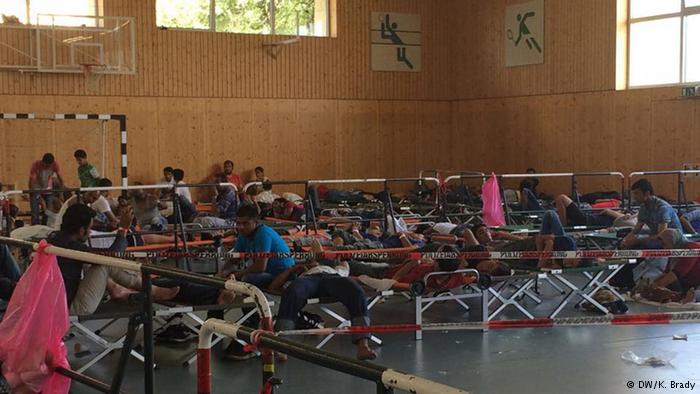
First, there were the images on TV of desperate, scared people climbing out of tiny boats and marching slowly along motorways and through woods. Then, not long after, the refugee crisis arrived on Shaked Spier’s doorstep in Berlin: overcrowded gyms, people waiting for weeks to be registered, overwhelmed officials.

“I knew immediately: If refugees are now in the country that my grandparents had to flee, and if they need help and protection, then I have to do my part,” Spier said. For him, there was absolutely no doubt. Since then, Spier, a Jew whose grandparents once fled the Nazis, has been volunteering at a refugee shelter in Friedrichshain, a hip district of Berlin filled with bars and cafes. Spier, 30, is a well-spoken man who works as a project manager at an IT company, and gives long, reflective answers when asked questions. At the refugee shelter, he helps to serve meals, plays with the kids and talks to the parents about the trauma they’ve experienced.

He is one of many Jews who’ve been helping refugees by donating clothes, working in shelters, or taking refugees into their homes. Spier says he hasn’t had any negative experiences. He says his identity, background and sexual orientation – Spier is openly gay – have never played a big role in his encounters with refugees. If someone notices the Hebrew tattoo on his arm or his accent, the reaction is typically one of, “Oh, you’re from Israel? Cool, I’m from Afghanistan.” He laughs.

Deutschland Rosenheim Grenze Österreich Turnhalle Lager Asylbewerber More than 1 million refugees came to Germany in 2015

No research to support the claims

But then he grows serious. It makes him angry, he says, when other people accuse refugees of being anti-Semites or harboring hate towards Israel simply because they come from countries whose governments espouse such sentiments. The head of Germany’s Central Council of Jews, Josef Schuster, has frequently spoken about the danger of importing anti-Semitism along with refugees. In a recent newspaper interview, he said that “a considerable proportion of Arabs have grown up with anti-Jewish, anti-Israeli stereotypes. These people cannot simply leave their prejudice behind at the border.”

Spier says he has experienced no hostility while working with refugees

Dervis Hizarci, a history and political science teacher in Berlin, also finds such generalizations problematic. There is no research on the extent to which refugees may be bringing anti-Semitism with them to Germany, he said. Hizarci is the head of KIGA, an initiative against anti-Semitism based in the Berlin neighborhood of Kreuzberg. The initiative has launched a project about anti-Semitism among refugees; he expects to have the initial results by the end of the year. Until then, Hizarci says people shouldn’t make generalizations about the issue, as that would only stir up anti-Islam and anti-foreigner sentiment. However, he points to research showing that between 15 and 20 percent of the German population harbor latently anti-Semitic views. “Of course there are Muslims among these people, even in the second and third generation, but they’re by far not all Muslims!”

Hizarci doesn’t deny that young German Muslims are susceptible to anti-Semitic views, fueled by the horrors of the Middle East conflict they see on their smartphones and televisions. Hizarci and his colleagues give workshops and lead debates about anti-Semitism, but also about hatred of Islam. He says his work requires a lot of time and resources. “Just like when it comes to fighting homophobia or right-wing extremism, you can’t change such views with a single workshop; it doesn’t happen overnight.” After the Easter holidays, the initiative wants to start a model project that, among other things, will offer welcome workshops on the topic.

Mosques are overwhelmed

But often, it’s individual people engaged in such efforts to promote tolerance: German mosques are often overwhelmed with the problem, in part because they are led by volunteers who also have to commit their time and energy to other problems facing members of their community, such as exclusion, anti-Islam sentiment and joblessness. There are barely any resources left for confronting the problem of anti-Semitism, said an insider who asked to remain anonymous due to the contentious nature of the topic. The source added that many young Muslims are not an integrative part of the mosque community: “When that’s the case, there’s no way to reach them.”

Source: Refugees and anti-Semitism: is it a problem? | Germany | DW.COM | 12.03.2016

Obama to Turnbull on Indonesia, Islam and the Saudis: ‘It’s complicated’

Always interesting to have a more inside account of these discussions, highlighting awareness in this case:

A revealing series of interviews with US President Barack Obama has given insight into a private discussion he had with Australian Prime Minister Malcolm Turnbull.

The 20,000-word feature published in The Atlantic magazine also relies on interviews with Mr Obama’s former Secretary of State Hillary Clinton, her successor John Kerry, Israeli Prime Minister Benjamin Netanyahu, other world leaders and key White House insiders.

It details part of a meeting between Mr Obama and Mr Turnbull during November’s APEC summit in Manila.

The president, according to The Atlantic, described to Mr Turnbull how he had watched Indonesia gradually move from a relaxed, multi-faceted Islam to a more fundamentalist, unforgiving interpretation with large numbers of Indonesian women adopting the hijab Muslim head covering.

“Why, Turnbull asked, was this happening?” the author of the feature, Jeffrey Goldberg, wrote.

Mr Obama told the prime minister the Saudis and other Gulf Arabs have funnelled money and large numbers of imams and teachers into Indonesia and in the 1990s the Saudis heavily funded Wahhabist madrassas, seminaries that teach the fundamentalist version of Islam favoured by the Saudi ruling family, according to The Atlantic.

Mr Obama also told Mr Turnbull Islam in Indonesia was much more Arab in orientation than it was when he lived there.

“Aren’t the Saudis your friends?,” Mr Turnbull reportedly asked Mr Obama.

Mr Obama smiled and said: “It’s complicated”.

Source: Obama to Turnbull on Indonesia, Islam and the Saudis: ‘It’s complicated’

Donald Trump’s success a ‘wake-up call’ for Michigan’s Muslims

Does not bode well:

On Thursday, Muslim leaders in this Detroit suburb were saying that members of their community still felt safer here than they would in just about any other place in their country.

….The source of considerable angst and reflection was this past Tuesday’s Michigan presidential primary. In one of the most Muslim-heavy states in the country, Republican front-runner Donald Trump – a candidate so overtly playing to Islamophobia that he pronounced during a CNN interview this week that “Islam hates us” – cruised to victory with about 37 per cent of the Republican vote. And in Dearborn itself, where nearly half the city’s roughly 100,000 residents are Arab-American and many country- or state-wide Muslim or Arabic organizations are based, Mr. Trump’s percentage was a couple of points higher than that.

Unsurprisingly, most of his votes came from the half of Dearborn that’s not really a Muslim capital at all. While the vast majority of residents on the east side of town are of Arabic descent – with roots primarily in Lebanon, Syria, Yemen and the Palestinian territories – the west side is primarily white. Of the 3,153 Dearbornians who voted for Mr. Trump, only about 500 live on the east side. (Christian Arabs, a small population here, may account for a few of those.)

But until recently, Dearborn seemed to be a success story of Muslims integrating into a city with a history of segregation, and a state that has seen more than its share of racial strife. Many have opened businesses on the west side, some have even moved there, and they are increasingly engaged civically, including on the city’s council. The town has attracted its share of attention from cranks: Right-wing bloggers have long propagated various bogus conspiracy theories, including that the city is under Sharia law, and the likes of Koran-burning Florida pastor Terry Jones occasionally show up seeing attention. But even following the attacks of Sept. 11, 2011, there wasn’t the degree of backlash for which many of its immigrant families braced themselves.

Now, with thousands of people with whom they co-exist either embracing Mr. Trump’s Muslim-bashing or proving willing to overlook it, Muslim residents have been given a reality check about how they’re perceived – and how much Mr. Trump has helped bring to the fore something ugly that was lurking below the surface.

“I think what is most troubling about this election cycle is that in Michigan, you would assume there is a certain familiarity with Muslims,” says Rana Elmir, who grew up in Dearborn and is now deputy director of the American Civil Liberties Union of Michigan. “And I don’t think what you’re seeing in those results reflects that familiarity and trust.”

Source: Donald Trump’s success a ‘wake-up call’ for Michigan’s Muslims – The Globe and Mail

Front commun contre les propos francophobes

More on the nature of on-line comments. My preference, rather than suppression, is requiring actual names and related authentication, as is done in letters to the editor:

Brodie Fenlon, le directeur des médias numériques pour le réseau CBC, a assuré au groupe par écrit vendredi que les commentaires identifiés seront supprimés. « Nous regrettons que ces commentaires se soient retrouvés sur notre site. Il s’agit d’une situation malencontreuse, mais inévitable lorsque l’on doit traiter un tel volume de commentaires. […] Dorénavant, nous nous assurerons que nos lignes directrices sont appliquées avec encore plus de rigueur et de jugement. » La politique de commentaires de CBC mentionne que les discours haineux, les attaques personnelles, les insultes ou encore les déclarations diffamatoires sont interdits.

En entrevue avec Le Devoir, l’instigateur de la lettre, Michel Doucet, n’est pas rassuré par cette réponse, tant s’en faut. Il exige que la CBC fasse preuve de vigilance en amont plutôt que de simplement retirer les commentaires litigieux après coup.

« Ils retirent les commentaires juste quand on les signale. Mais on ne va pas passer notre journée à surveiller le site de CBC ! C’est à CBC elle-même de veiller à la qualité du contenu », tonne-t-il. Selon l’avocat, il est inacceptable qu’une société d’État« permet[te] qu’on utilise son site de commentaires pour fomenter la division, l’incompréhension et l’intolérance vis-à-vis d’une communauté minoritaire ».

M. Doucet soutient que le phénomène existe « depuis que CBC a ouvert son site aux commentaires » et procède d’une tendance lourde. Chaque fois qu’il est question de sujets liés aux francophones au Nouveau-Brunswick, ces commentaires fusent. « L’autre jour, la ville de Dieppe a annoncé qu’elle aurait un anneau de glace et il y a eu des commentaires ! Un des commentaires qui revient souvent, c’est que les francophones ont tous les bénéfices alors que ce sont les anglophones qui payent tous les impôts. […] On mettrait une photo d’un beau petit chat portant un nom francophone que ces commentaires ressurgiraient », raille-t-il. Lui-même, un militant très en vue des droits linguistiques des francophones, est présenté dans certains commentaires comme un « individu radicalisé ».

Le sujet fait l’objet de conversations dans la communauté francophone néo-brunswickoise depuis très longtemps, raconte-t-il. Aussi, quand il a décidé de prendre la plume dimanche dernier, il a récolté ses 120 signatures prestigieuses en moins de 72 heures. C’est d’ailleurs un sénateur conservateur, Percy Mockler, outré et enflammé, qui a mis Le Devoir au parfum de la situation.

Les signataires demandent à ce que CBC ne permette plus les commentaires provenant de personnes anonymes, comme le font déjà plusieurs sites de médias. M. Fenlon rétorque dans sa lettre que cet anonymat est utile, quoiqu’il fasse l’objet d’un « examen ». « En autorisant l’utilisation de pseudonymes, on permet cependant à toutes les voix de participer au débat, y compris les victimes de crimes et les dénonciateurs d’abus, deux groupes qui, selon nous, ont de bonnes raisons de se cacher derrière l’anonymat. »

Brand Command: Canadian Politics and Democracy in the Age of Message Control

Alex Marland’s book on branding and message control under the Harper government is now out (Marland also edited the wonderful Canadian Election Analysis 2015 – Ubcpress.ca, issued just a few weeks after the election).

Now that the ‘brand’ has changed, interesting to reflect on the Liberal government’s equally – if not stronger – branding, evident at both the PM, Ministerial and other levels:

A brand-centric approach to power involves the strategic unification of words and visuals. At the most basic level, a branding philosophy holds that communicating disjointed messages in a haphazard style is less likely to resonate with intended audiences. Conversely, core information repeatedly communicated in an uncomplicated, consistent, and efficient way to targeted subgroups is more likely to secure support for the sender’s agenda. Branding strategy positions the sender as unique, reassures audiences, and communicates aspirational, value-based, and credible messages. Repetitiveness and symmetry are crafted to pierce the clamour. A “less is more” approach to communication reinforces information and messages and does so in a resource-efficient manner that accentuates visual imagery.

Branding balances the information demands of the impassioned and the uninterested. It communicates cues and signals to distracted audiences while stoking emotional connections with those who are most loyal. It involves marketers maximizing their communications investments by promoting messages designed to differentiate the brand and to resonate on an emotional level with target audiences. It understates or ignores the brand’s flaws. It turns a humdrum interaction into a memorable experience. The resulting brand loyalty felt by the most ardent supporters is such that they can be impervious to missteps and to courting by competitors. An organization requires tenacious leadership to assert branding objectives over the demands and criticisms of other actors. The more fractured that media become, the more that party strategists and senior public servants seek to standardize and centralize their messages. The more that message cohesion, discipline, and centralization are practised, the more that society makes political choices based on images of politicians rather than on policy details. In politics, the brand unites everything.Th e rest of us need to look at political leaders, party politics, the media, and public administration through a branding lens to understand this.

…This book … is concerned with establishing that changes in communications technology are enabling the centre to enforce communications control and to implement branding strategy. This examination will provide both believers and disbelievers of the Savoie thesis with a basis for further assessment of whether the centre has too much power – and in particular a better understanding of the institutional conditions and processes related to political communications and elite behaviour. Brand Command argues that the causes of centralization are systemic, not individualistic. In this light, Trudeau’s pledge to empower cabinet and buck the forces of centralization seems idealistic. Branding strategy seeks to influence public impressions and to set and advance agendas. It is accompanied by an organizational willingness to exploit opportunities to penetrate a communications cyclone and a motivation to achieve resource efficiencies. In interviews conducted for this book, many respondents pontificated, unaided, along the following lines: “Disseminating a message in the clutter or bombardment of information that you get today is a huge challenge … One of the solutions to that is consistency of messaging, which probably explains to a large degree the centralized approach that government has taken to its communications.”

Brand Command UBC Press

Engaging Newcomers: ‘We Haven’t Done Enough’

One of the strongest speakers at the recent Metropolis conference and certainly the strongest one on the ‘identities’ workshop (which most of the other panelists didn’t address):

Governments and bureaucrats need to focus less on numbers and more on starting real conversations that tackle critical problems, like race, in ways that engage immigrants rather than shaming them.

“A lot of time when it’s about race, we are afraid to talk about it,” said Yolande James, one of four speakers from the government and legal system who presented at the “Identities, Rights and Migration: A Session on the Intersection of Gender, Race, Class and Sexuality” session at the 18th National Metropolis Conferenceheld in Toronto last week.

“There is a way to have a conversation involving everybody, to be respectful and constructive. Everybody has something to give and we should have an equal life.”

James, a former provincial politician, was the first Black female cabinet minister in Quebec history, serving as Minister of Immigration and Cultural Communities & Minister of Family between 2007 and 2014.

As a former provincial government minister, and child of immigrant parents herself, James knows about how inefficient all levels of government are in engaging newcomers into their host country.

“Do we engage immigrant populations? Do we have engaged dialogue?” she asked. “We haven’t done enough.”

She said the lack of society-wide conversations that engage with immigrants sends the message that they do not matter.

“I feel the whole nation, in terms of why the issues touching immigration and diversity [are] important, is not engaged,” she said. “It’s all about being able to engage people to connect with other people’s experience.”

“There is so much emphasis on the numbers, but it’s not important. It’s about their journey.”

As an example, James pointed to the current challenge of accepting Syrian refugees to Canada. She said that the government needs to pay attention to more than just the number of refugees being accepted.

“Should it be 55,000 or 50,000?” she asked. “There is so much emphasis on the numbers, but it’s not important. It’s about their journey,” she said.

Source: Engaging Newcomers: ‘We Haven’t Done Enough’ – New Canadian Media