Trudeau urged to create gender-balanced Senate

Holding the Government to the spirit of the common wording in the mandate letters (“You are expected to do your part to fulfill our government’s commitment to transparent, merit-based appointments, to help ensure gender parity and that Indigenous Canadians and minority groups are better reflected in positions of leadership.”).

The previous Conservative government appointed 18 women out of 57 appointments (32 percent) and 9 visible minorities (16 percent – in line with the percentage of visible minorities who are Canadian citizens) by my rough count.

Good that this group has appropriately broadened their focus beyond gender parity:

The federal government is facing pressure to create gender parity in Canada’s upper chamber, two months after Prime Minister Justin Trudeau attracted global attention by forming a cabinet whose membership is half female.

A group of prominent women from across the country has seized on Mr. Trudeau’s move to achieve gender equality in the cabinet and his promise of Senate reform, and is now calling on him to fill the 22 current vacancies in the Senate with women – which would create gender balance for the first time in the chamber’s history.

In addition, the group – led by Donna Dasko, co-founder and former national chair of Equal Voice, a non-partisan organization advocating for women in politics – is asking that the female appointees be from diverse backgrounds, such as indigenous women and those from minority linguistic, racial and ethnic communities. This, they point out in a letter sent late last month to the Prime Minister, is in keeping with the Senate’s mandate to represent minorities.

“This is an historic opportunity,” Ms. Dasko wrote in the letter that is signed by more than 80 women, including former Progressive Conservative prime minister Kim Campbell, former Liberal deputy prime minister Sheila Copps, actress Sonja Smits and Vancouver’s deputy mayor, Andrea Reimer.

Currently there are 83 senators, 30 of which are women – representing 36 per cent of the Senate. Appointing 22 women immediately would make the chamber 50-per-cent female. The group says in the letter that “future appointees could include both men and women in equal numbers.”

Paul Duchesne, a spokesman for Democratic Institutions Minister Maryam Monsef, told The Globe and Mail in an e-mail on Sunday that “we share the desire of the signatories to achieve gender balance in the Senate.”

Source: Trudeau urged to create gender-balanced Senate – The Globe and Mail
Why some Syrian #refugees decline Canada’s resettlement offer

Not totally surprising that some prefer the known versus the unknown, and this applies more to less well-educated. The upshot is that the self-selection process will likely favour those better able to integrate:

“We are afraid of the unknown,” said Mr. al-Khlef. If the family went to Canada, he reasoned, they’d lose their UN food aid and cash assistance worth about $290 each month. The poverty and isolation he knew was preferable to the unknown elsewhere.

Other families from comparable socio-economic backgrounds said they had similar reasons for saying no. Omar Shahadeh, an illiterate construction worker living in Jerash, said it was “better to be among Arabs like us” than to wade into a new and uncertain culture. He said his decision was reinforced by the opinions of friends who doubted Canada’s commitment to the resettled refugees.

“People said the government of Canada would only care for us for one month, and then they would leave us. Lots of people are refusing for this reason,” said Mr. Shahadeh.

Despite having four children who have scant chance of attending university and beginning careers in Jordan, Mr. Shahadeh, like Mr. al-Khlef, admitted he was afraid of change.

The fathers have become part of a broader trend, where more informed families are taking up offers to resettle in Canada, and those with less access to information are saying no.

For many who do go, the fear of the unknown is overridden by a desire to give their children the chance of a better life, said UNHCR’s Ms. McDonnell.

“Many of those who are accepting this chance at a new life tell our team they are doing it for their children, to ensure they have a promising future.”

Source: Why some Syrian refugees decline Canada’s resettlement offer – The Globe and Mail

A testing year for Australia’s social cohesion as multiculturalism debate grows louder

A good overview of multiculturalism in Australia:

[Racial discrimination commissioner] Soutphommasane warns against taking an overly positive “Pollyanna” view of social cohesion.

“It would be foolish to be too optimistic or too defeatist,” he says, adding that predictions of multiculturalism’s “terminal decline” are baseless.

“There’s no doubt that there are challenges at the moment, but the strength of our multiculturalism shouldn’t be undermined,” Soutphommasane says. “We are dealing with profound challenges, but from a position of strength.”

Fierravanti-Wells agrees, noting that Australian society has faced bumps in the road before, but has always been able to draw on its reserves to get through.

Rowland has faith in the people, and in the country’s laws on inclusion and diversity, which have not changed despite the often heavy-handed rhetoric espoused by individual politicians.

“Our legislative structure has remained fairly consistent,” she says.

“For every negative reaction, there was a positive reaction from the whole of community,” he says.

But he thinks debate on multiculturalism and what it means to be Australian should not be gagged.

“Let’s talk about the challenges and what’s uncomfortable to talk about. We are ready for that.”

Source: A testing year for Australia’s social cohesion as multiculturalism debate grows louder | World news | The Guardian

ICYMI: Trudeau must clarify ‘unwritten’ PS rules: expert panel

Always interesting, the views of Kevin Lynch and others on the panel. Personally, not sure about the proposed solutions but report is raising  the right questions:

For the public service, the first thing to do is clarify the “conventions” or unwritten rules underpinning its role on policy advice, as well as carrying out programs and delivering services, says the panel.

Lynch said that clarity should come in a statement from the prime minister. He said the statement should be made in Parliament, with all-party support, and would be the benchmark for future behaviour.

After the sponsorship scandal of the Chrétien era, the Conservative government under Stephen Harper passed legislation that beefed up the role and responsibilities of deputy ministers, making them “accounting officers” responsible for the management of their departments.

The panel wants deputy ministers to also annually attest to measures that ensure regular meetings between the minister and deputy ministers, as well as working relationships between the minister, minister’s office and departmental officials.

Deputies would also have to attest to the “highest levels of integrity and impartiality” in the department on policy advice, program delivery, regulatory administration and departmental communications. They would have to confirm departments have the policy capacity to deliver the government’s agenda and handle the study of long-term issues.

The department would also be expected to consult Canadians and use digital technology to stay abreast of the public’s views when developing policies and programs.

Many argue the existing legislation for “accounting officers” covers much of this territory because deputy ministers are responsible for following all Treasury Board policies and the code of conduct.

Lynch said the panel was intent that its report, published by the Public Policy Forum, not be shelved without debate so it is taking the discussion on the road. He and other members are touring the public policy and management schools at universities across the country to discuss the proposals.

Academics and public management experts have sounded the alarm for years on the deterioration of Canada’s democratic institutions as more power was centralized in the Prime Minister’s Office. Many argue the problems got worse under the Conservative government.

Lynch said the panel is proposing “practical” fixes that could be done quickly without changing the constitution and new legislation.

A big problem for the public service is the mushrooming army of political staffers led by the PMO, the “political service” that has taken over some of the work of the public service.

Politicians began to rely on staffers for ideas and advice, sidelining the public service. As a result, the public service didn’t use, and thus lost, some of its policy capacity, and deputy ministers ended up more connected to the PMO than their ministers.

The panel recommended a new code of conduct for political staff that would clearly spell out the roles and duties of public servants and what political staff can do. It also urged more training and an oversight body for political staff.

Trudeau introduced a new code of conduct for staffers in his updated Guide to Ministers.

But Lynch said “short-termism” and political parties being in “permanent campaign” mode have changed the nature of the work of the public service and its relationship with politicians.

“This is not about going back to the good old days,” said Lynch. “These broad trends are happening regardless and what we have to do is figure out — given that reality — the checks and balances that will ensure (our institutions) work they way they are intended.”

Politicians are racing to keep up with today’s rapid, “technology-driven round-the-clock news cycle.” Parties are seen to be always in campaign mode and focus on short-term issues for political gain rather than long-term policies and strategies. Public servants, however, are supposed to be neutral and have no role in campaigns.

“We have drifted into a period of permanent campaigning, which is an American phenomenon …. which is not a good thing for the role of the public service because it doesn’t have a role in a campaign, said Lynch.

“Political parties operate less as a government and more as a party for re-election so the more we get into permanent campaign modes, it changes the relationships and not necessarily in good ways.”

Lynch argued that once the governance issue is fixed, the next challenge for the public service will be changing the way it does policy in a world driven by big data and analytics. Public servants must learn to manage risk; they will have to become innovative and use more open communications and using social media.

Source: Trudeau must clarify ‘unwritten’ PS rules: expert panel | Ottawa Citizen

ICYMI: French proposal to strip terror convicts’ #citizenship faces fire

More on some of the debates within France regarding citizenship revocation:

Patrick Weil, a political scientist who met Hollande and advised him against the decision, said France would become “the first democracy in the world” to enshrine in its constitution the principle of unequal treatment of dual nationals.

“It introduces the idea of a different penalty for the same act, just because of the random chance of their birth,” said Weil, who teaches at Yale University in the United States.

“That people — who sometimes don’t even know they have a second nationality — can be banned is like the return of banishment as a penalty.”

For many in Hollande’s Socialist party, and others on the left of French politics, the move is little short of ideological treason.

“In wanting to steal the thunder of the far right, we risk implementing their programme,” said Cecile Duflot, a former minister in Hollande’s government.

Economist Thomas Piketty, author of the blockbuster book on inequality “Capital in the 21st Century”, wrote on his blog: “To its economic incompetence, the government has now added infamy.”

As well as breaking a legal principle, the measure also touches a raw nerve from France’s history, say critics.

The Vichy regime, which collaborated with the Nazis in the 1940s, stripped thousands of Jews and foreigners of French citizenship during World War II.

Dissenters say Hollande has borrowed from the playbook of the right wing, not least since the treatment of immigrants was one of the few areas where there was clear daylight between the two mainstream parties.

When right-wing leader Nicolas Sarkozy raised the idea of removing the “droit du sol” from some types of violent criminals in 2011, he was blasted by the Socialists.

Worse still in the eyes of the left, it was an idea first mooted by the far-right, anti-immigrant National Front (FN).

FN leader Marine le Pen happily took credit when the new reforms were outlined last week, saying it was a direct result of her party’s record tally in recent polls.

“Removal of nationality: the first effect of the 6.8 million votes for the National Front in regional elections,” Le Pen wrote on Twitter.

Source: French proposal to strip terror convicts’ citizenship faces fire | The Times of Israel

Order of Canada Appointments 2015 – Diversity lens

Media commentary largely focused on gender and regional diversity as can be expected. The lengthy process involved (about a year) means that this largely took place under the previous government (although the process and decisions are under the GG).

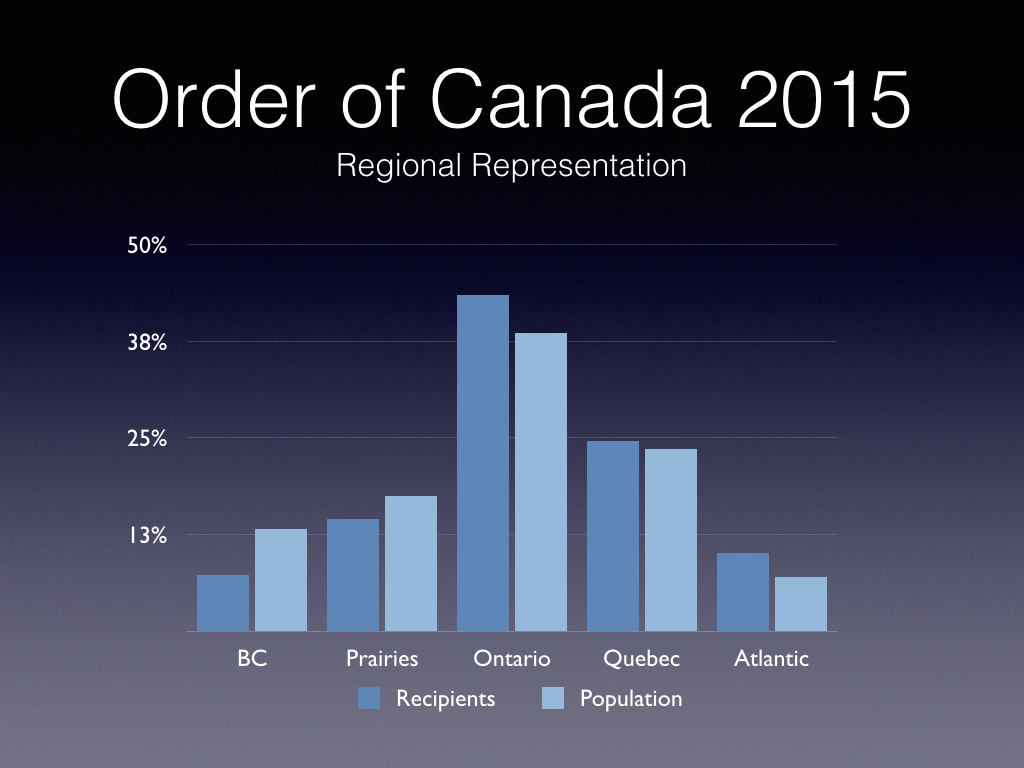
Looking at regional diversity, as some have noted, Ontario and Atlantic Canada are over-represented in relation to their share of the population:

Order of Canada 2015.001

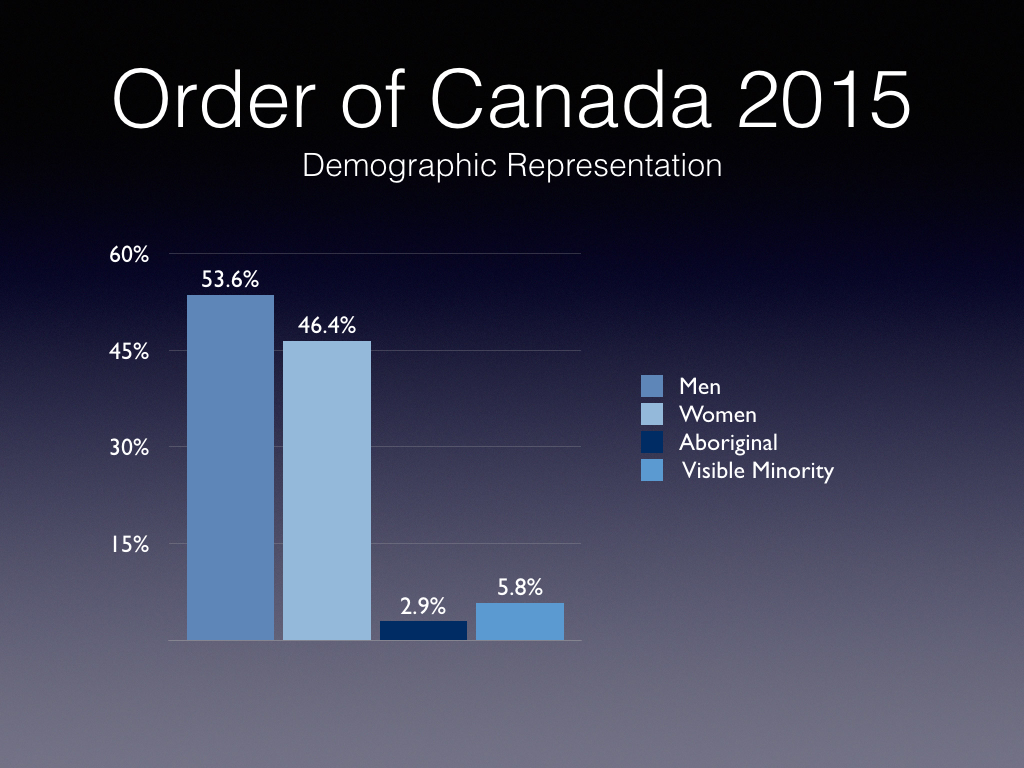
Looking at gender, indigenous and visible minority representation, both women and indigenous representation are relatively close to their share of the population.

However, visible minorities, whether measured against the overall number (19.1 percent) or the number who are Canadian citizens (15 percent), are under-represented at 5.8 percent. (Note: this analysis was based on names and descriptions and not correlated against photos and thus may understate representation).

Order of Canada 2015.002

This is not surprising, given that visible minorities have a shorter history in Canada than other ethnic groups and thus less time to make the kind of contributions that the Order recognizes. But, like other open nomination processes, it may also reflect fewer nominations, in turn reflecting less awareness among visible minorities regarding the Order.

Hard to say without more data but suggests that more outreach to get more nominations may be warranted.

Order of Canada Appointments

#WelcomeRefugees: Milestones and key figures

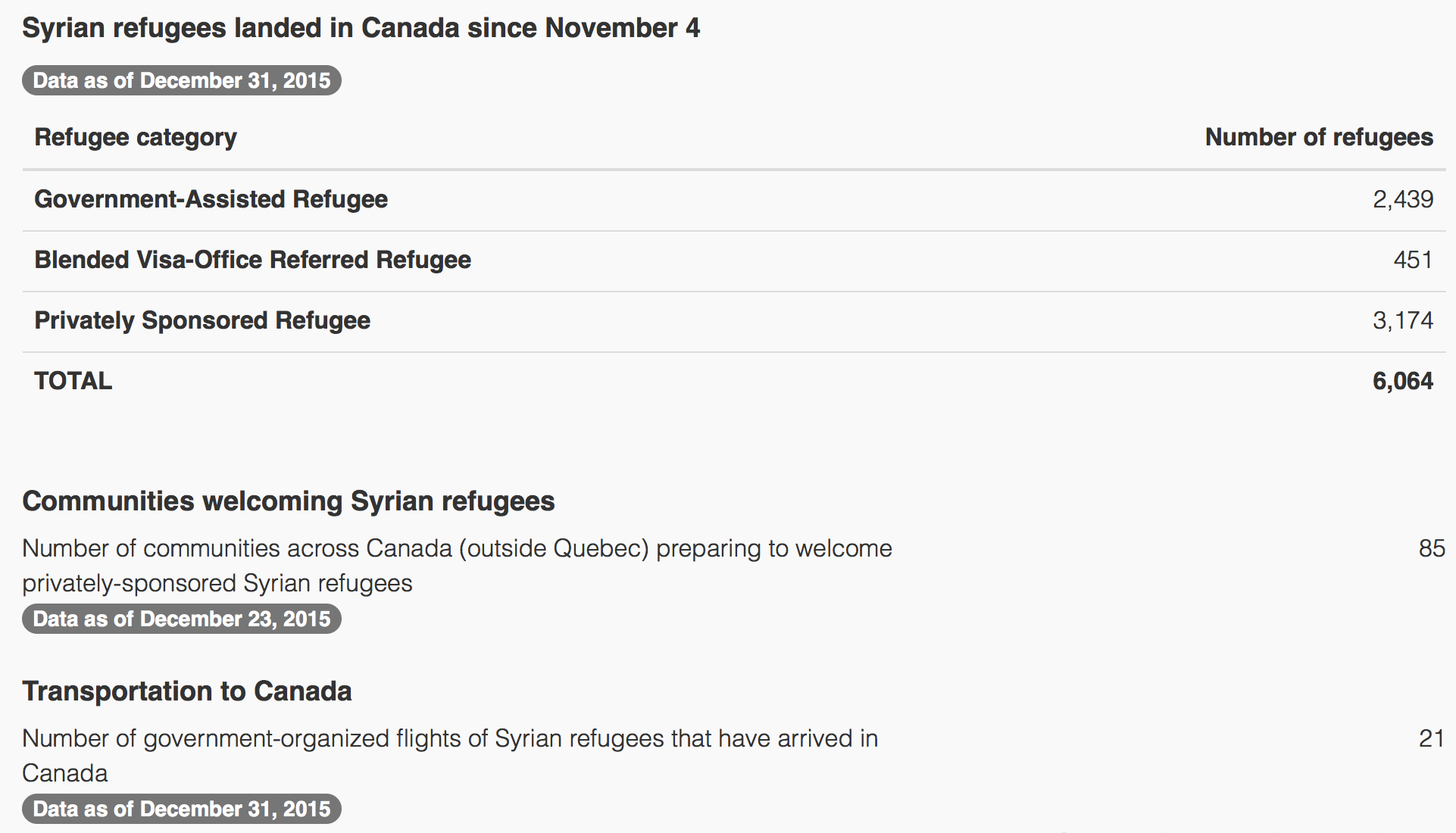
_WelcomeRefugees__Key_figures_1To the government’s credit, it is providing regular updates on the number of Syrian refugees, even if these show that the degree to which it has failed to meet its revised commitments.

_WelcomeRefugees__Key_figures_2Contrast this with the previous government’s repeated refusal to provide specific numbers until forced to.

On the less positive side, the regular CIC operational statistics for citizenship and immigration have not been updated since March 2015.

These should be released as automatically, and without political interference, as regular Statistics Canada data releases.

Source: #WelcomeRefugees: Milestones and key figures

Will Japan’s apology to ‘comfort women’ bring closure?

While leave to others the foreign policy and geopolitical dimensions, long overdue apology:

Now, in a landmark agreement this week, Japan has apologized anew for the practice and pledged $8.3-million (U.S.) to a fund set up for survivors in what both sides said was a “final and irreversible resolution.” Does this new agreement have the power to change the course of Asian geopolitics at a time when the U.S. needs a united front against China, or will it join all the other war-time apologies that are issued, criticized, forgotten and buried beneath the remarkably long-lasting, ever-lingering hatreds of East Asia?

The surprise deal was immediately hailed in Japan as a coup for Japanese Prime Minister Shinzo Abe, who seemed to have finally settled Japan’s grim historical record in Korea, after previously attempting to downplay Japan’s past abuses. This apology was as unambiguous as Mr. Abe was likely to give, offered remorse and considered the immeasurable suffering of the women – rather than trying to justify or fudge the history, as many on Japan’s right still do. The money being pledged also came straight from the Japanese government, which was meant to add an air of formality and officialdom.

But the agreement received a more muted response in Korea, where President Park Geun-hye, who is broadly unpopular, has squeezed anti-Japanese feelings for all they are worth. Former sex slaves and opposition politicians immediately criticized the deal for coming about without the participation of the “comfort women” themselves, for failing to acknowledge legal culpability and for not offering formal financial reparations. Former sex slaves said they were also angry Seoul agreed to discuss with them the possible removal of a statue – placed directly outside the Japanese embassy in Seoul – of a former sex slave sitting next to an empty chair, a symbol of the “comfort women” who died waiting for a full apology from Japan. One group of survivors called the deal “shocking” and said it was an act of “humiliating diplomacy” from Seoul.

Unlike in Europe, which has largely moved on from the scars of the Second World War, memories of Japan’s vicious imperial sweep across much of East and Southeast Asia are still vivid – and influence regional geopolitics to this day. South Korea and Japan still do not share sensitive military information, preferring to rout it through the United States, despite the obviously shared security concerns over China’s growing assertiveness in the region and the perennial problem of North Korea.

The U.S. has constantly urged Tokyo and Seoul over the years to reconcile historical disagreements and move forward in a more united fashion on matters of regional importance such as the Six-Party Talks involving North Korea. In a media briefing, a senior State Department official said the deal could be as transformative to regional relations as the monumental Trans-Pacific Partnership free-trade deal between the U.S., Canada, Japan and other Pacific nations.

Some, of course, argue that apologies in international politics are too often counterproductive. The academic Jennifer Lind has noted that reconciliation between nations does not necessarily require a formal apology – let alone many formal apologies, as in Japan’s case – because the apology provides a platform for nationalist elements in both countries to again debate and disagree over the facts.

But laying aside the criticisms of civil-society groups and opposition politicians in both countries, who have an obvious stake in milking the issue forever, the deal marks an enormously positive step in Japanese-Korean relations. Better military co-operation between Japan and South Korea might dampen China’s appetite for territorial disputes over islands in the East and South China seas, and will certainly help the U.S. execute its ongoing pivot to Asia. It will also prevent North Korea from using historical grievances as a convenient wedge to distract and divide the coalition of countries concerned about Pyongyang, and might dissuade the dictatorship from its destabilizing antics.

Japan has already indicated that it is ready to discuss the “comfort women” with Taiwan, though conversations on the issue with Beijing are likely far off. Still, Mr. Abe and Ms. Park – both arch-conservatives who thrive on the support of nationalist elements in their respective countries – will not be in power forever, and leadership transitions might generate additional warmth to thawing relations.

Though imperfect, the deal does represent an attempt to move forward peacefully, without forever nursing the sting of historic abuses. That sort of closure is something northeast Asia desperately needs.

Source: Will Japan’s apology to ‘comfort women’ bring closure? – The Globe and Mail

ICYMI: How does Canada compare when it comes to resettling refugees? Ibbitson

Good survey article, and noting correctly the advantages of relative geographic isolation:

So Canada’s contribution stacks up well in comparison to some of our closest allies. But our effort pales in comparison with that of Germany, which has taken an estimated one million Middle Eastern refugees this year. “We can do this,” Chancellor Angela Merkel repeats over and over, and she appears to be right.

Sweden has also been exceptionally generous. The nation of 9.6 million people took in 150,000 Syrian refugees in the past year, although authorities have started to crack down in the wake of increasing public resistance.

The absence of any similar backlash here to high intakes of refugees and immigrants – not only during this crisis, but year after year – is Canada’s special blessing. Part of the reason is that most of us are either immigrants or the descendants of immigrants. Our settler culture welcomes settlers.

But the real secret to Canada’s generosity may be its oceans. It is very difficult for a refugee to reach Canada uninvited, making it easier to screen applicants for criminal, security or health risks, and to choose refugees who have a good chance of integrating successfully into Canadian society.

European nations pushing back against the daily tide of desperate humanity flooding north out of the Middle East have no such luxury. Authorities must either admit people about whom they know little or seal their borders.

Mr. McCallum is right. History will not record what targets were missed by how many weeks. It will, instead, note Canada’s impressive humanitarian achievement in rescuing Middle Eastern refugees, even as it looks upon what Germany accomplished with awe.

Source: How does Canada compare when it comes to resettling refugees? – The Globe and Mail

2015 in review – My WordPress blog stats

For those interested, and in the spirit of openness and transparency, please find the WordPress 2015 annual report for my Multicultural Meanderings blog.

Here’s an excerpt:

The concert hall at the Sydney Opera House holds 2,700 people. This blog was viewed about 27,000 times in 2015. If it were a concert at Sydney Opera House, it would take about 10 sold-out performances for that many people to see it.

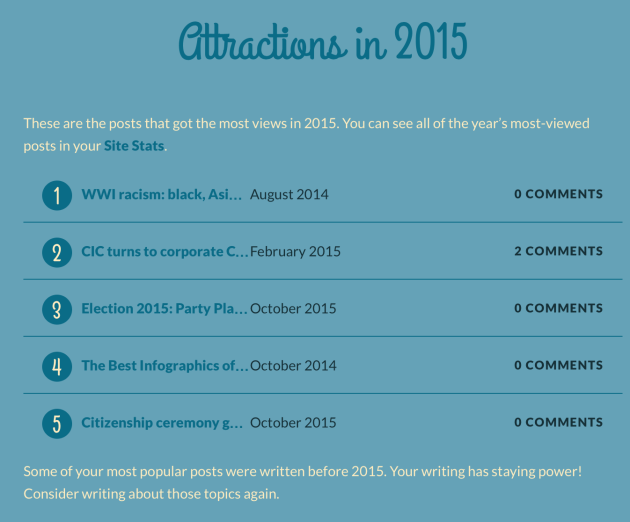
The top posts:

Your_2015_year_in_blogging

Click here to see the complete report.