Labour Market Participation of Immigrant and Canadian-born Wives, 2006 to 2014 (StatsCan study)
2016/01/08 Leave a comment
A good detailed StatsCan study comparing labour market participation of immigrant and non-immigrant women with an abundance of detailed data and breakdowns.
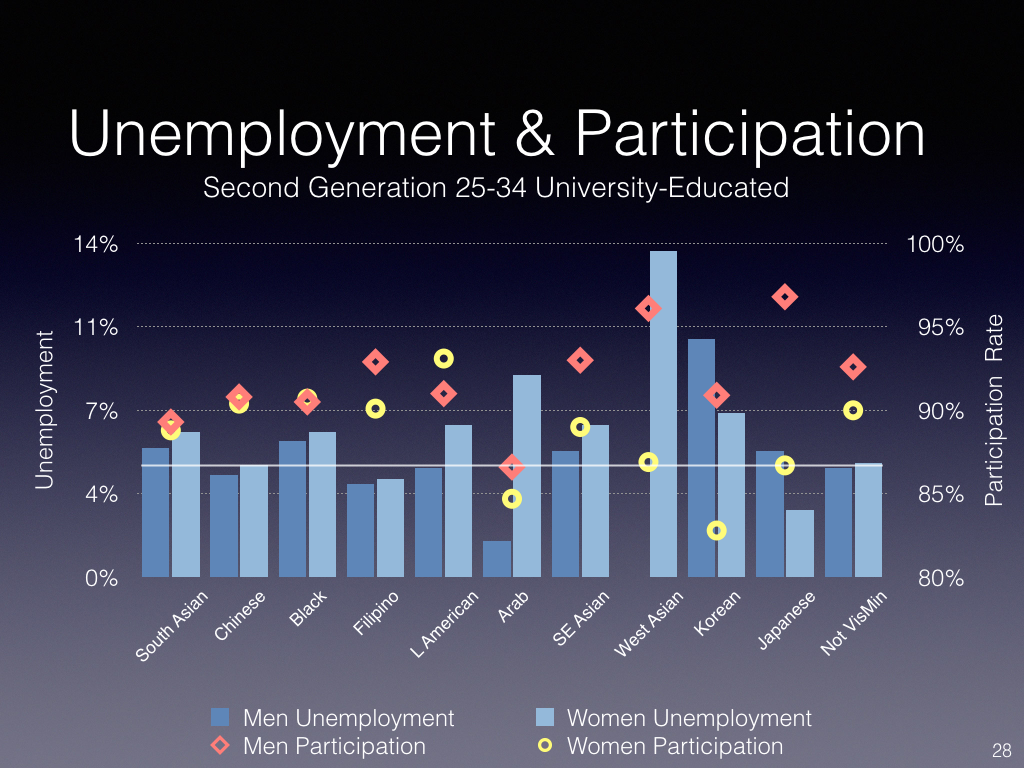 The chart above compares 2011 NHS unemployment and participation rates for visible minority groups with non-visible minorities for second-generation, aged 25-34, university-educated, which shows some interesting gender differences between groups.
Summary of the StatsCan study:
Immigrant wives participate in the Canadian labour market less than do Canadian-born wives. Because this lower participation has implications for the income and living standards of immigrant families, understanding the sources of the difference is important.
This study shows that differences in socioeconomic characteristics account for about half of the difference in labour market participation between immigrant wives and their Canadian-born counterparts observed for the 2006-to-2014 period. The results indicate that female-to-male labour market participation ratios in the source country and, to a lesser extent, family size are key drivers of the difference in participation observed between the two groups of women. The lower wages received by immigrant women in the Canadian labour market appear to play a role, but their contribution is difficult to quantify.
The results raise the question of which factors country-level female-to-male labour market participation ratios capture. Frank and Hou (2015) show that these ratios remain statistically significant in models of the labour market participation of immigrant women even after source-country gender-role attitudes are controlled for. This finding suggests that these ratios capture, at least partly, other influences that affect the participation of immigrant women.
Overall, the study shows that a thorough understanding of differences in family income between immigrants and the Canadian-born requires an understanding not only of wage differences―as most Canadian studies have achieved so far―but also of differences in the labour market participation of wives.
Source: Labour Market Participation of Immigrant and Canadian-born Wives, 2006 to 2014
 About Andrew
 Multicultural Meanderings