US Sikhs feeling vulnerable amid anti-Islam rhetoric, but joining Muslims to fight backlash | Fox News

Have not heard of recent similar attacks here on Sikhs but likely that there are some:

Pradeep Kaleka spent several days after 9/11 at his father’s South Milwaukee gas station, fearing that his family would be targeted by people who assumed they were Muslim. No, Kaleka explained on behalf of his father, who wore a turban and beard and spoke only in broken English, the family was Sikh, a southeast Asian religion based on equality and unrelated to Islam.

But amid a new wave of anti-Islamic sentiment since the terror attacks in Paris and San Bernardino, Kaleka is vowing to take an entirely different approach.

“For us it does not matter who they’re targeting,” said Kaleka, a former Milwaukee police officer and teacher whose father was one of six people killed in 2012 when a white supremacist opened fire at a Sikh temple in Oak Creek, Wisconsin. “This time we cannot differentiate ourselves; when hate rhetoric is being spewed we cannot be on the sidelines.”

Across the U.S., Sikhs and Muslims are banding together to defend their respective religions. Someone bent on harming Muslims wouldn’t understand — or care — about the distinction between the two faiths, they say, and both also deserve to live in peace.

So they plan educational sessions and rallies. They successfully pushed the FBI to track hate crimes against Sikhs. They speak to lawmakers and support each other’s legal action, including a lawsuit filed over a New York City police surveillance program targeting New Jersey Muslims.

“We are in this fight together,” said Gurjot Kaur, a senior staff attorney at The Sikh Coalition, founded the night of Sept. 11.

Sikhism, a monotheistic faith, was founded more than 500 years ago in Southeast Asia and has roughly 27 million followers worldwide, most of them in India.

There are more than 500,000 Sikhs in the U.S. Male followers often cover their heads with turbans — which are considered sacred — and refrain from shaving their beards.

Reports of bullying, harassment and vandalism against Sikhs have risen in recent weeks.

Last week, a Sikh temple in Orange County, California, was vandalized, as was a truck in the parking lot by someone who misspelled the word “Islam” and made an obscene reference to ISIS.

Source: Sikhs feeling vulnerable amid anti-Islam rhetoric, but joining Muslims to fight backlash | Fox News
China’s ‘hidden generation’: plea to give citizenship to stateless children of trafficked North Koreans | South China Morning Post

Under-reported:

Campaigners have urged Beijing to give citizenship to a “hidden generation” of stateless children born to trafficked North Korean women forced into marriage or prostitution in China.

They said an estimated 20,000 to 30,000 children born to North Korean women in China have no nationality and therefore cannot access education, health care and basic rights that most people take for granted.

If their mothers are deported, they are often abandoned by their Chinese fathers, leaving them effectively orphaned, according to the European Alliance for Human Rights in North Korea.

Thousands of North Koreans have fled hunger and oppression in the secretive state since a famine in the mid-1990s. Many are in hiding in neighbouring China, which considers them illegal migrants.

The plight of their children is outlined in a report by the rights group co-authored by Yong Joon Park, a teenager now living in Britain who grew up stateless in China.

They treated him badly. His life was worse than the starving children in North Korea. His mother, Jihyun Park, said traffickers sold her as a wife to a poor Chinese farmer after she fled North Korea in 1998.

When their son was five in 2004 she was reported to the authorities and deported back to North Korea.

There she was sent to a labour camp where she endured “horrific conditions” and prisoners were “worked harder than animals”.

“All I could think of was seeing my son again,” said Park, who eventually managed to escape and return to China.

She found her son, but barely recognised him. His skin was filthy and flaking, and when he was hungry he was sent outside to pick up grains of rice from the ground.

“They treated him badly. His life was worse than the starving children in North Korea,” she said. “The Chinese government does not give children like my son a nationality so they cannot go to school.”

She and her son managed to cross the Chinese border into Mongolia and later moved to Britain and were accepted as refugees.

“When my son arrived in the UK he was nine. It was the first time he had a nationality and the first time he went to school.”

Now 16, he scored straight As in his exams this year and is hoping to go to university to become a lawyer.

Source: China’s ‘hidden generation’: plea to give citizenship to stateless children of trafficked North Koreans | South China Morning Post

Refugees and the long political journey: Martin Patriquin

A reminder, as if needed, just how much can change with new political direction, and the ideology and values of the previous government’s restrictive approach. Must read:

Given all this, I asked Vassallo, a 27-year CIC veteran, why the Canadian government took so long to get comparatively few suffering souls to this country. “I can’t answer that, it’s a political question,” he said, with a hint of a smile.

Unfortunately, Vassallo is right, and his non-answer is a reminder of what happens when a life-or-death issue of refugees gets fed into the cauldron of partisan politics, then further distilled by an at times ugly election campaign. In a sense, the machinations by which potential refugees are sorted and selected should be as apolitical as, say, getting one’s license renewed. Yet as the previous Conservative government demonstrated, there was a distinct attempt to shape and direct the work of its civil servants here and overseas when it came to the victims of the crisis in Syria.

Last January, Stephen Harper’s government announced plans to bring in 10,000 Syrian refugees over three years. Yet several months later, only about 10 per cent of this number had been admitted—in part, it seems, because of a directive from Harper’s office itself that attempted to halt the screening process. At the time, it was presented as a security measure “to ensure the integrity of our refugee referral system,” as Citizenship and Immigration Minister Chris Alexander put it at the time.

Numerous sources, including one with first-hand knowledge of the processing of refugees, said the directive was less about security than about ensuring that Christian minorities took precedence over Muslims. “You got the feeling they were trying to cherry pick religious minorities,” one source said. (Syria, which is majority Sunni Muslim, has a sizeable Christian minority.)

It took the picture of Alan Kurdi, whose lifeless body washed up on a Turkish beach, for the government to slacken the reigns somewhat. Because Kurdi’s family was trying to reach Canada, the political intonations on the Harper election campaign were profound. On Sept 10, eight days after the picture made headlines worldwide, the government waived the stipulation that “resettlement candidates” must provide information regarding why they fled their country of origin.

“Going forward, unless there is evidence to the contrary, visa officers will be able to presume those fleeing the conflict meet the definition of a refugee, which will make processing faster,” reads a CIC briefing document.

There is a certain irony in this. The  government to first make a significant security-related change to the processing of refugees—arguably making it easier for Syrians and Iraqis to make it to these shores—was that of the ostensibly security-first, tough-on-terror Stephen Harper. And he did so as a political calculation, out of fear of losing an election.

Meanwhile, the “security concerns” that supposedly prevented the Harper government from increasing the numbers of refugees brought to Canada were seemingly a partisan mirage. “There have been no shortcuts to the process. They’ve accelerated it in the sense that they’ve sent over additional personnel,” Tim Bowen, chief of operations for Canadian Border Services Agency, told me. According to CIC staff, this includes the addition of some 500 officials deployed overseas to help with the effort, including between 50 and 70 visa officers.

Thankfully, there is a happy ending. First and foremost, refugees are finally arriving. Secondly, the Conservatives are critiquing the effort exactly as they should: on purely financial grounds. The refugee resettlement program will cost $671 million. It is a huge amount of money, and Conservative immigration critic Michelle Rempel promised to hold the government to account. “It is one thing to inspire Canadians, it’s another thing to be accountable to them,” she said.

That Rempel said as much without a fear-mongering whisper about “security concerns” shows how far the party has come in two months.

Source: Refugees and the long political journey – Macleans.ca

Quebec needs to confront its Islamophobia problem

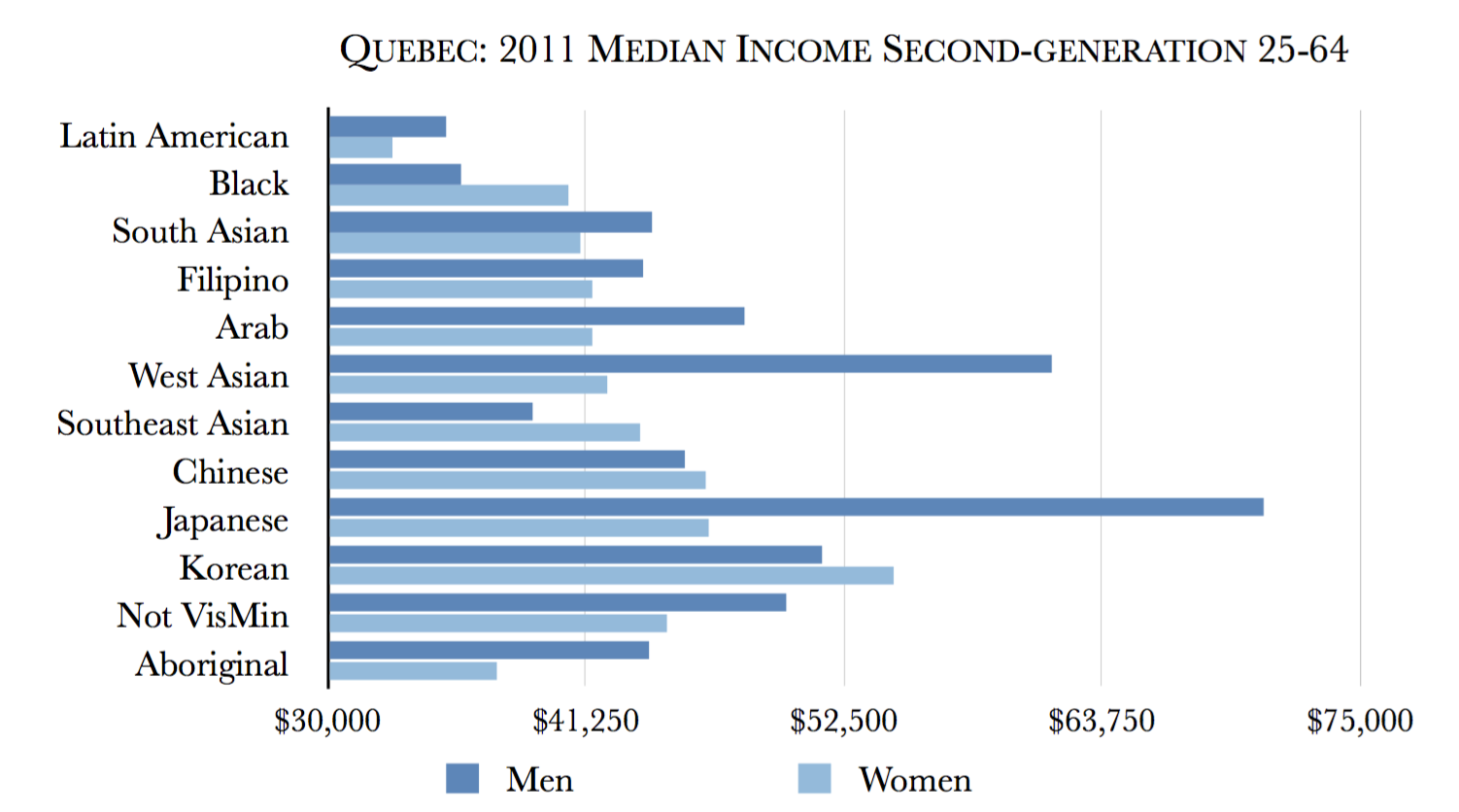
Quebec Second Gen Economic

More on the challenges faced by Muslims in Quebec by Amarnath Amarasingam and Higham Tiflati. Overall, economic outcomes for immigrants and their children are lower than elsewhere in Canada:

While Islamophobia and anti-Muslim animus exists throughout Canada, the nature of it in Quebec seems to be unique, and quite worrisome. Law-enforcement officials and social workers receive calls from concerned citizens wanting to report “suspicious persons” like a man with a long beard in their neighbourhood, and calls from concerned families asking whether their relative, a new convert to Islam, could become a terrorist.

Muslim students also report that Francophone CEGEPs do not allow their students to create Muslim Students’ Associations (MSAs), a policy not even practiced by Anglophone CEGEPs in Quebec.

Polling data backs up much of what these young people are expressing. A 2015 Quebec Human Rights Commission survey found that 43 per cent of Quebecers believe we should be suspicious of anyone who openly expresses their religion, with 49 per cent expressing some uneasiness around the sight of Muslim veils.

For many Muslim youth, this kind of public scrutiny is deeply alienating. Young Canadians from other ethnic and religious backgrounds have the privilege and the freedom to wrestle with adolescent identity issues in private. These struggles, ones we have all experienced, play out quite differently for Muslim youth.

Aspects of Muslim youth identity, such as whether to wear the hijab, are quite often national debates, discussed on the nightly news, and even find their way into speeches given by the prime minister. The young girl wearing a hijab is not someone who has made a fairly harmless and rudimentary religious choice, but is seen as someone making a political statement about Western values or ways of life.

It is no surprise then that these youth express an emotional exhaustion arising from being constantly watched, scrutinized, and pitied. Fairly mundane activities such as walking down the street or riding the bus become “events,” requiring mental and psychological fortitude. It takes a deep toll on their confidence, self-esteem and sense of inclusion. As Safiya remarked, “Shayma didn’t want to feel like a stranger here any more.”

Safiya, though, is committed to changing her life in Quebec, and changing the way Quebecers see her and her community. She has dreams and goals. “My parents brought me here for a reason,” she says. “Sure, things are not perfect, but I see potential in our Muslim community here in Quebec and if everyone just left it won’t help.”

Source: Quebec needs to confront its Islamophobia problem | Toronto Star

Nova Scotia premier to discuss statue Mi’kmaq community says is racist

Another example of significant historical figures and their mixed legacy viewed through contemporary eyes (e.g., the Princeton Woodrow Wilson controversy).

In general, rather than moving the statue ‘out of sight,’ it might be better to have an interpretative plaque that provides a more complete picture of his role and actions.

A learning opportunity for all that recognizes the Mi’kmaq’s valid concerns:

Nova Scotia’s premier says he will discuss options for a statue of Halifax city founder Edward Cornwallis that the Mi’kmaq community has long argued is racist.

A spokeswoman for Stephen McNeil says the premier plans to meet with Halifax Mayor Mike Savage to discuss the statue, which has stood in a downtown park for more than 80 years.

Mi’kmaq elder Daniel Paul says although Cornwallis is the city’s founder, he also issued a scalping proclamation in 1749 that offered a cash bounty for anyone who killed Mi’kmaq men, women and children.

Paul says his goal is not to erase Cornwallis from history books, but to strike a compromise that recognizes the atrocities he committed.

He says he would like to see the statue removed from the park and placed in the depths of the Citadel Hill fortress.

About four years ago, a local junior high school stripped Cornwallis from their name amid concerns from the Mi’kmaq community.

Source: Nova Scotia premier to discuss statue Mi’kmaq community says is racist – Macleans.ca

Canada’s refugee program draws praise around the world

Not surprising that the contrast in language and action noted.

Reinforces the branding strategy of “Canada’s back”:

Only a small fraction of Canada’s expected Syrian refugees arrived last week, but the fanfare around their welcome prompted a slew of headlines – and policy comparisons – around the world.

To New York Times editors, Prime Minister Justin Trudeau “spoke unmistakably to a broader audience” when he personally greeted refugees stepping off Canada’s first government-organized flight, which landed in Toronto late Thursday night.

“Canada’s generosity – and Mr. Trudeau’s personal warmth and leadership – can serve as a beacon for others,” said a Saturday editorial in the newspaper.

“In the meantime, it puts to shame the callous and irresponsible behaviour of the American governors and presidential candidates who have argued that the United States, for the sake of its security, must shut its doors to all Syrian refugees.”

The Thursday plane load to Pearson International Airport, along with a second flight that arrived in Montreal on Saturday, brought just 324 of the 25,000 refugees the Trudeau government has promised to help resettle, including 10,000 by the new year.

But video of their arrival drew hundreds of thousands of views in Canada and elsewhere. The flights coincided with controversy in the United States after Republican presidential front-runner Donald Trump announced a proposal to ban entry of all Muslims to the country.

With many state governors opposing refugee resettlement, several American news organizations noted the widespread support among Canadian leaders for the federal plan.

The Los Angeles Times spoke to Perrin Beatty, the chief executive of the Canadian Chamber of Commerce and a former Tory defence minister, who is working with Canadian Labour Congress president Hassan Yussuff to support the government’s effort.

Mr. Beatty was quoted as saying that Mr. Trump’s “rancid” comments would “drive Canadians in the other direction,” increasing their support for the refugees.

Britain’s Daily Mail wrote that all of Canada’s premiers support the refugee plan, and that members of the opposition, including Conservatives, attended the airport welcome, along with the ministers of Immigration, Health and Defence.

The British government has said it plans to resettle as many as 20,000 Syrian refugees by the end of 2020, and the U.S. government plans to take in at least 10,000 next year.

More coverage followed at Newsweek, the BBC, NBC, Paris Match, CNN, and the Guardian and Independent newspapers in Britain. The American magazine GQ called Mr. Trudeau a “sparklepile of progressive sunshine” at a time when U.S. politics is “a clown show of ventriloquized garbage bags.”

However, The Washington Post noted that recent polls show a similar level of public support in Canada and the United States for welcoming refugees, despite a drastically different tone of public debate south of the border.

A Forum Research poll conducted this month found that 48 per cent of Canadians approve of Mr. Trudeau’s refugee plan and 44 per cent are opposed. The Washington-based Public Religion Research Institute found late last week that 53 per cent of Americans support refugee resettlement, while 41 per cent are opposed, the Post wrote.

News organizations in other countries that have opened their borders to a flood of refugees, particularly in the Middle East, also published articles exploring the significance of Canada’s fledgling program.

“Canada’s programs are an expression of support to Syrian refugees, but importantly for us they are a demonstration, too, of solidarity to countries in the region hosting more than four million Syrian refugees,” Adrian Edwards, a United Nations spokesman, said in a Reuters article published in the Arab News, an English outlet in Saudi Arabia.

Source: Canada’s refugee program draws praise around the world – The Globe and Mail

New rules make it ‘nearly impossible’ for employers to keep foreign graduates on staff

The Liberal government will likely look at this issue as part of reviewing the overall Express Entry point system, along additional points for family siblings and restoration of pre-Permanent Resident time credit:

When Jorge Amigo chose to come to Canada for university, he hadn’t expected to want to spend his life here.

“My decision to come here as a student had nothing to do with immigration,” says Mr. Amigo, 33, who’s from Mexico City. “But after living here for a few months, I realized I loved this place and I wanted to stay.”

Before Ottawa’s points-based Express Entry system was introduced on Jan. 1, international students with a year of Canadian skilled work experience were almost guaranteed to stay by getting permanent residency under the Canadian Experience Class (CEC). But with the change, Mr. Amigo – who has bachelor’s and master’s degrees from the University of British Columbia, an impressive post-graduate résumé and a job with a booming Vancouver-based tech company – fears he may have to leave when his work permit expires in June.

With the new system, it’s nearly impossible for most international student graduates such as Mr. Amigo to get permanent residency under Express Entry – unless their employers can prove that no Canadians can do the job, immigration lawyers say.

“Tens of thousands of students are now heartbroken, stressed and don’t know what to do with their lives because they were misled by the government,” says Vancouver immigration lawyer Zool Suleman. “Employers are looking to lose a group of well-educated students who would be a benefit to the labour market.”

The online system, intended to eliminate a massive backlog of immigration applications from outside of Canada, now makes students compete in a points-based system with everyone else trying to get permanent residency.

“They shouldn’t have included [the CEC] in the Express Entry system because there never was a backlog with it – they never even met their quotas,” says Matthew Jeffrey, an immigration lawyer in Toronto. “These are the ideal immigrants because they’re educated in Canada and they have skilled work experience in Canada and they usually still have that job – they hit the ground running.”

Under Express Entry, applicants get points for education, age, work experience and their skills in English and French. If an applicant’s points are over the minimum score set by the government, they’re invited in.

“The problem for people who came in as students is they can’t rank very highly in the pool,” Mr. Jeffery says, a Toronto immigration lawyer. “They’re young and they only have a year or two of work experience, so their score from the beginning is going to be low.”

Source: New rules make it ‘nearly impossible’ for employers to keep foreign graduates on staff – The Globe and Mail

Bill Murray Befriends the Muslim World: ‘Not Every Flower Is the Same’

Some funny but pointed Bill Murray quotes, that aim to counter the current hysteria:

“There is a phobia about what Muslims are like,” he continues. “I have known about two-dozen. I went to school in Paris with Muslims. Most were from Iran. I found them much to be like friends back home. I was raised as a Catholic. It was always Catholics against Jews. I’m in Hollywood. There are lots of nutty Jews and lots of nutty Catholics. Muslims are just as goofy, too. It is what makes the garden beautiful: Not every flower is the same.”

…And the film [the new Ghostbusters], he says, carries an even deeper message.

“In Ghostbusters, what comes to destroy New York is a giant marshmallow,” explains Murray. “If you face your fears, they are all giant marshmallows. There were people that were afraid to come here to come along for the ride. That thought came into my mind. A friend said we just made a film about a girl that couldn’t sing. Are we going to be afraid to go back? Fear is negative imagination. Do I think these events have been terrible? Are they horrible? Are they dreadful? Yes. But I can’t live a life of fear like that. If I’m going to go, I’m going to go living. Here we all are and we are okay, aren’t we? As soon as I saw the cars and walls, I was like, ‘I’m so glad I’m here. I’m glad I came.’”

Source: Bill Murray Befriends the Muslim World: ‘Not Every Flower Is the Same’ – The Daily Beast

Parable on Bigotry and Citizenship Plays Out in a Supermarket – The New York Times

A good parable:

At the end of the aisle, Ms. Macksoud noticed a couple of middle-age white men talking. One in particular caught her eye with his beer belly, tattooed forearms and large golden cross. As she neared him, she heard the word “Bible.” When she passed him, he said in a raised voice: “not like the Quran those Muslims read.” He included an obscenity to describe Ms. Macksoud and 1.6 billion coreligionists.

Ms. Macksoud grew up on Staten Island, competing in soccer and track, and liked to think that she had that outer-boroughs bravado. Instead of firing back, though, she answered with forced calm: “You didn’t have to say that.”

Surface composure aside, she was shaken. Her flesh felt as if it were quivering. Her mind went so blank she made a wrong turn, and instead of heading into frozen foods, she was adrift and searching for Ms. Yu. “She was shocked and angry,” Ms. Yu recalled the other day. “More in a kind of disbelief that something like this could happen to her.”

Indeed, nothing before ever had. Even after the Sept. 11, 2001, attacks, when Ms. Macksoud began wearing the hijab as her personal way of reclaiming Islam from jihadists, nobody had ever said a word to her. No one objected even when she was working for MTV in Times Square and her building was evacuated during a failed car bombing by a militant Muslim in May 2010.

But in the United States of 2015 — weeks before the terrorist attacks in Paris and San Bernardino, Calif. — someone had insulted and implicitly threatened her in her favorite ShopRite. It felt to her as if all the toxic language of the Republican presidential campaign, with its various forms of Islamophobia, had infiltrated even a store she cherished for its commitment to diversity.

With Ms. Yu at her side, she went to the Customer Service counter to report what had happened. The agent there called for the store’s assistant manager, Mark Egan. “I’m not done shopping,” Ms. Macksoud recently recalled telling him, “but I don’t feel safe here.”

Mr. Egan was about as much of a Jersey guy as a Jersey guy can get. He grew up in Freehold, Bruce Springsteen’s hometown, and married in the young Springsteen’s parish church, Saint Rose of Lima. Mr. Egan, his hair starting to thin at 43, has worked at ShopRite for 13 years.

He told Ms. Macksoud he would protect her. And for the next half-hour, he walked alongside her on the pretense of checking inventory as she did the rest of her shopping. They never did find the man who had insulted her. Before leaving, Ms. Macksoud asked for Mr. Egan’s name so she could send a thank-you letter to the store.

The next day she wrote about the incident on Facebook. She had nearly 300 replies, some from other American Muslims on their experiences with bias — being called a “raghead” or a “Christian killer,” being almost run over, being told to go home, as if home were not here. Many offered solidarity and solace.

One of those correspondents, Sheryl Olitzky, is the wife of a rabbi and the mother of two others. Five years earlier, she and a friend, Atiya Aftab, had formed a group called the Sisterhood of Salaam Shalom, to bring Jewish and Muslim women together. Since then, it has grown to 20 local chapters across the country with another 15 in formation.

With Ms. Macksoud’s permission, Ms. Olitzky called Mr. Egan and told him, “I heard what happened, and you’re my hero.” He replied, “I was just doing my job.”

Modesty aside, Mr. Egan did agree to attend the Sisterhood’s annual convention last weekend to receive an award. His wife and father-in-law came with him, and the Saker family, which owns the North Brunswick ShopRite, made a donation to the group.

Source: Parable on Bigotry and Citizenship Plays Out in a Supermarket – The New York Times

US Conservatives Call For ‘Religious Freedom,’ But For Whom? : NPR

Good article on the ongoing hypocrisy of the religious right and Republican contenders:

Such prejudice bothers some advocates of religious freedom, including Russell Moore, president of the Ethics and Religious Liberty Commission of the Southern Baptist Convention.

“If we really believe in religious liberty, then religious liberty applies to everyone, and that means I’m not threatened by non-Christians having religious liberty,” he says. “I think the only way the Gospel can advance is with free consciences, and I think evangelical Christians particularly ought to be the most vocal about religious liberty for our non-Christian neighbors and friends.”

Robert George, the McCormick Professor of Jurisprudence at Princeton University and a leading lay Catholic intellectual, is also outspoken on the need to defend religious liberty for people of all non-Christian faiths, including Islam.

“It’s scandalous to me when members of a community say, ‘We don’t want a mosque in our town, because the Muslims are terrorists,'” George says. “The vast majority of Muslims are not terrorists or sympathizers of terrorists. They want the same things for themselves and for their children that Christians want, that Jews want, that Hindus want, that all of our fellow citizens want.”

In the aftermath of the Paris and San Bernardino shootings, the fear of more attacks has inflamed anti-Muslim sentiment, fueled in part by Donald Trump and others who are highlighting the threat of “Islamic terrorism.” Those candidates who have emphasized the struggle for religious liberty as a mobilizing cause, from Cruz to Jeb Bush, have either ignored Trump’s repeated anti-Muslim comments or condemned them.

For some conservatives, however, recent events may bring a decision point. They may need to choose between opposing Islam and advocating for religious freedom. To wage both fights at the same time is likely to become increasingly awkward.

Source: Conservatives Call For ‘Religious Freedom,’ But For Whom? : NPR