France’s Real Crisis Is About More Than Just Refugees | TIME

More on the French integration challenges and how laïcité has not helped:

“France is a diverse open minded society, but France also as a collective country has a dark history that they have to acknowledge. But not it’s really just about looking at the past, but facing up to the past in order to claim a common future. That’s still missing in France,” says Amel Boubekeur, a researcher on European Islamic issues at Grenoble University. “I believe that it is something that the U.K. has dealt with much more successfully than France, though it wasn’t the same experience—it was a less violent one. “

France utterly rejected the notion that being French included women covering their heads. Enshrined in its laws is the concept of laicité, or secularization. France moved to protect its culture and in the years since has, for the most part, banned Muslim girls from wearing headscarves to school. To level the playing field, they also banned Christian and Jewish symbols, including yarmulkes. Almost every year since there have been French-Muslim protests to allow their girls to wear foulards to school. The protests ebbed and flowed with the news: after the invasion of Iraq they found new life and have only grown since.

But this enforced secularism isn’t unique to France. In 2009, Antwerp in Belgium moved to ban foulards in schools, a move that spread across Belgium, though not uniformly. At the same time, a new Islamist group, Sharia4Belgium, flourished by opposing the prohibitions on head scarves in the name of religious and civil liberties. The ban “was a major rally point for organizations like Sharia4Belgium,” says Guy Van Vlierden, editor of a blog on Belgian foreign fighters. “A lot of spontaneous action started for that. That has driven a lot of young people into the arms of terrorism, that’s very clear.”

Sharia4Belgium, like many French extremist recruiters and imams, preyed on the immigrants’ sense of not belonging—of unsuccessful assimilation—even when those immigrants were second or third generation. It was the sense of being robbed of their “roots” that set the Kouachi brothers down their destructive path toward Al-Qaeda, that would prove fatal for the employees of Charlie Hebdo.

Europe is a society still grappling with its minority groups, even thousands of years later; just look at the Catalonian and Scottish pushes for independence. It’s also a continent of ancient, beautiful cultures that are fighting to survive within the bigger entity of the European Union; many of the things that make a nation a nation have been subsumed: currency, borders, even to some degree, military action. One means of resistance for France is to protect, at all costs, what makes French people French at a time when its cultural traditions seem under threat — both from the top, with the economic necessity of the European Union, and from the bottom, with the waves of immigrants, and the foulards in the schools. In an increasingly existential crisis, France is attempting to assimilate by force: no foulards, expel radical imams, speak French not Arabic, learn the Marseillaise. But the more they win, the more they lose.

“There has to be some nurturing otherwise people feel like second class citizens, when they’re only invited to speak out against terrorism but say nothing else,” says Boubekeur. “They will say: ‘I have other opinions, other voices and I have the right to express opinions that aren’t loyal to France if I want to do so.’ When you can’t speak to the mainstream, you withdraw from the mainstream.” Culture wars have no winners.

Source: France’s Real Crisis Is About More Than Just Refugees | TIME
Immigration museum in Paris is harsh and honest but incomplete: Keith Boag

Keith Boag highlights one aspect of France’s failure to integrate immigrants and their children, their portrayal in its national immigration museum:

Displays of books, magazines, pamphlets and buttons catalogue a history of French xenophobia.

There is poignant art representing the loneliness of exclusion and isolation from mainstream society.

It’s a pretty harsh and honest account, but still incomplete.

If there was anything said of the massacre of Algerians by Paris police in 1961, for instance, it wasn’t presented to draw my attention, and I missed it.

Nor was there much emphasis on why France should actually be proud to have immigrants settle here.

Marie Curie, who was born in Poland and became a French citizen, gets some attention. So does the German-born French composer Jacques Offenbach.

But the overall impression from the museum is one of “objectification, stereotyping and silencing,” in the words of Sophia Labadi, a scholar of cultural heritage.

She quotes the writer Ian McEwan to explain why it matters that a museum help us to understand the experiences of other people: “Imagining what it’s like to be someone other than yourself is the core of our humanity. It is the essence of compassion and the beginning of morality.”

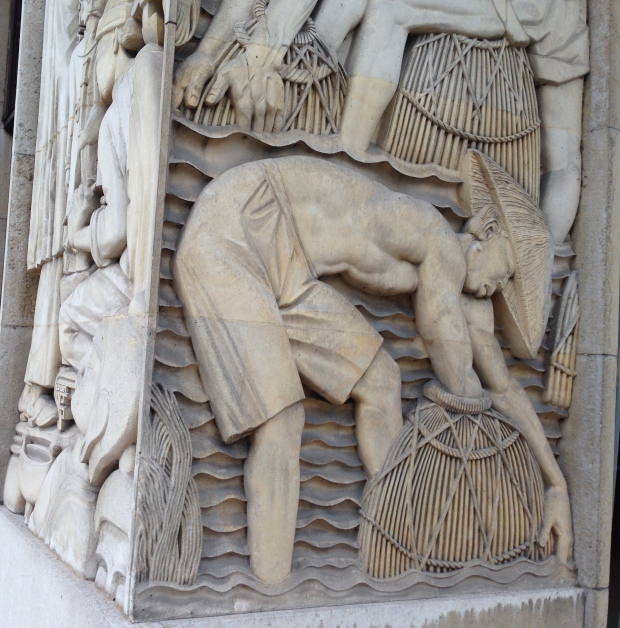
Bas-relief at The Centre for the History of Immigration, Paris

Bas-relief supposedly depicting immigrants’ experiences at the Centre for the History of Immigration. (CBC)

There are ways to do it all this better, writes Labadi. She points to the immigration museum called 19 Princelet Street in London.

There you’ll find overt attempts to put you into the shoes of someone who, for instance, must decide which three possessions — and only three — to take as he or she leaves home for a new beginning in a different country.

There are interactive experiments to uncover the submerged racism hidden inside us.

It’s a teaching museum in modern ways that its French counterpart is not.

On one wall of the National Centre for the History of Immigration in Paris there is text titled “Welcoming Land, Hostile France.”

It reads in part, “In every era, public opinion reinvents the image of the non-integrating foreigner.”

The familiar prejudices

It describes the familiar prejudices: “Too many foreigners, too many competitors for work, bringing disease, potentially delinquent, politically threatening, irreducibly different.”

But then it finishes: “Nowadays more and more people are opening up to diversity.”

Really?

That optimism seems misplaced at the moment. The anti-immigrant National Front party led by Marine Le Pen is on the rise in France.

Here and elsewhere in the Western world political leaders are trying to outbid each other on tough-minded and hard-hearted promises to push back against refugees.

A video by the anti-immigrant group Open Gates that talks of the forced collective suicide of European nations went viral in Europe a week ago before YouTube took it down.

And all that was before the attacks in Paris on Friday.

So if France’s National Centre for the History of Immigration is to help us imagine “what it’s like to be someone else” and discover “the essence of compassion and the beginning of morality,” then it is at best a well-intentioned failure and at worst, not even well-intentioned, just a failure.

Source: Immigration museum in Paris is harsh and honest but incomplete: Keith Boag – World – CBC News

We must not allow terrorists to turn us into beasts: Robin Sears

Reprinted in its entirety:

There is an easily missed photograph at Canada’s museum to our immigration history, Pier 21 in Halifax. It highlights a Polish immigrant family from the 1950s. The picture was clearly taken before they received the appalling news that they were being put on a boat back to Poland for having failed to adequately disprove “suspicions of communist sympathy.” One’s reaction is first shock and then anger at the official who summarily consigned this family, who must have escaped from Poland illegally, to a life in prison if not a more summary reception on their return.

But as you stare at this modest display in mounting anger a second thought occurs. How courageous was the curator who found this story, and probably had to fight for it to be displayed. How proud one should be of the determination of the museum’s creators to tell all sides of Canada’s decidedly mixed immigration history. They smack you in the head at the exit with Daniel Libeskind’s understated but powerful memorial sculpture marking the cowardly decision of the MacKenzie King government to turn back a boatload of desperate Jewish refugees a few years earlier.

Canada’s priceless contribution to the world’s understanding of the essential role of tolerance or mutual accommodation in every successful community is the philosopher Charles Taylor. Taylor puts his case starkly. None of us, he cautions, is capable of resisting the seduction of prejudice, exclusion, or even collective punishment if we are sufficiently terrified by propaganda about “the other.”

Equally, each of us is willing to walk the path of inclusion, tolerance and openness to religious, ethnic and racial diversity with sufficient reassurance about its wisdom and safety. He cites France’s painful passage from being one of the world’s most inclusive societies post-revolution, to its more shameful treatment of its Muslim citizens since they landed on its shores post-Algerian war.

The optimistic conclusion we should draw from the French case is two-fold, he points out. First, any society dragged to the dark side can be redeemed, even if the reverse is equally true. Second, it is all about leadership in the end. It is the inescapable task of genuine democratic leaders to build confidence in openness and tolerance. Leaders who breed fear and division for partisan gain shame themselves irredeemably, and doom their citizens to societies of paranoia and social discord.

So Canada and the world stand once again at this crossroad — do we build walls or bridges? Do we cede victory to these sub-humans who revel in their ability to shed massive amounts of human blood purely to instill terror — and refuse sanctuary to their fleeing victims? Or do we teach our children well, about the dead end that such cowardice necessarily delivers?

Do we again commit the sin of rejecting refugee ships like the St. Louis in Halifax or the Komagata Maru in Vancouver. Will a future Pier 21 curator mount a photo of a dead Syrian family, next to the courageous but rejected Polish family?

Because there is another lesson from Paris, and all the horrors like it, that we will no doubt yet have to endure.

Terrorism works.

My confidence in a serenely safe Japan was shattered the day I missed by 25 minutes the Tokyo subway hit by the bloody sarin attack. My rage at the IRA was deep and murderous when my wife left Harrods half an hour before they killed London’s Christmas shoppers. I was an enthusiastic consumer of angry rhetoric and demands for excessive measures. It was some time before Charles Taylor’s wisdom slowly overwhelmed my determination to support lashing out in rage.

Terrorists always have only one goal: to stab us into becoming the beasts their propaganda requires. To provoke the kind of sectarian intolerance and violent over-reaction that offers visible proof to their audiences that we are indeed bloodthirsty racists and simply liars about the values of tolerance and inclusion we claim.

So, in the days ahead, when we have had the time to reflect on the egregious horror of Paris on Friday night, when the images of so many corpses on blood-soaked streets begin to fade, let us also recall the photo of the tiny shattered body of Alan Kurdi on a Turkish beach.

Yes, we must all use our military, security and intelligence capabilities to crush ISIS — and Canada’s contribution in both military and humanitarian assistance must be greater.

But as hard as it may be to feel confident in doing so today, we must not repeat the mistakes of the last century. We must welcome into our neighbourhoods the victims fleeing this 21st century terror as future Canadians.

Margaret MacMillan: Terrorism almost fully died out in the 20th century. It could burn out again

Lessons of history:

In the next few days and weeks there will be many attempts to find explanations just as there have been after previous atrocities. Poverty is often singled out but that does not account for the fact that so often, as with 9/11, the perpetrators have come from the middle classes and had solid professions. Religion is blamed but the connection of many previous terrorists to Islam has frequently been tenuous. When two would-be jihadists left the United Kingdom a couple of years ago for the Middle East they took with them a copy of Islam for Dummies.

What we can say is that we are now seeing the dark side of globalization. The spread of information, ideas and above all images, are powerful tools of radicalization. Young men and women can identify with causes thousands of miles away. Most stop there, but a handful select themselves as warriors with a mission, even if it means they and others will die in its name. Every society has its maladjusted who, for whatever reason, feel themselves neglected, humiliated or marginalized. The cause does not make them radical; rather they are in search of something that will make them feel important and powerful. That could be the radical variants of Islam — or Christianity or Buddhism — today, or, as in the 19th and 20th centuries, revolutionary socialism or fascism.

The reasons for which people are prepared to commit terrorist acts against civilians have varied over time but terrorism itself is not new. In the years before the First World War anarchists in Europe and North America threw bombs, blew up railway tracks and assassinated key political figures from President McKinley of the United States to the Tsar of Russia. Their goal, as much as they had one, was to destroy what they saw as a corrupt and decadent capitalist society. One anarchist who calmly finished his meal in a restaurant in Paris and then shot a fellow diner said simply ‘I shall not be striking an innocent if I strike the first bourgeois that I meet.’ And like the terrorists of today those of the past frequently radicalised themselves. The young conspirators who succeeded in killing the Archduke Franz Ferdinand in Sarajevo ordered and read the works of the leading anarchists of the time. Gavrilo Princip, who fired the fatal shots, died without showing the slightest remorse for the catastrophe his act had brought on European civilization.

The terrorists of the past, like their counterparts today, were well aware of the disturbing effects of random acts of violence. In Barcelona, a bomb at a performance of an opera which killed 29 innocent people served to terrify the local population. In Paris in the early 1890s a series of attacks on the cafes, business offices, or the French parliament, spread panic and for a time Parisians avoided public spaces. Terrorists then as now knew the value of publicity both to call attention to their cause and to spread fear. Where in the past terrorists used handbills and letters to the newspapers, today they have access to a much greater range of techniques from tweets to professionally made videos such as the ones ISIS makes of its atrocities. And in the past as now there was the copy-cat effect. Terrorists imitated earlier atrocities perhaps to demonstrate their own revolutionary determination. In a chilling recent article in the New Yorker, Adam Gopnik explores the ways in which successive students carrying out mass shootings in American high schools have consciously modelled themselves on the Columbine murders right down to getting the same type of weapons and wearing similar clothes.

As we think about the events in Paris and wonder what is to come next, it is not much comfort to think that we have been through such things before. While history cannot offer us clear lessons as to how to respond, it can perhaps help us to avoid making some mistakes. We should remember the importance of good security and policing. Already this year effective surveillance and co-operation among police forces have uncovered and foiled several terrorist plots in Europe. Governments have to be careful not to act hastily in ways that can be counter-productive. An indiscriminate crackdown on, for example, all mosques and Muslim organizations, runs the risk of alienating a significant community.

The aim of terrorists is not just to panic societies but to sow divisions among them. Already in some of the responses in France and across Europe we are hearing demands that immigration from the Middle East be halted. An Egyptian passport found near the stadium was initially said to have belonged to one of the terrorists. It now appears to have belonged to a man who was killed. Whatever the truth people are already jumping to conclusions. Marine Le Pen, leader of the far-right National Front Party, is suggesting that France needs to drastically tighten its border controls and that French society is under threat from its own Muslims. If such reactions take strong hold in France and elsewhere across Europe, there is a grave danger that moderate and even secular Muslims, which most in Europe are, will feel themselves no longer part of European society.

Source: Margaret MacMillan: Terrorism almost fully died out in the 20th century. It could burn out again | National Post

Even after Paris – especially after Paris: Bringing refugees to Canada must be done well, not fast – Mike Molloy

Reasonable note of caution from a settlement and integration perspective:

The argument is about the rushed time frame. The enthusiasm of the Prime Minister, the ambitious goal he has set, the unprecedented creation of a large cabinet committee to co-ordinate the government’s response are a gust of fresh air after the stonewalling and obfuscation of the Harper regime.

The logistical and accommodation challenges are obvious. The argument championed by our front-line settlement workers, many of them former refugees, is that no matter how difficult it might be for refugees to spend their first months in crowded, improvised accommodation in Canada, anything will be better than their current circumstances. They will be safe. They will be welcome. They will be looked after by people who care. Their circumstances will improve from month to month. Strong arguments.

The counter argument is that our communities, our schools and our excellent settlement agencies will be able to do a better job from the start if the refugees arrive over the next few months rather than the next six weeks.

During the heady days of the Indochinese movement in 1979-80, when the challenge was to accept 60,000 people, a monthly average of 4,500 refugees arrived throughout the October-to-June peak period. On arrival at reception centres on military bases in Montreal and Edmonton, they had three to five days to clean up (deeply appreciated after months in squalid refugee camps), rest and eat.

They were welcomed, issued winter clothing and counselled about what would happen next. The underlying and time-tested philosophy was that they would quickly proceed to their new communities with dignity – clean, well equipped and rested. The faster we got them to their sponsors or new communities the better for them, and the sooner they would adapt to their new lives.

It worked. It has always worked. Keeping refugees in holding camps has never been the Canadian way.

Most importantly, as we allowed a little more time for processing overseas, the Indochinese refugees arrived with their medical and security clearances in hand. They had been screened, so when they left the Canadian reception centre they were Permanent Residents of Canada cleared for security and criminality, they were eligible to work, to study and for medical coverage, and they were on track for citizenship.

Memo to the Prime Minister: You are on the right track. Give yourself and the rest of us, including the refugees, a break. The media and the Opposition will fuss if they are not all here by Dec. 31 – but no one else will.

Do it as quickly as possible, but most importantly – do it well.

Source: Even after Paris – especially after Paris: Bringing refugees to Canada must be done well, not fast – The Globe and Mail

Court told to freeze citizenship revocations in terror cases

No surprise and consistent with campaign pledge and mandate letters:

The federal government is walking away from a legal battle over attempts to strip Canadian citizenship from dual-nationals convicted of terrorism offences.

Lawyers for the government recently asked the Federal Court to suspend proceedings in two cases brought by Canadians convicted of terrorism-related offences who had been told by the previous Conservative government they would lose their citizenship.

As a respondent in the cases, Immigration, Refugees and Citizenship cannot abandon the litigation but, instead, asked for and was granted adjournments while it re-examines a policy that featured prominently in last month’s federal election.

“The Department will work with Minister (John) McCallum on the urgent review of the policy and legislation related to the new citizenship revocation provisions,” media relations adviser Nancy Caron said in an email.

She repeated the line used by then-Liberal Leader Justin Trudeau during a campaign leadership debate, when he argued that Stephen Harper, prime minister at the time, had breached a fundamental principle of citizenship with Bill C-24, which allows the government to rescind the Canadian citizenship of dual nationals convicted of certain serious offences.

“The prime minister has been clear that ‘a Canadian is a Canadian is a Canadian,’ and he doesn’t support the revocation provisions that have a different impact on dual citizens than other Canadians,” said Caron.

In September, former Ottawa radiology technician Misbahuddin Ahmed took the government to court over a July 2015 decision to strip him citizenship.

Ahmed, 31, is currently serving a 12-year sentence in a medium-security federal prison for his role in the planned terrorist attacks foiled by the Project Samosa investigation. If he lost his citizenship, he would have been deported to Pakistan upon his release.

In a Charter challenge, he claimed the attempt to rescind his Canadian citizenship violated his right to safety of the person because he would be deported to a place where he would likely be at risk of mistreatment. He also argued the law offended the principles of justice because the sanction was introduced only after he was convicted.

Now, these issues will not likely be tested in court, as the government is expected to rescind the provisions in C-24 — even as France moves to expand its powers to revoke citizenship from dual nationals.

The Canadian government has also asked for a suspension in a similar case brought by Saad Gaya, a 27-year-old convicted in the “Toronto 18” bomb plot. He is serving an 18-year prison sentence.

Gaya was born in Montreal and had never visited Pakistan, but could be deported there after serving his sentence because, the government had argued, his parents had passed their dual nationality on to him.

Before C-24, Canadian citizenship could be revoked only in cases of fraudulent applications — when a subject had obtained citizenship based on false pretences. The Tories expanded the conditions to include those convicted of terrorism, treason or participation in military action against Canada.

Source: Court told to freeze citizenship revocations in terror cases | Ottawa Citizen

The niqab ban: 2011-2015 – The new Liberal government officially puts an end to the former Conservative government’s attempt to ban the niqab during the citizenship oath

RIP:

The niqab’s emergence as an election issue was unexpected and odd, but perhaps fated–a consequence of the Conservative government’s own policy, its determination to defend the policy in court and the whim of the Federal Court of Appeal’s calendar.

Though seemingly popular, the ban on the niqab is now linked with the Conservative government’s defeat. “Voters—including many who supported him—were personally offended by Harper’s blatant effort to exploit the niqab issue as a divisive wedge in the campaign,” Ensight reported after the election. As a result of that defeat, history will record Bill C-75, an attempt to put the ban into law, as the last piece of legislation tabled in the House of Commons by the Conservative government—its tabling coming just hours before the House adjourned for the last time before the election, an entirely symbolic gesture of pre-campaign posturing. Both the sponsor of the bill, Chris Alexander, and the minister who tabled the bill on his behalf, Tim Uppal, were subsequently defeated on October 19.

The Liberal government’s decision to abandon its predecessor’s legal appeal does not seem to have roused much, if any, condemnation from Conservatives.

Source: The niqab ban: 2011-2015 – Macleans.ca

The formal press release:

“On November 16, 2015, the Attorney General of Canada notified the Supreme Court of Canada that it has discontinued its application for leave to appeal in the case of Minister of Citizenship and Immigration v. Ishaq. The Federal Court of Canada found that the policy requiring women who wear the niqab to unveil themselves to take the Oath of Citizenship is unlawful on administrative law grounds, and the Federal Court of Appeal upheld this ruling. The government respects the decision of both courts and will not seek further appeal to the Supreme Court of Canada.

“Canada’s diversity is among its greatest strengths, and today we have ensured that successful citizenship candidates continue to be included in the Canadian family. We are a strong and united country because of, not in spite of, our differences.”

Earlier language by then Minister of Defence (and Multiculturalism) Jason Kenney:

“At that one very public moment of a public declaration of one’s loyalty to one’s fellow citizens and country, one should do so openly, proudly, publicly without one’s face hidden,” Conservative Jason Kenney told reporters in Calgary Wednesday.

“The vast majority of Canadians agree with us and that is why we will be appealing this ruling.” (September 15, 2015)

Source: Statement from the Minister of Immigration, Refugees and Citizenship and the Minister of Justice – Canada News Centre

Public service about to feel the heat of public scrutiny

Nothing like some sunshine to improve accountability. But the challenge is real as public service-cited evidence will be more open to scrutiny and questioning:

The work Canada’s public service undertakes to support federal cabinet decisions could be thrown into the public spotlight in a way never seen before, according to the instructions Prime Minister Justin Trudeau has given Treasury Board President Scott Brison.

In what is referred to as a “mandate letter,” Trudeau has told Brison to make sure departments use the “best available information” and evidence when shaping policy and decisions — and be prepared to make that information public.

The mandate letters, sent to the 30 cabinet ministers and made public late last week, are built on the key promises of the Liberal election campaign. Brison’s marching orders for open and transparent government include specific instructions to create a culture of “measurement, evaluation and innovation” in the way programs and policies are designed and services delivered to Canadians.

In a big change from the past, those orders also include publicly releasing key supporting information used for making decisions, such as background and analysis, that has been shrouded in cabinet secrecy.

Trudeau also directed Brison to ensure departments set aside money for innovation. The letter asked that a “a fixed percentage” of program funds be reserved “to experiment with new approaches to existing problems and measuring the impact of their programs.”

Sahir Khan, the former assistant parliamentary budget officer who is now a senior visiting fellow at the University of Ottawa, said the government seems to be taking a page from New Zealand’s cabinet disclosure policy, in which a significant amount of the information submitted in memorandums to cabinet is made public.

“This is a level of transparency that we have never seen laid out so clearly,” said Khan, who led the PBO’s work on the analysis of the government’s proposed expenditures. “This represents a fundamental cultural transformation for the public service.”

During its almost 10 years in power, the more secretive Conservative government didn’t seek much public service advice or ask for evidence to back up policy-making.

The big question is whether the public service can now generate sturdy evidence-based decision that will not only be seen by cabinet but will also withstand the scrutiny of Parliament and the public.

Making more of the information around cabinet decisions public will also ramp up the accountability of both ministers and the public service.

“The public service can respond to the challenge, but it has not been asked to flex those muscles in a very long time,” said Khan. “The question is not whether they can respond but how many years for the public service to make such a substantive cultural change for a new way of doing business.”

Source: Public service about to feel the heat of public scrutiny | Ottawa Citizen

Canada’s new foreign policy: the end of ‘ideological fantasies’ – Michael Bell

One of the better pieces on the impact on foreign policy of the change in government, but neglects to mention some of the diaspora politics pressure given the large number of visible minority MPs:

We are at the beginning of a new era in Canadian diplomacy with the election of Justin Trudeau as Prime Minister. Our place in the international community is about to undergo a dramatic and positive change. The appointment of Stéphane Dion as the Minister of Foreign Affairs is a harbinger.

Although there will be many challenges, often insurmountable, and mistakes will inevitably be made, the new Prime Minister’s world view and his commitment to international norms could not be more different than that of his predecessor.

Stephen Harper, the world’s last neo-conservative leader, is no longer with us. His modus operandi in foreign affairs viewed the international community, most markedly characterized in his eyes by the United Nations, as a threat to his deeply held but exclusionist ideology. For him, the very concept of accommodation with others constituted moral relativism: a sellout.

The result: Canada was viewed abroad as an outlier, as a contrarian, as a force for disruption. Mr. Harper’s colleagues abroad found him most often difficult, if not impossible, to deal with. For the first time in our history, and to our great shame, Canada was voted down for a seat on the UN Security Council, so much had we lost the respect of others.

Life was miserable for Canadian diplomats at home and abroad, including those charged with UN affairs; we lost the chairmanship of UN committees traditionally ours for asking; we lost any role in its consultative processes. Mr. Harper and his long-time foreign minister, John Baird, snubbed the institution. Their political staffs: “The boys in short pants” were the enforcers.

With Mr. Trudeau’s election, those days are now past. For instance, after a single day in office, he called on Canadian ambassadors abroad to engage fully with the governments, civil society and media in their countries of accreditation.

In retrospect, it is astounding that the Canadian government’s aversion to evidence-based decision-making lasted as long as it did. It is astounding that diplomacy (most often a backstage craft) was confined to the dustbin. It was depressing that truth could never speak to power. It was intolerable that bureaucrats felt it necessary to ensure that analytical assessments were censored so that the ire of the man in power was not brought down on them.

With Mr. Harper’s electoral defeat, it now seems obvious that Canadians need engagement in a very complex world in which effective policies depend on a deep understanding of foreign cultures and reliable barometers of impending difficulties. We need more reliable eyes and ears out there, not fewer. My hunch is that Mr. Trudeau and Mr. Dion will give us just that.

…A self-confident, socially adept and thoughtful Prime Minister with a feel for issues and a commitment to socially enlightened change. An intelligent, erudite Foreign Minister with a compelling, Cartesian intellect.

What a change.

Source: Canada’s new foreign policy: the end of ‘ideological fantasies’ – The Globe and Mail

Highest ever number of Muslim Canadian MPs elected in new House | hilltimes.com

Good range of interviews on the large number of Muslim Canadian MPs elected:

In interviews last week, MPs, political insiders, and academics said the newly-elected legislators from diverse cultural and religious backgrounds will bring unique perspectives, community feedback and different life experiences to the table which will prove to be valuable in the overall legislation and policy-making process at the highest level of government. They also pointed out that these MPs are not just token representatives of their respective communities but people who have solid credentials in a variety of professions including law, medicine, and business.

“Every Member of Parliament will bring their values to the debates and values are shaped by religion, by experience, by the community that they come from. So, it will shape their values and values will shape what they have to say and their positions, no question,” said Prof. Donald Savoie, the Canada Research Chair in public administration and governance at the Université de Moncton and one of Canada’s leading experts on public administration, in an interview with The Hill Times.

He said Muslim MPs and MPs from other religious backgrounds will have important input in Parliamentary debates in the new Parliament.

“They will have very important points of view that need to be heard,” said Prof. Savoie, adding that Muslim MPs should also not be stereotyped.

“Let them come and debate the issue and let’s hear what they have to say. What they will have to say is as important, as relevant, and ought to be listened to, as much as a white MP from Newfoundland, or from British Columbia.”

Meanwhile, pollster Greg Lyle of Innovative Research said that MPs from different cultural and religious backgrounds will offer valuable input in legislative debates on social and economic issues that affect all Canadians.

“When you are in the room, you don’t have to wait for someone to think about you. You’re right there to bring your concerns front and centre,” Mr. Lyle said.

He said that newly elected MPs from a variety of demographic groups won their ridings because they were the best candidates. Using the example of Justice Minister Jody Wilson-Raybould (Vancouver Granville, B.C.), Mr. Lyle said she is an indigenous woman who ran in a riding that has almost negligible presence of aboriginal people, but won by a margin of about 9,000 votes.

 “In a lot of cases, people are just nominating the best person for this job and they happen to come from different backgrounds,” Mr. Lyle said.

“When you look at their resumés, they’re not getting appointed as tokens. These are people who have really impressive stories to tell,” Mr. Lyle said.

Muslim MPs interviewed for this article said that the previous government’s Anti-Terrorism Bill C-51, the so-called Strengthening Canadian Citizenship Act Bill C-24, the niqab debate, and the barbaric cultural practices snitch line affected the Muslim community directly and motivated it to get engaged a lot more actively than in past elections.

“The community is reaching a new level of maturity, overall. The Muslim community in Canada tends to be a newer community. It’s going through various levels of growth and sophistication, maturity as a newer Canadian community,” said Mr. Alghabra who represented the riding of Mississauga-Erindale, Ont., from 2006 to 2008, lost the two subsequent elections and was elected again on Oct. 19.

“This was a new milestone in that growth process. There’s a greater level of sophistication, greater level of awareness about the importance of getting involved. It was demonstrated through various groups and organizations and individuals,” said Mr. Alghabra.

Ms. Ratansi, who represented the riding of Don Valley East from 2004 to 2011, lost the 2011 election but was re-elected last month, also reiterated that the divisive issues that the Conservatives pushed in the campaign made the Muslim community get involved more actively.

“People got a little concerned about the negativity against Islam. A lot of intelligent people who are lawyers, [legal scholars] who teach law in universities, who are accountants, businesspeople like me, got a little fed up with this constant badgering of Muslims as if we were a homogenous group and we all work the same way. We don’t,” said Ms. Ratansi, adding that unlike the impression portrayed by some in the last government and some news organizations, the Muslim community, overall, is a peaceful hardworking community trying to make the world a better place.

Carleton University Prof. Howard Duncan, who has conducted extensive research on immigration integration theory, multiculturalism theory, globalization, and migration, in an interview, predicted that the election of MPs from different religious and cultural backgrounds will encourage those who did not participate in this election to get engaged in the political process.

“What you’re going to find as time goes by is that immigrants from other countries and other religious and ethnic backgrounds are also going to participate more in politics,” said Prof. Duncan.

Andrew Cardozo, president of Pearson Centre for Progressive Policy, told The Hill Timesthat in the current international political scenario, a number of political conflicts are religion based. He said he hoped that the newly-elected MPs from different religions will prove they can all work together.

“If you think of it in global terms, the biggest division that’s taking place amongst people in the world is around religion. It’s good when you have a country that’s religiously diverse. It’s good to have so many religions represented. With many of them in the same caucus, there should be room for discussion and accommodation when there are differences,” said Mr. Cardozo.

Source: Highest ever number of Muslim Canadian MPs elected in new House | hilltimes.com