Let’s not forget the dark side of our ‘sunny ways’

I think Michelle Gagnon overstates her case.

On any major social issue, there are people who take a more conservative (which may or may not reflect intolerance). Examples include same sex marriage, abortion, criminals, death penalty, assisted death. The niqab and related identity issues are not that different, nor are past instances of intolerance against earlier waves of immigration:

Surely, all the dark forces unleashed these past many weeks can’t exclusively be laid at Stephen Harper’s door.

If wedge politics work, even if only for a while, they do so because a good chunk of the population is onside, or at the very least conflicted.

What’s more, far from being a mere distraction, as so many of those caught up in it contended, the niqab debate is probably better seen as part of the bumpy back road to the discussion about equality and the limits of inclusion in Canada.

To turn away from what the niqab debate and all its corollaries say about us is to refuse to think critically about ourselves. To take Trudeau’s election as proof that we’re “better than that” is just too easy and comforting.

In the abundance of election post-mortems, a few skeptics dared squeak that today’s fuzzy feelings will fade.

Among them, Buzzfeed writer Scaachi Koul who laid out her doubts about this new-found faith in ourselves and our government.

She received as many props as she did criticism. She also heard from one Twitter follower who refused to even read her ode to cynicism. “No time for negativity, sorry,” her non-reader signed off, apologetic.

Sure, this is one voice on social media. And, yes, it’s standard fare these digital days to allow ourselves to delete the unattractive or ugly snapshot.

But that response is also what underpins the downside of sunny ways — the notion that there can be no dissent from positivity, and that we are only what our better angels want us to be.

Our incoming prime minister would clearly like us to feel this way, but even he seems to recognize its limitations.

In a pre-election speech back in March, setting out his vision of the country, Trudeau said: “I want to argue that Canadian liberty is all about inclusion.

“We have had deeply regrettable moments. But the history of this country is one in which we are constantly challenging ourselves and each other to extend our personal definitions of who is a Canadian… I want to make the important point that none of this happened by accident, and it won’t continue without effort.”

In other words, we might want to hold on to those ugly snapshots of ourselves because we won’t know who we are if we don’t.

Source: Let’s not forget the dark side of our ‘sunny ways’ – Politics – CBC News

The Disproportionate Risks of Driving While Black – The New York Times

Black drivers stopped

Black Drivers ContrabandGood in-depth article and analysis:

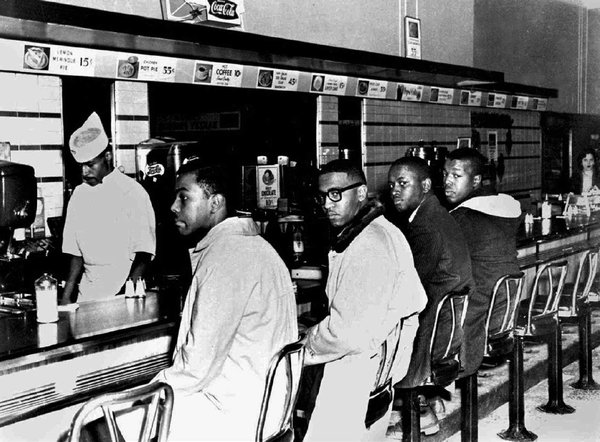
Greensboro has long cherished its reputation as a Southern progressive standout. This was the first Southern city to pledge to integrate its schools after the Supreme Court’s 1954 decision in Brown v. Board of Education, although it was among the last to actually do so. And when four black freshmen from North Carolina A&T State University occupied the orange and green stools at Woolworth’s whites-only lunch counter in 1960, Greensboro midwifed a sit-in movement that spread through the South.

Photo

North Carolina A&T State University students at the whites-only lunch counter at Woolworth’s in Greensboro in 1960. They were, from left, Joseph McNeil, Franklin McCain, Billy Smith and Clarence Henderson.CreditJack Moebes/Greensboro News & Record, via Corbis 

But this is also where hundreds of National Guardsmen suppressed black student protesters in 1969 and where, a decade later, five protesters were murdered at an anti-Ku Klux Klan rally conspicuously devoid of police protection.

And it was here, in 2009, that 39 minority police officers accused their own department of racial bias in a lawsuit that the city spent nearly $1.3 million fighting before agreeing to settle for $500,000. In a city that is 48 percent white, 75 percent of Greensboro’s force of 684 sworn officers remains white.

The Rev. Nelson Johnson, a civil rights leader here since the 1960s, contends that like Greensboro as a whole, the Police Department “has a liberal veneer but a reactionary underbelly.” An activist group he heads recently established a citizens’ board to hear complaints about the police, arguing that official investigations too often are shams.

“This is not about one officer,” Mr. Johnson said at a recent meeting about police behavior at the Beloved Community Center. “This is about a culture, a deeply saturated culture that reflects itself in double standards.”

The Times analyzed tens of thousands of traffic stops made by hundreds of officers since 2010. Although blacks made up 39 percent of Greensboro’s driving-age population, they constituted 54 percent of the drivers pulled over.

While factors like out-of-town drivers can alter the racial composition of a city’s motorists, “if the difference is that big, it does give you pause,” Dr. McDevitt of Northeastern University said.

Most black Greensboro drivers were stopped for regulatory or equipment violations, infractions that officers have the discretion to ignore. And black motorists who were stopped were let go with no police action — not even a warning — more often than were whites. Criminal justice experts say that raises questions about why they were pulled over at all and can indicate racial profiling.

In the past decade, officers reported using force during traffic stops only about once a month. The vast majority of the subjects were black, and most had put up resistance. Still, if a motorist was black, the odds were greater that officers would use force even in cases in which they did not first encounter resistance. Police officials suggested that could be because more black motorists tried to flee.

In an interview, Chief Scott said that overall, the statistics reflected sound crime-fighting strategies, not bias. They have produced record-low burglary rates, and most citizens welcome the effort, he said.

Deborah Lamm Weisel, an assistant professor of criminal justice at North Carolina Central University in Durham, said the best policing practices “involve officers making proactive contacts with citizens, and traffic stops are the main way they do that.”

But many criminal justice experts contend that the racial consequences of that strategy far outweigh its benefits — if, indeed, there are any.

“This is what people have been complaining about across the nation,” said Delores Jones-Brown, a professor at the John Jay College of Criminal Justice in New York. “It means whites are ‘getting away’ with very low-level offenses, while people who are poor or people of color are suffering consequences.”

“It amounts to harassment,” she said. “And police cannot demonstrate that it is creating better public safety.” To the contrary, she added, it makes minority citizens less likely to help the police prevent and solve crimes.

Source: The Disproportionate Risks of Driving While Black – The New York Times

Kareem Abdul-Jabbar: Hollywood Diversity Is a Special Effect | TIME

Good commentary:

Hollywood is the face of America to much of the world. Other cultures learn about us from what they see in our movies and television shows. And Hollywood has been creating roles of true substance for minorities, women, and other marginalized groups. For that, the industry should be applauded, and encouraged to do more. But if they want to achieve true diversity—and we don’t yet know if they do—that must happen not only in front of but behind the cameras, with writers, directors, producers, and others. They need to show they value those voices and stories in the larger culture. It’s a star, I think, within their grasp.

Source: Kareem Abdul-Jabbar: Hollywood Diversity Is a Special Effect | TIME

Richmond man, Xun Wang, gets 7 years behind bars for illegal immigration scheme

Likely one of the more egregious examples of immigration fraud:

A Richmond, B.C., man who made millions helping hundreds of people file fraudulent immigration applications was sentenced to seven years in prison and fined more than $900,000 in provincial court today.

Crown prosecutor Jessica Patterson said Xun Wang, 46, received two fines — one for $187,000 and one for $730,000 — and she said the prison term will be reduced by several months for time already served.

Patterson said the judge “intended to send a message that these kinds of activities are not going to be tolerated.”

“He clearly picked up on the large scale of this operation and the scope of it. It occurred over a number of years and was very sophisticated and very planned, and that appears to be the reason,” said Patterson outside the Vancouver provincial courthouse on Friday morning.

Profitable enterprise

According to court records Wang ran two profitable but unlicensed immigration consulting businesses in Vancouver from 2006 to 2014 called New Can Consultants Ltd. and Wellong International Investments Ltd.

After he was arrested last year, the married father of two pleaded guilty to 15 charges, including illegal immigration consulting, misrepresentation, forgery, fraud, illegally obtaining tax credits and tax evasion.

Wang’s profitable enterprises included creating fake Chinese passports and misrepresenting clients so it would appear they have Canadian addresses and phone numbers when they actually lived in China.

Wang admitted in court that he took these steps in order to create the fictitious appearance of Canadian residency for his clients so they could maintain permanent resident status and obtain Canadian citizenship.

Business records showed up to 1,200 people paid $10 million for Wang’s services. Patterson said it was not yet clear what measures the Canada Border Services Agency would take to follow up on the 1,200 potentially fraudulent immigration applications.

Seven people who worked for Wang were charged in the case. Five are set to appear in court next month. Two are wanted on outstanding warrants.

Source: Richmond man, Xun Wang, gets 7 years behind bars for illegal immigration scheme – British Columbia – CBC News

Citizenship: “Harder to get and easier to lose” Deck

For those interested, my deck presented at a workshop at the Canadian Ethnic Studies Association, October 24th (updated and expanded from my May presentation to the Canadian Bar Association immigration lawyers conference).

Citizenship – Canadian Ethnic Studies 24 Oct 2015

Other speakers included John Carlaw on how the Conservatives pragmatically adjusted their ideology and language to be more in favour of immigration, citizenship and multiculturalism, which he calls ‘Kenneyism’ (while making overall policies more restrictive – see his paper A party for new Canadians? The rhetoric and reality of neoconservative citizenship and immigration policy) and Christina Gabriel, who examined the rhetoric and language around spousal immigration.


One week after the Federal election: The aftermath in Québec’s context (#380)

Quebec Culture Blog well worth following for its insights and enjoyed working him in this piece.

Conservatives openly criticize party’s election performance, C-24 Citizenship

Interesting, Deepak Obhrai’s comment on C-24:

As the week wore on, more Conservatives opened up, with those in Calgary – Mr. Harper’s hometown – in a particularly candid mood.

Calgary Forest Lawn MP Deepak Obhrai, who most recently served as the Parliamentary Secretary to the Minister of Foreign Affairs, talked to media of how he had never liked Bill C-24, a key part of the Harper Conservatives’ legislative agenda that was controversial in the election campaign. Bill C-24, now law, allows Ottawa to revoke the Canadian citizenship of dual citizens convicted of serious crimes such as terrorism.

“I was not comfortable with the whole idea,” Mr. Obhrai said in an interview. He said he does not think the government should have the power to take away citizenship, adding that, in his job, he had “travelled around the world and seen this abuse take place.” He said he never hid his feelings on the bill. “The Prime Minister was aware of the fact I was not very happy about this.”

The legislation unnerved members of the immigrant community, and the Tories encountered concern while door-knocking. Mr. Obhrai said he thinks it hurt his party.

He called Mr. Harper a “visionary leader,” but added that, with a new chief, the Tories need to present “a different, softer image.”

“Somewhere in the middle of the campaign, we became out of touch with Canadians.”

Source: Conservatives openly criticize party’s election performance – The Globe and Mail

For the record, he raised this concern in Parliament on 28 May 2014:

Mr. Speaker, one of the strongest human rights principles is to create all Canadian citizens equal, no matter what. That is the fundamental human rights situation. That is what I am concerned about in this bill, and I would like clarification on from my friend, the minister of citizenship. I agree very much with all of the other aspects that the minister has mentioned. I strongly support this bill except on this one condition, which is the fundamental right for a Canadian to be treated as a Canadian, no matter what.

When a Canadian citizen’s citizenship is revoked, unless that citizenship was obtained fraudulently—and I can agree with revoking it for that reason—we are treating one Canadian differently from another Canadian, and in my opinion that is against a fundamental human rights provision. That is the area of my concern in relation to this bill.

I would like the minister to speak about how he would address this issue of this fundamental human rights principle that a Canadian is a Canadian is a Canadian. We do not talk about dual nationality. If a person has obtained a Canadian citizenship, it is then his legitimate right to be treated as a Canadian citizen. That is what I am asking my dear colleague.

https://openparliament.ca/debates/2014/5/28/deepak-obhrai-2/

Michael Den Tandt: You want a ‘sunnier’ conservatism, Jason Kenney? What a comedian

Some uncomfortable truths here, particularly given the drubbing the Conservatives received in those suburban ridings where new Canadians and visible minorities form a majority or close to a majority of voters (see Visible minorities elected to Parliament close to parity, a remarkable achievement):

Jason Kenney is a wizard in a scrum. Intellectually nimble, rhetorically agile, reflexively partisan, the Conservatives’ former “Mr. Fix-it” is everything one could ask for in a future party leader, yes? Of course yes. Kenney is also, it turns out, a comedian.

“We need a conservatism that is sunnier and more optimistic than we have sometimes conveyed,” he was quoted by The Canadian Press as saying, following his party’s historic drubbing at the hands of Justin Trudeau, a man Kenney himself has incessantly belittled and mocked, for years.

Apparently defeat has refocused the former immigration and multiculturalism minister’s mind on the better angels of his nature. Kenney, long believed to be angling for the Tory leadership in a post-Harper era, has had his conversion on the road to Damascus. He wishes to purge his party of its grim, Harperesque baggage. Perhaps he will be the wire brush, to borrow the Liberal expression from the post-Sponsorship-scandal era, to scrape the Conservative party clean. Perhaps he will tell jokes and smile and speak of building a greater Canada. Perhaps he, too, will hold a news conference in the National Press Theatre, during which he gently reminds shell-shocked journalists they have a role to play in democracy, and are not despised.

Optimism, it has been miraculously revealed, works, and Jason Kenney will be its new blue paragon.

Seriously, now. If there is a single minister other than Stephen Harper who must wear the Conservative loss, it is Kenney. That’s due to his abilities and strengths, ironically enough, as much as his omissions and flaws.

It was Kenney who famously delivered Ontario’s 905 seats, where many hundreds of thousands of new Canadians reside, in the 2011 federal election. It was he, lovingly dubbed the Minister of Curry-In-a-Hurry, who managed to pull off the apparent miracle of streamlining and toughening Canada’s immigration and refugee system, while increasing support among the various communities most affected.

It was Kenney also who spoke up most loudly and clearly, among federal ministers, in the fall of 2013 when former Parti Québécois premier Pauline Marois hauled out her xenophobic charter of values, which later cost her the premiership. “If you want people to become a part of your society and fully participate in it, then you have to create a space (and) send a message that people are welcoming (and) including,” Kenney was quoted by CTV as saying at the time.

But two years later, in the heat of a campaign, there was Kenney front and centre in the bid to transform fear of niqab into votes. It was on Oct. 2, in fact, the day his colleagues Chris Alexander and Kellie Leitch unveiled their proposed “barbaric cultural practices” tip line, that Kenney said this to radio host Evan Solomon: “I believe it (the niqab) reflects a misogynistic culture that — a treatment of women as property rather than people, which is anchored in medieval tribal customs …”

Four days later, prime minister Stephen Harper doubled down, saying in an interview with CBC’s Rosemary Barton that he’d consider banning the veil across the civil service. There were no women wearing niqabs in the civil service, it later emerged, but never mind. This was the Conservative leader saying the wrangling would go on, and on. That very week, Conservative support began to slump, polls showed. It never recovered.

What a difference a day makes: The reframing of Canadian Muslims has begun

More evidence of how the change in tone is being noticed:

Women in headscarves are smiling everywhere. They are in the subway station in Montreal with brightly coloured headgear and cell phones to match. They are at a rally in Ottawa, up close with the prime-minister-designate as they snap selfies that will trend on Twitter. They are walking with their heads held just a little higher, returning smiles offered by random passersby.

What a difference a day makes. The same women who were expressing feelings of fear and discomfort just walking to a mall, or to school, are now the same women whose text emoticons are high-fives, fist bumps, and smiley faces as they share videos of Justin Trudeau bhangra dancing.

It is as though Canadian Muslims, and Canadian Muslim women in particular, stepped out of one frame and into another.

The previous frame had been imposed on them, without their consent and despite their protests. Throughout the election, Canadian Muslims watched as they were vilified as “other,” practitioners of “barbaric cultural practices,” and making choices alien from “Canadian values.”

This othering led to a documented spike in anti-Muslim incidents, including verbal and physical attacks on visibly Muslim women in both hijab and niqab, along with increased Islamophobic online postings and comments.

Yet this deliberate framing throughout the election period was nothing new. Canadian Muslim communities have endured years of it. Whether it was making sweeping generalizations about an entire faith – claiming that “Islamicism” was the greatest threat facing Canada – or suggesting that Canadian mosques could be harbouring radical extremists – a decade of Stephen Harper changed perceptions about Canadian Muslims in deeper and perhaps more hurtful ways than even the aftermath of 9/11.

Back then, Prime Minister Jean Chretien made it a point to visit Ottawa’s main mosque soon after those horrific attacks, memorably doffing his shoes and joining the congregants in a public show of solidarity.

Little of that was on show during the Harper years. After the deadly attack at Parliament Hill by a deranged individual pledging allegiance to violent extremist ideology a year ago, the Prime Minister went nowhere near a mosque.

The local police chief, on the other hand, reached out to community leaders to reassure them that the force was on alert in case of any backlash. Mr. Harper preferred to amplify the incident as a terrorist attack and underplay the details of the perpetrator’s life, including the fact that he was a homeless drug addict who had no formal connection to international terrorist groups.

…Canadian Muslims stepped out of those unfair frames every day as they continued to lead typical lives, yet the national framing and its impacts could not be ignored. A poll found that the number of Canadians holding negative impressions of Islam and Muslims had climbed to 54 per cent in 2013 from 46 per cent in 2009.

Is this now over? Probably not: There is a small but growing cottage industry of anti-Muslim bloggers and commentators who seem bent on suggesting that Islam and Muslims are inherently anti-democratic and dangerous. This may be helping to feed a nascent anti-Muslim movement in this country.

Yet a change in tone and rhetoric from the highest office in the land is certainly something to smile about. That alone will help change the picture, or at least refocus the lens.

Random or arbitrary police carding will stop, province says

As always, the devil is in the details, but the direction is clear:

Random and arbitrary carding by police forces across Ontario will be illegal by the end of fall.

Yasir Naqvi, minister of community safety and correctional services, made the announcement during a debate Thursday where MPPs from across the province spoke out against carding. At the time they were considering a private member’s motion from an NDP MPP to ban random and arbitrary carding, also known as street checks.

“It’s a historic day,” said Margaret Parsons, executive director of the African-Canadian Legal Clinic, who watched the debate in the legislature.

“This is a monumental shift in our province,” said Parsons, who has worked to end carding. She repeatedly paused to compose herself when talking to the Star outside the legislature.

“We have been around for 21 years. We have been fighting on this issue since the day our doors opened, in July 1994.”

Earlier in the legislature, Naqvi moved quickly during debate to address the motion from NDP MPP and deputy party leader Jagmeet Singh.

“We as a government stand opposed, Speaker, to any arbitrary, random stops by the police simply to collect information when there are no grounds or reason to do so,” Naqvi said. “We have heard from the community that street checks, by definition, are arbitrary as well as discriminatory and therefore cannot be regulated; they must simply be ended. The province agrees that these types of stops must end.”

Asked later, outside the legislature, if Premier Kathleen Wynne, who was not at Thursday’s debate on the issue, supports the ban of carding and random street checks, Naqvi emphatically said, “What we’re doing is our government’s position under the leadership of premier Kathleen Wynne.”