Planned passport renewal change opens door to fraud, forgery

My working assumption is that there would have been considerable risk analysis undertaken before making this change, and that Public Safety and its agencies would have been consulted and likely would have commented on the potential risks.

As more and more information is captured and shared electronically, hard to see how an expired passport would allow entry to any OECD country or equivalent.

Option summary worth noting:

From the Citizenship and Immigration Canada documents

Option No. 1 — Status quo of requiring passport holders to return their travel documents

Pros:

  • Allows passport program to take previous travel documents out of circulation and invalidate them in the system.
  • Prevents applicants from having two valid travel documents in their possession.

Cons:

  • The application process would not be entirely online, since applicants would have to return their previous passport to a designated location or by mail.
  • May reduce the number of online applications.
  • May increase application processing time and the number of incomplete applications if the previous passport can not be located.

Option No. 2 — Policy change that does not require passport holders to return their travel documents to the passport program

Pros:

  • In line with New Zealand’s current practices.
  • Adapted to online service and in line with client services, since clients do not have to return their passport to the passport program.
  • The online declaration and the sharing of information about cancelled and expired travel documents would address the risks related to the fraudulent use of passports by a third-party.

Cons:

  • Goes against the United Kingdom, United States and Australian current practices, as all three countries require that the most recent travel document, whether valid or expired, be returned. These countries do not offer an online renewal service.
  • Could inconvenience travellers crossing a border with their previous passport that has been invalidated in the system.
  • Risk of not “catching” applicants that damaged or lost their previous travel documents.

Source: Planned passport renewal change opens door to fraud, forgery – Politics – CBC News
Stephen Colbert Opens Up About His Devout Christian Faith, Islam, Pope Francis, and More

From the interview and his noting historical parallels:

Colbert, who taught Catholic Catechism for several years, says he thinks there is a responsibility with devotion. When Rosica asked him about religious fanaticism and the Charlie Hebdo murders, Colbert said that the Catholic Church was once that extreme. He also said he’s relieved he wasn’t doing a show when the Hebdo massacre took place. “There’s no sufficient response I could’ve thought of at that moment, and I felt very lucky not to be on-air at that time,“ said Colbert. “When a big story happens, I would think, ‘I wish I were on-air to talk about this,’ that one was like, ‘I’m so glad I’m not because I don’t have anything I think that approaches it.”

But he said his second reaction to the murders was to look at his own faith. “If this were the 14th Century, Christians could have done this,” he said. “If the 15th Century Christians might have been offended to the point of violence, at blaspheme. You know, check your history books. So, in an ultimate sense, I do not perceive that action, is indicative of Islam…I’m not trying to make a moral equivalency between the Christianity of the Middle Ages and these people, who are doing this horror right now, but every religion has been so defensive of its beliefs that it has actually abandoned its beliefs at times.”

Colbert said that he hopes his connection to his faith helps him find his humor. “We know that I could do my show and make jokes about the Church, and now sit with a priest and laugh about it, that’s a fairly modern behavior,” he said. “That’s not a hundred-year-old behavior, this is a modern behavior—this is, I hope, the right relationship to have with your faith, which is to love it, but not to exclude it from your intellect.”

Source: Stephen Colbert Opens Up About His Devout Christian Faith, Islam, Pope Francis, and More – The Daily Beast

Public servants brace for war against Conservatives | Ottawa Citizen

More on the Tony Turner fall-out and the public service unions campaigning against the Conservatives:

It’s unclear when Environment Canada — Turner’s employer — will make a decision on whether the singer breached the ethics act with his song. This will turn on whether he can still be perceived as objective and impartial at his job, which is tracking migratory bird patterns.

But [Donald] Savoie and [Ian] Lee agree on one thing: the partisan Harperman performance could undermine any party’s trust in the neutrality of public servants and could particularly reinforce the Tories’ long-held view that bureaucrats are mostly a bunch of Liberals.

“The public service should be concerned about this,” said Savoie. “If the Conservatives are re-elected … they can question if they can really get policy advice that supports their agenda without fear or favour,” he said.

“If Harper sees this video he might say, ‘We can’t trust public servants’ advice …. so let’s go somewhere else.’ This doesn’t help a relationship that has been strained for years.”

Agree with Savoie as both the Turner song and the union campaign will only further Conservative distrust of the public service, not without reason.

Source: Public servants brace for war against Conservatives | Ottawa Citizen

Mr. Harper, this refugee crisis should be your moment: Former Immigration Minister McDougall

Former Progressive Conservative Minister of Immigration Barbara McDougall:

Although rarely spoken of, the irony that Germany, with its Nazi past, should be the most welcoming of any nation in today’s refugee crisis, is not lost on those with any knowledge of the era, which is just about everybody. Canada has its own stain from that dreadful period, the turning away of the Jewish refugee ship MS St. Louis in 1939. While there are many memories of prime minister MacKenzie King, that stain will remain forever on his reputation.

Conservative Leader Stephen Harper would do well to remember this in the current Syrian refugee turmoil. This is his moment to shine, and it is slipping away fast. Conservative Party followers may be split on this issue, but then Conservative Party voters always are, no matter what the issue. Mr. Harper has done well to hold the Conservative factions together for the past decade, but the coalition, which began to unravel shortly after the last election, is disintegrating at an accelerating rate, with the remnants of the old Red Tories becoming more vocal on the moral crisis the government faces.

It is beyond time for Mr. Harper to recognize that every leader faces an unexpected moral choice that sometimes seems to come out of nowhere – and this is his. The fact that he is in the election campaign of his life makes his situation more difficult, but does not make the choice less compelling. He surely does not want to go into history, whenever that may be, with the heartrending picture of a tragically drowned toddler at the top of his file. And it may well dominate, no matter what his accomplishments in government have been, unless he can find a way to navigate the flood of sympathy now rightly being expressed by Canadians from all walks of life, including many Conservatives. Canadians are looking for a leader to lead – to express the sympathetic outpouring of Canadians and act upon them.

Source: Mr. Harper, this refugee crisis should be your moment – The Globe and Mail

Here’s Why Germany Is Welcoming Migrants With Open Arms

Good analysis behind some of the considerations behind Germany’s welcoming large numbers of Syrian refugees:

But what’s the economic effect of so many migrants streaming into Germany? The country expects to receive 800,000 refugees and migrants by the end of 2015. That could cost as much as 10 billion euros, according to local government estimates. Next year, German officials estimate that as many as 460,000 more people could be entitled to social benefits.

Some anti-immigration groups argue foreigners are a drain on a country’s economy, as they seek to avail themselves of government services before contributing to the state themselves. But Germany has a long history of outsiders representing a net positive for the country’s economy. The 6.6 million people living in Germany with foreign passports paid $4,127 more in taxes and social security on average than they took in social benefits in 2012–generating a surplus of 22 billion euros that year, according to one report. German officials are hopeful that, in the long run, this summer’s new flood of refugees could result in a similar economic gain.

“We will profit from this, too, because we need immigration,” German Labor Minister Andrea Nahles said. “The people who come to us as refugees should be welcomed as neighbors and colleagues.”

Part of Germany’s rationale for allowing hundreds of thousands of migrants through the doors lies in demographics. Germany has one of the world’s most rapidly aging and shrinking populations. With one of the world’s lowest birthrates, the country relies on immigration to plug a growing workforce hole. According to one expert quoted in Deutsche Welle last year, the German economy needs to attract 1.5 million skilled migrants to stabilize the state pension system as more Germans retire. An influx of young migrants could improve the country’s dependency ratio, a measure of those over 65 compared to those of general working age between 15 and 64. According to current official estimates, every third German could be over 65 by 2060, leaving two workers to support each retiree.

Still, the jury is still hung on whether immigrants overall serve as drains or boosts to economies. According to one 2011 working paper from Harvard Business School, immigrants in Northern Europe have traditionally started off as a drain on state resources, though some of their wages tend to increase over time, allowing them to contribute back to the state.

Ultimately, whether or not this new wave of migrants helps or hinders Germany’s economy depends heavily on the skillsets they bring. Many of Germany’s current working foreigners — the ones that created the surplus mentioned above — are high-skilled workers from other European countries like Greece. In contrast, the migrants flooding into Germany right now may not be as well-trained. Though the research on the subject is thin, one estimate pegs more than half of refugees lack professional training. That means German policymakers will have to do a very good job of taking unskilled workers and incorporating them into the German labor force in a way that makes sense for long-term growth, whether that’s by incentivizing them to take low-skilled jobs or training them to do higher-level work.

Canada’s immigration reputation: Charting the Tories’ commitment to taking in refugees

The cumulative effect of changes to refugee policy and operations (safe-third country provisions were aimed at reducing those claiming refugee status for economic reasons, not those fleeing for political reasons):

But while the immigration system has been massively streamlined for economic newcomers, Canada has simultaneously made it increasingly difficult for certain refugees. In fact, the massive system overhaul in 2012 is being blamed for the country’s inaction in addressing the Syrian crisis.

A centralized processing facility was established in Winnipeg to expedite applications for privately sponsored refugee claims. However, an internal report made public by an access to information request revealed that staffing shortages caused backlogs to reach “an unprecedented high.”

Authorities also listed 37 countries as being a “designated country of origin,” and enacted a different system for processing refugee claimants from those countries.

Enacted as part of an attempt to cut down on bogus claims, the 37 countries are considered to be free from persecution, and refugees from these “safe” countries are expedited and have no right of appeal.

However, the system also means a refugee from Syria applying to Canada from a temporary home in a “safe” country may see  the chance of acceptance plummet.

“They’ve just added enormously to the paperwork and the hurdles people have to go through,” said Dench.

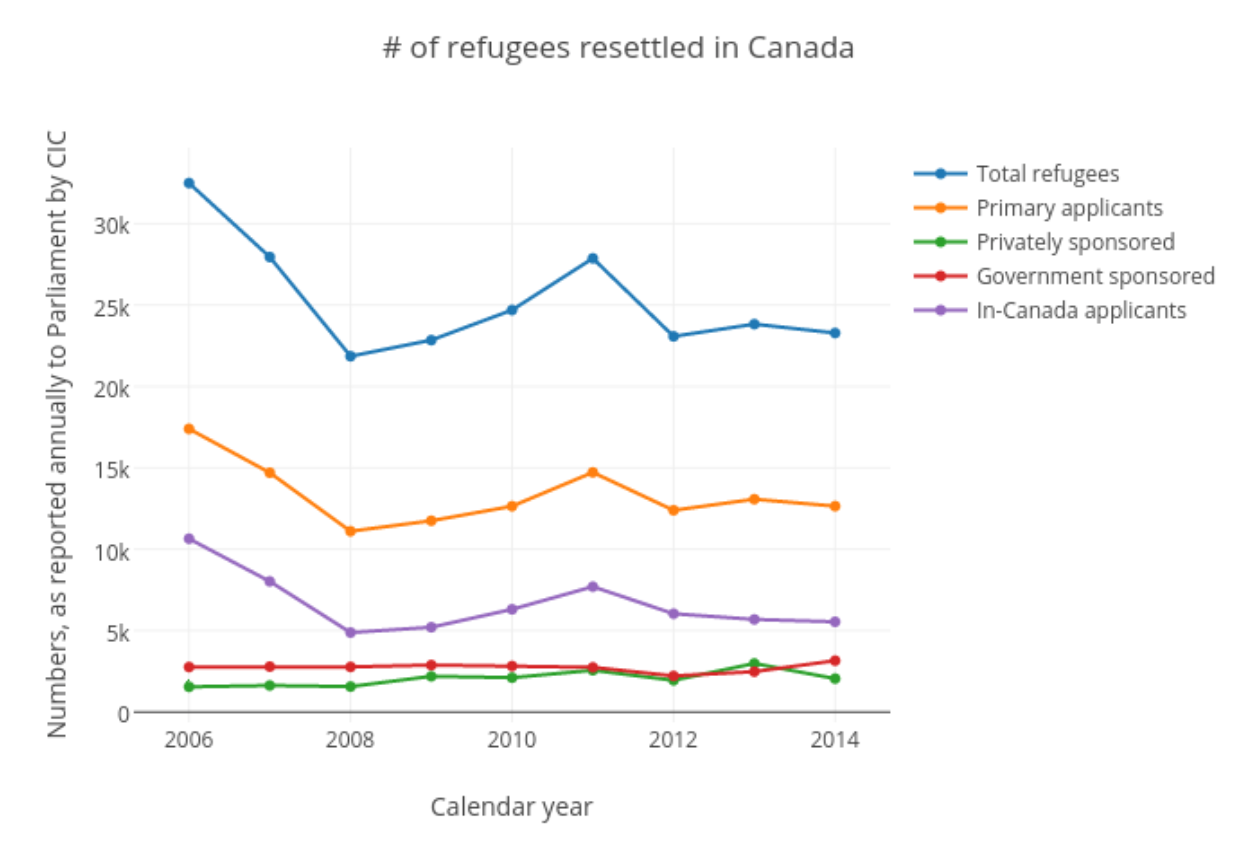
And the evidence, say critics, is in the numbers. Canada received 35,775 refugees in 2005, just before the Conservative election victory. By 2014, the number was 23,286 — a drop of nearly one third.

Most critical to Syrian refugees was the 2012 provision that G5s — refugees who have been sponsored by five or more Canadians — would need to be officially certified as refugees by the United Nations High Commissioner for Refugees (UNHCR).

And with tens of thousands of Syrians streaming into Turkey and Jordan, only a lucky few have been able to undergo the interview and screening process needed to obtain such a certification.

….According to UNHCR, Canada does take in relatively high numbers of “resettled” refugees, having accepted 12,173 of them in 2013 — second only to the United States.

However, this number only refers to refugees who are being transferred from a asylum country to a permanent home.

When it comes to total refugees, UNHCR numbers show Canada ranks 41st globally in terms of per-capita refugees — trounced by countries such as Turkey and Jordan whose share of Syrian refugees equal double-digit proportions of their domestic population.

When gross domestic product and geographic size are ranked, Canada places 55th and 93rd, respectively.

Canada’s immigration reputation: Charting the Tories’ commitment to taking in refugees

Racism Vs. Whites? You’re Kidding Me – The Daily Beast

Interesting and disturbing polling and related commentary by Barrett Holmes Pitner:

[Tom] Edsall pointed to a study conducted last fall by the Public Religion Research Institute (PRRI) that found that 52 percent of white respondents agreed with the following statement: “Today discrimination against whites has become as big a problem as discrimination against blacks and other minorities.”

Among subsets of respondents, 76 percent of those affiliated with the Tea Party agreed with the statement. Another 61 percent of Republicans, and 53 percent of independents. A majority of whites over age 50 also agreed with the statement, and 58 percent of working-class whites agreed. Evangelical Protestants (63 percent) and Catholics (56 percent) also agreed.

62 percent of white Democrats disagreed, and 61 percent of those with a college education. White Americans under 50 also disagreed, even though it was close. Only 48 percent of whites between the ages of 18-29 agreed, and 49 percent of them disagreed. Of whites 30-49, 46 percent agreed and 52 percent disagreed.

Upon seeing these figures I immediately wondered about what exactly white Americans perceive racism to be, and how the supposed racism they receive has become equal to that of African Americans and other minority groups.

Did a leading American presidential candidate refer to large swaths of the white American population as “rapists” and “murderers”?

Have countless white Americans taken to the streets to express their frustrations with a criminal justice system that disproportionately harms and negatively impacts the lives of white Americans?

Are white Americans campaigning against profound levels of income inequality that negatively impact the white community far worse than other racial and ethnic groups in America?

When I look around America I do not see white voices making these complaints. Instead I see large amounts of white Americans expressing their frustration that some traditional white American values are being questioned, or are “under attack,” as some might say.

Source: Racism Vs. Whites? You’re Kidding Me – The Daily Beast

Anti-Semitism in the UK: Hate crimes against London’s Jewish community surge by 93%

Latest UK (London) police-reported hate crimes numbers:

Hate crimes against London’s Jewish minority have surged over the last 12 months with an increase of 93.4% according to figures from the Metropolitan police. In the 12 months from July 2014, police recorded 499 anti-Semitic crimes in London compared with 258 in the same period the preceding year.

….In a statement to IBTimes UK, the Met attributed the rise to several factors, including increased reporting, but said that greater focus on the capital’s 250,000-strong Jewish communities in the wake of events elsewhere had led to the spike.

“In light of recent world events, we know communities in London are feeling anxious,” the Met statement said. “Local neighbourhood policing teams are providing a more targeted presence in key areas at key times, such as school routes, holy days and prayer times to give extra reassurance.”

…A spokesman for the Community Security Trust, which works to combat anti-Semitism in the UK, told IBTimes UK that, while numbers fluctuated, 2014 was a “record high” for anti-Semitic hate crime. He said this was due to “big trigger events” including the Israeli war in Gaza and the Charlie Hebdo attacks in January, which led to increased reporting. He explained that between 2010 and 2013 anti-Semitic crime had fallen, but that generally there had been an increase from 2000.

Islamophobia and crimes against London’s Muslim minority have also increased significantly in the same period. There has been a 71% rise according to the Met, with 816 offences recorded in the last 12 months, compared with 478 offences a year ago.

The police have said Muslim women are most likely to be targets of hate crime: “There are a number of reasons why Muslim women are targeted more than men. Their physical attire obviously says they are Muslim, they are normally by themselves and with children, and the cowardice shown by perpetrators is that it is easier to attack a woman with children than it is a man,” the Met said.

Source: Anti-Semitism in the UK: Hate crimes against London’s Jewish community surge by 93%

Making sense of Canada’s refugee and immigration numbers: Robson

Making_sense_of_Canada_s_refugee_and_immigration_numbersJennifer Robson highlights the obscurity of the formal government reports in understanding the refugee program:

I decided I would try to follow the numbers to better understand the current state of Canada’s federal immigration and refugee programs.

I learned at least four things that I thought are worth sharing:

1) As an outsider, it is very difficult to get detailed information, or to even get information that aligns from one source to the next.

2) There is a $10-million cut planned to Citizenship and Immigration (CIC)’s envelope for refugees.

3) Federal refugee programs are complex and complicated.

4) There are doubtless other cuts to other programs in other departments that any new government may have to live with, especially if it plans on a balanced budget for 2016.

Her report comes with a number of useful charts.

Source: Making sense of Canada’s refugee and immigration numbers