Is ‘they all look alike to me’ pure racism or is there a scientific reason for mistaken identity?

Another aspect of how our brains work and the implications in terms of how we see others:

Scientists, pointing to decades of research, believe something else was at work. They call it the “other-race effect,” a cognitive phenomenon that makes it harder for people of one race to readily recognize or identify individuals of another.

It is not bias or bigotry, the researchers say, that makes it difficult for people to distinguish between people of another race. It is the lack of early and meaningful exposure to other groups that often makes it easier for us to quickly identify and remember people of our own ethnicity or race while we often struggle to do the same for others.

That racially loaded phrase “they all look alike to me,” turns out to be largely scientifically accurate, according to Roy S. Malpass, a professor emeritus of psychology at the University of Texas at El Paso who has studied the subject since the 1960s. “It has a lot of validity,” he said.

Looking for examples? There is no shortage — in the workplace, at schools and universities, and, of course, on the public stage.

Lucy Liu, the actress, has been mistaken for Lisa Ling, the journalist. “It’s like saying Hillary Clinton looks like Janet Reno,” Liu told USA Today.

Samuel L. Jackson, the actor, took umbrage last year when an entertainment reporter confused him with the actor Laurence Fishburne during a live television interview.

“Really? Really?” Jackson said, chiding the interviewer. “There’s more than one black guy doing a commercial. I’m the ‘What’s in your wallet?’ black guy. He’s the car black guy. Morgan Freeman is the other credit card black guy.”

And as a Washington correspondent, I managed a strained smile every time white officials and others remarked on my striking resemblance to Condoleezza Rice, then the secretary of state in the Bush administration. (No, we do not look alike.)

Psychologists say that starting when they are infants and young children, people become attuned to the key facial features and characteristics of the those around them. Whites often become accustomed to focusing on differences in hair color and eye color. African-Americans grow more familiar with subtle shadings of skin color.

“It’s a product of our perceptual experience,” said Christian A. Meissner, a professor of psychology at Iowa State University, “the extent to which we spend time with, the extent to which we have close friends of another race or ethnicity.”

(Minorities tend to be better at cross-race identification than whites, Meissner said, in part because they have more extensive and meaningful exposure to whites than the other way around.)

Distinguishing between two people of a race different from your own is certainly not impossible, cognitive experts say, but it can be difficult, even for those who are keenly aware of their limitations.

Alice O’Toole, a face-recognition expert and professor of behavioral and brain sciences at the University of Texas at Dallas, admits that she often confuses two of her Chinese graduate students, despite her expertise.

“It’s embarrassing, really embarrassing,” O’Toole, director of the university’s Face Perception Research Lab, said. “I think almost everyone has experienced it.”

But as Blake’s case has demonstrated, the other-race effect can have serious consequences, particularly in policing and the criminal justice system. …

If you sometimes mix up people of different races, it might not be racism but an effect of psychological development, researchers say.

Malpass, who has trained police officers and border patrol agents, urges law enforcement agencies to make sure black or Hispanic officers are involved when creating lineups of black and Hispanic suspects. And he warns of the dangers of relying on cross-racial identifications from eyewitnesses, who can be fallible.

The good news is that we can improve our cross-racial perceptions, researchers say, particularly if there is a strong need to do so. A white woman relocating to Accra, Ghana, for instance, would heighten her ability to distinguish between black faces, just as a black man living in Shanghai would enhance his ability to recognize Asians. (Malpass believes that people who need to identify those of other races — in the workplace or elsewhere — are more likely to be successful than people who simply have meaningful experiences with members of other racial groups.)

Source: Is ‘they all look alike to me’ pure racism or is there a scientific reason for mistaken identity?
Excluding expats from voting process is wrong. We’re global citizens: Loat and McArthur

One of the clearest, if most inadvertent, identification of the segment most interested in having indefinite expatriate voting: internationally mobile professionals, or in popular parlance, the “elites”:

Our nation’s challenge is to develop a new conception of citizenship, one that celebrates professionals aspiring to work around the world while maintaining ties to their home country. We cannot afford to be the old “General Motors” of citizenship, presuming a single life-long job in a single location. Many people still have that benefit, but in the increasing Uber-ization of the world economy, a growing share of Canadians will juggle many professional roles over a lifetime of mixed geographies.

There could be countless creative ways to engage Canadians living abroad, ranging from an expatriate voting tax, to professional councils targeting specific communities and skills, to parliamentary representation for citizens abroad. At the deepest level, we need to find every way we can to tell these Canadians that their homeland wants their contributions, rather than pushing them away.

It’s an old trope to say the “the world needs more Canada.” This may well be true. But as a colleague of ours recently put it, “Canada needs more world.” A new conception of global citizenship is a pivotal building block for getting there.

I still don’t see how long-term expatriates, whatever their substantial contribution to Canada, are connected enough to the day-to-day issues that our elections are about. Self-interest – nothing wrong with that – leads them to pursue opportunities abroad.
For those who missed it, an earlier post showed a very small number of Canadian expat voters (Reframing the debate over expat voting: Russell and Sevi, Globe editorial).

Canadians of all stripes oppose face coverings at citizenship ceremonies: Vote Compass – Politics – CBC News

While CBC’s Vote Compass does not have the same rigour as a formal poll, it is likely accurate in reflecting overall public opinion regarding the niqab(E.g. this recent Angus-Reid poll, Religion and faith in Canada today: strong belief, ambivalence and rejection define our views, captures a similar picture):

The findings from Vote Compass largely bolster this claim. When broken down along party lines, the results show that Bloc Québécois and Conservative supporters were most opposed to the idea of allowing people to cover their faces during citizenship ceremonies — 96 per cent and 92 per cent, respectively.

NDP, Liberal and Green supporters were less opposed, with 62, 57 and 51 per cent, respectively, saying face coverings shouldn’t be allowed during this type of ceremony.

On the other hand, 31 per cent of Green supporters, 29 per cent of NDP supporters and 28 per cent of Liberal supporters agree that it should be allowed.

The issue is often “framed as religious freedom, but it’s also an issue about cultural norms, and right across the spectrum you’re seeing that Canadians are very uncomfortable with people covering their face for whatever reason,” says Kyle Matthews, senior deputy director for the Montreal Institute for Genocide and Human Rights Studies at Concordia University.

….The issue is most heated in Quebec, where the notion of reasonable accommodation was a major issue during the 2014 provincial election. While many commentators believe the Parti Québécois’ pursuit of a so-called charter of values was a prime reason for its defeat, religious accommodation remains contentious in Quebec.

According to the Vote Compass results, Quebecers are most opposed to facial coverings in citizenship ceremonies (90 per cent), followed by people in Alberta, Saskatchewan and Manitoba (72 per cent), the Atlantic provinces (68 per cent), Ontario (66 per cent) and B.C. (58 per cent).

Christopher Cochrane, a professor of political science at the University of Toronto, says this is “a textbook wedge issue, and also one of the few roads into Quebec for the Conservative party.”

The Conservatives and the Bloc have been vocally opposed to facial coverings in public ceremonies. While the Liberals and NDP have suggested a more inclusive stance, their positions have been tougher to pin down, says Cochrane.

For those parties, weighing in on the niqab issue is a tricky proposition, especially in Quebec.

“If Mulcair or Trudeau were to express support for a ban or a restriction, they’d alienate a pretty reasonable chunk of their support base,” says Cochrane.

At the same time, “if the Conservatives can make any inroads in [Quebec], then that’s a way of undercutting support precisely where the Liberals and New Democrats are far and away in the lead.”

Source: Canadians of all stripes oppose face coverings at citizenship ceremonies: Vote Compass – Politics – CBC News

Canadian passports exposed to security risks under new processing system

Normal teething pains or more serious problems?

At least 1,500 Canadian passports have been produced under a flawed new system that has opened the door to fraud and tampering, according to documents obtained by CBC/Radio-Canada.

Internal records from Citizenship and Immigration Canada reveal the processing program was rushed into operation on May 9, 2015, despite dire warnings from senior officials that it was not ready and could present new security risks.

One government source told CBC/Radio-Canada there are concerns that passports produced under the new system could wind up in the wrong hands.

Internal reports warn these problems endanger the security of the Canadian passport.

Since the launch of the new system, officials have been scrambling to fix hundreds of glitches and seal security gaps. Weeks after the new process was brought on line, there were calls to stop production.

Those recommendations were ignored, and the passports continue to be issued in the first phase of production under the new system, designed to enhance security and integrate with other global programs.

Numerous reports show that during a period of several weeks, it was possible for Citizenship and Immigration employees to alter the photo on a passport after it had been approved. And there are numerous reports of discrepancies between information contained in the database and what actually appeared on a passport.

In some cases, information disappeared from the system, making it difficult to verify if the applicant had used questionable guarantors or had made repeated claims of lost or stolen passports in the past.

That information acts as a safeguard to flag potential problems with applications.

Responding to the CBC report during a campaign event in Etobicoke, Ont., today, Foreign Affairs Minister Rob Nicholson said ensuring the Canadian passport is secure is a top priority.

“Any mistake, any problems are quickly looked into and remedied,” he said. “The system that we have in this country is as good as any in the world, and I’m confident that will continue.”

Source: Canadian passports exposed to security risks under new processing system – Politics – CBC News

Australia: Returning multiculturalism to the ministry

Marking a move back to the centre:

Overlooked so far in coverage of Prime Minister Turnbull’s remaking of the Australian government has been one intriguing change — the return of a Minister for Multiculturalism. Senator Concetta Fierravanti-Wells’ promotion from Parliamentary Secretary to the Minister for Social Services to Assistant Minister for Multicultural Affairs has gone largely unreported.

The possible significance is not in the nomenclature, as the new Prime Minister remarked when announcing his ministry, parliamentary secretaries are in fact assistant ministers and should be referred to as such.

The senator’s new title means that multicultural affairs are once again acknowledged formally in the ministerial line-up. This small change has leaders in the culturally and linguistically diverse sector wondering whether it signals any change in priorities.

Australia is a migrant nation, with almost half of us coming from overseas or having at least one parent born overseas. While most newcomers identify as proud Aussies, they often maintain their links with countries of origin and sustain legacy languages.

Neither side of politics owns their votes, but this powerful constituency has been recognised and courted by successive governments over decades.

While the demographics have evolved with time and prosperity, migrant communities have often settled in marginal seats such as those in western Sydney which are regarded as likely to decide the outcome of the next election.

Some, reportedly, were worried when the Abbott Government did not include a minister for ethnic or multicultural affairs on coming to power. There were concerns the previous administration did not see this sector as important.

As the Turnbull government signals a move back to the centre of Australian politics, there are hopes in community organisations that this political recognition means that Australian multiculturalism is again valued.

Source: Returning multiculturalism to the ministry | Business Spectator

Pentagon’s take on ISIS fight nothing like Canada’s campaign rhetoric

Contrast between measured and political language, the latter used to install fear and division:

The leaders of the Liberal and New Democratic parties, Stephen Harper tells his election rallies, are such a couple of timorous wet smacks that they can’t possibly be trusted to shield Canadians from the evil that constantly bears down upon us all.

“Justin Trudeau and Thomas Mulcair are so wrapped up in some form of twisted form of political correctness that they won’t even call jihadist terrorism what it is,” Harper told cheering supporters in Sault Ste. Marie this month.

“If you cannot even bring yourself to call jihadist terrorism what it is, then you cannot be trusted to confront it, and you cannot be trusted to keep Canadians safe from it.”

So, to summarize, and I’m using the words of the prime minister here, ISIS is a barbaric, fanatic, radically violent bunch of jihadist terrorist murderers. And they threaten Canadians every single day. And fighting them begins with calling them all those things, and if you can’t call them those things, you aren’t a fighter.

Now, here are the words of Christine Wormuth, the under-secretary of defence at the Pentagon, in testimony to Congress last week:

“While not 10 feet tall,” she told the Senate armed services committee last week, ISIS “remains a thinking enemy that adapts to evolving conditions on the battlefield.”

Wormuth, of course, is not running for office, and it is her job to take a clear-eyed view of her adversary.

She is tasked by President Barack Obama to help lead the military offensive in which Canada has been a proud participant, to use Stephen Harper’s words again.

Wormuth and the two top American generals who flanked her in the hearings tried to focus on the coalition’s meagre gains, but couldn’t obscure the utterly bleak reality that has emerged in the year since Obama announced the offensive.

Just a few days earlier, the outgoing chairman of the joint chiefs, Gen. Martin Dempsey, described the situation as “tactically stalemated.”

Senator John McCain, former naval commander, chairman of the armed forces committee and easily the Republican party’s reigning expert on war, used more pungent language.

“It seems impossible to assert that ISIL is losing and that we are winning. And if you’re not winning in this kind of warfare, you are losing. . . It’s an abject failure.”

McCain, like Wormuth and the generals, didn’t bother with any of the jihadist-murderer-terrorist-barbaric-fanatic-radical references Stephen Harper says a leader must make in order to protect the nation.

Source: Pentagon’s take on ISIS fight nothing like Canada’s campaign rhetoric – Politics – CBC News

Documents reveal government’s scramble to enact niqab requirements: Risks clearly flagged

Sounds all too familiar from my time in government and working on citizenship and multiculturalism files as detailed in my book, Policy Arrogance or Innocent Bias: Resetting Citizenship and Multiculturalism. The official cited was part of my team and I think he read the situation clearly: once the Department had provided appropriate legal and policy advice, and the Ministerial direction was clear, further signal checks would simply aggravate relations without changing the views of the Minister.

The question remains is whether these concerns remained at the Director/Director General level (unlikely) and the degree to which the risks were raised during regular Ministerial briefings or by the Deputy Minister (and whether the opportunity to flag again the legal risk was acted upon):

The documents show that Mr. Kenney’s office asked departmental officials in the late summer of 2011 for “advice on … rules requiring that when people take the oath, their face must be uncovered.”

Senior staff in the Department of Citizenship and Immigration sent a memo to Mr. Kenney headed, all in capital letters, “OPTIONS TO ACCOMMODATE PERSONS WITH RELIGIOUS/CULTURAL GARMENTS WHILE TAKING OATH.” The federal government, in disputes over religious freedom, normally opts for accommodating minorities, they said.

“While there has (sic) been mixed approaches to dealing with religious accommodation in Canada and … abroad, in general, the federal-level response to recent high-profile incidents has been to accommodate religious beliefs when no security reasons exist (see Annex B),” officials told the minister.

Before changes are made, it said, the department needs to consider “the impact on the clients’ rights and beliefs, operational factors and how the requirements of the Citizenship Act and Regulations can be met.” The Citizenship Act contains regulations that individual religious beliefs are to be accorded “the greatest possible freedom.” The act also says changes involving the oath or the duties of a citizenship judge need to be approved by cabinet.

Within weeks, the tone changed. Mr. Kenney had gotten his message across: Niqab-wearers would need to unveil publicly. Mondher BenHassine, the director of policy and knowledge development in the department’s citizenship and multiculturalism branch, told other officials in a memo on Nov. 8 that there was no need to go back to Mr. Kenney for a “signal check.”

“In looking over the hand written comments from the Minister, it is pretty clear that he would like changes to the procedure to ‘require’ citizenship candidates to show their face and that these changes be made as soon as possible. Therefore, I don’t think it would serve us well to go back up for a signal check, it would likely only be seen as foot dragging by bureaucrats. My interpretation is that the Minister would like this done, regardless of whether there is a legislative base and that he will use his prerogative to make policy change.”

Mr. BenHassine went on to ask whether officials would be able to repeat an earlier warning to the minister’s office, dubbed MINO. “Is there the opportunity to flag the legal risk to MINO (it would be good to re-iterate, but not sure if this will make a difference).”

The documents do not make clear what the answer was. Several pages have been redacted from the court record, on the grounds of solicitor-client privilege.

But the documents spell out repeatedly that the policy is “mandatory” or “required.” The word is used in briefing notes to the minister for Question Period, and for officials taking media calls. And the policy itself says that citizenship “candidates are required to remove their face coverings for the oath taking portion of the ceremony.” Mr. Kenney called the wearing of a face-veil while taking the oath “ridiculous” in a CBC interview.

Source: Documents reveal government’s scramble to enact niqab requirements – The Globe and Mail

Immigrants are not a monolithic voting block

Ethnic_Voting_Cochrane_SlideGood panel organized by the Munk Centre:

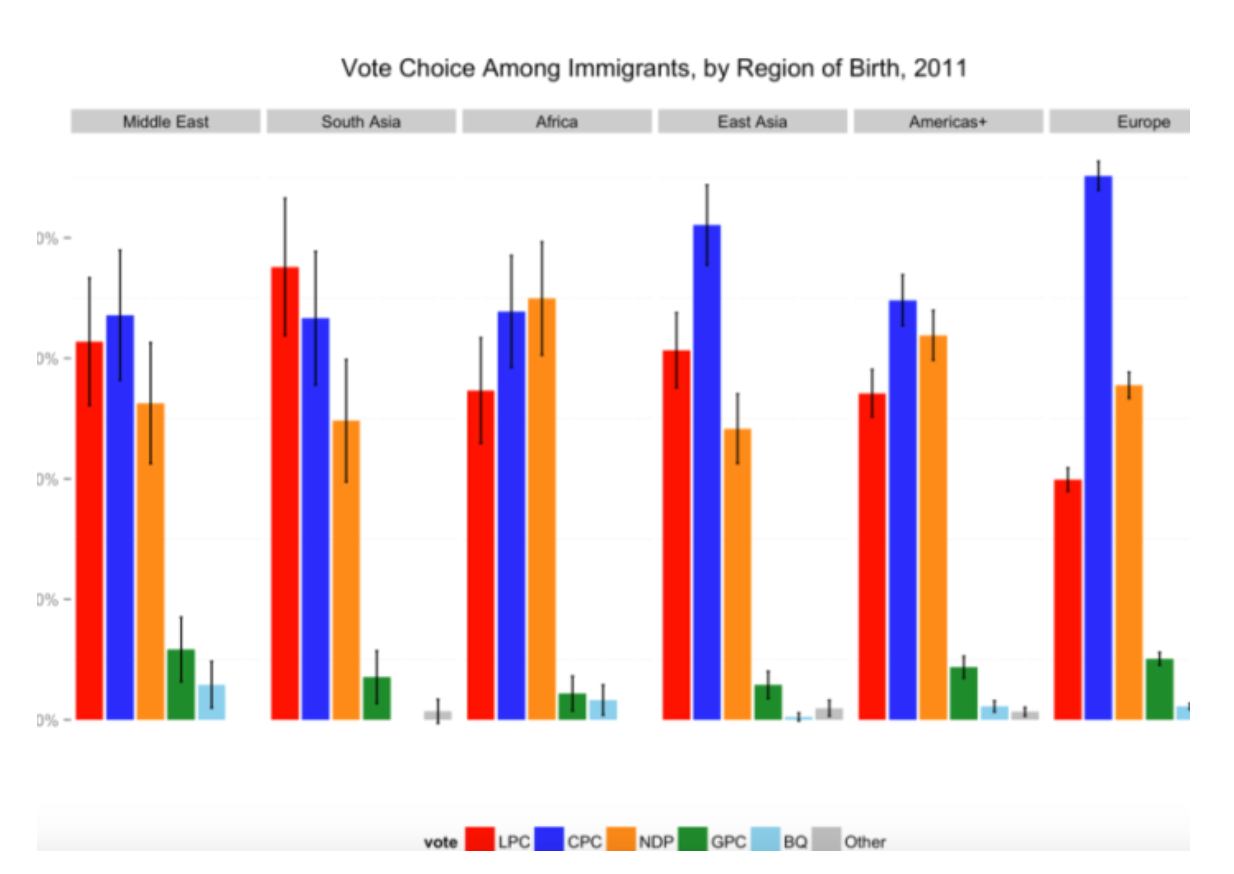
If the Conservative Party is banking on the immigrant and ethnic minority vote to win them the election, as some believe they did in 2011, they might need to revisit that narrative.

“They do well with white immigrants, not visible minority immigrants. I think there is a disconnect with the narrative and reality,” says Chris Cochrane, an associate professor of political science at the University of Toronto Scarborough.

Cochrane took part today in the University of Toronto’s Munk School panel, “Courting the Ethnic Vote: Immigration and Multiculturalism in the 2015 Federal Election.” The panel of experts discussed a variety of topics facing ethnic minorities, from the racialization of candidates to the importance of diversity in politics.

Jeffrey Reitz, the president of the Harney Program in Ethnic, Immigration and Pluralism Studies at the Munk Centre, moderated the panel and opened it by discussing the traditional voting narrative of immigrants in Canada: for generations, immigrants voted for the Liberal Party of Canada, because “they were the party of open immigration,” or for the New Democratic Party, because they were the “party of the underdog.”

There was an apparent breakthrough for the Conservative Party in getting the ethnic vote when the former minister of citizenship and immigration, Jason Kenney, embarked on a major outreach effort during the last federal election, said Reitz.

“Old-stock Canadians with conservative values meet new-stock Canadians with conservative values, that was the story.”

“There is no question about the dominance of the narrative of Conservative inroads among immigrant communities,” said Cochrane, but his findings show different conclusions.

But immigrants who have moved to Canada from the Middle East showed an almost equal vote distribution amongst the parties. South Asians voted strongly for the Liberals, and African immigrants voted for the NDP. The Conservatives were favoured by Europeans, East Asians and Americans.

“A story of a massive special immigrant vote that abandoned the Liberal Party, and shifted to the Conservative Party, outside of Quebec doesn’t seem to be consistent with the data.”

Cochrane’s findings on ethnic minority and immigrant voting patterns came from the “exit surveys” conducted by the research company IPSOS. They surveyed over 100,000 Canadians in the past three federal elections — including over 12,000 immigrant voters.

“This is a unique data set that allows us to look at small communities and discuss it with high statistical confidence, he told iPolitics.”

“Outside of Quebec, the immigrant as a whole mirrors to a larger extent the vote of other Canadians, and is equally heterogeneous. There is a lot of variation in diversity in the immigrant community — just as there is in the non-immigrant community.”

Source: Immigrants are not a monolithic voting block (paywall)

Another good presentation was by Erin Tolley, looking at the news coverage of immigrants and minorities in Canadian politics, sharing the results of her forthcoming book, Framed: Media and the Coverage of Race in Canadian Politics (see her earlier op-ed in the Globe Parties pigeonhole visible minority candidates)

Harper’s ‘old-stock Canadians’ line is part deliberate strategy: pollster (Ekos)

More on the intent behind ‘old-stock Canadians:’

Conservative leader Stephen Harper’s line about “old-stock Canadians” during  the Thursday leaders’ debate was a deliberate move to energize the Conservative base on an emotional topic, a pollster says.

Frank Graves, president of EKOS Research, says that kind of divisional tactic has been used successfully in the past.

“It’s part of the deliberate strategy to sort Harper’s constituency from the rest of the electorate,” Graves told CBC Montreal’s Daybreak. “It creates a sense of us versus others.”

Graves describes Harper’s comment as a “dog whistle”: something meant to be heard by a target audience, but misheard or ignored by the rest.

Harper made the comment while addressing health care for immigrants and refugees.

Source: Harper’s ‘old-stock Canadians’ line is part deliberate strategy: pollster – Montreal – CBC News

The contrary view is expressed by Andrew Coyne (Andrew Coyne: Harper’s ‘old stock’ faux pas was little more than that) and Lysiane Gagnon (In Quebec, old stock is just a fact of life) who maintain that it simply used in a descriptive sense. But words matter, and are chosen for both explicit and implicit messaging, with ‘old-stock’ having an implicit message in the political context.

Muslim, newcomer groups join coalition supporting sex-ed

A reminder of the diversity within and among newcomer groups:

Organizations representing Muslim parents and recent immigrants have joined a new, diverse coalition of 144 groups that plans to fight the ongoing anti-sex-education boycotts and billboards with their own public service announcements and open appeal to Ontarians.

“We have examined the new sex-ed curriculum and as people who live and breathe the health and well-being of Ontario’s diverse communities, we say that the curriculum stands on solid, honest ground,” says the Ontario Coalition Supporting Health Education, in an open letter.

Members of the new coalition will gather at Queen’s Park on Wednesday to voice their support for the new curriculum and to release the letter and a video that were provided to the Star in advance of the launch.

While opposition to the updated health curriculum has come from different faith and community groups — with thousands of families pulling their children out of school last spring for up to a week in protest — the epicentre of the controversy continues in Toronto’s Thorncliffe Park neighbourhood, where the local public school was half-empty on the first day and where 120 students remain out of school, most of them from Muslim families who oppose a curriculum they consider immoral and age-inappropriate.

Another province-wide school boycott is scheduled Oct. 1 and billboards are now springing up across the province warning the curriculum threatens children.

“It seems like the opposition as it exists is not just Muslim, but that has captured the narrative. But on the ground, it is really diverse” — and just as diverse as those who support the curriculum, says Toronto mom Rabea Murtaza, who founded the 682-member Muslims for Ontario’s Health and Physical Education Curriculum, which has joined the coalition.

“I’ve heard from a lot of people. I’m part of a number of Muslim mom Facebook groups and … they care about education. The debate is really rich in these groups and there are lots of voices that say ‘it’s OK, we came here for education, our kids need this.’ ”

The coalition comprises religious organizations, First Nations groups, hospitals, universities, parents and community health agencies, and was created to counter those who oppose the sex-ed curriculum, an issue it says has “polarized community agencies and parents across the province.”

Maya Roy, executive director of Newcomer Women’s Services Toronto, said her agency got onside after some of its South Asian members worked on a project where “aunties and grandmothers were trained to go out and run sharing circles in homes and mosques and temples” about domestic violence, and “they were shocked to find out that you can have sexual assault and rape within a marriage” and wanted to inform their own children and grandchildren about that as well as issues like inappropriate touching, which is covered in the new curriculum.

“We feel a small minority is getting a lot of attention,” said Roy, who heads the service that helps 3,000 women a year. “It’s been hijacked — the entire conversation has been hijacked.”

The curriculum itself is “benign,” she argues, and faith-based criticisms, even in her own Bengali community “don’t hold water,” said Roy, who is Hindu. Critics say the curriculum violates family values “but it actually supports family values and encourages kids to talk to an elder or go to a mosque or temple” for guidance.