Sex-ed guide aims to help Muslim parents deal with controversial new curriculum | Toronto Star

A more intelligent response to the new Ontario sex education guide:

A resource guide on the new sex-ed curriculum is making the rounds in the Muslim community, aimed at addressing parents’ concerns that their children will be getting information that directly conflicts with their religious beliefs.

Farrah Marfatia, principal of the Maingate Islamic Academy in Mississauga, wrote the guide, titled How to talk to your Muslim child about topics in the Ontario Ministry of Education’s Health Education Curriculum, 2015, over the summer, as a way to educate parents on what their children will be learning in class — and help them prepare for those sensitive discussions in advance.

How did this guide come about?

When the new curriculum came out, there was a lot of information and misinformation that was being thrown around. Personally, I was also confused about it, so when it came out I first read the document. It’s a huge document, and what kids will be learning is not all in one place, it’s scattered across the document. So, it started as a summary for me.

As an Islamic school principal, private schools are not required to cover the curriculum. But there are a lot of Muslim kids in the public school system, because parents can’t afford Islamic school, or there is no room in Islamic schools. And many parents don’t have the opportunity to home-school even if they want to. And I was thinking about those parents — how do I help public school parents who have no other choice to understand the curriculum from their religious point of view?

Source: Sex-ed guide aims to help Muslim parents deal with controversial new curriculum | Toronto Star

And it appears that the effect on enrolment in public schools is minimal:

No ‘mass exodus’ from Ontario schools despite threats to pull kids in protest of new sex ed curriculum

Long term expats find ‘loophole’ in voting ban; but casting ballot costly

A loophole or a test of commitment? Or both?

However, the method costs money, travel, and time, prompting some to argue the rules have effectively made their right to vote subject to financial ability.

“Voting should not be something you must purchase,” said Natalie Chabot Roy, 38, who was raised in northern Ontario but lives in Bonney Lake, Wash.

Earlier this year, the government successfully appealed a court ruling that would have allowed Canadians abroad for more than five years to keep on voting by way of a mailed “special ballot”.

Nevertheless, at least one enterprising expat has already cast his ballot for the Oct. 19 election under another section of the Canada Elections Act that amounts to a barely accessible backdoor around the ban, and others are considering following suit.

That section allows expats who show up in the riding in which they lived before leaving Canada to vote — if they show proof of the former residency along with accepted identification.

….Last week, Elections Canada finally updated its website to confirm the little-known voting information, even though spokesman, John Enright, said it was “not a new position.”

The law barring long-term expats from voting has been on the books since 1993, but it was only in 2008 that Elections Canada began enforcing the rules, catching some Canadians abroad by surprise.

One was former Montrealer Nicolas Duchastel de Montrouge, 43, who went to the U.S. in 2000 for work and now lives in suburban Seattle. The ballot refusal in 2011 prompted him to delve into the rules, where he discovered what he called the “loophole.”

In a letter to the self-described political junkie last month, a senior Elections Canada official confirmed his right to vote — if he could show up in Hull, Que. — where he was “ordinarily resident”, before leaving Canada.

Source: Long term expats find ‘loophole’ in voting ban; but casting ballot costly

Australia: Committee recommendations improve citizenship bill, but fundamental flaws remain

Will be interesting to see if the Abbott government accepts some of these recommendations (unlike the Canadian government which rejected any proposed amendments in committee hearings on Bill C-24):

The PJCIS [Parliamentary Joint Committee on Intelligence and Security] recommendations address several fundamental problems with the bill as drafted. The recommended tightening of Sections 33AA, 35 and 35A would ensure that some of the most inappropriate candidates for citizenship loss under the bill – teenagers who graffiti Commonwealth buildings, Red Cross aid workers or people who puncture Commonwealth car tyres – would no longer be vulnerable.

Additionally, the committee recommended the inclusion of a number of pivotal safeguards that were excluded from the bill’s original draft. For instance, for ASIO advice to be acted on, the committee recommended that – as is typical – a full security assessment should be required.

Where a person loses their citizenship, the committee recommended that, as far as possible, they should be informed of this and of their potential avenues for judicial review. The committee also recommended that additional safeguards should apply with respect to the citizenship of children.

These recommendations rectify fundamental defects in the bill’s original draft. However, important concerns about its constitutionality, clarity and adherence to the rule of law remain.

Source: Committee recommendations improve citizenship bill, but fundamental flaws remain

Foreign buyers flocking to Canada to find surrogate mothers after Asian countries crack down

Largely anecdotal rather than hard numbers, but nevertheless another aspect of birth tourism. Ironic that as developing countries crack down, Canada becomes a preferred location:

As doors are closed in some Asian countries, foreigners are flocking to Canada to make use of its surrogate mothers — and the taxpayer-financed health care system that looks after them, consultants and lawyers say.

One agency that helps “intended parents” work with surrogates says it has been “overwhelmed” with a 10-fold increase in business over the last few months.

Owner Sally Rhoads-Heinrich cites the closing recently of international surrogacy arrangements in Thailand, Nepal and — for same-sex couples — India.

Some parents are even having embryos they had stored in such countries shipped to Canada to restart the process here, said another consultant.

“I’m averaging about 600 emails a day,” said Rhoads-Heinrich. “I start usually at about 6:30 in the morning and I’m going until 11:30 at night. I can’t keep on top of it right now so I’ve had to hire more people.”

She used to sign up 20-40 clients a year, but now has more than 200, part of an industry estimated to be worth billions worldwide.

Rhoads-Heinrich worries, though, that people from overseas are essentially taking advantage of the fact Canadian surrogates are covered by medicare, an advantage promoted by at least one of her competitors.

“I don’t like Canada being seen as just a free-for-all for people to come here and use our health-care system,” she said. “We’re being flooded and I’m not seeing Canadian couples being helped. I’m seeing a lot of international couples being helped.”

The demand comes largely from other developed countries with more restrictive laws. Some, like France and Germany, ban surrogacy outright, while others, such as Israel, do not allow it for same-sex couples or single people.

Canadian law permits the practice, but prohibits commercial fees, a system on the verge of being tightened by contentious new rules.

Source: Foreign buyers flocking to Canada to find surrogate mothers after Asian countries crack down

More commentary on Syrian Refugee crisis: Impact of previous policy changes and recommendations what should Canada do?

Syrian_Refugees_MacleansStarting with the use of refugee or migrant:

For most of the Syrians we are hearing about, I would argue, the right term is “refugee.” The origins of that word also belong to the 17th century, when it referred to Protestants who fled religious oppression in a triumphantly Roman Catholic France. Over time the word’s meaning extended to include all those who were escaping war, persecution, or intolerable conditions at home. Kurdi’s family were determined to get away from a civil war that has all but destroyed Syria. They were not making a rational economic decision or a calm political choice. Just like the Vietnamese boat people in the late 1970s, they were fighting for their lives.

Are they refugees or migrants? Why what we call the people fleeing Syria matters

On the implications of the policy changes made to reduce fraud for family sponsorships with respect to Syrian refugees and the Kurdi case:

In earlier humanitarian crises, Canada went directly to the migrants and accepted large numbers quickly. That stands in stark contrast to Thursday’s response from the federal immigration department to the death of a boy found on a beach in Turkey. A group of Canadians had applied to bring in his uncle’s family and hoped to sponsor the boy’s family next. But the family had not been certified as refugees by the UN refugee agency, UNHCR, or a foreign state.

…Canada has required such certification since October, 2012 – when the Syrian crisis was developing – for “group of five” sponsorships, a reference to the minimum number of adult Canadians needed to bring over a refugee family.

…Among the other bureaucratic hurdles is the fact that the waits at visa offices for Canadian officials to review applications – a review that happens after that of the UNHCR – range from 11 months in Beirut to 19 months in Amman to 45 months in Ankara, according to Canadian government figures.

And the immigration department’s central processing office in Winnipeg – which handled the application for the boy’s extended family – takes two or three months to look at applications.

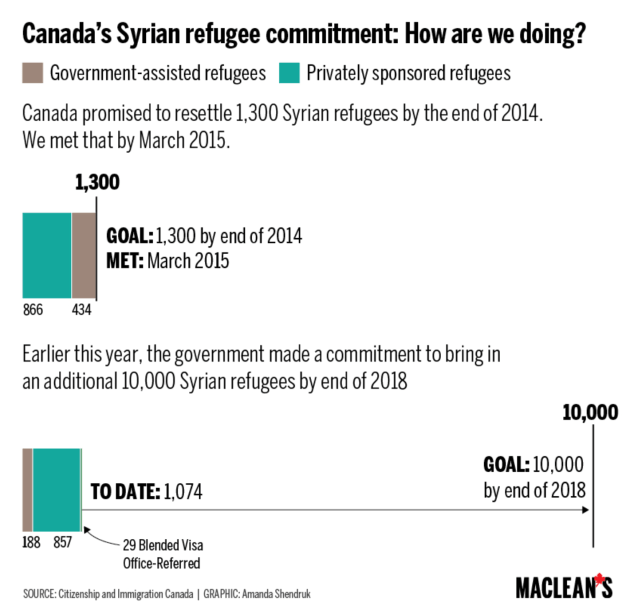
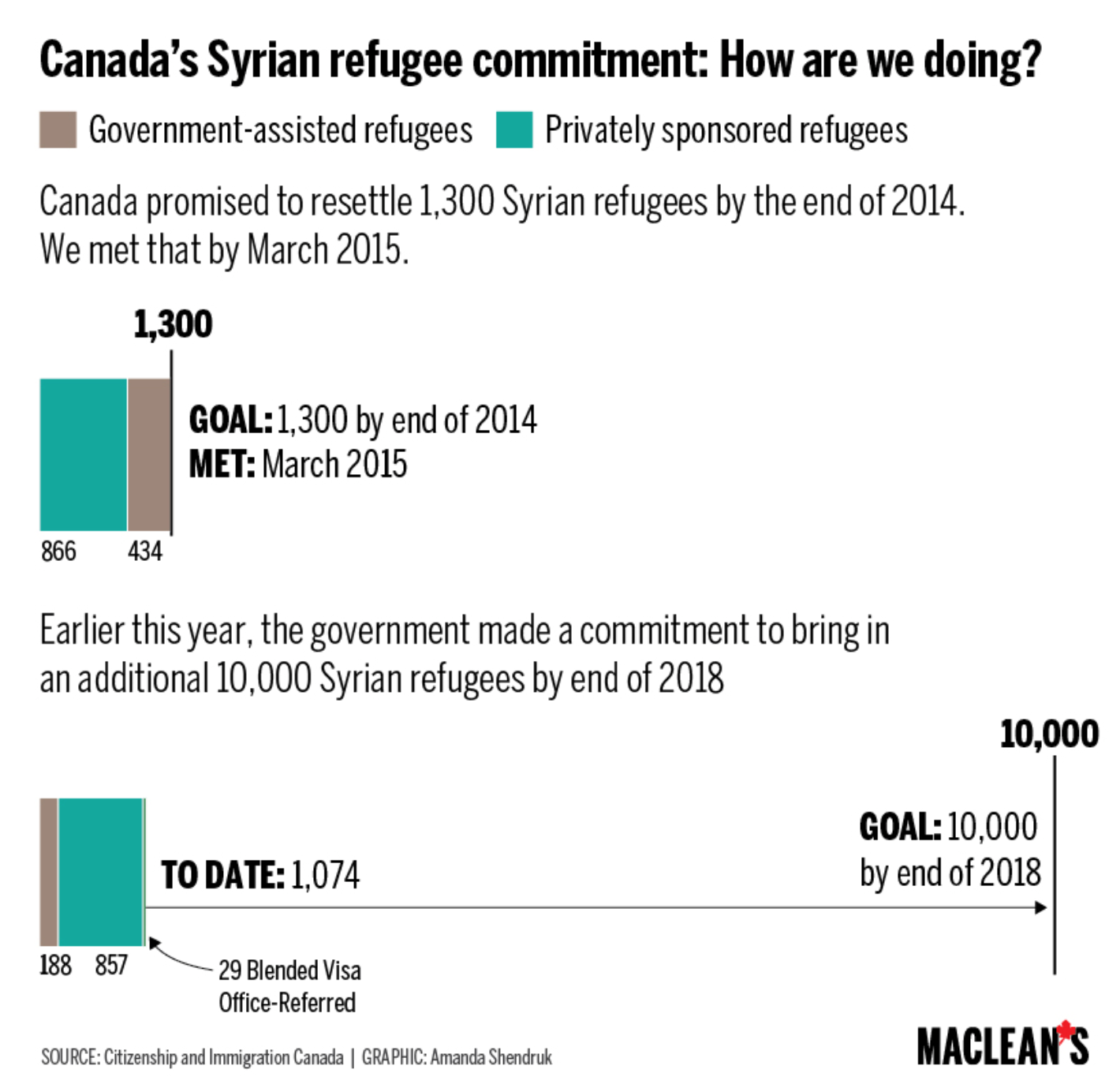
Decades before the current crisis, Canada airlifted 5,000 people from Kosovo in the late 1990s, 5,000 from Uganda in 1972, and 60,000 Vietnamese in 1979-80. From January, 2014, to late last month, Canada resettled 2,374 Syrian refugees.

Canada’s response to refugee crises today a stark contrast to past efforts

Amira Elghawaby and Bernie Farber criticize the Government for providing preference to Christian refugees:

The Canadian government’s departure from established refugee norms began in 2012 with the passage of new laws which created a two-tier system based on country of origin. Canada began to categorize refugee claimants based on group characteristics rather than using a case-by-case approach.

“Group labelling tends to exclude, not welcome. Placing individuals above categoric exclusions is the best way to ensure Canada continues granting asylum to people who need it most,” migration expert Dana Wagner wrote in a 2013 article for the Canadian International Council. It isn’t to deny the role of group identity in understanding why individuals and their families may fear persecution, or violence, in their countries of origin. It is simply to include it as one of many factors that must be examined in an individual’s claim.

While I understand the rationale for their critique, I equally appreciate the Government rationale for its focus on those communities which appear to be most at risk such as Christians and Muslim minorities such as the Yazidis.

 Forget labels when we witness such dire human need 

Ratna Omidvar’s suggests some practical actions:

First: Triple the number of visa officers processing Syrians.

Second: Relax visa requirements out of the European Union.

Third: Canada should grant prima facie refugee status to all Syrians outside their country. Full stop.

Fourth: Allow Syrians in Canada to quickly reunite with their families through a temporary resident permit.

A final requirement is political will. Without it, Canada will neither exceed nor meet its initial pledge.

Practical solutions for refugees flow from political will 

Peter Showler, former head of the Immigration and Refugee Board (IRB):

There are solutions. In addition to the 1979-80 boatlift when Canadians welcomed over 60,000 refugees, Canada has used emergency immigration programs and special teams of immigration officers to bring thousands of refugees quickly from Uganda and Kosovo. Refugees are processed efficiently and quickly and are granted temporary status in Canada. Private sponsorship groups can be enlisted to help them establish in Canada, providing financial support and helping families to integrate into their communities. Later, the refugees can apply for permanent residence from within Canada, if they so choose.

We have done it before. Canada has the expertise and capacity to do it again. Bringing 25,000 Syrian refugees to Canada does not end the war but it saves individual lives and sets an example for other nations to also open their doors. The government often invokes the historical generosity of the Canadian people but has done little to truly encourage it. In 1986, the Canadian people were awarded the Nansen Medal by the United Nations for their extraordinary generosity in welcoming the boat people. It is the only time the medal was given to an entire people.

Canada and its government once again have an opportunity to lead the world to relieve an excruciating humanitarian crisis.

Peter Showler: Canada can do more

Lawrence Hill reminds Canadians of the values at play:

We could do much, much more. We should, and we must. We should live up to the promises we have made – so far undelivered – to accept thousands of Syrian refugees. And then we should increase our quotas and meet them too. We have room for more people. We should send officials in large numbers into refugee camps to process people more expeditiously, cut through red tape, and bring them more quickly to Canada. It’s possible. We’ve done it before. We should demand greater action on the part of our politicians, not just to respond to the crises of famine, war and natural disasters but also to invest more in international development. By helping people develop stronger social and economic infrastructures in their own countries, we help them develop peaceful, organized means to cope with their own crises.

The refugee crisis that rocks the world today belongs to the world. And it belongs to Canada. For one thing, many active, engaged Canadians come from the countries most affected. For another, we have fought in wars – in Afghanistan, for example, and we are now participating in air strikes in Syria – that add to the mayhem forcing people to flee. And we have signed onto refugee conventions committing us to humanitarian principles and action with regard to accepting and assisting refugees. Most important, we owe it to ourselves to respond. To remember what it means to be human. To remember what it means to be Canadian.

 A moment to revisit our Canadian values 

Lastly, some fairly severe criticism of the the role that Gulf countries are (not) playing:

Gulf countries have funded humanitarian aid. Saudi Arabia has donated $18.4-million to the United Nations Syria response fund so far this year, while Kuwait has given more than $304-million, making it the world’s third-largest donor. The United States has given the most, $1.1-billion, and has agreed to resettle about 1,500 Syrians.

….This week, Kuwaiti commentator Fahad Alshelaimi said in a TV interview that his country was too expensive for refugees, but appropriate for laborers.

“You can’t welcome people from another environment and another place who have psychological or nervous system problems or trauma and enter them into societies,” he said.

Cartoonists have lampooned such ideas. One drew a man in traditional Gulf dress behind a door surrounded by barbed wire and pointing a refugee to another door bearing the flag of the European Union.

“Open the door to them now!” the man yells.

Another cartoon shows a Gulf sheikh shaking his finger at a boat full of refugees while flashing a thumbs-up to a rebel fighter in a burning Syria.

…Michael Stephens, the head of the Royal United Services Institute in Qatar, said the decision by the United States not to directly intervene against Assad had left many in the Gulf unsure of how to respond.

“The Gulf Arabs are used to a paradigm in which the West is continuously stepping in to solve the problem, and this time it hasn’t,” Stephens said. “This has left many people looking at the shattered vase on the floor and pointing fingers.”

 Gulf monarchies bristle at criticism over response to Syrian refugee crisis 

Asra Nomani takes a similar tack with a harder edge:

It is not politically correct to utter, but it has to be acknowledged that the arrival of millions of refugees from, yes, mostly Muslim regions raises serious long-term demographic and policing concerns for countries in the West, which will likely see the character and values of their communities completely transformed by refugees who may have values and attitudes about secularism very different from the countries they would be calling home. Already, countries like the United Kingdom struggle with issues of Islamic extremism among legal immigrants that have transformed British culture to the point that London is nicknamed “Londonistan.”

There are serious issues of ideology and identity at risk here.

Reasonable, rational, tolerant folks are saying that the refugee crisis isn’t Europe’s problem to fix, and it is, in fact, a form of reverse racism to let Muslim countries off the hook, as if they are just too backward, intolerant and incapable of finding homes for these refugees. The family of young Aylan, after all, was fleeing Turkey, a Muslim country, for the West, because the father said that the refugees weren’t treated respectfully in Turkey. That is a policy problem in Turkey that needs to be fixed, not displaced to other countries.

Last December, Amnesty International released statistics highlighting that the five Gulf countries—Qatar, United Arab Emirates, Saudi Arabia, Kuwait, and Bahrain—“have offered zero resettlement places to Syrian refugees.”

Mideast Needs To Save Its Own Refugees
Missing in Ottawa? Government transparency

Sounds familiar.

When I was in government, we regularly used Blackberry PINs for sensitive stuff although I was always careful (I think) in my use of language as I always assumed that anything electronic is saved somewhere (and there was a CIBC case, I believe, where PINs were accessed). But hadn’t heard the term off-line used as a verb before:

But the “real problems” go even deeper than that. The revealing PMO emails have hinted at an even more secretive Ottawa, where staffers, diplomats and journalists communicate with each other by direct messages, private emails, or services such as LinkedIn—in other words, on any platform that cannot be exposed under the Access to Information Act, or can be erased before called for as evidence. Call it the Official Underground Ottawa.

“The rule is: Don’t write anything down on official channels that you wouldn’t want to see on the front of the newspaper,” one government source told me. We connected via direct message on Twitter, then used the phone. No email. “And, since the Duffy trial, people in government are even more cautious.”

So what happens in Underground Ottawa? No one uses official, on-the-record channels for the “real” problems. Everyone “off-lines”—it’s a verb. As one MP told me, “I never get on those email chains where cc’ing 10 people is normal. I insist on using the phone.” At the Duffy trial, we learned that key players in the PMO were using instant messaging and text messages to talk about Duffy, but none of it was entered as evidence.

In 2013, information commissioner Suzanne Legault investigated a range of government departments over their use of offline communication. She uncovered the secret door leading to Underground Ottawa, a world with no oversight, no rules and no transparency. Key information “is being irremediably deleted or lost,” she wrote. Legault concluded that retrieving messages was “practically impossible,” and the likelihood of getting instant messages from within a ministerial office was “non-existent.” No records means no accountability.

Source: Missing in Ottawa? Government transparency

Donald Trump, Elizabeth I, and the English Origins of Birthright Citizenship

A good in-depth piece on the history of birthright citizenship, and how it was derived from British judicial decisions:

The Republican frontrunner’s assertion that the United States is “just about” the only country “stupid enough” to grant citizenship to all children born within its borders is easily proven false. Far from a scarlet letter of perversion, the U.S. policy is more like a badge of membership in the Western Hemisphere, where nearly all countries adhere to a version of the principle, a commonality some scholars argue is a legacy of colonial pro-immigration policies in the New World.

But the term “birthright citizenship” is also misleading. There are actually two common types of birthright citizenship in the modern world, and both are incorporated into U.S. policy. Trump and those who agree with him apparently only object to one of them.

You can be born into U.S. citizenship by being born in the United States—the principle known as jus soli, or “right of the soil.” Most countries in the Americas feature jus soli citizenship. And you can also be born into U.S. citizenship by being born to U.S. citizens, even if you’re born abroad—a concept known as jus sanguinis, or “right of blood.” “Roman law,” said University of Michigan law and classics professor Bruce Frier, “was very distinctly in the jus sanguinis category.” The policy has also frequently been incorporated into modern European states, emphasizing membership in the nation through parentage.

Yet the real irony of calling “birthright citizenship” a peculiarly American stupidity is that historically and theoretically speaking, geographical birthright citizenship is precisely as American as apple pie. That is to say: it’s English—and thoroughly monarchical in origin.

Given his “anchor baby” rhetoric, Trump may be pleased to learn one thing: The case many scholars cite as establishing the theoretical basis for geographical birthright citizenship did indeed involve a troublemaking toddler. The toddler was a Scottish aristocrat, and the case was a property battle.

In 1603, Elizabeth I, the “Virgin Queen,” died without an heir. The solution was to give her cousin Mary’s son, James VI of Scotland, a second crown, making him James I of England. The tough part about that, according to the University of Miami law professor Kunal Parker, author of a forthcoming history of immigration and citizenship law, was that “under English law, aliens—those who were born outside the allegiance to the king—were not able to hold or convey titles of real property.” Thus, in 1608, an English court found itself answering an intriguing question: If two-year-old Scottish infant Robert Colville had been given lands in England, were his claims on those lands valid? The traditional English position at the time of the case, Parker said, “was of course because he’s Scottish and hence an alien he should not have good titles to lands in England.” “Every one born within the dominions of the King of England is entitled to enjoy all the rights and liberties of an Englishman.”

In his influential report on what has, inexplicably given the actual names of those involved, become known as Calvin’s Case, the English judge Sir Edward Coke articulated a distinctly feudal-sounding jus soli principle that formed the basis of much law to come: “Every one born within the dominions of the King of England, whether here or in his colonies or dependencies, being under the protection of—therefore, according to our common law, owes allegiance to—the King and is subject to all the duties and entitled to enjoy all the rights and liberties of an Englishman.” Furthermore, “Seeing then that faith, obedience, and ligeance are due by the law of nature, it followeth that the same cannot be changed or taken away.”

In other words: People born in the king’s lands are his subjects and owe him allegiance, while he owes them protection, and there’s nothing the subject can do about it. This idea failed to delight the Lockean consent-of-the-governed junkies of later decades and centuries. As the law professor Peter Schuck and the political-science professor Rogers Smith put it in their famous 1985 critique of U.S. immigration policy, Citizenship Without Consent, “At a conceptual level, [birthright citizenship] was fundamentally opposed to the consensual assumptions that guided the political handiwork of 1776 and 1787.”

Source: Donald Trump, Elizabeth I, and the English Origins of Birthright Citizenship – The Atlantic

S. Africa may cancel dual citizenship to curb IDF enlistment | The Times of Israel

Foreign military service in principle suggests a greater loyalty to the country of military service, but this measure seems unduly targeted at South African Jews who join the IDF:

Obed Bapela, a senior ANC official who heads its National Executive Committee on International Relations, said the “model” of dual citizenship may not have “a place in the world,” the South African daily The Sunday Times reported.

The government in Pretoria has been among the most hostile to Israel in recent years. South Africa’s minister of higher education Blade Nzimande, a member of the Communist Party, has openly campaigned to boycott Israeli universities and other institutions, and was denied entry into the country for a working visit to Palestinian Authority areas in April.

An ANC party conference discussed the Israeli-Palestinian conflict, including the issue of South Africans serving in the IDF, in July. The issue would be taken up again in the party’s National General Council in October, the Times said.

The country’s Jewish Board of Deputies has accused ANC officials of singling out South African Jews.

While IDF enlistment was cited explicitly by Bapela and others as the reason for reconsidering South Africa’s acceptance of dual citizenship, no figures have been provided by the party for how many South Africans actually serve in the IDF. With a population over 53 million and large immigrant populations from Asia and other parts of Africa, any change to the South African constitution to enable stripping South African migrants to Israel of their citizenship may end up affecting millions of other citizens.

Jews account for an estimated 0.2 percent of the country’s population. It is not known how many currently serve in the IDF.

Source: S. Africa may cancel dual citizenship to curb IDF enlistment | The Times of Israel

Highlights of Media Coverage of the Politics of the Syrian Refugee Crisis

Canadians_divided_along_political_lines_over_whether_to_accept_thousands_of_refugees_in_current_crisis_-_Angus_Reid_InstituteMuch of the focus has been on Minister Alexander’s handling of the crisis. Starting with Calgary Mayor Nahid Nenshi:

“Minister Alexander should have been a star. He was an incredible diplomat. By all accounts he’s a brilliant man, but he’s also the minister behind Bill C-24, which I remind you means that me — born at St. Mike’s hospital in downtown Toronto — could have my Canadian citizenship stripped,” he said.

Calgary mayor lashes out at immigration minister on refugee crisis

Both Robin Sears and Scott Reid attribute his approach to the numbing effect of the overall Conservative party approach:

As one friend put it, he must have been given a Pierre Poilievre blood replacement treatment, so thoroughly have they crushed his humanity. Since becoming minister he has spoken in a wooden, angry snarl in interview after interview. Perhaps frustrated at the nonsense he has been instructed to deliver, he repeats it in a surlier tone. Few of us are able to be smiling, convincing liars in public. It is perhaps a testament to the angst he feels about the role he has been ordered to play that he does it so woefully.
The refugee story looks as if it might now become the pivot issue of the campaign. It speaks to the deep humiliation that many Canadians have come to feel about the harsh vision of Canada the Harper government flaunts to the world. (Alexander’s TV meltdown made the BBC’s front page online.) It speaks to their ferocious defensive attack in response to any criticism from any quarter. And it underlines how far their mean-spirited response to this crisis is from the values of a majority of Canadians.

Sears: The cost of mindless, heartless message control

But it’s not the first time he’s played the part of the unthinking partisan. Watching Wednesday night’s spectacle, one had to wonder what’s gone wrong. Where did that original Chris Alexander go? Up there on the screen that might as well have been Paul Calandra or Pierre Poilievre, government spokespersons that we’ve come to associate with transparent posturing.

That’s the really troubling thing. Alexander, a knowledgeable, talented and presumably well-motivated person, someone whose history and abilities once inspired sincere hopes for great things has allowed himself to become just another one of “them.” A snapping, snarling partisan.

Not because he’s a bad person. Not because he’s taken this particular stand on this particular issue. But because that’s what politics – specifically politics as it’s currently practiced on Parliament Hill – does to people. It brings them low.

If the Conservatives lose this election, don’t underestimate how much this sort of thing contributes to their downfall. When even the likes of Chris Alexander can be so diminished people can see that something about our politics simply has to change.

Reid: Chris Alexander the latest example of how politics debases even the best of us

Both Sears and Reid’s commentary recalls an early piece by Konrad Yakabuski on the almost Faustian bargain Alexander appears to have made (Chris Alexander balances his portfolio and power).

Turning to commentary on the Government and party leaders as a whole), Andrew Coyne calls for a combined non-partisan response by the three main parties (which has been echoed by Liberal leader Trudeau):

Into the void have stepped the country’s mayors. Toronto Mayor John Tory, in particular, has been attempting to organize some sort of coordinated municipal campaign, nationwide. The emphasis, it would appear, would be on encouraging private sponsorship. “I believe we should mobilize to sponsor Syrian refugees. This is who we are as Canadians,” he said Friday. “This will not happen by itself. It will happen when Torontonians step up.” Indeed, the mayor had reportedly already personally sponsored a refugee family, even before the events of recent days.

The thought occurs: what if our national leaders were to put themselves on the line in the same way? What if they were all to get behind the same campaign? What if they were to put politics aside, even for one day, and appear together on the same stage, exhorting the whole country to “step up”? What might we do then?

Andrew Coyne : It took a photo of a dead child to capture our attention. What matters is what we do next

One of the few to defend the PM and Government (silent on Minister Alexander) was Christie Blatchford:

Harper’s view is that only a three-pronged effort has a chance in Syria: accept more refugees and do it faster; give more humanitarian aid; continue to participate in the military campaign.

As he said once, “Laureen and I had the same reaction, but it doesn’t lead to the same conclusion. Our message is (also) we need to help people who are actually there, who can’t get away, and stop the violence being directed at them. I do not know for the life of me how you can look at that picture and say ‘Yeah, I want to help that family’ and say walk away from the military coalition. … It’s incomprehensible to me to see an image like that and conclude you do more of one thing and less of another.”

It wasn’t perfect, but it was a responsible, intelligent and reasoned response to that picture, and on a day when others took an easier path, the one strewn with flowers, teddy bears, balloons and sentiment. Alan Kurdi’s story certainly should galvanize the world, not only to be stricken and weepy, but to fury.

Blatchford: Alan Kurdi’s story should galvanize the world — but Harper can’t be blamed for this tragedy

Tasha Kheiriddin explains a likely factor in the Government’s reluctance:

Harper’s words reveal the unspoken subtext of fear in the Syrian refugee crisis: this new wave of migrants and refugees come from a country where the West is not only directly involved in a war, but in a war with an organization that threatens to take the fight beyond its borders, to our own shores. The fear isn’t simply that these refugees pose a security threat because there could be terrorists among them. The fear is that they pose a social threat — by bringing with them a worldview that could be at odds with the pluralist, secular and socially-liberal societies in which they seek sanctuary.
The fear is that even though the refugees are fleeing the depredations of ISIS, they will not integrate, but seek to change the fabric of their new societies against the will of the current citizenry. It’s a fear grounded in the experiences of European nations like Great Britain, France, the Netherlands and Sweden, which have witnessed social problems ranging from demands for gender-segregated swimming pools, to Islamic “takeovers” of local public schools in Birmingham, to riots in the banlieues of Paris.
It is grounded here at home in the debate over the former PQ government’s Charter of Values in Quebec, incidents of segregation at a Toronto public school and the federal government’s opposition to the wearing of niqabs during citizenship ceremonies.
No one wants to acknowledge the elephant in the room, but if the Syrian refugees are to be saved, someone must. It would be fallacious to deny that practices such as gender segregation, the wearing of the niqab and the subordination of man-made law to that of the divine would make it difficult for any immigrant to integrate into mainstream western society. But it’s just as wrong-headed to assume that all Muslims live this way, or that other religious groups already established in our country, such as the polygamous sect members of Bountiful, B.C., don’t also hold beliefs that conflict with those of the majority.
The answer is not to turn our backs on refugees from Syria, or refugees from any Islamic country, but to impress upon them and on all immigrants that immigration is a two-way street. Newcomers have the rights to their religion, beliefs and practices — but not if those practices violate the norms of the societies to which they must adapt. Values such as equality of the sexes, equal treatment for persons of different sexual orientation, freedom of association, and separation of church and state are not up for negotiation. Any “reasonable accommodation” must be just that: reasonable.
It’s the task of a mature democracy — and compassionate leadership — to find a way forward in this and future refugee crises, and to re-establish Canada’s reputation as a haven for those who need our help.

What’s holding us back from helping the Syrians? Fear.

Public opinion polling helps explain the different party positions.
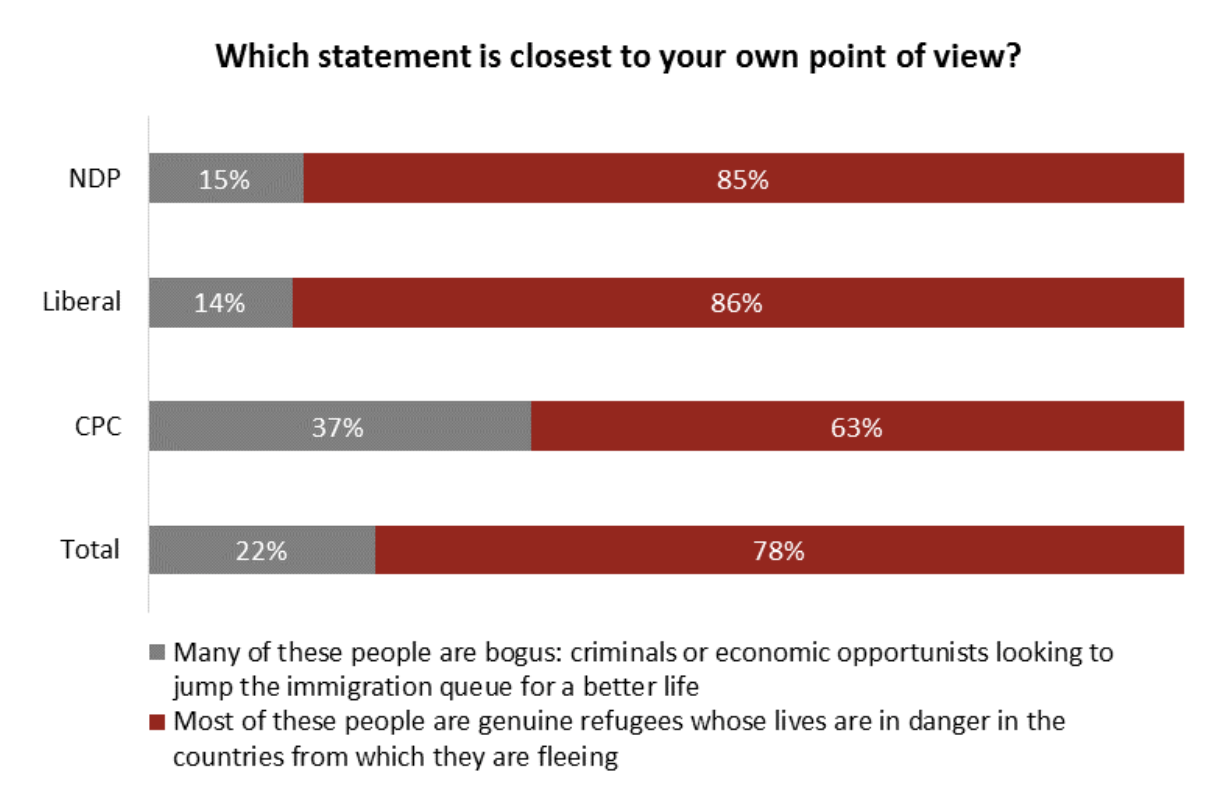
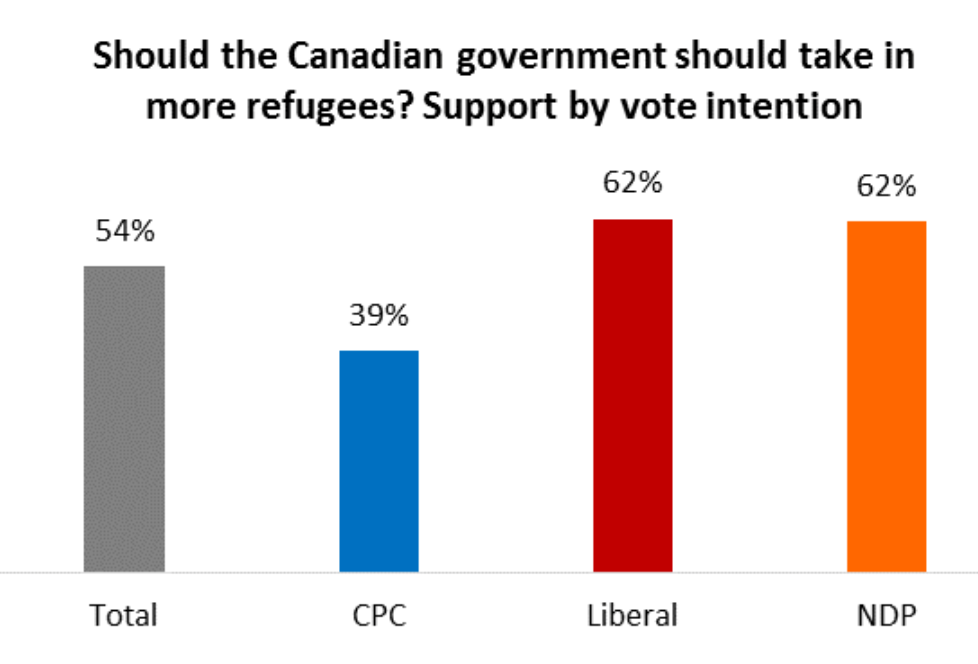
Bogus_refugees_or_notAngus-Reid conducted a useful poll, breaking down opinion by party affiliation, showing the Government’s position is aligned to the Conservative party base and messaging of “bogus refugees”, with the overall key findings being (all parties):

  • Overall, most Canadians (70%) say Canada has a role to play in the migrant crisis, but are divided on increasing the number of refugees the government sponsors and resettles here, and on seeing government spend more to make it happen. (54% and 51% support each, respectively)
  • A significant gender difference exists on whether the people fleeing to Europe from the Middle East are seen as “genuine”: Canadian men are twice as likely as women to say the migrants are “bogus”
  • As to what exactly this country should do, Canadians are most supportive of sending medical and armed forces professionals into the affected European countries areas to assist refugees, divided on taking more refugees and least supportive of “doing nothing”

Canadians divided along political lines over whether to accept thousands of refugees in current crisis

Chris Alexander defends Canada’s refugee response, blames media

For those who missed it, worth watching Alexander defending the Government’s policy and actions with respect to Syrian refugees.

Sep 2, 2015 | 17:53Power and Politics Syrian refugee crisis Video

Unfortunately, he clumsily reverted to attacking the media and getting the facts wrong, which became the focus of Twitter and other commentary:

Alexander, who has served as immigration minister since July 2013 and is running for re-election in Ontario, accused CBC News of ignoring the Syrian refugee crisis.

“I’m actually interested in why this is the first Power & Politics panel we’ve had on this,” he said.

Alexander went on to say that “the biggest conflict and humanitarian crisis of our time has been there for two years, and you and others have not put it in the headlines where it deserves to be.”

Barton noted later the subject had been discussed at least 32 times on Power & Politics, including in interviews with Alexander. As a minister, Alexander was not allowed to appear on panels.

No wonder that he has had to suspend his campaign and return to Ottawa, especially given that the file for the dead boy’s family had apparently been handed to him personally.

Source: Chris Alexander defends Canada’s refugee response, blames media – Politics – CBC News