A Current Snapshot of Canadian Multiculturalism – Review of my book

From the first review of Multiculturalism in Canada: Evidence and Anecdote, by Don Curry, Executive Director, North Bay & District Multicultural Centre, in New Canadian Media:

Griffith has the credentials for writing a comprehensive book of this nature. The author of Policy Arrogance or Innocent Bias: Resetting Citizenship and Multiculturalism, he is the former director general for citizenship and multiculturalism at Citizenship and Immigration Canada.

As someone leading an organization that is active in integration issues, I encourage anyone involved in citizenship, multiculturalism, immigration and integration issues to read this book to keep current with the latest available information, and perhaps alter some perceptions.

The only complaint I have about the depth of research is that it left out my corner of Canada – northern Ontario – and lumped it in with southern Ontario.

But I know why: it’s because, as Griffith notes, the National Household Survey of 2011 left a lot of gaps when it attempted to drill down to smaller census areas. He strengthens the argument for the return of the long-form census.

The evidence Griffith uses in the book is irrefutable, combining the best currently available data from Statistics Canada, employment equity, Citizenship and Immigration Canada operational statistics, and more to draw his conclusions.

As Griffith says, “My hope is that the evidence highlighted in this book will contribute to creating a more informed discourse as Canada – by most measures a remarkably successful, diverse and multicultural society – prepares for its 150th anniversary.”

Multiculturalism in Canada is an e-book modestly priced to reach a wide audience – and it deserves one.

A Current Snapshot of Canadian Multiculturalism – New Canadian Media.

Damian Clairmont’s mother says Harper pushing ‘quick fix’ on terrorism

Captures it exactly (Michael den Tandt made similar arguments in Michael Den Tandt: Harper pandering with plan to make it illegal to travel to terror-stricken zones):

An Alberta woman whose 22-year-old son was killed while fighting with Islamic extremists in Syria says Stephen Harper is looking for a “quick fix” to deal with terrorism instead of addressing the root cause of radicalized youth.

The Conservative leader promised on Sunday that, if re-elected, his government would make it a crime for Canadians to travel to countries or regions where they could fight alongside groups identified by the federal government as terrorist organizations.

He said the government would establish “declared areas” — parts of the world where terrorist groups such as the Islamic State of Iraq and Syria, or ISIS, hold control and use their base to recruit and train followers.

“Anybody can pick up and travel and book a flight to anywhere, and if you really want to go badly enough, you can book your flight to Europe and then from there book yourself into somewhere else,” Chris Boudreau of Calgary said in an interview with The Canadian Press.

“It’s window dressing. It’s not realistic.”

Damian Clairmont’s mother says Harper pushing ‘quick fix’ on terrorism – Politics – CBC News.

Some minorities more likely to see heart health deteriorate: study

Some_minorities_more_likely_to_see_heart_health_deteriorate__study_-_The_Globe_and_MailInteresting new study on how lifestyle in Canada affects different minority groups, as they integrate and adopt unhealthy Canadian food and lack of exercise habits:

The study looked at data from nearly 220,000 Canadians who took part in Statistics Canada’s Canadian Community Health Survey. The researchers focused on individuals belonging to Canada’s four major ethnic groups: white, South Asian, Chinese and black.

The results add to a growing body of evidence suggesting health problems affect ethnic groups at different rates. While genes certainly play a role, they do not tell the entire story, Chiu said.

“I like to think of it as genes load up the gun and environment pulls the trigger,” she said.

Her study helps explain why some ethnic groups appear to be more vulnerable to certain health conditions. Overall, the ethnic minority groups included in the study had household incomes that were as much as $30,000 lower than those of their white counterparts.

Those groups also reported that they ate fewer fruits and vegetables. At the same time, smoking rates among all of the groups studied fell, with the exception of black women and Chinese men.

“This is another wakeup call,” said Dr. Sonia Anand, professor of medicine and epidemiology at McMaster University in Hamilton and a spokeswoman for the Heart and Stroke Foundation. “We have to get going or we’re going to end up with an epidemic of obesity and type 2 diabetes in the next 20 years.”

Anand was not involved in this study, but much of her research focuses on the causes of heart disease in ethnic groups. She said the evidence is clear the differences exist, but there is no clear strategy on how to solve this complex problem.

The important question for researchers and policy makers, according to Chiu, is how to bridge the gap and reverse the trends.

One solution will be to tailor campaigns to ethnic groups, Chiu said. They need to know they are at risk and what changes they can make to reduce their vulnerability, such as quitting smoking or eating more fruits and vegetables.

And, as Anand noted, “we move less, we commute by car, we don’t live in walkable neighbourhoods.”

That means the necessary solutions are going to require a lot of time, co-ordination, funding and commitment, she said.

Some minorities more likely to see heart health deteriorate: study – The Globe and Mail.

Send in the psychologists to study the psychologists: Salutin | Toronto Star

Salutin on the role of psychologists and other social scientists, and the need to recognize for them to abandon some of their scientific pretensions:

New York Times’ reporter James Risen, a U.S. Senate committee which included former torture victim John McCain and, finally, a report commissioned by the APA itself, all confirmed the odious role played by psychologists and the APA. Top executives, including their chief of ethics, have been let go/resigned. All this is percolating through formal and informal sessions at the convention.

The social sciences have always generated ethical outrages — they deal, after all, with people, not electrons or chemical compounds. But nothing stimulates bad behaviour among the expert class like wars or terror attacks.

Anthropologists for instance have had a long, questionable record among the “primitive” peoples they first “examined” — either with noble intentions or as straight imperial tools. But since 9/11 the Human Terrain Systems (HTS) approach has been under fire, much like the APA situation. In Afghanistan or Iraq the idea was to use their “ethnographic” info to help “map” local societies in order, ultimately, to control and even “target” individuals, either for assassination (recently, by drones) or capture and interrogation, in which case, presumably, the guys from the APA could step up and join in.

What’s surprising about this is that anyone’s surprised. The root of their stupefaction, I’d say, is the delusion that the sciences — psychology, sociology, anthropology, economics etc. — are sciences at all, in the sense of the physical sciences. They aren’t.

They lack the basic qualities of “real” sciences, like clear terms, definitions, and theories, as Noam Chomsky recently noted. The terms they have are used “very loosely,” with a “strong ideological component.” In the 19th century, when their modern versions arose, they hitchhiked on the prestige and success of the natural sciences, appropriating the very word; and basked in the glow of Galileo or Newton. Unlike Prometheus, they didn’t so much steal fire from the gods to give to men; they stole false fire and hawked it. Economists, for instance, failed to see the housing bubble and the crash of 2008. True, some scruffy outsiders, like American Dean Baker, got it right, but all they did was look at the evidence and apply common sense, much as Aristotle would have.

In fact they should probably just drop the science pretensions and go back to where they belong: the inexact realm of the humanities, with the inevitable downgrading that would entail. Psychology was part of the philosophy departments not so long ago; and politics wasn’t a science — it went with economics in something called Political Economy that was more like history.

The late John Seeley, a superb sociologist and psychologist, spent much of his career effectively pursuing his own tail; pondering how to study something of which you were a part and which had made you what you were. It was like studying your own back at the same time as it relentlessly pushed you forward. “We may also hear,” he wrote, “in any serious piece of social science writing as in any poem — the cry of a soul calling for attention, obliquely but obstinately, to who he is, what he is, what he wants, what he suffers, who is with him and against.”

He’d have understood how objective “scientists” could happily verify that waterboarding isn’t torture. They aren’t just social observers, they’re social agents, with their own motives and needs that also deserve careful research.

Send in the psychologists to study the psychologists: Salutin | Toronto Star.

Multiculturalism in Canada: Evidence and Anecdote – Now Available in Print

For those interesting, my book is now available in print at a price of $39.00 directly from Lulu (direct link here) in addition to the pdf version at $3.99 (direct link here). The print version should become available through the usual on-line distributors in 6-8 weeks.

My personal preference is for the pdf version, given the charts are best in colour although I did optimize the print black-and-white charts as much as I could.

But doing the final review of the proof copy today, there is something oddly satisfying of holding it in one’s hand at last.

Reaction to Calgary cab video shows progress in fighting racism, says immigration lawyer

Raj Sharma on how Calgary is changing, using the example of a taxi driver who filed a complaint over the racist rant of a passenger:

One way to measure how this city has changed is the public response to a dash-cam video that recently surfaced, which has been seen and shared by many. It shows an enraged drunk inundating Sardar Qayyum — a meek, deferential, Pakistani émigré and Canadian citizen — with a racist diatribe.

Unlike those who preceded him, Qayyum felt that he could go to our law enforcement agencies. He didn’t necessarily have to turn the other cheek.

…The perpetrator in this case has been identified, shamed and has lost his job. Having run the gauntlet of the internet, he and his family will move on after the mob finds their next target.

The public reaction to the video has shown his behaviour is not condoned, it is condemned. That’s a good sign and the support that Qayyum has received is heart-warming.

Racism appears to have progressed. You no longer commonly hear the generic slur of “Paki” being smeared over all South Asians. Unfortunately, racist attacks and tirades against Muslims appear to be increasing. A network of women’s centres is reporting an alarming rise in intolerance, racism and violence against Muslim women in Quebec tied to the proposed Charter of Quebec values, which thankfully remained inchoate.

Violence against Muslim women on the rise, group says

The rant against Qayyum centred around his religion; this incident is merely a symptom of the overall disease wherein the vast majority of Muslims are being tarred and feathered for the actions of a tiny minority. Muslims are “terrorists” or “sympathizers,” but since 2001 nearly twice as many people in the United States have been killed by white supremacists, antigovernment fanatics and other non-Muslim extremists than radical Muslims. Racists, by their very nature, rarely let the facts get in the way.

As a result, it’s been a chilly few years for ordinary Muslims living in the West, including Canada. However, “ordinary” Canadians with their condemnation of one man’s unacceptable actions have spoken loudly. This should be celebrated in moderation for the concerns expressed above.

I am optimistic that, while it may well be chilly right now for Canadian Muslims, the beauty is that in Calgary, the next chinook is already on its way.

Reaction to Calgary cab video shows progress in fighting racism, says immigration lawyer | CBCNews.ca Mobile.

What’s the Right Way to Teach Civics? – The New Yorker

Interesting article sent my way by one of my readers, and the US debate over what kind of civics education is likely to be more effective, and some of the politics behind it:

A more common criticism of the civics tests, especially from the left, is that it gives over-tested students yet one more exam to take, meaning that time-crunched educators have less flexibility to develop their own lesson plans. Even some who agree with Riggs that students are undereducated in civics are skeptical that a hundred test questions will solve the problem. It’s also unclear whether the test is the best way to inspire civic-mindedness. Joseph Kahne, an education professor who has studied civic learning, said that, by some measures, young people are woefully disengaged in civic life; for example, they tend to vote at lower rates than older citizens. (To be fair, by other measures—like involvement in their local communities—kids do better than older people.) But research, Kahne said, suggests there are better ways to educate students in civics. He and colleagues have found that when students discuss current events and form their own opinions on hot-button issues, they become more interested and knowledgeable in these topics; also, when students have the chance to volunteer, they become likelier to volunteer in the future. As for the citizenship exam, “What it measures actually isn’t what we care most about,” he said. “It’s a set of disconnected facts. Certainly the questions like, ‘What’s the name of the ocean on the West Coast of the United States?’ aren’t even related to civic and political life.”

Over the next year, Riggs told me, the institute aims to pursue its civic-education initiative in more blue and purple states—places like Iowa, Minnesota, and perhaps Colorado. He has noticed that he and his colleagues have had to work harder, in those kinds of states, to defend their campaign against critics, including those who feel that a new test of factual civics knowledge would give teachers less time to focus on more nuanced aspects of civic education. Riggs argued that the test would complement, rather than replace, higher-level approaches. “It doesn’t impede, and shouldn’t be substituted for, the teaching of more advanced civics,” he told me. “It’s intended to ensure that high-school graduates have at least the basic knowledge of American civics that we require of naturalized citizens.”

In Canada, the extension of the citizenship test to 14-17 year-olds is one manifestation even though the experience of my kids (anecdote warning!) in Ontario was that the half-year civics course in Grade 10 was a reasonable way to engage students (and they had plenty of Canadian history as well).

What’s the Right Way to Teach Civics? – The New Yorker.

Tendering problems cause one-year delay in National Holocaust Monument

An update on the other (non-controversial) monument being built in Ottawa:

But the project ground to a halt when bids from pre-qualified firms for the construction contract came in well above budget, said Margi Oksner, executive director of the National Holocaust Monument Development Council, created in 2011 to raise money for the project.

“We weren’t sure what caused that,” Oksner said. “We were all surprised by it. None of us felt that our original estimates were loopy.”

The overall budget for the monument is about $8 million, including construction costs, artist fees, site studies and preparation, the fabrication of artistic elements and the cost of the national design competition.

The development council has raised $4.4 million to date and the federal government has contributed $4 million.

…The monument consists of six concrete and metal mesh triangular walls displaying large landscape photos by famed photographer Edward Burtynsky. The walls will be arrayed in the form of a Star of David, enclosing a central area and a contemplation space featuring an eternal flame.

“We are getting there slowly but surely,” said Rabbi Daniel Friedman, chair of the development council. “Fundraising is on track to build the most impressive holocaust monument in the world.”

After the construction contract bids came in well over budget, the National Capital Commission, which is responsible for the monument’s construction and will assume ownership once it’s completed, surveyed the contractors.

Its findings convinced the council and the project team that the contractors had “overestimated a lot of things,” Oksner said. “For example, they overestimated the amount of concrete compared to what we estimated by something like 80 per cent.”

To reduce costs, the project team has made a few minor changes to the monument design, Oksner said.

Architect Daniel Libeskind has reduced the size of a high wall near the entrance to the monument — something he been thinking about doing anyway — to make the monument more welcoming for visitors, Oksner said.

…The monument is now scheduled to be unveiled on April 24, 2017, the day that Yom HaShoah falls on that year.

Tendering problems cause one-year delay in National Holocaust Monument | Ottawa Citizen.

U.K. immigration crackdown could hit 6,000 Canadian students

Strange – the worry about fraud undermines a pathway to skilled immigrants (cancellation of pre-Permanent Resident credit in Canada towards citizenship residency requirements, while not as strong as UK measures, will likely reduce attractiveness of Canada as a destination):

British Home Secretary Theresa May has announced a wave of changes to the United Kingdom’s immigration rules, effective in November, that target international students.

The aim is to curb what the government calls an increase in visa fraud by students who arrive on a study permit and enter the job market instead, thereby bypassing the strict requirements needed to obtain a legal work visa.

It’s the latest in a series of crackdowns by Prime Minister David Cameron’s government, which has promised to reduce annual net migration to the U.K. from “hundreds of thousands to tens of thousands.”

The U.K. is one of the most popular places for Canadians to study abroad, second only to the U.S. For the 2013-14 academic year, there were more than 6,000 Canadian students enrolled at higher education institutions in the U.K., a three per cent increase from 2012, according to Britain’s Higher Education Statistics Agency.

Like Hirschy, many of these students hope to stay and work, but the new legislation will make this more difficult.

U.K. immigration crackdown could hit 6,000 Canadian students – Canada – CBC News.

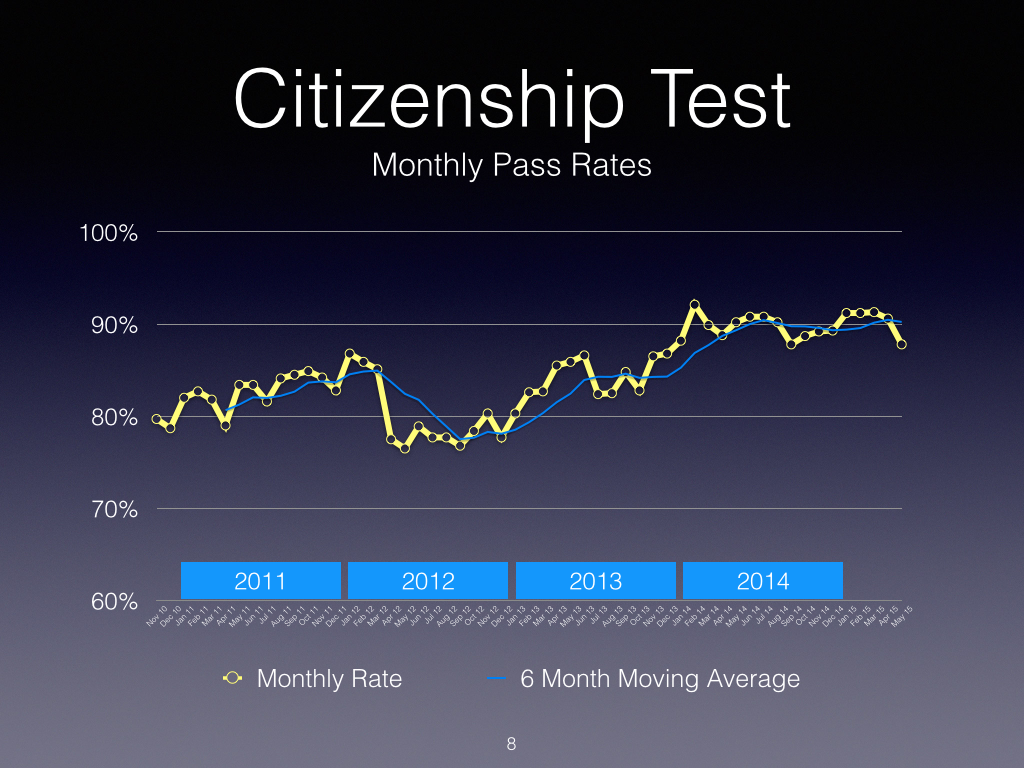
Monthly Citizenship Test Pass Rates 2011-2015

Citizenship Monthly Test Pass Rates.001This time series shows the variation in monthly citizenship test pass rates from November 2010 to May 2015, highlighting the dramatic shifts over the past 4 ½ years.

This chart highlights a number of challenges that CIC faced:

  • the difficulty in managing the citizenship test to ensure broadly consistent results;
  • the inability to introduce new questions in a predictable manner, likely reflecting political reluctance to engage in focus testing  (2012 drop);
  • the eventual corrective measures in 2013, both administrative and test question wording changes, that resulted in a reversion to the previous average pass rates in the 80-85 percent range; and,
  • other changes, likely reflecting conscious policy choices as part of the effort to address the backlog of citizenship applications, aimed to increase the average pass rate to the 90 percent range in 2014.

This roller-coaster variation, also seen in citizenship applications processed, once again reflects the lessor priority CIC (and Ministers) attach to sound management of the program, in sharp contrast to the relative consistency and predictability of the immigration program.

The relevant memos to the Minister were heavily (excessively in my view) redacted as the following example from a 2013 memo indicates:

Citizenship_Monthly_Test_Results_A201510634_2015-08-06_08-29-32_pdf__page_8_of_13_Lastly, the CIC analysis of the number of those affected by the extension of knowledge testing and language assessment is relatively small: 5.5 percent for 14 to 17 year olds, 5.9 percent for 55 to 64 year olds (both figures for the period 2009-13 (see Citizenship Impact of Extending Testing to 14-17 and 55-64 year olds, while accompanying memo less redacted than above example, still some serious redactions on cost implications and the like).