And just like that, the NCC’s a problem again: Kate Heartfield

More fall-out of the Government’s efforts to railroad the NCC on the Memorial to Victims of Communism:

No longer reviled and mistrusted, the NCC has done a great job lately at seeking ideas and input. The few political fights in recent years have been a symptom of the still-unresolved contradiction at the heart of the very idea of the NCC. It’s supposed to be a check on politicians (and the people who elect them). But there is a limit, or should be, to what an unelected body can do with any legitimacy.

That contradiction might have evolved into a healthy tension, steering the NCC into a role of wise, independent counsel.

Instead, as with another chamber of sober second thought, the Conservative government chose to manipulate the NCC into doing the government’s bidding. So we have the worst of both worlds: an unelected body doing the bidding of (certain) politicians.

An email from chairman Russell Mills to Kristmanson (released under access to information) shows the NCC felt it didn’t have a say in the new location of the memorial to the victims of communism, because two Tory ministers had already announced it. “There was really no choice but to approve what had already been announced,” Mills wrote.

This despite the fact that Mills acknowledged that opposition to the memorial’s location “likely reflects the view of most thinking people in our community.”

This news led my colleague, Kelly Egan, to wonder, “isn’t it wonderful to know we fly in these esteemed thinkers from across Canada so they can rubber-stamp stupid ideas, cooked up in a partisan kitchen?”

The mayors of Ottawa and Gatineau have asked for representation on the NCC board, which might help prevent future rubber-stamping.

The next minister responsible for the NCC will have a choice: To encourage and respect independent thought at the NCC, or not. If it’s the latter, let’s revisit that abolition idea.

And just like that, the NCC’s a problem again | Ottawa Citizen.

Multiculturalism in Canada: Evidence and Anecdote: Print Version Now Available on Amazon.com

For those who prefer to purchase on Amazon (US site), the print version is now available at the following leak (USD 29):

Multiculturalism in Canada: Evidence and Anecdote – Amazon US

Donald Savoie: How government went off the rails

Donald Savoie confirms the policy/service delivery hierarchy.

My experience when Service Canada was established, and then watching how the both the Government and the public service whittled away at the vision of making service as important as policy, is a case in point.

Another example was Citizenship and Immigration Canada’s inability in 2010-12 to implement a series of inter-related changes – new citizenship test, language assessment process, anti-fraud efforts and program review cuts to the regions – which resulted in a dramatic fall in the number of new citizens:

Below the fault line is where government is coming up short, often because the ones operating above it have no appreciation of how the machinery operates. It is also where the great majority of Canadians deal with their government. The view among politicians and the courts is that government is about 90 per cent ideas and 10 per cent implementation. Making a policy or program announcement, defining the right media line and keeping an eye on the blame game as it is played out in Parliament and the media are what truly matters. They expect that program managers below the fault line should simply run on their tracks and avoid providing fodder for the blame game. The view among the majority of Canadians and front-line government workers, however, is that government should be 90 per cent delivering services efficiently and 10 per cent ideas. Canadians are too often left waiting, for an hour or so, to talk to someone after calling a 1-800 number, days to get a phone call returned or weeks to get an answer to what they regard as a straightforward question.

Not only have we overloaded the machinery, we have also misdiagnosed the patient. The thinking that we could somehow make the public sector as efficient as the private sector was misguided, costly and counterproductive. The thinking conveniently overlooks the fact that the public and private sectors are different in both important and unimportant ways. Consider the following: 76 per cent of public-sector employees belong to a union versus 16 per cent for the private sector. The blame game plays very differently in both sectors and the private sector has an unrelenting bottom line, while the public sector has none, or rather has a top line called the prime minister, Parliament and the media. In the private sector, good managers learn to delegate down. In the public sector, good managers learn to delegate up.

In the search for a bottom line, governments have created an abundance of oversight bodies, management constraint measures and vapid performance and evaluation reports. It has only made the machinery of government thicker, more risk-averse and created a veritable army of public servants kept busy turning a crank not attached to anything. It has also given rise to a serious morale problem in the public service.

This is not an indictment on what government tried to do or on the role of government in modern society but rather how the government tried to do it. Thinking that you can simply pile on responsibilities to the existing machinery and somehow emulate private-sector management practices while retaining the command and control approach to operation is where things went off the rails.

  Donald Savoie: How government went off the rails  

Racial profiling not addressed in Ontario public consultation over street checks

Valid concerns. That is the issue:

A public consultation about the police method of street checks Friday afternoon left some attendees disappointed over its structured format that left no time to discuss issues such as racial profiling.

The consultation, which was held at Carleton University and addressed issues including the definition of “street check,” rules about how they should be applied and administrative oversight, was attended by approximately 15 members of the public, along with a handful of Ottawa police and government officials.

“It’s a very active conversation,” said Minister of Community Safety and Correctional Services Yasir Naqvi. “I’m very happy to hear the diversity of the people who are attending from our community, so we have varied perspectives represented in this consultation.”

The format of the consultation involved discussions among small groups on three specific questions, with results of their ensuing discussion written on sticky notes and posted on a board.

Participants were also encouraged to speak to the group as a whole after the group segment was finished.

But not all the people in attendance were satisfied with the scope of the conversation.

Carl Nicholson, a member of the Police Services Board who was not acting in an official capacity, said the “structured” discussion left little wiggle room to discuss potential bias and racial profiling.

“You can be sure it’s not far from our minds,” he said. “We do want the opportunity to explore what is driving those numbers.”

The numbers he mentioned refer to a document released in July. The police service’s combined statistics from 2011 through 2014 showed that 58 per cent of people it has street checked are white, 20 per cent are black and 14 per cent are Middle Eastern. Aboriginal, Asian, East Indian, Latin American and those whose race is unknown accounted for about seven per cent. The ethnicity of about 10 per cent of people street checked wasn’t recorded.

Racial profiling not addressed in public consultation over street checks | Ottawa Citizen.

The persistence of history | Islam and Slavery – The Economist

Good and needed piece:

But while IS’s embrace of outright slavery has been singled out for censure, religious and political leaders have been more circumspect about other “slave-like” conditions prevalent across the region. IS’s targeting of an entire sect for kidnapping, killing and sex trafficking, and its bragging, are exceptional; forced labour for sexual and other forms of exploitation is not. From Morocco, where thousands of children work as petites bonnes, or maids, to the Syrian refugee camps in Jordan where girls are forced into prostitution, to the unsanctioned rape and abuse of domestics in the Gulf, aid workers say servitude is rife.

Scholars are sharply divided over how much cultural mores are to blame. Apologists say that, in a concession to the age, the Prophet Muhammad tolerated slavery, but—according to a prominent American theologian trained in Salifi seminaries, Yasir Qadhi—he did so grudgingly and advocated abolition. Repeatedly in the Koran the Prophet calls for the manumission of slaves and release of captives, seeking to alleviate the slave systems run by the Greeks, Romans, Byzantines and Jewish Himyarite kings of Yemen. He freed one slave, a chief’s daughter, by marrying her, and chose Bilal, another slave he had freed, to recite the first call to prayer after his conquest of Mecca. His message was liberation from worldly oppression, says Mr Qadhi—enslavement to God, not man.

Other scholars insist, however, that IS’s treatment of Yazidis adheres to Islamic tradition. “They are in full compliance with Koranic understanding in its early stages,” says Professor Ehud Toledano, a leading authority on Islamic slavery at Tel Aviv University. Moreover, “what the Prophet has permitted, Muslims cannot forbid.” The Prophet’s calls to release slaves only spurred a search for fresh stock as the new empire spread, driven by commerce, from sub-Saharan Africa to the Persian Gulf.

… No labour practice has drawn more international criticism than the kafala system, which ties migrant workers to their employers. This is not slavery as IS imposes it; migrants come voluntarily, drawn by the huge wealth gap between their own countries and the Gulf. But the system “facilitates slavery”, says Nicholas McGeehan, who reports for Human Rights Watch on conditions in the desert camps where most such workers live. The Gulf’s 2.4m domestic servants are even more vulnerable. Most do not enjoy the least protection under labour laws. Housed and, in some cases, locked in under their employer’s roof, they are prey to sexual exploitation.

Again, these workers have come voluntarily; but disquieting echoes persist. Many Gulf nationals can be heard referring to their domestics as malikat (slaves). Since several Asian governments have suspended or banned their female nationals from domestic work in the Gulf out of concern for their welfare, recruitment agencies are turning to parts of Africa, such as Uganda, which once exported female slaves. Some domestic servants are abused with irons and red-hot bars: resonant, says Mr McGeehan, of slave-branding in the past.

….Gulf states insist they are dealing with the problem. In June Kuwait’s parliament granted domestic servants labour rights, the first Gulf state to do so. It is also the only Gulf state to have opened a refuge for female migrants. Qatar, fearful that reported abuses might upset its hosting of the World Cup in 2022, has promised to improve migrant housing. And earlier this year Mauritania’s government ordered preachers at Friday prayers to publicise a fatwa by the country’s leading clerics declaring: “Slavery has no legal foundation in sharia law.” Observers fear, though, that this is window-dressing. And Kuwait’s emir has yet to ratify the new labour-rights law.

Rather than stop the abuse, Gulf officials prefer to round on their critics, accusing them of Islamophobia just as their forebears did. Oman and Saudi Arabia have long been closed to Western human-rights groups investigating the treatment of migrants. Now the UAE and Qatar, under pressure after a wave of fatalities among workers building venues for the 2022 World Cup, are keeping them out, too.

Internal protests are even riskier. Over the past two years hundreds of migrant labourers building Abu Dhabi’s Guggenheim and Louvre museums have been detained, roughed up and deported, says Human Rights Watch, after strikes over unpaid wages. Aminetou Mint Moctar, a rare Mauritanian Arab on the board of SOS Esclaves, a local association campaigning for the rights of haratin, or descendants of black slaves, has received death threats.

Is it too much to hope that the Islamic clerics denouncing slavery might also condemn other instances of forced and abusive labour? Activists and Gulf migrants are doubtful. Even migrants’ own embassies can be strangely mute, not wanting criticism to curb the vital flow of remittances. When Narendra Modi, India’s prime minister, visited the UAE this week, his nationals there complained that migrant rights were last on his list. Western governments generally have other priorities. One is simply to defeat IS, whose extreme revival of slavery owes at least something to the region’s persistent and pervasive tolerance of servitude.
The persistence of history | The Economist.

An Early Look at Express Entry Candidate Selection

__An_Early_Look_at_Express_Entry_Candidate_SelectionGood summary of experience to date with Express Entry by the Conference Board:

A new report by Citizenship and Immigration Canada (CIC) provides a mid-year update on Express Entry, CIC’s new, two-step application management system.1 Launched on January 1, 2015, Express Entry seeks to be more responsive to Canada’s economic needs while processing immigration applications more efficiently.2 In step one, candidates complete online profiles and are awarded up to 1,200 points based on various criteria. In step two, CIC draws the highest scorers from the pool of candidates, who then become eligible to submit applications for permanent residence in Canada.

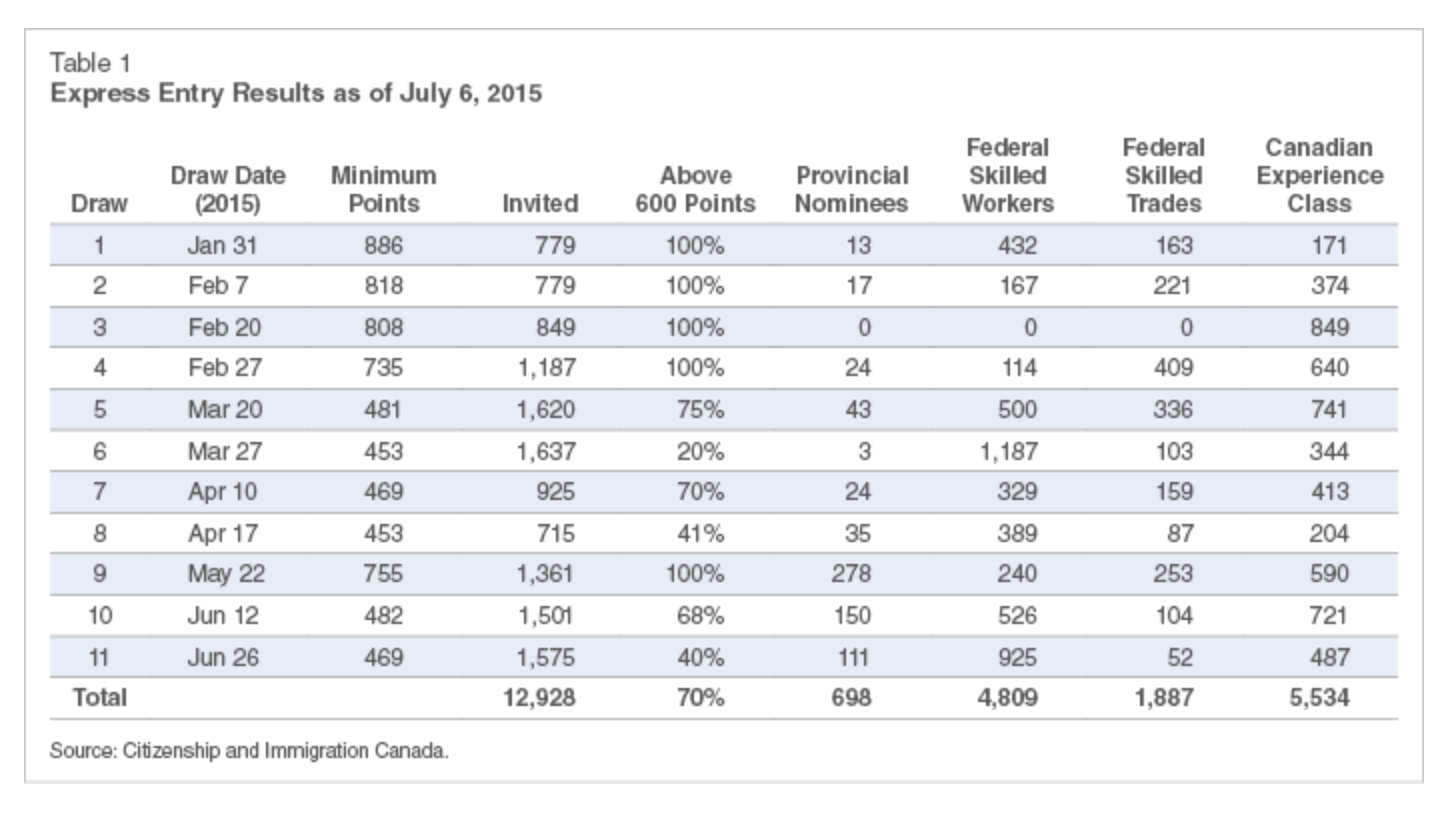
As of July 6, 2015, 112,701 Express Entry profiles had been submitted. Of these profiles, 48,723 candidates (43 per cent) were found ineligible since they did not meet Express Entry criteria. Of the remainder, 12,928 received invitations to apply for permanent resident status (in eleven draws which took place January 1–July 6: See Table 1). Among the invited candidates, 70 per cent scored above 600 points, meaning that the majority either obtained a job offer backed by a Labour Market Impact Assessment (LMIA),3 or a Provincial Nomination Program (PNP) certificate.4 Scoring over 600 points was a prerequisite to receiving an invitation to apply in Express Entry’s first four draws. Since then, point requirements have declined, though never below 453 points.

The overwhelming majority of invited candidates resided in Canada at the time of their Express Entry application (85.5 per cent), followed by India (3.2 per cent), and the United States (1.8 per cent). The top five source countries of invited candidates were India (20.8 per cent), the Philippines (19.4 per cent), the United Kingdom (7.4 per cent), Ireland (5.3 per cent), and China (4.1 per cent).

An Early Look at Express Entry Candidate Selection.

Police Association of Ontario defends carding ahead of consultations

Clumsy and inappropriate way to influence the consultations and discussion:

As the province launches a round of public consultation on police carding, Ontario’s largest police association is stepping up its defence of the controversial practice with a poll suggesting 40 per cent of Ontarians support carding when provided with highly selective examples of the procedure.

In an online survey of 1,350 people conducted for the Police Association of Ontario (PAO) by ResearchEtc. last month, 36 per cent of respondents said they opposed carding, a colloquial term for the police practice of stopping, questioning and collecting information from residents without arresting them. Another 24 per cent stated they supported the measure, with a remaining 40 per cent falling into the “neutral/don’t know” category.

Those percentages changed when respondents were informed that a street check – another term for carding – was involved in capturing Russell Williams, the former commander of CFB Trenton currently serving two life sentences for first-degree murder. Opposition to the practice dropped to 18 per cent while support increased to 40 per cent.

“All the publicity around this has cast a shadow of doubt on our members,” said association president Bruce Chapman. “We believe the public supports the police and this verifies it.”

But the Williams example is a far cry from the repeated stopping and interrogating of young black men in Toronto that has stoked calls to rescind carding entirely, which speaks to the troublesome broadness of the term. Police netted Mr. Williams at a road block set up specifically to find one of the women he’d killed. In Toronto, critics claim street checks are rarely related to specific, ongoing crimes. Of 1.1 million carding entries filed from 2009 to 2011, the most common justification was “general investigation” – given in one-third of all stoppages, according to a Toronto Police report.

“This survey amounts to a lot of propaganda and distortion of facts,” said Knia Singh, a law student who said he has been carded by police 10 times and launched a constitutional challenge of carding in June. “The example the association gives is not carding as the African-American community or First Nation community know it. Members of these communities are being stopped when they are standing around minding their own business.”

Police Association of Ontario defends carding ahead of consultations – The Globe and Mail.

A Racial Gap in Attitudes Toward Hospice Care

Interesting. Wonder the degree to which it is similar in Canada? There is now and then anecdotes (see Family overjoyed as top court rules doctors must seek consent before taking a patient off life support) but have not seen any surveys:

It is an attitude borne out by recent federal statistics showing that nearly half of white Medicare beneficiaries enrolled in hospice before death, compared with only a third of black patients. The racial divide is even more pronounced when it comes to advance care directives — legal documents meant to help families make life-or-death decisions that reflect a patient’s choices. Some 40 percent of whites aged 70 and over have such plans, compared with only 16 percent of blacks.

Instead, black Americans — far more so than whites — choose aggressive life-sustaining interventions, including resuscitation and mechanical ventilation, even when there is little chance of survival.

The racial gaps are expected to widen when Medicare is expected to begin paying physicians in January 2016 for end-of-life counseling, and at a time when blacks and other minorities are projected to make up 42 percent of people 65 and over in 2050, up from 20 percent in 2000.

At the root of the resistance, say researchers and black physicians, is a toxic distrust of a health care system that once displayed “No Negroes” signs at hospitals, performed involuntary sterilizations on black women and, in an infamous Tuskegee study, purposely left hundreds of black men untreated for syphilis.

“You have people who’ve had a difficult time getting access to care throughout their lifetimes” because of poverty, lack of health insurance or difficulty finding a medical provider, said Dr. Maisha Robinson, a neurologist and palliative medicine physician at the Mayo Clinic in Jacksonville, Fla. “And then you have a physician who’s saying, ‘I think that we need to transition your mother, father, grandmother to comfort care or palliative care.’ People are skeptical of that.”

Federal policies surrounding hospice also arouse suspicion in black communities since Medicare currently requires patients to give up life-sustaining therapies in order to receive hospice benefits.

That trade-off strikes some black families, who believe they have long had to fight for quality medical care, as unfair, said Dr. Kimberly Johnson, a Duke University associate professor of medicine who has studied African-American attitudes about hospice.

Dr. Johnson said her black patients were more likely to believe there are actual religious prohibitions against limiting life-sustaining therapy, and that suffering can be redemptive, or “a test from God.” And those beliefs, she added, were “contrary to the hospice philosophy of care.”

But now some doctors and clergy members are trying to use church settings to reshape the black community’s views, incorporating the topic in sermons, Bible study groups and grief and bereavement ministries.

Dr. Robinson, who is black and a daughter of Tennessee pastors, has been helping pastors develop faith-based hospice guidelines. She tells them, “God can work miracles, yes he can, but even in hospice.”

That message recently rang out from the pulpit at God Answers Prayer Ministries, an African-American church in South Los Angeles, as Bishop Gwendolyn Coates-Stone tried a sermon theme on advance care.

“It’s such a great cost to hold on to some of those sicknesses and diseases that eventually are going to take us out,” she exclaimed into a microphone, bobbing and weaving in a swirl of royal purple robes. “Just like Jesus talked about his death and prepared his disciples for his death, we ought to be preparing our disciples for our death!”

A Racial Gap in Attitudes Toward Hospice Care – The New York Times.

The [US] Foreign Service is too white. We’d know — we’re top diplomats.

Good article on the need for diversity within the US foreign service by former senior diplomats:

Like Wall Street and the medical and legal professions of the mid-20th century, the diplomatic corps long drew its members from traditionally elite, exclusive institutions, not themselves very diverse at the time. Moreover, college students of color rarely knew that diplomacy was a professional option for them.

That’s changing. Today, our diplomats are more representative. But we haven’t made nearly enough progress. According to the latest statistics, 82 percent of Foreign Service officers (the commissioned career officers serving in embassies and consulates abroad as well as some policy positions stateside) are white. Seven percent are Asian American, 5.4 percent are African American, and 5 percent are Latino. About 60 percent are men. In contrast, the U.S. population is more than 50 percent female, more than 17 percent Hispanic and more than 14 percent African American.

U.S. foreign policy is informed and improved by a wider range of experiences, understandings and outlooks. To represent America abroad and relate to the world beyond our borders, the nation needs diplomats whose family stories, language skills, religious traditions and cultural sensitivities help them to establish connections and avoid misunderstandings. For some of our international allies that are themselves facing diversity issues, American diplomats of diverse backgrounds can help them build bridges. For others, diversity in the American diplomatic corps makes the United States seem more approachable.

….How can the Foreign Service draw upon the country’s total talent pool? The challenge isn’t only eliminating the last vestiges of discrimination but also actively recruiting the most talented and dedicated people from every segment of society, especially those of great ability but limited means.

When the Foreign Service drew upon a narrow swath of the population, most future diplomats already knew people who had represented the country overseas. As part of their upbringings, these young people acquired the mannerisms that would make them at home in the Foreign Service. To diversify the diplomatic service, we must recognize that promising young people from less privileged backgrounds do not enjoy these advantages and assurances. They need to know that the Foreign Service welcomes their skills and experiences. They need role models with whom they can identify. And they need the reassurance that diplomacy can be rewarding and remunerative.

Not sure what the Canadian numbers are. Anecdotally from my time there, things were starting to change.

The Foreign Service is too white. We’d know — we’re top diplomats. – The Washington Post.

How do tech’s biggest companies compare on diversity? | The Verge

How_do_tech’s_biggest_companies_compare_on_diversity____The_VergeSome good comparative data. Chart above highlights Asian Americans given other minorities are relatively small (Amazon rates higher given the number of people who ship product):

Key takeaways [for overall employment]:

  • Amazon sets the bar for female employment with 37 percent of its US workforce. Microsoft lags the pack with just 24 percent (sampled average is 29 percent female) — far below the 47 percent of the US workforce that’s female.
  • Apple employs a higher percentage of people claiming hispanic / Latino origin than its peers in the US. At 12 percent of its US workforce, it’s well ahead of Twitter’s 2 percent (sampled average is 8 percent Hispanic or Latino).
  • Amazon employs far more people that identify as Black or African American than the other companies sampled. At 15 percent, it is well ahead of Facebook’s 1 percent and the 2 percent employed by Google and Twitter (sampled average is 7 percent).
  • Amazon (13 percent) and Apple (16 percent) lag the others in the percentage of employees who identify as Asian (sampled average is 23 percent).
  • The sampled average for people that identify as Asian is 23 percent of the workforce even though they compromise just 4.7 percent of the US population.

And what about the leadership composition of some of the world’s most powerful and profitable companies?

Key takeaways [for leadership]:

  • Facebook (23 percent) and Twitter (22 percent) are the best at promoting women into leadership roles among the companies sampled. Microsoft is the worst at 13 percent (sampled average is 18 percent).
  • While women represent an average of 29 percent of all employees in the US tech firms sampled, that number quickly falls to 18 percent of leadership positions (Women make up 47 percent of the US workforce).
  • Amazon’s leadership is the whitest at 90 percent followed by Apple at 87 percent, far above Twitter’s 68 percent (sampled average is 79 percent white).
  • Amazon (75 percent) and Apple (72 percent) promote the greatest percentage of white males into leadership positions (sampled average is 65 percent).

As dire as these charts appear, the tech industry is advancing toward the goal of greater inclusiveness and transparency. Apple, Microsoft, Facebook, and Intel have all released customized reports showing mid-2015 progress globally, beyond the 2014 US data provided in the EEO-1. Progress is slow, but it is happening.

How do tech’s biggest companies compare on diversity? | The Verge.