Brazil’s colour bind: How one of the world’s most diverse countries is just starting to talk about race

Brazil’s_colour_bind__How_one_of_the_world_s_most_diverse_countries_is_just_starting_to_talk_about_race_-_The_Globe_and_MailGood, in-depth profile of Brazil by Stephanie Nolen, its history of slavery, its national myth of colour blindness, racial inequality and efforts to acknowledge and address these legacy issues:

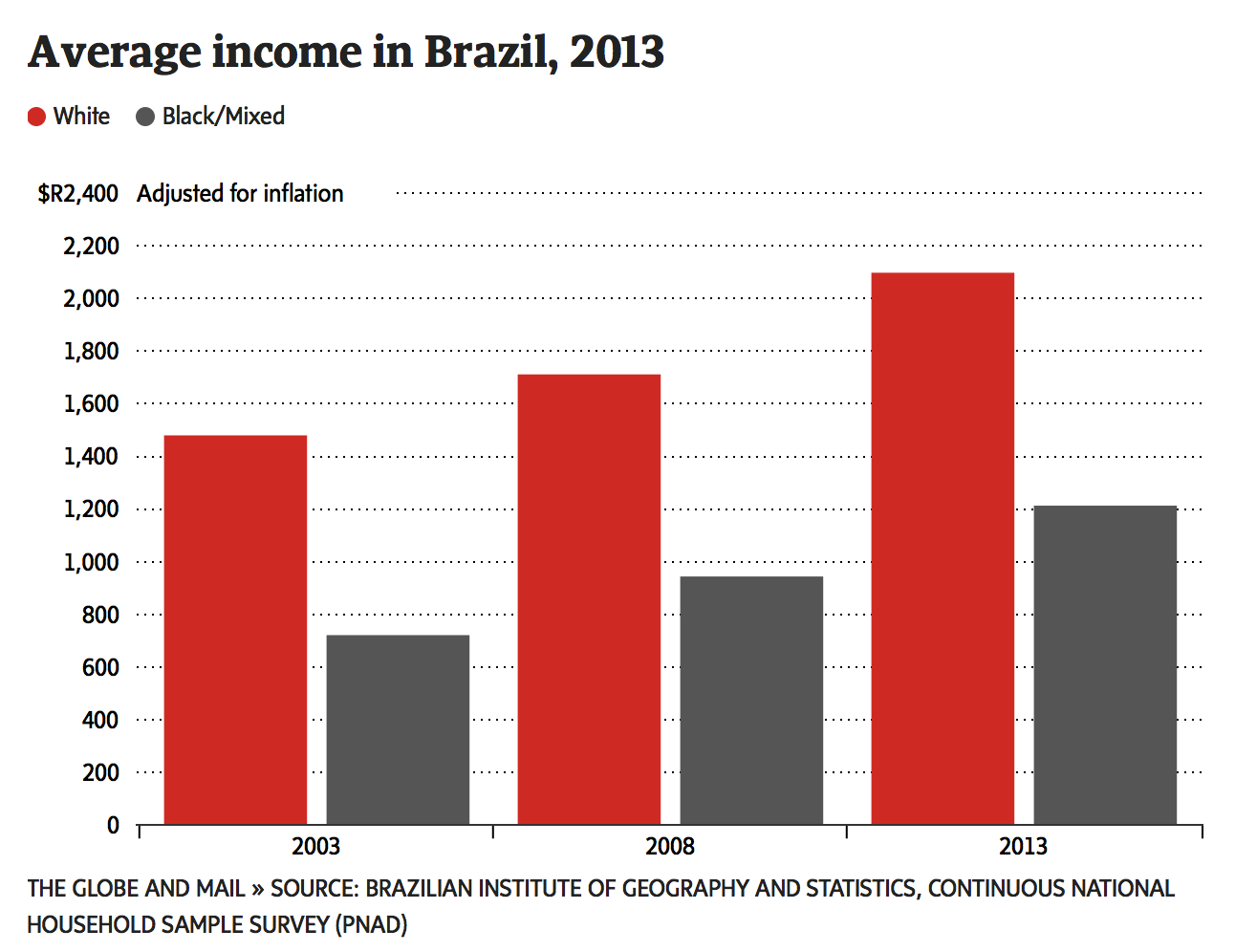
Even as the former slave owners set about diluting the country’s blackness, they also went to work on their cover story. In the Brazilian creation myth – the country’s version of Canada’s “cultural mosaic” or the U.S. “melting pot” – the country is a democracia racial, a racial democracy. This official story was built on the idea that from the day slavery ended, Brazilians of all colours were equal. After all, there was no segregation, no apartheid, no Jim Crow. Glossing over the massive disparities between the former owners and the newly freed slaves – who had no education, land or assets – the Brazilian elite, almost entirely white, declared the country uniquely equal and, in effect, postracial.

“It was ‘invisibilization,’” says Marcelo Paixão, who is black and a professor of economics at the Federal University of Rio de Janeiro. “The discourse was that we don’t have race in Brazil, so you don’t have race problems in Brazil, and you don’t need to discuss the inequality.”

The first census after the end of slavery, in 1890, asked not about race, but about colour: Citizens were asked if they were white, brown, black, yellow or caboclo – a Portuguese word for those with some indigenous ancestry, more commonly known here as being vermelha, or red. Over the next years, racial identity was steadily replaced with considerations of colour. In 1976, the national statistics institute, seeking to hone the precision of the census, surveyed thousands of Brazilians about what word they themselves used – and came back with a list of 136. They included terms such as amarela-queimada (burnt yellow), canela (cinnamon) and morena-bem-chegada: very nearly morena, a word for brown.

On some level, it was a progressive ideology, notes Prof. Paixão – it allowed for nuance instead of clear-cut indicators of racial purity. It also resulted in a more genuinely mixed culture, although that mixture is the outcome, in part, of appropriation. Cornerstones of black culture – such as samba music and the martial art capoeira, practised in secret by slaves – have been thoroughly co-opted into Brazilian identity.

But within that culture, and that society, there was an ineluctable hierarchy of what were to be considered racial traits. The dominant idea, propagated by whites, and eventually accepted by many black and mixed-race people as well, he explains, was that the “white” part of the mix brought a European rationality, while Africans brought happiness and creativity, a positive outlook – he ticks off adjectives and rolls his eyes. The more white that one was, the more of the “valuable” characteristics one had. To be whiter was to have a better chance of getting a job, and of earning more in that job. To be whiter, in other words, was to have it easier. Brazil became what is sometimes called here a “pigmentocracy.” (Prof. Paixão is among the fewer than five per cent of faculty members at the Federal University who are black.)
Brazil’s colour bind: How one of the world’s most diverse countries is just starting to talk about race – The Globe and Mail.

Refugees Describe Life Under ISIL | Al Jazeera America

Haven’t seen much detailed reporting like this:

In the Syrian capital of the Islamic State in Iraq and the Levant’s self-declared caliphate, Raqqa, the group’s extreme interpretation of Sharia law is enforced through extraordinary punishments, including death. The list of potential violations is long and reminders of the consequences of crossing the groups are on constant display, with executed and beheaded men displayed in public squares and roundabouts, their crimes often detailed in notices pinned to their corpses.

And even so, some say the chaos and destruction that characterizes most of Syria after four years of war is such that the comparative calm in Raqqa resulting from ISIL’s strict governance actually offers a respite.

Those who recently fled from Raqqa to Turkey describe a new form of governance taking root as ISIL, also known as ISIS or Daesh, continues its effort to entrench itself into the social fabric of the capital. Despite daily bombardment from U.S.-led coalition airstrikes on the city, ISIL has managed to expand its reach both geographically and socially, taking control of even the minute details of everyday life.

The group has restored electricity supply, painted road signs, imposed taxes, implemented a new education system and operates a highly functional — albeit punitive and brutal — judicial system. The organization now controls about one-third of the country, and rules over millions of people across Syria and Iraq. The group has commandeered oil refineries and gas fields in the desert terrain, helping to finance its operations.

ISIL police battalions made up of mostly foreign fighters patrol the streets in 4×4’s and on foot, also setting up checkpoints across the city to inspect identification documents and report any violations to the strict code. Residents must provide tax receipts, proving they have paid the mandatory portion of their agricultural or retail dividends to the state, in order to cross.

Refugees Describe Life Under ISIL | Al Jazeera America.

The suffocating experience of being black in Canada

Anthony Morgan on the Black experience:

As we enter early adulthood we are collectively realizing that, despite what many think, blacks in Canada cannot speak about their lived experience and the ongoing injustices they face without being met with silencing indifference, dismissal and sometimes hostility.

While tolerating degrees of anti-black racism may have been a successful survival strategy for a previous generation of blacks in Canada, our generation has never known a Canada without a Canadian Charter of Rights and Freedoms or provincial human rights codes that enshrine our universal entitlement to equality as Canadians.

As such, we find it impossible to accept today’s black Canadian experience: extreme marginalization and disadvantage; restricted access to housing; racial profiling in policing, security, education and child welfare; criminalization; over-representation in the criminal justice system; high levels of unemployment; and disproportionate and extreme poverty.

This is part of the reason why when you tell the upcoming generation of social justice-oriented black Canadians to “Go back to your home country if you don’t like it here,” we stare at you with blank confusion, if not in angry defiance. Canada is the only home country we’ve ever known.

Our righteous resistance is not an expression of hatred for Canada, cops, or Confederate flags. It’s a thrashing attempt to break the stranglehold of Canadian-brand anti-black racism and wake our society up to an irrefutable fact:

We have the right to be treated equally as human beings, but also as Canadians. And as such, we resist suffocating racism because we are true black strong and free.

The suffocating experience of being black in Canada | Toronto Star.

New Aussie anti-Islamic party guns for 20 per cent of the vote

Australia’s newest political party:

Australia officially now has a political party modelled on the far-right wing movements in Europe and dedicated to the idea that Islam is a “totalitarian ideology with global aspirations”.

The Australian Liberty Alliance gained approval from the Australian Electoral Commission on Wednesday for registration as a party, having signed up well over the required 500 members and attracted no objections.

Its national secretary, Ralf Schumann, confirmed that controversial anti-Muslim Dutch politician Geert Wilders planned to launch the party on October 20.

Mr Schumann told sympathisers this week that the party faced “a strong headwind and … some nasty windshears”, but reminded supporters that “so did like-minded parties with similar policies in Europe”.

…Mr Schumann refused an interview about the party, which is the political offshoot of the “Islam-critical” Q Society. But Q Society national president Debbie Robinson, who is also a director of the ALA, told Fairfax Media that Islam was “a dangerous ideology that’s definitely not compatible with Western culture and society”.

“There is no moderate version of Islam … there may be people who don’t follow it to the letter, but there is no moderate version, so it’s dangerous. It’s dangerous for our society.”

In Q Society emails, Ms Robinson has said the Australian Liberty Alliance intends to “rebuild the lucky country”.

The party’s manifesto says “Our Australia stands for individual liberty, small government, Western values built on Judaeo-Christian and Humanistic foundations, social fairness and an integrated multi-ethnic society”.

It outlines a number of policy positions including “smarter, smaller government”, and “integration over separation” when it comes to multiculturalism.

Islam, the manifesto says, “uses the religious element as a means to project itself onto non-Islamic societies … No other religious ideology in our time has both the doctrinal aspiration as well as the economic and demographic muscle to impose itself globally”.

New Aussie anti-Islamic party guns for 20 per cent of the vote.

Back to the beginning: the Conservatives burst a hiring bubble of their own making

Back_to_the_beginning__the_Conservatives_burst_a_hiring_bubble_of_their_own_making___Ottawa_CitizenGood analysis by James Bagnall on public service employee number swings. Most interesting figure for me was shift from the regions to Ottawa/Gatineau (from 33.9 to 39.4 percent), reflecting in part that the decisions are made in the capital, not the regions, and likely disproportionate cuts to service delivery. The controversy over the closing of Veterans Affairs example being the most public example, with cuts to CIC’s regional network being partly responsible for the dramatic decline in the number of new citizens in 2012 and 2013 :

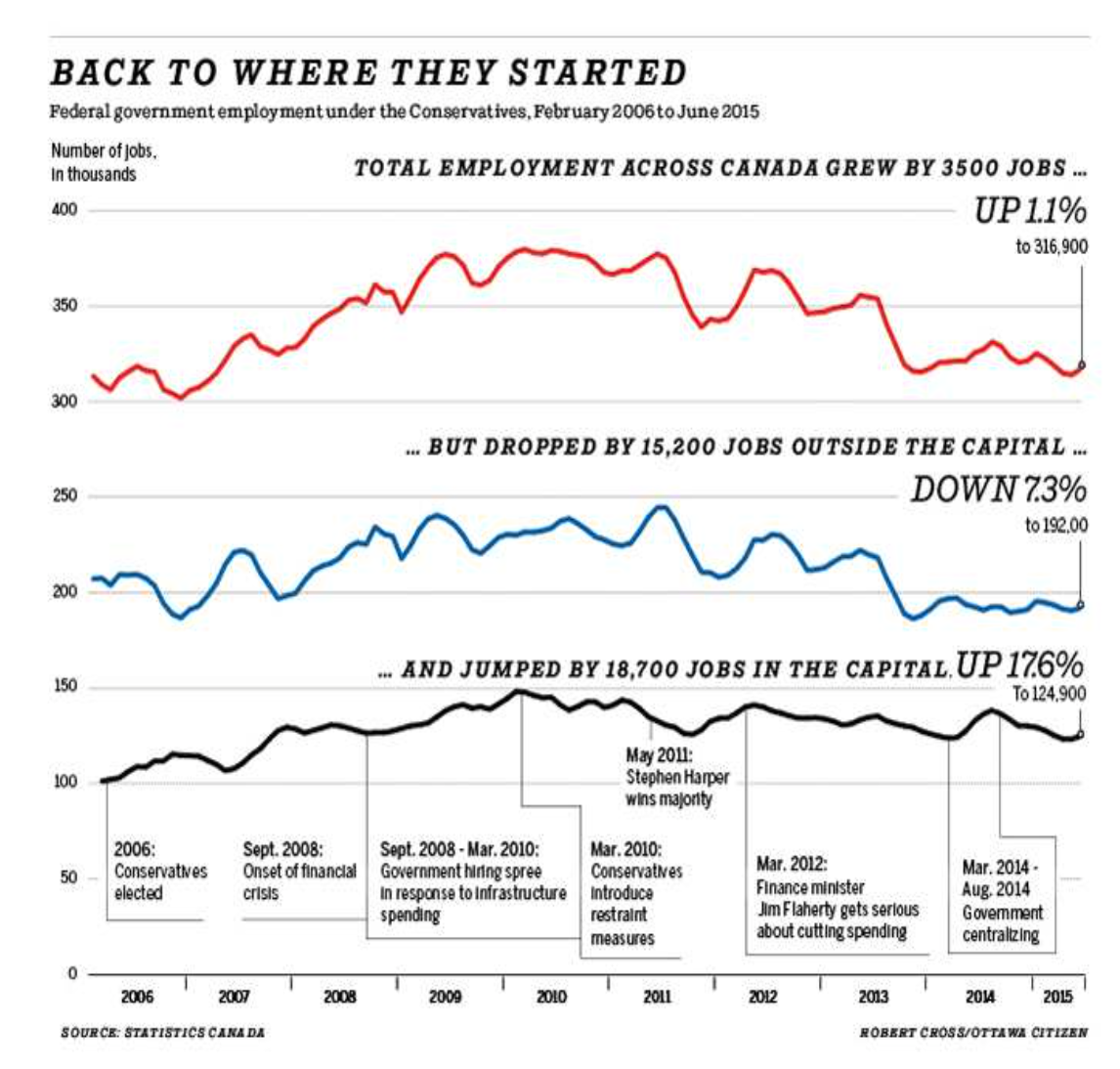
The initial rapid rise in the size of the federal workforce was a response to the onset of the 2008 financial crisis. The thinking was that if the private sector stopped spending, government had to pick up the slack to prevent economic collapse.

When it became apparent a couple of years later that the world hadn’t ended, the Conservatives reasserted a party imperative: the budget must balance. The late finance minister Jim Flaherty began signalling restraint in 2010, then accelerated things with his March 2012 budget. An important catalyst was the introduction of executive bonus programs that rewarded managers who trimmed their budgets.

Huge swings in government employment aren’t unique to Conservatives. The Liberals under prime minister Jean Chrétien implemented equally drastic cuts in percentage terms during the mid- to late-1990s. Chrétien and his finance minister, Paul Martin, had little choice. Interest payments on the federal government’s debt consumed 31 per cent of total revenues and were growing.

Even after adding more than $150 billion to taxpayers’ debt burden, the Conservatives budget is still much healthier. Last year, debt interest represented little more than 10 per cent of revenues, thanks in large part to substantially lower interest rates than were faced by Chrétien.

An unexpected result of the Conservative government’s recent retrenchment has been a sharp rise in the percentage of public sector employees based in the National Capital Region. According to data compiled by Statistics Canada, 39.4 per cent of the federal government’s workforce in June lived in Ottawa or Gatineau – compared to just 33.9 per cent when the Conservatives were sworn in almost nine-and-a-half years ago.

Indeed, had it not been for this centralization, the economy of the National Capital Region might have dipped perilously close to recession. Another way to look at it: From early 2006 to mid-2015, the Conservatives added 18,700 government jobs in Ottawa and Gatineau – and took away 15,200 from the rest of the country. Among the federal departments disproportionately hurt by the job losses were Veterans Affairs, Agriculture, Defence, Employment and Environment – organizations with a strong presence nationally.

Whoever wins the federal election will find much within the government’s workforce in need of repair – and many employees who would like to see an end to the wild swings of the past 20 years.

Back to the beginning: the Conservatives burst a hiring bubble of their own making | Ottawa Citizen.

Air travel and religion don’t always mix. Examples and Jon Kay commentary on El Al

Further to the Porter incident, useful list of other examples:

El Al

A more dramatic incident in 2014, aboard a flight from New York to Israel, drew attention to the challenges of accommodating some ultra-Orthodox Jewish men, who refuse to sit next to women to whom they are not married or otherwise related.

The El Al flight turned into an “11-hour nightmare,” according to one passenger, after a group of men, who had earlier tried to switch their seats with other passengers, reportedly stood up and blocked the aisle shortly after takeoff.

The Tel Aviv-based daily newspaper Haaretz had earlier reported that Orthodox Haredim were causing “a host of logistical problems” for the Israeli airline. But despite outcry at home and abroad, El Al said it has no official policy for dealing with religious seating requirements, and no plans to introduce one.

…Patting down priests

CBC News revealed last year that Canada Border Services Agency managers at Toronto’s Pearson airport allowed a small group of Hindu priests to avoid screening by female border guards to comply with their religious beliefs.


…Check your dagger, please

Kirpans, the ceremonial daggers that many Sikhs are required to carry, have been the focus of controversies across Canada — not the least of which was an outright ban by a Quebec school board that the Supreme Court overturned in 2006.

The daggers are allowed in some places that don’t permit weapons — including Parliament buildings and some courthouses — but don’t try to take one on a plane.

Kirpans are specifically mentioned by the Canadian Air Transport Security Authority among the “religious and cultural items” that “should be packed in your checked baggage.” They are also banned by the Transportation Security Administration in the U.S.

Air travel and religion don’t always mix – World – CBC News.

Jon Kay on El Al:

There is a simple way to address such complaints from a Haredi passenger: Have the flight attendants (preferably women) throw him off the plane, give him back his money, and instruct him that he should instead travel to Israel on a mode of transportation more suited, in technological sophistication, to his primitive mindset — such as a canoe made from a hollowed out tree.

Of course, stories of Haredi sexual segregation of have been coming out of Israel for years now. In a move that would make Saudi Arabia proud, some Israeli communities even have sex-segregated busses. And some ultraorthodox communities practice a disgusting mouth-to-penis circumcision practice called Metzitza B’peh, which would be the subject of child-sex abuse charges here in North America if Muslims were doing it. Israeli society shouldn’t stand for such deplorable practices, but ultimately that is Israel’s business.

El Al, on the other hand, is a company that uses Canadian airports and flies hundreds of Canadian passengers to and from Israel every day. Putting aside the question of whether the episodes described above violate Canadian human-rights law, how does it look for Israel’s national flagship carrier to put on display, in front of rows of horrified passengers, the poisonous prejudices of the most narrow-minded constituency in Israeli society?

We are always told (by Stephen Harper and Benjamin Netanyahu alike) that Israel is a beacon of progressive thought, democracy and pluralism in a Middle East brimming with repressive, retrograde attitudes. And in general, that is true. But it seems to me like Elana Sztokman can be forgiven for feeling otherwise.

Jonathan Kay: On El Al’s planes, a case study in appalling sexism

The dichotomy of life as a gay Palestinian with Israeli citizenship

Interesting vignette:

For the 27-year-old, a well-known socialite in Tel Aviv’s LGBT community, the city is a haven for gay men, but Abu Seif says he considers himself a Palestinian and that as such, he can never fully integrate.

His struggles, along with those of two other protagonists are the subject of “Oriented,” a new Israeli documentary, touted as the first to focus on gay Palestinian citizens.

…During an interview this week at a spacious apartment in Jaffa — the mixed Arab-Jewish city merged with Tel Aviv — the three protagonists of “Oriented,” sporting the latest trend in beards, could easily be mistaken for any hip Jewish residents of Tel Aviv.

The liberal Israeli city is considered a gay refuge in an otherwise largely intolerant Middle East, where in some places, gays are persecuted and sometimes killed. Same-sex relations are punishable by death in Iran, Mauritania, Saudi Arabia, Sudan and Yemen. Some gay Palestinians in the West Bank and Gaza Strip have fled their conservative homes to come out in Tel Aviv. Even in Jerusalem, the same gay friendly climate does not always thrive.

Abu Seif is critical of Israel, his country of citizenship, over its policies toward Palestinians but also criticizes the Palestinian society, where homosexuality remains taboo and where there is little tolerance for gays.

On his documents, he is an Arab citizen of Israel, like the two other protagonists in “Oriented” — 27-year-old Fadi Daeem and 26-year-old Naeem Jiryes. The Arab minority makes up about 20 percent of Israel’s population.

All three are fluent in both Arabic and Hebrew and easily switch between the languages. But while in Tel Aviv their sexuality is hardly an issue, they say their national identity is.

“At the airport while my Jewish partners … are already at the duty free, I’m still being checked,” said Abu Seif, referring to the extra level of scrutiny Arab Israelis often face. “So I’m for sure not an Israeli gay man. I’m gay something. So I’m gay Palestinian.”

The dichotomy of life as a gay Palestinian with Israeli citizenship – Israel – news | Haaretz.

A politician in Finland declared war on multiculturalism. This is how his country responded.

More on Finland:

Finland is one of the less diverse nations in northern Europe. In 2010, only 250,000 people out of population of around 5 million were born outside the country, according to government statistics. But that number is steadily growing.

Immonen’s party is something of a rising force in Finland’s politics. It got 17.7 percent of the national vote in elections in April, making it the second biggest party in Finland and winning it a place in the country’s governing coalition. Timo Soini, Finland’s current foreign minister, is the leader of The Finns party.

While Soini issued no comment about Immonen’s declaration, other prominent Finns did. The post struck a nerve, in part because it came so close to the four-year anniversary of the massacre carried out by Norwegian far-right bigot Anders Breivik, who in his writings also fumed about the evils of multiculturalism.

“I want to develop Finland as an open, linguistically and culturally international country,” tweeted Finnish Prime Minister Juha Sipilä soon after the post emerged. “I cannot accept Immonen’s remarks.” His finance minister, Alex Stubb, said on Twitter that “Multiculturalism is an asset. That’s all I have to say.”

Erkki Tuomioja, a member of the Social Democrats, the main opposition party, was a bit more direct. “When multiculturalism and diversity are put into question it must be answered loudly,” Tuomioja told Bloomberg News. “There is no such thing as a harmless hate speech, and it’s a short step from there to hate acts. It must not be tolerated.”

The biggest response, though, came on Tuesday, when thousands of Finns gathered in Helsinki in defense of multiculturalism. Images and messages of solidarity appeared on social media under the hashtag  #meillaeonunelma, or “we have a dream” — a direct riposte to the beginning of Immonen’s statement.

A politician in Finland declared war on multiculturalism. This is how his country responded. – The Washington Post.