Planning guru Larry Beasley on a monumental controversy

Good and interesting interview on how the Government’s political politicization of the memorial differed from the normal practice, fuelling the controversy:

Q: So what changed? What went wrong in the case of the victims of communism memorial?

Two things happened. One is that, several years ago, the responsibility for managing the conceptualization, as well as the implementation of monuments, moved away from the National Capital Commission, which is one step removed from government, and shifted over to [the Department of Canadian Heritage].

Second, in more recent times, the governments of the day have been more interested in using monuments and memorials to communicate themes. In the past, memorialization was not so much a part of the government’s communications strategy. Some of the more recent memorials have been sponsored by the government and have been communication vehicles for government.

Q: Such as?

The 1812 memorial on Parliament Hill, for example, is a good indication. That was a part of a whole communications program the government has. I’m not trying to interpret the politics of why that was the case, but it was the case.

Q: The process was less political in the past?

In the past, what tended to happen is that organizations would come to the NCC. The NCC has a very well-articulated policy on the location of monuments according to their stature, saving certain sites for the primary monuments of the country, identifying sites where monuments were appropriate. That was managed through the NCC, at arm’s length from government, working with the sponsoring organizations.

In recent years, there have always been competitions, truly independent panels, the advice of our committee, and other kinds of advice. The projects then move forward.

Q: And that didn’t happen in the case of the victims of communism memorial?

As I understand it, the monument is basically sponsored by the government and has been implemented through a department of the government. The NCC is put in the position of an approval authority, but it’s much more constrained than if it was managing the project from the beginning.

Planning guru Larry Beasley on a monumental controversy.

UAE, concerned about militant Islam, passes law against race, faith hate | Reuters

Expect application will be broader than cracking down on militant Islam given that it also outlaws “insults against religions”:

The United Arab Emirates has outlawed religious or racial discrimination, the state news agency WAM said on Monday, citing a royal decree by President Sheikh Khalifa bin Zayed Al Nahyan.

The law is aimed in part at countering Islamist militancy, particularly the practice known as takfir, whereby hardline Muslims label followers of other schools of Islam unbelievers, but it also outlaws insults against religions.

“The new law No. 02 of 2015 criminalizes any acts that stoke religious hatred and/or which insult religion through any form of expression, be it speech or the written word, books, pamphlets or via online media,” WAM reported.

The UAE, an oil-exporting confederation of seven Muslim emirates ruled by hereditary dynasties and bordering Saudi Arabia and Oman, is worried about political Islam, which appeals to religious conservatives while challenging its lack of democratic rule.

UAE, concerned about militant Islam, passes law against race, faith hate | Reuters.

Reframing the debate over expat voting: Russell and Sevi, Globe editorial

Reframing_the_debate_over_expat_voting_-_Macleans_caTwo contrasting views on expatriate voting.

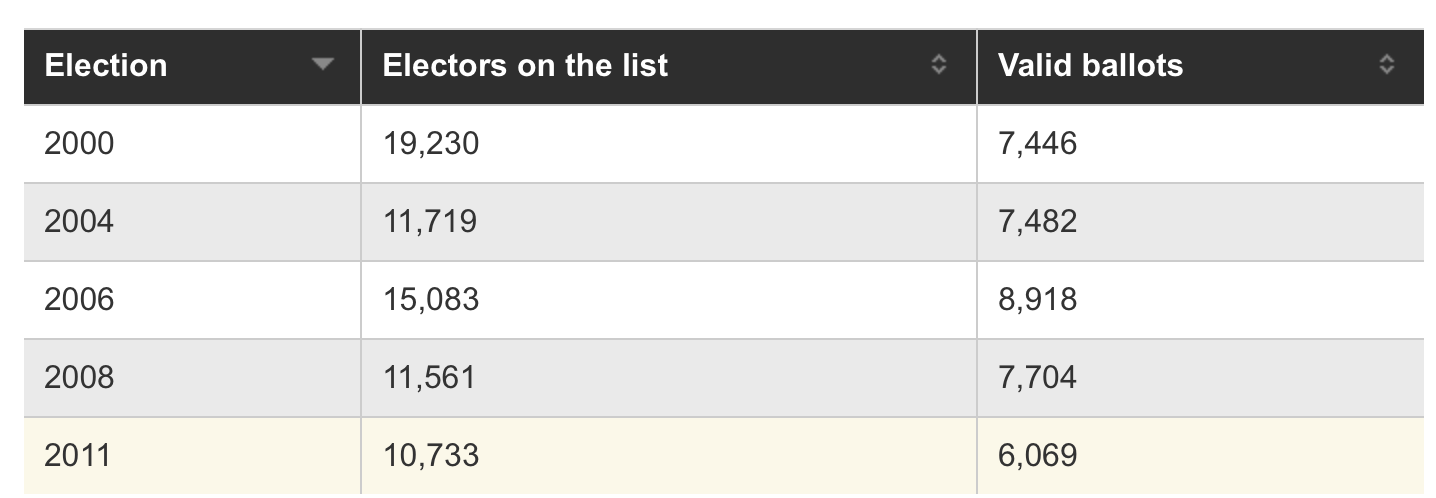
The first, by Peter Russell (a former excellent and insightful professor of mine) and Semra Sevi (who has written before Canadian expatriates should never lose the right to vote), provides useful data on the number of expatriates who actually vote.

The number, as shown above, is minuscule compared to the estimated almost three million Canadian expatriates. The article also has the following international comparisons:

The five-year limitation, as opposed to some other limit, is overly drastic and Canada’s provision is not comparable with similar democracies around the world.

Americans living outside of the country have the right to vote no matter how long they have been abroad providing they pay taxes. The right to vote expires in the United Kingdom after 15 years abroad. To put this into perspective, this is three times longer than what Canada permits even though Canada is part of the Commonwealth.

Australian citizens abroad are allowed to vote so long as they intend to return to Australia within six years. After six years, citizens can renew their status by making an annual declaration of their intention to return “at some point” thereby voting for an indefinite period. In New Zealand, there is a three-year limit but the clock restarts every time citizens visit the country. Moreover, New Zealand extends the right to vote to non-citizen residents from other Commonwealth countries.

The United Kingdom extends similar voting rights to citizens of Commonwealth countries and citizens of the Republic of Ireland. The five-year limit in Canada is an arbitrary number and is unnecessarily onerous. On the surface, it is a year less generous than Australia, but Australians can renew their status by expressing a mere intent to return to the country “at some point” in the future. Canadians, on the other hand, need to resume residency to regain their right to vote abroad.

The right to vote is a fundamental right of citizenship that is protected by the Charter and does not depend on place of residence. The five-year limitation does not conform to the 21st-century demands of globalization. While there is currently an NDP-sponsored bill to repeal the provision that limits voting rights for Canadians abroad as unconstitutional, it is possible that the unconvincing judgment of two Ontario appellate judges could be overturned on appeal to the Supreme Court of Canada—but, alas, not in time to restore democratic rights to the close to a million and a half Canadians living abroad for the fall election.

Reframing the debate over expat voting – Macleans.ca.
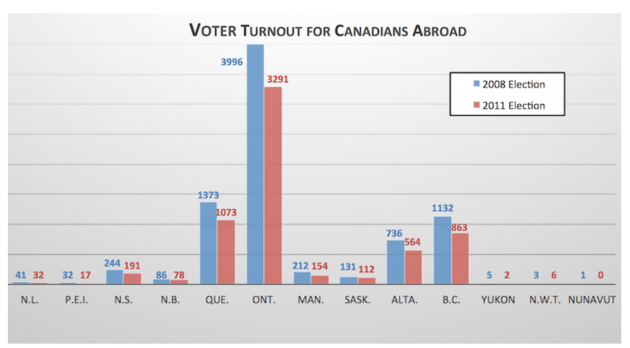
Expatriate Voter TurnoutThe Globe editorial takes, correctly in my view, takes the opposite view:

We think the decision is the right one, for three reasons.

First, because our electoral system, based as it is on residence in a particular electoral district, assumes a connection between residence and voting, governors and the governed.

Second, because we live in a world of national borders and laws that do not apply extraterritorially, which means the lives of non-resident Canadians are largely not governed by Canadian law. As Ontario Chief Justice George Strathy put it, “permitting all non-resident citizens to vote would allow them to participate in making laws that affect Canadian residents on a daily basis, but have little to no practical consequence for their own daily lives.”

And third, because reasonable people can disagree, reasonably, over how long a citizen should reside outside of Canada before having her vote suspended. Should the limit be five years? Ten? Two generations? Never? The practical question of setting reasonable limits is best left where the Ontario Court of Appeal left it, in the hands of Parliament.

The Canada Elections Act says that Canadian citizens are entitled to vote in the riding in which they typically reside. However, the Act also says that Canadian citizens living abroad for more than five years cannot vote. There are exceptions for people sent overseas in service to the country, such as members of the Armed Forces.

All of which is not unreasonable. Justice Strathy noted that “residence is a determinant of voter eligibility in all provinces and territories.” If you move from Nova Scotia to Alberta, you can’t continue voting in Nova Scotia in perpetuity.

He also pointed out that “residence is a requirement of the electoral laws of the other Westminster democracies. The U.K., Australia and New Zealand limit the voting rights of non-resident citizens to those temporarily resident abroad.” The maximum time overseas before one loses the vote is 15 years in Britain, six years in Australia and three years in New Zealand. Canada’s current law is fair.

 No, Canadians living abroad shouldn’t get to vote 
10 chiffres qui vont vous surprendre sur l’immigration en France

Apologies for the capitalization but the original site had these all in caps and I couldn’t find an easy way to reformat.

Good and interesting data:

  1. CHAQUE ANNÉE EN MOYENNE, ENTRE 2004 ET 2012, 200 000 IMMIGRÉS SONT ENTRÉS EN FRANCE, SOIT MOINS QUE LA MOYENNE DES PAYS DE L’OCDE.
  2. 226 FILIÈRES D’IMMIGRATION CLANDESTINE ONT ÉTÉ DÉMANTELÉES EN 2014
  3. 63 % DES IMMIGRÉS ENTRÉS EN FRANCE EN 2012 SONT AU MOINS TITULAIRES D’UN DIPLÔME DE NIVEAU BACCALAURÉAT
  4. 40% DES IMMIGRÉS DE PLUS DE 16 ANS, NON ÉTUDIANTS, ENTRÉS EN FRANCE EN 2012, DÉCLARAIENT AVOIR UN EMPLOI L’ANNÉE DE LEUR ARRIVÉE.
  5. DANS L’ENSEIGNEMENT SUPÉRIEUR FRANÇAIS, 289 274 ÉTUDIANTS SONT DE NATIONALITÉ ÉTRANGÈRE (⅛)
  6. LE “PASSEPORT TALENTS” OUVRIRA UN DROIT AU SÉJOUR VALABLE JUSQU’À 4 ANS
  7. LA FRANCE A ENREGISTRÉ 64 310 DEMANDES D’ASILE EN 2014 (Germany 202,815).
  8. LA RÉFORME DE L’ASILE PERMETTRA DE RÉDUIRE LE DÉLAI D’EXAMEN DES DEMANDES À 9 MOIS (reduction from current 2 years)
  9. EN 2014, 105 613 PERSONNES ONT ACQUIS LA NATIONALITÉ FRANÇAISE.
  10. PRÈS D’UN IMMIGRÉ SUR DEUX ENTRÉ EN FRANCE EN 2012 EST NÉ DANS UN PAYS EUROPÉEN, contre trois sur dix dans un pays africain.

10 chiffres qui vont vous surprendre sur l’immigration en France | Gouvernement.fr.

“Reclaim Australia” – How racists are co-opting multiculturalism

Commentary by Ruby Hamad:

Even the name “Reclaim Australia” is a dead giveaway. Reclaim it for whom and from whom? Despite the nod to the “traditional owners”, they clearly they do no want to reclaim it for them. It’s about the ideals of whiteness.

As experts are now warning, we are going to see a lot more of this sort of thing in the future as our understanding of race and racism evolves.

When the dominance of the white race was indisputable and seemingly insurmountable, racism was simply about skin colour. Now, decades after the abolition of the White Australia policy, the civil rights movement in the US and the end of apartheid in South Africa, it’s about assimilation. Who is willing to play by the rules, to show us they are really “one of us”?

Islam is the primary target of Reclaim Australia not because of any real threat it represents to our country but because many Muslims visibly and defiantly hold onto their traditions and clothing. Islam and its traditions – be it the hijab, halal food, or praying at the mosque – is regarded as an explicit rejection of Australian (and more broadly Western) ideals, and for that reason, Muslims are seen as a threat that must be extinguished.

Never mind that “tolerance” is one of those values we supposedly do better than anyone else.

Racist statements and ideologies do not magically become non-racist when a non-white person espouses them. Nor does racism have to take the form of neo-Nazism (although there appears to be plenty of that lately), but simply the persistent insistence that non-white people fall into line, that we know our place and that we acknowledge that white culture is the best one.

How racists are co-opting multiculturalism.

Foreign caregivers face lengthy wait for permanent status

More challenges for CIC:

It’s taking twice as long for foreign caregivers to get permanent resident status in Canada as it did a year ago despite Ottawa’s promise to expedite the process.

According to an immigration department internal memo titled “advice to minister,” the processing time for caregivers’ permanent residency reached a record 50 months in January, up from 26 months a year ago. That’s on top of having to work two years alone in Canada — separated from family — in order to meet the residency requirement.

Immigration officials are still wrestling with a huge backlog. As of February, more than 17,600 caregivers who had met the work requirement — down from a peak of 24,600 last year — were still waiting in the queue to be reunited with their spouses and children living abroad.

Delays in granting permanent status and reuniting families often lead to family breakups and cause other adjustment problems for caregivers’ children, including high school dropout rates, said immigration lawyer Richard Kurland, who obtained the government memo.

“Caregivers waiting for PR (permanent residency) are unfortunately subject to longer processing,” said Kurland. “In the long term, it’s going to have expensive consequences.”

Ottawa introduced two new caregivers programs in November to replace the decades-old live-in caregivers program. The two programs — designed to bring in caregivers for children and people with high medical needs — remove the live-in conditions but are limited to a combined 5,500 applications a year.

“We have improved the program to make it faster, safer and provide better career opportunities for caregivers across Canada,” Kevin Menard, spokesperson for Immigration Minister Chris Alexander, told the Star.

“We have taken aggressive action to reduce backlogs by planning 30,000 caregiver admissions this year alone, an all-time record, and we will completely eliminate it by the end of 2016.”

Foreign caregivers face lengthy wait for permanent status | Toronto Star.

David Cameron launches 5 year-plan to tackle Islamic extremism in Britain

Always interesting to observe and take note of how UK approaches against violent extremism evolve and build upon previous experience and lessons learned (and no, there is no magic bullet).

But encouraging to see a strong emphasis as well on the “soft” side, not just security:

Young Muslims are drawn to fundamentalist Islam in the same way young Germans were attracted to fascism in the 20th century, David Cameron will suggest today, as he sets out a five-year strategy to combat Isis-inspired radicalisation.

In a speech in Birmingham, Mr Cameron will say Islamic extremist ideology is based on the same intolerant ideas of “discrimination, sectarianism and segregation” that led to the rise of Hitler and that still exist in the far right.

He will also reject suggestions that Western foreign policy has contributed to the rise of Isis and its popularity among Muslim populations in the West, arguing that such extremism existed long before the Iraq war.

The Prime Minister will also announce details of a new drive to promote integration led by the Government’s “tsar” for troubled families, Louise Casey. This will include addressing issues around integration, language and employment and learning from “past mistakes” where government funding was “simply handed” over to “self-appointed ‘community leaders’” who “sometimes used it in a divisive way”.

Downing Street said Mr Cameron was determined to make tackling Islamic extremism in Britain a central priority over the next five years with a comprehensive strategy that involved not just the police and the criminal justice system but also “softer interventions” to tackle the root causes of radicalisation.

However he is likely to face criticism for the tough language in the speech from some in the Muslim community who have warned it could play into the hands of extremists.

And on the question of “tough language,” hard to argue with the following:

“It is an extreme doctrine and like any extreme doctrine, it is subversive. [It] subscribes to intolerant ideas which create a climate in which extremists can flourish.

“Ideas which are hostile to basic liberal values such as democracy, freedom and sexual equality. Ideas which actively promote discrimination, sectarianism and segregation. Ideas – like those of the despicable far right – which privilege one identity to the detriment of the rights and freedoms of others.”

David Cameron launches 5 year-plan to tackle Islamic extremism in Britain – UK Politics – UK – The Independent.

Auschwitz verdict will make it harder for Holocaust deniers, Canadian witness says

Another enduring reminder:

“The fact that he was found guilty was, to me, a very satisfactory outcome,” said Bill Glied, the Canadian survivor of Auschwitz who testified in Germany at the trial of Mr. Groening.

“Holocaust deniers will no longer be able to deny it after all, as a Nazi SS officer has said that what has happened is true – which is proof enough that the Holocaust actually existed.”

Mr. Glied was 13 when he arrived in at the camp in May, 1944, with his family. He was the only one who survived.

At least 1.1 million prisoners died at Auschwitz in German-occupied Poland, around 90 per cent of them Jewish.

“So, as far as the jail sentence, I couldn’t care less and I still don’t care. The important part is that he was found guilty,” said Mr. Glied, who works with March of the Living, a group dedicated to remembering those who perished, while also paying tribute to those who survived and making sure the events of more than 70 years ago are not forgotten.

The Simon Wiesenthal Center’s head Nazi hunter, Efraim Zuroff, also praised the verdict.

“This verdict was critical, because this is the first case brought where the prosecution charged a person who wasn’t involved in the physical side of mass murder,” he said in an interview last week with The Associated Press.

Auschwitz verdict will make it harder for Holocaust deniers, Canadian witness says – The Globe and Mail.

The beauty of Milliken’s ‘multicultural hodge-podge’

A reminder that it is in neighbourhoods like this one that highlight how multiculturalism in Canada works in practice:

Helen Stratigos’ eyes light up when she talks about her neighbourhood.

For the last 15 years, she’s been living in Milliken – a north Scarborough community on the Markham border that’s a “multicultural hodge-podge” home to mostly first and second-generation immigrants, where only 25 per cent of the population was born in Canada.

“People here are proud to be Canadian – they love to be Canadian – but they retain their cultural identity,” says Stratigos, 43. “And that’s something that’s part of your soul, part of your roots.”

Stratigos, a full-time mom with two daughters aged 6 and 15, comes from a Filipina-Greek background and says most of the Milliken community comes from mainland China, Hong Kong, India, Sri Lanka, and the Philippines.

On this July afternoon, she’s leading the Star on a tour of the neighbourhood, pointing out the community’s lush parkland, authentic Asian cuisine and welcoming atmosphere for newcomers to Canada.

“Every time I step out my door, I’m getting an education in world cultures and world religions,” Stratigos says.

The beauty of Milliken’s ‘multicultural hodge-podge’ | Toronto Star.

Canadians deserve stronger response on assisted death

More on the lack of balance on the assisted death advisory panel (see earlier Federal government appoints panel to review assisted dying but critics fear bias):

Just as importantly, to improve end-of-life care there needs to be a commitment and investment in palliative care – but that is a complement, not a substitute, for right-to-die legislation.

A panel of experts could be helpful in making recommendations. But the threesome chosen by the government features Harvey Max Chochinov, the Canada research chair in palliative care at the University of Manitoba; and Catherine Frazee, former co-director of the Ryerson-RBC Institute for Disability Studies Research and Education, both of whom are opponents of assisted death; and Benoît Pelletier, a constitutional law professor at the University of Ottawa and proponent of asymmetrical federalism (meaning he’s not a big believer in federal legislation).

The three are top-flight academics but they come to the table with clear biases – or a perception of bias – that strips the exercise of any real credibility. There is little doubt the government wants them to recommend the most restrictive rules imaginable.

This is an issue that cries out for rules that are consensual and compassionate, not restrictive and partisan. The nitty-gritty of right-to-die legislation should be determined by an all-party committee of elected representatives.

Let’s not forget the most important admonition of the Supreme Court, that denying the choice of a hastened death to those who are suffering “intolerably and permanently” amounts to cruel and unusual punishment. Delaying a correction to this injustice is doubly and unnecessarily cruel.

Canadians deserve stronger response on assisted death – The Globe and Mail.