Douglas Todd: Mixed unions applauded by some, but dismissed by others as brownwashing
2015/07/27 Leave a comment
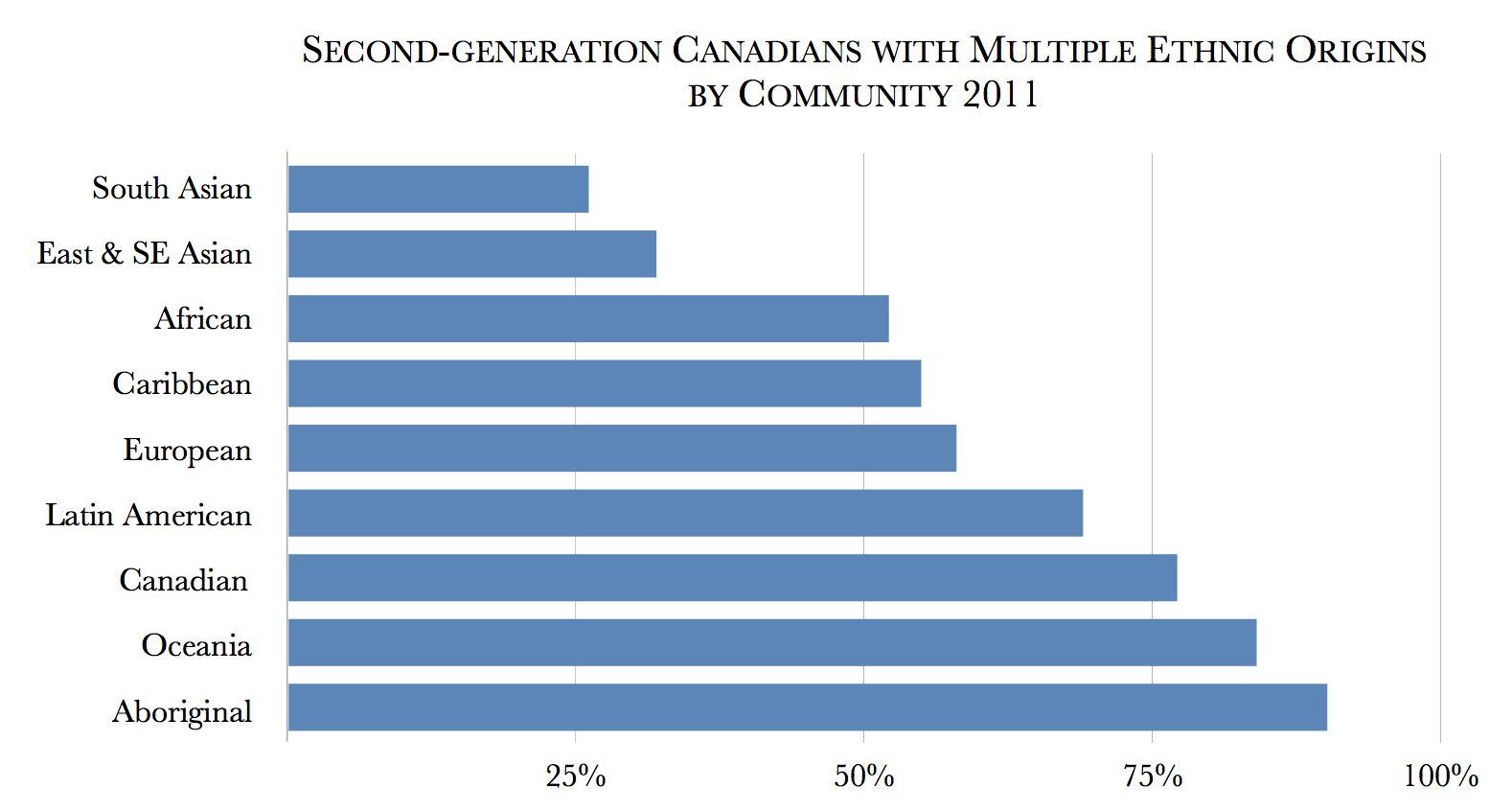 Todd reports on the study by Feng Hou, Zheng Wu and Christoph Schimmele showing that community size and availability matter (“Group Size and Social Interaction: a Canada-US Comparison of Interracial Marriage”).
The overall StatsCan ethnic origin data shows the longer the community has been in Canada, the greater the number of Canadians with mixed ethnic origins, the result of more mixed unions. The above chart highlights second-generation immigrants who indicate also having Canadian ancestry (the third generation for most of the newer communities are not large enough, and old enough, to analyze):
But three cultural trends are shaking up this utopian dream, which places inter-ethnic couples at the vanguard of cultural fusion.
The first shift is demographic. Canadian statisticians have documented how the growth of ethnic groups in the Western world is actually making inter-ethnic couples less likely in major cities.
Secondly, many of the countries with traditional cultures that produce immigrants to the West remain resistant to ethnic intermarriage, often because of concerns about offsprings’ religious identities.
Thirdly, some race activists and social scientists are criticizing what they call the “brownwashing” of the population, arguing a mixed-union revolution is mostly sought by white liberals.
… A study published this year by Hou, Zheng Wu and Christoph Schimmele found the intermarriage rate among members of an ethnic group goes down in regions that house a large cohort of that group. No one is quite sure why.
The intermarriage rate in mid-sized Canadian cities such as Kelowna, Victoria and Trois-Rivières, where there are relatively few visible minorities, is reaching almost 40 per cent. People there appear motivated to go outside their ethno-cultural group for friends, dates and, importantly, marriage partners.
On the other hand, in Canadian metropolises where visible minorities, mostly Asians, account for almost half the population, the intermarriage rate is much lower. In Metro Vancouver it’s just 9.6 per cent. In multi-racial Toronto it’s only 8.2 per cent.
People seem to feel little need to find a partner outside their ethno-cultural group when living among hundreds of thousands of people with familiar backgrounds.
For instance, South Asians and ethnic Chinese make up the largest immigrant groups to Canada. But Statistics Canada reports they’re among the least likely to intermarry. Only 19 per cent of Chinese-Canadians in a couple, and 13 per cent of South Asian-Canadians, are in a mixed union.
Hou admits researchers can’t explain the complicated causes of intermarriage. But he cautioned against “blindly treating the prevalence of intermarriage as the litmus test of inter-group relations.” Hou says, “The prevalence can be low or go down simply for demographic reasons.”
Douglas Todd: Mixed unions applauded by some, but dismissed by others as brownwashing.
 About Andrew
 Multicultural Meanderings