Blatchford: Convicted hate-monger gets added jail time for his Muslim-offending ‘social experiment’

Worth reading. Eric Brazau, the person convicted, certainly seems a nasty piece of work.

Blatchford appears to be critical of the judge’s decision to “throw the book” at Brazeau. Would she be as critical of the judge’s decision had the comments been directed at Jews? Blacks?

Blatchford: Convicted hate-monger gets added jail time for his Muslim-offending ‘social experiment’.
Barbara Kay: When it comes to Islam, the media needs to ditch the ‘narrative,’ and report the truth

What Kay misses, in her reductionist approach to ideology and extremism of all kinds, is what are the factors that push some to violence and what are the ones that increase resilience to these appeals.

With lone-wolf extremists, it is clear that mental illness and other issues can be one of the factors that push them over the edge. It does not mean that Islamist ideology is not involved; it is just that there can be other factors as well that make some individuals more susceptible.

And I would distinguish between these kinds of attacks and the more “sophisticated”and “professional” attacks that took place on Charlie Hebdo.

And of course, none of this reduces the horror over any attack, no matter the motives or factors:

We’re in the middle of a Hot War with Islamism. There will be more attempted, or realized, lone-wolf terrorist attacks on our shores. In the event, it would be helpful if the liberal media could ditch its love affair with narratives, and stick with the truth.

The right-wing media also should ‘ditch its love affair with narratives’ and recognize the complexity of the various factors involved.

Barbara Kay: When it comes to Islam, the media needs to ditch the ‘narrative,’ and report the truth | National Post.

Why Americans should think twice about dual citizenship – LA Times

Editorial in the LA Times on dual citizenship:

Yet there’s no question that dual citizenship poses practical problems both for those who possess it and for the government. The U.S. State Department discourages U.S. citizens from retaining or applying for citizenship in another country because “dual nationality may limit U.S. government efforts to assist nationals abroad. The country where a dual national is located generally has a stronger claim to that persons allegiance.” The department also warns that “dual citizenship can present a security issue whether to permit access to classified information which affects recruitment, employment and assignments.” In some cases, dual citizenship could disqualify an applicant for a sensitive position with the CIA or the State Department.

The complexities and complications raised by dual citizenship are not enough to justify amending the Constitution to overrule the Supreme Court. But we agree with the State Department that U.S. citizens should think twice about professing allegiance to another country. Moreover, by reinforcing the doubts that some hold about the loyalty of immigrants — some U.S. citizens, for instance, fume when Mexican Americans display the Mexican flag at Cinco de Mayo rallies — the persistence of dual citizenship may make it politically more difficult to secure a path to citizenship for immigrants who came here illegally.

In questioning dual citizenship, we aren’t saying that immigrants must forget their countries of birth or repudiate their language or culture. In large parts of the southwestern United States, U.S. citizens of Mexican descent frequently travel back and forth between the two countries, enriching the cultures and economies of both countries. Rather, we believe that citizenship in this country should be an expression of allegiance to it, enforced not by a pledge but rather by a desire to be part of this country. Dual citizenship may have a place in American society, but the goal should be the cultivation of undivided Americans, proud of their heritage and committed to this nation.

Why Americans should think twice about dual citizenship – LA Times.

ICYMI: Are Immigrants Happy? It Depends … – New Canadian Media – NCM

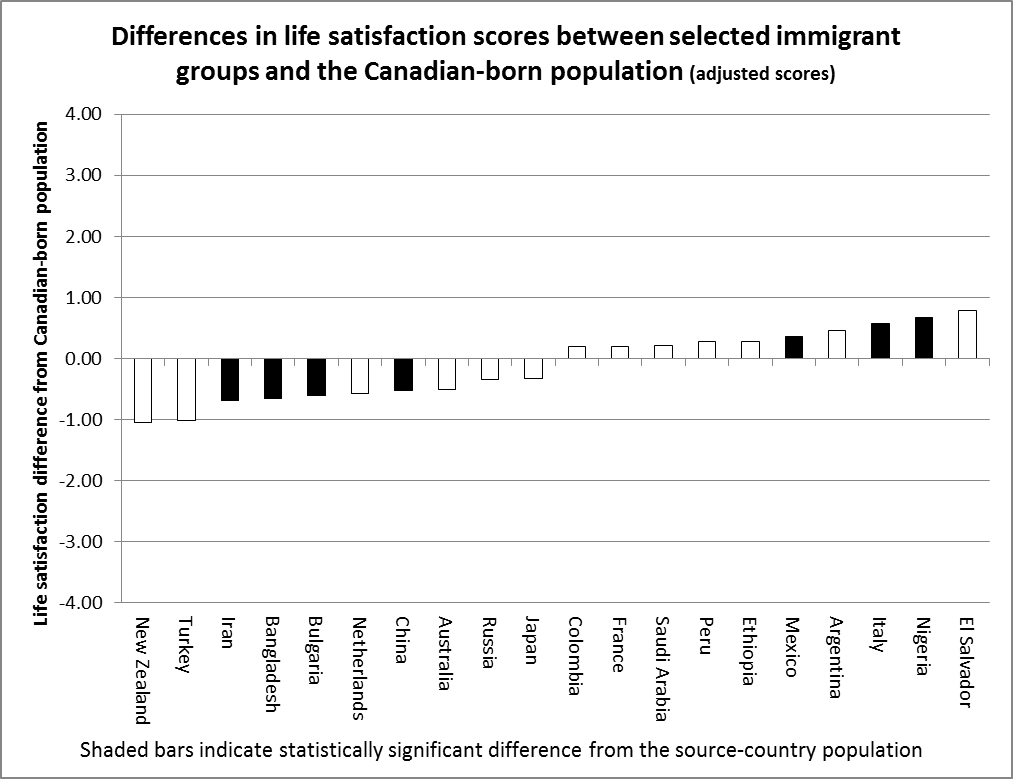
Life satisfactionInteresting but not surprising: Maslov’s hierarchy of needs means economic outcomes prevail:

Interestingly, economic differences far outweighed the influence of civil liberties (freedom of expression, assembly, association, education and religion) in determining the final happiness score.

“The regression results indicate that when we control for both source-country GDP and civil liberty, only the effect of source-country GDP is statistically significant. This indicates that immigrants who come to Canada from nations with lower GDP per capita [poorer nations] generally have larger improvements in their life satisfaction compared to their source-country population.

“In a separate model, we also found that about one-quarter of the variation in life satisfaction across source countries was accounted for by GDP per capita. These results again indicate that immigrants from countries with lower levels of GDP experience greater improvements in their life satisfaction,” Frank said in exclusive comments. For example, for India, the difference in “life satisfaction” between the resident population and immigrants in Canada went down from 2.04 to 1.73 points when the difference in GDP was taken into account.

Further, the researchers were able to show that the ‘happiness gaps’ remain even though immigrants may not be representative of the general population in the countries they come from, given that they tend to be drawn from the middle and upper classes. The survey data in Canada covered those immigrants who continue to stay in Canada: only the relatively successful persevere in Canada.

A separate Statscan study released in 2006 reported the phenomenon of “out migration.” It found that as many as 35 per cent of male immigrants (mainly principal applicants) who have been in Canada for under 20 years return to their home countries, with the bulk of them returning in the first year after arrival. This return to their homelands is most acute in times of economic recession, when the researchers found the exit rate could reach as much as 50 per cent, as in the early 1990s.

Are Immigrants Happy? It Depends … – New Canadian Media – NCM.

I am Charlie

A lot will be written about this with good reason. Arun’s post captures it well.

Arun's avatarArun with a View

Top: Georges Wolinski, Jean Cabut (Cabu), Stéphane Charbonnier (Charb)  Bottom: Bernard Maris, Bernard Velhac (Tignous) (Image credit: AFP/Metronews) Top: Georges Wolinski, Jean Cabut (Cabu), Stéphane Charbonnier (Charb)
Bottom: Bernard Maris, Bernard Velhac (Tignous) (Image credit: AFP/Metronews)

I’m in the US right now, so heard the horrific news from Paris when waking up this morning. I’m in a state of shock. I’ve had tears in my eyes. I cannot believe what has happened. For me this is more than a terrorist attack and with twelve people—journalists, writers, cartoonists, intellectuals—murdered in cold blood. This happened in my city and to people I knew, not personally but via their writings, drawings, and media appearances, and to whom I have linked numerous times on this blog (here, here, here, here, here, and also here, here, here, and, above all, here). Bernard Maris was one of my favorite economists, whom I’ve been reading and listening to on Friday mornings on France Inter since…

View original post 286 more words

Meet Toronto’s disenfranchised non-citizens

Further to my post on the declining number of immigrants taking up citizenship (Ottawa hiking citizenship fees for second time in a year | various), Myer Siemiatycki and Ratna Omidvar on how it plays out in Toronto and the links to poverty and precariousness:

Imagine a city the size of Halifax and then superimpose it onto the map of Toronto. Now imagine a wall surrounding that city state — a wall that divides its residents from the rest of the metropolis.

That’s perhaps the best way to think of the roughly 380,000 residents who live in Toronto who are without Canadian citizenship, says Myer Siemiatycki, professor of politics and the founding director of Ryerson University’s graduate program in immigration and settlement studies. And that number, from the 2006 Census, could be even higher today.

Some estimates suggest the number could be even higher if you include undocumented migrants, whose exact numbers are unknown. Some are foreign temporary workers; some are here on two-year work permits; some are live-in caregivers; many are permanent residents; others are refugee claimants. Some may one day achieve status or citizenship; others will remain underground eking out a living, always looking over their shoulder, perhaps not even able to speak English.

Critics say it’s a lost opportunity for them and for Toronto.

A deep divide separates non-citizens from most of the city’s residents, says Siemiatycki. They work here; pay property taxes; use the TTC. Their children go to school here; some use recreational facilities, community centres and libraries. But they are detached, disengaged, without a voice or a vote. Some are able to get only precarious or low-paying work. Many stay under the radar by working for cash and not paying taxes. Others live in constant fear of being deported. They pay for health care out of pocket.

“Imagine if you did not have papers,” says Ratna Omidvar, executive director of the Global Diversity Exchange at Ted Rogers School of Management at Ryerson University. “Imagine if you could only work for cash. Imagine if you were always in fear that someone would come and get you. Imagine you’re paying a premium for rent … of course they’re disengaged. They can’t not be disengaged.”

Meet Toronto’s disenfranchised non-citizens | Toronto Star.

A MacArthur Grant Winner Tries to Unearth Biases to Aid Criminal Justice – NYTimes.com

Further to my earlier post (The Science of Why Cops Shoot Young Black Men), a good interview with Jennifer Eberhardt, another psychology professor looking into subconscious biases:

We’re finding that the beliefs of the police aren’t generally that different from everyone else’s. A lot of the tests we’ve done, we give them to students, to ordinary citizens and to police officers. We’re finding the results are generally similar. The police are people like everyone else.

….One thing I do is work with police departments. We do workshops where we present these studies and show what implicit bias is, and how it’s different from old-fashioned racism. I don’t think this alone can change behavior. But it can help people become aware of the unconscious ways race operates. If you combine that with other things, there is hope.

A MacArthur Grant Winner Tries to Unearth Biases to Aid Criminal Justice – NYTimes.com.

In Sweden, the Land of the Open Door, Anti-Muslim Sentiment Finds a Foothold – NYTimes.com

Good article on the politics of refugees and immigrants in Sweden:

Despite a lackluster economy, Sweden was third behind only Germany and France in the number of people registering for asylum in 2012, according to the Migration Policy Institute in Washington. Relative to its population, Sweden received the second-highest share of asylum applications in the European Union after Malta, the institute says.

The Syrian conflict has boosted the number of asylum seekers. Of 81,000 people seeking asylum in Sweden in 2014, roughly half were from Syria, the Swedish Migration Board said.

Opposition to the rising numbers is growing. The far-right, anti-immigrant Sweden Democrats had their best showing ever — nearly 13 percent of votes — in elections in September.

The entry of the Sweden Democrats to parliament in 2010 had already opened the door for a previously unthinkable discussion about turning back the country’s policy of taking in foreigners on humanitarian grounds and granting them access to the country’s generous welfare system.

Adrian Groglopo, a professor of social science at the University of Gothenburg, has studied discrimination in Sweden over the past decade. He said that Sweden has long been a racially segregated country where many immigrants live in ghettos and struggle to find jobs, but that the success of the Sweden Democrats has made racism more socially acceptable.

“It is a very difficult time in Sweden,” Dr. Groglopo said. “Now we can talk about things that we weren’t allowed to talk about before. It is a kind of coup d’état.”

In Sweden, the Land of the Open Door, Anti-Muslim Sentiment Finds a Foothold – NYTimes.com.

Don Cayo: Canada needs to teach immigrants better language skills

Not too surprising, and the call for better language training makes sense. Not an issue for second generation immigrants given Canadian schooling (but who also have persistent income and unemployment gaps:

It turns out that a significant factor is not only whether an immigrant’s mother tongue is English or French, but if not, then how closely related it is to one or the other of Canada’s official languages. For example, immigrants who grow up with a Nordic language, which shares two of four linguistic roots with English, are likely to earn six per cent less than native-born Canadians, whereas the gap widens to 33 per cent for those who speak a dialect of Chinese, which has no common roots with English or French.

…But two other researchers, Ana Ferrer of University of Waterloo and Alicia Adsera of Princeton, take this a step further, looking at the link between immigrants’ economic success and what they call linguistic proximity — the degree of similarity between an immigrant’s mother tongue and one or both of Canada’s official languages.

They found that not only do immigrants from countries with languages closely related to English or French get better jobs when they come to Canada — specifically, jobs requiring social and analytical skills rather than just brawn — the difference in earning potential is magnified when the level of education is higher. In other words, a labourer will make a little less than Canadian-born co-worker, but a specialist or professional will make a lot less.

Don Cayo: Canada needs to teach immigrants better language skills.

‘High error rate’ found in Canada’s immigration processing

Hard to know how many of these errors were major, but they do create processing inefficiencies not to mention the additional burden and frustration on applicants:

According to the review of 996 files handled between Nov. 1 and Dec. 6, 2014, at the Vegreville operation, which deals with permanent residence applications, the quality management team found these shortcomings in the 617 request letters sent:

  • 13 per cent did not address all missing items.
  • 23 per cent had no timeline or an incomplete one or did not mention the consequences of failing to reply.
  • 6 per cent were either “not professional” or chose the incorrect template form.

Of 426 files that received a second review during the five weeks, decisions were pending for 149 owing to errors made by decision-makers at an earlier stage.

While the 2013 review of the Canadian Experience Class — a pathway for those with Canadian work experience and education to obtain permanent residence — found 23 per cent of the decisions had “significant” eligibility concerns, the evaluation of refugee permit applications identified 113 errors in 88 files.

‘High error rate’ found in Canada’s immigration processing | Toronto Star.

And the subsequent story, with CIC’s response:

“Employees receive an initial three-day training on the department’s Global Case Management System, but there is additional training and coaching that takes place depending on the line of business,” wrote Chan.
“Before any employee begins to make any application decision, they receive comprehensive training on eligibility and admissibility assessments.”
Chan said immigration officials conduct quality monitoring exercises regularly to evaluate programs and procedures and adjust staff training accordingly.
“CIC is focused on making our application processes and our correspondence with clients simpler and clearer,” said Chan. “The integrity of these programs was not compromised.”

Ottawa defends errors in immigration processing