Ezra Levant wrongly accuses Ontario school board of allowing exemptions for Muslim students on Remembrance Day

Never let facts get in the way of sensationalism – or marketing:

The school board memo, which was primarily about the significance of Remembrance Day, included a series of six links directing teachers to online resources.

It was accompanied by 10 photographs, including pictures of Sikh soldiers and veterans, an Ojibwa Canadian veteran of the Korean War, a Mennonite veteran and a Jewish soldier in a prayer shawl carrying a Torah.

“Remembrance Day is a wonderful ‘teachable moment’ – and the Canadian War Museum has lots to offer with resources that are reflective of our Canadian nation – and our equally diverse local population,” read the memo, with a link to a page on the National War Museum site.

Other links included a memorial about the first Canadian Muslim woman to wear a hijab in uniform. There are also links to Google Image search results featuring aboriginal Canadian soldiers, African Canadian soldiers, and Asian Canadian soldiers.

“There were some links included on the memo that were provided for principals and schools doing Remembrance Day ceremonies that helped reinforce the diversity of our armed forces, because that’s sometimes a forgotten element,” said Mr. Scantlebury, who noted that the Greater Essex County is one of the most diverse in Canada.

Mr. Scantlebury said on Tuesday that he was not aware of any student that had requested any special accommodation. He added that he had been receiving calls on the matter for much of the day.

“We feel it’s very unfortunate that this has taken away, somewhat, from what is a very solemn occasion in our schools,” he said.

Mr. Levant’s column ends with a call to sign a petition protesting the school board at LoveItOrLeave.ca. There, Levant’s supporters can purchase T-shirts sporting a Canadian flag design and the statement “If you don’t love it, leave.”

They can also buy tickets to a three-night “Free Speech” tour featuring Levant and Sun Media’s Brian Lilley. VIP seats for the stop in Red Deer, Alta., are priced at $109.85.
Ezra Levant wrongly accuses Ontario school board of allowing exemptions for Muslim students on Remembrance Day – The Globe and Mail.

Information watchdog says cash crunch endangers Canadians access rights

All too true. My experience with CIC ATIP confirms the delays and obfuscation:

“This growth in workload occurs in the context of significant financial restraint measures that have had a large impact on my budget,” Legault says in the report.

“With the incoming complaints volume showing no sign of abating, and with no financial flexibility, it is increasingly difficult, if not impossible, to keep ahead of demand and respond to complainants in as timely a manner as possible.”

It means a gap of about six months between the time a complaint about lack of access to records is received and the time it is assigned to an investigator.

The commissioners budget must absorb salary increases next year, leaving her concerned “we have been stretched to the limit.”

“It is my responsibility to alert the government and Parliament to the risks that the organization is facing,” Legault adds in the report.

“Without additional funding, I will no longer be able to carry out my mandate responsibly and ensure full respect of Canadians rights of access to information. As such, I intend to seek the support of the Treasury Board to obtain the necessary financing.”

Information watchdog says cash crunch endangers Canadians access rights – Politics – CBC News.

Globe editorial in favour of more resources and better compliance with ATIP:

Response times have dropped disastrously as a consequence. Ms. Legault, in going public this week about the impact of the cutbacks, said the wait time between the filing of a complaint and the assigning of an investigator has reached six months. Her next move will be to make a formal request to the Treasury Board for more money. Treasury Board President Tony Clement has had no comment, so far.

Mr. Clement should give the Information Commissioner the resources she needs. Since taking power, the Harper government has focused on putting more information online and on launching its Open Government web portal. But those efforts, however worthwhile, will mean little if the government simultaneously makes it harder for Canadians to get information that has been classified or held back for political reasons – arguably the most important information of all in a free society. The Conservatives knew this in 2006; why don’t they know it now?

 Harper government cutbacks hurting access to info 

State-sponsored hackers target human rights groups, study says – The Globe and Mail

Not surprising:

In an interview with The Globe and Mail, Mr. Deibert explained the Internet has extended the reach of repressive states.

Cyberespionage may well cost businesses their profits, he said, but for refugees and dissidents the downstream effects can be “arrest, detention, or even loss of life.” Consider what could happen to exiles who return to countries that never stopped capturing their conversations.

For its study, the Citizen Lab examined eight groups engaged in “rights issues related to China and Tibet.” It also looked at two larger human-rights groups operating globally. The organizations submitted their data and devices for analysis, on the condition that they remain anonymous.

The report suggests that hackers known to cybersecurity experts as “APT1” – short for Advanced Persistent Threat 1 – were targeting at least one China-focused group and one international rights group. This is significant because experts regard APT1 as a powerful hacking team run by the Chinese People’s Liberation Army.

Such groups use social media to study up on key personnel in targeted organizations. This research helps them craft messages that their prey will more likely open – and be infected by.

May be some opportunities for capacity-building but the Government doesn’t exactly have good relations with many NGOs.

State-sponsored hackers target human rights groups, study says – The Globe and Mail.

ICYMI: Getting information on the ground on the Islamic State

Fascinating reporting in the Globe of some of the efforts to collect information on war crimes and other human rights violations:

There are risks, however, that come with sending investigators into a combat zone with armed opposition groups. Some outside observers worry about the reliability of the embedded investigators, in part because there is always a risk they could become involved in wartime atrocities themselves.

Documentation collected now could be dismissed by a future war crimes tribunal for multiple reasons. Questions about the investigators’ methods, issues with the way witnesses are interrogated, and errors in tracking custody of documents that are retrieved are all issues that could be picked apart by a defence team.

But many observers seem to believe the benefits of running an investigation now – rather than waiting until the conflict is over – far outweigh the risks.

Independent groups like the one investigating Islamic State also have a higher tolerance for risk than the more formal investigation by the United Nations commission of inquiry on Syria, which has produced reports on atrocities but is not focused on linking specific crimes to the individuals who may have ordered them.

“There is going to be an immense security challenge once the conflict ends,” one investigator said. “If the Syrians don’t want to endure a decade or more of terrorism, as experienced by Iraq, they’re going to need a security foundation, and that foundation will be built on information derived from investigations now.”

Getting information on the ground on the Islamic State – The Globe and Mail.

The government doesn’t know how many jobs the small business job credit will create

The depths that the Government and public service have descended to:

The federal government has put forward a new policy, but it has not released its own analysis of the policy’s impact. An official with the relevant department says an estimate of the number of jobs expected to be created by the policy was not calculated and that calculating the number of jobs produced by a single measure is difficult. Nonetheless, the minister touts the estimate of a business association, but the finance department has not done its own analysis of the methodology behind that estimate.

The government doesn’t know how many jobs the small business job credit will create – Macleans.ca.

Declare soldiers who died fighting in WWII Canadians – Macleans.ca

The last battle of the “Lost Canadians” are the deceased:

Don Chapman and Howe Lee want Canadians to know that those who died before 1947, and whose graves are marked with maple leaves, are still not officially considered citizens by the federal government.

At issue is Ottawa’s interpretation of the law, which holds that citizenship didn’t officially exist until Jan. 1, 1947, when the first Citizenship Act came into effect.

Chapman, of the group Lost Canadians, has started a petition, calling on the federal government to recognize as citizens the war dead who were killed before 1947.

…Sonia Lesage, a spokeswoman for Citizenship and Immigration Canada, said the legal concept of Canadian citizenship has only existed since Jan. 1, 1947.

“That was not retroactive, and the act which created the concept contains no authority to grant citizenship posthumously,” she said in an email.

Lesage said recent reforms have included extending citizenship to more “lost Canadians” who were born before 1947 and to their children born outside of Canada.

…. [Green Party Leader Elizabeth] May said she has agreed to introduce the petition to Parliament when it’s ready.

“For the most part, this is a matter of respect and setting this historical record straight,” she said.

“These people were Canadian. And these soldiers, these people who gave their lives for this country, were Canadian citizens at the time and should be recognized as such, despite the weirdness of our laws.”

Declare soldiers who died fighting in WWII Canadians – Macleans.ca.

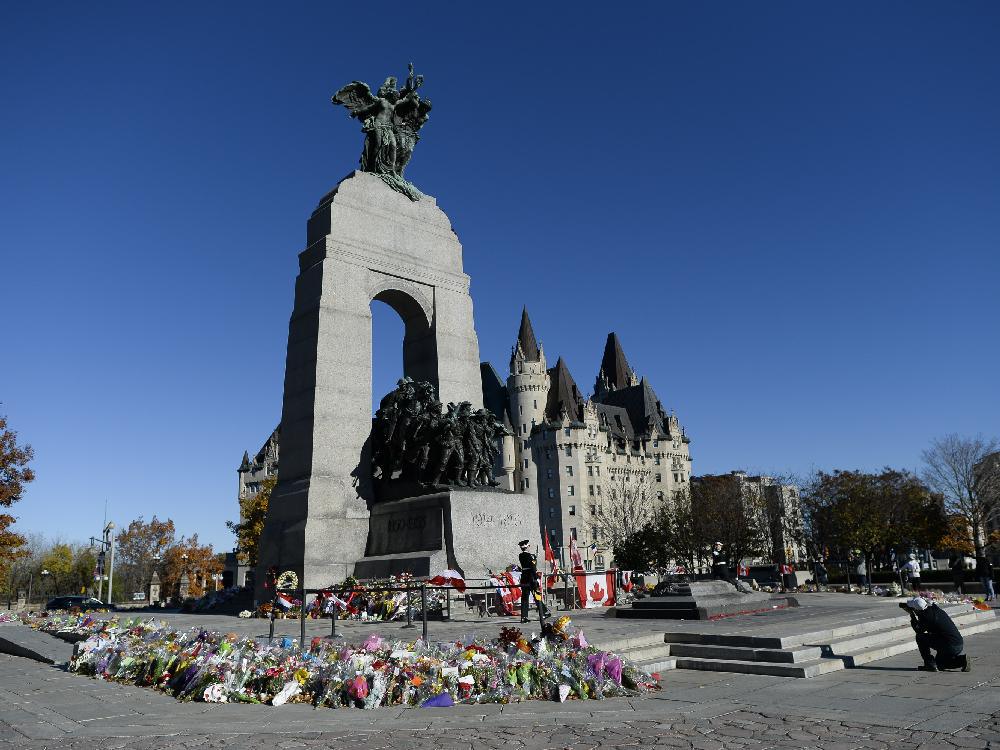
Lest We Forget

1103 warmemorial 002.JPG

Photo Ottawa Citizen

The face Canada showed the world – Margaret Wente

Margaret Wente’s cheery piece on what Canada got right, referring to the Hamilton video experiment on attitudes towards Muslims (Hamilton racism social experiment ends with a punch | Toronto Star) and the community efforts to clean up the damage at the Cold Lake Mosque (Volunteers help clean vandalism from Cold Lake mosque):

When I wear the poppy, I sometimes think of my dad and grandfather, who fought so that some day we could live in a nation just like this. But why us? Why are we the lucky ones? How have we managed to escape the racial and ethnic strife that plagues most of the rest of the world?

One reason is that Canada is so new. Almost all of us are immigrants – newcomers ourselves not so long ago. And our dual English-French identities have been a great test of our ability to accommodate our differences without tearing each other to shreds. So far, so good. We’ve learned a lot from that.

Our identity is not defined by blood, or by our sense of destiny. We have no concept of Volk. We’re just folks. We don’t care who you are or where you came from or who or what you worship, as long as you share our good Canadian bourgeois values. Don’t litter. Send your kids to school. Wear a poppy.

We are blessed with a lot of elbow room, and we have borders that are relatively impermeable. No massive waves of refugees and migrants wash up on our shores. We never imported guest workers who we thought would go home, but didn’t.

Unlike Europe, our immigrants come from all corners of the planet. We’ve dodged the problem of large subgroups that self-ghettoize and don’t assimilate. Here, everyone gets thrown together and winds up at Tim Hortons or maybe Starbucks. And the locals are extremely friendly, which means that the whole world wants to come here, so we get our pick. We have created a virtuous circle of tolerance and openness that is rivalled only by Australia, a nation just like ours, only with a better climate and a worse accent.

As my friend and colleague Sheema Khan said of Mr. Albach’s video, “This is the face that Canada is showing to the world.” After two terrorist attacks, people punched out the bigots and took flowers to the mosque. No wonder we’re the envy of the world.

The face Canada showed the world – The Globe and Mail.

Don’t Overreact, Canada – Patriquin

Martin Patriquin on the risks of over-reaction:

Canadians need only look to the south to see how attacks on individuals and establishments can’t usually be prevented by increased surveillance of a country’s civilians. The United States arguably is home to the world’s largest and most sophisticated intelligence-gathering network, the excesses of which have been documented by leaks from the former National Security Agency contractor Edward J. Snowden.

Yet none of this prevented the breach of the White House in September, in which an Iraq war veteran scaled the White House fence and made it to within feet of where the president and his family live before being apprehended. Nor has surveillance hindered the ability of various gunmen to inflict mass murder on innocents throughout the years. As the former Vice President Al Gore noted last year, in a speech decrying the folly of such mass intelligence gathering, “When you are looking for a needle in a haystack, it’s not always wise to pile more hay on the haystack.”

Theoretically, it would be possible for the Canadian government to legislate itself the powers to prevent all such attacks. Yet the trade-off — constant surveillance, criminalization of dissent, restriction of free movement and the economy — would make the country unlivable. It would be a travesty if the actions of two troubled individuals moved the country closer to that possibility.

Don’t Overreact, Canada – NYTimes.com.

‘Not our idea,’ Ontario tells Ottawa over controversial refugee welfare restrictions | Toronto Star

Oops. Mistaking a general policy discussion on options for indicating support for a particular measure.

Given Ontario’s strong public opposition for the cuts to the IFHP for refugee claimants (partially rolled back following the successful court challenge), that Ontario had continued to fund health care for refugee claimants, hard to imagine that Ontario would support such a measure:

On Thursday, a senior federal immigration director told a Senate committee that the proposal to allow provinces to impose a minimum residency requirement for people seeking social assistance — currently embedded in the omnibus budgetary Bill C-43 — “came up” during conversations with provincial officials.

“We had a number of conversations with the Government of Ontario where we were looking at the very generous benefits Canada provided to asylum claimants in the past, when we’re trying to identify what adjustments we should be making in order to discourage inappropriate asylum claims,” said Mark Davidson, Immigration’s director general for international and intergovernmental relations.

“During that conversation, the Province of Ontario actually reminded us that there’s a provision in the federal law that limits the ability of provincial governments to make this policy choice in their own jurisdiction.”

When pushed by Toronto Senator Art Eggleton as to whether Ontario asked for the change, Davidson replied: “I wouldn’t say the Government of Ontario has specifically asked for this but certainly it’s come up in the conversation we had with them in the recent past.”

A spokesperson for Community and Social Services Minister Helena Jaczek immediately rebuffed that claim.

“The government of Ontario has not requested the ability to impose residency restrictions, and we were not consulted on this legislation,” said Amber Anderson.“

In fact, the Ministry of Community and Social Services has concerns about the potential human rights implications of imposing a waiting period for a specific group. We believe that a waiting period could impact people with legitimate refugee claims who are truly in need. We have communicated our concerns to the federal government.”

Critics and advocacy groups said the province’s response confirms that the proposed changes were undertaken by the Conservative government with little consultation.

Interesting how easily officials stray into Government political language, “very generous benefits” rather than more neutral language “benefits.” Stockholm syndrome in action.

Not our idea,’ Ontario tells Ottawa over controversial refugee welfare restrictions | Toronto Star.