Minister knew Canada wouldn’t meet Syrian refugee commitment

Caught out. At best, misleading the House and Canadians.

Four days later [March 25, 2014], C.I.C. officials told Alexander in a briefing note that the government “will not meet its Syrian private sponsorship commitment by the end of 2014” because “it takes time for private sponsors to organize and raise the funds to welcome a refugee to Canada.”

Highlighting the point, officials provided Alexander an update on June 10 that showed just 58 private sponsorship applications had been approved since January.

The update, which did not say how many, if any, had actually arrived in Canada, was provided the day before Alexander hung up on CBC’s As It Happens when he was being asked about the government’s response to the Syrian refugee crisis.

The minister later said he hung up because he was late getting to question period. But the incident prompted suspicions the government was lagging in its promise to resettle 1,300 Syrian refugees.

Alexander had repeatedly said more than 1,150 Syrians had received “Canada’s protection,” a figure he also cited in the House of Commons throughout the spring.

However, the documents show that number refers to all Syrian refugees accepted since 2011, including 942 who had travelled to Canada on their own before applying for asylum in the country.

Only 219 had actually been resettled from overseas, of which 93 had arrived in 2014 and would count toward the commitment to take in 1,300.

Liberal immigration critic John McCallum says the fact the Conservative government won’t meet its own “pathetically, ridiculously small” commitment demonstrates it has no real interest in accepting Syrians into Canada.

“They don’t care,” he said Friday. “It’s not a priority. If they cared, they could get the United Nations and people out in the field to give them huge numbers. There’s no shortage of needy people out there.”

NDP immigration critic Lysane Blanchette-Lamothe said the documents could explain why Alexander has been extremely evasive when asked to provide concrete numbers about how many Syrian refugees have arrived in Canada as part of its commitment to the UN.

“I would be very ashamed if I was the minister and I wasn’t able to fulfil such a small commitment in that massive crisis,” she said. “There’s nothing to be proud of in how the government has answered the international call.”

Always safer to stick to the truth, provide an explanation for some of the difficulties, rather than being ‘clever’ and  evasive. Eventually, the truth will come out.

Minister knew Canada wouldn’t meet Syrian refugee commitment | Ottawa Citizen.

More refugee claimants get 2nd chance with new appeal process

Interesting:

Under the old system of judicial review, only about seven per cent of rejected claimants were granted leave to appeal their cases to the Federal Court. That means the number of people who are now getting a chance at an appeal has nearly tripled.

“They’re doing a better job, a much better job than the previous federal court process,” said Peter Showler, professor emeritus at the University of Ottawa and a former chair of the Immigration and Refugee Board. “[But] that’s because that process was so drastically limited.”

Under the old system, the standard for overturning a decision was too narrow, Showler argued. Federal Court judges could only consider whether the decision reached by the refugee board was “reasonable” in law. That filter, he said, prevented many legitimate claims from being reviewed.

“One way of seeing it is the Refugee Appeal Division is certainly doing a better job of identifying mistakes than the federal court,” he said.

“Another way of seeing this is we’ve had 10 years of lack of justice in this country where claimants were incorrectly refused and we did not catch those mistakes.”

CBC News asked officials in Immigration Minister Chris Alexanders office to comment on the new figures. His office did not immediately respond.

But other experts say that while the numbers are encouraging, there are still far too many restrictions on who gets to appeal their case.

Refugee lawyer Lorne Waldman noted that claimants from so-called safe countries like Hungary and Mexico are barred from appealing their cases, as are claimants who arrive and lodge a refugee claim at the U.S. border.

The Government could tout this as evidence that refugee reform both tightened the system and made it more fair than the previous Federal Court process.

But that might undermine their overall anti-fraud and misrepresentation messaging.

More refugee claimants get 2nd chance with new appeal process – Politics – CBC News.

Ontario girl can rely on traditional medicine to treat cancer, court rules

This is a very uncomfortable ruling. So the rights of the parents and their belief in aboriginal healing outweigh the rights of the child to have a future:

Hospital president Dr. Peter Fitzgerald says there are no plans to appeal the ruling at this time.

“My main concern is for this child’s life,” he said. “Without treatment this child has no chance of survival. We really want to keep our doors open to the family and reach out as much as possible.”

The judge sided with McMaster on all other issues. He ruled the girl was not capable of making her own medical decisions. He affirmed that a court is the place to decide these cases, not Ontario’s Consent and Capacity Board. He agrees she requires medical treatment that her “caring loving” parent is not providing.

The hospital told court that before she withdrew from treatment in August, the girl had a 90 to 95 per cent chance of being cured by chemotherapy done in phases. However, in the end, it came down to Edward’s conclusion that the mother’s choice to pursue traditional medicine “is her aboriginal right.”

“This is not an eleventh hour epiphany employed to take her daughter out of the rigours of chemotherapy,” the judge wrote in his decision. “Rather it is a decision made by a mother, on behalf of a daughter she truly loves, steeped in a practice that has been rooted in their culture from its beginnings.”

“It is this Court’s conclusion therefore, that the mother’s decision to pursue traditional medicine for her daughter is her aboriginal right. Further, such a right cannot be qualified as a right only if it is proven to work by employing the western medical paradigm. To do so would be to leave open the opportunity to perpetually erode aboriginal rights.”

Noteworthy that the other aboriginal child in a similar situation, Makayla Sault, has relapsed, given her parents’ choice for alternative therapy.

Sad.

Ontario girl can rely on traditional medicine to treat cancer, court rules | Toronto Star.

Commentary by Arthur Schafer on the medical ethics involved:

Respect for the autonomy of children is important, especially when, as in cases involving chemotherapy, the proposed treatment is highly aggressive and distressing. These days, even quite young children are encouraged to participate. That’s good medicine as well as good ethics.

The question that should always be asked is whether this particular child is competent to make the difficult medical decisions on which the child’s life may depend. If a child appears to be dominated by the scientifically eccentric beliefs of her parents, then it may be the duty of a judge to rule that the child requires protection.

If the odds of survival were reversed, if chemo treatment had only a five to 10 per cent (instead of a 90 to 95 per cent) likelihood of saving the child’s life, then it would be reasonable for the family to make its own decision, without interference from doctors or courts. But when the scientific evidence strongly favours treatment then, whatever the family’s culture or religion, courts generally see it as necessary to override family autonomy in favour of child protection.

Canadian society has an ugly record of riding roughshod over the wishes of First Nations families. We should never forget the shameful legacy of the residential schools. Respect for First Nations cultural values is undeniably important.

When the crunch comes, however, and the life of a child hangs in the balance, then even if the parents and child favour traditional healing or alternative medicine our courts should take the child’s best interest as the deciding criterion. In this case, that didn’t happen.

First Nations children not well served by chemotherapy ruling: Arthur Schafer

Saskatchewan Multicultural Week kicks off with forum, new PSAs

Despite its relatively lower level of diversity compared to neighbouring provinces Alberta and Manitoba, clear focus on multiculturalism:

A forum on multiculturalism kicked off Saskatchewan Multicultural Week on Saturday at the First Nations University of Canada.

“We need to understand everybody’s different cultures and embrace them as opposed to just seeing differences,” said Mark Docherty, minister of Parks, Culture and Sport.

The free event, titled ‘Remember our Past, Envision our Future’, focused on topics such as how to grow multiculturalism in Saskatchewan. The provincial government and the Multicultural Council of Saskatchewan MCoS partnered for the annual week to celebrate the 40-year anniversary of The Saskatchewan Multiculturalism Act.

Many in attendance at the forum weren’t born in the same country but could find unity in their experiences of living in Saskatchewan.

Saskatchewan Multicultural Week kicks off with forum, new PSAs – Regina | Globalnews.ca.

On LinkedIn, a Reference List You Didn’t Write – NYTimes.com

Interesting test case and a reminder of how social media is being used, and the potential impact, not to mention on the need to take care in one’s various social media profiles and activities:

In Sweet v. LinkedIn, a class-action suit filed last month in Northern California, the plaintiffs contended that LinkedIn, in providing the job reference material, enabled potential employers to “anonymously dig into the employment history of any LinkedIn member, and make hiring and firing decisions based upon the information they gather,” without ensuring that the information was accurate. This, they said, is a violation of the Fair Credit Reporting Act.

“You may never know you did not get the job based on one of these so-called references,” said James L. Davidson, one of the lawyers for the plaintiffs.

Joseph Roualdes, a spokesman for LinkedIn, says the company takes member privacy very seriously and intends to vigorously fight the lawsuit, whose claims it sees as without merit.

“A reference search, which is only available to premium account holders, simply lets a searcher locate people in their network who have worked at the same company during the same time period as a member they would like to learn more about,” Mr. Roualdes said in an email. “A reference search does not reveal any of that member’s nonpublic information.”

Whatever the suit’s merits, the case illustrates how social media sites have become an essential tool for many employers and recruiters, a productive fish bowl in which to trawl for, identify, observe and vet job candidates. It also suggests that many job seekers may be unaware of the techniques a company can use to parse the information they have publicly posted online — with possible consequences for their career prospects.

On LinkedIn, a Reference List You Didn’t Write – NYTimes.com.

A Norwegian Tragedy

Good summary and commentary.

Arun's avatarArun with a View

Adam Shatz has a first-rate review essay—as one would expect from him—in the latest issue of the London Review of Books, on two books on Anders Behring Breivik: A Norwegian Tragedy: Anders Behring Breivik and the Massacre on Utøya, by Aage Borchgrevink—a well-known Norwegian writer and literary critic; his book was first published in Norwegian in 2012—, and Anders Breivik and the Rise of Islamophobia, by Oslo-based social anthropologist Sindre Bangstad.

Borchgrevink’s book, which Adam says is “superb,” recounts the troubled parcours of Anders Breivik and the massacre he committed on July 22, 2011 (which I had a post on at the time, ironically speculating on the possible Tea Party GOP reaction to the bloodbath). Breivik, as it happens, had friends in Oslo’s Muslim immigrant community—the largest component of which is Pakistani—as an adolescent but gradually developed a virulent hatred of them, which Borchgrevink examines…

View original post 402 more words

Holocaust survivors: ‘Shameful’ that Pier 21 not displaying memorial to victims of ‘voyage of the damned’

One of the good projects funded by the Community Historical Recognition Program that I was involved with.

Sad that it is not being displayed (like everything Libeskind does, there is considerable complexity in the Wheel of Conscience and the mechanical difficulties are not necessarily surprising but were not anticipated at the time):

The Canadian government provided the Canadian Jewish Congress $500,000 for the memorial. The organization selected a design from world famous architect Daniel Libeskind, the child of holocaust survivors.

[Sydney) Zoltak was part of the group that selected Libeskind,

The memorial features an electric mechanism that spins wheels marked Hatred, Racism, Xenophobia and Antisemitism, which has had maintenance problems. After it was sent to the manufacturer, Soheil Mosun, in Toronto for repairs, the museum told the company to hang onto it while they decide what to do with it.

That process is ongoing, said Cailin MacDonald, a spokeswoman for the museum on Thursday.

“We are continuing to work with representatives from the Canadian Jewish Congress and the Centre for Israel and Jewish Affairs to determine next steps,” she said.

Zoltak, who praised former immigration minister Jason Kenney for his role in establishing the memorial, said the government should ask the federally funded museum to display the memorial.

Holocaust survivors: ‘Shameful’ that Pier 21 not displaying memorial to victims of ‘voyage of the damned’.

Imagining the Settlement Agency of the Future

Interesting piece in New Canadian Media by Meyer Burnstein and Carl Nicholson on future models for settlement agencies:

Six potential business areas have been identified for the pilot studies. These include:

  1. Concierge service for employers, helping them to navigate the Express Entry system for processing skilled immigrants;

  2. Pre-arrival services for prospective immigrants helping them to facilitate their labour market insertion and settlement in Canada.

  3. Services aimed at public and private institutions implicated in refugee resettlement but lacking specialized knowledge, and assistance to private sponsorship groups to help with organization, fund raising and preparation;

  4. Support for immigrant entrepreneurs and agencies interested in economic development as well as succession planning for SME’s in smaller centres and remote areas;

  5. Services for international students and educational institutions to boost recruitment and student retention, especially in smaller centres;

  6. Services directed to businesses that recruit highly skilled temporary workers.

Imagining the Agency of the Future – New Canadian Media – NCM.

Saudi Arabia Bulldozes Over Its Heritage

A reminder that our nominal allies in the struggle against ISIS have their own ISIS and Taliban-like tendency to obliterate history and anything that does not conform to their historical and cultural interpretation of Islam:

Over the last few years, mosques and key sites dating from the time of Muhammad have been knocked down or destroyed, as have Ottoman-era mansions, ancient wells and stone bridges. Over 98% of the Kingdom’s historical and religious sites have been destroyed since 1985, estimates the Islamic Heritage Research Foundation in London. “It’s as if they wanted to wipe out history,” says Ali Al-Ahmed, of the Institute for Gulf Affairs in Washington, D.C.

Though the Saudi rulers have a long history of destroying historical sites, activists say the pace and range of destruction has recently increased. A few months ago, the house of Hamza, the Prophet Muhammad’s uncle, was flattened to make way for a Meccan hotel, according to Irfan Al Alawi, executive director of the Islamic Heritage Research Foundation. There have even been rumored threats to Muhammad’s tomb in Medina and his birthplace in Mecca.

Saudi Arabia Bulldozes Over Its Heritage | TIME.

Taking the Plunge: Immersion Programs Help Children Learn Other Languages

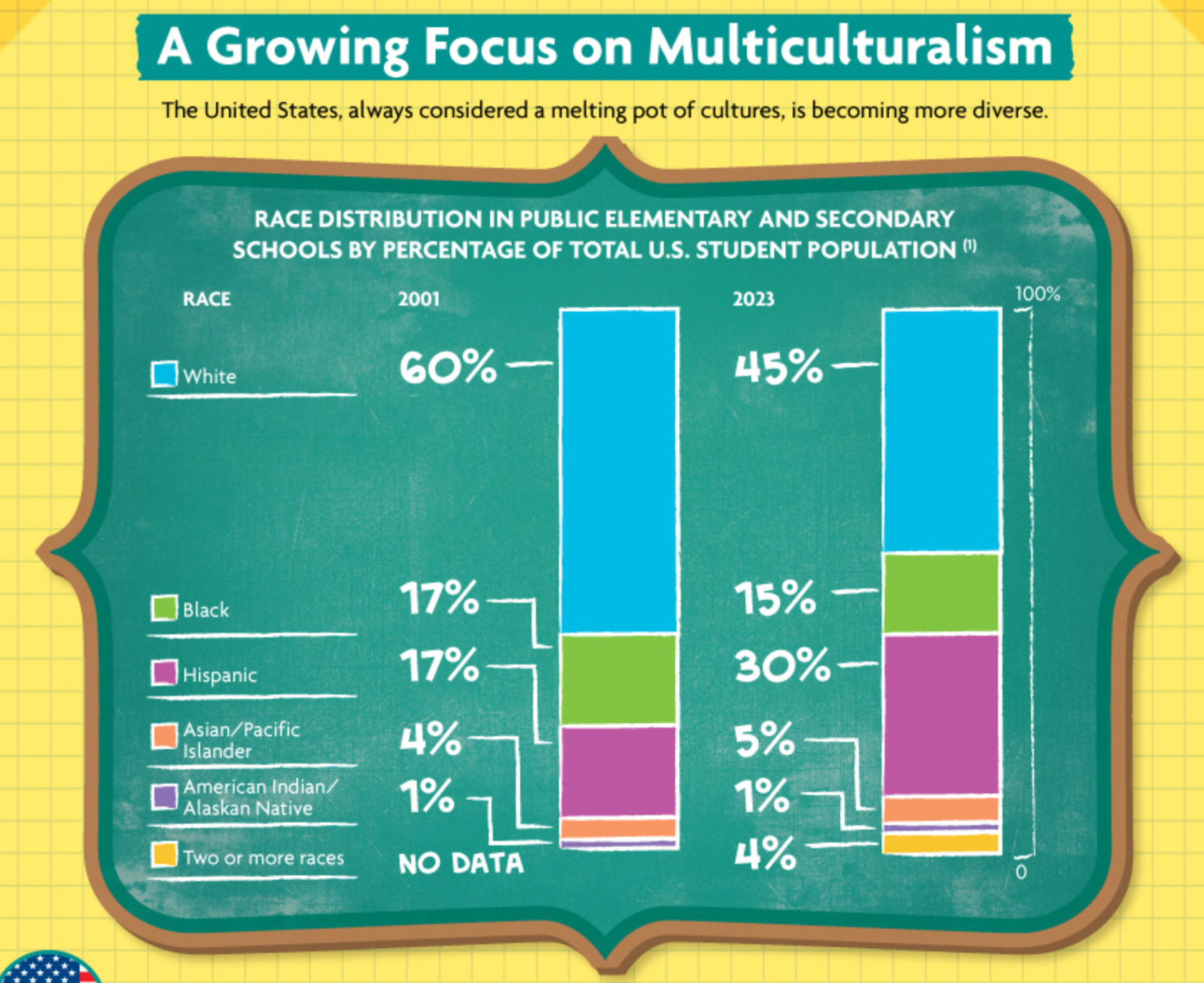
Taking_the_Plunge__Immersion_Programs_Help_Children_Learn_Other_LanguagesNice infographic on US multiculturalism and immersion education (link below has full infographic).

Taking the Plunge: Immersion Programs Help Children Learn Other Languages.