ICYMI: Salman Rushdie on Kazuo Ishiguro: His legendary novel The Remains of the Day resurges – The Globe and Mail

For fans of Salman Rushdie and Kazuo Ishiguro and depictions of the English aristocracy and butlers, Rushdie’s re-review of The Remains of the Day worth a read, along with the reflection of how a great writer can write beyond his context and identity:

With The Remains of the Day, Ishiguro turned away from the Japanese settings of his first two novels and revealed that his sensibility was not rooted in any one place, but capable of travel and metamorphosis. “By the time I started The Remains of the Day,” he told the Paris Review, “I realized that the essence of what I wanted to write was movable … For me, the essence doesn’t lie in the setting.” Where, then, might that essence lie? “Without psychoanalyzing myself, I can’t say why. You should never believe an author if he tells you why he has certain recurring themes.”

Salman Rushdie on Kazuo Ishiguro: His legendary novel The Remains of the Day resurges – The Globe and Mail.

7 facts about world migration | Pew Research Center

Pew World Immigration MapInteresting portrayal of countries and migration. Check out the interactive map:

Here are seven interesting global migration patterns we found using the map.

  1. The United Kingdom is home to the most diverse immigrant community in the world. It used to be said that the sun never set on the British Empire. Now, people from the many countries the British once ruled live inside the U.K.’s borders. Based on the Herfindahl-Hirschman index – which is widely used by biologists, ecologists, linguists, economists, sociologists and demographers to measure the degree of concentration of human or biological populations – the diversity of immigrant birth countries in the U.K. on a 0 to 100 scale is 97. For immigrants living in the U.S., it is 91.
  2. The French like to live all over the world – emigrants from France live in more countries than emigrants from any other nation. Using the Herfindahl index, the destination diversity of emigrants born in France is 95 on a 0 to 100 scale. It is 89 for American-born people living outside of the U.S. There are at least 1,000 French-born people living in each of 83 different countries and territories; the most popular destinations are Spain 220,000 and the United States 180,000.
  3. The Mexico-to-U.S. link is the most popular bilateral migration path in the world. As of 2013, more Mexican immigrants 13 million were living in the U.S. than all immigrants to Russia combined 11 million. Russia has the second largest number of total foreign-born residents, after the United States, which has a total foreign-born population of about 46 million.
  4. The number of Indian-born people living outside of India and the number of Chinese-born people living outside China both doubled between 1990 and 2013 – for India, from 7 million to 14 million, and for China, from 4 million to 9 million. India has the largest number of people living outside of its borders, in 2013 surpassing Mexico, the former leader. Russia and China rank third and fourth, respectively. The United Arab Emirates 2.9 million and the United States 2.1 million have the most Indian migrants, while Hong Kong 2.3 million and the U.S. 2.2 million are the top destinations for Chinese migrants.
  5. The number of immigrants living in Spain grew nearly eightfold between 1990 and 2013, from less than 1 million to more than 6 million. Spain’s economy was soaring prior to the global recession, drawing migrants from Europe, Latin America, North Africa and elsewhere. Spain’s economic structure, immigration laws and demographics combine to create an attractive landing spot for prospective immigrants.
  6. The United Arab Emirates has the highest share of foreign-born people 84% of its population. The next three highest – Qatar 74%, Kuwait 60% and Bahrain 55% – also are in the Persian Gulf area. Immigrants in the UAE and neighboring countries come from many different places, but the largest numbers are from India, Bangladesh and Pakistan. The foreign-born population has grown by nearly 500% in recent decades, from 1.3 million in 1990 to 7.8 million in 2013.
  7. Countries with the fewest resources send lower shares of migrants. Although international migration is intrinsically tied with the search for jobs, people in the most impoverished countries may not have the money to finance a trip. The Central African Republic, the Democratic Republic of the Congo and Niger – countries with some of the lowest U.N. Human Development Index ratings and GDP per capita – all have less than 3% of their population living outside their borders.

7 facts about world migration | Pew Research Center.

Canada Inspires Scandinavian Policy Rethink – New Canadian Media – NCM

Looking at the Canadian model from the Nordic perspective, an interesting paper and interview with a European academic currently at Bishop’s University. Most interesting point for me:

Q: You found in your study that Canada has managed to reconcile important welfare state objectives with increased immigration and diversity? Could you please explain?

A: The notion that there is a potential trade-off between a more open and accommodating approach to immigration and the maintenance of a robust welfare state has been increasingly expressed in many European countries.

However, Canada has managed to reconcile important welfare state objectives and principles with increased immigration and diversity.  Although not as comprehensive and generous as the Scandinavian welfare states, the Canadian social security system includes unemployment insurance, child tax credits, universal childcare benefits, medicare, the Canada Pension Plan, old age security, and social assistance. In contrast to many other countries, Canada has not actively sought to fence off the welfare state from newcomers.

Further, public attitudes in Canada reveal little tension between ethnic diversity and support for social programs. In fact, the welfare state and multiculturalism are for many Canadians the two most important ingredients in the Canadian identity, i.e. what it means to be Canadian.

Canada Inspires Scandinavian Policy Rethink – New Canadian Media – NCM.

Vietnamese flag at Ottawa City Hall angers protesters

More diaspora politics. But if we recognize the country, and have diplomatic relations, hard for a municipal government to have any other policy but the current one of basing it on diplomatic recognition:

“The flag of the communist regime being flown here today is something that represents a government that denies human rights,” said Kalvin Nhan of Canadian Youth for Human Rights in Vietnam, which organized the protest.

“We don’t believe that it should be flown side by side with the Canadian flag, something that represents freedom and hope.”

…. Under city policy, any country with which Canada has diplomatic relations is invited to provide the city’s protocol office with a flag to fly outside city hall on that country’s national day. The city defers to the Department of Foreign Affairs on which flags the Canadian government recognizes.

“Right now the policy that we apply is we will fly the flag of any nation that is recognized by the Government of Canada,” said Cathy Bowles, the city’s chief of protocol. “It’s a practice that has continued over the years to recognize our diverse population, and to recognize the number of embassies that make Ottawa their home.”

Bowles said Tuesday’s controversy was “unexpected” because this is the eighth year the flag has flown at city hall. “We have flown it since 2006, and this is the first year that we’ve experienced resistance.”

Nothing that prevents members of diasporas from protesting what the flag represents to  them.

Vietnamese flag at City Hall angers protesters | Ottawa Citizen.

Vancouver real estate titles reveal city’s racist history

A reminder of our not so distant past, and how it has been overtaken by reality (Vancouver, along with Toronto, are almost 50 percent visible minority):

Early immigrants to B.C. faced not only the hardship of settling into a new home, but also seemingly racist policies — Chinese and Indo-Canadians did not have the right to own property and only got the right to vote in 1947.

In Vancouver, West Vancouver and Victoria, owners tried to use restrictive land covenants to keep minorities from buying land — and many of those covenants remain in place to this day.

Realtor Wayne Hammil recently spotted a covenant in a land title dating back to 1928 when he was putting a Vancouver home up for sale.

“One of the clauses in the restrictive covenant makes reference to not selling to certain ethnic minorities in the world,” said Hammil.

The covenant prevents the sale or rent of the land to people who are of Chinese, Japanese, Indian and African descent or any other Asiatic race.

“[Theres a ] total irony because most of the buyers are from mainland China,” said Hammil. “If this was enforced, it would preclude them from purchasing the property.”

Ron Usher, general counsel for the Society of Notaries Public of British Columbia, says Sec. 222 of the Land Title Act makes the discriminating covenants void.

“I would imagine though there are probably hundreds if not several thousand lots covered by this,” said Usher. “Where they find these, they’ve already put on the title the Except for Clause X notation.”

If this note has not yet been made on the title, Usher says its simple to have title updated through a phone call to the province’s Land Title and Survey Authority.

The race-based covenants are still embarrassing because of what they stand for, he says, but getting them completely removed from the land title can be an expensive process as they almost always have other provisions that are valid restrictions on the use of the property.

Vancouver real estate titles reveal city’s racist history – British Columbia – CBC News.

How Are Different Asian-American Groups Faring Economically? : Code Switch : NPR

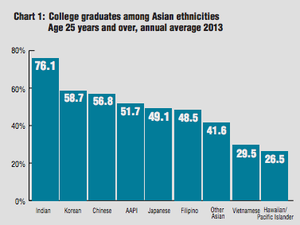
Asian AmericansSome highlights from a US Department of Labour Report on Asian Americans:

“Overall, 53.4 percent of Asians over the age of 25 have a bachelors degree or higher — the highest percentage by far among the major race groups.”

“The AAPI community has the second highest share of unemployed workers who are long-term unemployed 41.7 percent … Asian Americans who are unemployed, are without work for longer than whites and Hispanics.”

“When controlled for age, sex and educational attainment, unemployment rate for Indians is actually higher than comparable whites. This difference suggests that the Indian community as a whole tends to be more educated, but when looking at similarly situated white workers, their employment outcomes are less favorable.”

How Are Different Asian-American Groups Faring Economically? : Code Switch : NPR.

Fixing the public service: Groom stronger, specialized managers, says Hugh Segal | Ottawa Citizen

Always worth listening to Hugh Segal, given his long and distinguished career and of course his current role as co-chair of the PM’s blue-chip advisory committee on the public service.

His thoughts help address some of the systemic issues:

Segal said the committee will have to grapple with these changes but he broadly supports getting rid of management layers, scrapping more rules and reorganizing work to give public servants more flexibility and authority to do their jobs. It will demand stronger managers and more training for them.

He said the existing snare of rules, structures and processes limit managers’ power and “discretion” in influencing or making change. He said they need more discretion to open up and speed up decision-making. Also, he said the managers’ talents will vary by department with, for example, Canada Border Services Agency needing very different skills than Canadian Heritage.

Segal isn’t wed to the longstanding notion that managers are generic and can be moved from department to department.

He argued the second-in-command in the navy wouldn’t have got there without specific training, credentials and expertise, but the same isn’t expected of civilian public servants as they climb the ranks of the bureaucracy. The government needs to offer employees specific career paths with opportunities to get specialized certifications or designations.

Segal said the government must get a better handle on the work of some 7,000 executives and whether they are really doing executive work.

At the same time, he said deputy ministers should be skilled and knowledgeable about their portfolios when appointed to the job. He argued deputy ministers should stay put in their jobs for four or five years before being rotated into the next senior post.

Fixing the public service: Groom stronger, specialized managers, says Hugh Segal | Ottawa Citizen.

Statistics Canada rewrote our story on Statistics Canada – Macleans.ca

This is quite funny, but not for the lack of judgement it showed in trying to “correct” the spin of a story. Worth reading as most points are editorial rather than substantive in nature.

A short letter to the editor focussing on substance would have been more effective:

Problems like these are pretty common in big organizations, where it’s not unheard of for IT departments to start updating computer systems without telling anyone for updates to systems to be made without a full understanding of their impact and for senior managers to have no idea how their computer systems work, causing mass panic and confusion.

Statistics Canada rewrote our story on Statistics Canada – Macleans.ca.

Tories target diasporas in foreign-aid talk tour | Embassy – Canadas Foreign Policy Newspaper

Good piece in Embassy Magazine on some of the diaspora politics of the Government and “shopping for votes”:

Harper government members have reached out to immigrant communities in places where their numbers are strong: Haitians in Montreal; Ukrainians in Saskatoon and Winnipeg; Somalis in Edmonton; Asians in Vancouver and Surrey, BC; and people of Caribbean origin in Brampton, Ont., for instance.

They’ve dropped by the Calgary Afghan Charitable Society to announce money for UNICEF in Afghanistan; stepped on stage at a Vancouver festival, billed as the largest Filipino cultural event in Canada, to say they’re doling out $500,000 to help a conflict-affected island in the Philippines; and sat across from Ukrainian-Canadians at St. Vladimir Ukrainian cultural centre in Windsor, Ont.

…. Pollster Nik Nanos of Nanos Research said he saw the roundtables as part of the Conservatives’ broader “segmentation strategy” to piece together a winning coalition.

“This is quite, what I’ll say, niche politics: where one single group will not put them over the top, but a combination of successful outreach initiatives to these groups could incrementally help the Conservatives,” he said.

He pointed to the government’s staunch support for Ukraine in its conflict with Russia, for instance.

“There are ridings in Saskatchewan where in very close races, a one, two, three or four per cent shift of public opinion in favour of the Conservatives can just make it a little better for them in that particular riding,” he said.

Tories target diasporas in foreign-aid talk tour | Embassy – Canadas Foreign Policy Newspaper.

ISIS: The Death Rattle Of Islamism? « The Dish

Interesting take by Jonah Shepp:

This is all by way of saying, as a reminder, that “Caliph Ibrahim” Baghdadi represents Muslims about as thoroughly as Tony Alamo represents Christians. The fact that he has attracted enough funding and followers to run roughshod over northern Iraq and eastern Syria is nothing to brush off, but it’s not winning him any friends, and it doesn’t make his ideology any less ridiculous. It’s certainly not “Islam”, at least not as any Muslim I know practices it. That’s why I suspect it will fail, like most grandiose visions of world domination do. And by radicalizing the Islamic heartland against radicalism, as it were, perhaps ISIS will take the entire edifice of radical Islamism down with it.

The Death Rattle Of Islamism? « The Dish.